








Let’s be honest, blockchain sounds like one more overhyped tech concept that is carelessly used in the crypto field, startup pitches, and TED talks. However, behind all this jargon, blockchain platforms are revolutionising and quietly reshaping how the digital world operates.
Blockchain is a decentralized system that allows recording, verification, and sharing of digital information across a network of computers without central authority. Blockchain drives Bitcoin, Ethereum, and every major cryptocurrency out there.
Key takeaways:
-
- Blockchain is a decentralized database that records transactions across a network of computers, making the data transparent and tamper-proof.
- The surge of blockchain adoption in business leads to speculations that blockchain market will reach $41.2 billion in 2025, rising to $1.88 trillion by 2034 (CAGR ~53%).
- Nearly 90% of businesses are exploring or deploying blockchain solutions
- Blockchain operates across a peer-to-peer network. Consensus mechanisms (like Proof of Work or Proof of Stake) ensure that all participants validate data without needing a central authority.
- blockchain and traditional databases are systems for storing and managing data, their underlying architectures, operational principles, and ideal use cases are vastly different
But here’s the kicker: blockchain is so much more than crypto.From finance and healthcare to supply chains, art, and even the voting systems, distributed ledger technology is transforming industries in ways beyond imagination.
So, if you’re wondering what is blockchain app development, how it works, the benefits of blockchain application development for business, and why everyone’s losing their minds over it. In that case, you’re in the right place.
Let’s break down, leaving out the tech snobbery.
What Is Blockchain?
Blockchain serves as a record-keeping platform or ledger that is incorruptible, enforces transparency, and bypasses censorship. It’s incorruptible, transparent, and decentralized, meaning no single person or organization controls it.
- Decentralized: All the transactions are distributed globally.
- Immutable: Transactions in the Blockchain cannot be tampered with.
- Audit Trail: Every transaction in the blockchain can be traced back to its starting point.
- Data transparency: All changes made to the public blockchain can be viewed by its participants.
Simply put, the purpose of blockchain technology is to prevent censorship, establish trust without the need for intermediaries, and provide radical transparency in the sharing and storage of data.
What are Blockchain Applications?
The answer to the question ‘What are blockchain applications’ is very simple. A blockchain application refers to the use cases and implementations of blockchain technology in various industries and sectors, exceeding cryptocurrencies. It’s a digital, distributed ledger that records transactions in a secure, transparent, and immutable way.
To make an app on blockchain, you need to utilize the core functionalities of blockchain, such as decentralization, clarity, safety, and immutability, to address real-world problems and enhance existing processes.
How Does Blockchain Work?
Now that we understand what is blockchain app development, let’s move on and see how the blockchain industry works is crucial. The points mentioned below explain how blockchain works:
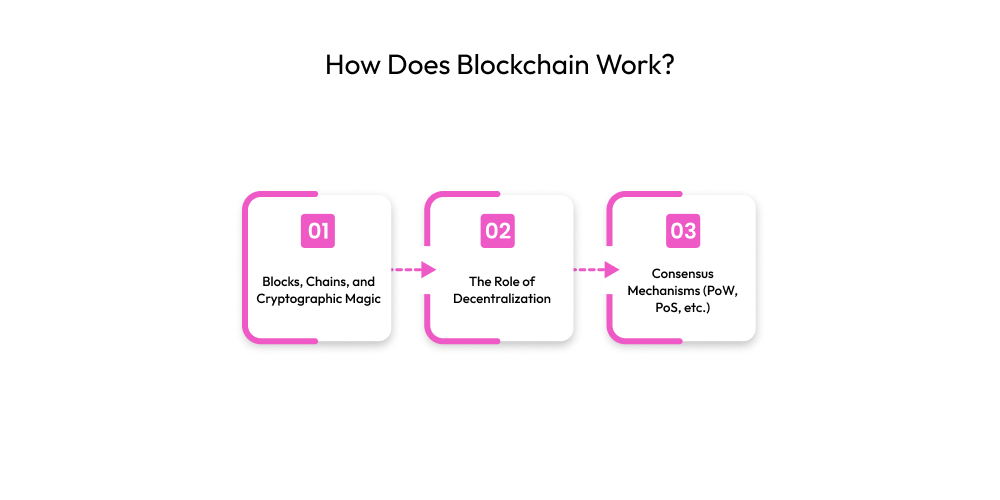
1. Blocks, Chains, and Cryptographic Magic
At its core, blockchain, as the name suggests, is a chain of blocks, each one of the blocks contains a transaction list, a timestamp, and a cryptographic hash block before.
- Every new transaction gets bundled into a block.
- Each block is cryptographically linked to the one before it.
- This creates a secure, tamper-evident chain of data, and the whole chain breaks.
2. The Role of Decentralization
Traditional databases store data in one central location. Blockchain flips the script.
- It functions on a peer-to-peer network of computers (nodes).
- Every node possesses a copy of the entire blockchain.
- In blockchain platforms, no single party controls the data. Instead, the system relies on collective agreement.
3. Consensus Mechanisms (PoW, PoS, etc.)
So, how do all those nodes agree on what’s true? According to a top blockchain development company, this is when consensus mechanisms make their entrance, protocols that ensure everyone on the network validates the same data.
- Proof of Work (PoW): Used by Bitcoin. Nodes solve complex math puzzles to validate transactions. It’s secure but energy-intensive.
- Proof of Stake (PoS): Used by Ethereum 2.0 and others. Validators are chosen depending on the amount of cryptocurrency they “stake.” It’s faster and more energy-efficient.
- Other models: Other ways, such as delegated proof of stake (DPoS) and Practical Byzantine Fault Tolerance (PBFT), are emerging to balance speed, scalability, and security.
Types of Blockchains
After knowing the answer to ‘what is blockchain app development’ and how it works, let’s learn about its types. Here are the some of the most popular types of blockchain applications that you can consider during blockchain application development for business:
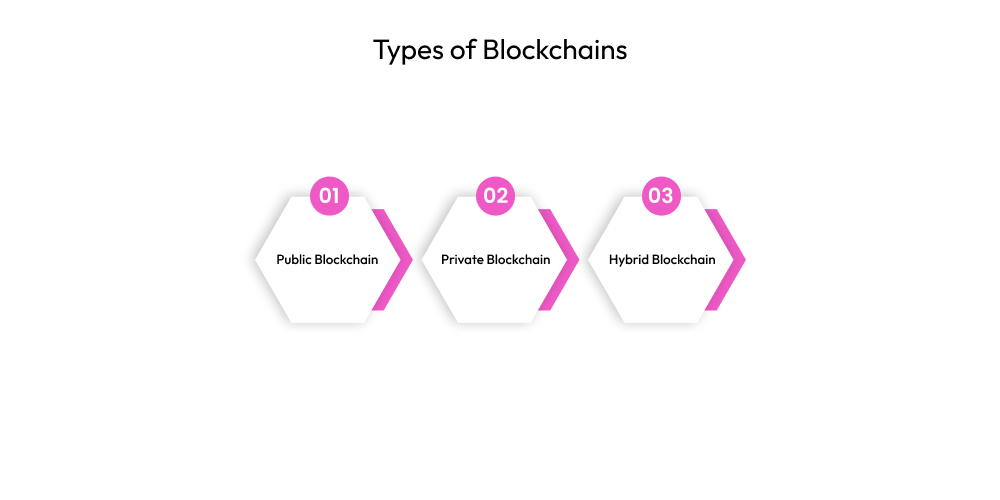
1. Public Blockchain:
These types of blockchain applications are completely decentralized and open networks where anyone can join, validate, and see their history of transactions. This maintains transparency, trust, and security, without a single main authority.
2. Private Blockchain:
Private blockchain apps are the permissioned blockchain applications managed by a single organization or entity. Only selected participants can access, validate, and manage the network.
3. Hybrid Blockchain:
A blend of public and private blockchains that offers both openness and controlled access. Organizations that make an app on blockchain can choose what data stays private and what is made public.
For those who want to know what is blockchain app development, should learn about these above-mentioned types.
Type |
Access |
Control |
Speed |
Transparency |
Common Use Case |
| Public | Open to all | Decentralized | Slow | High | Crypto, DeFi |
| Private | Restricted | Centralized | Fast | Low/Moderate | Internal enterprise processes |
| Hybrid | Mixed | Partially Centralized | Moderate | Controlled | Healthcare, Real Estate, Govt |
| Consortium | Group-controlled | Federated | Fast | Moderate | Banking, Supply Chain, Auditing |
Want a chatbot demo or pricing? Fill the form and talk to our experts today.
Pick what you need below — you can select more than one — then tap Get detail to continue.
-
Chatbot demo dashboard
-
Cost to develop an app
-
Industry report
-
Case study
Blockchain vs. Traditional Databases
The difference between blockchain app and normal app may not be much but crucial to know. While both blockchain and traditional databases are systems for storing and managing data, their underlying architectures, operational principles, and ideal use cases are vastly different.
1. Traditional Databases (Centralized/Distributed Relational Databases)
The difference between blockchain app and normal app is that traditional databases, such as SQL databases, or NoSQL databases, have been the backbone of almost all digital applications for decades.
According to companies that provide blockchain development services, in traditional databases, data is maintained through ACID (Atomicity, Consistency, Isolation, Durability), properties and access controls, but relies on the integrity of the central authority.
Ideal Use Cases:
- Most enterprise applications (ERP, CRM)
- Websites and mobile decentralized applications requiring frequent data updates
- Real-time analytics and reporting where data can change
- Applications where a central authority is trusted to manage data.
2. Blockchain (Distributed Ledger Technology)
A blockchain is a specific type of distributed ledger technology (DLT) where data is stored in “blocks” that are cryptographically linked together in a chronological “chain.” No single entity controls the entire network. Transactions are verified by a consensus mechanism among these nodes.
Ideal blockchain app use cases:
- Cryptocurrencies: Decentralized finance, Ethereum, secure digital money (e.g., Bitcoin).
- Supply Chain Management: this is one of blockchain app use cases that tracks goods for transparency.
- Digital Identity Management: Secure, user-controlled personal data.
- Voting Systems: Tamper-proof, transparent electoral records.
- Financial Transactions: Faster, cheaper, transparent cross-border finance.
Feature |
Blockchain |
Traditional Database |
| Structure | Chain of blocks (linked and immutable) | Tables and rows (structured by admins) |
| Control | Decentralized (shared across nodes) | Centralized (controlled by one entity) |
| Data Immutability | Once written, cannot be altered | Data can be created, updated, or deleted |
| Transparency | Fully visible to participants (depending on type) | Access limited to admins or authorized users |
| Security | Highly secure through cryptography and consensus | Vulnerable to centralized breaches or admin misuse |
| Verification | Consensus-based (e.g., Proof of Work, Proof of Stake) | Verified and authorized by central authority |
| Use Case | Ideal for trustless environments (e.g., crypto, supply chain) | Ideal for fast, internal data processing (e.g., banking systems, ERPs) |
Why Should Businesses Care About Blockchain?
According to companies that make apps with blockchain for start-ups and enterprises, here’s why businesses should invest in blockchain applications:
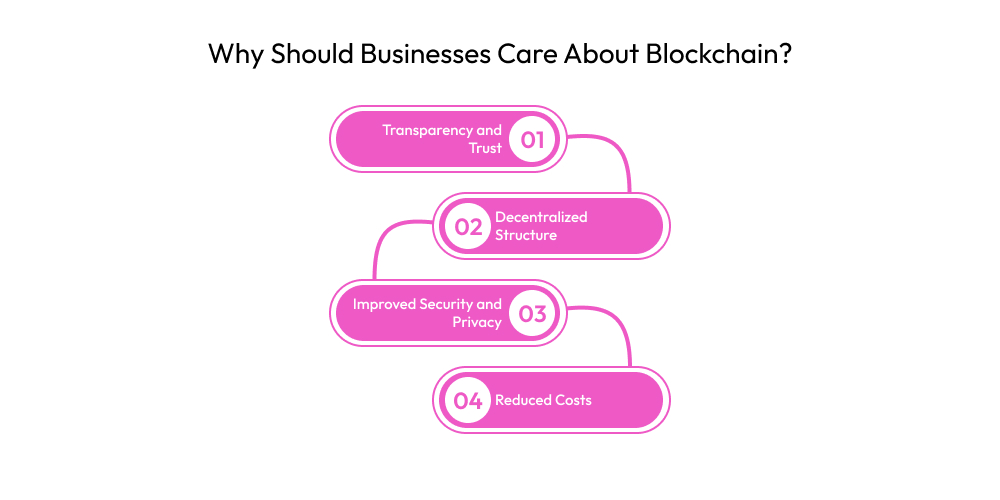
1. Transparency and Trust
One of the major benefits of blockchain app development is that it creates shared, unchangeable records, fostering deep trust among partners and reducing disputes. This clarity boosts accountability across business operations.
2. Decentralized Structure
Its distributed nature eliminates central control, making systems highly resilient to attacks. Another benefit of blockchain app development is that it enables enhanced security and reduced dependence on single points of failure through blockchain technology.
3. Improved Security and Privacy
Strong cryptography ensures data is tamper-proof and highly secure. According to companies that develop apps using blockchain for start-ups and enterprises, this technology protects sensitive business information, preventing fraud and enhancing data integrity for compliance purposes.
4. Reduced Costs
Blockchain streamlines operations by cutting out intermediaries. Automating reconciliation and processes leads to lower transaction fees, reduced administrative overhead, and significant operational savings for businesses. Contact top providers to know more about blockchain app development cost and services.

Cool Stuff People Are Building With Blockchain
From digital art to decentralized banking, below are some of the most cool and amazing innovations created through blockchain technology:
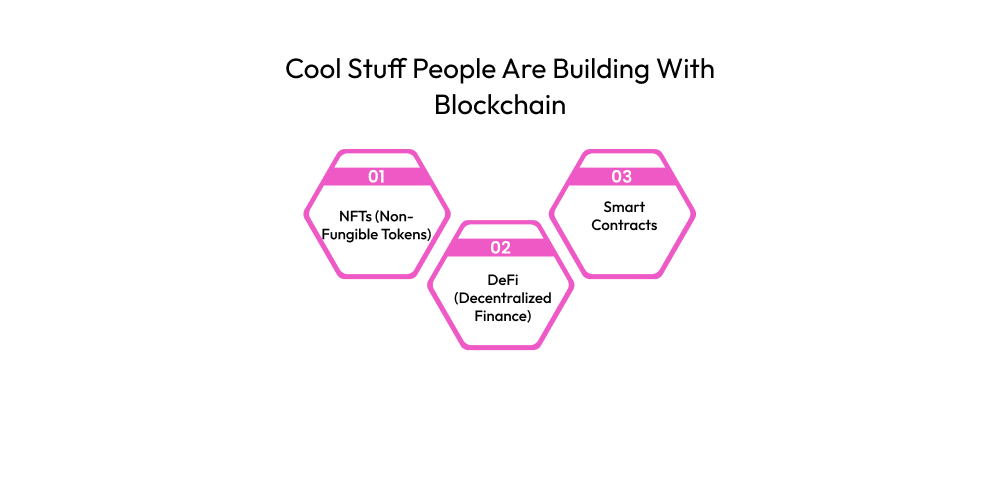
1. NFTs (Non-Fungible Tokens)
NFTs are unique digital assets that prove authority over videos, music, art, design, and collectibles on the blockchain.
With growing demand, many companies are investing in NFT marketplace development services to allow users to mint, buy, and sell NFTs seamlessly. These platforms are the core of the digital creator economy.
2. DeFi (Decentralized Finance)
DeFi or decentralized applications for finance are revolutionizing banking by offering lending, borrowing, staking, and yield farming, all without traditional financial institutions. Many of these DeFi apps are built on Ethereum-compatible Layer 2 networks using infrastructure such as optimism rpc to reduce fees and increase speed.
At the heart of many DeFi apps are Ethereum services, which help create decentralized apps (dApps) and integrate token economies on the Ethereum blockchain.
3. Smart Contracts
Smart contracts are one of the self-executing pieces of code that automatically fulfill the terms of an agreement when specific conditions are met.
Used in everything from insurance to gaming, smart contract development is a key part of web3 basics, enabling trustless transactions and automated systems.
Real-World Use Cases Beyond Crypto
blockchain’s potential reaches far above crypto, it is used in various other things from NFT marketplace development to smart contract implementation in logistics and even healthcare. It’s setting a strong base for a more secure, efficient, and trust-driven world. Here are some of the real-world blockchain app examples and use cases:

1. Supply Chain Management
- With blockchain, every step of a product’s journey is transparent and verifiable, from farm to shelf.
- The real-world blockchain app examples include Walmart and IBM, which utilize supply chain management to prevent fraud and ensure product authenticity.
2. Voting Systems
- Blockchain-enabled voting can reduce fraud and increase voter confidence through verifiable and immutable records.
- Several governments and organizations, including Estonia, South Korea, and the United Nations, are piloting blockchain-based elections to ensure secure and transparent democratic processes.
3. Healthcare
- Blockchain enables secure sharing of medical records, reducing the possibilities of data breaches and improving patient care.
- It plays a big role in preventing counterfeit drugs from entering the market and enables rapid recalls in case of any issue, enhancing patient safety.
- Medicalchain is one of the real-world blockchain app examples. It uses blockchain for tasks like tamper-proof patient histories, drug traceability, and efficient billing.
Common Misconceptions
Here we present some of the common misconceptions about blockchain:
1. It’s just about crypto
While blockchain is the foundational tech behind cryptocurrencies like Bitcoin and Ethereum, its use cases go far beyond digital money.
Blockchain technology is used in supply chain management, secure data storage, healthcare, digital identity verification, and voting systems, to name just a few. Its power lies in providing secure, transparent, and tamper-proof record-keeping, which is valuable in any industry where trust and traceability are crucial.
So no, it’s not just about crypto, it’s about redefining how we store and share information.
2. It’s Unhackable (Kind of)
According to the Solana blockchain development company, Blockchain is often hailed as unhackable. While blockchain is incredibly secure, it’s not invincible.
Its decentralized and cryptographic structure makes altering the blockchain itself very difficult, especially on large networks like Bitcoin or Ethereum. However, individual wallets, exchanges, or even poorly written smart contracts can be vulnerable to attacks. Social engineering, bugs, and phishing still pose real risks.
The truth? The larger and more decentralized the network, the harder it is to hack, but no system is 100% foolproof. Therefore, when utilizing blockchain in Ethereum development services or any other larger network, proceed with caution.

The Future of Blockchain
Blockchain is growing rapidly, doing tasks beyond crypto, opening doors to a more secure, efficient, and tech-driven future.
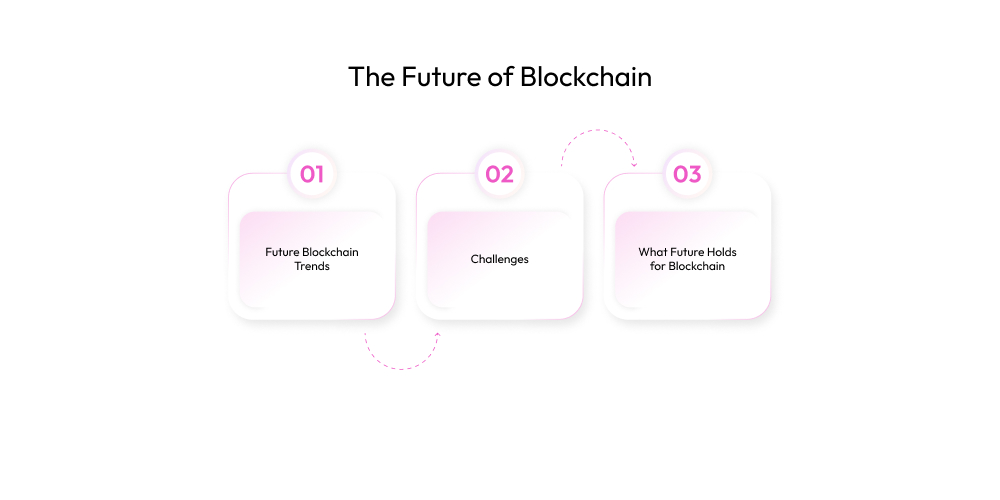
1. Future Blockchain Trends:
- Scalability Solutions: Putting focus on faster transactions (Layer 2, modular blockchains).
- Real-World Asset Tokenization: Converting physical assets into digital tokens for liquidity.
- Zero-Knowledge Proofs: Enhancing privacy and efficiency without revealing data.
- Interoperability: Connecting various different blockchains for smooth flow of data.
- Sustainability: Businesses move slowly towards more energy-efficient consensus mechanisms.
2. Challenges:
- Scalability: Still needs to handle massive transaction volumes efficiently.
- Regulatory Uncertainty: Lack of clear, consistent global laws creates hurdles.
- Complexity & Cost: High implementation costs and specialized expertise required.
- User Experience: For wider reach, businesses should make more user-friendly apps.
3. What Future Holds for Blockchain:
- Ubiquitous Enterprise Adoption: Use of blockchain in major operations.
- Tech Convergence: Better integration with technologies like AI and IoT.
- Digital Identity: People are gaining more control over their secure digital identities.
- DeFi & CBDCs: Continued growth in decentralized finance and central bank digital currencies.
- Web3 Foundation: Core infrastructure for a decentralized, user-owned internet.
Recap and Final Thoughts!
Blockchain is not just for cryptocurrency, and it’s not completely unhackable, but it is one of the most secure, decentralized technologies to ever exist. With innovations like NFTs, DeFi, smart contracts, and Web3 development, we’re only viewing the surface-level possibilities.
Whether you’re a development provider, a start-up, or just blockchain-curious, one thing’s clear. This tech is here to stay. So, if you are a business looking for a blockchain app development company, turn to Dev Technosys, one of the leading blockchain app development companies, and stay tuned for more informative updates.
FAQs
Q1. What is Blockchain Application Development?
Blockchain application development refers to the process of building decentralized applications (dApps) that run on blockchain technology. These apps use smart contracts and a distributed ledger technology to ensure transparency, security, and immutability of data.
Q2. How Does Blockchain App Development Work?
Blockchain app development involves defining a use case, choosing a blockchain platform (like Ethereum, Polygon, or Hyperledger), writing smart contracts, integrating a user interface, and deploying nodes to run the app. The backend logic runs on a decentralized network rather than a traditional server.
Q3. How to Build a Blockchain App?
To build a blockchain app:
- Define your goal and use case (e.g., finance, supply chain, healthcare.)
- Choose a blockchain platform (Ethereum, Solana, BNB Chain, etc.)
- Develop smart contracts using languages like Solidity or Rust.
- Create the frontend and connect it using Web3 tools like MetaMask and web3.js.
- Test, audit, and deploy your dApp on the network
Q4. Is Blockchain Really Secure?
Yes, it’s incredibly secure due to cryptography and decentralization. But while the blockchain itself is tough to hack, wallets and apps built on it can still be vulnerable.
Q5. Is Blockchain Only Used For Cryptocurrency?
Nope! Blockchain is used in healthcare, supply chain, real estate, voting systems, and even for verifying digital identities – way beyond just Bitcoin.