








Key takeaways:
-
- To develop an ERC1155 consists of various steps, such as environment setup, smart contract creation, minting logic, metadata configuration, testing, deployment process, and maintenance.
- The cost to develop an ERC1155 token is around $5,000 to $25,000, based on the crucial factors, such as features, services, backend infrastructure, blockchain, and development approach.
- According to the global market insights, the ERC-1115 is mostly used in gaming NFTs because of multi-token efficiency and batch minting.
- These ERC-1115 tokens can generate revenue or profit from various monetization techniques, such as white-label NFT solutions, membership & access tokens, digital collectibles, and NFT gaming assets.
Creating an ERC-1155 token is a simple way to build powerful NFTs and digital assets on the blockchain. This token standard is special because it allows you to manage multiple types of tokens, both NFTs and regular tokens, in one smart contract. That makes it faster, cheaper, and easier to use compared to older standards. Because of this flexibility, ERC-1155 is widely used in games, NFT marketplaces, and Web3 apps.
However, building it still requires a basic understanding of blockchain, smart contracts, and deployment steps. You need to set up your tools, write the contract, test it carefully, and then deploy it on the Ethereum network. In this guide, you will learn each step in a clear and simple way so you can create your own ERC-1155 token without confusion and launch it successfully on the blockchain.
Quick summary: Learn how to create ERC1155 token, its features, average cost, and the tech stack used in its development. Also, understand its uses, its future, and how investors benefit from its development.
Introduction of the ERC1155 Token
The ERC 1155 is a token standard that has changed the Ethereum blockchain by enabling the creation of fungible, sem-fungible, and non-fungible tokens within a single contract.
This is a major improvement over older standards like ERC 721 and ERC 20 as they required separate contracts for different types of tokens. ERC1155 is very efficient because of its ability to reduce transaction costs and simplify token management.
That is what makes ERC1155 perfect for apps-like video games, where different types of items must be handled. The ERC-1155 Token standard offers great efficiency and flexibility that make blockchain technology more powerful and versatile.
Market Analysis of ERC1155 Token
Blockchain technology cloud market size worldwide in 2021, with a forecast for 2030(in billion U.S. dollars)
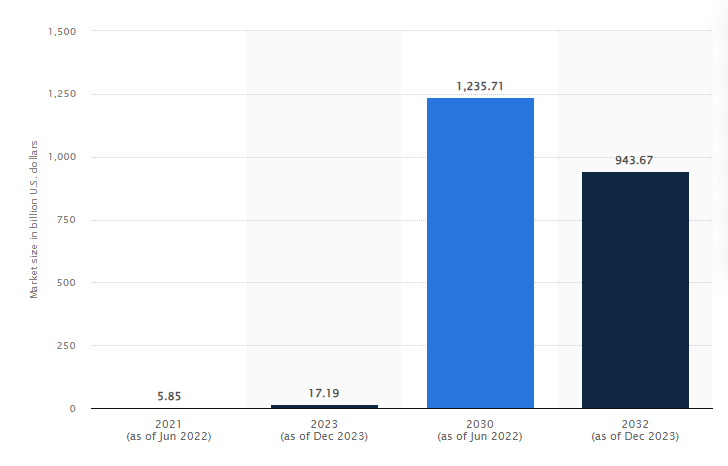
- The projected value of blockchain technology is expected to reach over $1 trillion by 2032, although this estimate was revised down from the prior one.
- According to an initial June 2022 prediction, “blockchain technology” is expected to reach 1,235 billion U.S. dollars by 2030, growing at a compound annual growth rate of 82.8 percent.
- With a CAGR of 56.1 percent, a more recent estimate from December 2023 values the market at 943 billion US dollars in 2032. The source does not clarify this distinction.
How Do ERC1155 Tokens Work?
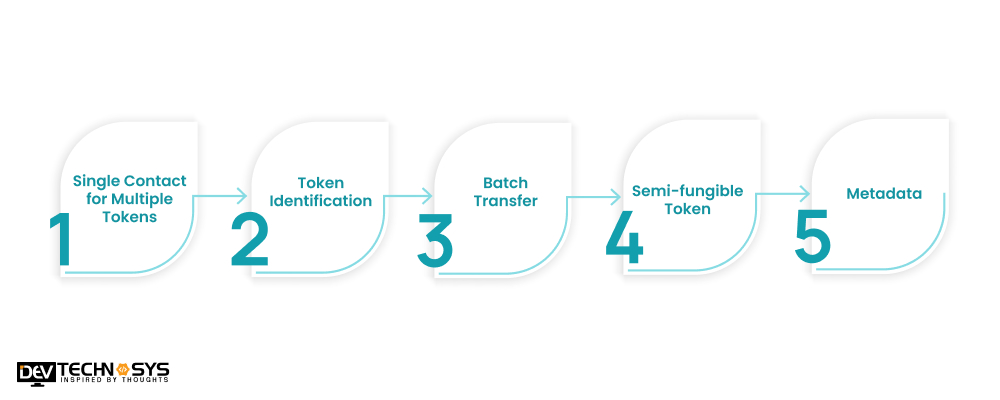
Now that you have learned what ERC1155 is and how big its market is is, let’s understand its work process step by step:
- Single Contact for Multiple Tokens
- Token Identification
- Batch Transfer
- Semi-fungible Token
- Metadata
1. Single Contact For Multiple Tokens
ERC1155 allows for managing different token types inside a single, smart contract, while ERC 10 (fungible) and ERC 721 (non-fungible) tokens require separate contracts. Hence, it significantly reduces the complexity of the contract and gas fees.
2. Token Identification
All tokens within ERC1155 contract are identified by a different token ID. After this, ID differentiates between different token types, whether fungible or non-fungible.
3. Batch Transfer
Create ERC20 tokens that allows for different types of tokens to be sent to several receivers in a single transaction. Hence, this improves gas efficiency and user experience even more.
4. Semi-fungible Token
ERC1155 enables semi-fungible tokens in addition to fungible and non-fungible tokens. These tokens can be used for different use cases as they possess the characteristics of both fungible and non-fungible tokens.
5. Metadata
The metadata feature for ERC1155 allows all tokens to have more information attached to them. This metadata can describe the token’s traits and attributes and any other pertinent information.
Benefits of Developing the ERC1155 Tokens
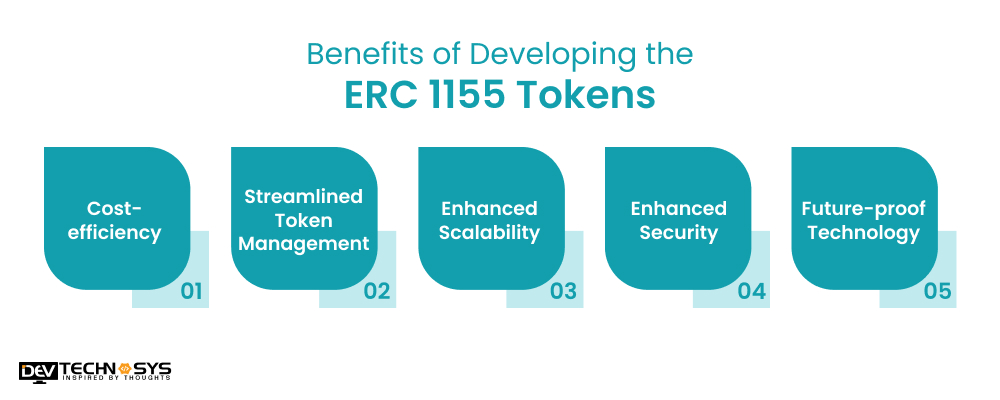
With the advanced technology, the ERC1155 standard brings numerous significant benefits to block chain applications. Here is how with the cryptocurrency development services, business can get benefits:
- Cost-efficiency
- Streamlined Token Management
- Enhanced Scalability
- Enhanced Security
- Future-proof Technology
1. Cost-efficiency
One key benefit businesses can enjoy with the ERC1155 token development services is the cost. Businesses can enable the management of multiple token types within just a single, smart contract, reducing gas fees associated with token transactions. Hence, this efficiency translates into substantial cost savings, especially for projects that involve large numbers of tokens.
2. Streamlined Token Management
With Ethereum development services entrepreneurs can oversee and control their entire token ecosystem from a centralized platform. Hence, this reduces administrative overhead, simplifies operations, and minimizes the risk of errors associated with managing different token contracts.
3. Enhanced Scalability
ERC1155 can handle both fungible and non-fungible tokens in a single contract. This enables businesses to scale their token offerings without requiring multiple smart contracts.
Hence, this scalability has been considered critical for projects that predict expansion and growth as this proves the flexibility to accommodate different token varieties.
4. Enhanced Security
ERC1155 minimizes the risk of contract vulnerabilities. This reduces the potential points of failure by consolidating multiple types of tokens into one contract. Moreover, the standard includes a built-in mechanism to avoid common attack vectors.
Apart from this, the robust, secure features of the token make it a trustable choice for businesses that are interested in blockchain app development services.
5. Future-proof Technology
It’s a significant consideration for business success in the long run. If businesses create ERC1155 tokens on the robust Ethereum block chain, it ensures compatibility with future advances. By adopting the token, businesses can position themselves to adapt and grow in the ever-changing block chain landscape.
Want a chatbot demo or pricing? Fill the form and talk to our experts today.
Pick what you need below — you can select more than one — then tap Get detail to continue.
-
Chatbot demo dashboard
-
Cost to develop an app
-
Industry report
-
Case study
7 Key Steps to Create an ERC1155 Token
To develop an ERC1155 token, follow several steps, like setting up a blockchain environment, writing a smart contract, implementing minting logic, configuring metadata, test features & functionality, and deployment & maintenance.
The ERC1155 smart contract enables efficient multi-chain token management within a single contract. Let’s explore the step-by-step guide to create ERC1155 token on Ethereum:
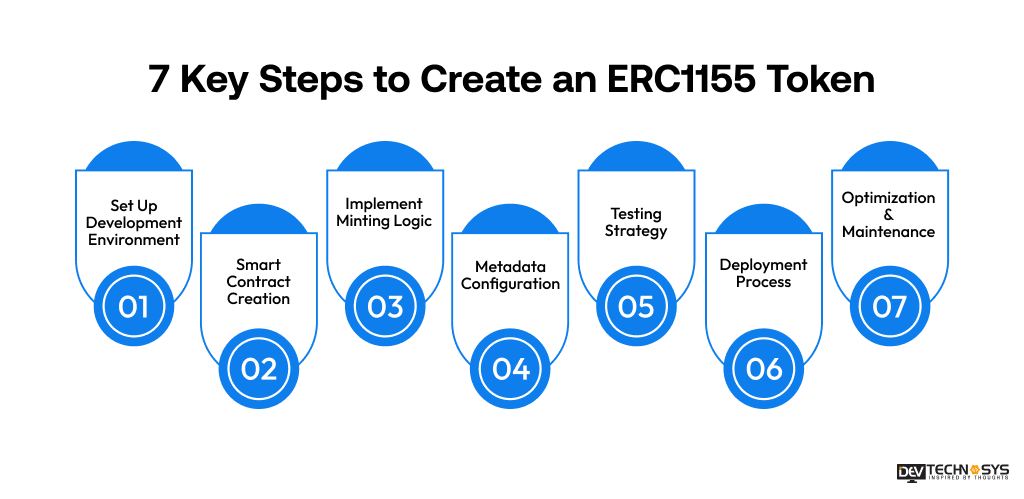
1. Set Up Development Environment
First of all, you will need to set up the environment for the ERC1155 token by installing npm, Node.js, Foundry, or Hardhat. After that, make a proper sheet of ERC1155 features that are must to integrate, such as batch transfers, multi-token standard ERC1155, metadata URIs, and more.
Initialize a new project directory and configure dependencies, including OpenZeppelin Contracts. Hire an RWA tokenization development company to make sure that the environment variables for private keys and RPC endpoints are perfectly and securely configured.
2. Smart Contract Creation
Move to the second stage to create an REC1115 token, create a new smart contract file, and name it MyERC1155.sol. Now, import OpenZeppelin ERC1155 and Ownable contracts, and define the contract and set a base URI for metadata.
Implement the constructor and initialize the token supply settings. Make sure the declarations are corect of Solidity version and SPDX license. At last, this structure is the foundation of non-fungible and minting fungible types.
3. Implement Minting Logic
Now, it’s the right time to implement minting logic functions using OpenZeppelin ERC1155 _mint and _mintBatch methods. After that, define the access control that enables only authorized members to create tokens and access their data.
It includes the tracking ID of the token, supply limits, and more. Employ a DEX development company to make sure that safe minting rules can prevent unauthorized access. After implementing the minting, test their functions for single and batch token issuance.
4. Metadata Configuration
Configure token metadata using the ERC1155 URI function with dynamic substitution for token IDs. Host JSON metadata on IPFS or decentralized storage. Ensure metadata includes name, description, image, and attributes.
Implement URI replacement logic for each token type. Validate metadata accessibility through gateways. Maintain consistency between on-chain IDs and off-chain metadata references for reliable NFT display across the decentralized applications ecosystem.
5. Testing Strategy
In the fifth stage of p2p crypto exchange development process, write comprehensive test cases using Hardhat or Foundry to validate ERC1155 contract behavior. Test deployment, ERC1155 minting process, batch transfers, approvals, and burning functions.
Use Chai or Forge assertions to confirm expected outcomes. Simulate edge cases like unauthorized access and invalid token IDs. Ensure coverage reports exceed standard thresholds. Debug failing tests and optimize contract logic before mainnet deployment and final audits.
6. Deployment Process
Smart contract deployment using Hardhat ERC1155 to a testnet such as Sepolia using Hardhat scripts. Verify contract source code on Etherscan for transparency. Configure deployment parameters, including URI and initial mint settings. Record the deployed contract address securely.
Conduct post-deployment checks to ensure correct initialization. Prepare for mainnet deployment after successful testnet validation and audit approval, ensuring production readiness and security compliance.
7. Optimization & Maintenance
In this final stage, to make an ERC1155 token, you need to hire some professional blockchain developers to maintain the overall performance and monitor them.
Hire an ICO token development company to conduct maintenance services that include implementing an upgrade pattern, regular updates, adding some enhancements, monitoring contract activity, conducting periodic security audits, and vulnerability assessments. These maintenance services maintain the long-term scalability and reliability.
Must-have Features of an ERC1155 Token
As you know , ERC-1155 is a versatile token standard that handles both fungible and non-fungible tokens within a single smart contract. This flexibility makes it a suitable tool for most of the apps.
If you want to develop a token like MetaHero and make your ERC1155 token the first choice for the users, consider installing all the following features:
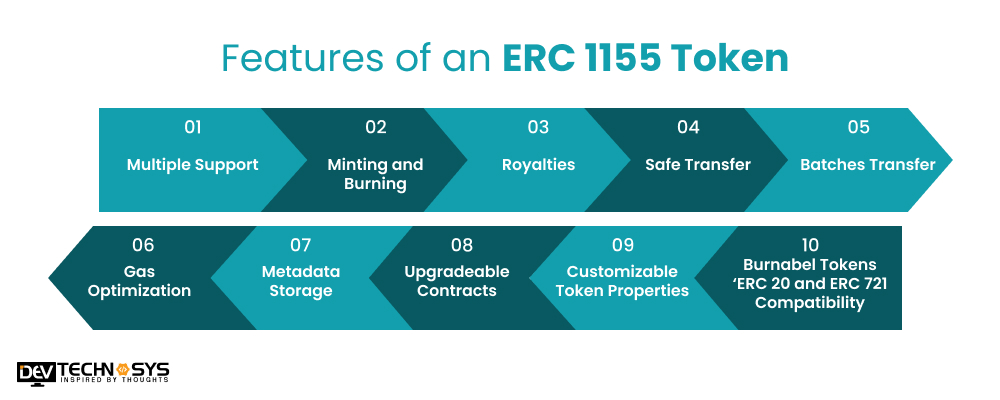
1. Multiple Support
It’s the fundamental elements of ERC1155 that enable different types of tokens to be contained within a single contract.
2. Minting and Burning
With ERC1155, businesses can create new tokens and destroy the existing ones. Hence, this helps in controlling the supply and keeping the token ecosystem balanced.
3. Royalties
ERC1155 includes royalty payments that manage creators earn a % every time their token is resold. Hence, this supports artists and developers as well by providing ongoing revenue.
4. Safe Transfer
Create a token like BenQi that guards against the token’s transfer, which is either inadvertent or fraudulent.
5. Batches Transfer
ERC1155 allows for batch transfer, enabling users to send multiple tokens in a single transaction. Hence, this saves on games fees and also makes transactions more efficient.
6. Gas Optimization
ERc1155 are designed to be gassed-efficient that can lower transaction cost and make the system more economical.
7. Metadata Storage
Create erc1155 token that supports on-chain and off-chain metadata storage that allow for flexible and detailed descriptions of each token.
8. Upgradeable Contracts
Create ERC1155 tokens that support upgradeable contracts, allowing a NFT marketplace development company to fix issues or add new features without disrupting the token ecosystem.
9. Customizable Token Properties
The flexibility allows for the tokens’ creation within different or unique attributes, such as level, rarity, or expiration date.
10. Burnabel Tokens ‘ERC 20 and ERC 721 Compatibility
For the successful STO development services, ensure that there is a smooth connection with token standards that are already in place.

Cost Analysis to Develop an ERC1155 Token
If you are here that means searching for the ERC token development cost. However, the cost to develop NFT marketplace or ERC1155 token depends on a range of factors, including its design, functionalities, and many more.
Furthermore, if your project has unique requirements, it will increase the complexity level, requiring more effort and resources to build. So, how does the complexity level impact the cost create erc1155 token? Let’s understand:
ERC1155 Token Development |
Estimated Cost |
Time Frame |
|
Simple ERC1155 Token Development |
$4000 – $5000 | 2 to 3 Months |
|
Medium-Complex ERC1155 Token Development |
$5000 – $6000 | 3 to 5 Months |
|
High-Complex ERC1155 Token Development |
$7000+ | 6+ Months |
5 Major Factors That Impact ERC1155 Token Development Cost
There are various factors that are highly impact on the total ERC1155 token development cost. It includes smart contract complexity, blockchain network selection, UI/UX & platform integration, development team expertise, and security audits. You must be know about these factors to avoid them for a budget-friendly ERC1155 development.
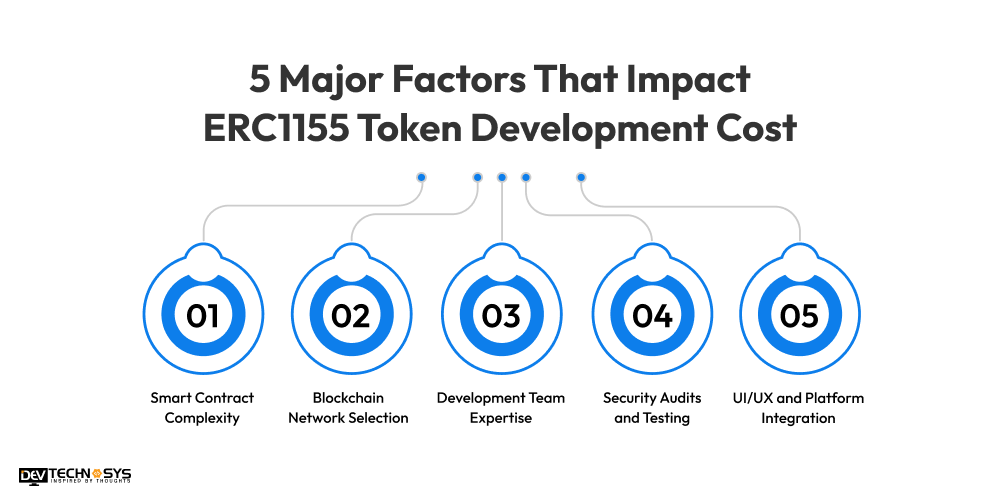
1. Smart Contract Complexity
The complexity of ERC1155 basically impacts the total pricing of NFT token development services. It includes various features like burn, mint function, batch transfers, staking, royalties, and marketplace; they require additional cost or pricing.
The more advanced features require additional cost or expenses. The simple ERC1155 token build as lower cost compared to an enterprise or customized ERC1155 token.
Level |
Description |
Cost Impact |
| Basic ERC-1155 | Standard token with mint and burn functions only | +$2,000 – $4,000 |
| Moderate Features | Includes batch transfers, metadata handling, and basic logic | +$4,000 – $7,000 |
| Advanced Logic | Complex functions like staking, royalties, and dynamic NFTs | +$7,000 – $10,000 |
2. Blockchain Network Selection
The selection of a blockchain network can affect the final cost to develop an ERC1155. Ethereum 1155 is one of the most used blockchain networks, but it has higher gas fees. The layer-2 solutions like Polygon can reduce the transaction cost.
So, basically, each blockchain network has a different configuration, compatibility checks, deployment strategies, and many more. At last, this can influence the overall ERC1155 token development cost and time.
Network Type |
Description |
Cost Impact |
| Ethereum Mainnet | High security, high gas fees, widely adopted network | +$3,000 – $6,000 |
| Layer-2 / Polygon | Lower fees, faster transactions, scalable environment | +$1,500 – $3,500 |
| Multi-Chain Deployment | Supports multiple blockchains for wider accessibility | +$5,000 – $8,000 |
3. Development Team Expertise
The experience level of the mobile app development company strongly affects cost and quality. Highly skilled blockchain developers charge more but deliver secure, optimized, and scalable solutions faster.
Inexperienced teams may offer lower rates but often require longer timelines and additional revisions. Expertise also reduces the risk of vulnerabilities and ensures better adherence to ERC-1155 standards.
Team Level |
Description |
Cost Impact |
| Junior Developers | Less experience, slower delivery, basic implementations | +$2,000 – $4,000 |
| Mid-Level Developers | Balanced experience with stable delivery and code quality | +$4,000 – $7,000 |
| Senior Experts | Highly skilled blockchain engineers ensuring security & optimization | +$7,000 – $9,000 |
4. Security Audits and Testing
Security is critical in token development, making audits a necessary factor affecting the ERC155 and Stablecoin development cost. Professional audits help identify vulnerabilities such as reentrancy attacks, overflow issues, or logic flaws.
Extensive testing, including unit tests and stress testing, ensures reliability under real-world conditions. The more complex the contract, the higher the audit cost due to deeper analysis requirements.
Audit Level |
Description |
Cost Impact |
| Basic Testing | Internal QA checks for simple bugs and functionality | +$1,500 – $3,000 |
| Standard Audit | Third-party review to detect common vulnerabilities | +$3,000 – $6,000 |
| Advanced Audit | Deep security testing with penetration and stress analysis | +$6,000 – $10,000 |
5. UI/UX and Platform Integration
The cost to develop an ERC1155 mainly depends on the design of what token you represent to users. The simple user interface of the token is cheaper than the premium or advanced user interface of the token, which can highly affect the cost to launch a social token.
It includes various design elements, such as layouts, themes, wireframing, prototyping, fonts, styles, textures, and many more. There are various ERC1155 NFT marketplace integrations available, such as payment gateways and advanced analytics.
Integration Level |
Description |
Cost Impact |
| Simple UI | Basic dashboard for token interaction and viewing | +$2,000 – $4,000 |
| Marketplace Integration | Wallet connection, trading features, and user dashboards | +$4,000 – $7,000 |
| Full Platform System | Advanced UI with analytics, APIs, and multi-wallet support | +$7,000 – $11,000 |
Tech Stack For ERC1155 Token Development
Building an ERC1155 token involves the use of a specific tech stack to ensure functionality and efficiency. As per the Ethereum token development company, if you are considering creating ERC1155, you must know the tech stack used in successful development. If you are not familiar with the tech stack, look at the table below:
Component |
Technology |
Descriptions |
|
Blockchain |
Ethereum |
Decentralized platform for smart contracts and token |
|
Programming |
Solidity |
Primary programming language for writing Ethereum smart contracts |
|
Development |
Hardhat |
Ethereum development environment for compiling, testing, and deploying contracts |
|
Framework |
Truffle |
The development environment and testing framework for Ethereum |
|
Token Standard |
ERC-115 |
Multi-token standard for fungible and non-fungible tokens |
|
API |
Web3.js / Ethers.js |
JavaScript libraries for interacting with the Ethereum blockchain |
|
Frontend |
React.js / Vue.js |
JavaScript libraries for building user interfaces |
| Backend |
Node.js |
Server-side JavaScript runtime environment |
Use Cases For ERC-1155
ERC1155 has made it possible to hold a range of objects in a single contact. Due to this, it has become easy to exchange several items with different people in a single transaction rather than multiple transactions. As a result, it has been widely accepted. Here is a list of leading use cases for ERC1155; you must know the following:
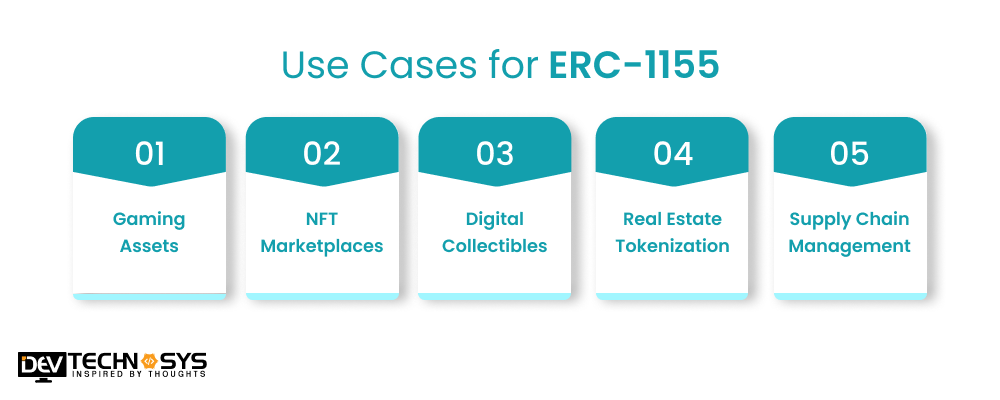
1. Gaming Assets
ERC1155 is versatile for gaming apps. Games often require a mix of fungible tokens and in-game currency or non-fungible tokens (unique character skins or weapons). The token efficiently manages these different assets, enabling players to own, trade, and use them across various platforms and games.
2. NFT Marketplaces
While ERC 721 is associated with NFTs, ERC1155 offers extra benefits for NFT marketplaces. the token can easily manage unique items and multiple copies of digital assets, making it the most suitable and first choice for different NDT types. Furthermore, ERC1155 also streamlines the minting and management procedure. This improves scalability while reducing gas fees.
3. Digital Collectibles
ERC 1155’s ability to represent multiple and unique items within a single contract makes it ideal for digital collectibles. This enables businesses to offer limited education collectibles and variations of rarity. Collectors benefit from the efficient trading and ownership of diverse collections.
4. Real Estate Tokenization
Real estate tokenization is gaining traction, and ERC1155 can play a significant role here. It allows for fractional ownership of the land, enabling investors to buy and trade shares for real estate assets. It can be utilized to tokenize various units within a property, providing flexibility in management and ownership.
5. Supply Chain Management
ERC1155 has potential in supply chain management. The token represents various product variations, verifies authenticity, and tracks items through the supply chain. By tokenizing products, entrepreneurs can reduce fraud, enhance transparency, and improve efficiency in managing logistics and inventory.
Hence, these use cases highlight the versatility of ERC1155 that make it a valuable assets for different industries, even those involved in cryptocurrency wallet development.
ERC1155 Vs ERC 721 Vs ERC-20: Quick Comparison
Feature / Standard |
ERC-20 |
ERC-721 |
ERC-1155 |
| Token Type | Fungible | Non-Fungible (NFT) | Multi-token (fungible + non-fungible) |
| Uniqueness | All tokens are identical | Each token is unique | Supports both unique and identical tokens |
| Divisibility | Yes (can be fractional) | No (indivisible) | Depends on token type |
| Primary Use Case | Cryptocurrencies, utility tokens | Digital art, collectibles, NFTs | Gaming assets, complex ecosystems |
| Batch Transfers | Not native (multiple tx needed) | Not supported | Supported (gas-efficient NFT standard ERC1155) |
| Gas Efficiency | Medium | Low for bulk operations | High (optimized for batches) |
| Contract Flexibility | Single asset type | Single NFT collection | Multiple asset types in one contract |
| Examples | USDT, DAI | CryptoPunks, Bored Ape Yacht Club | Game items like weapons, skins, and coins |
Future Prospects of ERC1155
If you are investing in ERC1155 token, you must know about its future growth. The future of ERC1155 is promising because of its efficiency and versatility in managing multiple toke types within a single contract.
Hence, this multi-token standard is likely to play a critical role in the growing fields like collectibles, gaming, and many more that offer scalable solutions for digital asset management.
- Expanding Gaming and Virtual Worlds
- Driving Innovation in Digital Collectibles
- Enabling New Business Models
1. Expanding Gaming and Virtual Worlds
ERC1155 is ideally suited for the entire gaming sector. Its capacity of representing different in-game items from characters to weapons to virtual real estate, the token can change the assets management.
2. Driving Innovation in Digital Collectibles
The market for digital collectibles is booming and ERC1155 is at the forefront. Hence, by enabling the creation of complicated collectibles with different attributes and rarities, the token opens up new possibilities for collectors, artists, and platforms.
3. Enabling New Business Models
ERC1155’s flexibility will give a rise to innovative business models in future. For instance loyalty programs, subscription services, and tiered access models can be implemented using ERC1155 tokens. Hence, this could lead to new revenue streams.
Why Choose Dev Technosys for ERC1155 Token Development?
Selecting a blockchain development company for ERC-1155 token development depends on expertise, security practices, and end-to-end capability. Dev Technosys has 15+ years of expertise and offers full-cycle blockchain services, including smart contract development services, testing, deployment, and dApp integration under one roof.
Their team has experience working with NFT standards like ERC-1155, ensuring efficient ERC1155 batch minting and low gas optimization. They also emphasize secure coding practices and rigorous testing to minimize vulnerabilities.
With strong UI/UX integration skills and support for Ethereum and Layer-2 networks, they can deliver scalable, user-friendly NFT platforms. Post-launch maintenance and technical support further add reliability for long-term projects.
Frequently Asked Questions
Find answers to the most common questions related to this article.
The cost to create an ERC1155 Token standard is around $5,000 to $25,000 or based on the unique project requirements and demands. There are many factors that highly affect the project cost, such as blockchain platforms, security audits, platform integration, ERC 1155 smart contractsmart contract complexity, UI/UX design services, and many more.
To build an ERC1155 Token, it usually takes around 3 to 6 months or longer. The total development time is mainly impacted by various elements or factors, such as a higher number of advanced features, functions, services, backend infrastructure, project complexity & size, design UI/UX, and more.
You need Node.js, npm, and a blockchain development framework like Hardhat or Truffle. OpenZeppelin contracts are commonly used for secure coding. An ERC1155 wallet, like MetaMask, and access to Ethereum testnets such as Sepolia or Goerli are also required for deployment and testing purposes.
Yes, ERC-1155 is highly suitable for gaming applications. It allows developers to create multiple in-game assets like weapons, skins, characters, and rewards within a single smart contract. Its batch transfer feature reduces gas fees and improves efficiency, making it ideal for handling large volumes of transactions in blockchain-based games and metaverse platforms.
OpenZeppelin is a widely trusted library that provides secure and standardized smart contract templates, including ERC-1155. It helps developers avoid writing contracts from scratch, reducing errors and vulnerabilities. By importing OpenZeppelin’s ERC-1155 contract, developers can quickly build, customize, and deploy token systems with best security practices built in.