


















Quick Summary:
The average cost to build a real estate app in 2026-2027 can range from $30,000 to $1,50,000. The final cost is driven by the app’s complexity, features, integrations, and several other factors.
-
- Basic / MVP Real Estate App ($30,000 to $70,000): Includes essential features such as property listings, search filters, user registration, basic UI/UX, and agent contact functionality for quick market entry.
- Mid-Level Real Estate App ($70,000 to 1,10,000): Includes enhanced UI/UX, map integration, push notifications, advanced filters, booking options, and third-party integrations like payment gateways and CRM systems.
- Advanced / Enterprise Real Estate Platform ($1,10,000 to $1,50,000): Includes AI-powered recommendations, real-time chat, virtual tours, analytics dashboards, multi-role access, and scalable backend architecture for large user bases.
Key Factors Influencing Cost
-
- Feature Complexity: Advanced features like AI-based property recommendations, virtual tours, and real-time chat significantly increase the real estate app development cost.
- Third-Party Integrations: Integration with maps, payment gateways, CRM tools, and property databases adds to development time and overall cost.
- Technology Stack & Platform: Choosing native or cross-platform development, along with backend infrastructure and cloud services, directly impacts the total cost.
Development Timeline
-
- Basic Real Estate App: 2 – 4+ months
- Mid-Level Real Estate App: 4 – 7+ months
- Advanced Real Estate Platform: 7 – 12+ months
Real Estate App Development Cost by Country
-
- North America (USA & Canada): $50 – $100 per hour
- Western Europe (UK, Germany, France): $45 – $80 per hour
- Eastern Europe (Poland, Ukraine): $40 – $70 per hour
- Asia (India & Others): $20 – $40 per hour
Additional Costs to Consider
-
- App Maintenance & Updates: Ongoing maintenance typically costs 15% – 20% annually, covering updates, bug fixes, and performance optimization.
- Third-Party Services & APIs: Costs for maps (Google Maps), payment gateways, CRM systems, and analytics tools add to the overall budget.
- Cloud Hosting & Infrastructure: Cloud services like AWS or Firebase, database management, and storage solutions create ongoing operational expenses after launch.
In this highly competitive PropTech market, entrepreneurs and businesses are increasingly investing in mobile real estate solutions. These solutions can streamline the way people search, buy, sell, rent, and manage their properties.
If you are one of those, knowing the average real estate app development cost is really essential. The average cost to develop a real estate app ranges from $30,000 to $1,50,000. The final budget is determined by the platform’s complexity, features, integrations, and scalability requirements.
Simple property listing apps are more affordable than the advanced platforms. The fully-featured, advanced real-estate platforms include MLS/IDX integration, AI-powered recommendations, virtual tours, and CRM tools, which are expensive.
In this guide, we break down the complete real estate app development cost structure. This blog also covers features, types, country-wise pricing, and key factors influencing overall development expenses in 2026-2027.
What is a Real Estate App?
A real estate app is a mobile or web platform designed to handle buying, selling, renting, and managing properties. It acts as a digital marketplace that connects buyers, sellers, and renters. It also enables users to search using filters and take virtual property tours.
A real estate app also lets property seekers or landowners connect with the agents. In short, it is a mechanism that caters to busters, sellers, renters, and agents as well. Through this platform, users can evaluate properties without visiting them physically.
Real estate apps provide detailed market trends and property comparisons, and foster direct communication between the parties.
Essential Features of Real Estate Application:
- Advanced Search & Filters
- Interactive Map Search
- Simple Registration
- Agent/Broker Dashboard
- User Profiles & Saved Listings
Real Estate App Market Statistics and Growth Trends (2026-2027)
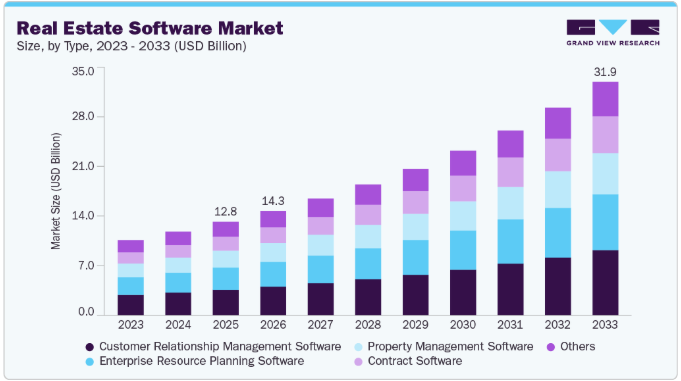
As people are looking for convenience in every industry, how could real estate apps lag behind? The real estate industry is getting advanced worldwide due to rising PropTech solutions. This is transforming how properties are listed, searched, and managed in 2026-2027. Have a look at the market predictions analyzed by Grand View Research.
-
- The global real estate software market was valued at USD 12.8 billion in 2025, showing strong growth.
- The market is expected to reach USD 14.3 billion in 2026, driven by digital transformation adoption globally.
- It is also predicted that the real estate app market will hit USD 32 billion by 2033. It is expanding at 12.2% CAGR from 2026 to 2033.
- North America led the market share with 33.4% revenue dominance in 2025 across real estate software.
- Growth driven by property management, sales automation, and improved client engagement through digital solutions.
How Much Does it Cost to Build a Real Estate Application?
The cost to develop a real estate app is around $30,000 to $1,50,000, depending on the specific functionalities. There are many factors that can affect the overall real estate app development cost, such as premium features, functions, project size, complexity, infrastructure, deployment platforms, developers team, and more.
It also has additional costs like security measurements, testing, designing, paid tech stacks, quality assurance, and more. To know the cost estimation of real estate app, you can reach out to an experienced mobile app development company to get detailed cost information.
Planning a Real Estate App Project?
Get a tailored development cost estimate in a few simple steps.
- 3 quick steps
- 100% free
- Reply in 1 business day
2 Minutes Read
Real Estate App Development Cost by Type: A Complete Pricing Guide
Do you know that the real estate mobile app development cost also varies according to its types? Some common types include property listing platforms, tenant management systems, and full-scale real estate marketplaces.
The types of real estate apps require different functionalities, which directly impact the overall development budget. We will now understand the cost variation according to different types.
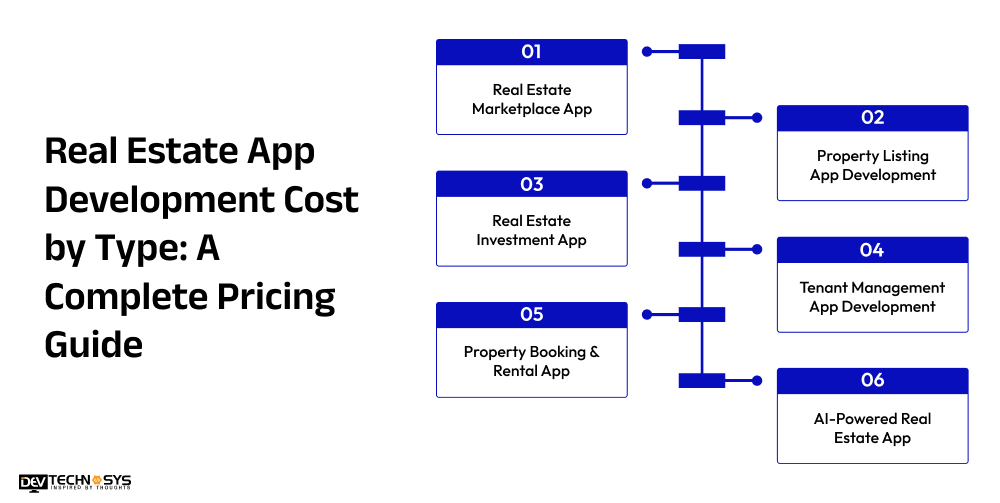
1. Real Estate Marketplace App
A real estate marketplace app is a single platform connecting buyers, sellers, agents, and brokers. Such apps include essential features like property listings, advanced search filters, chat systems, and transaction workflows. Developing a real estate marketplace app has higher complexity, primarily due to multi-user roles.
2. Property Listing App Development
A property listing app development platform is where users can browse, upload, and manage real estate properties. The core features included in these apps are search filters, image galleries, location mapping, and inquiry forms. Building a property listing app involves moderate complexity. It is primarily because of the features like verification and agent dashboards.
3. Real Estate Investment App
A platform where users can invest in properties, track portfolio performance, and analyze ROI is a real estate investment app. Financial dashboards, analytics, and secure payment systems are the crucial features such apps must contain. A real estate investment app development is complex, as it involves compliance requirements.
4. Tenant Management App Development
A tenant management app development is especially built for landlords to handle tenants, rent payments, agreements, and maintenance requests. Critical features these apps have are dashboards, notifications, and payment tracking systems. Complexity to develop a tenant management app is medium, but it increases with automation and accounting integration features.
5. Property Booking & Rental App
A property booking and rental app allows users to book residential or commercial properties for a short or long-term stay. It includes important features such as availability calendars, payment gateways, and booking management. The complexity of making a property booking and rental app is high because it offers real-time syncing.
6. AI-Powered Real Estate App
An AI-powered real estate app integrates modern technology like machine learning algorithms for property recommendation through user behavior. The significant features these apps include smart search, chatbots, and automation. The complexity of the AI-powered real estate app is very high due to AI model training and data processing needs.
Real Estate App Type |
Complexity Level |
Estimated Cost Range |
| Real Estate Marketplace App | High | $80,000 – $150,000+ |
| Property Listing App Development | Medium | $30,000 – $60,000 |
| Real Estate Investment App | High | $70,000 – $140,000 |
| Tenant Management App Development | Medium | $40,000 – $80,000 |
| Property Booking & Rental App | Medium–High | $50,000 – $100,000 |
| AI-Powered Real Estate App | Advanced |
$100,000 – $150,000+ |
Industry Insight: According to Deloitte, real estate technology costs vary significantly based on application complexity. A simple listing platform requires minimal investment, whereas advanced systems involve higher investment. It is due to automation, analytics, and enterprise integrations that demand higher budgets.
The Cost to Develop a Real Estate App in Popular Countries
How Much Does It Cost to Build a Real Estate App? A look at the cost in top countries like Australia, the UK, the UAE, Saudi Arabia, Canada, and More. Find out where you can save the most!
1. Real Estate App Development Cost In Canada
The real estate app development cost in Canada is around CAD40,000 to CAD2,05,000. The cost can be changed due to various factors like experienced developers’ demand for higher salary packages, deployment platforms, and more.
| App Complexity | Estimated Cost (CAD) | Time Frame |
| Simple App | CAD 40,000 – CAD 60,000 | 2–4 Months |
| Mid-Complex App | CAD 60,000 – CAD 120,000 | 4–6 Months |
| High-Complex App | CAD 120,000 – CAD 205,000+ | 8+ Months |
2. Real Estate App Development Cost In Australia
In Australia, real estate app development ranges from AUD 45,000 to AUD 2,30,000. Native design, map search, real-time listings, and agent chat are popular features. The local market favors responsive design, performance optimization, and integration with platforms like Domain or REA.
| App Complexity | Estimated Cost (AUD) | Time Frame |
| Simple App | AUD 45,000 – AUD 70,000 | 2–4 Months |
| Mid-Complex App | AUD 70,000 – AUD 140,000 | 4–6 Months |
| High-Complex App | AUD 140,000 – AUD 230,000+ | 8+ Months |
3. Real Estate App Development Cost In Dubai
Dubai real estate apps cost between AED 1,10,000 to AED 5,50,000. Demand is high for bilingual support, geo-location services, and luxury property visuals. Integration with Dubai Land Department APIs and digital payments boosts complexity and influences total development costs.
| App Complexity | Estimated Cost (AED) | Time Frame |
| Simple App | AED 110,000 – AED 185,000 | 2–4 Months |
| Mid-Complex App | AED 185,000 – AED 370,000 | 4–6 Months |
| High-Complex App | AED 370,000 – AED 550,000+ | 8+ Months |
4. Real Estate App Development Cost In UK
App development in the UK falls between £24,000 to £1,20,000. Features like mortgage calculators, interactive maps, and scheduling viewings are common. UK compliance (GDPR) and integration with Zoopla or Rightmove influence cost and timeline significantly for developers.
| App Complexity | Estimated Cost (GBP) | Time Frame |
| Simple App | £24,000 – £40,000 | 2–4 Months |
| Mid-Complex App | £40,000 – £80,000 | 4–6 Months |
| High-Complex App | £80,000 – £120,000+ | 8+ Months |
5. Real Estate App Development Cost In USA
The real estate app development cost in the USA ranges from $30,000–$150,000+. It is influenced by MLS/IDX integration, admin tooling, lead routing systems, and AI features. The cost range is also affected by the extensive QA testing across multiple devices for performance and scalability.
| App Complexity | Estimated Cost (USD) | Time Frame |
| Simple App | $30,000 – $70,000 | 2–4 Months |
| Mid-Complex App | $70,000 – $1,10,000 | 4–6 Months |
| High-Complex App | $1,10,000 – $1,50,000+ | 8+ Months |
6. Real Estate App Development Cost In Saudi Arabia
Real estate app development in Saudi Arabia ranges from SAR 1,12,000 to SAR 5,63,000. Arabic interface, Islamic finance calculators, and interactive map searches are often required. Localization and integration with regional property portals significantly affect project scope and pricing.
| App Complexity | Estimated Cost (SAR) | Time Frame |
| Simple App | SAR 112,000 – SAR 188,000 | 2–4 Months |
| Mid-Complex App | SAR 188,000 – SAR 375,000 | 4–6 Months |
| High-Complex App | SAR 375,000 – SAR 563,000+ | 8+ Months |
7. Real Estate App Development Cost In Germany
In Germany, costs range from €28,000 to €1,40,000. Real estate apps here often include tenant screening, contract management, and regional language support. GDPR compliance, stable back-end systems, and support for multiple property types impact the real estate website development cost.
| App Complexity | Estimated Cost (EUR) | Time Frame |
| Simple App | €28,000 – €45,000 | 2–4 Months |
| Mid-Complex App | €45,000 – €90,000 | 4–6 Months |
| High-Complex App | €90,000 – €140,000+ | 8+ Months |
8. Real Estate App Development Cost In India
Indian real estate apps cost between ₹6,50,000 to ₹20,00,000. Popular features include agent dashboards, property comparison, and WhatsApp integration. India’s tech ecosystem allows cost-effective development, though scaling, cloud hosting, and multi-platform support can raise costs in advanced builds.
| App Complexity | Estimated Cost (INR) | Time Frame |
| Simple App | ₹15,00,000 – ₹30,00,000 | 2–4 Months |
| Mid-Complex App | ₹30,00,000 – ₹70,00,000 | 4–6 Months |
| High-Complex App | ₹70,00,000 – ₹90,00,000+ | 8+ Months |
9. Real Estate App Development Cost In France
In France, the cost for a real estate app is between €28,000 to €1,40,000. Integration with local agencies, French language support, and digital contract generation are common. Compliance with EU data privacy laws (GDPR) also adds to development considerations.
| App Complexity | Estimated Cost (EUR) | Time Frame |
| Simple App | €28,000 – €45,000 | 2–4 Months |
| Mid-Complex App | €45,000 – €90,000 | 4–6 Months |
| High-Complex App | €90,000 – €140,000+ | 8+ Months |
10. Real Estate App Development Cost In Kuwait
In Kuwait, real estate app development typically costs between KWD 15,300 and KWD 46,000. According to the mobile app development agency in Kuwait, key features often include bilingual support, location-based search, property galleries, and integration with local property databases and payment gateways.
| App Complexity | Estimated Cost (KWD) | Time Frame |
| Simple App | KWD 9,200 – KWD 15,300 | 2–4 Months |
| Mid-Complex App | KWD 15,300 – KWD 30,600 | 4–6 Months |
| High-Complex App | KWD 30,600 – KWD 46,000+ | 8+ Months |
What Are the Crucial Factors That Can Affect the Real Estate App Development Cost 2026?
Are you curious to know about the factors that affect the overall development cost? Knowing about the factors is one of the most important things to complete the project on a fixed budget. So, let’s figure out which factor can affect most:
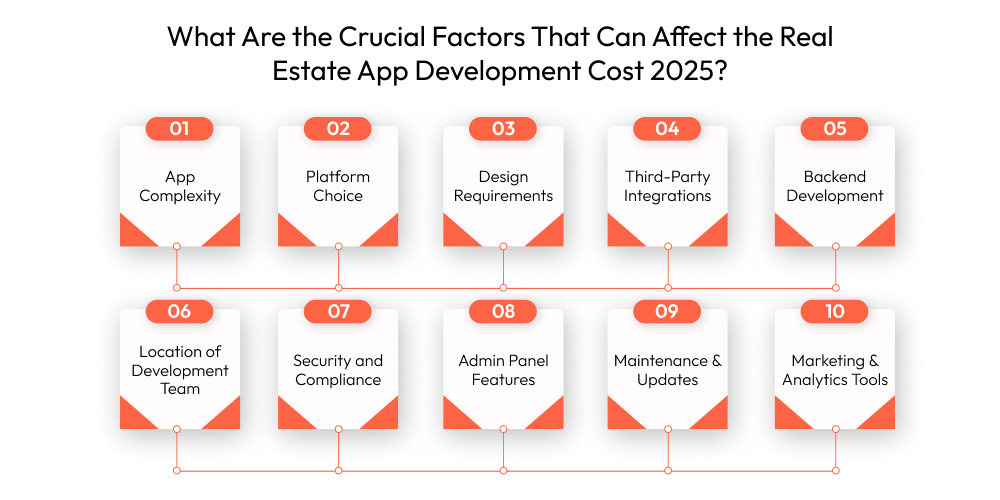
1. App Complexity
The number and complexity of features (e.g., property filters, chat, map integration) directly impact development time and cost. A simple app with basic listings is much cheaper than one with real-time messaging, AI recommendations, or video tours. More features require more design, coding, and testing effort, thus raising the budget.
Level |
Description |
Estimated Cost |
| Basic | Property listings, search, user login, agent contact | $30,000 – $60,000 |
| Moderate | Advanced filters, chat, favorites, scheduling, push notifications | $60,000 – $100,000 |
| Advanced | AI-powered search, AR/VR tours, mortgage calculators, multi-role access | $100,000 – $150,000+ |
2. Platform Choice
Choosing to build for iOS, Android, or both increases costs. Native apps require separate codebases for each platform, while cross-platform solutions (like Flutter or React Native) can reduce time and budget. However, performance or UX goals might make native development necessary, influencing the overall cost to create a mobile app like real estate.
Platform |
Description |
Estimated Cost |
| Android or iOS | Development for a single platform | $30,000 – $55,000 |
| Cross-Platform | Flutter or React Native for Android & iOS | $50,000 – $90,000 |
| Native for Both | Separate Android and iOS development | $90,000 – $150,000+ |
Read also: Top 10 Home Finder Applications
3. Design Requirements
Custom UI/UX design, branding, animations, and responsiveness across devices can add significant cost. A simple template-based design is cheaper, while a fully customized user experience tailored to real estate behaviors, micro-interactions, and branded elements takes more design hours, increasing both design and front-end development costs.
Design Level |
Description |
Estimated Cost |
| Basic | Standard UI with limited customization | $5,000 – $12,000 |
| Custom UI/UX | Custom branding, user-friendly interfaces, and animations | $12,000 – $25,000 |
| High-End UX & Motion | Advanced interactions, micro-animations, premium design | $25,000 – $40,000+ |
4. Third-Party Integrations
Integrations such as Google Maps, payment gateways, CRM systems, or property databases add complexity. These APIs often require setup, customization, and handling of edge cases or limits. Some services may also have associated subscription fees, making the total development and ongoing operational costs higher.
Integration Type |
Examples |
Estimated Cost |
| Maps & Geolocation | Google Maps, Mapbox | $3,000 – $8,000 |
| Payment Gateway | Stripe, PayPal | $4,000 – $10,000 |
| CRM/MLS/IDX Integration | Zillow APIs, Realtor APIs, CRM Platforms | $8,000 – $25,000+ |
| Total Estimate | Depends on the number and complexity of integrations | $15,000 – $45,000+ |
5. Backend Development
A scalable backend is crucial for handling property data, users, messaging, and analytics. Custom backend development adds cost, especially if using microservices, complex logic, or admin dashboards. Cloud hosting choices (AWS, Firebase, etc.) also affect infrastructure costs and scalability planning.
Backend Scope |
Description |
Estimated Cost |
| Basic Backend | User management, property database, and authentication | $15,000 – $30,000 |
| Advanced & Scalable | Real-time chat, notifications, analytics, multi-role access | $30,000 – $70,000 |
| Cloud Infrastructure (Optional) | AWS, Azure, Firebase, Google Cloud | Additional $5,000 – $20,000 |
6. Location of Development Team
Developer rates vary by region. Hiring teams from North America or Western Europe is significantly more expensive than in Eastern Europe or Asia. For example, a US-based developer may charge $150/hour, while one in India may charge $30/hour, making the development cost vary widely for the same app.
Region |
Average Hourly Rate |
Impact on Cost |
| North America | $80 – $150/hr | $90,000 – $150,000+ |
| Western Europe | $60 – $120/hr | $70,000 – $130,000 |
| Eastern Europe | $40 – $80/hr | $50,000 – $100,000 |
| South Asia (India) | $20 – $40/hr | $30,000 – $80,000 |
7. Security and Compliance
If your app handles sensitive user data, payments, or real estate contracts, implementing high security standards is essential. GDPR or CCPA compliance, data encryption, role-based access, and secure authentication add complexity and cost, especially if legal consultation or audits are required.
Security Measures |
Description |
Estimated Cost |
| Basic Security | SSL, encryption, authentication | $3,000 – $8,000 |
| Advanced Compliance | GDPR, CCPA, data governance, security audits | $8,000 – $25,000+ |
8. Admin Panel Features
A powerful admin dashboard lets admins manage users, listings, payments, and analytics. A simple CMS may suffice for basic needs, but custom reporting, role management, or automation workflows require advanced features that increase both backend and front-end development time.
Admin Panel Scope |
Description |
Estimated Cost |
| Basic Dashboard | Manage users, listings, and basic analytics | $8,000 – $15,000 |
| Advanced Admin Panel | Reports, moderation, workflow automation, and role management | $15,000 – $35,000+ |
9. Maintenance & Updates
Post-launch support, bug fixes, security patches, and periodic updates must be considered in the total cost. The on-demand app development solutions need long-term maintenance for smooth performance, OS updates, and user feedback. A one-time build budget won’t cover this, so allocating 15–20% andnually for maintenance is standard.
Service |
Description |
Annual Cost Estimate |
| Bug Fixes & Minor Updates | Security patches and performance improvements | $5,000 – $12,000/year |
| Feature Enhancements | New modules, AI features, integrations | $10,000 – $30,000/year |
| Hosting & Infrastructure | Cloud hosting, databases, CDN services | $3,000 – $15,000/year |
10. Marketing & Analytics Tools
Integrating tools like Google Analytics, Mixpanel, Hotjar, or push notification services can enhance business insight but adds to development complexity. These tools often require backend event tracking, SDK setup, and testing, which increases initial development time and ongoing operational costs.
Tool/Feature |
Examples |
Estimated Cost |
| Analytics Integration | Google Analytics, Firebase, Mixpanel | $2,000 – $8,000 |
| SEO/ASO Tools | App Store Optimization, keyword tracking | $2,000 – $5,000 |
| Campaign & Push Tools | OneSignal, Mailchimp, customer engagement tools | $2,000 – $7,000 |
| Total Estimate | Depends on implementation depth | $6,000 – $20,000+ |

How to Reduce the Real Estate App Development Cost?
If you want to build a real estate app within a fixed budget. Then you need to consider the reducing factors that help businesses reduce the overall development cost. So, let’s figure out the real estate app development cost breakdown:
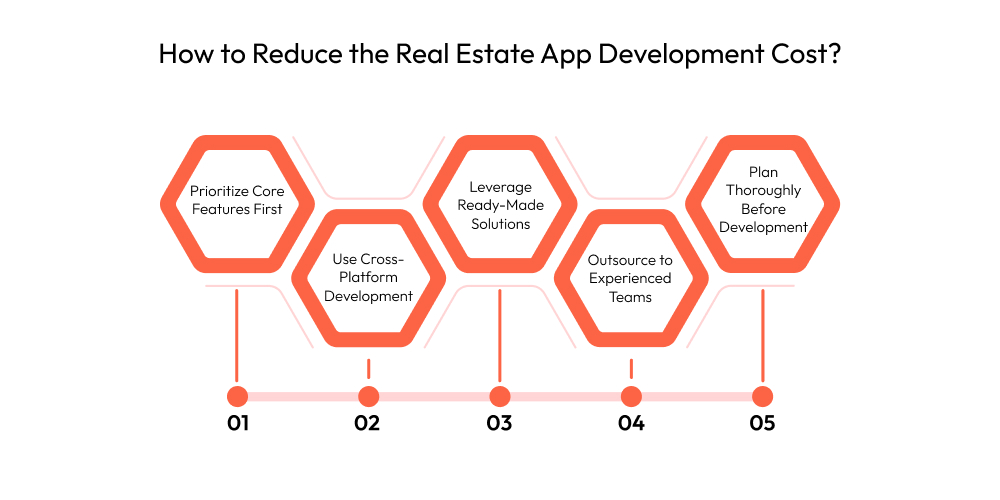
1. Prioritize Core Features First
Focus on building a Minimum Viable Product (MVP) with essential features like property listings, search filters, and contact forms.
Avoid adding complex tools like AR or chatbots early on. This lets you launch faster, gather user feedback, and invest in improvements based on real user needs, saving both time and money.
2. Use Cross-Platform Development
Instead of building separate apps for iOS and Android, choose a cross-platform framework like Flutter or React Native.
These allow you to write a single codebase for multiple platforms, reducing development time and maintenance costs. This approach delivers near-native performance and helps you reach a broader audience without doubling your expenses.
3. Leverage Ready-Made Solutions
Use pre-built templates, SDKs, and third-party APIs for maps, payment gateways, or analytics. These tools are often well-tested and save time versus building from scratch.
For example, integrating Google Maps or Firebase reduces the need for custom backend development, thereby cutting both costs and risks associated with Android app development services.
4. Outsource to Experienced Teams
Hiring an experienced app development company or freelance team from cost-effective regions can lower expenses significantly. Look for teams with real estate app experience and a strong portfolio.
Outsourcing gives you access to skilled professionals without the high overhead of hiring a full-time in-house team.
5. Plan Thoroughly Before Development
A clear roadmap and detailed requirements document can prevent expensive mid-project changes. Define your goals, user flow, and technology stack early. Involve all stakeholders in the planning process. Proper planning ensures smoother execution, reduces rework, and helps stay within budget and timeline.
Item |
Description |
| Strategy | Avoid scope creep, clarify specs, wireframes, and timeline early. |
| Poor Planning Cost Overruns | +20% to +50% of budget (e.g., $10,000–$15,000 extra) |
| With Planning (Avoided Waste) | $0 – $5,000 |
| Estimated Savings | $2,000 – $4,000 |
| Impact | Reduces rework, dev hours, and improves communication. |
Hidden Costs of Real Estate App Development: 5 Expenses to Watch
While developing an app, businesses normally focus on the core real estate app development cost. However, they ignore several expenses that can give you surprises after increasing your budget. We will understand these hidden costs that help you avoid overspending and plan your investment more effectively.
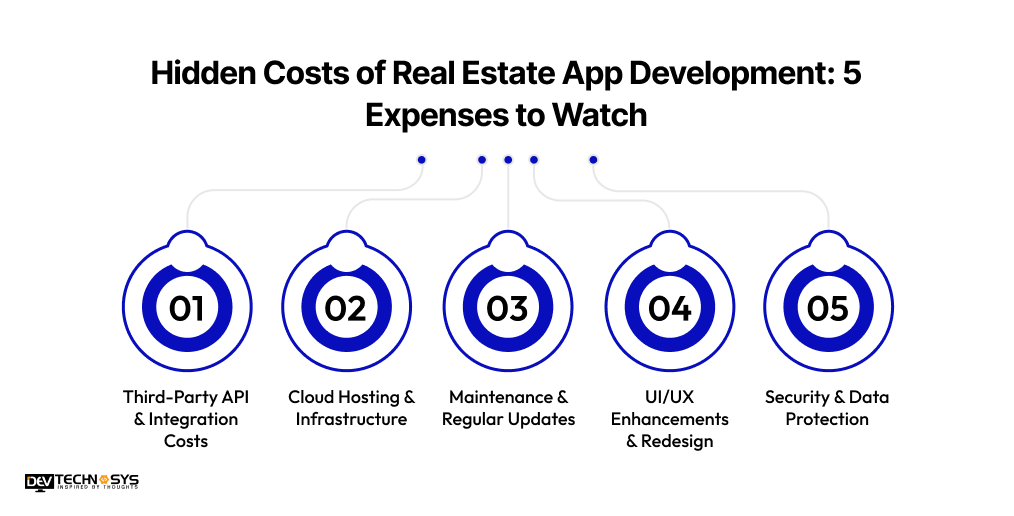
1. Third-Party API & Integration Costs
Third-party integrations can significantly increase the cost to build a real estate app over time. It includes APIs like Google Maps, MLS databases, payment gateways, chat systems, and CRM tools. The usage-based pricing model of APIs might increase the real estate app cost estimation by 10%–25%.
2. Cloud Hosting & Infrastructure
Cloud hosting and infrastructure costs are frequently underestimated during initial budgeting. As user traffic and property listings increase, businesses may require scalable cloud environments, CDN services, and database optimization. Infrastructure scaling alone can increase overall real estate app expenses by 15%–30% post-launch.
3. Maintenance & Regular Updates
Real estate applications require continuous maintenance to ensure performance, security, and compatibility with evolving technologies. Regular bug fixes, feature enhancements, operating system updates, and server monitoring contribute to recurring expenses. Annual maintenance costs typically account for 15%–20% of the original development budget.
4. UI/UX Enhancements & Redesign
Many businesses revise their app interface after user feedback, usability testing, or changing market trends to build a real estate app like Zillow . Additional UI/UX improvements, redesign cycles, and frontend modifications can increase development costs. In complex projects, design-related revisions may contribute an additional 10%–20% to the total budget.
5. Security & Data Protection
Implementing advanced security measures such as encrypted transactions, secure authentication, role-based access control, and data protection protocols increases development complexity. Real estate platforms handling sensitive customer and payment data often require enterprise-grade security infrastructure. It can raise total development costs by 10%–25%.
How to Develop A Real Estate App?
Before knowing the actual cost to develop an app like Rex Real Estate. You should know how to build a real estate app with unique and customized features. We offer the initial development steps to the final post-launch maintenance services step. So, here we provide the real estate app development process:
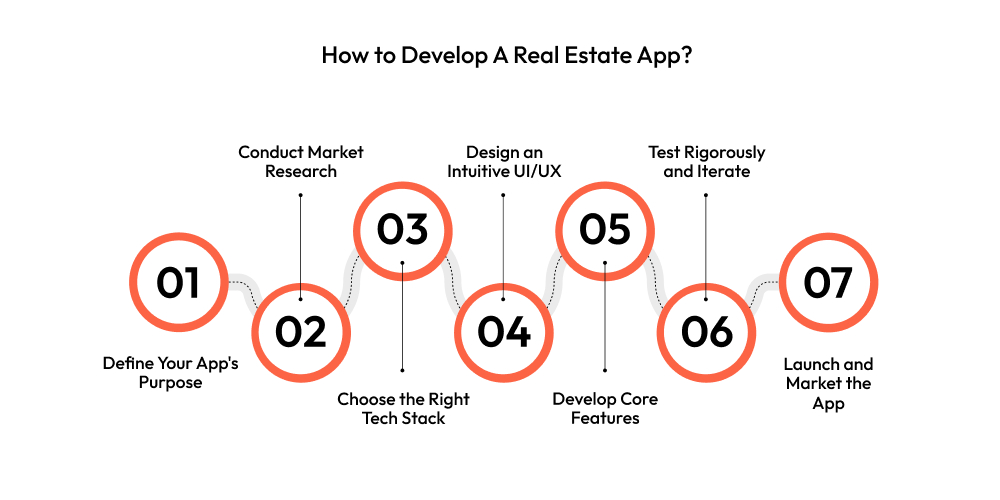
- Define Your App’s Purpose
- Conduct Market Research
- Choose the Right Tech Stack
- Design an Intuitive UI/UX
- Develop Core Features
- Test Rigorously and Iterate
- Launch and Market the App
1. Define Your App’s Purpose
Clarify your app’s main goal, whether it’s property listing, rentals, or investment tracking. Identify your target users, like buyers, sellers, or agents. Understanding their needs helps in shaping features, design, and user experience effectively, ensuring your app offers real value and stands out in a competitive real estate market.
2. Conduct Market Research
Study leading real estate apps to understand trends, user preferences, and feature sets. Identify gaps in the market and pain points users face. Analyze what competitors are doing well or missing, helping you design a unique value proposition and informed feature roadmap that addresses actual market demands and user expectations.
3. Choose the Right Tech Stack
Hire real estate application developers to select appropriate technologies based on your app’s complexity, performance requirements, and budget. For mobile apps, consider React Native or Flutter for cross-platform development.
Use scalable backend solutions like Node.js or Django, and databases like PostgreSQL. Ensure your tech stack supports integration with maps, search filters, chat, and payment gateways.
4. Design an Intuitive UI/UX
Create a clean, user-friendly interface that allows users to easily search, view, and filter listings. Focus on seamless navigation, high-quality images, interactive maps, and minimal steps for actions like contacting agents or booking visits. A well-designed user experience increases engagement, retention, and overall satisfaction with your real estate platform.
5. Develop Core Features
Implement essential features like user registration, property search, geolocation, filters, image galleries, virtual tours, and agent communication. Add extras like mortgage calculators or saved searches for better functionality. Prioritize performance and responsiveness to ensure the app works smoothly on different devices and handles large databases efficiently.
6. Test Rigorously and Iterate
Perform thorough testing to identify bugs, UI issues, and performance bottlenecks. Use manual and automated tests across multiple devices and screen sizes.
Gather feedback from early users or beta testers, then iterate to fix issues and improve features. Continuous testing ensures reliability, security, and a smooth user experience upon launch.
7. Launch and Market the App
Hire experienced developers from an iOS application development company to publish your app on iOS and Android stores with optimized listings and clear descriptions.
Run digital marketing campaigns using SEO, social media, influencer partnerships, and paid ads to generate interest. Collect user feedback post-launch to plan updates. Strategic promotion and ongoing support are key to building user trust and retention.
How Long Does It Take to Build a Real Estate App? Full Timeline Explained
The development of a real estate application typically takes 3 to 6+ months. This timing depends on the complexity of features, integrations, and scalability requirements. Each development stage contributes differently to the overall timeline, from planning and design to development, testing, and launch. Below is a step-by-step timeline mapped to the key stages of real estate app development.
Development Step |
Description |
Estimated Timeline |
| Define Your App’s Purpose | Identifying business goals, target users (buyers, sellers, agents), and core app functionality | 1 Week |
| Conduct Market Research | Analyzing competitors, user expectations, feature gaps, and monetization strategies | 1–2 Weeks |
| Choose the Right Tech Stack | Selecting frontend, backend, database, and cloud infrastructure for scalability and performance | 1 Week |
| Design an Intuitive UI/UX | Creating wireframes, user journeys, and interactive designs for a seamless property browsing experience | 2–4 Weeks |
| Develop Core Features | Building property listings, search filters, user profiles, chat systems, and admin panels | 6–12 Weeks |
| Test Rigorously and Iterate | Performing functional, performance, and security testing with continuous bug fixes and improvements | 2–4 Weeks |
| Launch and Market the App | Deploying the application, app store submission, and initial marketing rollout | 1–2 Weeks |
Industry Insight: We have worked on multiple projects in real estate development and analyzed that: A simple, MVP real estate app takes approximately 3 months for development, whereas. A feature-rich, scalable platform with AI integration and advanced analytics can extend the timeline to 6+ months.
AI in Real Estate Applications
- AI analyzes user behavior and preferences to suggest personalized property listings, improving user experience and boosting platform engagement.
- AI-powered chatbots provide 24/7 customer support, answer queries, schedule viewings, and assist users throughout the property search journey.
- AI in real estate industry detects suspicious listings, fake profiles, and unusual behavior patterns to minimize fraud and ensure trust across real estate applications.
- AI simplifies documentation by auto-filling forms, validating inputs, and assisting with contracts, leases, and compliance checks in real estate workflows.
- Predictive algorithms analyze demand, pricing, and neighborhood trends, helping agents and investors make data-driven, forward-looking real estate decisions.
Industry Insight: McKinsey highlights that the real estate app development cost is driven by digital transformation needs. It includes AI adoption, data-driven decision-making, and platform scalability. Costs increase as apps evolve from basic to advanced ecosystems with analytics, automation, and integrated property management tools
Why Real Estate App Costs Fail: Common Budget Overruns
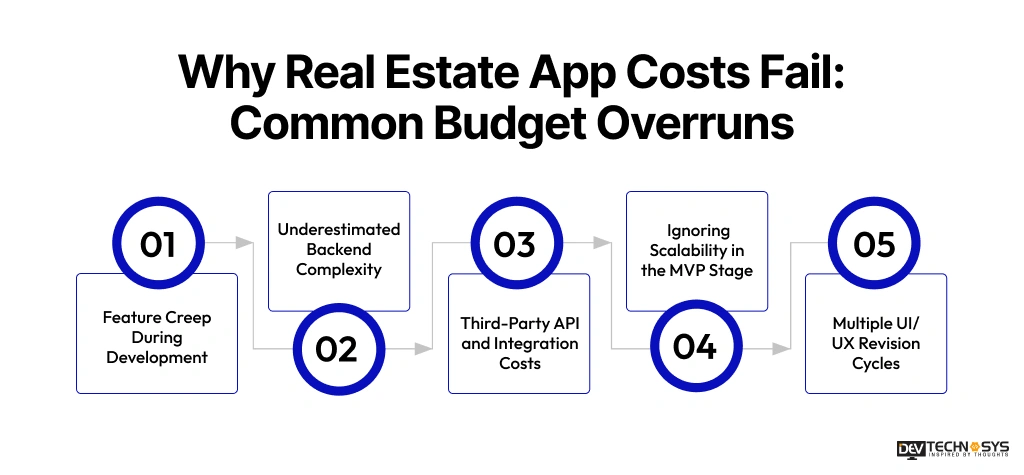
It is a fact that real estate app development projects hardly stays withing pre-defined budget. In many scenarios, the cost of property investment platform development exceeds the set budget by 20% to 45%.
It is mainly due to evolving requirements, scaling challenges, and underestimated technical complexity. Here, we will understand these cost overrun patterns to prevent unexpected financial pressure.
1. Feature Creep During Development
Many real estate platforms begin with a defined MVP scope, but gradually, additional features are introduced mid-development. This is one of the biggest reasons for budget failure. It increases the commercial real estate software development budget by 15% to 30%.
Each new feature impacts:
- Backend architecture structure
- API integrations
- UI/UX redesign requirements
- Testing and QA cycles
How to prevent it:
Finalize a locked feature scope before development begins and follow a structured change-request process for any additions.
2. Underestimated Backend Complexity
Backend infrastructure is something a real estate application depends on. During development, the main focus remains on UI that underestimates backend complexity. These backend insufficiencies can raise the real estate application development cost by 20%–40%.
Challenges include:
- Advanced filtering and search logic
- High-volume property database handling
- Real-time data synchronization
- Multi-role user management (buyers, agents, admins)
How to prevent it:
Use scalable architecture planning (microservices or modular backend design) from the beginning.
3. Third-Party API and Integration Costs
Modern real estate apps depend on external APIs such as Google Maps, MLS listings, and payment gateways. Usage-based pricing models of these APIs often lead to unexpected cost increases post-launch. It might raise the cost to develop a real estate app gradually 10%–25% over time.
Common cost drivers include:
- Map API request charges
- Listing data synchronization fees
- Payment gateway transaction fees
- SMS/email notification services
How to prevent it:
Evaluate API pricing models early and forecast usage-based scaling costs during planning.
4. Ignoring Scalability in the MVP Stage
Many businesses design their MVPs for limited users, but when adoption increases, the system fails to handle traffic. This leads to performance issues, and Infrastructure upgrades can increase total cost by 25%–50%.
Common issues include:
- Server overload during peak usage
- Database performance bottlenecks
- Slow property search response times
- Need for cloud infrastructure migration
How to prevent it:
Design MVP with scalable cloud infrastructure (AWS, Azure, or GCP), even if initial usage is low.
5. Multiple UI/UX Revision Cycles
UI/UX design is often underestimated during budgeting. After user testing or stakeholder feedback, multiple redesign iterations are commonly required. It leads to an elevated on-demand real estate app cost by 10%–20%.
This leads to:
- Reworking design components
- Frontend redevelopment
- Additional testing cycles
- Delays in product launch
How to prevent it:
Invest in strong prototyping and usability testing before final development begins.
Expert Insight:
As we have worked on 35+ real estate projects and analyzed that these apps don’t exceed budget because of coding insufficiencies. It is affected due to unclear scope definition, underestimated system complexity, and a lack of scalability planning at the beginning. Businesses that invest time in proper planning are likely to stay within budget.
Build, Buy, or Partner: Best Strategy for Real Estate App Development Cost Optimization
The selection between building, buying, or partnering for a real estate app is not just important but difficult also. This decision directly impacts the development cost, scalability, and speed to market. Each approach offers different levels of control, investment, and customization. This has made the decision critical for startups, enterprises, and proptech businesses. Here, we have explained the core difference between them to make it easier to select.
Factor |
Build (Custom Development) |
Buy (Ready-Made Solution) |
Partner (With Dev Technosys) |
| Estimated Cost | $30,000 – $150,000+ | $5,000 – $30,000 | $30,000 – $150,000+ (flexible engagement models) |
| Time to Market | 4–9+ Months | 2–8 Weeks | 3–7 Months (faster with agile delivery) |
| Customization | Fully tailored to business needs | Limited customization options | Fully customizable with expert guidance |
| Feature Flexibility | Unlimited feature control | Fixed features set by the vendor | Flexible feature planning with iterative upgrades |
| Scalability | High, but requires strong architectural planning | Limited scalability | Enterprise-ready scalable architecture |
| Technology Control | Full control over tech stack | No control (vendor-defined stack) | Shared control with technical experts |
| Data Ownership | 100% ownership | Vendor-controlled or restricted access | Full ownership with secure infrastructure setup |
| Security Control | Fully managed in-house security | Standard vendor security | Enterprise-grade security implementation |
| Integration Capability | Extensive but requires effort | Limited integrations available | Seamless third-party API & MLS integrations |
| Maintenance & Updates | In-house responsibility | Subscription-based updates | Dedicated ongoing support & maintenance |
| Compliance (GDPR/Local Laws) | Self-managed compliance | Vendor-dependent compliance | Built-in compliance support & advisory |
| Risk Level | Medium–High (development complexity risk) | Low (pre-built system risk) | Medium (dependency on partner expertise) |
| ROI Potential | High long-term ROI | Quick but limited ROI | Balanced ROI with scalability + efficiency |
| Best For | Enterprises, funded startups, long-term platforms | MVPs, early-stage validation |
Startups to enterprises needing speed + expertise |
Case Study: Shree Estate
At Dev Technosys, we built Shree State, a scalable real estate app for property discovery, listings, and agent connections. We implemented cloud infrastructure, optimized APIs, and ensured smooth performance and reliable real-time data handling. The initial cost to develop this app was estimated as $90,000. However, the cost increased as we integrated advanced features like interactive listings and improved navigation.
Challenge Faced
The major challenge we have come across was managing large-scale property data efficiently. Along with that, we have to ensure fast search performance, secure data handling, and seamless integration. The integrations include dynamic listing updates without affecting system speed or stability.
Project Highlights
- Project Name: Shree State
- About Client: Vivek Videra
- Industry: Real Estate / PropTech
- Client Location: Not Disclosed
- Development Timeline: 6 Months
- Team Size: 5 Developers
- Platform Type: Real Estate Listing & Property Management Application
Conclusion
We are standing at the last stage of this blog. We discussed in depth how much it cost of real estate app development and what factors can affect the cost. We hope that you have cleared all your doubts and confusion regarding the real estate mobile app development cost. You need to simply observe the cost-affecting factors that help to build the app within the fixed budget.
Are you planning to create a real estate app? Then, simply connect to an experienced real estate app development company to receive an affordable real estate mobile app.
Frequently Asked Questions
Find answers to the most common questions related to this article.
The cost of real estate app development cost is around $30,000 to $1,50,000 or higher, based on the specific requirements and demands. The development cost can be changed due to specific factors such as features, functions, complexity, infrastructure, deployment platforms, development teams, and more.
To make a real estate app, it mainly takes around 3 to 6 months of overall development. The timeline is based on various factors such as developers’ working hours, project complexity, a vast number of features, and more.
To start a real estate app, businesses or clients need to consider these steps, such as market analysis and planning, identifying core features, choosing tech stacks, designing UI/UX, app development, testing and QA, and launching and post-maintenance services.
There are various factors that can impact the real estate app development cost, such as app complexity, premium features, maintenance and support services, third-party integrations, backend infrastructure, design, and more.
The cost of real estate app development depend on the developer for that their cost’s ranges from $15 to $25 per hour or based on the project requirements. The hiring cost fluctuates due to some factors such as developers’ experience level, skill set, living location, and more.
The cost to maintain a real estate app is around 15% to 20% of the initial mobile app development cost. It includes various maintenance services such as OS upgradation, updating outdated features, fixing bugs or glitches, performance optimization, and regular updates.