















Key takeaways:
-
- Overall Cost Range: Courier delivery app development costs typically range between $30,000 and $1,50,000+, depending on complexity, delivery model, tracking, and integrations.
- Cost by Complexity:
- Basic / MVP: $30,000 – $75,000 (registration, order placement, basic tracking, notifications)
- Mid-Level: $75,000 – $1,10,000 (real-time GPS, route optimization, chat, payments, better UI/UX)
- Advanced: $1,10,000 – $1,50,000+ (AI routing, fleet management, analytics, multi-location support)
- Key Cost Factors: Feature complexity, technology stack, third-party integrations (maps, payments, APIs), and platform choice (iOS, Android, or cross-platform).
- Development Timeline:
- Basic App: 2 – 4+ months
- Mid-Level App: 4 – 7+ months
- Advanced Platform: 7 – 12+ months
- Regional Development Rates: North America ($50–$90/hr), Western Europe ($45–$80/hr), Asia ($20–$50/hr).
- Additional Costs: Maintenance (15%–20% annually), third-party services (APIs, hosting, SMS), and fleet or logistics infrastructure.
According to Grand View Research, the courier delivery market is expected to reach $2,976.0 billion by 2033. With this analysis, it is evident that the courier and logistics industry is evolving rapidly. Due to this, users are now searching for:
- Faster deliveries
- Real-time tracking
- Seamless shipment management
This growing digital transformation has led many startups, logistics providers, and enterprises to invest in courier management software development. But the question appears: How much is the cost of a courier delivery solution development?
The average courier delivery app development cost can be estimated at $30,000 – 1,50,000. The final cost is influenced by the platform’s complexity, features, integrations, backend, security, third-party APIs, design, and other factors.
Are you a startup or an enterprise interested in courier booking app development? This blog can definitely answer all your questions. It will help you estimate your budget, prioritize features, and successfully launch a scalable courier business in 2026-2027.
Industry Insight: The global Delivery-as-a-Service market is projected to grow from USD 656.66 billion in 2026 to USD 1,415.19 billion by 2034. This growth reflects a CAGR of 10.10% during the forecast period. – Fortune Business Insight
What is the Courier Delivery App?
A platform that connects users with local or international couriers is a courier delivery app. These applications are known for secure and quick deliveries while offering real-time courier tracking. They include deliveries for parcels, food, goods, luggage, documents, groceries, medical supplies, and other on-demand items.
A courier delivery app is highly recommended by businesses and customers for streamlined logistics. It even offers on-demand booking, digital signatures, and automated dispatch via smartphones. Borzo, Lalamove, Delhivery, UPS, Wefast, etc., are some real-life examples of courier delivery apps.
How Much Does it Cost to Build a Courier Delivery App?
The average courier delivery app development cost in India or worldwide ranges from $30,000 to $1,50,000+. This cost is highly determined by the complexity of the application. We will explain it this way:
- A basic courier delivery app relies on MVP development, which requires fewer integrations and development efforts. This leads to lower complexity and a development budget ranging between $30,000 and $75,000.
- A mid-level app combines basic and advanced integrations, which balances the development resources and efforts. Due to this, the complexity remains moderate, and the development cost is from $75,000 to $1,10,000.
- A fully-featured, advanced courier delivery app requires multiple integrations, resources, and efforts. This increases the development complexity and cost by somewhere $1,10,000 to $1,50,000+.
Now, we will explain the courier mobile app development cost through a breakdown table:
| App Level | Best For | Development Timeline | Estimated Cost |
| Basic Courier App (MVP) | Startups & Local Courier Businesses | 3–5 Months | $30,000 – $75,000 |
| Growth-Stage Courier App | Regional Delivery Companies | 5–7 Months | $75,000 – $110,000 |
| Enterprise Courier Platform | Large Logistics & Courier Enterprises | 7–10 Months | $110,000 – $150,000+ |
Cost Breakdown of Courier Delivery App Basic Features
The total courier delivery app development cost is largely influenced by the modules you decide to build. Every delivery courier solution is built using three main modules that include the Customer App, the Driver App, and the Admin Panel. These modules perform different tasks and require various amounts of work to develop.
1. Customer App Development Cost Breakdown
The customer app is what users will be using in order to place an order, monitor its status, and manage deliveries.
| Customer App Feature | Functionality | Estimated Cost |
| User Registration & Login | Sign up via email, phone, or social accounts | $300 – $800 |
| Profile Management | Manage personal details and delivery preferences | $300 – $700 |
| Shipment Booking | Schedule pickups and delivery requests | $500 – $1,000 |
| Address Management | Save and manage multiple addresses | $300 – $700 |
| Real-Time Shipment Tracking | Monitor package location live | $500 – $1,000 |
| Fare & Delivery Cost Estimator | Calculate delivery charges automatically | $300 – $800 |
| Multiple Payment Options | Cards, wallets, and online payments | $400 – $900 |
| Push Notifications | Delivery alerts and updates | $300 – $700 |
| Delivery History | View previous shipments and invoices | $300 – $700 |
| Ratings & Reviews | Customer feedback and service ratings | $300 – $700 |
2. Driver App Development Cost Breakdown
The driver app allows delivery personnel to manage their tasks, optimize the route, and update delivery status.
| Driver App Feature | Functionality | Estimated Cost |
| Driver Registration & Verification | Onboarding and document verification | $300 – $800 |
| Driver Profile Management | Manage personal and vehicle information | $300 – $700 |
| Delivery Request Management | Accept or reject delivery assignments | $400 – $900 |
| Route Navigation | GPS-powered navigation and routing | $500 – $1,000 |
| Real-Time Delivery Updates | Update the package and delivery status | $300 – $800 |
| In-App Communication | Chat or call customers and dispatchers | $300 – $800 |
| Earnings Dashboard | View completed deliveries and earnings | $300 – $700 |
| Delivery History | Access past delivery records | $300 – $700 |
| Push Notifications | Receive delivery alerts and reminders | $300 – $700 |
| Proof of Delivery | Upload signatures or package photos | $400 – $900 |
3. Admin Panel Development Cost Breakdown
The admin panel acts as a center where you can manage users, drivers, deliveries, and other things related to your business performance.
| Admin Panel Feature | Functionality | Estimated Cost |
| Admin Authentication | Secure login and role-based access | $300 – $700 |
| Customer Management | Manage user accounts and activities | $300 – $800 |
| Driver Management | Approve, monitor, and manage drivers | $400 – $900 |
| Delivery Management | Track and oversee all deliveries | $500 – $1,000 |
| Fleet Monitoring | Monitor active drivers and vehicles | $400 – $900 |
| Pricing & Commission Management | Configure delivery charges and commissions | $300 – $800 |
| Analytics Dashboard | Delivery performance and business insights | $400 – $900 |
| Reports & Data Export | Generate operational reports | $300 – $700 |
| Notification Management | Manage alerts and announcements | $300 – $700 |
| Support & Dispute Management | Handle customer complaints and issues | $400 – $900 |
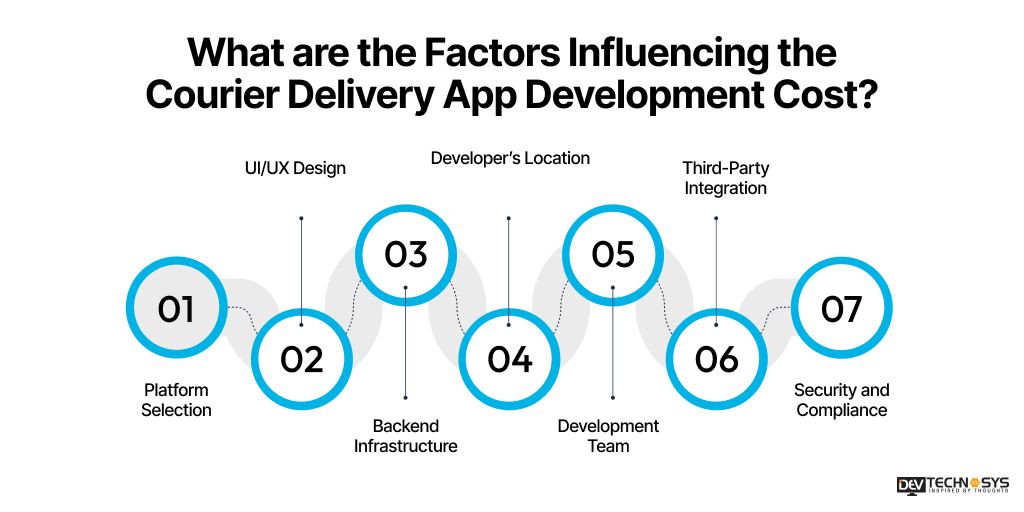
What are the Factors Influencing the Courier Delivery App Development Cost?
App complexity, backend infrastructure, security, third-party APIs, development team & their location, etc., are highly cost-influencing factors. These factors play a vital role in determining the final on-demand courier app development cost. By analyzing these factors, businesses can strategically plan their development and get better ROI.
1. Platform Selection
Choosing the platform, either Android, iOS, or both, can impact the cost of pickup and delivery app development services. Developing an app on separate platforms requires specialized expertise and testing efforts. This can increase the complexity, timeline, and cost to make a courier delivery app.
| Platform Strategy | Business Impact | Development Complexity | Estimated Cost |
| Android-First Launch | Ideal for testing market demand with lower investment | Low | $10,000 – $15,000 |
| Cross-Platform Development | Faster launch on Android and iOS with a shared codebase | Medium | $15,000 – $22,000 |
| Native Android + iOS | Maximum performance, scalability, and user experience | High | $22,000 – $30,000 |
2. UI/UX Design
The last-mile delivery app development cost can be raised by a highly interactive and user-friendly interface. Such an interface demands advanced tools for designing, prototyping, and testing. AI in logistics and courier services elevates the design complexity, which leads to a higher cost to create a courier delivery app.
| Design Investment Area | Business Value Delivered | Estimated Cost |
| Core User Journey Design | Easy booking, shipment tracking, and payment flow | $5,000 – $8,000 |
| Custom Brand Experience | Unique layouts, personalized dashboards, and improved engagement | $8,000 – $15,000 |
| Conversion-Focused UX | Advanced prototypes, micro-interactions, and retention-driven design | $15,000 – $20,000 |
3. Backend Infrastructure
To manage tracking, data processing orders, and users together, a strong backend is needed. For a robust backend system, a scalable cloud infrastructure, database management, and server-side logic are necessary. However, they can escalate the budget to create a courier delivery app like DPD.
| Infrastructure Requirement | Operational Benefit | Estimated Cost |
| Core Backend System | Handles users, bookings, and order management | $10,000 – $15,000 |
| Real-Time Delivery Network | Supports live tracking and instant updates | $15,000 – $20,000 |
| Enterprise Logistics Architecture | Supports thousands of daily deliveries and fleet operations | $20,000 – $25,000 |
4. Development Team
The selection between freelancers, in-house teams, or development agencies influences the cost to build a logistics mobile app.
- Freelancers can be hired at lower prices but offer limited scalability.
- In-house teams are great, but they demand infrastructure and salaries.
- Development companies have a higher cost but offer expertise and strategic project execution.
| Hiring Model | Advantages | Challenges | Estimated Cost |
| Freelancer | Lowest initial investment | Limited scalability and support | $12,000 – $16,000 |
| In-House Team | Greater control over development | Recruitment and operational costs | $16,000 – $21,000 |
| Courier App Development Company | Complete project delivery with dedicated specialists | Higher upfront investment | $21,000 – $25,000 |
5. Developer’s Location
The multi-vendor courier app development cost can be affected by the developer’s location. Developers from North America or Western Europe are more expensive than those from Eastern Europe or Asia. It is because of the higher per-hour development rates. This makes location a major factor impacting the expenses to build a courier delivery app for courier business.
| Development Region | Average Cost Efficiency | Project Cost |
| India & South Asia | Highest value for budget-conscious businesses | $10,000 – $15,000 |
| Eastern Europe | Strong technical expertise with moderate rates | $15,000 – $19,000 |
| Western Europe | Premium development and consulting services | $19,000 – $23,000 |
| North America | Enterprise-grade development at higher rates | $23,000+ |
6. Third-Party Integration
An AI-powered courier app development relies on third-party tools. It includes payment gateways, GPS tracking, SMS notifications, and analytics tools. These functionalities require API usage fees, integration complexity, and ongoing maintenance. This increases the cost to develop a courier delivery app.
| Integration Category | Business Purpose | Estimated Cost |
| Payment & Communication APIs | Secure payments, SMS alerts, email notifications | $4,000 – $6,000 |
| Maps & Tracking Services | Route navigation and live driver tracking | $6,000 – $9,000 |
| Enterprise System Integrations | ERP, CRM, warehouse, and fleet management systems | $9,000 – $12,000 |
7. Security and Compliance
Data encryption, secure authentication, and compliance with regulations are mandatory for a delivery management software development. These measures guarantee the protection of user data properly. However, they require regular audits and additional development efforts. This can increase the courier and logistics app development cost.
| Security Investment | Protection Offered | Estimated Cost |
| Essential Security Layer | User authentication, encrypted transactions, secure APIs | $7,000 – $12,000 |
| Advanced Threat Protection | Fraud prevention, access controls, and monitoring tools | $12,000 – $17,000 |
| Enterprise Compliance Framework | GDPR compliance, penetration testing, security audits | $17,000 – $22,000 |
Next-Generation Features for Courier Delivery Apps and Their Costs
As courier services grow, simple features aren’t enough when dealing with large volumes of deliveries, expectations, and efficiency. That’s when an advanced courier delivery app’s features make a difference by adding automation, accuracy, and real-time decision-making. Here is a list of advanced features and their approximate development costs.
| Advanced Feature | Business Value / Functionality | Estimated Cost |
| AI-Based Route Optimization | Automatically selects the fastest and cost-efficient delivery routes | $800 – $1,500 |
| Smart Dispatching System | Assigns deliveries to drivers based on availability and location | $600 – $1,200 |
| Real-Time Fleet Tracking Dashboard | Live monitoring of all delivery vehicles on a single map | $700 – $1,400 |
| Predictive Delivery ETA | Uses data analytics to estimate accurate delivery times | $500 – $1,200 |
| Automated Notifications Engine | Sends intelligent updates to customers and drivers | $400 – $900 |
| Multi-Warehouse Management | Manages inventory and dispatch across multiple hubs | $700 – $1,500 |
| AI Chatbot Support System | Handles customer queries automatically | $600 – $1,300 |
| Advanced Analytics & Reporting | Provides insights into performance, delays, and efficiency | $500 – $1,200 |
| Dynamic Pricing Module | Adjusts delivery charges based on demand and distance | $600 – $1,300 |
| Fraud Detection & Security Alerts | Identifies suspicious activities and prevents misuse | $500 – $1,000 |
Why Should Entrepreneurs Invest in Courier Delivery App Development?
Investing in an on-demand app development like a courier delivery app in 2026 is a great opportunity. It allows businesses to tap into the rapidly evolving online courier service market. A dedicated courier app helps enterprises optimize workflow and enhance delivery efficiency.
When a courier delivery app is strongly built, it enhances customer satisfaction. It reduces the need for manual efforts, and it simultaneously lowers the operational costs. People are demanding fast and transparent deliveries, which leads to the development of digital courier and logistics solutions.
Additionally, it also provides businesses with a strong competitive advantage. It opens multiple revenue options and makes it a profitable, long-term investment. In short, building a courier software development for startups or businesses has long-term profitable growth.
Is Budgeting for Your Courier Delivery App Development Project Crucial?
Yes, budgeting is an extremely crucial step while developing a courier delivery app. This helps enterprises in resource planning, prioritizing features, and avoiding unexpected expenses. When the budget is planned properly, it ensures that essential features are added without overspending.
With budgeting, businesses can easily allocate funds for regular maintenance, updates, and third-party services. It also allows industries to pick the right courier delivery app development company.
In case businesses lack in clearly defining the budget, the project may face development delays. Also, the quality of the app gets compromised, which can affect its performance. Ultimately, the return on investment is impacted as well.
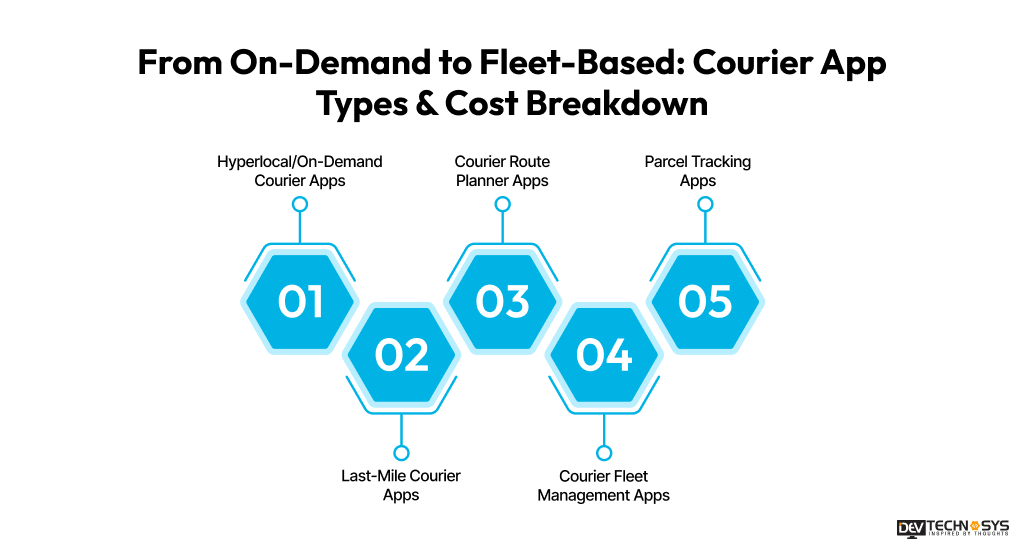
From On-Demand to Fleet-Based: Courier App Types & Cost Breakdown
Hyperlocal, last-mile, fleet, package delivery, and parcel delivery are some of the key types of courier apps. We will learn about these types, along with the cross-platform courier app development cost. This will make entrepreneurs understand which app to build with your matching budget.
1. Hyperlocal/On-Demand Courier Apps
Hyperlocal or on-demand courier apps generally work for instant and short-distance deliveries. They only work within a specific area and make deliveries on the same day or at the same hour. Their order matching, live tracking, and quick dispatch system make it highly perfect for local deliveries.
2. Last-Mile Courier Apps
The app that handles deliveries from the distributor to the customer’s doorstep is a last-mile courier app. These apps optimize the delivery routes to reduce delays and improve delivery success rates. The last-mile courier app directly influences customer satisfaction and operational efficiency.
3. Courier Route Planner Apps
The courier route planner app provides quick and efficient delivery routes to drivers and logistics teams. Its main purpose is to decrease the expenses of fuel by reducing travel time. Such courier and logistics software development services provide their customers with advanced algorithms and GPS integration.
4. Courier Fleet Management Apps
Fleet management apps can monitor vehicles and drivers to manage multiple deliveries. The common features of this app are vehicle tracking, driver performance monitoring, maintenance scheduling, and centralized control. This app is also selected for many large-scale logistics operations.
5. Parcel Tracking Apps
A parcel tracking app provides exact tracking of shipments to businesses and customers. It is unique because it offers transparency to users. They can monitor parcel status, delivery progress, and estimated arrival times. Parcel tracking apps enhance user trust by improving their experience.
We will understand the logistics app development cost breakdown table:
Courier App Type |
Cost Range |
Best For |
Key Differentiator |
| Hyperlocal / On-Demand Courier Apps | $12,000 – $18,000 | Startups & local delivery services | Instant deliveries with real-time order matching and quick dispatch |
| Last-Mile Courier Apps | $14,000 – $22,000 | E-commerce & logistics businesses | Optimized final-mile delivery with faster drop-offs and route efficiency |
| Courier Route Planner Apps | $15,000 – $24,000 | Delivery drivers & logistics teams | Smart route optimization using GPS and real-time traffic data |
| Courier Fleet Management Apps | $18,000 – $30,000 | Large logistics & transport companies | Centralized fleet tracking, driver monitoring, and operations control |
| Parcel Tracking Apps | $12,000 – $20,000 | Businesses & end-users | Real-time shipment tracking with live status updates |
5 Famous Courier Delivery Apps & Their Cost Structure Explained
Multiple courier delivery apps are available in the market. Stuart, UPS, Fetchr, and DHL Express are some of the best courier delivery apps. Entrepreneurs are interested in developing apps like these to replicate their business model. In this section, we have explained some widely used courier delivery apps along with the cost structure to build such apps.
1. App Like UPS
To build a courier delivery app like UPS, businesses need enterprise-level features. It includes features like global shipping support, real-time tracking, route optimization, and supply chain management. These apps require strong backend infrastructure, advanced APIs, and high scalability.
| Development Component | Estimated Cost |
| UI/UX Design | $12,000 – $18,000 |
| Pickup & Delivery Features | $25,000 – $35,000 |
| Real-Time Tracking System | $15,000 – $22,000 |
| Fleet & Logistics Management | $10,000 – $15,000 |
| API Integrations (Maps, Payments, ERP) | $10,000 – $15,000 |
| Security & Compliance Systems | $8,000 – $10,000 |
| Testing & Deployment | $5,000 – $7,000 |
| Final Estimated Cost | $90,000 – $120,000 |
2. App Like DHL Express
Building an app like DHL Express requires international logistics capabilities, customs integration, and real-time shipment tracking. The cost to develop a parcel delivery tracking system plays a crucial role. It is because the accuracy and transparency are key to global delivery operations.
| Development Component | Estimated Cost |
| UI/UX Design | $15,000 – $20,000 |
| Advanced Pickup & Delivery System | $30,000 – $40,000 |
| Real-Time Global Tracking | $18,000 – $25,000 |
| Multi-Warehouse & Fleet Management | $12,000 – $18,000 |
| API Integrations (Custom + Enterprise) | $12,000 – $15,000 |
| AI-Based Route Optimization | $10,000 – $12,000 |
| Testing, Security & Deployment | $10,000 – $10,000 |
| Final Estimated Cost | $110,000 – $140,000 |
3. App Like Fetchr
To develop an app similar to Fetchr, businesses must focus on GPS-based delivery systems instead of traditional addresses. The cost to build a pickup & delivery app like Fetchr depends on advanced location tracking, real-time updates, and seamless user experience.
| Development Component | Estimated Cost |
| UI/UX Design | $14,000 – $18,000 |
| On-Demand Delivery System | $25,000 – $32,000 |
| Real-Time GPS Tracking | $15,000 – $20,000 |
| Driver & Fleet Management | $12,000 – $18,000 |
| API Integrations | $10,000 – $14,000 |
| AI Logistics Optimization | $12,000 – $18,000 |
| Testing & Deployment | $10,000 – $15,000 |
| Final Estimated Cost | $100,000 – $135,000 |
4. App Like Dunzo
Creating an app like Dunzo involves hyperlocal delivery features like instant booking, quick dispatch, and real-time tracking. These apps are ideal for short-distance deliveries. The courier management software development cost depends on integrating efficient routing, order management, and backend systems.
| Development Component | Estimated Cost |
| UI/UX Design | $10,000 – $15,000 |
| Hyperlocal Delivery System | $20,000 – $30,000 |
| Real-Time Tracking System | $15,000 – $20,000 |
| Driver Matching Algorithm | $10,000 – $15,000 |
| API Integrations (Maps, Payments, Notifications) | $8,000 – $12,000 |
| Multi-Service Delivery Modules | $12,000 – $18,000 |
| Testing & Deployment | $10,000 – $15,000 |
| Final Estimated Cost | $85,000 – $125,000 |

5. App Like Stuart
If you plan to build a pickup and delivery app like Stuart, focus on last-mile delivery solutions. Such apps rely on API integrations and fleet management. Apps like Stuart require scalable architecture and real-time logistics tracking, which directly impacts development cost.
| Development Component | Estimated Cost |
| UI/UX Design | $15,000 – $20,000 |
| Instant Delivery System | $30,000 – $40,000 |
| Real-Time Courier Tracking | $18,000 – $25,000 |
| Fleet Optimization System | $12,000 – $18,000 |
| API Integrations | $10,000 – $15,000 |
| AI Dispatch System | $12,000 – $18,000 |
| Testing, Security & Deployment | $10,000 – $15,000 |
| Final Estimated Cost | $105,000 – $145,000 |
Courier Delivery App Tech Stack: Complete Development Guide 2026-2027
Selecting the right tech stack for on-demand courier delivery app development is crucial. It streamlines the project’s performance, scalability, security, and development costs. A correctly selected tech stack guarantees:
- Real-time delivery tracking
- Flawless courier service operations
- Smooth communication among users, drivers, and administrators
Modern courier services in 2026-2027 are developed with cloud architecture, real-time API, and scalable backend frameworks. These can effectively work with high-volume logistics and courier services. Here is a correctly structured, SEO-friendly tech stack for developing a courier delivery app.
| Layer | Technology Used | Why It’s Used (Business Value) |
| Mobile App (Customer & Driver) | Flutter / React Native / Swift / Kotlin | Enables cross-platform development with fast performance and a native-like experience |
| Web Admin Panel | React.js / Angular / Vue.js | Provides fast, responsive dashboards for real-time logistics management |
| Backend Framework | Node.js / Python (Django, Flask) / Java Spring Boot | Handles APIs, delivery logic, tracking, and business operations efficiently |
| Real-Time Tracking System | WebSockets / Socket.io / Firebase Realtime DB | Enables live shipment tracking and instant status updates |
| Database | MongoDB / PostgreSQL / MySQL | Stores user data, orders, delivery history, and logistics records securely |
| Cloud Infrastructure | AWS / Google Cloud / Microsoft Azure | Ensures scalability, uptime, and high-performance global delivery operations |
| Maps & Navigation APIs | Google Maps API / Mapbox | Powers route optimization, geolocation tracking, and delivery navigation |
| Payment Integration | Stripe / PayPal / Razorpay | Enables secure, multi-payment options for customers |
| Notifications System | Firebase Cloud Messaging / Twilio | Sends real-time alerts for delivery updates and status changes |
| DevOps & Deployment | Docker / Kubernetes / Jenkins | Ensures automated deployment, scalability, and system reliability |
Tech Trade-Offs: Hidden Backend Choices Affecting Courier App Development Cost
Businesses only focus on the components that are visible while determining the courier and logistics app development cost. But it is important to understand that many big-budget decisions take place behind the scenes. Several backend choices can influence both development expenses and long-term operating costs. Here we are discussing some of these choices and their influence on expenses.
1. Real-Time Tracking Architecture: WebSockets vs. HTTP Polling
The real-time tracking architecture is highly recommended to transmit the data of live location directly. This can significantly influence the infrastructure requirements and scalability.
| Feature | HTTP Polling | WebSockets | Cost Impact (%) |
| Connection Type | Repeated server requests at intervals | Persistent real-time connection | 10%–15% |
| Implementation Effort | Easier to build initially | More complex setup | 15%–20% |
| Server Load | High due to frequent requests | Lower due to event-based updates | 20%–25% |
| Scalability | Becomes inefficient at scale | Highly scalable for large user bases | 15%–25% |
| Performance | Delayed updates possible | Instant real-time updates | 10%–15% |
Cost Impact: Choosing a scalable tracking architecture early in development can significantly reduce infrastructure strain. It can also improve long-term platform efficiency as delivery volumes increase.
2. Location Intelligence Strategy: Continuous Tracking vs. Dynamic Geofencing
The most heavily utilized element of a courier application is location services. Every GPS update, route calculation, and map request contributes to operational costs.
| Feature | Continuous Tracking | Dynamic Geofencing | Cost Impact (%) |
| Tracking Method | Constant GPS updates | Zone-based smart tracking | 20%–30% |
| API Usage | High and continuous | Optimized and reduced | 25%–30% |
| Accuracy | High throughout the journey | High near delivery points | 10%–15% |
| Battery Consumption | Higher | Lower | 10%–20% |
| Cost Efficiency | Expensive at scale | More cost-efficient | 15%–25% |
Cost Impact: If the location management is smart, it helps the courier business handle deliveries accurately. It even optimizes long-term infrastructure and mapping costs.
3. Background Tracking Stability: Standard vs Optimized Implementation
The live tracking feature on courier delivery platforms not only depends on GPS accuracy. It also works on how a mobile operating system allows it to collect location data in the background. Since smartphones prioritize battery savings, they often restrict or limit background location updates. This can directly impact courier tracking reliability and app stability.
| Feature | Standard Background Tracking | Optimized Background Tracking | Cost Impact (%) |
| System Behavior | Limited by OS restrictions | Uses approved background services | 15%–20% |
| Reliability | Tracking may stop in the background | Continuous location updates | 20%–30% |
| Battery Usage | High consumption | Optimized usage | 10%–20% |
| Development Effort | Basic setup | Platform-specific implementation | 20%–30% |
| App Stability | Possible tracking gaps | Stable tracking flow | 15%–25% |
Cost Impact: If the background tracking is unoptimized, it might reduce development expenses initially but result in higher maintenance later on. Proper implementation increases upfront investment but ensures stable long-term performance.
Industry Insight: At Dev Technosys, we look beyond the surface features. During a live project execution, our engineering team used a Redis caching layer. It is to handle 90,000+ real-time server pings per hour from active fleets. This technical choice kept server response times under 200 milliseconds and kept database utilization below 45%. Basically, it proves that smart backend choices protect your budget as your business scales.
Should You Build, Buy, or Partner: Courier App Development Decision Guide
The most crucial decision is to select whether to buy ready-made solutions or partner with a development company. This choice directly influences your courier delivery app development cost, time-to-market, scalability, and long-term ROI. To make this decision easier, we have broken down the key differences in a structured comparison below.
| Factor | Build (Custom Development) | Buy (Ready-Made Solution) | Partner (Development Company Model) |
| Estimated Cost | $30,000 – $150,000+ | $5,000 – $30,000 | $30,000 – $1,50,000+ (flexible based on scope) |
| Time to Market | 4–10+ Months | 2–6 Weeks | 3–7 Months |
| Customization Level | Fully tailored to business requirements | Limited customization | High customization with expert guidance |
| Feature Flexibility | Unlimited feature expansion | Fixed feature set | Flexible, scalable feature roadmap |
| Scalability | High (requires strong architecture planning) | Low to medium | High (enterprise-ready architecture) |
| Technology Control | Full control over tech stack | No control (vendor-defined system) | Shared control with technical experts |
| Data Ownership | 100% owned by the business | Vendor-controlled or restricted access | Full ownership with secure setup |
| Security Implementation | Fully managed in-house | Basic vendor-level security | Enterprise-grade security implementation |
| Integration Capability | Extensive but requires time & effort | Limited integrations | Seamless third-party API integrations |
| Maintenance & Support | In-house responsibility | Subscription-based vendor support | Dedicated ongoing technical support |
| Compliance Handling | Fully self-managed | Vendor-dependent compliance | Built-in compliance advisory & setup |
| Risk Level | Medium–High (development complexity) | Low (limited flexibility risk) | Medium (dependency on partner expertise) |
| ROI Potential | High long-term ROI | Quick but limited scalability ROI | Balanced ROI with growth potential |
| Best For | Large enterprises & funded startups | MVP testing & small courier businesses | Startups to enterprises needing speed + scalability |
What Hidden Costs impact the Courier Delivery App Development Cost?
Despite every cost segment being planned well, there are some hidden costs that are ignored. That’s why they lead to an unexpected budget imbalance. To avoid this in the future, here are the hidden costs that might appear. Learning about these costs can help you plan your development expenses better.
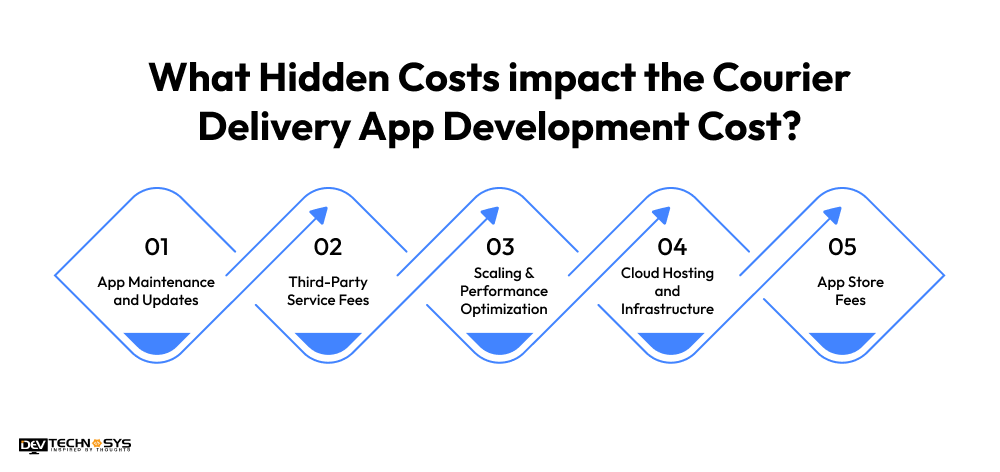
1. App Maintenance and Updates
Maintenance and updates are continuous expenses after the app development. It involves bug fixes, feature updates, performance improvements, and compatibility upgrades. These inclusions guarantee the smooth functioning of the app with proper security. Typically, Courier app maintenance and hidden costs can be 15–20% of the initial development cost annually.
2. Third-Party Service Fees
Many courier delivery app development companies create a courier delivery app with third-party tools. It includes APIs like payment gateways, GPS tracking, SMS notifications, and analytics tools. These services often charge subscription or usage-based fees, adding continuous operational expenses beyond the initial development cost.
3. Scaling & Performance Optimization
As user traffic grows, apps require performance tuning, database optimization, and infrastructure upgrades. A scalable and high-performing app ensures fast load times and seamless operations. However, this optimization demands additional investment in development and system enhancements.
4. Cloud Hosting and Infrastructure
Building a courier app requires reliable cloud hosting to store data, manage traffic, and ensure smooth performance. As your user base grows, a logistics software development company works on storage, bandwidth, and server power. It gradually increases ongoing costs to maintain speed, uptime, and stability.
5. App Store Fees
To launch your app on platforms like Google Play or the Apple App Store, enterprises need to pay. It includes registration fees and a percentage of in-app transactions. These charges may seem small initially, but they can increase as your app scales and generates more revenue.
How Long will it Take to Make a Courier Delivery App: Timeline Explained
Developing a courier delivery app will take approximately 3 to 6+ months. The development timeline is determined by the complexity of each development stage. The complexity is decided by the level, either basic, mid-level, or advanced, of the application. Have a look at the Courier delivery app development timeline through a tabular breakdown.
Development Stage |
Estimated Time |
Description |
| Market Analysis | 1 – 2 weeks | Research the target audience, competitors, and market demand to define app goals and business strategy. |
| Deciding on Features | 1 – 2 weeks | Finalize core and advanced features based on business model and user needs. |
| Selecting the Tech Stack | 1 week | Choose suitable technologies, frameworks, and tools for scalable app development. |
| UI/UX Design | 2 – 3 weeks | Create wireframes, prototypes, and user-friendly interface designs. |
| Courier App Development | 6 – 10 weeks | Develop frontend, backend, APIs, and integrate core functionalities. |
| Testing & Quality Assurance | 2 – 3 weeks | Perform bug fixing, performance testing, and ensure smooth app functionality. |
| App Launch & Marketing | 1 – 2 weeks | Deploy the app on platforms and initiate marketing campaigns. |
| Post-Launch Support | Ongoing | Monitor performance, fix issues, and release updates for improvements. |
Which Measures Can Help Reduce the Courier Delivery App Development Cost?
Every entrepreneur wants to reduce development costs without compromising quality. To control expenses, businesses should focus on strategic planning and smart development approaches. These proven measures help optimize the courier delivery app development cost while maintaining performance and scalability:
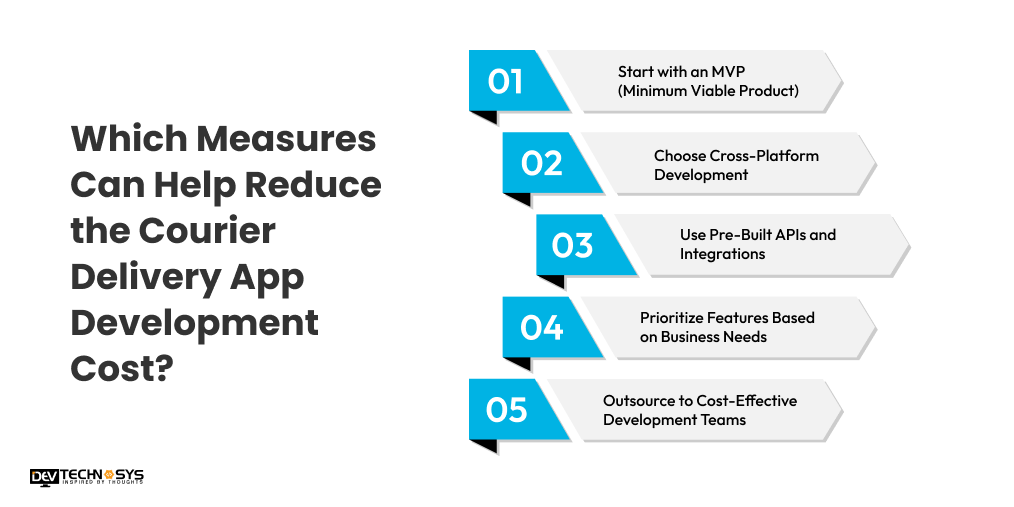
1. Start with an MVP (Minimum Viable Product)
Rather than building a full-featured app from the beginning, start with MVP development services. It includes basic but essential features like booking, tracking, and payments. This approach helps you test your idea, reduce initial investment, and make improvements based on user feedback over time.
2. Choose Cross-Platform Development
Building separate apps for iOS and Android increases cost and effort. Using cross-platform frameworks allows you to develop a single app that works on both platforms. It reduces development time, resource usage, and overall project expenses without compromising functionality.
3. Use Pre-Built APIs and Integrations
Developing features from scratch can be expensive and time-consuming. By integrating ready-made solutions for payments, maps, and notifications, businesses can save development time. This measure reduces complexity and lowers overall costs while still delivering essential app functionalities efficiently.
4. Prioritize Features Based on Business Needs
Adding too many features at once can increase cost and delay launch. The main focus of the businesses should be on features that directly support their business goals and user needs. This way, the budget can be managed effectively while ensuring the app delivers real value to users.
5. Outsource to Cost-Effective Development Teams
Hiring developers from regions with lower hourly rates can significantly reduce development costs. Outsourcing to experienced teams ensures quality work, faster delivery, and better budget control, making it a practical option for startups and growing businesses.
Revenue Generating Models Behind Successful Courier Delivery Apps
Successful courier delivery apps become profitable by implementing monetization models. These include commission, subscription, delivery fee, surge charges, and so on. Here we are discussing some of these models that will help courier delivery businesses make a continuous revenue stream.
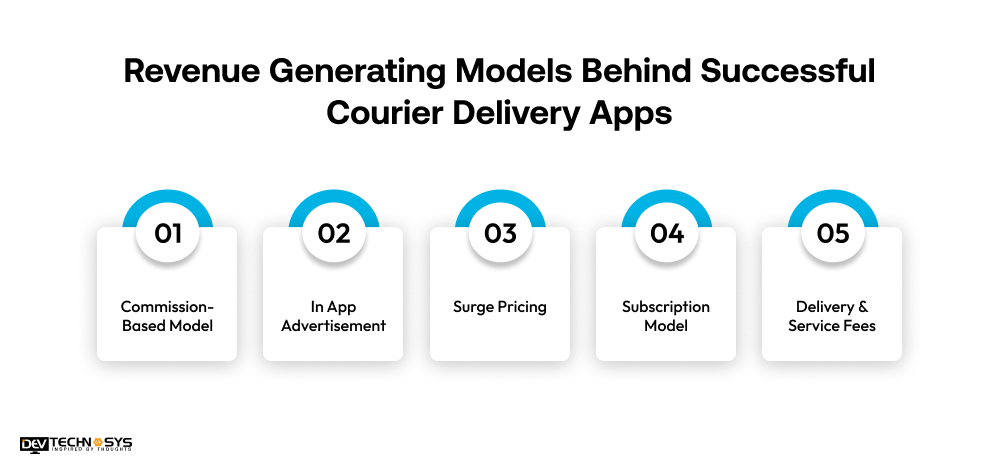
1. Commission-Based Model
The most common monetization model used by courier delivery businesses is commission. They charge a small fee as a commission from vendors on every delivery. Commission is a guaranteed profit-making model that earns more with increased orders.
2. In App Advertisement
Another highly preferred money-making model is displaying ads in the app. These ads are generally from third-party businesses targeting user behavior. It helps the brand to reach potential customers and makes courier apps have additional income.
3. Surge Pricing
During peak hours and high demand, courier apps increase delivery prices by adding surge charges. This model creates a balance between demand and supply while making higher profits. It is implemented especially during holidays, weekends, or urgent delivery requests.
4. Subscription Model
In the subscription model, users or businesses pay a regular fee for premium services. The subscription offers them services like free deliveries, faster shipping, or exclusive offers. It ensures predictable and consistent revenue while improving customer retention.
5. Delivery & Service Fees
Courier apps usually charge fixed delivery fees according to the distance, package size, or urgency. Sometimes, additional fees may also apply for special services like handling or express delivery. It contributes directly to the app’s primary revenue stream.
You can reach out anytime; we are available 24/7. Our team provides a quick response.
Why Dev Technosys is the Perfect Choice for Courier Delivery App Development?
With more than 15 years of experience, Dev Technosys has been a top-class mobile application development company. We have worked with multiple industries and offered highly scalable and reliable digital products. Our backend, API, cloud, full-stack, and front end development services are famous all around the world.
Courier Delivery App Investment vs. Return: When Does Your App Start Making Money? (Before conclusion)
Before committing $30,000–$150,000 to courier app development, every founder asks, “How fast does it pay me back?” The answer depends on the order volume, revenue model, and the app’s launch scope. Here is the complete mathematical analysis that works for different real business scenarios.
| Business Stage | Daily Orders | Avg. Revenue Per Order | Daily Revenue | Monthly Revenue | Est. Dev Cost | Payback Period |
| Early-Stage Startup | 50–100 | $3.00 | $150–$300 | $4,500–$9,000 | $30,000–$50,000 | 5–8 months |
| Growth-Stage Platform | 200–500 | $4.50 | $900–$2,250 | $27,000–$67,500 | $50,000–$90,000 | 2–4 months |
| Enterprise / Fleet Model | 1,000+ | $5.00–$8.00 | $5,000–$8,000 | $1,50,000–$2,40,000 | $90,000–$150,000+ | 3–6 weeks |
The figures shown above are highly conservative. The actual payback timeline highly depends on the business’s
- Market
- Pricing Model
- Launch Strategy
Conclusion
Throughout the software development life cycle, understanding the cost structure is extremely important. Similarly, developing a courier delivery app needs thorough clarification related to the development pricing. Therefore, we have tried to add all the information on the courier delivery app development cost.
After understanding cost breakdowns, hidden expenses, and monetization strategies, businesses can make smart decisions. Simultaneously, investing in the right technology and online marketplace app development company is equally important.
A well-planned budget for a courier delivery app development can open the doors for sustainable business growth.
Frequently Asked Questions
Find answers to the most common questions related to this article.
The average cost to develop a courier delivery app can range from $30,000 to $1,50,000+. The final cost is highly dependent on the platform’s complexity and other factors. These factors include platform choice, UI/UX, security, maintenance, backend, and so on. A basic app following the MVP structure is less costly as compared to advanced app.
Some of the most important factors that influence the development cost of a courier delivery app are:
● Platform Selection
● UI/UX Design
● Backend Infrastructure
● Development Team
● Developer’s Location
● Third-Party Integration
● Security and Compliance
These factors help in determining the overall development budget. This way, businesses analyze each element carefully and plan efficient and cost-effective development.
Several measures that help enterprises in reducing the cost of making a courier app include:
● Start with an MVP (Minimum Viable Product)
● Choose Cross-Platform Development
● Use Pre-Built APIs and Integrations
● Prioritize Features Based on Business Needs
● Outsource to Cost-Effective Development Teams
Such measures help in scalable and less costly development without sacrificing the quality.
A courier delivery app can take 3 to 6+ months for development. It is surely because of the platform features and complexity. A basic app follows the MVP structure, so it can be built in less time. In contrast, an advanced app with fleet management, real-time tracking, and analytics has an extended development timeline.
Yes, a courier delivery app development can be a profitable investment in 2026. It is mainly due to the rising demand for on-demand and last-mile services. Therefore, this development can offer a strong revenue potential to businesses in the long run. If the right business model, features, and cost-related techniques are implemented, the app offers high ROI.
MVP means Minimum Viable Product strategy is the cheapest way to develop a courier delivery app. It uses cross-platform frameworks like Flutter or React Native. It also integrates third-party APIs for maps, payments, and notifications. Using a white-label solution can further reduce initial development costs, but it limits customization and scalability options.
Yes, a courier delivery app development is highly profitable, especially when built with a scalable business model. Also, businesses should take into account all other factors that have an influence on the profitability of their product. The main sources of income include delivery commissions, subscription plans, surge prices, and enterprise partnerships.
A white-label courier app development process involves the use of a ready-to-go solution. It allows businesses to launch the platform within a short period of time, with limited customization possibilities. On the other hand, a custom courier delivery app is created from scratch according to specific business requirements. Everything in this development can be personalized according to the business goal.
Maintenance of the courier delivery application usually takes up 15% to 25% of the initial development cost annually. This includes server management, bug fixes, API updates, security patches, and feature enhancements. The exact cost depends on app complexity, user base size, infrastructure requirements, and ongoing scalability needs.