
















Key Takeaways:
-
- An approximate budget for creating a Udemy sort of application is somewhere between $8,000 and $30,000, based on features, level of growth, and the technology package, so it is definitely a feasible undertaking for businessmen.
- Creating an eLearning app is a very promising avenue since worldwide demand for skill-based learning and adaptable methods is increasing greatly among millions.
- Achieving success relies on discovering an untapped market, offering top-notch materials, and developing a flawless, captivating interaction both for the learners and the teachers.
- Incorporating modern capabilities such as AI, personalization, and data analysis can make your site stand out, improve user attraction, satisfaction, and ultimately lead to expansion.
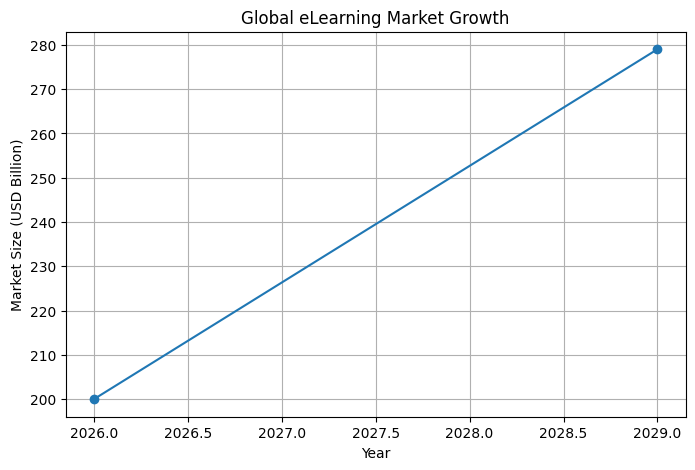
The digital learning sector is flourishing, expected to hit $279 billion in 2029, with more than 1 billion learners worldwide looking for flexibility and knowledge through skills. Learning platforms on the lines of Udemy, which have 82 million users, 250,000+ courses, and 75,000+ instructors, have demonstrated that digital learning apps can grow quickly while at the same time generating various revenue streams. Business people now have a great chance to enter this expanding market by establishing their own eLearning platforms.
In this blog, we plan to guide you through 5 simple steps to create an app similar to Udemy by 2026, covering project planning, selecting a technology stack, advanced features, and monetization strategies. Keep reading to find out how you can turn your idea into a profitable and modern learning platform.
eLearning & Udemy Market Insights: Growth, Users, and Opportunities for Entrepreneurs
- According to reports, the global eLearning market size exceeded $200 billion in 2026 and is projected to surpass $279 billion in 2029 due to the increasing adoption of mobile and digital learning.
- The eLearning market will grow at a compound annual growth rate (CAGR) of 24.2% during 2025-2030, offering a multibillion-dollar market opportunity by the decade’s end.
- The number of online learners across the world is predicted to hit approximately 1.1 billion in 2029, indicating a massive worldwide acceptance of digital education platforms.
- As of 2025, Udemy caters to over 82 million students globally, backed by 85, 000 instructors and offering around 250, 000 courses, a testament to its wide marketplace.
- In 2025, Udemy’s revenue was estimated to be in the range of $789, $796 million, which further highlights their solid financial position and market performance.
- Udemy, there are also other massive open online course platforms, such as Coursera, which have more than 90 million users, illustrating that the demand for online education is quite broad.
What is an e-Learning App?
An e-learning app is a tool that presents learning content in a digital form, such as videos, quizzes, and interactive modules. One of the biggest advantages of these apps is that users can learn at their convenience. Besides, these apps offer the possibility of a self-paced learning path and provide access to a variety of courses in different subjects and industries.
What is the Udemy App?
The Udemy app is a kind of virtual classroom that provides more than 30, 000 courses in the fields of technology, business, design, and personal development. Through video lectures, assignments, and quizzes, users can learn at their own pace, which makes education not only accessible in terms of location but also flexible and affordable for learners all over the world.
How Udemy Works?
- Sign Up/Login: Access the platform and enjoy the personalized learning experience by creating an account either through email or social login.
- Browse Courses: Search for various topics or categories such as coding, marketing, or finance if you want to get qualified for a specific job, or if you just have different interests.
- Select a Course: Before purchasing the course of your choice, it is best to check the details of the course, ratings, instructor’s profiles, and prices.
- Enroll & Pay: You can buy the course or download free ones, gaining lifetime accessibility to the content on the app.
- Start Learning: Besides going through the video lectures, you can also get the study materials, do the quizzes, and monitor your learning progress on the go.
- Earn Certificate: After the course is done, learners get a certificate of completion, which they can use as proof of their newly gained skills and knowledge.
Why Invest in Building an App Like Udemy? (2026–2030)
Investing in tutor app development solutions unlocks high-growth potential in the booming eLearning industry. Here are compelling reasons backed by data that make it a smart business move for 2026–2030.
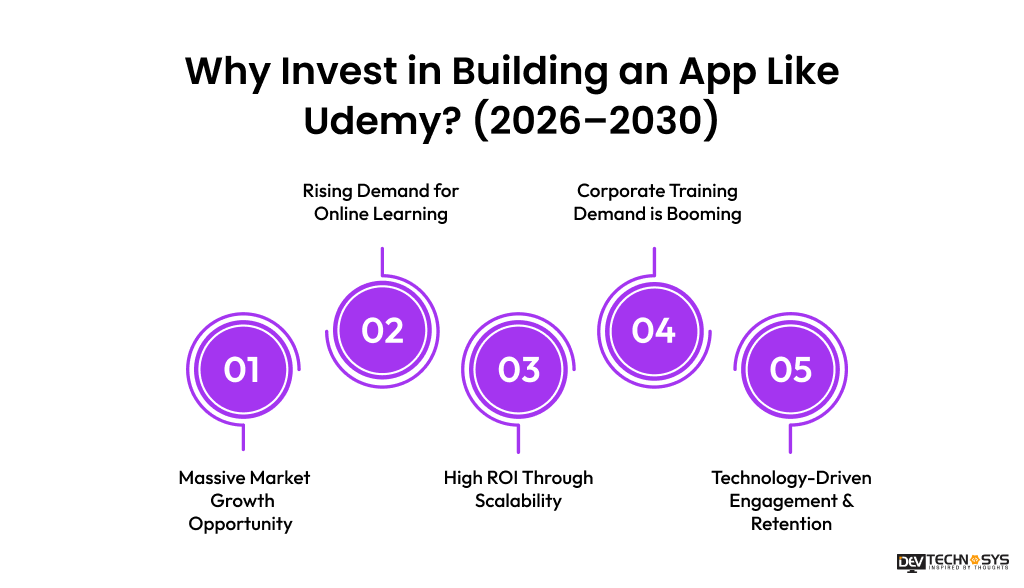
1. Massive Market Growth Opportunity
Buying an app like Udemy gives you access to the high-growth potential of the e-learning industry, which continues to expand rapidly. The worldwide online learning market is expected to increase from $356 billion in 2026 to $891 billion by 2034.
2. Rising Demand for Online Learning
More than 73% of students, even after returning to face-to-face learning, prefer the online mode. It means that education apps like edX will be relevant for a long time and will generate continuous user engagement and revenue for the developers.
3. High ROI Through Scalability
Online learning app development solutions can scale globally with minimal operational costs. With 1.1 billion users expected by 2029, businesses can reach massive audiences without physical infrastructure, maximizing profit margins and long-term ROI.
4. Corporate Training Demand is Booming
About 90% of businesses have integrated eLearning as part of their training systems, thus establishing a strong B2B revenue stream. An educational app like Masterclass can monetize through enterprise subscriptions, making it a highly profitable and sustainable business model beyond individual learners.
5. Technology-Driven Engagement & Retention
AI-driven learning enhances engagement by up to 80%, with users remembering 25- 60% more than with traditional methods. This leads to higher user satisfaction, more course completions, and a stronger growth of the platform in the long run.
5 Steps To Build an App like Udemy
Make an app like Udemy, which involves following a plan. These five easy steps will guide companies in simplifying the e-learning app development process, making sure the platform can grow, and building an e-learning app like Lingokids rich with features that can effectively engage today’s learners.
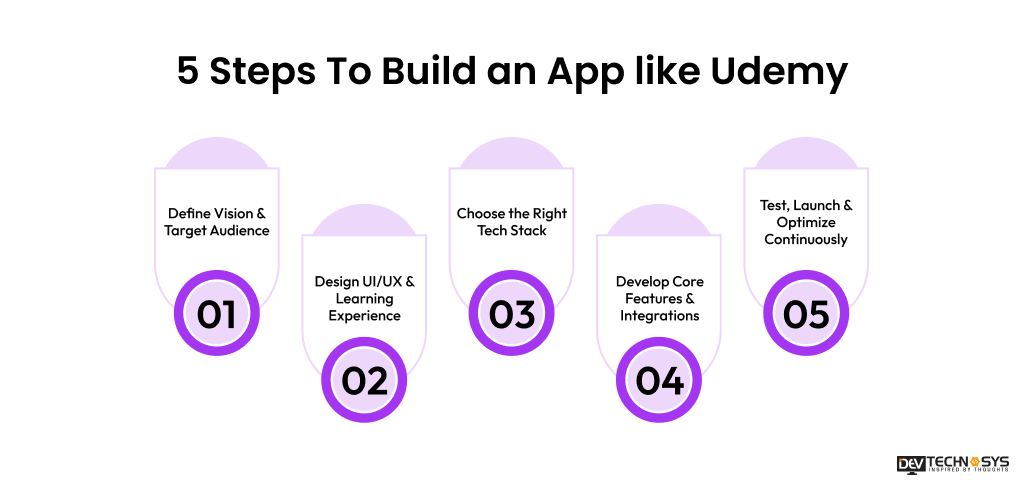
1. Define Vision & Target Audience
Begin by defining your app’s primary goal, niche, and the segment of the audience you are targeting. Select your focus: students, professionals, or enterprises. Hire a mobile app development agency to make a list of main features, a way to earn money, and types of learning materials.
Having a well-defined product vision assists your education app development firm in synchronizing design, technology, and business objectives efficiently.
2. Design UI/UX & Learning Experience
Develop a simple, appealing interface with easy navigation. Consider personalized user panels, course finding, watching videos, and checking one’s own progress. Also, think about guaranteed accessibility and a design suitable for mobile first.
A strategically planned UI/UX leads to higher user retention, greater educational involvement, and lays a solid groundwork for prolonged app success.
3. Choose the Right Tech Stack
Choose highly scalable tools such as React Native or Flutter for the frontend and dependable backend frameworks like Node.js or Django.
Besides video hosting, payment gateways, and cloud storage, your education app development firm must ensure performance, security, and scalability while keeping the platform flexible for future feature additions.
4. Develop Core Features & Integrations
Develop the main features for your platform, e.g., course building, video streaming, user profiles, rating systems, reviews, and secure payment options. Besides these, you can include AI-driven suggestions, push notifications, and a set of analytics tools.
These features not only keep users engaged but also enable instructors to organize content efficiently and create a personalized learning environment.
5. Test, Launch & Optimize Continuously
Run thorough tests from different angles, including bugs, usability, and performance across various devices. Employ an experienced e-learning app development company to release the app in app stores, combined with appropriate marketing plans.
Keep on collecting feedback, studying user activities, and rolling out updates. Continuous refinement leads to better performance, higher user satisfaction, and greater growth for your eLearning platform.
Most Popular Apps Like Udemy
Comparing different types of education apps on key parameters can certainly help entrepreneurs spot new opportunities and design their platform in a way that stands out. To facilitate this, here is a brief comparison of major players in the eLearning domain.
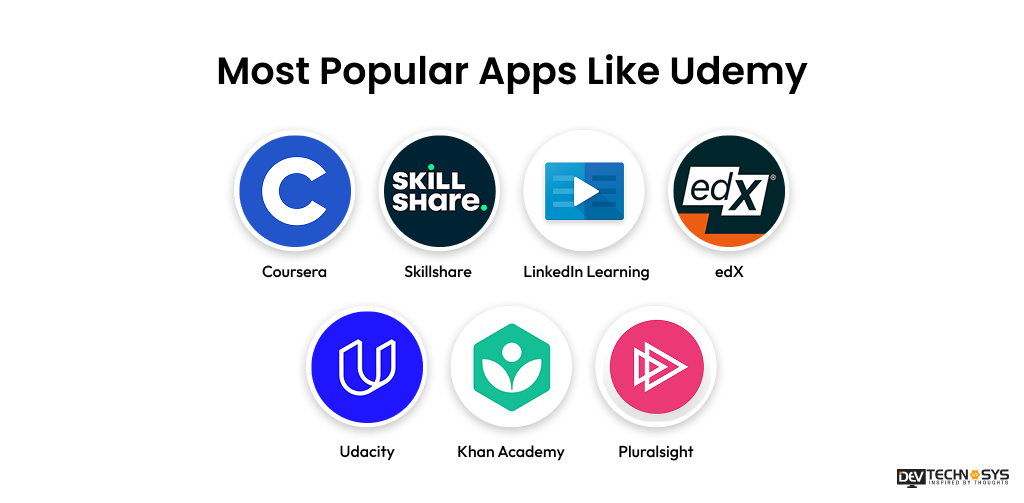
| App Name | Downloads | Rating | Launch Date | Founder(s) | USP |
| Coursera | 100M+ | 4.6 | 2012 | Andrew Ng, Daphne Koller | University-certified courses |
| Skillshare | 10M+ | 4.3 | 2010 | Michael Karnjanaprakorn | Creative project learning |
| LinkedIn Learning | 50M+ | 4.5 | 1995 (as Lynda) | Lynda Weinman | Career-integrated learning |
| edX | 10M+ | 4.5 | 2012 | Harvard & MIT founders | Academic-level courses |
| Udacity | 5M+ | 4.4 | 2012 | Sebastian Thrun | Job-ready nanodegrees |
| Khan Academy | 50M+ | 4.6 | 2008 | Sal Khan | Completely free education |
| Pluralsight | 1M+ | 4.2 | 2004 | Aaron Skonnard | Advanced tech training |
1. Coursera
Coursera is a major eLearning platform where you can find university-level courses, certifications, and even degree programs from prestigious institutions. If businesses develop an app like Coursera, it deals with academic and career-focused education, providing learners with credentials recognized by employers and opportunities to advance their careers. Through well-structured and high-quality educational programs.
- University partnerships
- Professional certificates
- Guided projects
2. Skillshare
Skillshare is a creative online learning community. The platform primarily offers video courses in creative fields such as design, photography, and writing. The learning method is via short, project-based classes that allow the learners to work on real-world projects. It is a perfect fit for creatives who want to strengthen their practical skills swiftly and effectively.
- Project-based learning
- Creative courses
- Community interaction
3. LinkedIn Learning
LinkedIn Learning offers business, technology, and creative courses designed especially for professionals. Since it is linked with LinkedIn profiles, the platform not only lets users display their skills but also aids them in becoming more employable and gaining access to expert-led content that matches current industry trends and career growth opportunities.
- Career-focused content
- Skill badges
- Expert instructors
4. edX
edX is a platform where one can access superior-level courses from leading universities and institutions worldwide. It confers professional certifications and degree programs, with a focus on academic quality and career progression, hence, it stands as a good option for those learners who want a more formal and reputable education.
- University courses
- Verified certificates
- Degree programs
5. Udacity
Udacity is very much engaged in the tech part of education, offering nanodegree programs in fields like AI, data science, and coding. Collaborating with industry giants, it aims to equip students with the skills they need to get hired, so it is also suitable for those who want to start or develop a career in high-tech areas.
- Nanodegree programs
- Industry partnerships
- Career mentorship
6. Khan Academy
Khan Academy is an educational website that offers free courses in subjects such as math, science, and more. It is mainly geared towards school-level and fundamental education and features interactive exercises, as well as personalized dashboards to assist students in learning at their own pace.
- Free courses
- Interactive exercises
- Personalized dashboard
7. Pluralsight
Pluralsight is a technology-centered learning website created for developers and IT specialists. Apart from providing advanced classes, the platform also offers skills evaluation and learning tracks to help individuals and companies become proficient in areas such as software development, cybersecurity, and cloud technologies.
- Skill assessments
- Tech paths
- Hands-on labs
Is Building an App Like Udemy the Right Idea?
It is fair to say that reviewing the actual success of people before making an investment would be a reasonable thing to do. Let’s see how strong figures are helping Udemy expand its business quite well worldwide.
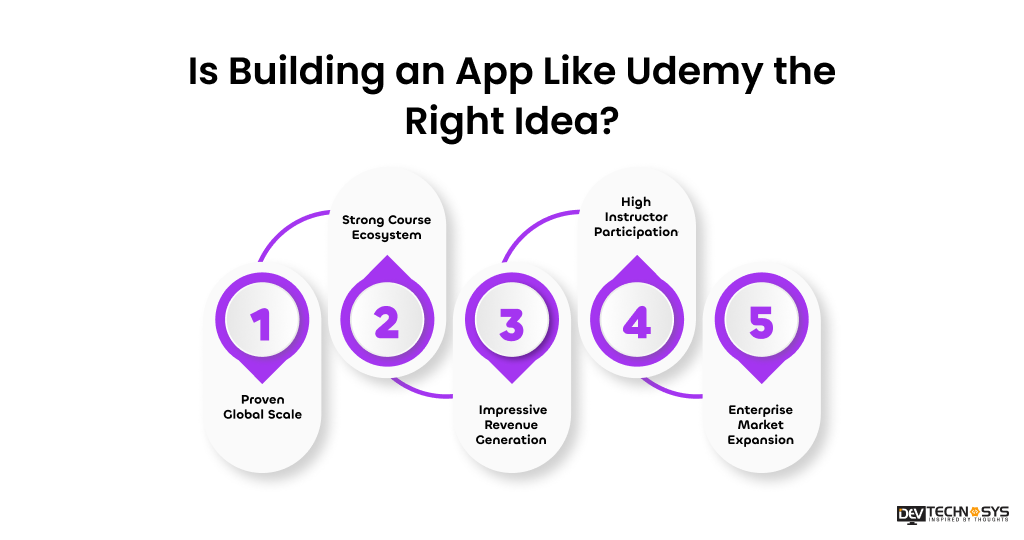
1. Proven Global Scale
Udemy has attracted over 70 million learners worldwide, illustrating the global thirst for online education platforms. Such phenomenal growth clearly establishes that a well-made eLearning app can appeal to millions of learners and establish a robust global footprint while constantly increasing its user base.
2. Strong Course Ecosystem
With 210,000+ courses in its arsenal, Udemy sets a great example of how diverse content can bring learners back more often and keep them longer. It stresses the necessity of having an extensive course catalog so that entrepreneurs will be able to cover many industries and cater to learners’ needs most adequately.
3. Impressive Revenue Generation
The company’s approximately $700 million in annual revenue demonstrates the profitability of the eLearning business model. This confirms that with the proper monetization tactics, the platform can achieve high financial results and long-term prosperity.
4. High Instructor Participation
Udemy has over 75,000 educators who provide courses worldwide, demonstrating a strong, creator-driven ecosystem. This not only takes the content creation weight off the platform but also guarantees more content development constantly, hence, it is much easier for the startups to scale up efficiently.
5. Enterprise Market Expansion
Udemy Business caters to over 15,000 companies, which clearly points out a strong demand for corporate training solutions. It proves that targeting enterprises for employee training and skills upgrade, apart from individual learners, can open the door to very valuable B2B revenue streams for the businesses.
How Much Does It Cost to Build an App Like Udemy?
The cost to develop an app like Udemy is between $8000 and $30000 on average. The education app development cost depends on the app features, ability to scale, and development complexities. Below are the major cost-determining factors that affect the overall budget.
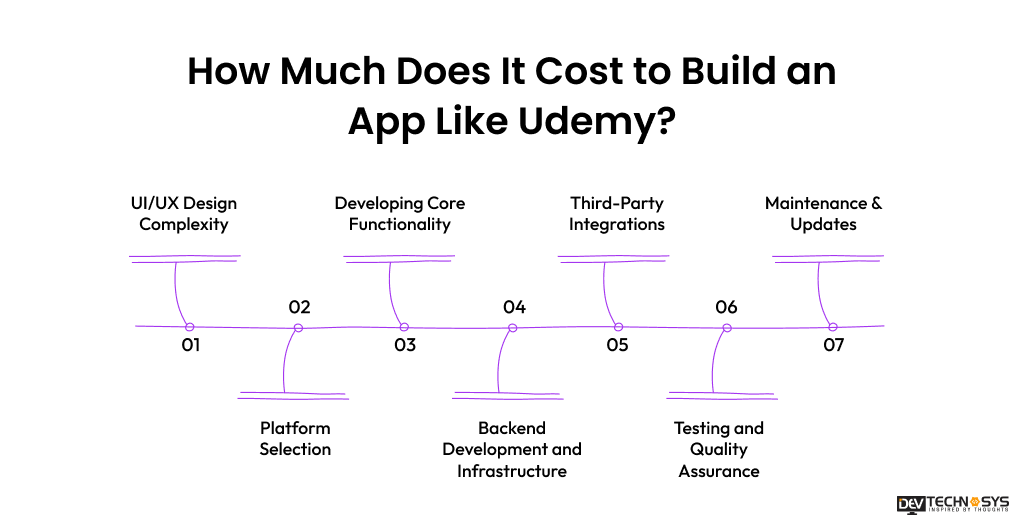
7 Factors Affecting the Cost to Build an App Like Udemy
1. UI/UX Design Complexity
A simple, clean design is cheaper; on the other hand, a design with animations, personalized dashboards, and easy navigation will increase the cost of developing a Udemy clone app. A high-quality design attracts more users and keeps them longer, and it also greatly increases the brand value. Therefore, it is a very important investment for the success of the business in the long run.
| Design Level | Estimated Cost |
| Basic Design | $1,000 – $3,000 |
| Moderate Design | $3,000 – $6,000 |
| Advanced Design | $6,000 – $10,000 |
2. Platform Selection
You should consider cost in choosing android, iOS or using a cross-platform approach to LMS app development. Apps developed for a single platform will be less costly than developing for more than one platform (cross-platform and/or multiple platforms). Using a framework like Flutter will reduce your overall cost to build an education app from scratch, as there is no need to develop two sets of code for native applications (one for each of the different operational systems).
| Platform Type | Estimated Cost |
| Single Platform | $3,000 – $8,000 |
| Cross-Platform | $5,000 – $12,000 |
| Native (Both) | $10,000 – $18,000 |
3. Developing Core Functionality
Basic functionality includes things like course lists and video streaming which have relatively low cost to develop an app like Udemy. Whereas complex functionality (e.g., artificial intelligence recommendations, live classes and certification) generally requires more time to develop and thus the total cost of developing the app will be higher. Generally speaking, the more complex the developed features, the more investment you will have to make into app development.
| Feature Level | Estimated Cost |
| Basic Features | $2,000 – $6,000 |
| Mid-Level Features | $6,000 – $12,000 |
| Advanced Features | $12,000 – $20,000 |
4. Backend Development and Infrastructure
You will need to create a robust backend to support user management, course management, and the payment process. While a scalable cloud infrastructure will increase your initial development investment, it provides you with improved scalability and performance. Additionally, large data sets (i.e., video data), real-time updates, and related high-volume usage will increase the complexity of the overall development process and your total cost to develop a mobile app like Udemy.
| Backend Type | Estimated Cost |
| Basic Backend | $2,000 – $5,000 |
| Scalable Backend | $5,000 – $10,000 |
| Advanced Backend | $10,000 – $18,000 |

5. Third-Party Integrations
Integrating third-party services (payment gateway, video hosting service, analytics tools, and push notifications) into your app will increase the total cost to build an app like Udemy. Each integration will require configuration and testing prior to being implemented. However, integrating third-party services will provide increased functionality, enhance your app’s user experience, and provide for a more seamless user experience across your app.
| Integration Level | Estimated Cost |
| Basic Integration | $1,000 – $3,000 |
| Moderate | $3,000 – $6,000 |
| Advanced | $6,000 – $10,000 |
6. Testing and Quality Assurance
Testing (QA) for your app provides you with the ability to verify that your app is bug free and runs correctly across devices. Creating an app with complex functionality will require more testing than an app with basic functionality, which will result in less cost for kids learning app development than complex functionality.
| Testing Level | Estimated Cost |
| Basic Testing | $1,000 – $2,500 |
| Moderate Testing | $2,500 – $5,000 |
| Advanced Testing | $5,000 – $8,000 |
7. Maintenance & Updates
Post-launch maintenance includes bug fixes, feature updates, and performance improvements. The complexity of an App along with the growth in users determines the e-learning app development cost. Regular updates will keep the App up-to-date, secure, and current to both the evolving expectations of its Users, while also keeping the App current with changing Market conditions.
| Maintenance Level | Estimated Cost (Per Year) |
| Basic | $1,000 – $3,000 |
| Moderate | $3,000 – $6,000 |
| Advanced | $6,000 – $10,000 |
Key Features for Each Panel in an App Like Udemy
To make an App like Udemy, you must have a basic understanding of what features are important to Students, Instructors, and Administrators so that functionality is seamless. So, consider the features to develop educational apps like Udemy.
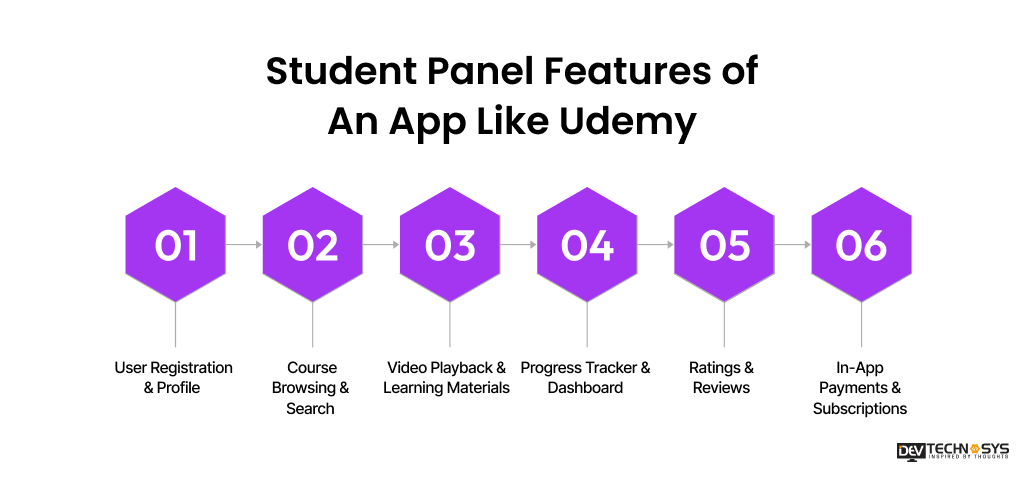
Student Panel Features
- User Registration & Profile
The Student must be able to register and create a Student Account (also known as a User Profile), and will ensure that their Learning Experience is customized to them along with a method to track their Course Progress.
- Course Browsing & Search
Searching for Courses can be done in many ways (i.e., by Category, Ratings, or Instructors) which will allow for quick and efficient results.
- Video Playback & Learning Materials
It will have access to high-quality videos, PDFs, and resources, and will be able to play them smoothly, download them offline, and also have a means to track their progress whenever they complete any Course.
- Progress Tracker & Dashboard
The student will utilise a dashboard to track their course progress, completed lessons, and upcoming modules to provide a structured learning environment. - Ratings & Reviews
Students can rate courses and write reviews, helping improve quality, guide others, and enhance community trust. - In-App Payments & Subscriptions
The student will securely pay for their courses, subscribe to premium plans, and take advantage of special offers through multiple methods (payment gateways).
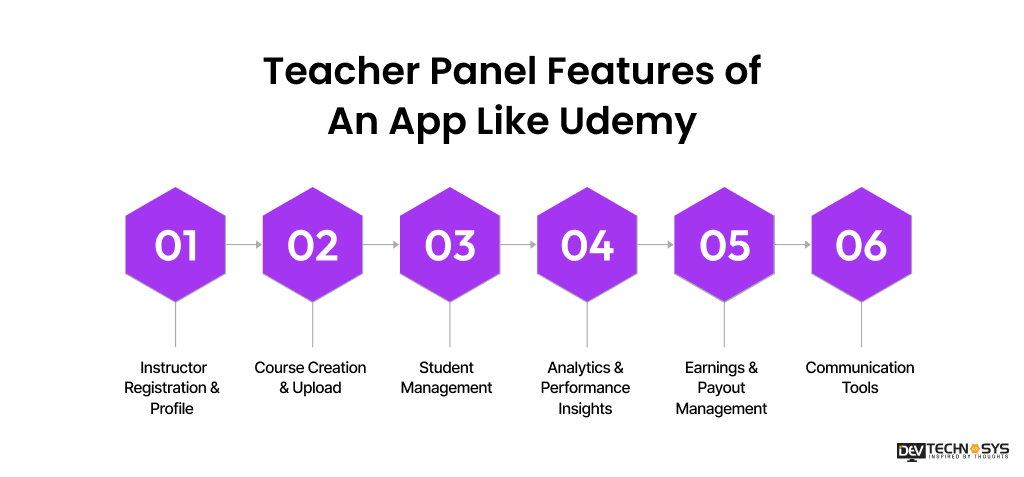
Teacher/Instructor Panel Features
- Instructor Registration & Profile
Teachers create profiles, showcase expertise, and manage their courses, enhancing credibility and visibility to potential learners. - Course Creation & Upload
Courses can be created, edited, and uploaded with ease. This includes videos, quizzes, assignments, and downloadable resources. - Student Management
Udemy app development solutions keep track of students enrolled in your courses, see how they are progressing, and give personalized support and feedback for better learning results. - Analytics & Performance Insights
Get access to detailed metrics such as course views, completion rates, and student engagement to enhance your content quality.
- Earnings & Payout Management
Keep an eye on revenue from course sales, subscription fees, and receive payouts via secure payment systems.
- Communication Tools
Create a bond with your students through messages, announcements, live sessions to increase engagement and solve their problems.
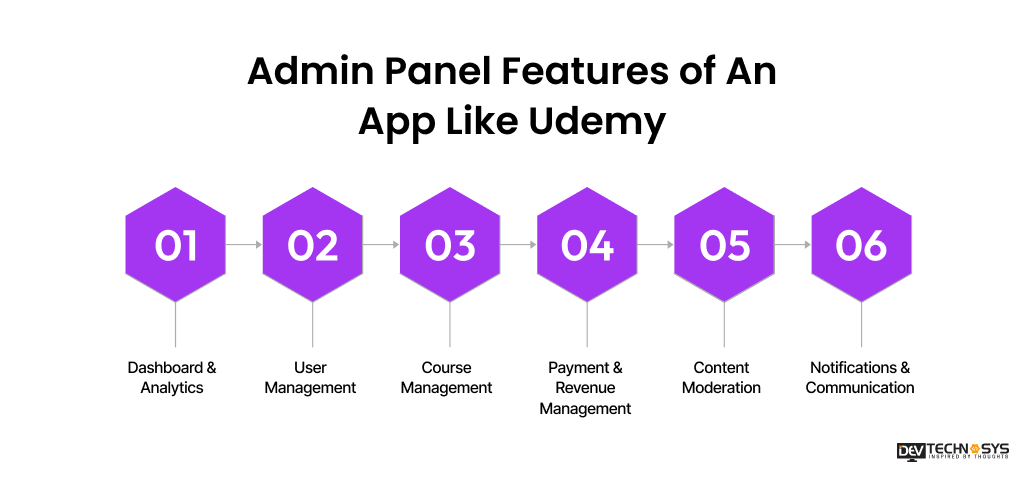
Admin Panel Features
- Dashboard & Analytics
A thorough examination of platform performance, user activity, revenue, and engagement metrics to base decisions on.
- User Management
Online course websites like Udemy handle the registration, usage, and suspension of student and instructor accounts as well as ensure the security of the platform.
- Course Management
Udemy alternatives allow, modify, or delete courses and thus guarantee quality control and uphold high educational standards on the platform.
- Payment & Revenue Management
Follow up on transactions, manage instructor payouts, oversee subscriptions, and ensure financial transparency throughout the platform.
- Content Moderation
Examine course content, comments, and reviews to check if they comply with platform policies and to avoid inappropriate content.
- Notifications & Communication
Udemy alternatives send out platform-wide updates, announcements, or promotional messages to students and instructors not wasting a moment.
5 Must-Have Advanced Features for an eLearning App Like Udemy (2026–2040)
As the field of eLearning matures, the integration of cutting-edge technologies becomes imperative. Here are five futuristic features that a platform like Udemy would need to be engaging, secure and personalized until 2040.
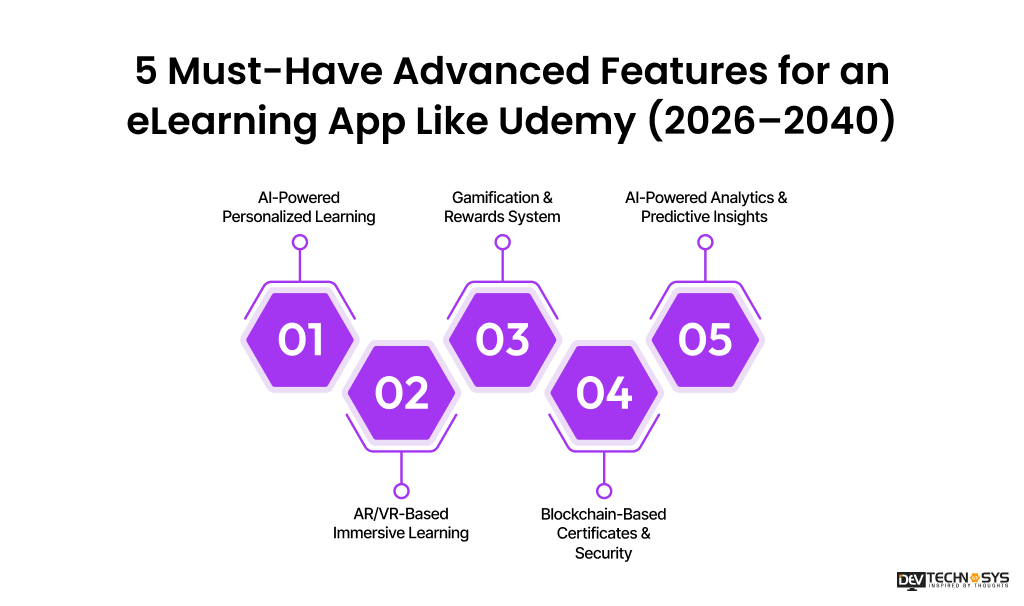
- AI-Powered Personalized Learning
Adaptive learning algorithms help to tailor courses for each learner by analyzing their actions, choices, and progress, which results in higher engagement, completion rates, and better learning outcomes. - AR/VR-Based Immersive Learning
Virtual and augmented reality tools stem from the creation of immersive, experiential learning that is interactive. Both voices, the invention of appealing teaching methods and the improvement of game-dependent learning experiences, go hand-in-hand with the evangelization of students worldwide.
- Gamification & Rewards System
Users earning badges, being shown their ranks on leaderboards, and receiving rewards will be more than satisfied learners. This setup increases learners’ engagement and energizes their desire to be part of the learning process: it becomes more of a game.
- Blockchain-Based Certificates & Security
Blockchain technology can be used to provide hard-to-copy certificates, merchandise transactions, and safeguard the correctness of data, thus, creating trust between the students and the institutions while reducing the risk of cheat sheets.
- AI-Powered Analytics & Predictive Insights
By using sophisticated data analysis, user details are being followed; this shows where users are at risk of leaving the system, thus concomitant actions are taken by teachers or administrators to improve the courses and the platform’s efficiency.
Business Models of App Like Udemy
eLearning platforms akin to Udemy could generate revenue through any number of sources, thus becoming highly scalable and profitable enterprises. These are the five main business and revenue models that provide consistent earnings:
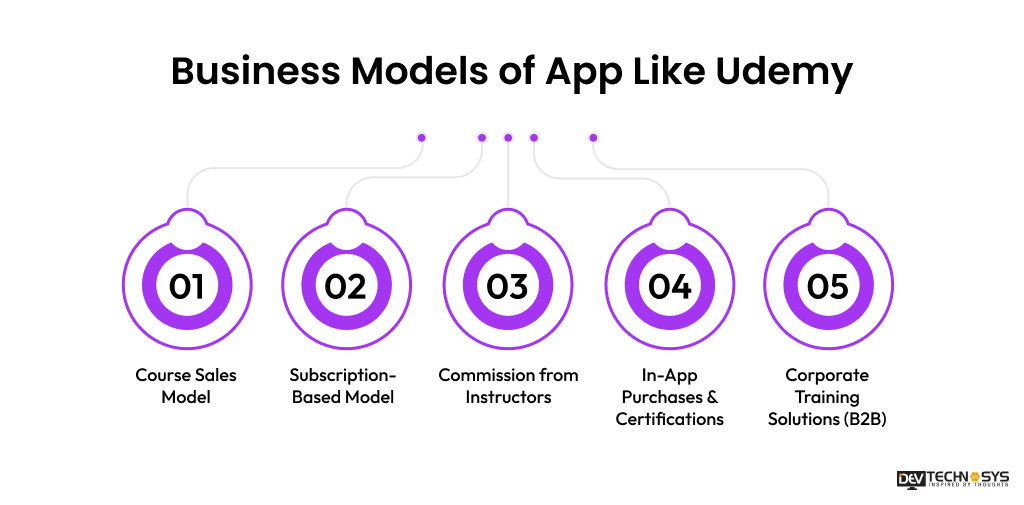
- Course Sales Model
Users make a one-time payment including purchasing courses. Platforms only make revenue by gaining a fraction of each deal. This is the main tactic of Udemy along with providing learners with flexibility and the platform getting a steady income. - Subscription-Based Model
A platform may opt to offer subscriptions on a monthly or yearly basis for unlimited access to courses. This approach not only guarantees a source of recurring revenue but also elevates the lifetime value of customers and goes hand in hand with maintaining a regular engagement with the platform from the user’s side. - Commission from Instructors
Usually, platforms take a commission (generally 30%–70%) from instructors on the sales of their courses. The main point is that this creates an incentive for instructors to prepare good content and at the same time, it is a way of generating steady revenues without the need of creating courses of your own. - In-App Purchases & Certifications
A good idea would be to get some extra profits by selling certifications, promotional content, downloadable resources, or exclusive live sessions. According to the education app development services provider, adding all those features will improve the user experience and magnify the general platform monetization potential. - Corporate Training Solutions (B2B)
Similarly, to the point of giving training to employees, first provide personalized learning solutions to companies. Firms, then, would purchase a number of access points in bulk, thereby creating a revenue stream of significant value that goes beyond the individual learners.
5 Common Mistakes Entrepreneurs Make While Building an eLearning App Like Udemy
- Ignoring Market Research
Numerous founders simply don’t go deep enough into market research, which results in products that are poorly aligned with the market. Without a thorough grasp of user needs, competitors and thus trends, the app becomes unattractive to users. Conducting detailed research is an essential first step for determining the features, price and overall position of your product, thus allowing its success in the long run.
- Overloading with Unnecessary Features
If you pack a lot of features into your product from the beginning, not only will you bump up the cost and complexity, but you will also slow down the on-demand application development process and make it difficult for users to understand the product. To avoid these problems, it is better to start with an MVP and add features gradually based on user feedback, which will lead to a more user-friendly and a better-optimized use of your resources.
- Poor UI/UX Design
Complex or outdated interfaces can be very frustrating for users. If the navigation is hard or the learning experience is not engaging, users will not stay. By putting money into a nice and simple design that users want to engage with, you can greatly increase user satisfaction and platform adoption.
- Neglecting Content Quality
Even with great technology, poor-quality content leads to failure. Entrepreneurs often overlook instructor quality and course structure. High-quality, valuable, and updated content is essential to build trust, attract learners, and ensure long-term engagement.
Tech Stack to Build an App Like Udemy
| Layer | Technology Options |
| Frontend (Mobile) | Flutter, React Native |
| Frontend (Web) | React.js, Angular, Vue.js |
| Backend | Node.js, Django, Ruby on Rails |
| Database | MySQL, PostgreSQL, MongoDB |
| Cloud & Hosting | AWS, Google Cloud, Microsoft Azure |
| Video Streaming | AWS S3, Vimeo API, Cloudflare Stream |
| Payment Integration | Stripe, PayPal, Razorpay |
| Authentication | Firebase Auth, OAuth 2.0 |
| AI & Personalization | TensorFlow, OpenAI APIs |
| Notifications | Firebase Cloud Messaging, OneSignal |
| Analytics | Google Analytics, Mixpanel |
| DevOps & Deployment | Docker, Kubernetes, Jenkins |
Turn Your eLearning Vision Into Reality with Dev Technosys
To create an App like Udemy in 2026, is over and above a mere business idea; it’s a real chance to develop an all-encompassing digital learning ecosystem capable of reaching millions of people around the world. Your app can bring in learners, keep them engaged, and open up various avenues for revenue generation through an effective combination of strategy, features, and a highly user-focused design.
An orderly and well-thought-out course of action for development guarantees the platform will be scalable, secure, and bring growth over the long haul; it also benefits your platform in staying competitive in the ever-growing eLearning industry.
Finding the right education app development agency that matches your vision is very important, as they will be able to give your idea a reality in the form of a smooth, highly capable app. This is the strength of Dev Technosys: figuring out and delivering brilliant solutions that will meet your needs and business objectives perfectly.
Why Choose Dev Technosys?
- 15+ Years of Experience
- 1000+ Successful Projects Delivered
- Expert eLearning App Developers
- Scalable & Secure Solutions
- End-to-End Development Support
Frequently Asked Questions
Find answers to the most common questions related to this article.
Generally speaking, creating an app like Udemy can be completed in a timeframe of 3 to 6 months, depending on features and complexity levels. An MVP (minimum viable product) model can be done in less time, whereas a very advanced platform with AI, live classes, and several integrations will take a longer time to complete the whole process of development, testing, and deployment.
Main features are user registration, course catalog, video streaming, online payments, user reviews, and tracking of progress. Additional features such as AI-driven recommendations, certificates, and live sessions not only increase engagement but they also improve the overall user experience and retention.
The answer is yes, it is possible that you develop your basic version for $8,000 to $30,000 by deciding to build only your core features. A side of that, an MVP launch would get validation for your idea, also a substantial reduction in your initial investment, and at the same time, you will get a kind of scaling opportunity depending on user feedback and market demand.
Apps like Udemy generate revenue through course sales, subscriptions, instructor commissions, certifications, and corporate training programs. Diversifying monetization strategies helps maximize revenue and ensures long-term profitability and business growth.
Yes, due to the rapid growth of the eLearning market and increasing demand for skill-based learning, building an app like Udemy can be highly profitable with the right niche, quality content, and effective marketing strategy in place.