



















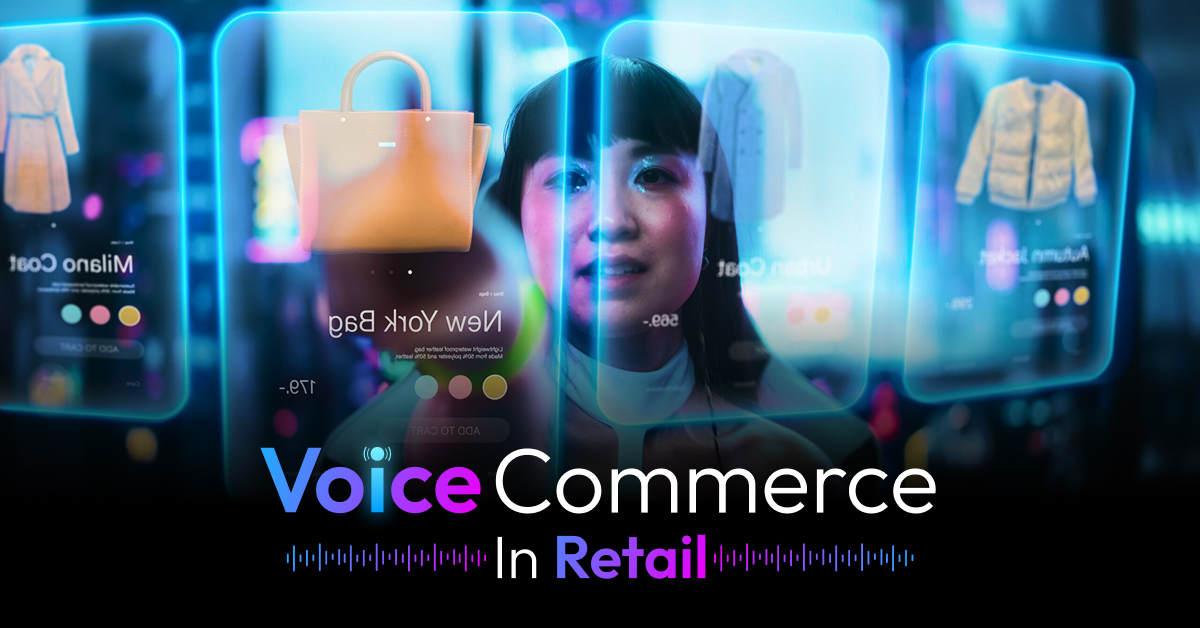
Have you ever bought your weekly groceries or a new gadget with just a few spoken words? If yes, you know what I mean. This is no longer science fiction! Voice commerce, also known as v-commerce, is rapidly disrupting the e-commerce market, transforming the way we shop. With the global voice commerce market forecasted to be valued at approximately $49.6 billion in 2024, before expanding to nearly $148 billion by 2030, it’s clear that the future of hands-free shopping is approaching rapidly.
But how does this seemingly unbelievable interaction actually happen, what benefits can it provide for businesses and consumers, and what challenges will retailers have to work through to really embrace this vocal commerce revolution? Let’s talk about Voice commerce in retail industry, what benefits it provides, and what challenges there are in the retail industry in this blog.
What is Voice Commerce?
Voice commerce refers to a type of commerce that allows consumers to make purchases and interact with online retail stores through voice commands made using a smart speaker or a voice-enabled device. It utilizes technologies like natural language processing (NLP) and AI to understand spoken requests.
Voice-enabled shopping app development solutions allow users to search for products, compare prices, add items to their cart, and complete checkout on a hands-free basis! Simplicity, speed, and the personalization of the shopping experience!
Market Size & Growth of Voice Commerce in E-commerce
- According to Grand View Research, the global voice assistance commerce market was estimated at US$108.33 billion in 2024.
- Projected to grow to US$147.9 billion by 2030 (20% CAGR 2024-2030).
- Another projection expected the market to reach US$693.0 billion by 2034 (25.5% CAGR 2025-2034).
- Smart speakers were the highest revenue-generating device type in India in 2024, with 53.05% of the revenue share.
- The global smart speaker market size was US$13.71 billion in 2024.
- Projecting that to grow to US$29.13 billion by 2032.
- Wearables are the fastest-growing device type segment, with a projected CAGR of 26.5% for the forecast period.

- Almost 89.2% of people are accessing voice assistants through their smartphones.
- Voice-command transactions increased by more than three times, from US$4.6 billion in 2021 to US$19.4 billion in 2023.
- 71% prefer to use voice queries instead of typing.
- 60% of US e-commerce shoppers say they purchase at least once daily or weekly using a smart home voice assistant.
- 80% of people who shopped using voice assistants indicate they are satisfied with their experience.
- Over 50% of consumers expect to use voice assistants for e-commerce within the next five years.
- 8% of US adults report that they make purchases online (regularly) using voice-assisted shopping
- Significant voice purchases occurred in the health and beauty products category (8.9 million consumers) and the electronics category (8.8 million consumers).
How Does Voice Commerce Work?
Voice-activated commerce utilizes smart technology and AI to complete purchases via voice commands. This is how the process generally breaks down:
i. Voice Input:
The user gives a voice command to the voice-enabled device, e.g., “Alexa, order more coffee” or “Hey Google, buy new headphones.”
ii. Automatic Speech Recognition (ASR):
If businesses develop an AI chatbot for e-commerce, it uses automatic speech recognition technology to translate the spoken command into text. The ASR technology must be able to recognize various accents, dialects, and speech patterns.
iii. Natural Language Understanding (NLU):
The text converted from voice is then processed by Natural Language Understanding (a branch of NLP) to discern what the user was trying to accomplish, spot keywords within the text, and determine the degree of meaning within the context of the user’s request.
iv. Query Processing:
The smart technology processes the user’s interpretation and initiates a search through either its product database or, through an integrated e-commerce platform, and passes along the user’s intent in the product search.
v. Response Generation:
The AI voice agents for e-commerce processes the user’s input and generates verbiage to convey an audible response that confirms the item, provides a user with a variety of options, or seeks clarification.
vi. Confirmation and Action:
The user provides verbal confirmation of the selection. The voice assistant processes the transaction using stored payment methods, shipping information, adds to cart, processes a payment method, and begins scheduling the product’s delivery time.
Why Are Retailers Investing in Voice Commerce?
The retail world is changing quickly into voice-enabled commerce, where customers can buy things from retailers using voice assistants (e.g., Alexa, Siri, or Google). As consumer behavior trends toward convenience and hands-free experiences, here are six great reasons for retailers to invest in voice-activated shopping:
1. Customer Convenience
Voice commerce AI allows customers to shop using their own natural language, making it more convenient for consumers to shop. Customers can now search for products, place orders, or track existing orders without lifting a finger—whether they are cooking, driving, or multitasking at home.
This hands-free functionality creates an effortless route for customers to shop, making it a seamless experience, which ultimately drives satisfaction and loyalty.
2. Speedy Shopping
Speed is a significant factor within voice shopping. Instead of paging or typing through a set of pages or products, customers can simply speak their preferences and receive quick, relevant responses.
Voice shopping can enhance and minimize the time span from intent to purchase; when voice shopping can be faster than a traditional purchase path, the conversions become higher, particularly for repeat or habitual orders.
3. Smart Device Adoption is on the Rise
Voice-enabled devices are becoming staples in households with the growth of smart speakers and smartphones. As consumers become used to using voice assistants for their daily tasks, retailers who expand their efforts to adopt Voice commerce in retail industry will be able to take hold of this growing market and have an advantage over competitors who remain lagging behind in this area.
4. Personalization
Voice assistants can provide personalized product suggestions based on past purchase history, preferences, or previous browsing behaviors. Retailers can use artificial intelligence (AI) to create exciting, one-to-one shopping experiences that feel natural and tailored to each customer, which increases sales.
5. Enhanced Customer Engagement
If entrepreneurs develop a multilingual chatbot, customers are able to engage in a more human way with voice interaction. Retailers build trust and engagement with their brand through helpful conversational shopping experiences; they take a simple interaction and create an experiential engagement with their brand.
6. Getting Ahead of the Competition in an Omnichannel World
In the omnichannel world we live in today, voice commerce has now become a valuable contact point along the consumer’s customer journey. By leveraging voice commerce in retail to advance their digital strategy, not only are retailers setting themselves up for future-proofing their business, but they are also positioning themselves with a competitive advantage in a saturated market.
7 Real Examples of Voice Commerce in Retail and E-Commerce
Voice commerce in retail industry is no longer an aspirational concept; it is already changing the way the biggest brands are connecting with their customers. Below are seven strong examples of how companies are using voice technology, along with the impact it is making:
1. Amazon:
The creator of voice shopping, Amazon, is the one who truly set off the voice commerce in the e-commerce revolution with their line of Alexa and Echo devices.
Through voice-enabled device set-up and using voice command shopping, Amazon has seamlessly entered a convenient, hands-free shopping method from reordering household staples to recommending new products.
Metric |
Growth/Revenue Analysis |
| Alexa Device Sales | Over 500 million Alexa-enabled devices sold globally by 2023. |
| Voice Transactions | A significant portion of Prime Day sales are attributed to Alexa, with voice-assisted transactions showing substantial year-on-year increases. While specific dollar figures for voice revenue are proprietary, the sheer volume of devices and stated customer satisfaction indicates massive scale. |
2. Starbucks: Coffee on Command
Starbucks offers customizable coffee ordering using voice commands through their mobile app and Alexa. This process optimizes the morning routine, allowing customers to order coffee before leaving their homes, and pick up the drink without queueing or wasting time.
Metric |
Growth/Revenue Analysis |
| Monthly Revenue per User | Starbucks reported a 16% increase in monthly revenue per user for customers who used voice to place orders. |
| Mobile Order & Pay | While not exclusively voice, their Mobile Order & Pay (which includes voice) accounts for almost 20% of Starbucks’ revenue, highlighting the success of frictionless ordering. |
3. Domino’s: Pizza with a Pre-Ad
Domino’s was ahead of the game by adopting a voice ordered pizza assistant called “Dom,” who can instantly reorder favorite pizzas or provide status updates on existing orders by voice.
Metric |
Growth/Revenue Analysis |
| Voice Orders | “Dom” recorded half a million orders since its launch. |
| Digital Sales Share | With 50% of Domino’s sales coming from digital platforms, voice ordering plays a significant role in their overall digital strategy, contributing to growth by catering to customer convenience. |
4. Walmart: Combined In-Store and Online Shopping Experiences
Walmart is one of the most popular eCommerce app development solutions to add items to the shopping cart and create shopping lists using voice. This process currently only covers grocery shopping, so quantitative ordering and combining the online carts with the in-store delivery or pickup can be easier.
Metric |
Growth/Revenue Analysis |
| Shopping List/Cart Integration | While specific direct revenue from voice is not public, Walmart’s focus on reducing stockouts by 17% through voice analytics demonstrates efficiency gains. |
| Customer Convenience | The integration with physical stores for pickup or delivery enhances the overall customer experience, driving satisfaction and repeat business. |
5. Sephora: Beauty Recommendations by Voice
Sephora’s voice assistant makes personalized beauty recommendations about past purchases, skin types, and other preferences. Their use of voice enhances their non-transactional proposition by making the overall experience feel more personalized and inviting.
Metric |
Growth/Revenue Analysis |
| Average Order Value (AOV) | Sephora reported a 35% increase in average order value through their voice assistant compared to their website. |
| Personalization Impact | This significant AOV increase highlights the power of personalized recommendations delivered through an intuitive voice interface. |
6. Kroger: Smart Shopping Lists and Reordering
Kroger’s smart shopping list consumption patterns of a household through machine learning suggest food and grocery items proactively that are likely to need replenishing. According to the eCommerce app development company, their use of prediction makes a regular grocery run nearly effortless.
Metric |
Growth/Revenue Analysis |
| Customer Retention | Kroger’s system improved customer retention by 28%. |
| Repeat Purchases | By simplifying routine grocery shopping and proactively suggesting items, Kroger fosters habitual buying and strengthens customer loyalty. |
7. Nike: Voice-Activated Product Drops
Nike executed voice commerce in e-commerce for a unique campaign by advertising a collection of shoes that lace themselves. Customers were able to “Ask Nike” during a broadcast using Google Assistant and be led to a page to complete their purchase.
Metric |
Growth/Revenue Analysis |
| Sales Velocity | Nike successfully sold the entire collection of shoes within just six minutes using this voice-activated campaign. |
| Innovative Marketing | This demonstrates voice commerce’s potential not just for routine shopping, but also for high-impact, limited-edition product launches and engaging marketing activations. |
Want a chatbot demo or pricing? Fill the form and talk to our experts today.
Pick what you need below — you can select more than one — then tap Get detail to continue.
-
Chatbot demo dashboard
-
Cost to develop an app
-
Industry report
-
Case study
8 Incredible Benefits of Voice Commerce
Implementing voice assistant development for retail offers several valuable benefits of Voice commerce in retail industry to improve customer experiences and operational efficiency.
1. Better Convenience And Ease Of Use.
Voice commerce is extremely convenient. Customers can shop and engage in other activities while using voice commerce (e.g., cooking, driving, etc.) without typing or clicking.
Voice commerce in retail industry speeds up the entire purchase process while reducing barriers, i.e, if a customer sees a long checkout process, they might abandon their cart before completing the purchase.
2. Increased Customer Experience (And Personalization).
Voice assistants are able to create a personal shopping experience. Voice assistants can leverage AI and machine learning to learn about customer purchases, preferences, browsing behavior, and offer recommendations, be conversational, and create an engaging experience. This is helpful in creating deeper customer relationships and loyalty.
3. Increase Sales And Conversion Rate.
The ease of use offered by voice shopping creates a simple, intuitive, and fast shopping experience, leading to improved sales. Customers can make quick decisions and complete transactions while only using their voice.
This potentially creates more impulse purchases and hence higher conversion rates. Simplified reordering of frequently purchased items also contributes to higher sales frequency.
4. Greater Accessibility And Inclusivity:
Voice commerce in e-commerce opens access to online shopping to a wider audience that includes people with visual impairments, motor disabilities, or individuals who have challenges engaging with traditional online interfaces.
voice commerce in e-commerce industry is much more accessible and gives a more inclusive ability for everyone to engage in e-commerce with more independence.
5. Lower Customer Support Expense:
AI in voice commerce has the ability to assist with a considerable number of basic customer questions, such as order tracking, store hours, product information, and frequently asked questions.
According to the AI chatbot development company, this self-service aspect reduces the efforts of human support teams to focus on more complicated issues, as well as cuts down on volume and wait times.
6. 24/7 Access:
Voice assistants are accessible at all hours of the day and night. This capability means that customers can shop or get support at any time, day or night. This increases hours and opportunities for businesses to make sales and ensure that customers have access to support, regardless of their local time or business hours.
7. Adaptable And Responsive To Advancements In Technology:
Embracing the use of voice commerce indicates a business’s willingness to engage with the fast-evolving technological landscape. As voice-assisted devices become increasingly ubiquitous, implementing voice commerce in e-commerce industry may show a genuinely forward-thinking position, which attracts tech-savvy consumers and gives a business a competitive advantage.
8. New Marketing And Discoverability Opportunities:
Voice-based search behavior is inherently different from text-based searches and usually comprises more verbose, conversational phrases.
By implementing voice commerce in e-commerce industry enhancing content and product descriptions using voice search SEO, businesses can improve the chances of discoverability on any voice-enabled service. This can also help businesses find additional ways to personalize promotions, ads, and recommendations through voice assistants.
Challenges to Voice Commerce Adoption
If you develop a Chatbot from Scratch, it has many potential benefits; however, adopting voice-based commerce also has challenges that must be faced:
1. Speech Recognition Ability And Accuracy:
Despite improvements in technology, voice recognition is still not perfect. Accents, dialects, background noise, multiple people speaking, and even slight variations in intonations may cause issues with “reading” commands accurately.
This leads to misinterpretation of the command and can lead to erroneous product suggestions, incorrect orders, and annoyances to the user, all resulting in customer dissatisfaction and dropping out of the voice channel.
2. Privacy/Security:
Consumers are fearful of sharing sensitive personal and financial information using their voice, sometimes even for mundane items. Concerns of data breaches, children making unauthorized purchases as a result, and device passive-listening of personal activities all lead to this hesitancy.
Developing security protocols, including biometric identification (as a means of verification), and a clear understanding of how data is handled, will aid in helping users trust the experience.
3. Limited Visual Feedback And Product Information:
The marketplace app development solutions present a unique challenge as they rely solely on audio cues. It can be difficult to relay a fully-rounded product description, allow for complex comparisons, or convey product aesthetics through voice alone, which can limit opportunities in certain product categories.
4. Integrating With Existing Systems:
Voice commerce in e-commerce industry relies on the integration with the business’s e-commerce platforms, inventory systems, payment systems, and CRM platforms, there can be technological complexity, especially if the new voice implementation is being layered on top of legacy business systems. Existing systems may not be compatible or may not have powerful APIs to allow for a production-level solution that works seamlessly.
5. User Adoption, Shift In Behaviour:
As voice assistants become part of more people’s lives, it may still take some time for consumers to transition to purchases via voice. Many consumers prefer the tactile and visual experience associated with traditional online shopping.
Critical to adoption will be to help the user understand the value, provide easier-to-browse environments with voice, and help the user become comfortable with a new way of interacting.

The Future that Voice Commerce Holds
The future of voice commerce in e-commerce industry is positioned for new heights of growth, and in ways that change the way consumers behave with brands and purchase. This isn’t just niche voice commerce trends; it’s a significant shift driven by technological advancements and evolving consumer behaviors.
1. Market Projections and Growth Drivers:
Here are some market projections of voice commerce in e-commerce industry that you need to focus on:
i. The Research Statistics Tell A Compelling Story.
The global voice commerce market is expected to reach approximately $89.8 billion by 2025 and increase significantly to approximately $693.0 billion by 2034 with a Compound Annual Growth Rate (CAGR) of 25.5%. This trajectory is fueled by multiple factors:
ii. Rise Of Smart Devices:
The rise of smart speakers (expected to have a revenue share of 48.9% in the market by 2025), smartphones, wearables, and in-vehicle systems with voice assistants is developing a wide-ranging ecosystem for voice commerce.
iii. Advancements In AI and NLP:
With the continued advancement of Artificial Intelligence (AI) and Natural Language Processing (NLP), allowing voice assistants to become more precise, contextually relevant, and nuanced in commands, voice assistants’ advancements will allow for much smoother, seamless, and intuitive conversational interfaces.
iv. Consumer Desire For Convenience:
As consumers continue to desire hands-free, fast, and efficient shopping experiences for routine purchases or reorders, there will be increasing adoption of voice commerce.
2. New Trends That Will Shape the Future:
As growth is important, there are both new and future trends that will shape the future of voice commerce:
i. AI Supervised Hyper-Personalization:
In the voice commerce future, AI will push voice commerce to the hyper-personalization of shopping experiences. Voice assistants will not only remember past purchases but also analyze vocal patterns, behavioral biometrics, and even emotional cues to offer tailored product recommendations and promotions, anticipating needs before they’re explicitly stated.
ii. Advanced Voice Biometrics and Security:
Voice biometrics will be more readily adopted to offset privacy and security issues. Voice biometrics involves the unique patterns of one’s vocal cords and even the potential for “liveness detection” to confirm that transactions are not fraudulent.
The ability to establish more trust in voice payments will not only help the gradual adoption in this channel but also lead to an overall improvement of the payment practices presently.
iii. Multi-Platform and Cross-Device Integration:
Voice commerce in retail industry will no longer be associated with standalone devices. Devices will be able to work together seamlessly. With the help of a mobile app development agency, integrating voice commerce that will allow shopping lists and ideas to be started with your smartphone, and eventually purchased through your smart speaker.
iv. Conversational AI and Generative Models:
The amalgamation of more capable conversational AI and generative models will lead to more natural and dynamic dialogues. Voice assistants and commerce will become more than basic product inquiries.
It will allow for greater comparisons and guiding users through a multi-step decision-making process, resulting in less distinction between human and AI interactions.
v. Localized and Multilingual:
As voice commerce continues to grow globally, there will also be a greater focus on multilingualism and localization. Voice commerce will wade into region and language differences, including understanding smartphone / smart speaker distinctions, speech differences such as accents, colloquialisms, and culture that reflects a truly inclusive shopping experience for various populations.
vi. Voice Search Optimization (VSEO) Evolution:
As more businesses begin to optimize their digital content for conversations with voice search queries, which tend to be longer and more natural, it will become vital for discoverability and brand visibility in the voice-first world.

How Dev Technsoys Can Assist You With Voice Commerce In E-commerce & Retail?
At Dev Technosys, we help online eCommerce and retail businesses prepare for the future of commerce through the power of voice. Our expert developers integrate AI-driven voice assistants and smart speaker compatibility, which deliver frictionless hands-free shopping experiences.
From voice-enabled search and product discovery to secure voice-based checkout, we will enhance your users’ journey, enabling fast, intuitive, and personalized experiences.
We create a voice shopping app for e-commerce features that build user engagement, customer satisfaction, and conversions, whether you’re a startup business looking to implement an effective voice strategy or an enterprise looking to integrate and raise the bar around voice commerce in retail capabilities, we require consultation with the developers at Dev Technosys. With more than 15 years of experience in the tech development solutions industry, we help revolutionize retail as the leading and innovative artificial intelligence development company.
FAQ
Q1. How Does Voice Commerce Recognize My Request, And How Does It Recognize The Commands?
Voice commerce in e-commerce relies on Automatic Speech Recognition (ASR) technology, which converts your voice to text. This computer emulator version relies on Natural Language Understanding (NLU) to teach students the intent and context, thus enabling the voice commerce business to identify the request and trigger an appropriate response.
Q2. What Are The Main Benefits For Consumers?
Consumers have limitless convenience as they are able to shop hands-free while multitasking. It creates access for varying users and provides personalized recommendations, allowing users to shop faster, in a more natural way, and generating an overall satisfying shopping experience.
Q3. What Do Retailers Gain From Adopting Voice Commerce?
Retailers can increase overall sales by eliminating friction at checkout and bringing convenience, increasing customer loyalty through personalization, lowering customer support costs, establishing new marketing channels, and keeping businesses engaged with future technology trends.
Q4. What Is Most Challenging About Imparting Voice Commerce Successfully?
Some of the most common challenges and issues are achieving high speech recognition rates by accounting for and compensating for differences in people’s accents or ambient noise, addressing consumer concerns over privacy and security, and providing a way to replace visual product information. Technical voice commerce integration and reliable synchronization with existing systems can also provide a challenge.
Q5. Is Voice Commerce Secure For Transactions?
Security is always a concern. Although voice commerce utilizes security practices like voice biometrics and encryption, it is important for systems to be in place and have clear and public data governance policies. Businesses must make sure secure authentication is done, especially for money transactions, to ensure confidence among users.