





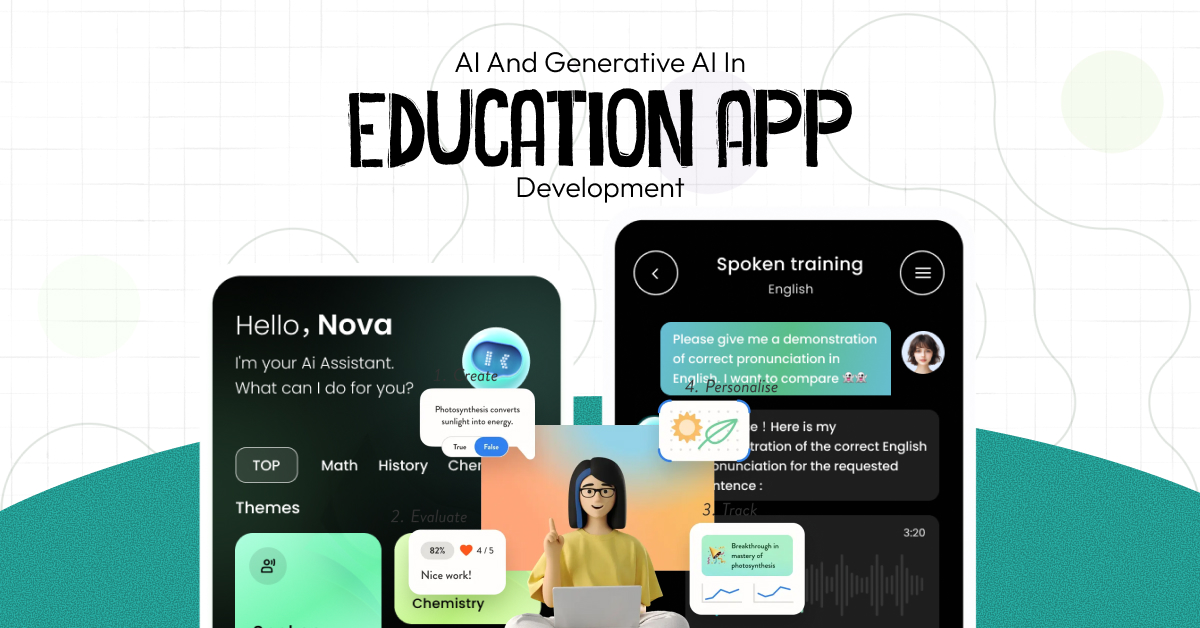
AI in education apps uses machine learning, natural language processing, computer vision and predictive analytics to personalize learning, recommend content, identify learning gaps and support educators. Generative AI extends these capabilities by creating explanations, quizzes, practice exercises and conversational tutoring.
Production-ready education apps should ground AI responses in approved curriculum, protect student data, apply age-appropriate safeguards and keep teachers involved in assessment and other high-impact decisions. This guide explains how to do that, from use cases and architecture to safety controls, KPIs and a practical build roadmap.
Key takeaways:
-
- Traditional AI predicts, recommends or classifies. Generative AI creates explanations, questions and learning material.
- Retrieval-Augmented Generation (RAG) connects an AI tutor to approved curriculum and source documents.
- Student-facing answers need citations, moderation and age-appropriate controls.
- AI-generated grades, progression decisions and assessments need human oversight.
- Success must be measured through learning outcomes, not engagement alone.
AI vs Generative AI in Education: What Is the Difference?
Traditional AI analyses existing data to predict outcomes and recommend actions. Generative AI creates new content, such as questions, explanations or summaries, from a prompt. Most modern EdTech platforms use both together.
Area |
Traditional AI |
Generative AI |
| Primary purpose | Predict, classify and recommend | Generate new content |
| Education example | Predict at-risk students | Generate practice questions |
| Input | Student and learning data | Prompt, curriculum and context |
| Output | Score, category or recommendation | Text, image, audio or conversation |
| Main risk | Bias or inaccurate prediction | Hallucination or unsafe content |
| Best control | Validation and explainability | RAG, citations, moderation and human review |
What Is The Role Of AI In Education App Development?
In offering personalized learning, smart tutoring, real-time feedback, and more, AI plays a significant role in transforming education app development. Now, we will discuss some of the key roles of artificial intelligence in education system.
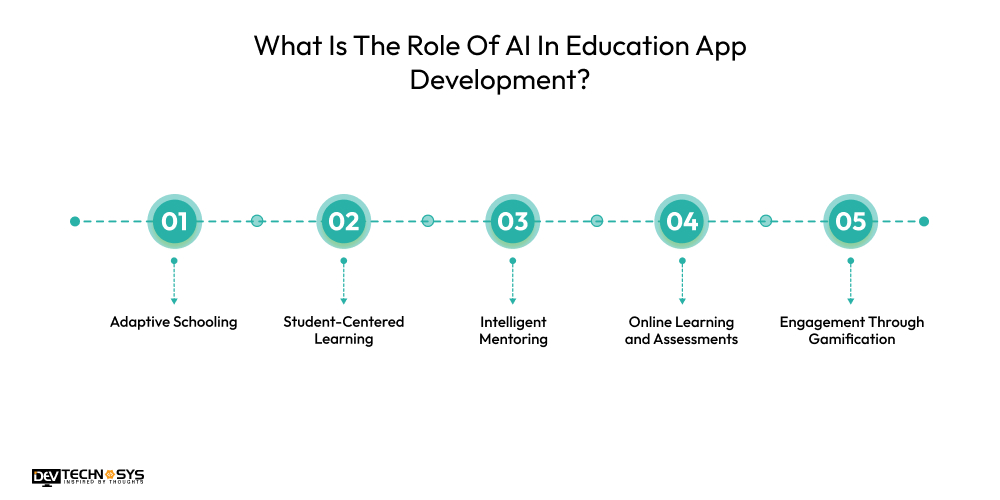
1. Adaptive Schooling
A custom education app development integrates AI to modify the learning as per the student’s performance. This is an adaptive schooling approach that customizes content so that students can learn and master the concept at their own pace, while making learning interactive.
2. Student-Centered Learning
AI in education app development personalizes the learning experience according to each student’s learning pace and performance needs. The education app development with AI ensures personal support while offering better engagement and effective learning.
3. Intelligent Mentoring
AI-powered education apps generally provide immediate guidance and feedback to users. The students can get personalized suggestions and advice with intelligent monitoring. Also, students can improve their learning by getting relevant insights for their development.
4. Online Learning and Assessments
Nowadays, e-learning app development services are integrating AI, especially to access and track the progress of students. It helps them analyze the responses given by students and give instant feedback. This identifies the area for improvement while redefining online learning.
5. Engagement Through Gamification
AI-powered education apps use gamification to make learning more interactive and fun. By incorporating challenges, rewards, and progress tracking, students stay motivated, improving participation and retention in educational content.
What Are The Key Use Cases Of AI In Education Applications?
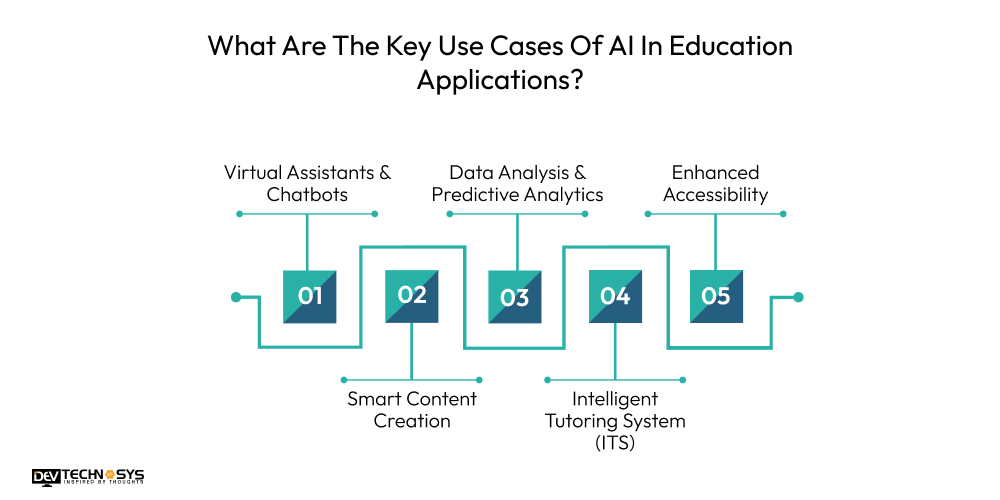
The AI for e-learning platforms use cases usually focus on Intelligent Tutoring Systems (ITS), Virtual Assistants & Chatbots, and much more. Here, we will learn about some of the key AI use cases in education app development.
1. Virtual Assistants & Chatbots
An AI development company incorporates virtual assistants and chatbots in an education app development. It delivers instant support, answers FAQs, and guides students in no time. AI chatbots for education not only enhance user engagement but also provide them with accessibility.
2. Smart Content Creation
Another use case of AI in education applications is the creation of smart and attractive content. This helps in making customized lesson plans, quizzes, and offering interactive materials and summaries. This makes the content more dynamic, and students get attracted to learn more.
3. Data Analysis & Predictive Analytics
The data analysis and predictive analytics are strongly supported by Artificial Intelligence in an educational app. The data analysis and predictive analytics in education find out the learning gaps, students at risk, and offer timely measures for better results.
4. Intelligent Tutoring System (ITS)
The most popular use case of AI in education app development is the intelligent tutoring systems (ITS). This provides users with on-demand help that remains available 24/7. It explains the concept clearly and guides the students in solving their problems instantly in less time.
5. Enhanced Accessibility
There are a number of students with special needs, such as dyslexia, visual impairments, Autism spectrum disorder (ASD), and so on. So, enhanced accessibility of AI in education applications provides text-to-speech, translation, and several tailored tools for these children.
Which AI Models Are Commonly Used In Education App Development?
ML, NLP, deep learning, predictive analytics, generative AI, and more are among the commonly used AI models in an education app development. In this section, we will discuss the topmost and widely preferred AI models.
1. Machine Learning (ML)
Machine Learning (ML) is prominently used in educational apps to identify students’ behaviour and then adjust content difficulty. It recommends lessons and adaptive paths that suit children’s learning pace. Machine learning in education apps improves the results by offering personalizations that are data-driven.
2. Generative AI
An on-demand app development, including education apps, incorporates generative AI broadly. It creates attractive content, questions, and summaries, enabling personalized learning using AI. Generative AI for Edtech helps teachers and students save time by developing study material that matches students’ learning levels.
3. Natural Language Processing (NLP)
Natural Language Processing (NLP) is one of the most common AI models that is used to power virtual teaching assistants. It helps in understanding and answering speech and text questions while chatting naturally. It explains tech concept more briefly and accurately while giving feedback to support students anytime, anywhere.
4. Data Analytics and Computer Vision
Data analytics and computer vision are AI models that analyze the performance, behavior, and visual inputs in an adaptive learning technology. These models focus on AI-powered student assessments that track their progress, learning patterns, and detect mistakes. It allows students to make and improve their learning decisions.
What Are The Real-World Education Apps That Use AI?
Duolingo, Quizlet, Photomath, Gradescope, and many more are the real-world educational apps that are using AI. Here, we will see how these apps make learning more efficient and tailored to diverse student needs.
1. Duolingo
Duolingo is an educational app that uses AI to customize language-based lessons according to the user’s performance. By using gamification methods, it measures the difficulty and provides instant feedback. This hybrid app development keeps the learner motivated and regular in their daily practice.
2. Quizlet
Quizlet is one of the best AI-based learning applications that generates personalized study activities and practice tests. It examines the learning patterns of the users and recommends the topics based on them. With this, students can study more efficiently while upgrading their memory retention.
3. Photomath
Photomath is also among the topmost AI-driven learning platforms that uses AI and computer vision to scan and solve math problems. They deliver step-by-step solutions to the question, making it easier for students who have difficulty with mathematics, rather than just reaching the final answer.
What Are The Struggles Of Integrating AI In Education App Development?
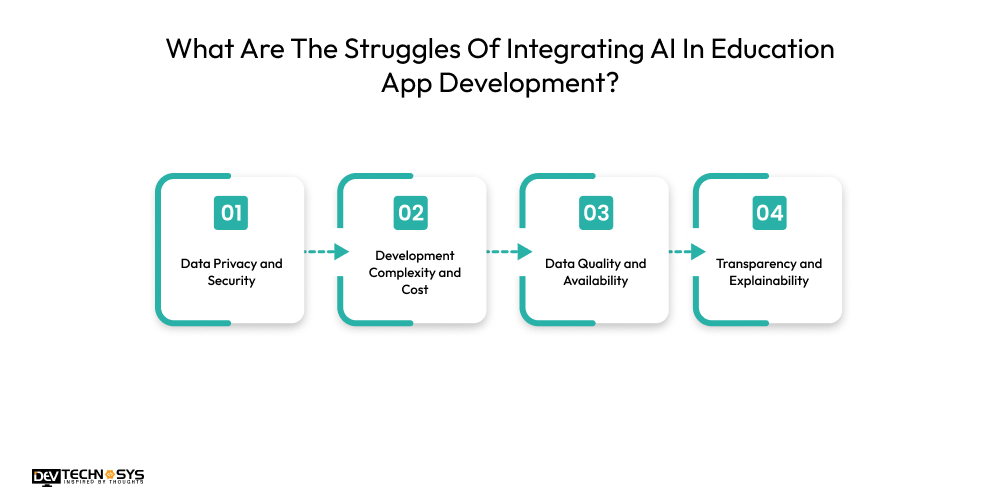
We all know that if there are many boons of AI in education app development, there must be some drawbacks. If it transforms the learning via personalization and efficiency, it raises concerns related to cost, privacy, management, technological, and more. Here, we will learn about the potential struggles of incorporating AI-based learning analytics.
1. Data Privacy and Security
Generally, AI-enabled classroom technology asks for sensitive data from the users. But keeping that data secure from major security breaches is a big concern. Therefore, there is a requirement for strict adherence to regulations such as GDPR or FERPA.
2. Development Complexity and Cost
To create a mobile app in the education industry with AI for personalized learning paths, resources and significant investment is required. This investment demands specialized talent, infrastructure, and computational power, which raises the development time and cost.
3. Data Quality and Availability
Be it automated grading systems or intelligent tutoring systems, education technology AI needs quality and quantity of data. It relies on large, high-quality datasets to provide users with accuracy, but generating such relevant data can be difficult and expensive.
4. Transparency and Explainability
Major advanced AI models have a “black box” nature. This makes it difficult to understand how the app arrives at any specific assessment and recommendations. This leads to mistrust and confusion among parents as well as teachers.
What Are The Future Trends Of AI-Powered Education Applications?
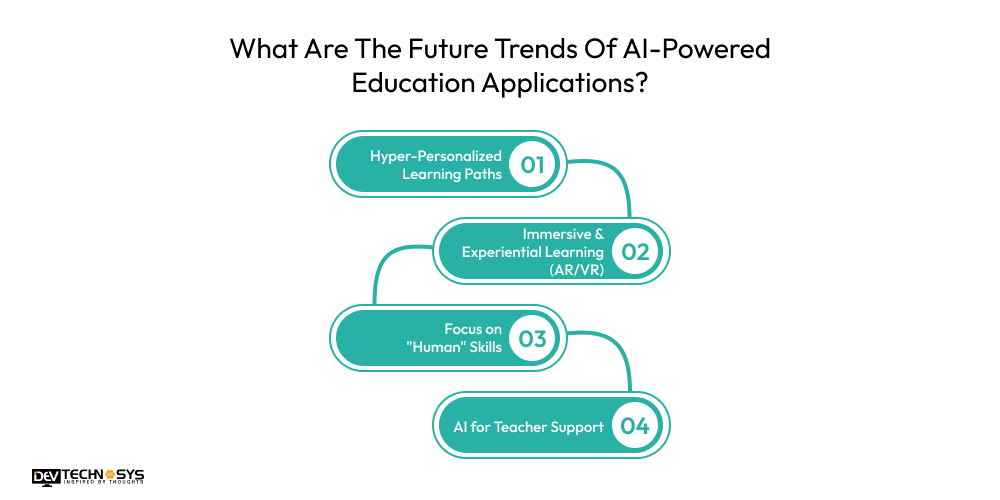
Everything that is considered normal today will be advanced in the future. Similarly, AI-powered education app development can reach another level over time. So, here are some future trends of AI in EdTech app development.
1. Hyper-Personalized Learning Paths
Slowly but precisely, AI will analyze the strengths, weaknesses, and styles of individuals more deeply. Then it will adjust curricula, pace, and content in a more personalized way so that no student is left behind.
2. Immersive & Experiential Learning (AR/VR)
The education app development features will integrate AR and VR to develop virtual labs and simulations. This can easily take users on a virtual field trip with a motive to make the concepts tangible and engaging.
3. Focus on “Human” Skills
Nowadays, AI can easily handle routine tasks like homework, assignments, tests, and so on. But the future of AI focuses on fostering the creativity, critical thinking ability, and emotional intelligence of humans.
4. AI for Teacher Support
AI will not only remain useful for students but also for teachers. It helps them with administrative tasks and lesson planning. The AI-powered personalized learning apps even allow teachers to focus on mentorship properly.
What Is The Role Of Generative AI In An Education App?
Generative AI is a concept that comes with the ability to create new, original ideas and content. It includes generating solutions, personalizing learning materials, and delivering adaptive educational experiences in real time. Now, we will understand the role of generative AI in education app development.
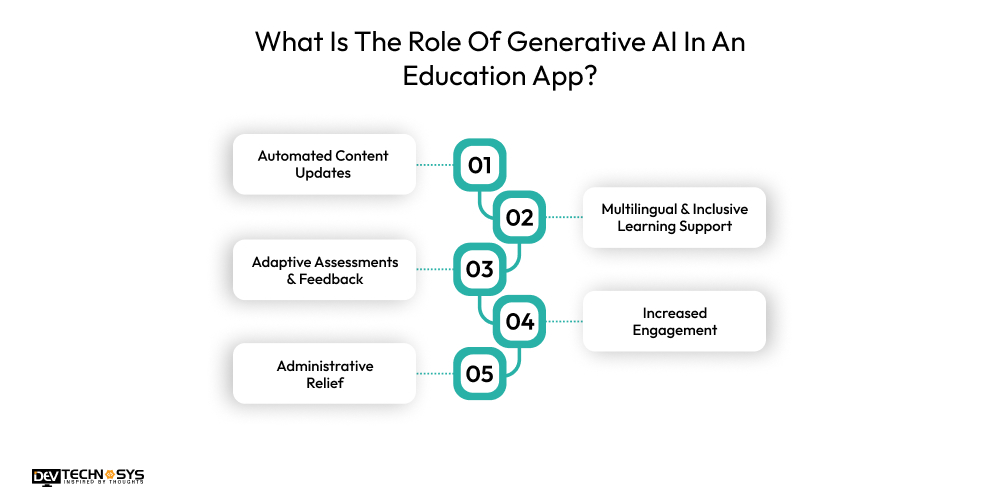
1. Automated Content Updates
An education app development with generative AI has content, lessons, quizzes, and study material, which is created automatically. Its purpose is to keep the education app integrated with the latest features, relevant content, and reduced manual work.
2. Multilingual & Inclusive Learning Support
Generative AI in an education app can easily translate the content into several languages to simplify the explanations for everyone. It is beneficial for users from different backgrounds so that they can understand the lessons, making education apps more accessible to everyone.
3. Adaptive Assessments & Feedback
Generative AI for adaptive learning with updated assessments and continuous feedback is becoming a new trend. A generative AI development company can build features that identify the strengths and weaknesses of the students while offering them progressive insights.
4. Increased Engagement
The generative AI-based content generation for education apps includes quizzes, stories, and practice exercises, making learning more engaging and enjoyable. It keeps encouraging and motivating students for their active participation.
5. Administrative Relief
Generative AI model integration in education apps automates the administrative tasks like grading, report making, and class scheduling. It reduces the workload of teachers and lets them focus on teaching and supporting the student curriculum.
Want a chatbot demo or pricing? Fill the form and talk to our experts today.
Pick what you need below — you can select more than one — then tap Get detail to continue.
-
Chatbot demo dashboard
-
Cost to develop an app
-
Industry report
-
Case study
What Are The Key Use Cases Of Generative AI In Education Applications?
Generative AI in education app development transforms the industry by offering intelligent, adaptive, and interactive learning experiences. In this stage, we will learn the key use cases of generative AI in education apps.
1. Curriculum Design
Using generative AI for curriculum design helps educators develop structures and an updated syllabus faster with little to no human effort. With this, teachers can create lectures based on learning goals, student levels, and real-world skills.
2. Data-Driven Insights
Generative AI helps students analyze their performance while highlighting strengths and weaknesses. It includes AI-powered assessment and grading systems that allow teachers to improve their teaching strategies and support students better.
3. Resource Management
To optimize content usage, digital resources, and learning schedules, generative AI is primarily preferred. It manages materials efficiently and reduces costs for AI-powered LMS development. This makes sure students get the right educational resources easily.
4. Enhanced Security
Artificial Intelligence monitoring can uncover strange behavior signaling the possibility of danger to personal information in AI education applications. Furthermore, generative Artificial Intelligence capabilities require their core oversight and control system to abide by all educational regulations and prevent revealing personal student information.
5. Immersive Experience
Generative AI creates interactive lessons, simulations, and conversations that attract users and make their experience unforgettable. Through LLM-powered education applications, learners experience engaging, realistic learning environments that improve understanding and retention.
Which Generative AI Models Are Widely Used In Education App Development?
To enable personalized learning, intelligent content generation, real-time assistance, and adaptive educational experiences, several generative AI Models are used. Let’s know these generative AI models in education app development.
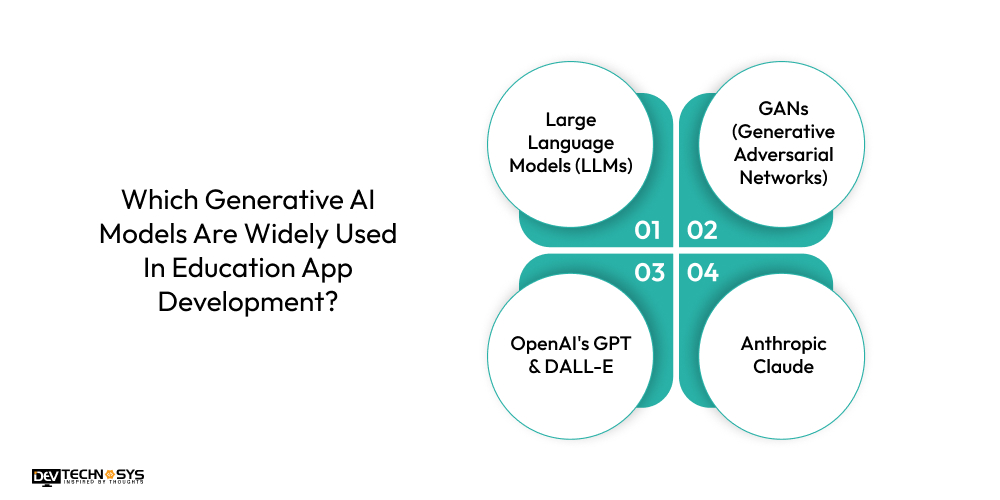
1. Large Language Models (LLMs)
Large Language Models (LLMs) are primarily used as AI tutors in education apps, which easily understand and generate human-like texts. It can explain, summarize, and communicate effectively with students. Its purpose is to make students learn new concepts with more clarity.
2. GANs (Generative Adversarial Networks)
For learning content, a web development company utilizes GANs (Generative Adversarial Networks) and generative AI model to design realistic images and visual simulations. In doing so, difficult subjects become more comprehensible due to appealing imagery. Nonetheless, many contemporary educational applications rely on large language models for text processing and diffusion concepts for picture processing.
3. OpenAI’s GPT & DALL-E
Normally, OpenAI’s GPT makes lessons, explanations, and quizzes in a humanized way, while DALL-E mainly creates images from text or visual prompts. It is like integrating ChatGPT for education app development for personalized and creative learning easily. It even enhances learner engagement and understanding.
4. Anthropic Claude
Generally, Claude Anthropic supports ethical usage of Artificial Intelligence and other tools, focused on providing explanations, summaries, and education with the help of its systems. However, like any model, its output still needs bias testing and teacher review to address the ethical issues of AI in EdTech.

What Does an AI Education App Architecture Look Like?
A production AI education app is more than an LLM connected to a chat window. It combines identity and permissions, approved curriculum, AI models, safety checks and human review, with monitoring at every step.
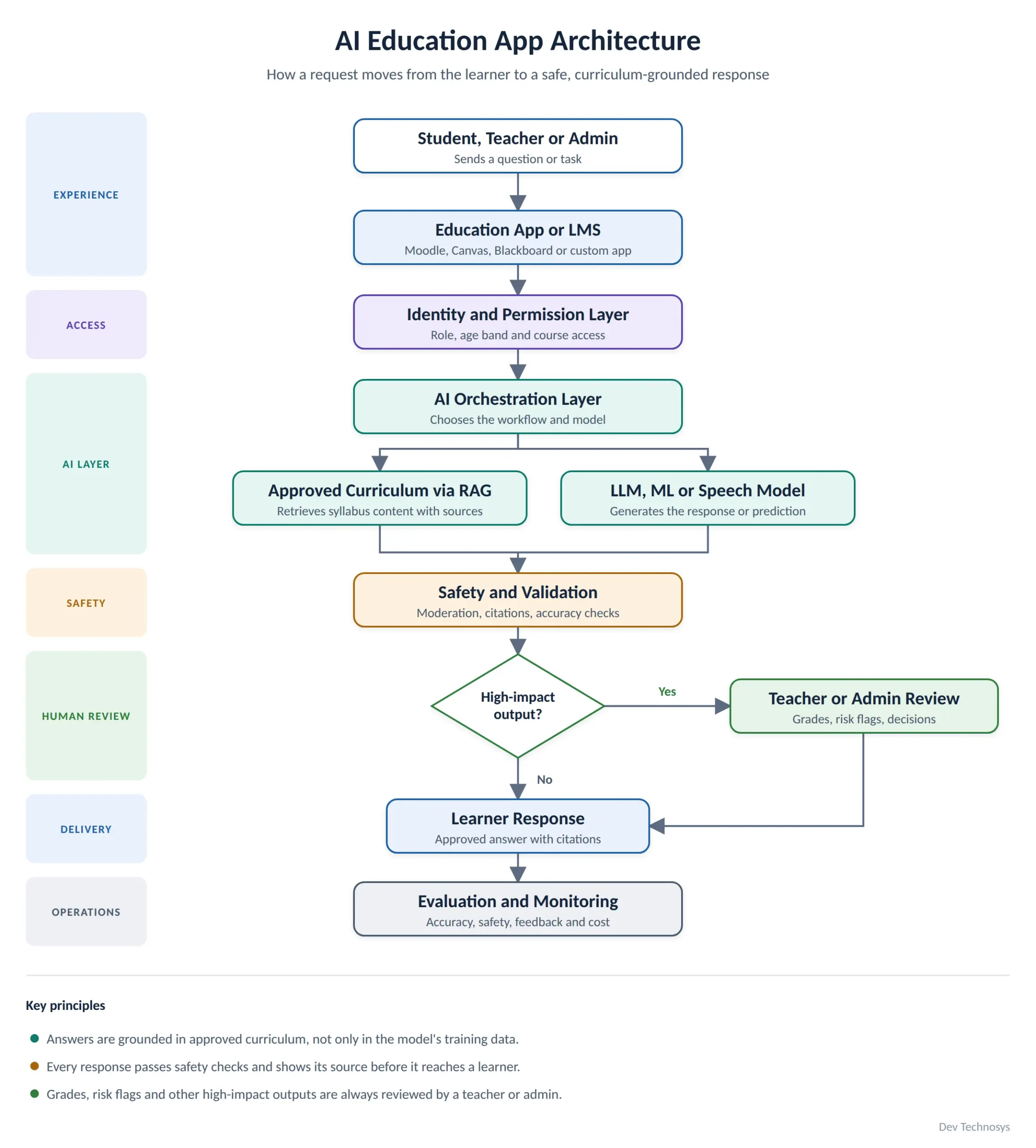
How a Request Flows Through the System
- A student, teacher or admin sends a request from the education app or LMS.
- The identity and permission layer checks the user’s role, age band and course access.
- The AI orchestration layer decides which workflow and model to use.
- The RAG layer retrieves relevant, approved curriculum content.
- The LLM, ML or speech model generates a response or prediction using that content.
- The safety and validation layer checks for harmful content, accuracy signals and citations.
- High-impact outputs, such as grades or risk flags, go to a teacher or admin for review.
- The learner receives the approved response.
- Evaluation and monitoring track accuracy, safety, feedback and cost.
Core Architecture Components
Layer |
Components |
| Experience layer | Education app or LMS, teacher dashboard, admin console |
| Data layer | Student information system (SIS), curriculum/content repository, vector database |
| Access layer | Identity, role management, age-band rules, consent records |
| AI layer | RAG retrieval, LLM or predictive model, prompt and workflow orchestration |
| Safety layer | Content moderation, age-appropriate response rules, citation generation, prompt-injection protection |
| Human layer | Teacher approval, escalation queue, appeal process |
| Operations layer | Feedback collection, accuracy and cost monitoring, audit logs |
How AI Connects With an LMS or SIS
Most institutions already run a learning management system (LMS) such as Moodle, Canvas or Blackboard, and a student information system (SIS). AI features should plug into these systems rather than replace them.
- Single sign-on and roles: reuse existing student, teacher and admin roles so AI access matches course access.
- Standards-based connections: use LTI to embed AI tools inside LMS courses, and APIs or OneRoster-style data sync for rosters and grades.
- Content sync: pull approved course material into the RAG repository when teachers update it.
- Gradebook write-back: send AI-assisted scores to the gradebook only after teacher approval.
- Data minimization: share only the fields each AI feature needs.
How Does RAG Keep an AI Tutor Accurate?
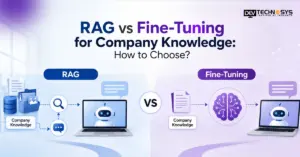
Retrieval-Augmented Generation (RAG) lets an AI tutor answer from your approved curriculum instead of relying only on what a public LLM learned during training.
What Can Go Wrong Without RAG
- Answers that go beyond the syllabus
- Incorrect facts presented confidently
- Explanations at the wrong learning level
- Answers that ignore institutional policy
How RAG Works in an Education App
- Curriculum documents are organized by subject, grade and unit.
- Grade, subject and access rules are added as metadata.
- Content is split into chunks and converted into embeddings.
- When a student asks a question, the system retrieves the most relevant chunks.
- The LLM answers using only the retrieved content.
- The answer shows the source chapter or document as a citation.
- Low-confidence answers are escalated to a teacher instead of guessed.
Important: RAG reduces hallucination but does not eliminate it. Education apps still need an evaluation dataset, source validation and a human escalation path
What Are The Real-World Education Applications That Use Generative AI?
Generative AI is accepted almost everywhere in this technological world, and the education industry is no exception. Here we are with some real-world examples using Generative AI to offer a seamless experience to students.
1. Gradescope
Gradescope is widely applied with the newest trends in the field of developing educational applications, but it is not based on the capabilities of generative AI. The system clusters together student responses to similar questions, so grading is more efficient although teachers still have to impose marks manually following their grading scheme and awarding a final score. The system makes it possible to provide feedback for the students on the same assignments multiple times effectively.
2. Coursera
Coursera is another well-known AI education software development that uses generative AI for personalized recommendations. With generative AI, it also assesses students’ progress and offers automated feedback. It even provides a large-scale online education system that is built to enhance the learning experience of students worldwide.
3. Brainscape
Brainscape predominantly uses generative AI as a core feature. It is included in the list of AI-driven education SaaS platforms. It analyzes the text, notes, or user prompts and provides users with amazing content creation. This app widely uses generative AI in optimizing imported files, images, and coursework into study-ready content.
What Are The Challenges Of Integrating Generative AI In Education App Development?
Despite having so many positive approaches to integrate generative AI in education app development, there are some challenges as well. Here, we will learn about these challenges that help app developers build mobile app development solutions with careful planning.
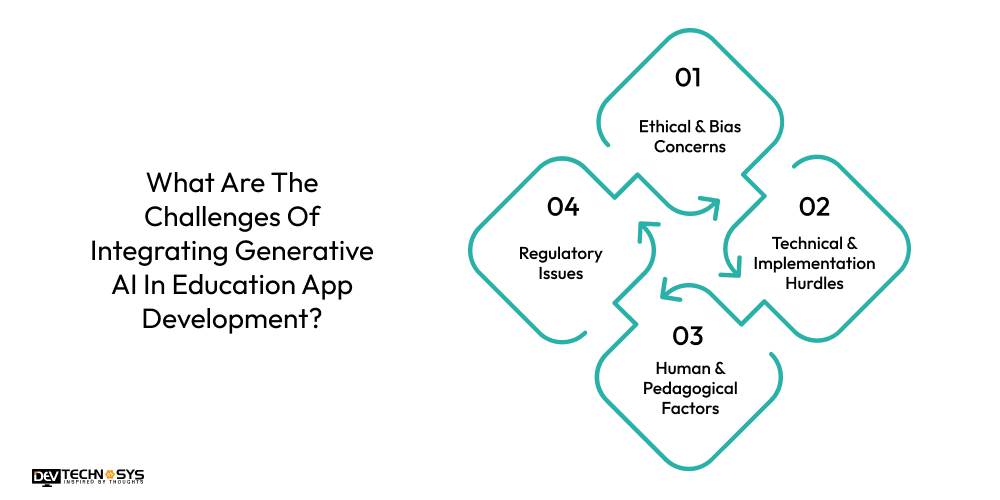
1. Ethical & Bias Concerns
Generative AI can be a red flag reflecting unfair data patterns, which can cause AI bias in education apps. This can strongly affect the learning equality, content accuracy, and user trust. It also makes ethical design and careful monitoring really essential.
2. Technical & Implementation Hurdles
Sometimes, incorporating technical models in Generative AI can be difficult and costly. Usually, AI API integration for EdTech apps needs skilled development teams, robust backend infrastructure, and testing to avoid unreliable AI outputs.
3. Human & Pedagogical Factors
Generative AI in education app development can lead to overdependence on these tools and a reduction in human interaction. This can be the reason for AI hallucination in education apps that can easily confuse the learners in different ways.
4. Regulatory Issues
With generative AI, there are high chances of compliance risks in AI-based learning platforms. These issues arise especially when handling student data and requiring secure systems with maximum transparency.
How Do You Protect Student Privacy and Child Safety in AI Education Apps?
Education AI is not an ordinary business chatbot, especially when children use it. UNESCO’s guidance on generative AI in education calls for a human-centred approach, strong data protection, teacher capacity building and age-appropriate safeguards.
Required Safety Controls
Area |
Controls |
| Age and consent | Age verification or age-band experiences; parent or school consent where applicable |
| Data protection | Data minimization; no advertising based on student data; clear retention and deletion policy |
| Content safety | Harmful-content moderation; bullying and inappropriate-content detection; restricted external links |
| Wellbeing escalation | Defined escalation to trained staff for self-harm, abuse or safeguarding signals |
| AI security | Prompt-injection protection; role-based access; teacher and admin audit logs |
| Answer quality | Source citations; confidence indicators; an “I don’t know” response when sources are missing |
| Fair decisions | Human approval for high-impact decisions; assessment and grading appeal process |
Which Regulations Apply to AI Education Apps?
Regulation / standard |
When it may apply |
What it means for your app |
| FERPA | U.S. education records | Protects access to and disclosure of education records, with rights for parents and eligible students |
| COPPA | Online services directed at U.S. children under 13 | Requires verifiable parental consent (or school authorization in limited cases) and limits data use |
| GDPR | Personal data of people in the EU | Requires a lawful basis, transparency, data rights and data protection by design |
| EU AI Act | AI systems used in the EU | Some education uses, such as admissions, evaluating learning outcomes or proctoring, can be high-risk; each use case needs classification |
| WCAG 2.2 | Digital accessibility | Sets international guidelines for accessible web and app content |
Disclaimer: Applicable obligations depend on users’ age, jurisdiction, institution type, the data collected and the AI system’s intended purpose. Obtain qualified legal advice before deployment.
Which KPIs Measure the Success of an AI Education App?
Engagement alone does not prove that learning improved. Track learning, quality, safety and cost together.
Category |
KPI |
| Learning | Mastery improvement; assessment score gain against a baseline |
| Accuracy | Grounded-answer accuracy on an evaluation dataset |
| Tutoring | Helpful-answer rate from learner feedback |
| Engagement | Lesson completion; return rate |
| Teacher efficiency | Time spent preparing lessons and feedback |
| Safety | Unsafe-response rate; escalations resolved |
| Accessibility | Task completion by accessibility group |
| Reliability | Escalation rate; error rate; response time |
| Operations | Cost per active learner |
| AI quality | Hallucination rate; citation accuracy |
Vanity metrics such as chat volume or the number of generated quizzes should not be treated as proof of learning success.
How Can Education Apps Protect Academic Integrity?
There are varying levels of risk associated with different AI features. An AI suggestion is not equal to an institution’s final outcome and controls need to adhere to that principle.
Risk Level |
Example |
Recommended Control |
|---|---|---|
| Lower | Lesson summary | Source citation |
| Moderate | Practice-question generation | Teacher review |
| Moderate | Course recommendation | Explanation and opt-out |
| High | Automated grading | Human review and appeal process |
| High | Admission decision | Formal governance and validation |
| High | Student-risk profiling | Restricted access and an intervention policy |
| High | Proctoring or biometric monitoring | Legal and proportionality assessment |
How to Reduce AI Misuse
- Show reasoning steps instead of only final answers
- Use hint-first tutoring that guides rather than solves
- Restrict direct answers during assessments
- Generate original practice variations for each learner
- Require citations and AI-use disclosure where relevant
- Set assignment-level AI policies
- Let teachers view AI interaction history
- Avoid relying only on AI-content detectors, which can be unreliable
- Design assessments around application and reasoning
What Are The Future Trends Of Generative AI-Powered Education Applications?
Somehow, it is true to say that the future of AI is bright, as generative AI in education app development drives smart initiatives. It offers immersive learning, global accessibility, and continuous skill development even in the future. Have a look at the future trends of Generative AI-powered education applications.
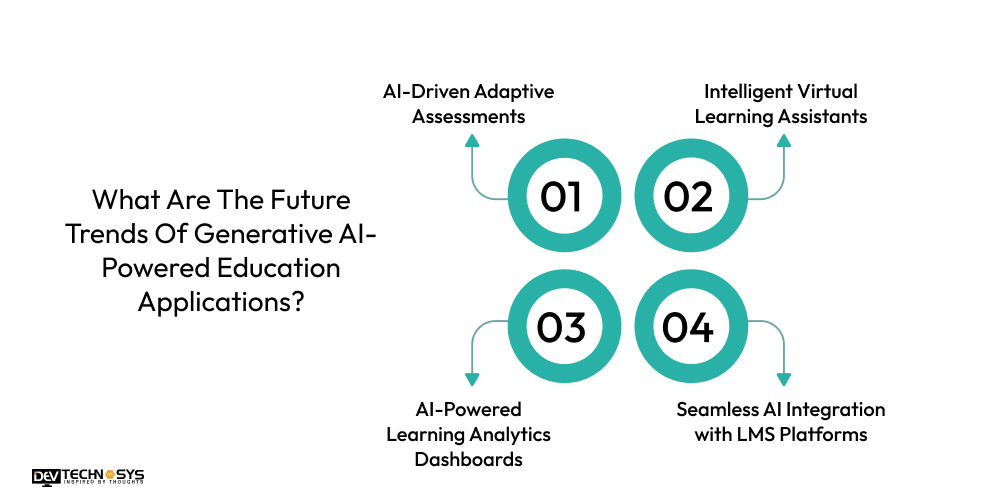
1. AI-Driven Adaptive Assessments
Generative AI in education app development trends creates exams or tests as per the performance and learning of the students. These assessments can become more accurate with the implementation of an AI quiz and exam generator. It helps learners improve through personalized evaluation methods.
2. Intelligent Virtual Learning Assistants
Smart assistants like AI chatbot development for education help students in answering questions effortlessly. With this, learners receive instant support for improving engagement and understanding without depending on constant human availability.
3. AI-Powered Learning Analytics Dashboards
Development companies that build an education app from scratch use analytic dashboards to analyze user progress, behavior, and outcomes. It helps educators make informed decisions while addressing the risks of generative AI in education through data transparency.
4. Seamless AI Integration with LMS Platforms
Generative AI tools can smoothly connect with learning management systems. However, there are compliance risks in AI-based learning platforms that require secure integration. It also ensures data protection, ethical use, and regulatory adherence across digital classrooms.
How to Build an AI-Powered Education App: Step-by-Step Roadmap
- Define the problem: name the learner or teacher problem and the business goal.
- Identify users and regions: confirm age groups and jurisdictions, since these decide consent and compliance needs.
- Set a baseline: measure current learning outcomes before adding AI.
- Audit data and content: review curriculum quality, ownership and student-data sources.
- Classify risk: decide which features are low, moderate or high impact.
- Choose the architecture: select the model, RAG design and hosting approach.
- Design human workflows: define where teachers and admins review, approve or override.
- Build safety and privacy controls: moderation, access rules, logs and retention.
- Create an evaluation dataset: real questions with approved answers to test accuracy.
- Run a limited pilot: one course, grade or user group.
- Measure KPIs: compare learning, safety and cost results with the baseline.
- Scale gradually: expand only after the pilot meets its targets, with ongoing monitoring.
How Much Does It Cost to Build an AI Education App?
At Dev Technosys, the cost to build an AI education app ranges from $30,000 to $150,000. The basic app education app MVP costs less than an advanced application with cross platform support and AI features and functionalities. The final cost to develop an AI education app depend on factors like:
- Number of AI features and whether they use traditional AI, generative AI or both
- Volume and condition of curriculum content for RAG
- LMS, SIS and third-party integrations
- Platforms (web, iOS, Android) and accessibility requirements
- Safety, moderation and compliance requirements for your age group and regions
- Model hosting choice and expected learner volume
- Evaluation, pilot and ongoing monitoring scope
A focused pilot is the most cost-effective way to validate value before a full rollout.
AI + Our Experts: How Dev Technosys Builds AI Education Products
AI speeds up the work. Our experts make sure it is accurate, safe and aligned with how teaching actually happens.
AI layer |
Expert layer |
| Curriculum retrieval | Learning-workflow design |
| Personalized explanations | LMS/SIS architecture |
| Practice-question generation | Data and access rules |
| Learning-gap identification | Age-appropriate safeguards |
| Multilingual support | Teacher-review workflows |
| Student-query classification | Accuracy and bias evaluation |
| Administrative automation | Security controls, and cost and model monitoring |
What You Receive
- AI opportunity assessment
- Learner and teacher workflow map
- Education AI architecture
- Curriculum/RAG data structure
- Working proof of concept
- Safety and evaluation framework
- LMS integration plan
- Deployment and monitoring dashboard
Fine-tuning is not the default answer. We first test prompting, RAG, tools, evaluation and workflow controls, and recommend fine-tuning only when those are not enough.
Why Choose Dev Technosys As Your Trusted AI Education App Development Partner?
Dev Technosys has built software products since 2010 and does business globally with a team of 250+ in-house professionals. The company is appraised at CMMI Level 3 and certified to ISO 9001:2015, maintains an 89% project success rate, and wins most of its new business through client referrals. We have built education apps, tutor apps, online exam portals and school management software, including the Birlingo language-learning app. Being an expert in this industry, we use RAG to connect AI tutors with your approved curriculum, so answers stay within the syllabus and show their sources.
Conclusion
Now, we are done with the blog that explains everything about AI and generative AI in education app development. We hope you have a clear concept of both approaches, because they are transforming the education industry in a productive way.
AI helps analyze student data, automate assessments, and support adaptive learning paths, while Generative AI focuses on creating content, quizzes, and interactive experiences. Together, they enhance learning outcomes, reduce educators’ workload, and improve accessibility for diverse learners.
If you are also seeking an experienced artificial intelligence development company for your app, Dev Technosys can be your best bet. Since 2010, we are the leading providers of custom software for clients around the world,. by combining AI engineering with safety-first, curriculum-grounded product design, we deliver education apps that learners and teachers can trust.
The architecture, RAG, student-safety and compliance sections of this guide were technically reviewed by Mohit Nag, the AI/ML Architects at Dev Technosys, so that the recommendations reflect current best practices in AI education app development.
Frequently Asked Questions
Find answers to the most common questions related to this article.
AI is a system that examines the data and then makes decisions, whereas generative AI develops new and fresh content. Both AI and Generative AI help education apps deliver smarter, more personalized learning experiences.
AI enhances education apps by providing customized learning, automated assessments, tracking progress, and delivering instant feedback. It upgrades the user’s learning efficiency and engagement, while delivering data-driven insights.
AI analyzes data to make predictions, for example, Automated Grading, Predictive Analytics, Recommendation Engines, or Spam Filters/Content Filters. In contrast, generative AI can generate new content from a simple prompt or data, such as Content Creation, Personalized tutors, Interactive Simulations, etc.
The Generative AI is beneficial in an education app development because:
● It creates learning materials & quizzes
● It gives feedback automatically
● It saves time and supports adaptive learning
● It improves engagement
● It allows education apps to scale efficiently
No, AI cannot replace teachers. However, it supports educators by handling routine tasks and providing insights. While teachers guide, motivate, and address the emotional, creative, and critical learning needs of students.
Retrieval-Augmented Generation (RAG) lets an AI tutor retrieve approved curriculum content before answering, so responses stay within the syllabus and can show source citations. It reduces, but does not eliminate, hallucination.
It can be, if the app uses age-appropriate controls, content moderation, data minimization, parental or school consent where required, safeguarding escalation and teacher oversight.
Common ones include FERPA and COPPA in the U.S., GDPR and the EU AI Act in the EU, and WCAG 2.2 for accessibility. The exact obligations depend on users' age, location, institution type and the AI feature's purpose
Track learning outcomes such as mastery improvement, along with grounded-answer accuracy, unsafe-response rate, teacher time saved and cost per active learner.
At Dev Technosys, AI education app projects start from $10,000. Cost depends on AI features, content volume, integrations, platforms and compliance needs.