

















Key Takeaway
-
- The price of a token should not be confused with the price of successful business operations carried out by an AI model. An economic AI model can force the user to retry or refactor tasks more times, which may increase the final expenses to achieve the target and affect AI cost efficiency.
- The price of AI institutions used to accomplish a business task must include model operating costs, infrastructure, expenses for retries, tool charges, and human interventions.
- The following approach can be used to calculate an AI workflow price: Total Workflow Expenses ÷ Number of Completed Tasks.
- To minimize their AI expenses, companies need to measure AI cost at every step, choose the right model, avoid extra AI requests, and optimize their workflows for better task efficiency..
The commitment to Artificial Intelligence in businesses is beginning to shift from test stages to achieving predictable and measurable results. However, utilizing tokens, API calls, or models alone to track the financial spending on AI does not indicate what the organization benefits from.
The interaction with AI can be inexpensive but still costly if the expected results are omitted, repeated, or manually fixed. You can measure AI cost according to the profitability of using AI by comparing the cost of its application to each successfully completed business task, as this links spending to outcomes and supports AI cost benefit analysis.
In other words, it enables you to calculate the total cost of the process and the number of successful outcomes. In this blog, we will explain how to calculate, measure, and reduce AI cost per business task.
What Is AI Cost per Successfully Completed Business Task?
AI cost per completed task measures the total expense required to achieve one acceptable business outcome through an AI-powered workflow. Unlike basic AI cost efficiency metrics, it connects operational spending with actual task completion and business value.
AI Cost vs. Cost per Successful Task
AI cost typically refers to expenses associated with running AI systems, including model inference, API usage, infrastructure, data processing, and related managed AI operations services. Cost per successful AI task goes further by considering whether the AI actually delivers the required outcome.
This metric can account for:
- AI model and API costs
- Infrastructure and processing expenses
- Tool and workflow execution costs
- Retry and failure-related costs
- Human review or intervention
- Monitoring and operational expenses
The basic calculation is:
AI Cost per Business Task (Successful) = Total AI Workflow Cost ÷ Number of Successfully Completed Tasks
This provides a more outcome-focused measurement of AI efficiency than tracking usage or interactions alone.
What Counts as a Successful Business Task?
A successful business task is an AI-assisted task that meets predefined business, quality, and operational requirements. Success criteria should be measurable and aligned with the purpose of the workflow.
Key criteria may include:
- Required accuracy and quality
- Correct output or action
- Completion within the defined timeframe
- Compliance with business rules
- Successful system or workflow execution
- Minimal or no human correction
- Completion without unnecessary retries
Clearly defining successful outcomes ensures that businesses measure AI costs against meaningful results rather than simply counting AI interactions or completed requests.
What Should Be Included in AI Cost Measurement?
A reliable calculation requires more than the model’s advertised token price. AI inference costs are influenced by model complexity, token usage, infrastructure, data movement, and workload patterns.
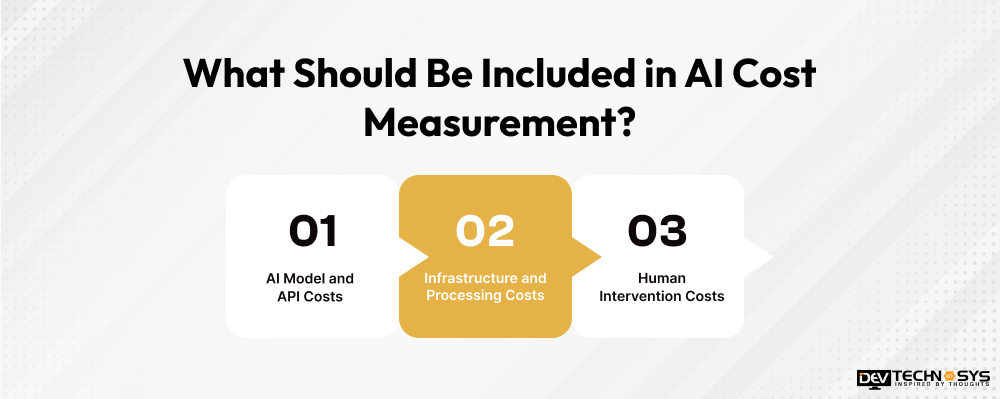
AI Model and API Costs
Include the AI development cost of input and output tokens, model calls, reasoning usage where applicable, embeddings, and other AI APIs involved in completing the workflow.
If an AI agent uses several models during one task, combine their costs instead of evaluating each call separately.
Infrastructure and Processing Costs
AI workflows may also depend on cloud computing, databases, storage, monitoring systems, vector databases, networking, and other infrastructure.
For self-hosted AI, GPU or other compute resources can form a significant part of the overall operating cost. For API-based systems, supporting infrastructure should still be considered when calculating the full AI processing cost.
Human Intervention Costs
Human involvement can significantly change the economics of an AI workflow.
If employees must review, correct, validate, or redo AI-generated work, account for the associated time and labor cost. A model that appears inexpensive at the API level may become more expensive when frequent human intervention is required.
Expert Insight:
AWS recommends right-sizing AI models according to workload requirements because model size, token usage, and hosting choices directly influence inference costs.
Planning to Build an AI Development Project?
Get a quick cost estimate based on your AI features, integrations, and development scope.
- 3 Quick Steps
- 100% FREE
- Hear Back Within 1 Business Day
2 Minutes Read
How to Calculate AI Cost per Successfully Completed Task
The calculation is straightforward once the business defines its workflow and success criteria.
The Basic Formula
AI Cost per Business Task (successful) = Total AI Workflow Cost ÷ Number of Successfully Completed Tasks
The total AI workflow cost can include:
Model/API Costs + Infrastructure Costs + Tool Costs + Retry Costs + Human Intervention Costs
The denominator should contain only tasks that satisfy the predefined success criteria.
Step-by-Step Calculation
Step 1: Identify the business task
Choose one measurable workflow, such as resolving a support ticket, reviewing a document, qualifying a lead, or generating an approved report. This establishes the basis for measuring AI business task automation cost.
Step 2: Track all AI activity
Record model calls, tokens, tool calls, retries, fallbacks, and other AI-related usage connected to each task. These inputs help identify AI usage cost, AI token cost, and AI retry cost.
Step 3: Add supporting costs
Include infrastructure, data processing, monitoring, and human review where applicable to determine the complete AI workflow cost.
Step 4: Define successful completion
Decide what makes a task acceptable before calculating the metric. This establishes a consistent AI task success rate and prevents failed outputs from being counted as successful outcomes.
Step 5: Count successful outcomes
Separate completed tasks from failed, rejected, escalated, or repeated tasks. Tracking the AI task failure rate and successful task completion rate provides a more accurate view of workflow performance.
Step 6: Apply the formula
Divide total workflow spending by successful outcomes to calculate AI cost per outcome, AI inference cost per task, and the overall cost of achieving business results.
How to Measure AI Task Success Accurately
The quality of your cost metric depends heavily on how you define success. If almost every AI output is counted as successful, the resulting AI task cost may look artificially low.
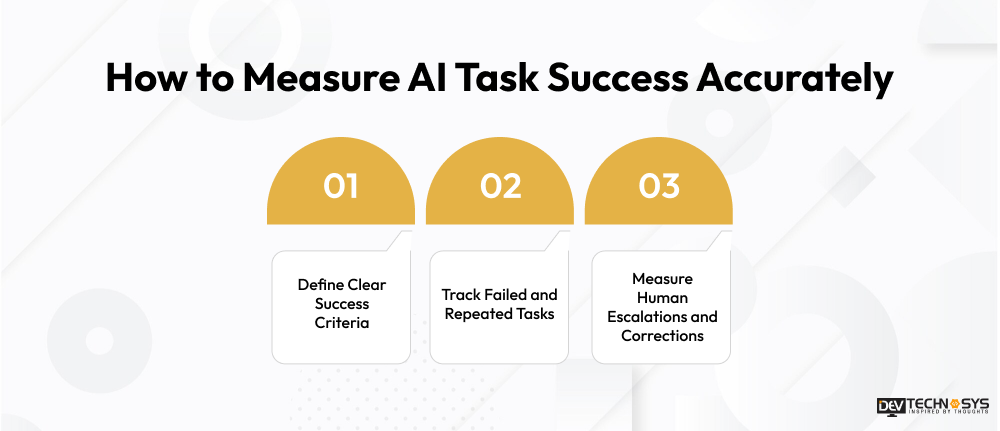
Define Clear Success Criteria
Success should be measurable and directly connected to the business workflow.
For customer support, success could mean a ticket is resolved without escalation. For software development, it could mean AI-assisted code passes required tests. For document processing, it could mean extracted information meets a specified accuracy threshold.
Track Failed and Repeated Tasks
An AI system may require several attempts before completing one task. Each retry can consume additional tokens, computing resources, and employee time.
Therefore, track:
- Initial attempts
- Retries
- Failed outputs
- Regenerations
- Fallback model usage
- Rejected results
This prevents businesses from underestimating the true AI cost per business task.
Measure Human Escalations and Corrections
Human intervention is another important indicator. If AI completes 90% of a workflow but employees must manually fix 30% of the outputs, the business should include that effort in its cost analysis.
The objective is not simply to increase AI task completion cost. It is to increase accepted, useful outcomes at an economically sustainable cost. You should gradually include AI integration services in your project for lower costs.

AI Cost per Task vs. Cost per Successful Task: What’s the Difference?
AI cost per task measures how much a business spends each time an AI system processes a request or performs an action. However, this metric does not account for failed outputs, retries, corrections, or human intervention.
AI cost per successful task provides a more practical view by measuring the total cost required to achieve an acceptable business outcome. For example, if an AI system processes 1,000 tasks but successfully completes only 800, the cost should be divided by 800 successful outcomes rather than 1,000 attempts.
Metric |
AI Cost per Task |
AI Cost per Successful Task |
| Measures | AI usage | Business outcomes |
| Includes failures | Usually no | Yes |
| Includes retries | May be excluded | Included |
| Human intervention | Often overlooked | Can be included |
| Business relevance | Limited | Higher |
For businesses evaluating ROI, AI cost per business task offers a clearer picture of whether an AI workflow is delivering efficient and valuable results.
Businesses should not automatically choose a model based on the lowest token or API price. They can also hire AI developers from AI service providers for a good AI task success rate. A more capable model can sometimes produce an acceptable result with fewer retries or less human intervention. OpenAI’s current AI economics framework similarly highlights the difference between token cost and the full cost of producing a successful outcome.
For agentic workflows, this distinction becomes even more important because one business task can involve multiple model calls, tools, reasoning steps, and external systems.
Expert Insight:
Gartner reports that more sophisticated AI workflows use significantly more tokens than simple chatbot interactions, increasing overall inference costs.
How to Reduce AI Cost per Successfully Completed Business Task
Once the metric is established, businesses can optimize the workflow rather than simply trying to reduce AI usage.
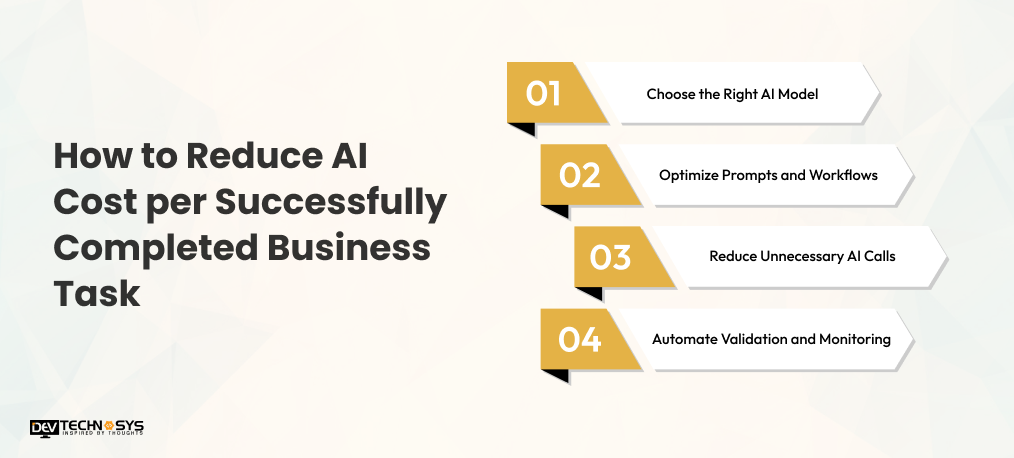
Choose the Right AI Model
Not every task requires the most powerful model. Use models according to task complexity, accuracy requirements, response time, and workload volume.
Simple classification or extraction tasks may be handled by a smaller model, while complex reasoning tasks may justify a more capable model.
Optimize Prompts and Workflows
Poorly designed prompts can increase token consumption and generate unnecessary outputs. Clear instructions, structured context, reusable prompts, and concise inputs can reduce unnecessary processing.
Workflow design also matters. Remove redundant model calls and avoid asking multiple AI systems to perform overlapping work.
Reduce Unnecessary AI Calls
Use rules, deterministic code, caching, or existing business logic where AI is not necessary.
For example, a workflow does not need an AI call to validate a fixed numerical range if a simple software rule can perform that check reliably.
Reducing unnecessary inference can directly lower operating costs. Current enterprise guidance identifies model selection, token reduction, caching, infrastructure optimization, and workload management as important AI cost-control levers.
Automate Validation and Monitoring
Automated validation can identify incorrect outputs before they reach employees or customers. Monitoring can also reveal expensive workflows, excessive retries, unusually high token consumption, and declining success rates.
Businesses should regularly compare:
Total AI Cost → Successful Tasks → Cost per Successful Task → Success Rate
This creates a continuous feedback loop for improving AI economics.
Conclusion
Doing calculations of the cost of AI per business task leads to more clarity on how valuable the investments in AI technologies were. Instead of focusing only on the number of tokens, the number of API calls, or the price of the source model, this approach provides opportunities for linking total cost for workflows with the cost of successfully performed business processes.
The calculations require that the specific business add the necessary AI costs, costs of infrastructure (for example, costs for accessing output), costs of retrying if AI processes fail, as well as expenses related to intervention of personnel only for the tasks that were successful.
This approach helps to reveal inefficient workflows since the firms will be able to monitor this metric continuously. Businesses can also take help from an experienced AI development company, such as Dev Technosys, for affordable AI costs.
Frequently Asked Questions
Find answers to the most common questions related to this article.
The AI cost per business task refers to the total amount of money spent by businesses to be able to achieve one successful business task. This cost includes AI usage, infrastructure, integration, monitoring, and AI operational costs of the business related to completed tasks.
To calculate this cost, divide total costs associated with AI for the selected time frame by the number of successful business tasks completed during the same period of time. Make sure to include model usage and infrastructure utilization costs as well as API fees, maintenance, monitoring, and other operational costs in order to get a more realistic measure of this cost.
The AI cost per business task helps determine if the implementation of AI is a feasible choice in financial terms. It goes beyond just measuring costs and instead relates AI costs to measurable business results and allows for better identification of mismatches, optimization of processes, and assessment of ROI.
Companies need to account for the charges of the model or API, the costs involved in the cloud infrastructure, data processing, storage, integration, monitoring, maintenance, security, and supervision. Considering both direct and operational costs helps in providing a clearer picture of the costs related to each AI-powered business process.
In order to lower the costs of AI processing for each operation, business enterprises have several options available to them, such as improving their prompts, using affordable models, avoiding unnecessary API calls, enhancing their performance, keeping repeated data stored, automating complementary processes, and assessing the achievements of their operations.