


















Key Takeaways:
-
- Define a Clear Niche: Build around a specific audience, community need, and repeat interaction.
- Prioritize the MVP: Start with essential features before adding advanced AI, live streaming, or marketplace capabilities.
- Plan Your Budget: Social media app development can cost $15,000–$40,000+, depending on features, platforms, integrations, AI, security, and scalability
- Use AI Strategically: Apply AI to recommendations, moderation, personalization, search, and analytics where it adds measurable value
- Secure User Data: Build authentication, authorization, encryption, privacy, moderation, and compliance into the platform from the start
- Measure Business Performance: Track retention, engagement, LTV, monetization, and ROI instead of focusing only on downloads.
If you want to launch a social platform in late 2026, you can’t just copy the features of Instagram, Facebook, or TikTok leading into 2027. There is a much stronger opportunity to target a specific community with a focused product, better user experience, and a clear reason for people to return. Businesses who decide to build a social media app need to think beyond the profiles and simple feeds. Aside from this, they need to look out for product strategy, scalable architecture, AI, privacy, security, and monetization, all influencing long-term success.
Whether you plan to develop a social media app for creators, professionals, interest groups, or private communities, the development approach should match your audience and business model. This guide explains how to plan, design, build, secure, launch, and scale a social media app in 2026.
Why Build a Social Media App in 2026?
The opportunity to design a social media app is no longer limited to creating another general-purpose network. Users now engage with platforms built around specific interests, professional communities, creators, entertainment, commerce, and private interactions. This gives businesses room to pursue social media platform development around a clearly defined audience and purpose. A focused mobile social network can also compete through stronger community experiences instead of trying to match every feature offered by established platforms.
Social Networking App Market in 2026
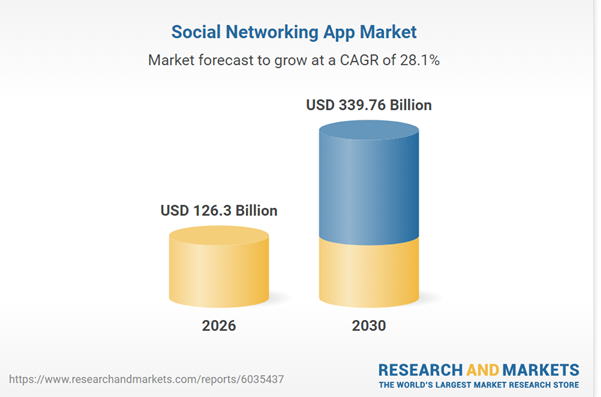
- According to Research and Markets, the global social networking app market is expected to reach $126.3 billion in 2026.
- The market is projected to reach $339.76 billion by 2030 at a 28.1% CAGR.
- Asia-Pacific was the largest regional market in 2025.
- AI-powered recommendations, social commerce, short-form video, cross-platform access, and stronger privacy controls are among the major market trends.
These figures create opportunities for specialized products, but market size alone does not guarantee adoption. The right social networking business model should connect the audience, core interaction, monetization strategy, and product experience. Businesses can also study top social media applications for businesses to understand different platform opportunities.
What Type of Social Media App Should You Build?
Before you develop a social media app, determine the kind of user connection you’ll make. It shouldn’t try to reach everyone since the right social networking platform must have a clear audience, core interaction, and monetization path.
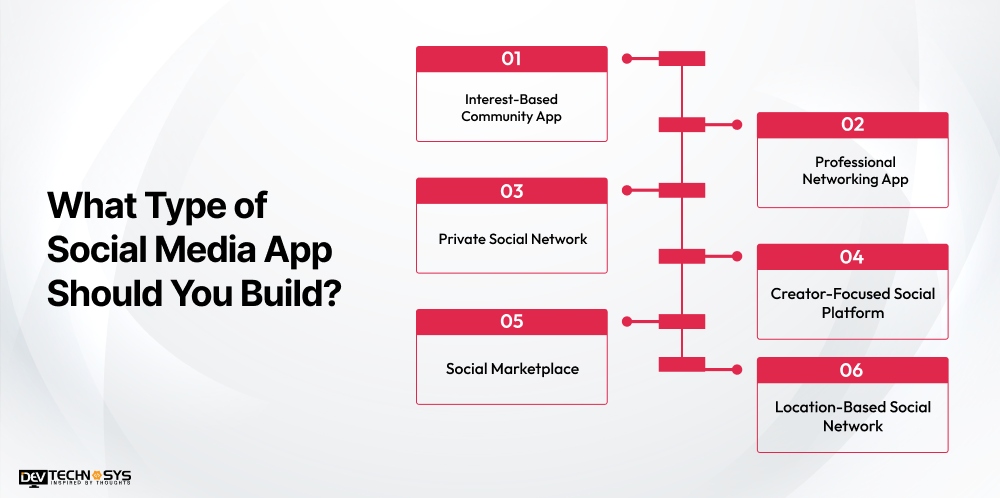
i. Interest-Based Community App
These platforms are designed to connect people with hobbies, interests, causes, or shared experiences. When users require specific areas for conversations, groups, events, and sharing content, community app development is effective.
Example: Developing a platform inspired by Meetup can be based around purposeful interaction in communities.
ii. Professional Networking App
A business-oriented social networking app for careers, industry, skills, and business opportunities. It can make its core experiences profiles, professional groups, messages, job discovery, recommendations, and knowledge sharing.
Example: LinkedIn focuses on professional profiles, networking, jobs, and industry conversations.
iii. Private Social Network
Private networks are networks for closed communities like schools, organizations, associations, families, or member groups. This type of custom social media app can offer content sharing, events, private discussions, announcements, and controlled access, as well as secure content sharing.
Example: Mighty Networks supports private communities, memberships, discussions, and events.
iv. Creator-Focused Social Platform
The platforms are creator-based and audience-focused. There are multiple ways content publishing, followers, live interaction, subscriptions, digital products, and creator analytics can help grow engagement and revenue.
Example: Patreon helps creators build audiences through memberships and exclusive content.
v. Social Marketplace
A social marketplace is a platform that brings together community interactions and buying and selling. Users can find products, follow sellers, leave recommendations, communicate on the platform, and make transactions.
Example: Facebook Marketplace combines social discovery with product listings, buyer-seller communication, and transactions.
vi. Location-Based Social Network
A mobile social network can match people by locality, events in locality, activities in locality, or interests in locality. This model has the potential to enable local discovery and to provide opportunities for businesses and communities to participate with local users.
Example: Nextdoor connects people within local neighborhoods for discussions, recommendations, events, and local updates.
6-Step Process to Build a Social Media App in 2026
A strong social media app development process is not simply about moving from design to coding. Each stage should answer a product question, reduce development risk, and create a clear foundation for the next decision.
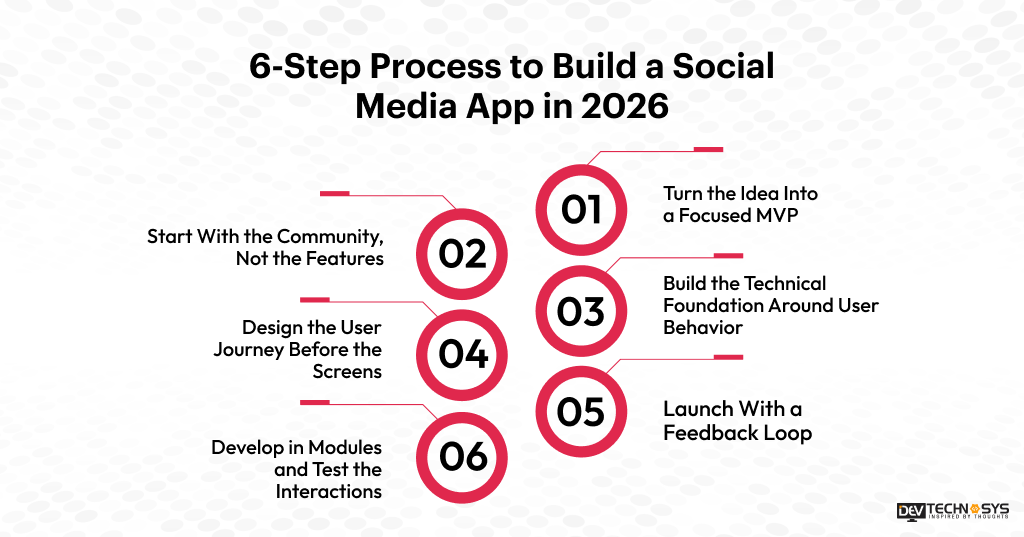
1. Start With the Community, Not the Features
Before you develop a social media app, define the people you want to bring together and the interaction that will keep them returning. Study competing platforms, identify an underserved need, and clarify what your product can do differently.
Ask Before You Build:
- Who are your first 1,000 users?
- What problem will they solve on your platform?
- What will they do repeatedly?
- Why would they invite other users?
The goal is to validate the audience, problem, differentiation, and initial social networking business model before significant development begins.
2. Turn the Idea Into a Focused MVP
To create a social media app, the strategy should start with the smallest product capable of generating meaningful interaction. Avoid spending the initial budget on features users may never need.
Core MVP |
Phase 2 |
Scale-Up |
| Profiles | AI recommendations | Advanced AI |
| Feed | Live streaming | Social commerce |
| Posts | Communities | AR/VR |
| Messaging | Creator tools | Advanced analytics |
| Moderation | Marketplace | Predictive moderation |
This approach gives your team a measurable first release while leaving room to expand based on real user behavior.
3. Design the User Journey Before the Screens
UX should follow the way people actually use the platform:
Sign Up → Profile → Discover → Feed → Interact → Create → Connect → Return
A suitable mobile app development company can turn this journey into wireframes and prototypes while reducing friction at every stage. Onboarding should be quick, discovery should surface relevant people or content, publishing should feel simple, and notifications should encourage useful return visits rather than overwhelm users.
4. Build the Technical Foundation Around User Behavior
Effective social networking app development requires more than selecting popular technologies. Your social platform development architecture should support the relationships and interactions that make the product work.
App → API Layer → Authentication → Social Graph → Feed & Content Services → Database & Cache → Cloud/CDN
The architecture should account for follower or friend relationships, feed generation, media delivery, messaging, notifications, search, moderation, and future scalability. These decisions should be made before development starts because changing the underlying architecture later can increase both cost and technical debt.
5. Develop in Modules and Test the Interactions
Custom social media app development can be organized into four implementation layers:
- Frontend: Profiles, feeds, messaging, content creation, notifications
- Backend: Users, relationships, posts, permissions, moderation, business logic
- Integrations: Payments, analytics, cloud storage, authentication, maps, and third-party APIs
- Testing: Functional → Performance → Security → Usability → Device Compatibility
If specific expertise is missing internally, you can hire dedicated developer resources for specialized frontend, backend, AI, security, or infrastructure work.
6. Launch With a Feedback Loop
Launching the first version is the beginning of product learning. Monitor how users move through the platform, where they stop engaging, and which interactions create repeat usage.
Stage |
Metrics to Track |
| Activation | Profile completion, first interaction |
| Engagement | Posts, comments, messages |
| Retention | D1, D7, D30 retention |
| Community | DAU/MAU, connections per user |
| Monetization | Conversion, ARPU, subscription rate |
Use the results to follow a continuous cycle:
Launch → Measure → Identify Friction → Improve → Test Again
Planning a Mobile App?
Get a tailored development cost estimate in 3 simple steps — app basics, features, timeline, and your contact details.
- 3 quick steps
- 100% free
- Reply in 1 business day
2 Minutes Read
What Features Should a Social Media App Have?
The right features should support the core reason people join and return to your platform. When you build a social media app, prioritize features that make it easy to create content, discover relevant people, build relationships, and participate safely.
Feature |
What It Does |
Why It Matters |
| User Registration & Profiles | Lets users create accounts and personalize profiles | Establishes identity and enables personalization |
| Personalized Feed | Displays relevant posts, updates, and recommendations | Drives content discovery and repeat engagement |
| Content Creation | Supports text, images, video, stories, or other formats | Gives users a reason to participate |
| Follow/Friend System | Connects users through follows, friends, or subscriptions | Builds the platform’s social graph |
| Likes, Comments & Shares | Enables reactions and content interactions | Encourages conversations and content distribution |
| Messaging | Enables private one-to-one or group communication | Strengthens relationships between users |
| Groups & Communities | Creates spaces around interests or specific audiences | Supports community app development and deeper engagement |
| Search & Discovery | Helps users find people, content, groups, or topics | Reduces discovery friction |
| Push Notifications | Alerts users about messages, interactions, and relevant activity | Encourages timely return visits |
| Reporting & Blocking | Lets users report harmful content or restrict accounts | Supports trust, safety, and moderation |
| Admin Dashboard | Gives operators control over users, content, reports, and platform settings | Enables effective platform management |
What to Prioritize While Designing the Features?
When you create a social media app, not every feature needs to launch simultaneously. Start with the capabilities required for the core user interaction, then introduce advanced functionality as adoption grows.
Essential for MVP → Engagement Features → Safety & Moderation → Scale-Up Features
For example, profiles, feeds, content creation, connections, and messaging can form the initial experience. Groups, advanced discovery, creator tools, and marketplace capabilities can follow once user behavior reveals where additional value exists. A platform inspired by developing a social networking app like BAND can also demonstrate how focused communities can become a central part of the product experience.
What Advanced Features Can You Add to a Social Media App?
Once the core product is validated, advanced features can help a social platform improve engagement, retention, personalization, and revenue. If you want to build a social media app that scales, add these capabilities based on proven user behavior rather than launching everything in the first release.
Advanced Feature |
What It Adds |
| AI Recommendations | Personalizes feeds, profiles, groups, and content discovery. |
| Live Streaming | Creates real-time interactions between creators and audiences. |
| Creator Monetization | Supports subscriptions, tips, virtual gifts, and paid content. |
| Social Commerce | Connects product discovery with purchases and creator-led selling. |
| Advanced Communities | Enables niche groups, private spaces, events, and discussions. |
| AI Moderation | Detects spam, abuse, harmful content, and suspicious activity. |
| Marketplace Integration | Adds buying, selling, bookings, or service transactions within the platform. |
| Advanced Analytics | Helps businesses, creators, and administrators understand user behavior. |
What Should You Avoid Building in the MVP?
Do not overload your first release with AR/VR, complex AI systems, large marketplaces, or numerous third-party integrations. A custom social media app should first prove its core interaction, retention, and community value. Later, social media platform development can expand based on real usage data.
For examples of niche platform strategies, see build a social media app like Truth Social.
How Can AI Improve a Social Media App?
AI can make a social media app more personalized, safer, and easier to manage at scale. When you build a social networking app, practical AI use cases include feed recommendations, content moderation, intelligent search, creator insights, and automated support.
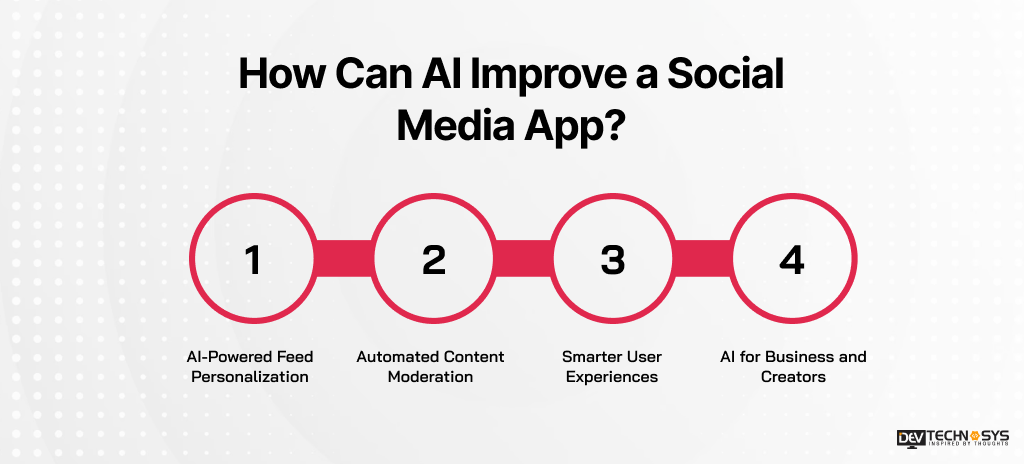
a. AI-Powered Feed Personalization
AI can analyze follows, clicks, watch time, likes, comments, searches, and content preferences to rank relevant posts.
The workflow can move from:
User signals → content candidates → ranking → personalized feed → feedback
This allows recommendations to improve as users interact with the platform.
b. Automated Content Moderation
For a growing platform, manual moderation alone can become difficult. AI can classify uploaded content, identify spam or abusive behavior, assign risk scores, and route high-risk cases to human moderators. This creates a faster moderation process while keeping human oversight for sensitive decisions.
c. Smarter User Experiences
If you create a social media app, AI can also support intelligent search, profile recommendations, automated captions, translation, content suggestions, chatbots, and spam detection. These capabilities can reduce friction while helping users discover relevant people and communities.
d. AI for Business and Creators
In social platform development, AI can analyze engagement patterns to identify trending topics, audience segments, churn signals, and content performance. Creators can use these insights to understand their audiences, while administrators can make better product and monetization decisions.
AI can also improve content discovery by identifying user interests, predicting relevant posts, and suggesting communities. This approach connects naturally with broader strategies around AI in Social Media, particularly when personalization becomes a core part of the product experience.
How Does Social Media App Architecture Work?
A scalable social media app architecture connects the user interface, APIs, authentication, social graph, content services, databases, caching, and cloud infrastructure. When you build a social media app, these layers must work together to deliver fast feeds, secure interactions, reliable messaging, and smooth content delivery.
What Are the Core Architecture Components?
A typical social networking app architecture follows this flow:
App → API Layer → Authentication → Feed & Content Services → Database & Cache → Cloud/CDN
- Frontend: Handles profiles, feeds, messaging, notifications, media uploads, and user interactions.
- API Layer: REST API connects the client with backend services and manages data requests.
- Authentication: Manages sign-up, login, sessions, permissions, and access controls.
- Content Services: Manages posts, comments, reactions, media, notifications, search, and moderation.
- Database & Cache: Stores user, content, relationship, and interaction data while caching frequently requested information.
- Cloud Infrastructure: Supports scalability, backups, monitoring, storage, and traffic management.
Planning a Community App Project?
Get a tailored development cost estimate in a few simple steps.
- 3 quick steps
- 100% free
- Reply in 1 business day
2 Minutes Read
What Technology Stack Is Best for Social Media App Development?
The right social media app technology stack depends on your target platforms, expected traffic, real-time interactions, media volume, security requirements, and scalability goals. A flexible architecture helps social media app development teams add features without rebuilding the entire platform.
Layer |
Recommended Technologies |
Purpose |
| Mobile | Android, iOS, Cross-Platform | User-facing applications |
| Backend | Node.js, Python, Django | Server-side logic and scalable services |
| APIs | REST API | Communication between app and backend |
| Database | PostgreSQL | User, content, and interaction data |
| Cloud | AWS | Hosting, storage, scaling, and backups |
| Real-Time | WebSockets, WebRTC | Messaging and live interactions |
| Media | Cloud Storage, CDN | Efficient image and video delivery |
| Search | Elasticsearch/OpenSearch | User, post, and content discovery |
How Should You Choose the Technology Stack?
For social networking app development, technology decisions should follow product requirements rather than popularity. Android requirements may differ from those handled through dedicated iOS development expertise, while cross-platform products can consider hybrid app development services to reduce duplicated development effort.
Expert Insight
“Having delivered 10+ social media apps, we select technologies based on real-time needs, scalability, security, integrations, platforms, and long-term maintenance.”
Promod Jangid, Technical Head, Dev Technosys
How Long Does It Take to Build a Social Media App?
A social media app can take around 3–6+ months to develop, depending on feature complexity, platforms, integrations, team size, testing requirements, and whether you are launching an MVP or an enterprise product.
Development Stage |
Estimated Time |
Key Activities |
| Discovery & Planning | 1–2 weeks | Requirements, audience research, feature planning, technical architecture |
| UI/UX Design | 1–3 weeks | User flows, wireframes, interface design, prototypes |
| MVP Development | 6–12 weeks | Frontend, backend, APIs, database, and core social features |
| Testing & Security | 2–4 weeks | Functional testing, performance checks, security testing, and bug fixing |
| Launch Preparation | 1–2 weeks | Deployment, app-store preparation, analytics, monitoring, and final checks |
To develop a social media app faster, start with a focused MVP and add advanced capabilities after validating user behavior. AI systems, live streaming, complex social graphs, enterprise integrations, and extensive security requirements can extend the overall timeline.
Expert Insight
“Our 10+ social media projects help us estimate timelines using actual development dependencies, platform requirements, integrations, testing, and feature complexity.”
Navneet Rajput, Project Delivery Head, Dev Technosys
How to Ensure Privacy and Security in a Social Media App?
Security should be incorporated into a social media app from the beginning of the architecture and development process, at launch, and then through continuous maintenance. With its expanding user base, it becomes increasingly important to minimize risks with strong authentication, authorization, encryption, secure APIs, moderation, monitoring, and privacy controls.
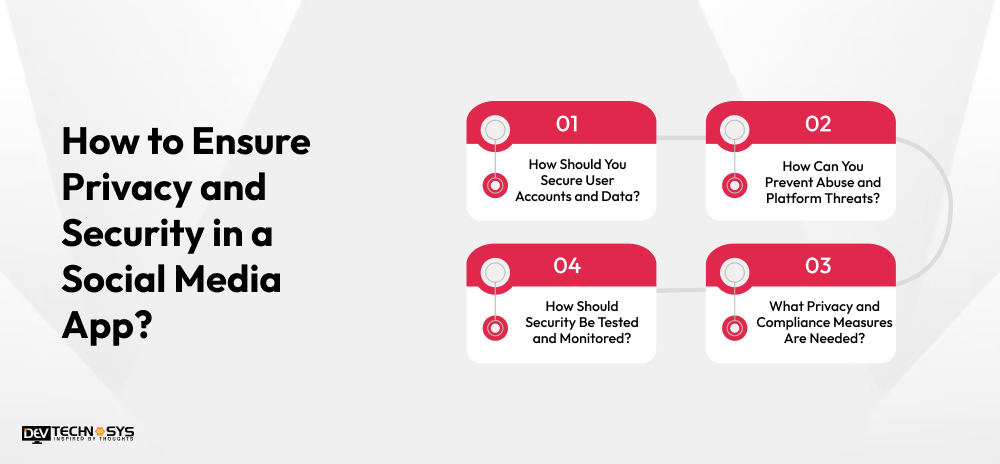
1. How Should You Secure User Accounts and Data?
Use strong authentication, role-based access control, secure session management, and “least privilege” permissions first. Personal and platform information ought to be safeguarded by encryption, secure APIs, and monitored storage. The OWASP mobile application security project aims to deliver security standards, common weakness guidelines, and mobile application testing resources.
We adhere to OWASP secure coding practices and encryption at rest & data security to help foster better mobile app security and social networking security.
2. How Can You Prevent Abuse and Platform Threats?
For social platforms, there are requirements for spam, harassment, malicious content, account abuse, and automated attacks. Blocking, reporting, content review, DDoS protection, and audit logs should complement each other. Content moderation & abuse prevention can help this layer, and vulnerability assessment and penetration testing can identify vulnerabilities so that attackers cannot exploit them.
3. How Should Security Be Tested and Monitored?
Security must be maintained after launch via regular security audits, vulnerability assessments, penetration testing, monitoring, and security incident response procedures. NIST Cybersecurity Framework 2.0 establishes a methodical way for businesses to comprehend, evaluate, prioritize, and discuss cyber risks.
DevTechnosys also takes security measures in line with other best practices and standards set by ISO/IEC 27001 and SOC 2, depending on the extent of the application and engagement.
4. What Privacy and Compliance Measures Are Needed?
When deciding on GDPR compliance, CCPA compliance, and overall data privacy compliance, it must be done based on data collected in the market and the data being used. Moreover, platforms catering to younger audiences must be more robust in safeguarding children’s privacy, COPPA compliance, consent, data collection, data retention, and age verification where applicable.
We adhere to GDPR Data Protection, CCPA Data Privacy, and ISO 27701 privacy practices that offer strong security coverage.
A practical security lifecycle is:
Prevent → Detect → Respond → Audit → Improve
This approach helps a social media app adapt its security controls as users, content, integrations, and regulatory responsibilities increase.
How Much Does It Cost to Build a Social Media App in 2026?
The cost to build a social media app can range from $15,000 to $40,000 depending on the range of features, functionalities, platform, and more. While enterprise platforms with AI and major functionalities start at $40,000+, the final budget depends on features, platforms, integrations, security, and scalability.
Development Level |
Estimated Cost |
Typical Scope |
| MVP Social Media App | $15,000–$25,000 | Registration, profiles, basic feed, posts, likes, comments, follows, basic messaging, notifications, and admin controls |
| Mid-Level Social Media App | $25,000–$35,000 | Groups, communities, real-time chat, media sharing, advanced search, analytics, and moderation |
| Advanced Social Media App | $35,000–$40,000 | Live streaming, creator tools, recommendation features, social commerce, third-party integrations, and stronger scalability |
| Enterprise Social Media App | $40,000+ | AI personalization, AI moderation, predictive analytics, advanced social graph, enterprise integrations, high-scale infrastructure, multilingual capabilities, and major custom functionality |
What Factors Affect Social Media App Development Cost?
The social media app development cost increases as product requirements become more complex. The main factors include:
- Platform Selection: Building for Android, iOS, or both affects development and testing requirements.
- UI/UX Complexity: Custom interfaces, animations, onboarding flows, and accessibility requirements can increase design effort.
- Real-Time Features: Messaging, live interactions, voice, and video require additional backend and infrastructure capabilities.
- AI Functionality: Recommendations, AI moderation, personalization, predictive analytics, and generative features can increase development and infrastructure costs.
- Media Infrastructure: Image and video storage, processing, CDN usage, and bandwidth can add ongoing expenses.
- Third-Party Integrations: Payment gateways, maps, analytics, authentication, advertising, and other APIs can affect development and maintenance costs.
- Security and Compliance: Encryption, access controls, security testing, privacy requirements, and regulatory compliance add development and testing work.
- Scalability Requirements: A platform designed for large user volumes needs stronger cloud infrastructure, caching, monitoring, and performance optimization. Businesses planning to create a social media app should also account for post-launch expenses. Infrastructure, security updates, bug fixes, feature improvements, monitoring, and technical support contribute to ongoing costs.
After launch, regular updates, infrastructure management, security improvements, and technical support also contribute to the mobile app maintenance cost. Planning these expenses early helps avoid unexpected costs as the platform grows.
Expert Insight
“After building 10+ social media apps, we estimate costs using actual feature complexity, platforms, integrations, security, AI, and scalability requirements.”
Mohit Nag, CTO, Dev Technosys
Which Monetization Models Work With Niche Social Media Apps in 2026?
A social media app can generate revenue through advertising, subscriptions, creator payments, virtual goods, sponsored content, paid communities, and marketplace transactions. When you go through development, the right model should match your audience, engagement patterns, and overall social networking business model.
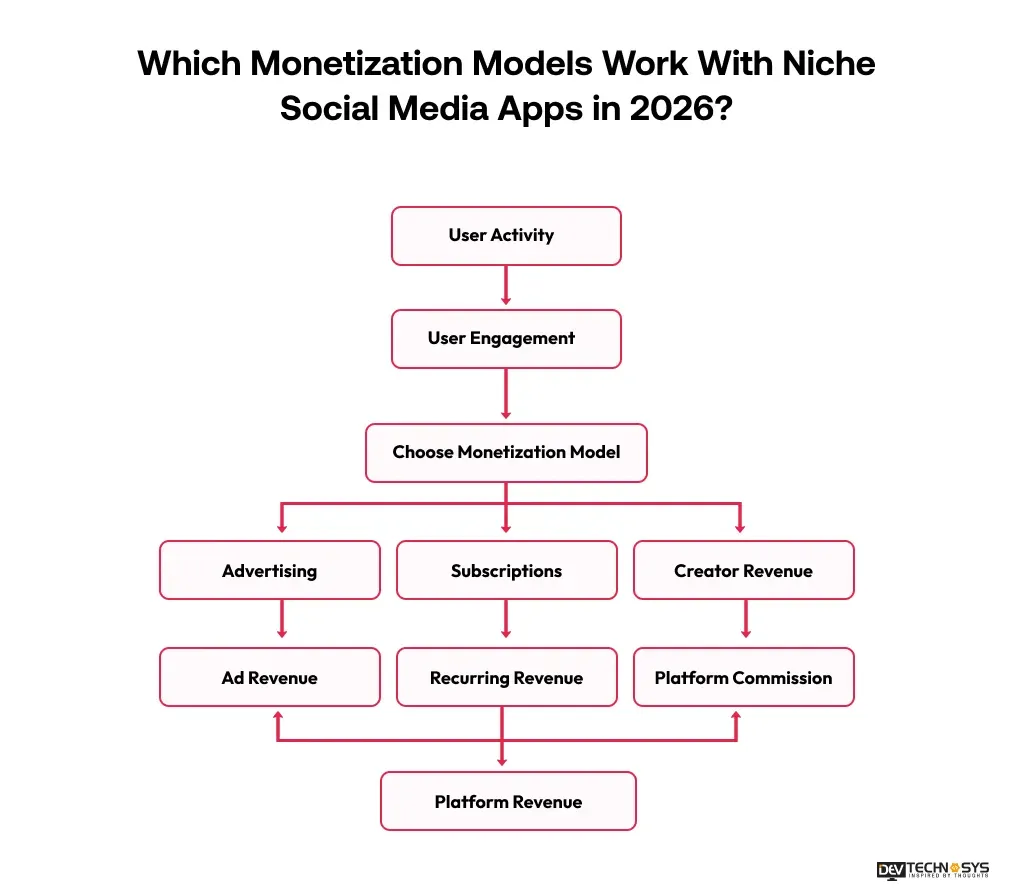
Monetization Model |
How It Works |
Best Fit |
| Advertising | Sponsored posts, display ads, and video advertising | Large user bases |
| Premium Subscriptions | Users pay for advanced features or ad-free access | Professional or niche communities |
| Creator Subscriptions | Followers pay creators for exclusive content | Creator-focused platforms |
| Virtual Gifts | Users purchase digital items for creators or interactions | Live and social engagement |
| Sponsored Content | Brands pay for campaigns and promoted content | Interest-based communities |
| Paid Communities | Members pay for access to exclusive groups | Expert and niche networks |
| Marketplace Fees | The platform charges a fee on completed transactions | Social commerce platforms |
How Should Monetization Influence Product Development?
Monetization should be considered before development rather than added after launch.
- Subscription plans require payment and entitlement systems.
- Creator monetization needs earnings dashboards and payout workflows.
- Advertising requires ad-management infrastructure and analytics.
- Marketplace features need secure payments, seller workflows, and transaction tracking.
These requirements should be reflected early in social platform development so revenue features can scale with user growth.
How to Maximize ROI From a Social Media App?
ROI depends on more than downloads. When you make a social media app, long-term returns come from user retention, engagement, customer lifetime value, efficient acquisition, and sustainable monetization. Businesses should track these metrics from the MVP stage and use them to guide product decisions and custom social media app development.
ROI Metric |
What It Measures |
| CAC | Cost required to acquire each user |
| LTV | Revenue generated by a user over their lifetime |
| DAU/MAU | Daily engagement compared with monthly activity |
| Retention Rate | Percentage of users who continue returning |
| Churn Rate | Percentage of users who stop using the platform |
| ARPU | Average revenue generated per user |
| Conversion Rate | Users completing valuable actions |
What Can Improve Social Media App ROI?
Focus on the onboarding experience, then engage with them through meaningful interactions, personalization, relevant content, and communities for better retention. Tools like analytics can be used to pinpoint areas of drop-off, which can help identify high-impact improvements.
Businesses can also collaborate with experienced social media app development services to fine-tune the app, add monetization mechanisms, and expand infrastructure based on real users’ demand.
Why Choose DevTechnosys for Social Media App Development in 2026?
Selecting the right development partner has the potential to impact the success of the idea, transitioning from product strategy to product launch and scaling. DevTechnosys integrates product planning, scalable design, UI/UX development, testing, security, and continuous support to make a social media app that meets the unique needs of a community and company. It is a social media app development solution that can be customized to suit various audiences, messaging, monetization, and growth phases.
What Makes DevTechnosys Suitable for Social Platform Development?
Building a social networking platform is not as simple as just profiles and feeds. The team is able to assist in planning the social graphs, content workflows, messaging, communities, moderation, AI-driven features, analytics, and third-party integrations. This helps ensure that architecture and feature priorities stay focused on business objectives and support custom social media app products. Community app development can narrow down the experience for niche platforms to specific user behaviors.
Coddle Case Study: A Social Platform for Pet Owners
- Idea & Challenge: Coddle was developed around the idea of creating a dedicated social experience for pet owners, giving users a focused environment built around their shared interests and pet-related interactions.
- How Did Dev Technosys Overcome Them: DevTechnosys approached the product as a specialized community platform, focusing the application experience around its target audience and the social interactions relevant to pet owners.
- Goal & Achievements: The goal was to create a dedicated digital community where pet owners could connect and interact around a shared interest. This project demonstrates how niche-focused social platform development can translate a specific community concept into a digital product.
- App Features: Personal profiles, follow and unfollow friends, incident map view, earn rewards, post videos and images, add incidents
- Time Duration: 34 Weeks
View the Coddle Pet Application Case Study
Free App Idea Reality Check: Let's Stress-Test Your Concept
Share your app idea with us. Within 3 business days, we'll uncover UX gaps, feature opportunities, and potential development challenges, so you can build with confidence. No strings attached.
Conclusion
The key to success in social media app development in 2026 is to begin with a clear audience, concentrate on a focused MVP, and have a solid motivation for customers to return. Your features, technology, AI, security, and monetization strategy should be based on the right product strategy, not vice versa.
Scalable architecture, personalization, community engagement, privacy, moderation, analytics, optimization, and more are all crucial as the platform expands and evolves. For companies looking to build a social media app, it is recommended to work with a social media app development company with a technical understanding and community-oriented product strategy. Your platform can go from an idea to a successful and measurable user and business community, with the right strategy.
Dev Note: This blog has been reviewed by Navneet Rajput, Project Delivery Head, Dev Technosys.
Frequently Asked Questions
Find answers to the most common questions related to this article.
The social media app development cost can range from $15,000 to $40,000+. The price of an MVP ranges from $15000 to $25000, and for advanced and enterprise platforms, the price increases depending on features, AI, integrations, security, and scalability.
A social media app can take around 3–8 months to develop. An MVP with core features may launch faster, while advanced platforms with AI, live streaming, complex social graphs, integrations, and extensive security requirements require additional development and testing time.
Essential features include user registration, profiles, personalized feeds, content creation, follows or friendships, likes, comments, sharing, messaging, notifications, search, groups, reporting, blocking, and administrative controls. Later, advanced platforms can introduce live streaming, AI recommendations, creator tools, social commerce, and so on.
AI can enhance personalization, content discovery, content moderation, search, content recommendations, customer service, and analytics. For instance, engagement signals can be leveraged to prioritize relevant content in recommendation models, and AI moderation can be employed to detect spam, abusive content, and even potentially harmful content for review.
Security solutions include robust authentication, authorization, encryption, secure APIs, access control, vulnerability assessments, penetration testing, monitoring, moderation, and audit logs. There should also be appropriate data collection, retention, consent, and compliance procedures for the markets being served, which should reflect the privacy requirements.