
















Key Takeaways
The social media app development cost in 2026 typically ranges from $20,000 to $150,000+, depending on feature complexity, platform coverage, backend architecture, security, integrations, scalability, and business requirements.
Cost Based On Social Media App Complexity:
-
- Basic Social Media App ($20,000–$45,000): User profiles, feeds, posts, likes, comments, following, and notifications.
- Mid-Level Social Media App ($45,000–$80,000): Real-time messaging, media sharing, stories, search, moderation, and advanced user interactions.
- Advanced Social Media App ($80,000–$150,000+): Live streaming, AI-powered recommendations, advanced moderation, real-time features, and scalable infrastructure.
Cost Factors On Social Media App Requirements:
-
- Feature Requirements: Profiles, feeds, posts, messaging, stories, live streaming, notifications, and content moderation increase development effort as functionality becomes more advanced.
- Platform Requirements: Android, iOS, cross-platform, or separate native applications affect development, device compatibility, testing, and maintenance costs.
- Backend & Scalability: Real-time communication, database optimization, APIs, cloud infrastructure, media storage, and scalable architecture add to backend development costs.
- Security & Integrations: Authentication, encryption, privacy compliance, payment gateways, analytics, moderation tools, and third-party APIs can increase engineering, testing, and ongoing expenses.
Social media app development doesn’t mean just designing an engaging interface and launching it to connect users and talk. It starts with understanding the market, building upon it, then the development part, and ultimately maintenance and support services. This makes the social media app development cost a crucial part to understand before you begin.
Compare counterparts: a basic community platform and a media-heavy social network. Both require different development approaches depending on features and functionalities such as real-time messaging, video sharing, live streaming, personalized feeds, and content moderation, which can significantly influence the overall scope.
To understand the initial development budget and then move on to the overall cost, this blog will give you a clear picture of how much it costs to develop a social media app in 2026. We will break down the major cost drivers, components, platforms, development stages, ownership expenses, and monetization strategies to help you plan your investment more accurately.
What is the Average Social Media App Development Cost in 2026?
The cost to build a social media app in 2026 starts from $20,000 and ranges up to $150,000+. The final cost of development is dependent on the range of features, platform choice, app complexity, and business requirements. The mobile app development cost is further influenced by functionalities, advanced features such as AI, and a major part goes to building infrastructure for security and compliance.
| App complexity | Estimated cost | Typical scope |
| Basic | $20,000–$40,000 | Profiles, feed, posts, likes, comments, notifications |
| Mid-level | $40,000–$80,000 | Messaging, media sharing, stories, search, moderation |
| Advanced | $80,000–$150,000+ | Live streaming, advanced moderation, recommendations, scalable infrastructure |
These average costs are estimated by our team after analyzing the 12 social media apps we have created in the past. The final cost depends on your business’s requirements and long-term goals.
– Promod Jangid, CTO, Dev Technosys
What Factors Affect Social Media App Development Cost?
Several variables determine the final development budget, from feature complexity and backend architecture to platform choices, team expertise, and business requirements.
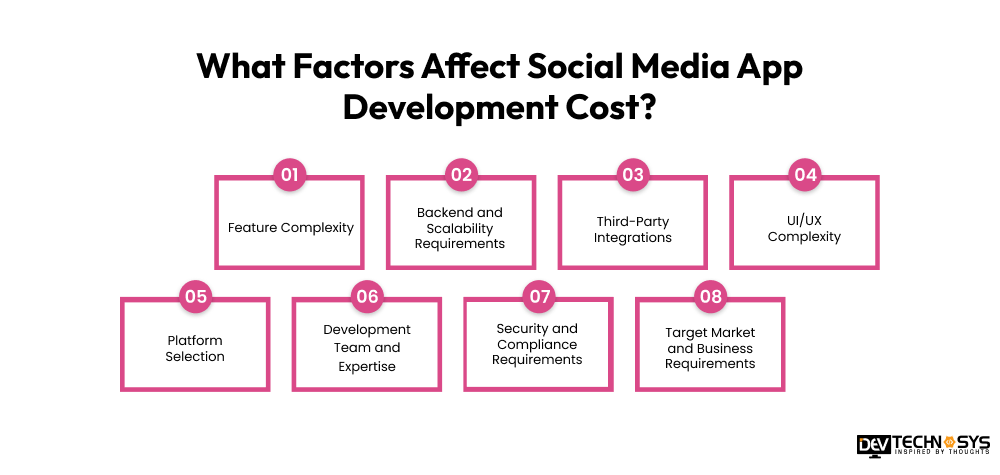
1. Feature Complexity
Basic features like user profiles, feeds, likes, and comments require less effort to develop in the app. Messaging, storytelling, live streaming, media sharing, and content moderation are advanced features that require extra engineering and testing. The scope of social media app development services is a major factor influencing development cost.
2. Backend and Scalability Requirements
A platform that supports rapid growth needs a scalable back-end infrastructure from day one. For example, building a real-time messaging app requires WebSockets; increased data volumes require database optimization and reliable cloud infrastructure. And building these according to your requirements varies the cost.
3. Third-Party Integrations
External services incur development and ongoing expenditures such as API integrations & testing for payment gateways, authentication providers, analytics systems, cloud storage, media processing, and moderation tools. REST APIs or GraphQL APIs can also be chosen depending on the design and integration requirements of the application.
4. UI/UX Complexity
Custom interfaces demand more time to design and develop than standard layouts. Interactive feeds, animations, personalization, media creation, accessibility, and complicated navigation can all contribute to the burden. A good interface also needs usability testing to make sure that users are able to use the platform seamlessly across supported devices.
5. Platform Selection
The platform you develop for, Android, iOS, or both, affects the total scope. Native development can result in different code bases, while cross-platform techniques can minimize repeated development efforts. Device compatibility, operating system versions, performance requirements, and platform-specific testing also affect the ultimate cost of social networking app development.
6. Development Team and Expertise
A simple social media app development project needs mobile developers, backend engineers, UI/UX designers, QA specialists, and DevOps. Factors like developer experience, team size, project duration, and engagement model can affect the ultimate development cost.
7. Security and Compliance Requirements
Security is an integral part of the growth of social platforms, as they deal with personal information, communications, media, and activity data. Authentication, encryption, secure APIs, control of access, moderation, and relevant data protection standards can increase engineering and testing needs, particularly for platforms targeting regulated markets or younger users.
8. Target Market and Business Requirements
Your target audience and your company model also affect development needs. Scope can expand through many languages, regional payment systems, localization, business accounts, enhanced analytics, and specific user workflows. Setting these needs at an early stage will allow the business to create a social media app with a more realistic budget and clearer development goals.
Social Networking App Development Cost Breakdown by Component
The development budget is distributed across several components, including design, mobile development, backend engineering, databases, integrations, infrastructure, administration, and testing.
Technology choices can also influence the social media platform development cost:
- API integration: REST APIs and GraphQL APIs can add development and testing effort when connecting external services.
- Real-time communication: WebSockets support real-time messaging but require additional backend architecture and testing.
- Database requirements: PostgreSQL or MongoDB selection depends on data structure, while database optimization adds performance-focused development work.
- Cloud infrastructure: AWS infrastructure costs vary with hosting, storage, bandwidth, traffic, and scalability requirements.
- Architecture complexity: More integrations and real-time capabilities generally require more backend engineering and quality assurance.
| Development component | What it covers | Cost impact |
| UI/UX design | Wireframes, prototypes, interface design | Low–medium |
| Mobile app development | Android, iOS, or cross-platform implementation | High |
| Backend development | APIs, business logic, authentication, data processing | High |
| Database development | Data modeling, storage, and optimization | Medium |
| API and third-party integrations | Payments, analytics, authentication, media services | Low–medium |
| Cloud infrastructure | Hosting, storage, bandwidth, and scaling | Ongoing |
| Admin panel | User management, moderation, analytics, and controls | Medium |
| Testing and QA | Functional, performance, compatibility, and security testing | Medium |
Social Media App Development Cost by Platform
The cost to develop a social networking app varies by platform because each approach has different development, testing, compatibility, and maintenance requirements. Android apps require additional testing because of varied devices and operating system versions. An iOS-focused app generally has a more controlled device ecosystem.
However, complex apps may still require platform-specific development. Businesses can consider a hybrid app development services approach when they need both platforms with shared functionality that optimizes platform-specific requirements and long-term costs.
| Platform approach | Estimated cost | Cost consideration |
| Android | $20,000–$60,000 | Device fragmentation and compatibility testing |
| iOS | $20,000–$55,000 | Apple ecosystem and device testing |
| Cross platform | $30,000–$70,000 | Shared code can reduce duplicate development |
| Android + iOS native | $50,000–$150,000+ | Separate development and testing efforts |
Social Media App Development Cost by Team Location and Hourly Rates
The social media app development hourly rates affect development cost as the region, their expertise, and team structure change. Outsourcing to a skilled mobile app development company in India costs way less than hiring a developer in USA, as the hourly rates increase due to a much higher cost of living.
Team composition also matters, as designers, developers, QA engineers, and project managers contribute to the overall budget. Therefore, comparing hourly rates alone may not provide an accurate estimate of the total development cost.
| Team location | Typical hourly rate | Cost impact |
| India | $20–$40/hour | Lower development cost |
| Eastern Europe | $30–$60/hour | Moderate cost |
| Western Europe | $50–$100/hour | Higher development cost |
| USA/Canada | $80–$150+/hour | Highest development cost |
Social Media App Development Cost by Type of App
The cost to develop a social media app varies by its business model, audience, functionality, and infrastructure requirements. Different app types require different levels of development effort.
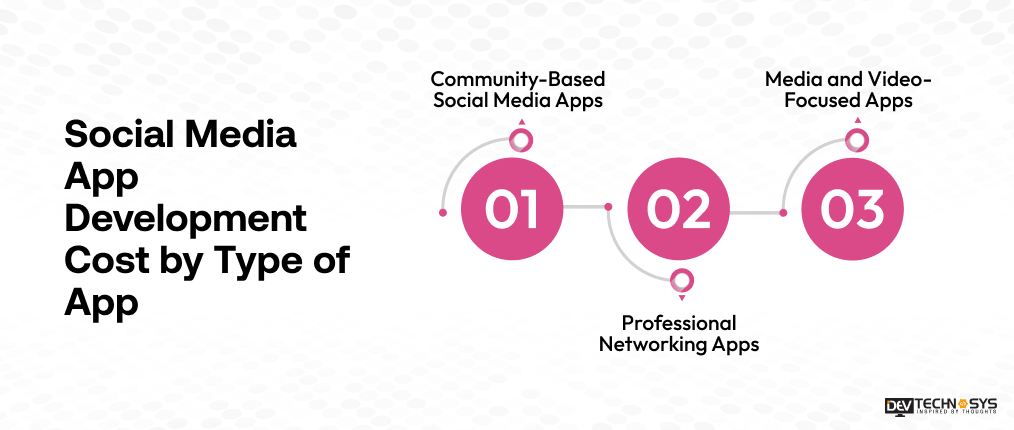
1. Community-Based Social Media Apps
Community platforms usually have minimal development requirements as they are centered on user profiles, content sharing, feeds, comments, and user following. A social media platform like Meetup may need more functionality for groups, events, and location-based discovery.
2. Professional Networking Apps
Professional networking sites need more robust profiles, more connections, more messaging, more search, and more business interactions. The cost of social networking app development is higher than that of basic community platforms due to these needs.
3. Media and Video-Focused Apps
Sharing services for photos, short videos, and live streaming demand more sophisticated media processing and storage. An app like Truth Social needs content moderation, tailored feeds, notifications, and scalable backend infrastructure.
| Social media app type | Estimated development cost | Key requirements |
| Community-based app | $20,000–$45,000 | Profiles, feed, posts, comments, and following |
| Professional networking app | $40,000–$70,000 | Profiles, connections, messaging, and search |
| Photo and video sharing app | $45,000–$80,000 | Media uploads, stories, feeds, and engagement |
| Short video social app | $60,000–$100,000 | Video processing, recommendations, and moderation |
| Live streaming social app | $80,000–$150,000+ | Live video, real-time interaction, and scalable infrastructure |
Cost Breakdown by Stages of Development
Social media app development is divided into different stages, such as planning & design, development, testing, deployment, and post-launch support. The development phase is usually the most expensive because it includes frontend implementation, backend engineering, API integration, database work, and core functionality.
| Development stage | Typical share of budget | What it includes |
| Planning and research | 5%–10% | Requirements, market research, scope, and technical planning |
| UI/UX design | 10%–15% | Wireframes, prototypes, and interface design |
| Development | 40%–50% | Frontend, backend, APIs, and core functionality |
| Testing and QA | 10%–15% | Functional, performance, compatibility, and security testing |
| Deployment | 5%–10% | Production configuration, app store submission, and launch setup |
| Post-launch support | 10%–15% | Bug fixes, optimization, and initial technical support |
Security and Compliance for Social Media Apps
Security concerns can increase the cost of social media app development depending on user data, target markets, payment features, and platform functionality. This is especially critical when developing a social media application for businesses that manages sensitive company and user data.
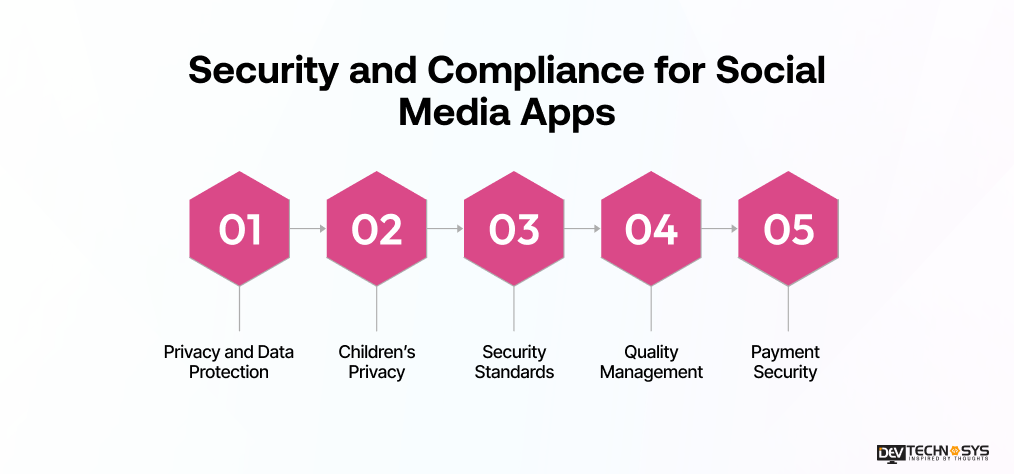
1. Privacy and Data Protection
GDPR, CCPA, and CPRA compliance may require consent management, data access controls, deletion workflows, encryption, and privacy features. These requirements can increase development and testing effort.
2. Children’s Privacy
COPPA compliance applies when platforms target or knowingly serve children. Age verification, parental consent, restricted data collection, and additional privacy safeguards can increase development complexity and associated costs.
3. Security Standards
Security, monitoring, access management, risk controls, and documentation are improved with SOC 2 compliance and ISO 27001 standards. Additional engineering, testing, and operational processes may be needed to implement these standards.
4. Quality Management
ISO 9001:2015 certification focuses on quality management rather than privacy or cybersecurity. ISO 9001:2015 certified companies support structured development, testing, documentation, and quality management practices.
5. Payment Security
When social apps accept card payments for subscriptions, premium features, or creator services, PCI-DSS compliance applies. Secure payment integrations and card tokenization might add security requirements and testing efforts.
Note: Our teams follow PCI-DSS and ISO 27001 protocols throughout development, keeping sensitive data protected at every stage of the build.
Hidden Costs of Social Media App Development
The initial development quote does not represent the complete investment. Several recurring and unexpected expenses can emerge as the application gains users, content, integrations, and technical complexity.
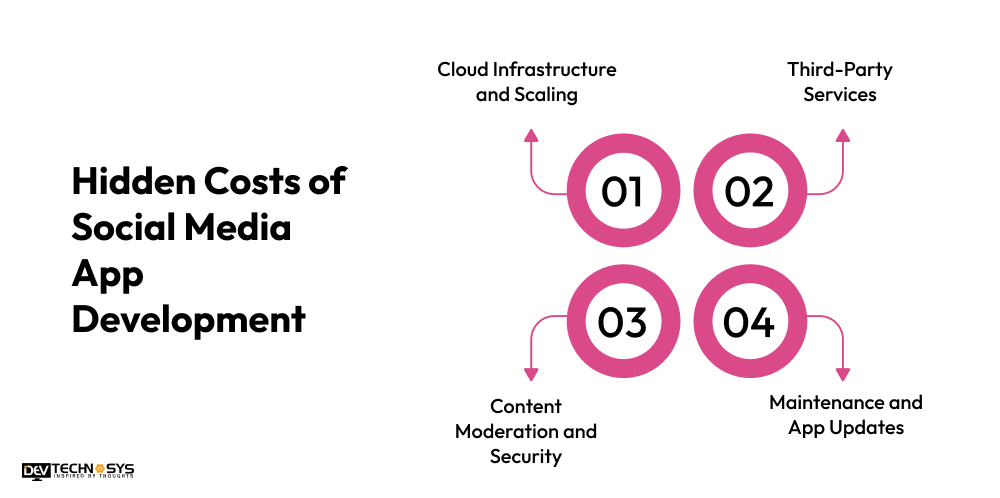
1. Cloud Infrastructure and Scaling
Cloud infrastructure costs cover hosting, storage, bandwidth, databases, CDN services, and other computing resources. With increasing user traffic and media consumption, organizations may require scalable backend infrastructure and increased capacity to maintain performance.
2. Third-Party Services
APIs, analytics platforms, authentication providers, messaging tools, payment gateways, and media processing services can all produce recurrent costs through third-party services. With a growing user base, these expenses can increase with usage-based pricing.
3. Content Moderation and Security
Content moderation includes automatic screening, reporting mechanisms, human review, and abuse prevention; Security costs might also include monitoring, vulnerability testing, encryption updates, and compliance tasks needed to secure users and platform data.
4. Maintenance and App Updates
Continuous maintenance includes bug fixes, performance tweaks, OS compatibility, security upgrades, and feature improvements. Understanding the possible mobile app maintenance cost allows organizations to create realistic budgets for the post-launch period.
Social Media App Total Cost of Ownership: 3 Year Investment Plan
The social media app development cost is just the start. Investors and companies should see the project as a technological investment over a period of three years, which includes development, maintenance, infrastructure, security, and future expansion.
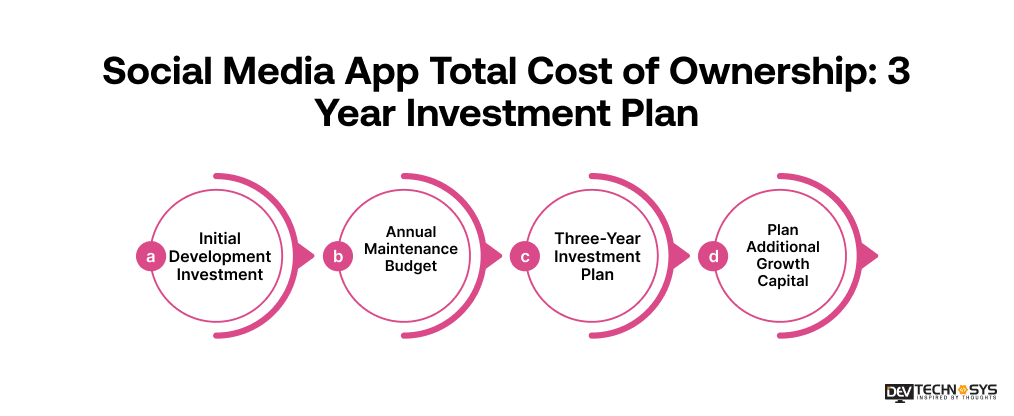
1. Initial Development Investment
The first investment includes product strategy, UI/UX design, mobile development, backend engineering, integrations, testing, and deployment. Your initial development budget should also be in the range of $20,000 to $150,000+ depending on complexity.
2. Annual Maintenance Budget
We’re looking at 15% to 20% of the initial development cost annually for upkeep after launch. This budget can cover bug fixes, security upgrades, Operating System support, performance optimization, monitoring, and technical assistance.
3. Three-Year Investment Plan
These calculations offer an indicative investment plan based on the 15–20% yearly maintenance benchmark. They leave out marketing, big product additions, infrastructure increases, moderation, and unforeseen scale needs.
| App level | Initial development | 3-year maintenance | 3-year TCO |
| Basic | $20K–$40K | $11.25K–$27K | $36.25K–$72K |
| Mid level | $40K–$80K | $20.25K–$48K | $65.25K–$128K |
| Advanced | $80K–$150K+ | $36K–$72K+ | $116K–$192K+ |
4. Plan Additional Growth Capital
Investors should have a separate reserve for user acquisition, content moderation, cloud expansion, advanced features, and market expansion. Understanding the challenges and opportunities of social media can help businesses determine where additional capital may create long-term value.
A lower first quote does not always indicate a cheaper investment. Instead, a better way is to look at total ownership costs and think about scalability, revenue possibilities, security, and future product extension.
Ways to Reduce Social Media App Development Cost
To control the cost to build a social media app, businesses can prioritize the scope, cut the unneeded development effort, and choose the technologies that offer long-term scalability.
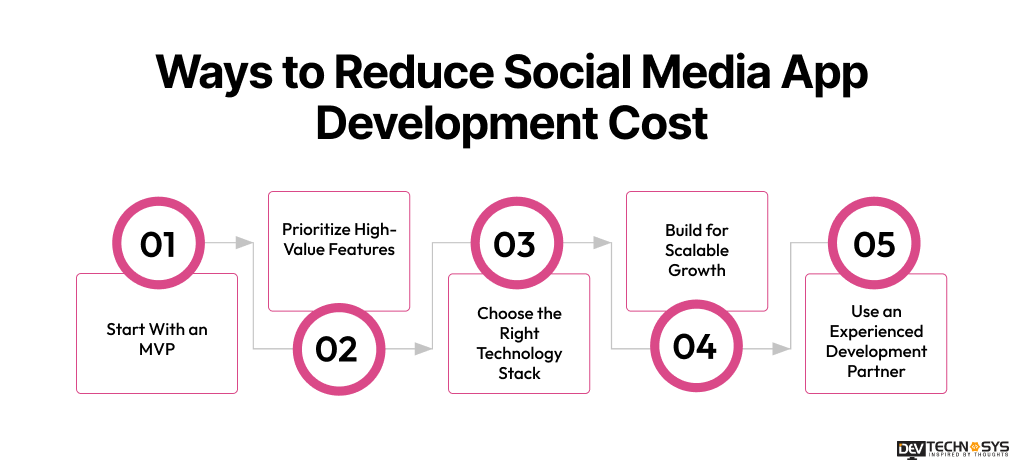
1. Start With an MVP
Launch with basic features like user registration, profiles, social media feed, posts, likes, comments, following, and push alerts. Advanced features can be implemented after testing user demand.
2. Prioritize High-Value Features
Prioritize the features based on business value, user demand, and development difficulty. This avoids premature spending on features that might not boost adoption, engagement, or income.
3. Choose the Right Technology Stack
Choose technologies depending on development speed, scalability, team knowledge, and maintenance requirements. When the product requirements permit shared functionality, cross-platform development can help to save duplication of work.
4. Build for Scalable Growth
Use scalable backend infrastructure, but don’t over-engineer the first version of the product. Cloud design helps enterprises scale processing, storage, and database capacity as traffic and user activities develop.
5. Use an Experienced Development Partner
The companies that provide comprehensive social media app development solutions can help reduce rework, technical errors, and inefficient development. Clear requirements and regular testing also assist in keeping the social media app development pricing in check.
Monetization Strategies for Social Media Apps
A clear monetization strategy helps businesses recover development investments and create recurring revenue. The right model depends on the audience, app type, engagement levels, and features offered.
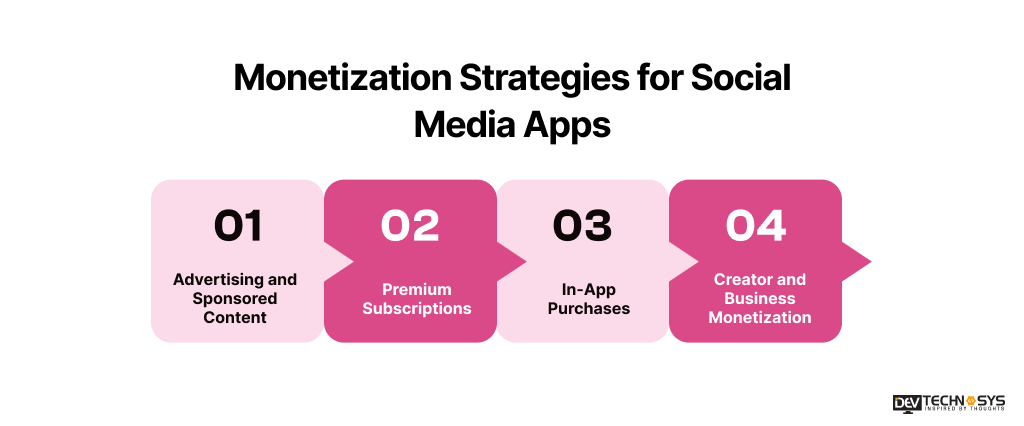
1. Advertising and Sponsored Content
Advertising can generate revenue through display ads, native placements, sponsored posts, and targeted campaigns. Businesses can also use AI in social media to improve audience segmentation, content recommendations, and ad personalization.
2. Premium Subscriptions
Subscription plans can provide recurring revenue through ad-free experiences, exclusive content, advanced features, creator tools, or increased usage limits. Tiered pricing allows businesses to serve different user segments while creating predictable income.
3. In-App Purchases
In-app purchases can monetize virtual goods, digital content, profile enhancements, creator support, and other paid interactions. This model works particularly well for platforms with highly engaged communities and frequent user interactions.
4. Creator and Business Monetization
Social platforms can generate revenue through business accounts, paid promotions, creator commissions, marketplace services, and revenue sharing. These models allow the platform to earn from commercial activity while providing additional value to creators and businesses.

How Dev Technosys Helps Optimize Social Media App Development Costs
Dev Technosys, with more than 16 years of engineering experience and 1,000+ digital solutions supplied using scalable architecture, targeted feature design, and efficient development techniques, helps organizations minimize social media app development costs. Our experts assist you in saving wasteful development costs while providing safe, high-performance platforms for long-term growth.
Conclusion
The social media app development cost can range from $20,000 to $150,000+, depending on features, platforms, technology, security, and scalability requirements. However, the initial development budget is only one part of the investment.
Businesses also have to consider maintenance, infrastructure, security, third-party services, and potential product expansion. The 3-year total cost of ownership gives a more realistic picture of financials and helps investors make informed decisions.
Partnering with an experienced social media app development company may help organizations manage development risks, select the proper technology, and construct a scalable platform that meets their long-term growth goals.
Frequently Asked Questions
Find answers to the most common questions related to this article.
The cost to develop a social media app ranges from $20,000 to $150,000+. A simple app with profiles, feeds, posts, likes, and comments may be cheaper to develop. But video sharing, live streaming, AI capabilities, and advanced moderation can drastically increase the development costs.
Creating a basic social media app can take between 3 to 5 months. Developing mid-level platforms can take around 5-8 months, whereas advanced apps involving live streaming, intricate backend systems, AI, and extensive integrations might take 8-12 months or beyond.
The final cost will depend on feature complexity, platform choice, UI/UX needs, backend structure, third-party integrations, security, development team location, and scalability. Apps that do real-time chat, video processing, personalized suggestions, or advanced moderation usually need a bigger development and infrastructure expenditure.
Maintenance costs per year are usually 15% to 20% of the original development cost. This may include bug patches, security updates, OS compatibility, performance optimization, monitoring, infrastructure changes, and technical assistance. Costs escalate with increased user engagement, the number of content items, and platform complexity.
An MVP can cut down the initial expenditure by focusing on core functions like registration, profiles, feeds, posts, engagement, and alerts. Businesses can test demand before committing to sophisticated services like live streaming, AI-powered recommendations, complex monetization, and large-scale infrastructure.