














Key takeaways:
-
- A social networking app development company follows each development step, from planning to deployment, strategically to develop an app like Instagram.
- The social media apps market is growing worldwide and is estimated to reach USD 77.71 billion by 2034.
- The cost to create an app like Instagram can range from $30,000 and $1,50,000. This cost is affected by the app’s complexity and several other factors.
- Implementing strategies like targeted advertising, shoppable posts & e-commerce, influencer partnerships, etc., apps like Instagram can generate recurring revenue.
The idea to build an app like Instagram did not just begin with coding. It starts with a simple question: What makes people come to the same app every day? This question is important after all, Instagram is the first morning thing we do before even opening our eyes.
One thing that is true is that apps like Instagram are habits built on emotions and curiosity. In 2026, AI is reshaping this experience by offering exact content that people imagine or like. Therefore, building an Instagram clone is like combining psychology, smart technologies, and amazing designs.
Now the main question arises: how to make a social media app like Instagram? This guide has covered every necessary thing to make an app like Instagram in 2026. After reading this blog, you will craft an experience that is impossible to ignore.
What is Instagram?
Instagram is a widely known social media platform where people can share their photos, videos, and thoughts. The content on this app can be shared privately with selected people or worldwide with millions of people.
On Instagram, users can enjoy making reels, streaming live, messaging, voice/video calls, and content discovery. People can follow accounts, engage through likes and comments, and build communities based on their interests.
Some Key Details:
- Founders: Kevin Systrom and Mike Krieger
- Launch Year: 2010
- Headquarters: Menlo Park, California
- Owner: Meta Platforms, Inc.
- Current Head/CEO: Adam Mosseri
Industry Insight: Instagram has evolved into a global social media giant with over 2.4–3 billion monthly active users worldwide: saasultra
How Does Instagram Work?
Instagram works on a simple flow that allows users to interact, engage, discover, and share. From downloading and making profiles to the matching algorithm, each step of this workflow is really essential. We will now understand how Instagram works step-by-step.
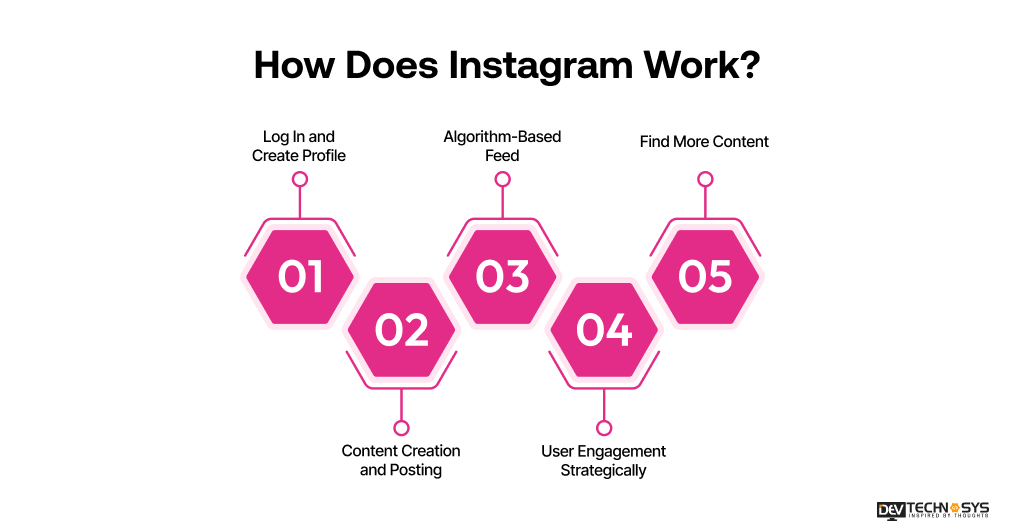
Step 1: Log In and Create Profile
Download the app and create an account. The profile can be built using email, phone, or social login. After that, find friends and follow each other.
Step 2: Content Creation and Posting
Users can now post photos, videos, reels, and stories. It is like sharing your update with your audience and followers.
Step 3: Algorithm-Based Feed
Instagram offers content according to the user’s interests and activities. It grabs the engagement pattern of users and provides similar content.
Step 4: User Engagement Strategically
Users can simply interact with each other by liking or commenting on posts. The engagement also increases with content sharing, saving, and direct messaging.
Step 5: Find More Content
By exploring different pages and reels, users can discover trending and relevant content. This search should be beyond the followers.
Social Media App Market Growth Explained with Statistics & Insights
The social media app market is witnessing rapid growth globally. This expansion is highly influenced by rising digital engagement, data-driven decision-making, and increasing demand for advanced analytics tools. We are here with the market analysis by Fortune Business Insight to understand this growth.
- The global social media analytics market was valued at USD 16.53 billion in 2025.
- Market size is expected to grow from USD 20.3 billion in 2026 to USD 77.71 billion by 2034.
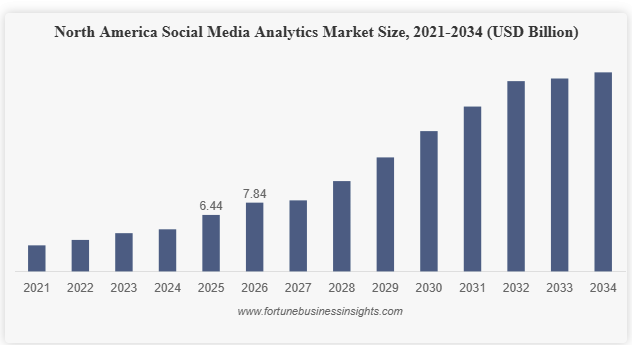
- The industry is projected to expand at a CAGR of 18.3% during the forecast period.
- North America led the market in 2025, accounting for approximately 39% share .
- The U.S. market is anticipated to grow significantly, reaching an estimated USD 16.96 billion by 2032.
Is Building an App Like Instagram Worth It? Key Reasons Explained
Yes, creating a platform like Instagram is really worth it, especially in 2026. This world is highly driven by social media, posting, making online friends, and sharing life events. Entrepreneurs build an app like Instagram because of high ROI, growth & learning, advanced tools, niche opportunity, and more. Here are some reasons elaborated below.
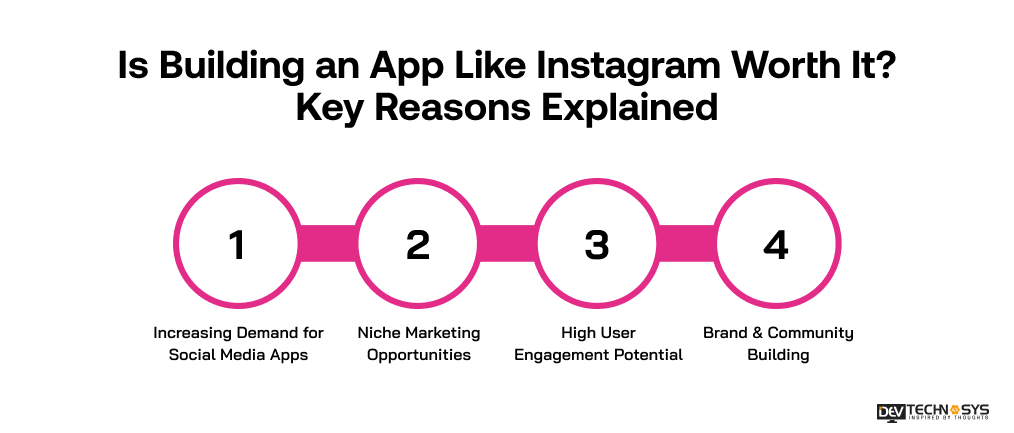
1. Increasing Demand for Social Media Apps
The usage of social media is highly popular among people in 2026. It is because they largely rely on digital apps for entertainment, communication, and content sharing. This elevates the demand for Instagram-like app development as a new opportunity in this online landscape.
2. Niche Marketing Opportunities
Targeting a specific niche rather than a broad app helps the best social media apps stay competitive. The entrepreneurs should largely target a particular audience base and interest. With this, they can develop a loyal user base and deliver personalized, relevant experiences.
3. High User Engagement Potential
A mobile app development for social media is a successful opportunity as it keeps users engaged. It offers everything that a user usually likes, such as continuous content, interaction, and personalization. All these encourage users to use frequently, which creates growth options.
4. Brand & Community Building
When entrepreneurs build an app like TikTok, Instagram, etc., it allows people to form communities to express themselves. This enhances user loyalty and builds brand recognition. A cross-platform mobile app development like Instagram grows naturally with user-generated content and social interactions.
Different Instagram App Types You Can Develop in 2026
The world is studded with social media applications like Instagram. These are becoming popular because they allow seamless content sharing. Instagram clone apps offer great user experiences and engagement with strong profitability for users and businesses. Have a look at the types of Instagram-like apps.
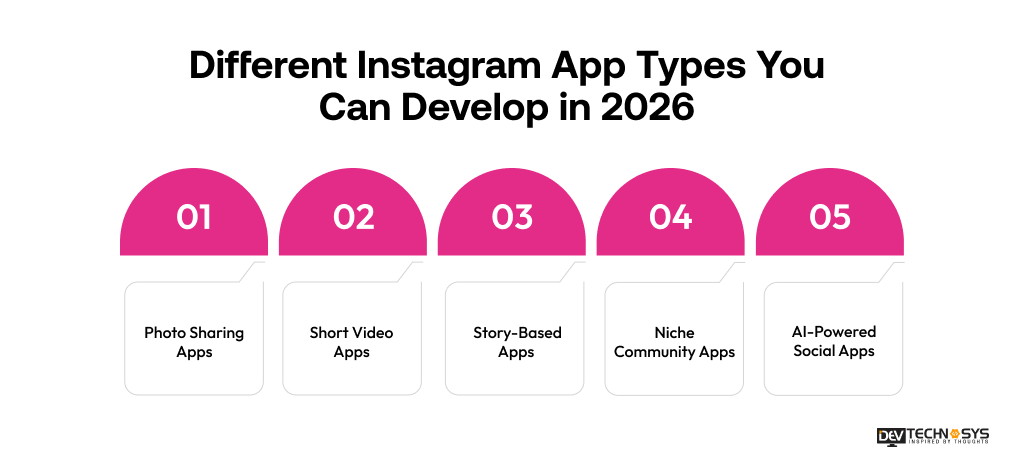
1. Photo Sharing Apps
Photo-sharing apps are used for visual storytelling and personal branding. Generally, it is preferred by general users, influencers, and businesses. The main purpose of photo-sharing app development is user engagement and content marketing.
2. Short Video Apps
To create and share bite-sized videos with music and filters, short video apps are used. It increases the user engagement with viral content and algorithm-driven feeds. These apps are popular among Gen Z users, creators, and entertainment-focused audiences.
3. Story-Based Apps
Story-based apps can be a great software development for startups. This app allows users to share content temporarily that disappears after a set time. It encourages users to post frequently and get real-time user engagement with casual updates.
4. Niche Community Apps
The apps that are built for constant sharing by a specific interest group are nice community apps. It is usually used for creating content for fitness, travel, gaming, fashion, etc. Their target always remains on the targeted audience instead of the mass audience.
5. AI-Powered Social Apps
The apps that utilize artificial intelligence to enhance user experience are AI-powered social apps. They offer personalized feeds, smart recommendations, automated moderation, and content optimization. It improves engagement, retention, and scalability by delivering relevant content.
Industry Insight: Users spend an average of 30–70+ minutes daily on Instagram, with many opening the app multiple times per day: SproutSocial
Which Must-Have Features an Instagram-like App Should Have?
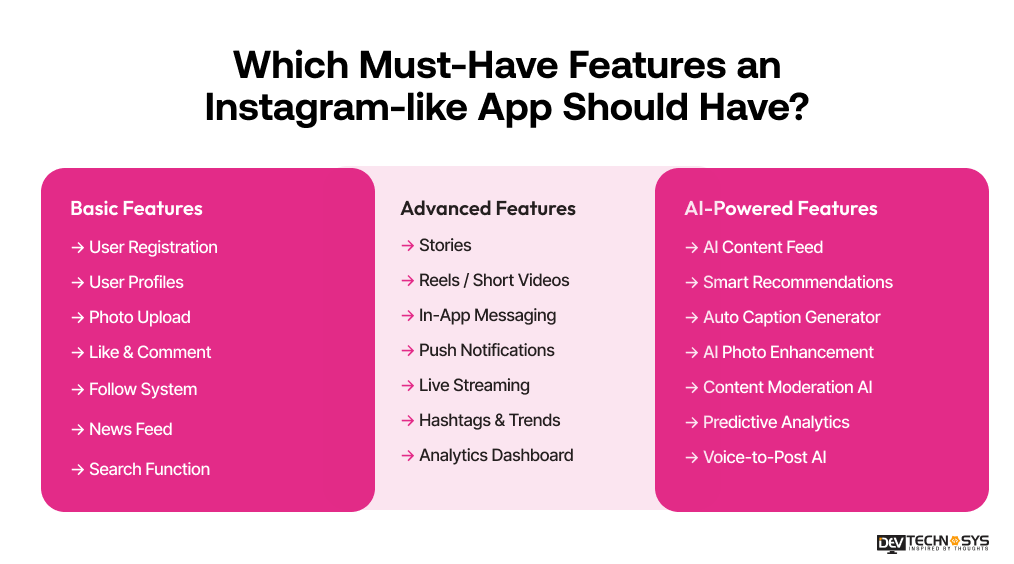
An Instagram-like app must have features divided into 3 categories: user/basic, advanced, and AI-powered features. These features are really essential for user engagement, stability, and personalization. We will now explain the Instagram clone app features that built a complete and competitive app.
1. Basic Features
The basic and core features of an Instagram clone app are the foundation of the application. They allow users to log in, create a profile, share content, and build engagement. These are the most essential features of an app like Instagram.
Basic Feature |
Description |
| User Registration | Allows users to sign up using email, phone, or social login |
| User Profiles | Personal profiles with bio, profile picture, and posts |
| Photo Upload | Enables users to upload and share images |
| Like & Comment | Basic engagement tools for interaction on posts |
| Follow System | Let users follow/unfollow other users |
| News Feed | Displays posts from followed accounts in a scrollable feed |
| Search Function | Helps users find accounts, hashtags, and content |
2. Advanced Features
Stories, reels, messaging, live streaming, and analytics are the advanced features of an app like Instagram. A custom application development firm surely adds these features to upgrade user engagement and the app’s scalability.
Feature |
Description |
| Stories | Temporary posts that disappear after 24 hours |
| Reels / Short Videos | Short-form video content for higher engagement |
| In-App Messaging | Private chat between users |
| Push Notifications | Alerts for likes, comments, and messages |
| Live Streaming | Real-time video broadcasting |
| Hashtags & Trends | Content categorization and discoverability |
| Analytics Dashboard | Insights for creators on performance and engagement |
3. AI-Powered Features
AI has taken over almost every industry, and social media apps are no exception. Adding AI features like content recommendations, smart feeds, moderation, etc., to the Instagram cloner can be beneficial. They bring personalization and automation while improving user experience.
Feature |
Description |
| AI Content Feed | Personalized feed based on user behavior and interests |
| Smart Recommendations | Suggests posts, accounts, and hashtags intelligently |
| Auto Caption Generator | Generates captions for posts using AI |
| AI Photo Enhancement | Automatically improves image quality and filters |
| Content Moderation AI | Detects spam, harmful, or inappropriate content |
| Predictive Analytics | Forecasts engagement and trending content |
| Voice-to-Post AI | Converts voice input into captions or posts |
Why Most Instagram Clone Apps Fail and How to Avoid It?
Before you start development, there’s something most businesses overlook. Making an app like Instagram might look like a piece of cake, but it is not. Many Instagram clones fail because they just copy-paste the development without understanding user behavior. Here are the reasons why they fail and how to stop this:
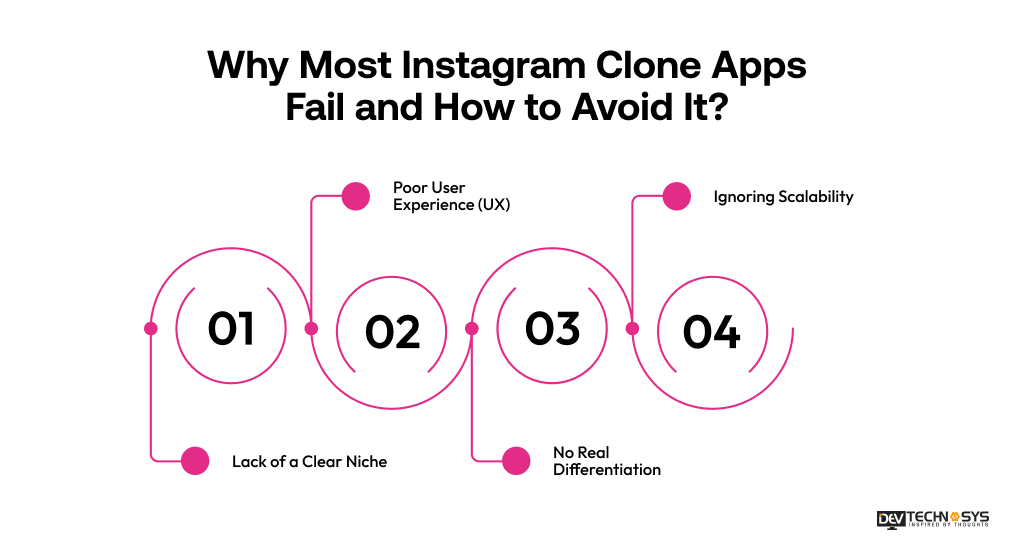
1. Lack of a Clear Niche
If the app tries to capture and target everyone, it will end up blank. The social media industry is a crowded market, and without niche targeting, the app cannot survive.
How To Avoid It: The focus should be on the specific interests of the users, fitness, traveling, creation, etc. It will help you build a loyal user base.
2. Poor User Experience (UX)
The expectations of the users is to use a fast, intuitive, and appealing application. Even a small delay in app opening, buffering, or complicated layout can be a reason for users to abandon the app.
How To Avoid It: Loading speed should be optimized, and navigation has to be simplified. It guarantees a seamless user experience, engagement, and retention.
3. No Real Differentiation
By just copying features, design, and quality, you cannot make the app valuable for users. Users want something unique and compelling to switch to; if they don’t get it, the app will fail.
How To Avoid It: Add new and unique features and give better usability. Also, bring a fresh concept that makes the app different from existing ones.
4. Ignoring Scalability
With a growing user base, the activity on the app also increases. If the app is built poorly, it may crash or slow down. This will lead to the failure of the Instagram clone app development.
How To Avoid It: Invest in a strong backend, cloud infrastructure, and performance optimization from the beginning to support growth smoothly.
How to Build an App Like Instagram Step by Step: 7 Steps Explained
Developing an app like Instagram is something beyond just coding; it is strategic planning. Many social media app development companies follow the step-by-step approach to make such apps. From the market research to app deployment, and even after that, the development is not limited. Here, we will discuss the 7-step Instagram app development guide 2026
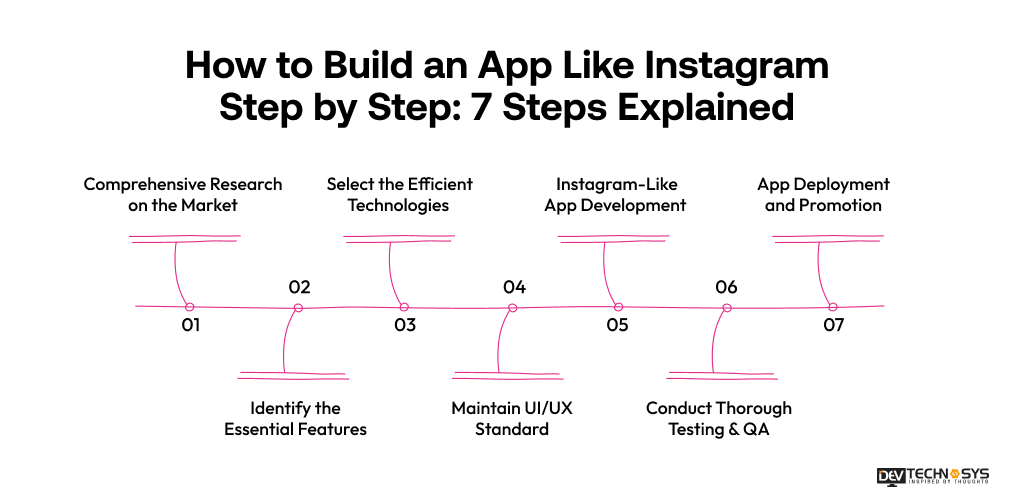
1. Comprehensive Research on the Market
The first step of the Instagram app development process begins by analyzing the social media market. It includes examining user behavior, audience preferences, trending features, and pain points to terminate disruptions. When the research on the social media landscape is done properly, it helps define your niche. Also, it makes businesses target the right users and stand out in this competitive market.
2. Identify the Essential Features
List the most important features you want in your social media app. Some of the core features include user registration, profiles, photo & video sharing, filters, likes, comments, messaging, and notifications.
Many organizations prefer MVP development services to test the market and enhance features as per user feedback. Adding essential features ensures faster development, better usability, and even validates your idea with real users.
3. Select the Efficient Technologies
The scalability and performance of apps like Instagram are supported by a reliable tech stack. It includes the right selection of frameworks for frontend and backend, cloud storage, and APIs for media handling.
These technologies guarantee the application works smoothly without any issues. Efficient technologies can even handle large user traffic while delivering an amazing and seamless user experience on different devices.
4. Maintain UI/UX Standard
The next steps to create an Instagram-like app are to design a clean, intuitive, and visually appealing interface. A user-friendly interface helps users navigate easily, have a fast loading speed, and have consistent design elements. If the UI/UX strategy of the platform is strong, it improves user satisfaction and experience. Also, it increases session time and plays a crucial role in retaining users.
5. Instagram-Like App Development
The final development with divided tasks is the most crucial step of social media app development. Businesses hire mobile app developers to start coding with agile methodology. Here, the tasks are divided into frontend and backend modules, and core features are developed. Then APIs are real-time updates like feeds and messaging, which are integrated. This step transforms your idea into a fully working product.

6. Conduct Thorough Testing & QA
It’s time to test your app thoroughly to ensure quality assurance. At this stage, the app is checked on different devices, screen sizes, and operating systems. Thai will help detect bugs, security, and performance issues. This step also involves both manual and automated testing methods. When the app gets quality assurance, it makes sure the app is secure and reliable.
7. App Deployment and Promotion
The final step of the social media app development process is to launch your app on the app stores. For this, entrepreneurs can optimize the stores with keywords, descriptions, and visuals. To make the app reach targeted audiences, businesses should implement marketing strategies like social media promotion, influencer marketing, and paid ads. This will help improve performance and sustain long-term growth.
How Long Does It Take to Build an App Like Instagram: Timeline Explained
An Instagram-like app typically takes 3 to 6+ months to get developed. The development time of a basic, mod-level, or advanced app depends on its complexity and scalability requirements. The Instagram app development timeline can vary according to development complexity. Here, we have explained the app like an Instagram development timeline as per the development stages.
Stage |
Basic App (3–4 Months) |
Mid-Level App (4–5 Months) |
Advanced App (5–6+ Months) |
| Planning & Research | 1–2 weeks | 2–3 weeks | 3–4 weeks |
| Feature Definition | 1 week | 1–2 weeks | 2–3 weeks |
| UI/UX Design | 2–3 weeks | 3–4 weeks | 4–6 weeks |
| Development | 6–8 weeks | 8–10 weeks | 10–14 weeks |
| Testing & QA | 2–3 weeks | 3–4 weeks | 4–5 weeks |
| Deployment & Launch | 1–2 weeks | 2–3 weeks | 3–4 weeks |
| Maintenance | Ongoing | Ongoing | Ongoing |
Build a Scalable Instagram Clone: Tech Stack Explained
To build an app like Instagram, the selection of the right tech stack is mandatory. Tech stack is a combination of frontend, backend, database, cloud-storage, APIs, etc. These technologies help in enhancing the app’s performance, security, and real-time user engagement. Have a look at the Instagram clone app tech stack.
Layer |
Technology Options |
Description |
| Frontend | React Native, Flutter | Builds responsive and cross-platform mobile app interfaces |
| Backend | Node.js, Django, Ruby on Rails | Handles business logic, APIs, authentication, and server-side operations |
| Database | PostgreSQL, MongoDB | Stores user data, media metadata, and application information |
| Cloud Storage | AWS S3, Google Cloud Storage | Manages and stores images, videos, and media files securely |
| APIs | REST APIs, GraphQL | Enables smooth communication between frontend and backend systems |
| Authentication | OAuth 2.0, Firebase Auth | Ensures secure login and user identity management |
| Real-Time Features | WebSockets, Firebase Realtime DB | Supports live chat, notifications, and real-time updates |
| AI/ML Integration | TensorFlow, OpenAI APIs | Powers personalized feeds, recommendations, and content moderation |
| DevOps & CI/CD | Docker, Jenkins, GitHub Actions | Automates deployment, testing, and continuous integration workflows |
| Analytics | Google Analytics, Mixpanel | Tracks user behavior and app performance for optimization |
Planning a Mobile App?
Get a tailored development cost estimate in 3 simple steps — app basics, features, timeline, and your contact details.
- 3 quick steps
- 100% free
- Reply in 1 business day
2 Minutes Read
The Underlying Architecture: How to Scale an Instagram Clone to Millions of Users?
Creating an app similar to Instagram takes more than just building features for users. As the platform has expanded, there are now:
- Millions of media uploads that require processing
- Millions of personalized feeds to deliver in real-time
- Support for messaging with no delay
To scale this way, developers require a modern cloud-native architecture. This architecture will give equal consideration to performance, storage efficiency, and user experience.
1. The Media Pipeline: WebP Compression, AWS S3, and Global CDN Caching
In an Instagram-like application, most of the stored data belongs to media files. Each user-uploaded photo, reel, story, and video must be optimized for delivery.
Media Processing Pipeline for Apps
| Stage | Function |
| Upload Processing | Receives images and videos from users |
| Compression Engine | Converts images into WebP format to reduce file size |
| Cloud Storage | Stores media assets securely in AWS S3 buckets |
| CDN Distribution | Delivers content through geographically distributed edge servers |
| End User Delivery | Loads optimized media with minimal latency |
High-resolution media will put enormous pressure on the infrastructure. It also increases page load times if they are not compressed via CDN integration for mobile apps. Using WebP compression and a global CDN will optimize the application’s performance while reducing bandwidth usage.
2. Real-Time Data Flow: Managing Instant DMs via WebSockets
Users expect messages to be delivered in real-time. Traditional HTTP requests cannot provide this level of speed because they require constant polling of the server.
Real-Time Messaging Architecture
| Component | Responsibility |
| WebSocket Server | Maintains persistent user connections |
| Message Queue | Processes and distributes incoming messages |
| Notification Service | Alerts offline users of new messages |
| Database Layer | Stores chat history securely |
| Mobile Client | Displays messages instantly |
Why Instagram Uses Real-Time Infrastructure?
The real-time messaging architecture WebSockets creates an open/long-lived connection with the server, allowing for features such as:
- Immediate message delivery
- Typing indicators in real-time
- Read receipts
- Online presence updates in real-time
The architecture of WebSockets provides a seamless communication experience with lower server resource usage.
3. The Database Dilemma: Why You Need a Hybrid SQL and NoSQL Schema
A social media app like Instagram creates multiple varieties of data. Due to this, a database solution with a single codebase is insufficient.
Recommended Database Architecture
| Database Type | Use Case |
| PostgreSQL (SQL) | User accounts, authentication, and payment data |
| MongoDB (NoSQL) | Posts, comments, hashtags, engagement activity |
| Redis | Session management and caching |
| Elasticsearch | Search and content discovery |
Why Hybrid Databases Work Best?
SQL database is widely preferred because it provides consistency and transactional integrity. In contrast, NoSQL databases are used to handle large-scale content and engagement data more efficiently.
This hybrid approach enables:
- Faster content retrieval
- Improved scalability
- Better query performance
- Reduced database bottlenecks
4. Feed Generation Engineering: Fan-Out Write vs. Fan-Out Read Models
Developing a feed that is personalized is among the most difficult and technically challenging aspects of Instagram-like app development. Whenever a user opens the app, the platform must determine:
- Which posts to show
- In what order to display them
- Which content is most relevant
- Fan-Out Write Model
Fan-Out Write Model
Through this model, the content gets distributed to the worldwide followers instantly after being posted. It is the ideal option for smaller and mid-sized social networking applications.
Advantages of Fan-Out Write Model
- Faster feed loading
- Improved user experience
Limitations of the Fan-Out Write Model
- Higher storage consumption
- Increased write operations
Fan-Out Read Model
In this model, the content is seamlessly gathered dynamically every time the user opens the application. It is highly suitable for large-scale social media platforms with millions of users.
Advantages of Fan-Out Read Model
- Lower storage requirements
- Better scalability for large networks
Limitations of the Fan-Out Read Model
- Higher read latency
- More processing power is needed
Hybrid Feed Scalable Social Media Architecture
In 2026-2027, the modern social media platforms are combining both approaches for different purposes. The Fan-Out Write Model is integrated for regular users, and the Fan-Out Read Model is for celebrity and high-follower accounts. Using this approach, performance and scalability are balanced while achieving lower operational costs.
Why Architecture Determines the Success of an Instagram Clone?
To make an Instagram alternative highly successful in this modern world, its architecture has to be scalable. There is a lot more than front-end design and feature development. It includes the ability to process media efficiently, support real-time messaging, manage massive datasets, and generate personalized feeds. This can directly influence the user engagement and platform scalability. This is the result of a scalable cloud-native architecture creating a future-ready social media platform.
Security by Design: Safeguarding User Privacy and Data Ecosystems in Apps like Instagram
Security becomes one of the most important elements during the development of an Instagram application. Contemporary social media apps process a vast amount of personal data. It includes user profiles, messages, media content, user location, and other behavioral details. A single issue with security can result in:
- Data leakage
- Legal fines
- Reputational damage
- User loss
Therefore, security must be integrated into the system right from the beginning of the app development process.
1. Hardening the App: API Gateway Rate Limiting and OWASP Protection
The API Gateway serves as the first point of contact for blocking malicious traffic and preventing attacks on the platform. Businesses can secure their platform from cyberattacks by using rate limiting and validating the traffic.
Security Protection Framework
| Security Layer | Purpose | Business Impact |
| API Rate Limiting | Restricts excessive requests from a single source | Prevents bot attacks and API abuse |
| Authentication Controls | Validates user identities and access permissions | Reduces unauthorized access risks |
| Input Validation | Filters malicious user inputs | Prevents SQL injection and XSS attacks |
| OWASP Security Controls | Mitigates common web application vulnerabilities | Strengthens overall platform security |
| Web Application Firewall (WAF) | Monitors and blocks suspicious traffic | Enhances threat detection capabilities |
Why It Matters
According to security guidelines, most cyberattacks on application APIs occur because they serve as gateways to the business’s backend systems. Therefore, by protecting your API, you can ensure your platform’s availability and protect users’ sensitive data.
2. Data Encryption: Implementing E2EE and Platform-Native Secure Storage Sandboxes
Data encryption is recommended to protect user information during transmission. It also secures the data even when it is stored on devices or servers. Encryption is a foundational security requirement for social media apps. It helps in handling private messages and personal content.
Recommended Encryption Strategy
| Encryption Layer | Function |
| TLS Encryption | Secures data transmitted between users and servers |
| End-to-End Encryption (E2EE) | Protects private conversations from unauthorized access |
| Database Encryption | Secures stored user information and media metadata |
| Secure Storage Sandboxes | Protects locally stored credentials and sensitive data |
| Encryption Key Management | Controls and secures cryptographic keys |
Benefits of End-to-End Encryption
- Enhances user trust
- Protects private communications
- Reduces exposure to data interception
- Strengthens compliance readiness
- Improves platform credibility
With encryption, businesses can significantly reduce security risks while protecting user privacy throughout the data lifecycle.
3. Global Compliance: Structuring Architecture for GDPR, CCPA, and COPPA
Generally, social media platforms work across multiple regions. Due to this, regulatory compliance is an essential requirement. Non-compliance can result in substantial financial penalties and legal challenges.
Key Compliance Frameworks
| Regulation | Region | Primary Requirement |
| GDPR | European Union | User consent, data portability, and privacy rights |
| CCPA | California, USA | Consumer data transparency and control |
| COPPA | United States | Protection of children’s online privacy |
| Data Retention Policies | Global | Secure handling and deletion of user data |
| Consent Management Systems | Global | Tracking and managing user permissions |
Compliance Best Practices
- Obtain explicit user consent before collecting personal data
- Provide mechanisms for account deletion and data export
- Maintain transparent privacy policies
- Restrict unauthorized data sharing
- Conduct periodic compliance audits
A compliant architecture of a social media platform helps businesses avoid costly legal issues. It also improves trust among users and stakeholders.
4. Risk Assessment: Evaluating the Business Cost of Data Vulnerabilities
Social media businesses usually underestimate the costly security incidents until a breach occurs. It is different from technical remediation costs. Also, data vulnerabilities can disrupt operations, reduce user confidence, and damage brand reputation.
Potential Risks and Business Consequences
| Security Risk | Potential Impact |
| Data Breach | Exposure of sensitive user information |
| Account Takeovers | Unauthorized access to user accounts |
| API Exploitation | Service disruption and unauthorized data access |
| Compliance Violations | Regulatory penalties and legal liabilities |
| Malware Injections | Platform instability and compromised systems |
| Reputation Damage | Reduced user retention and trust |
Why Proactive Security Investment Matters
Organizations that integrate security into the development lifecycle often experience:
- Lower remediation costs
- Stronger customer trust
- Improved regulatory readiness
Security investments made during development are typically more cost-effective than addressing vulnerabilities after deployment.
Industry Insight: Recent high-profile app data breaches have highlighted the growing importance of privacy-by-design architectures.- The Washington Post
The Invisible Constraint: Designing a Scalable Content Moderation Infrastructure (After Security by Design)
Content moderation in social media apps is one of the most underappreciated aspects. While most engineers focus on UI, feeds, and chat systems, they ignore actual products. These products require handling user-generated photos and videos at scale in real time. The absence of an efficient content moderation system can lead to the failure of social apps because of:
- App Store policy infractions
- Uploads of illegal or otherwise harmful content
- Spam bots and fake accounts
- Exorbitant operating costs caused by manual moderation
Therefore, the modern way to build an app like Instagram means adding an efficient moderation system architecture.
1. Two-Layer Moderation Pipeline (Core Architecture)
A high-performance Instagram clone app development utilizes a dual-stage moderation flow. It is primarily used to balance the speed and safety.
Stage 1: Synchronous Moderation (Real-Time Filter)
The synchronization moderation layer runs instantly when a user uploads any content. This stage guarantees that unsafe content is automatically stopped before it enters the system.
| Function | Purpose |
| Metadata validation | Removes EXIF data (location, device info) for privacy |
| Keyword scanning | Blocks harmful or banned text instantly |
| Basic validation | Ensures file format and size compliance |
| Request handling time | ~50–100ms for real-time response |
Stage 2: Asynchronous Moderation (AI Processing Layer)
If the content goes through initial checks, it enters an AI content moderation system pipeline. It ensures that the performance of the platform is not impacted while allowing deep content inspection.
| Function | Purpose |
| Media queue system | Offloads processing from main servers |
| AI content analysis | Uses AWS Rekognition / Google Vision AI |
| Safety scoring | Assigns a risk score to the media |
| Temporary placeholder | Shows a blurred image until approval |
| Final publishing decision | Approves, flags, or rejects content |
2. Scalable Content Safety Architecture
It is very important to maintain the platform’s safety and scalability to increase user trust. For this, Instagram-like platforms implement multiple automated protection layers.
-
AI-Based Media Filtering System
The media that is uploaded on a social media platform should bypass the main application server. It should be routed through an AI moderation pipeline.
- Utilizes services such as AWS Rekognition or Google Cloud Vision
- Recognizes any inappropriate content, violence, and spam content
- Assigns probability to all uploads
- Blocks or flags any risky content automatically
This can be really helpful in avoiding server overloads and increasing the platform’s accuracy.
-
User-Driven Reporting System
Even though AI moderation is becoming common in Instagram clones, human input still plays a pivotal role.
| Feature | Function |
| One-click report button | Allows users to flag content quickly |
| Threshold-based action | 3–5 reports trigger auto-review |
| Explore feed protection | Reported content removed from recommendations |
| Admin dashboard routing | Escalates high-risk content for review |
A user-driven reporting system is mandatory to ensure a safety net is formed through community input.
-
Shadowban System for Spam Control
Instead of blocking spam accounts immediately (which alerts attackers), modern platforms use silent enforcement mechanisms.
- Spam users can still post normally
- Their content becomes invisible to other users
- Engagement is hidden from public feeds
- System avoids alerting bots they’ve been detected
The shaowban system reduces spam regeneration and protects system integrity.
Industry Insight: According to a Forbes Technology Council analysis, leading social media platforms increasingly combine AI-driven moderation with human review processes. It helps them manage user-generated content at scale.
How Much Does it Cost to Build an App Like Instagram?
The average cost to develop an app like Instagram can be estimated from $30,000 to $1,50,000. The overall development budget is determined by the complexity of the app. Let’s understand it in this way:
- A basic app built with an MVP structure has limited integrations, so it has less complexity. That’s why the basic social media app development cost can range between $30,000 and $65,000.
- A mid-range app combines basic and advanced integrations, resulting in moderate complexity. The cost of a moderate app can be between $65,000 and $1,05,000.
- A fully featured, highly advanced app has modern integrations that increase complexity. So, the Instagram-like app development cost can range between $1,05,000 and $1,50,000.
It will be clearly understood by the breakdown table given below:
| App Version | Features & Complexity Level | Estimated Development Cost |
| Basic MVP App | User registration, profile management, photo uploads, likes, comments, follow/unfollow functionality, and basic notifications. | $30,000 – $65,000 |
| Mid-Range App | Includes all MVP features along with Stories, direct messaging, advanced search, content sharing, and third-party integrations. | $65,000 – $105,000 |
| Advanced Instagram-Like App | Features Reels, live streaming, AI-powered recommendations, content moderation, analytics dashboard, social commerce, cloud scalability, and enterprise-grade security. | $105,000 – $150,000+ |
Apart from the app’s complexity, there are multiple factors affecting the social media app development cost. These include platform choice, security, backend infrastructure, API integration, design, and more. We will now explain some of the most essential factors that affect the Instagram-like mobile app development cost.
1. Platform Choice
Selecting between iOS, Android, or a cross-platform application can affect development cost directly. Developing native applications would require different frontend development for different platforms. Such developments cost more development time, resources, and expenses.
| Platform Option | Estimated Cost |
| Android App Development | $10,000 – $15,000 |
| iOS App Development | $12,000 – $18,000 |
| Cross-Platform Development | $18,000 – $25,000 |
| Native Android + iOS Development | $25,000 – $30,000 |
2. Security and Compliance
Incorporating high-level security measures will increase the Instagram-like app development cost. Some security measures include encryption, proper authentication, and compliance with privacy laws. However, it will guarantee the protection of users’ data more securely.
| Security Requirement | Estimated Cost |
| User Authentication & Encryption | $5,000 – $8,000 |
| Multi-Factor Authentication (MFA) | $8,000 – $12,000 |
| Data Privacy Compliance (GDPR/CCPA) | $12,000 – $16,000 |
| Enterprise Security Framework | $16,000 – $20,000 |
3. UI/UX Design
Creating appealing UI/UX design takes considerable research, wireframes, and prototyping, with frontend development. The addition of animations and interactions will increase design cost. An interactive and user-friendly design improves the user experience.
| Design Component | Estimated Cost |
| Wireframing & User Flow Design | $6,000 – $9,000 |
| Custom UI Design | $9,000 – $14,000 |
| Interactive Prototyping | $14,000 – $18,000 |
| Premium UX Optimization | $18,000 – $21,000 |
4. Third-Party APIs
Integrating third-party APIs such as logins, payment methods, tracking, and media processing will incur additional costs. However, it helps develop features faster and more seamlessly. But these integrated services come with fees, which might be costly.
| API Integration Type | Estimated Cost |
| Social Login APIs | $4,000 – $5,500 |
| Push Notification APIs | $5,500 – $7,000 |
| Payment Gateway APIs | $7,000 – $9,500 |
| AI, Video & Analytics APIs | $9,500 – $12,000 |
Build vs Buy vs Partner: Choosing the Right Development Approach
When developing an application similar to Instagram, selecting the proper development method the most important decision. The choice will affect both the development expenses and timeline. Also, it influences the app’s scalability and long-term return on investment. There are different development approaches a business can choose according to its budget and objectives.
| Factor | Build (Custom Development) | Buy (Ready-Made Solution) | Partner with Dev Technosys |
| Estimated Cost | $30,000 – $150,000+ | $5,000 – $30,000 | $30,000 – $150,000+ (optimized engagement models) |
| Time to Market | 4–7+ Months | 2–8 Weeks | 4–7 Months (agile delivery approach) |
| Customization | Fully tailored solution | Limited customization | Fully tailored with expert consultation |
| Scalability | High but requires strong planning | Moderate scalability | Enterprise-grade scalable architecture |
| Technology Control | Complete control over the stack | Restricted to platform limits | Flexible and modern tech stack |
| UI/UX Experience | Fully custom design | Template-based UI | Custom, research-driven UI/UX |
| Feature Flexibility | Unlimited | Limited to platform features | Highly flexible and extensible |
| API & Integrations | Fully customizable but complex | Limited integrations | Seamless third-party integrations |
| Security Implementation | Fully managed in-house | Basic vendor security | Advanced security & compliance support |
| Data Ownership | 100% ownership | Vendor-controlled in some cases | Full ownership with secure infrastructure |
| Maintenance | Internal responsibility | Subscription-based | Dedicated ongoing support |
| Risk Level | High development risk | Low initial risk | Balanced and managed risk |
| Best For | Large enterprises & tech-driven startups | MVP testing & small businesses | Startups to enterprises seeking scalability |
Key Challenges in Building an App Like Instagram and Their Solutions
It is complicated to create a feature set that allows users to share photos, post stories, or send messages. While developing an app like Instagram, managing millions of users, and processing large amounts of media content. These factors pose significant challenges to providing real-time interaction and maintaining system performance for many users simultaneously. As user engagement grows, so will the challenges of data storage, performance optimization, scalability, and security.
| Challenge | Impact on Application | Recommended Solution |
| Massive Media Storage | High storage cost and slower performance due to large image/video uploads | Use AWS S3, optimized media compression (WebP), and CDN caching |
| Real-Time Messaging | Delays in chat delivery and poor user experience | Implement WebSockets with message queue systems like RabbitMQ or Kafka |
| Social media app scalability challenges | Slow loading of personalized feeds during high traffic | Use hybrid fan-out architecture (write + read model) |
| High User Traffic Spikes | Server crashes during peak usage | Enable auto-scaling cloud infrastructure (AWS, Azure, GCP) |
| Content Moderation | Spam, fake accounts, and harmful content | AI-based moderation + human review system |
| Data Security Risks | Data breaches and unauthorized access | End-to-end encryption, secure APIs, and OWASP compliance |
| Performance Optimization | Slow app response and poor UX | Use caching layers like Redis and CDN optimization |
| User Retention | Decline in engagement over time | AI-powered recommendation engine for personalized content |
| Backend Complexity | Difficult system management as the app scales | Microservices architecture with API Gateway |
| Compliance & Privacy | Legal risks across global markets | GDPR, CCPA, and COPPA compliance implementation |
Top Apps Like Instagram You Should Know in 2026
From Instagram, Snapchat, to BeReal, these platforms are shaping the future of digital interaction and engagement in 2026. In this section, we will explain these Instagram alternatives to use in this highly digital world.
App Name |
Key Feature |
Best For |
Unique Advantage |
| TikTok | Short-form video content | Viral videos & entertainment | Highly engaging algorithm |
| Snapchat | Disappearing stories & messages | Real-time sharing | Strong privacy & AR filters |
| Visual discovery & idea sharing | Inspiration & creativity | Search-driven content discovery | |
| BeReal | Authentic, real-time posting | Genuine social interaction | No filters, real-life moments |
| VSCO | Advanced photo editing & sharing | Photographers & creators | High-quality editing tools |
1. TikTok
TikTok dominates the short-form video space with highly engaging, algorithm-driven content. It allows users to create, edit, and share videos with music, filters, and effects. This makes TikTok a powerful platform for entertainment, trends, and viral content.
2. Snapchat
Snapchat focuses on real-time communication through disappearing messages, stories, and AR filters. It emphasizes privacy and spontaneity, attracting younger audiences who prefer quick, authentic interactions and creative visual storytelling experiences.
3. Pinterest
Pinterest is a visual discovery platform where users explore ideas, inspiration, and products through images and pins. It is widely used for planning, shopping inspiration, and creative projects. This makes Pinterest ideal for businesses and lifestyle content.
4. BeReal
BeReal promotes authenticity by encouraging users to share unfiltered photos at random times daily. It reduces social media pressure and highlights real-life moments. It makes Be Real popular among users seeking genuine and less curated online experiences.
5. VSCO
VSCO combines advanced photo and video editing tools with a creative community. It focuses on high-quality visuals and artistic expression. It offers premium filters and editing features that attract photographers, creators, and design-focused users.
Industry Insight: Instagram generated over $70 billion in advertising revenue in 2025, contributing a major share of Meta’s earnings: BusinessStats
How Instagram-Like Apps Make Money: Top Monetization Strategies
Instagram-like apps generate revenue through multiple monetization strategies that balance user experience and profitability. From advertising to in-app purchases, choosing the right model ensures sustainable growth and higher engagement. These measures also offer long-term success in the competitive social media app market.
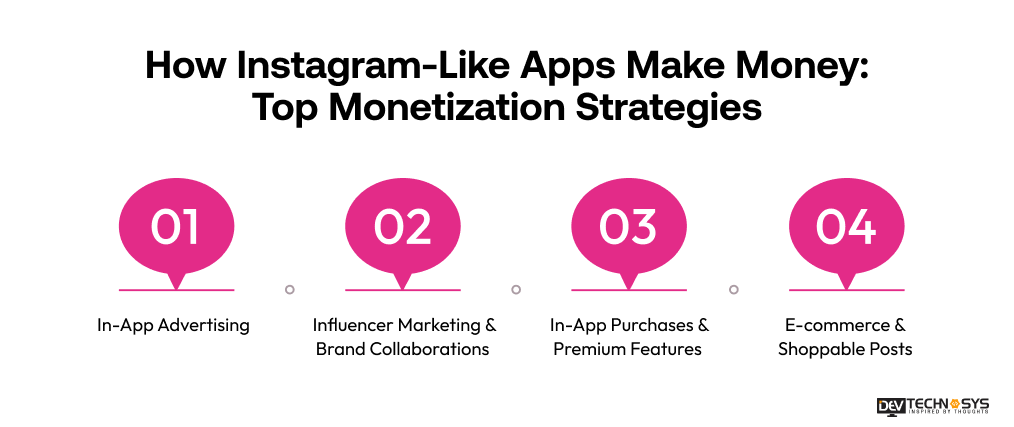
1. In-App Advertising
Displaying targeted ads within feeds, stories, and reels is a primary revenue source. Advanced algorithms analyze user behavior to deliver personalized ads, increasing click-through rates. It even generates revenue while maintaining a seamless user experience.
2. Influencer Marketing & Brand Collaborations
Apps enable influencers to partner with brands for sponsored posts and promotions. Platforms can earn commissions or offer paid creator tools. This makes influencer marketing a highly scalable and profitable monetization strategy.
3. In-App Purchases & Premium Features
Offering paid features like advanced filters, exclusive content, or ad-free experiences generates steady revenue. Freemium models attract users initially and convert them into paying customers. It is generally done through enhanced functionality and personalized experiences.
4. E-commerce & Shoppable Posts
Integrating shopping features allows users to discover and purchase products directly within the app. Businesses pay for product listings or commissions on sales. It is turning the platform into a powerful social commerce ecosystem.
Future of Instagram-Like Apps: Latest Trends You Can’t Ignore
Instagram-like apps are rapidly evolving with new technologies and changing user expectations. From AI-driven content to immersive experiences, staying ahead of these trends is essential. They help in building scalable, engaging, and future-ready social media platforms in an increasingly competitive market. Now, we will understand these latest trends that can’t be missed.
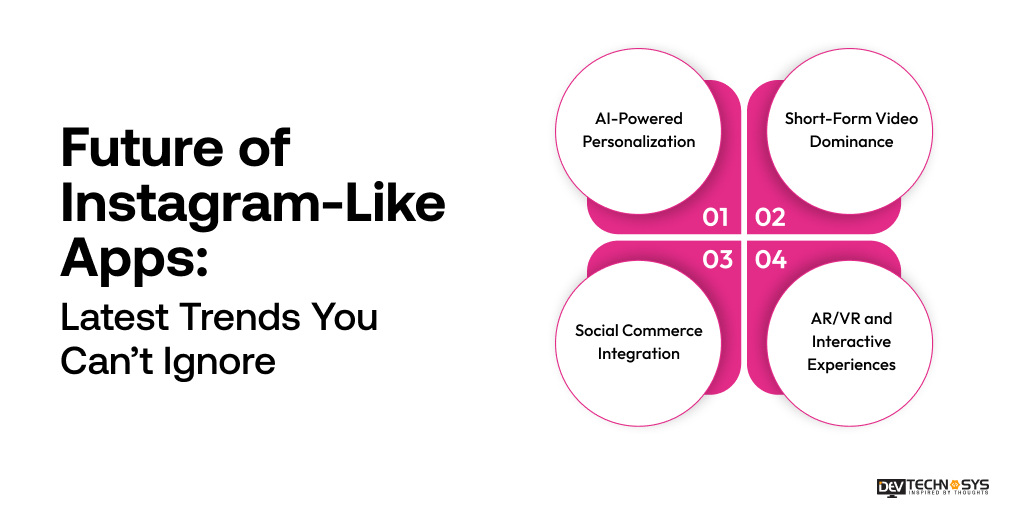
1. AI-Powered Personalization
Artificial intelligence is transforming how users consume content by delivering highly personalized feeds, recommendations, and ads. AI-driven algorithms improve engagement, increase retention, and help platforms offer a tailored experience. These experiences are based on user behavior and preferences.
2. Short-Form Video Dominance
Short-form video content continues to dominate user attention with features like reels and stories. These formats boost engagement, encourage content creation, and provide monetization opportunities. It makes short-form video dominance a must-have feature for any modern social media app.
3. Social Commerce Integration
Instagram-like apps are evolving into shopping platforms with in-app purchases and shoppable posts. Integrating e-commerce features allows users to discover and buy products seamlessly. This can create new revenue streams and enhance the overall user experience.
4. AR/VR and Interactive Experiences
Augmented and virtual reality features, such as filters and immersive environments, are enhancing user interaction. These technologies increase engagement, enable creative expression, and provide unique experiences. It helps apps stand out in a highly competitive social media landscape.
Why Choose Dev Technosys for Instagram Like App Development?
Dev Technosys is a well-known mobile app development company, serving its clients with reliable, scalable digital solutions. We have been serving in this field with trust and consistency for more than 15 years. Dev Technosys has served over 2900 online solutions across 35+ industries. So what are you waiting for? You can be the next!
You can reach out anytime; we are available 24/7. Our team provides a quick response.
Case Study: I Challenge You
At Dev Technosys, we have developed a fully-featured challenge-based social networking platform, I Challenge You. Through this platform, users can create, join, and compete in various challenges. These challenges can be related to fitness, dance, adventure, and lifestyle.
The initial scope focused on challenge creation and participation. However, as the project evolved, the client requested advanced social engagement features. These include live challenge streaming, video comparison voting, challenge invitations, follower management, and winner badge systems.
Challenge Faced
The most significant challenge was developing a real-time challenge ecosystem. It must support live broadcasting, video-based voting, challenge invitations, and location-based competitions. It should manage large video uploads, ensure fair voting mechanisms, and handle live challenge sessions.
Project Highlights
| Project Details | Information |
| Project Name | Challenge App |
| About Client | Vermon |
| Industry | Social Networking & Entertainment |
| Platform Type | Challenge-Based Social Media Application |
| Development Timeline | 6 Months |
| Team Size | 5 Developers |
| Core Categories | Fitness, Dance, Adventure & Lifestyle Challenges |
| Key Technologies | Live Streaming, Video Processing, Real-Time Voting, Cloud Infrastructure |
| Primary Features | Challenge Creation, Video Uploads, Live Challenges, Voting System, Winner Badges, Social Engagement |
Conclusion
Building an app like Instagram requires strategic planning, the right technology stack, and a clear understanding of user expectations. From feature selection to monetization and future trends, every component plays a vital role in success.
Partnering with a reliable social media app development company ensures scalable architecture, seamless frontend development, and cost-efficient execution. As competition grows, focusing on innovation, user experience, and performance will help your app stand out.
With the right approach, you can create a powerful social platform that drives engagement, attracts users, and achieves long-term growth in the evolving digital landscape.
Frequently Asked Questions
Find answers to the most common questions related to this article.
A user profile or program specifically built to reward followers is a loyalty account on Instagram. These programs offer followers exclusive content, discounts, or other similar benefits. Many businesses opt for this model to create a strong relationship with customers. Also, it increases user engagement and retention.
To build an app like Instagram, businesses should follow the given steps properly with a strategy:
Comprehensive Research on the Market
Identify the Essential Features
Select the Efficient Technologies
Maintain UI/UX Standard
Instagram-Like App Development
Conduct Thorough Testing & QA
App Deployment and Promotion
Apps like Instagram can generate steady income streams by implementing several common monetization models. Some of these include:
In-App Advertising
Influencer Marketing & Brand Collaborations
In-App Purchases & Premium Features
E-commerce & Shoppable Posts
The cost to make an app like Instagram can range somewhere between $8,000 and $30,000. This cost can vary according to the app’s complexity. Some other factors that affect the development budget include platform choice, backend infrastructure, UI/UX, security, third-party API, tech stack, and so on.
The essential features that an Instagram-like app should incorporate are:
User Registration
Like & Comment
Search FunctionReels / Short Videos
Push Notifications
Analytics Dashboard
AI Content Feed
Smart Recommendations
AI Photo Enhancement
Predictive Analytics