


















Key Takeaways:
The fitness tracking app development cost with basic features is around $8,000 to $15,000. Building a complex or AI-powered fitness tracking app ranges from $25,000 or higher, based on requirements.
Development Cost Impacted by App Complexity:
-
- MVP-Based Fitness Tracking Apps ($8,000 – $15,000): It includes several features like basic workout logging, simple analytics, integration with sensors, and activity tracking.
- Mid-Complex Fitness Tracking Apps ($15,000 – $20,000): Many different types of features are involved, such as advanced user profiles, custom workout plans, and more.
- Fully-Featured Fitness Tracking Apps ($20,000 – $25,000+): AI-powered personal coaching, personalized workout plans, voice assistant integration, and mental wellness & meditation tracking.
Fitness Tracking App Development Cost, Type-Wise:
-
- Basic Fitness Trackers App: $8,000 – $18,000
- Workout and Training App: $10,000 – $22,000
- Diet and Nutrition App: $12,000 – $25,000
- Wearable Integration App: $14,000 – $22,000
- Advanced Fitness Apps with AI Features: $15,000 – $28,000
Fitness Tracking App Development Cost, Country-Wise:
-
- The cost to build a fitness tracking app in San Francisco, USA, lies between $15,000 and $27,000; it normally depends on the labor cost, the developer’s expertise, project complexity, and more.
- The fitness tracking app development cost in Switzerland is around $10,000 to $22,000, based on the number of features, the developer’s living expenses, and advanced technologies.
- The cost to develop a fitness tracking app in London, UK, ranges from $13,000 to $25,000 or higher; it can change because of higher development expenses, project demands, and customization level.
Extra Cost Factors:
-
- Maintenance Services Cost: The price to maintain a fitness tracking app ranges from 10% to 20% of the overall development cost. It involves solving security patches, fixing errors, backups, and daily updates.
- Security Measures: There are various types of security measures that must be integrated, such as two-factor authentication, encryption techniques, and biometrics.
Fitness tracking applications have become an integral component of everyday life. From counting steps to logging workouts and tracking sleep, fitness tracking applications allow users to be more physically and emotionally healthy.
If you’re interested in developing your own fitness tracking application, one of the questions that could arise is, “What’s the cost of developing a fitness app?”
The answer is complex due to numerous factors influencing development, such as features, design, and technologies.
In this blog, we will outline how to determine the total fitness tracking app development cost.
Whether you’re a business, a startup, or simply interested in fitness apps, this guide will provide insight into the actual costs associated with developing a fitness app and what you can expect prior to getting started.
How Much Does it Cost to Develop a Fitness Tracking App in 2026?
The cost to build a fitness tracking app is around $8,000 to $25,000; it can change because of several reasons or factors. It includes functions, project complexity, backend infrastructure, platform choice, design UI/UX, security measures, and more.
The AI-powered fitness tracking app can incur a higher cost because it involves advanced features like personalized recommendations, real-time fitness monitoring, and many more. There are many additional factors, such as emerging technologies, third-party integrations, tech stacks, maintenance & support services, and more.
| Component / Feature | Description | Estimated Cost (USD) |
| UI/UX Design | Basic app layout, user-friendly screens | $800 – $2,000 |
| User Authentication | Signup/login, profile management | $500 – $1,500 |
| Activity Tracking | Steps, calories, workout logging | $1,500 – $4,000 |
| Dashboard & Analytics | Progress charts, stats display | $1,000 – $3,000 |
| Backend Development | Database, APIs, server setup | $2,000 – $6,000 |
| Integration (Basic APIs) | Google Fit / Apple Health (optional basic sync) | $1,000 – $3,000 |
| Testing & QA | Bug fixing, performance testing | $800 – $2,000 |
| Deployment (App Stores) | Launch on Android/iOS | $400 – $1,000 |
What is the Cost of Different Types of Fitness Tracking Applications?
The app’s type and the features available for fitness tracking alter how much they each cost. For example, basic, standard software fitness trackers that do not require advanced technology will typically cost less than more complex tracking applications that use AI, machine learning, etc.
1. Basic Fitness Trackers
These are the most common health-related apps and include basic features such as step count, caloric intake, and distance traveled. These apps are also generally designed simply, which makes them the least expensive option. Their development costs are also lower due to fewer features, less complex integrations, and basic functionality required for startups and small projects.
| Tier | Features | Estimated Cost (USD) |
| Basic MVP | Step counter, calories burned, simple UI | $8,000 – $10,000 |
| Intermediate | User profiles, goals, basic analytics | $10,000 – $15,000 |
| Advanced | Notifications, badges, simple social features | $15,000 – $18,000 |
2. Workout and Training Apps
These types of health apps typically provide users with access to scheduled workouts/activities, along with video demonstrations, instructions, and planned workouts. Some of these types of apps will provide a means to create a user profile and track progress.
The overall workout app development costs of these apps are moderate compared to the aforementioned app types, due to the inclusion of additional features, such as a content management system.
| Tier | Features | Estimated Cost (USD) |
| Basic | Predefined workout library, logging workouts | $10,000 – $14,000 |
| Intermediate | Video tutorials, progress charts, and reminders | $14,000 – $18,000 |
| Advanced | Personalized training plans, community features | $18,000 – $22,000 |
3. Diet and Nutrition Apps
The primary function of these apps is to assist users in meal preparation, tracking caloric intake, and tracking nutrition. Many of these apps also include food databases with comprehensive food recommendations.
These types of applications generally have increased costs due to the need to include an external database and user-customized features. Some diet/nutrition apps also incorporate AI or machine learning in order to provide suggestions.
| Tier | Features | Estimated Cost (USD) |
| Basic | Food log, calorie counter | $12,000 – $15,000 |
| Intermediate | Meal plans, nutrient analytics | $15,000 – $20,000 |
| Advanced | Personalized diet recommendations, AI-based suggestions | $20,000 – $25,000 |
Industry Insights:
According to the Grand View Research, Smartphones dominate usage, contributing over 66% market share, while wearables show the fastest future growth trajectory.
4. Wearable Integration Apps
Wearable device integration apps allow users to connect their smart devices to the app in order to receive real-time data regarding their health status. Wearable or yoga app development services costs for these types of applications are generally higher due to requirements for device compatibility and API integration, as well as the real-time data needs of the users seeking to use the wearable analysis features.
| Tier | Features | Estimated Cost (USD) |
| Single Device | Sync with one device (steps, heart rate) | $14,000 – $18,000 |
| Multiple Devices | Sync with several devices & platforms | $18,000 – $20,000 |
| Advanced | Real-time multi-sensor sync, analytics | $20,000 – $22,000 |
5. Advanced Fitness Apps with AI Features
Such applications tend to include the following features: AI-based coaching, customized insights, and real-time performance feedback, which rely heavily on machine learning and advanced analytical techniques. Due to their complexity, AI applications tend to have much higher development costs than traditional, straightforward applications, primarily because of the complexity of the algorithms used.
| Tier | Features | Estimated Cost (USD) |
| Basic AI | Simple AI suggestions for workouts/diet | $15,000 – $19,000 |
| Intermediate AI | Personalized AI plans and progress prediction | $19,000 – $24,000 |
| Full AI Suite | Deep learning, adaptive coaching, and advanced analytics | $24,000 – $28,000+ |
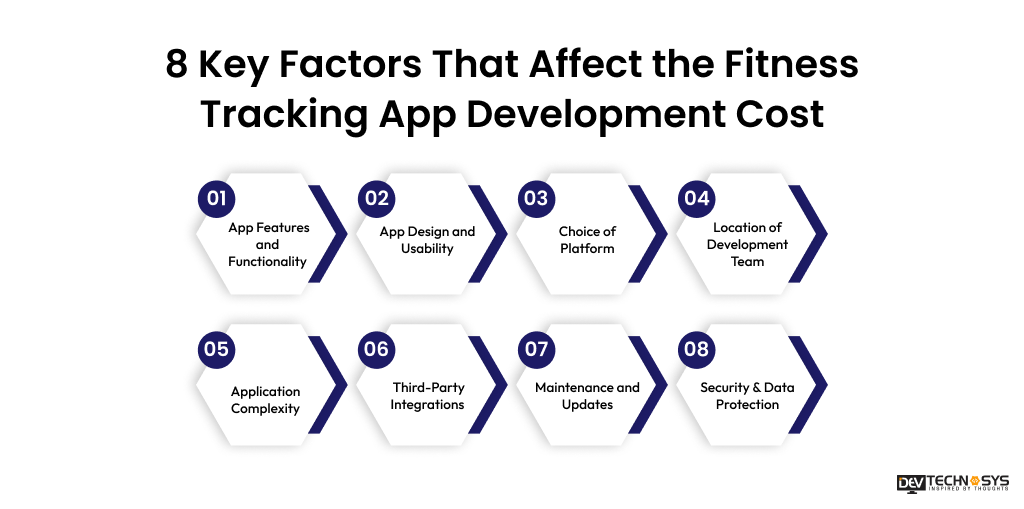
8 Key Factors That Affect the Fitness Tracking App Development Cost
A fitness tracking app is an essential tool to help you understand the overall fitness tracking app development cost. Many factors will affect your final budget, including features, design, platform and maintenance. This guide will provide you with a better understanding of the key elements. Let’s take a look at the fitness app development cost breakdown:
1. App Features and Functionality
The price of an app is significantly affected by the amount and type of functionality included. Simple functions are less expensive than complex features such as GPS tracking, live coaching, and artificial intelligence, which will typically require more resources to develop and therefore increase the overall cost to develop a fitness app.
| Tier | Feature Set | Additional Cost (USD) |
| Basic | Step tracking, simple dashboard | $1,000 – $3,000 |
| Intermediate | Workout plans, progress charts | $3,000 – $6,000 |
| Advanced | Social sharing, notifications, and gamification | $6,000 – $8,000 |
2. App Design and Usability
A simple app design will cost less to create than an aesthetically attractive, intuitive, and user-friendly app. Creating custom animations, maintaining fluid navigation, and providing interaction require skilled designers, thus increasing total fitness tracking app development cost while increasing user engagement and satisfaction.
| Tier | Design Complexity | Additional Cost (USD) |
| Basic UI | Standard screens, minimal graphics | $500 – $1,500 |
| Intermediate UI/UX | Interactive dashboards, smooth transitions | $1,500 – $3,500 |
| Advanced UI/UX | Custom animations, branded graphics, and user testing | $3,500 – $6,000 |
3. Choice of Platform
Developing an app for one operating system, such as iOS or Android, is less costly than building an app for both systems. Cross-platform development could reduce costs; however, native applications typically perform better and can result in considerable increases in the overall cost of fitness app development services.
| Tier | Platform | Additional Cost (USD) |
| Single Platform | iOS OR Android | $1,000 – $3,000 |
| Cross-Platform | Flutter / React Native | $2,500 – $5,000 |
| Native Both | Full iOS + Android | $5,000 – $9,000 |
4. Location of Development Team
Pricing differences are a result of a difference in regional wages. For example, developers in North America will charge more than developers in certain regions of Asia or Eastern Europe. Thus, location is one of the most important factors to consider in the overall fitness tracking app development cost.
| Tier | Team Location | Additional Cost (USD) |
| Low-Cost Region | India, Southeast Asia | $500 – $2,000 |
| Mid-Cost Region | Eastern Europe, Latin America | $2,000 – $5,000 |
| High-Cost Region | USA, Western Europe, Australia | $5,000 – $10,000 |
5. Application Complexity
The fitness app development cost depends on the complexity of the app itself. Simple applications are less expensive than complex applications with integrations like connections to third-party services, real-time data synchronization, or analytics. With the increased complexity of an application, there is an associated increase in the cost of development.
| Tier | Complexity Level | Additional Cost (USD) |
| Simple MVP | Minimal features, no backend-heavy logic | $1,000 – $3,000 |
| Moderate | Multiple features, basic analytics, moderate backend | $3,000 – $5,000 |
| Complex | Advanced tracking, AI hints, multi-module backend | $5,000 – $7,000 |

6. Third-Party Integrations
Incorporating an application programming interface, such as a payment gateway, fitness wearables, or social network, will increase the cost of developing the app. Each API integration has its own development time requirement, which contributes to both the overall fitness tracking app development cost and will also significantly affect the ongoing maintenance costs.
| Tier | Integration Level | Additional Cost (USD) |
| Basic | Google Fit / Apple Health sync | $500 – $1,000 |
| Intermediate | Wearable devices, nutrition APIs | $1,000 – $1,500 |
| Advanced | Payment gateways, social media, multiple SDKs | $1,500 – $2,000 |
7. Maintenance and Updates
Once the app has launched, ongoing costs will include regular updates, bug fixes, updating outdated features, addressing security patches, upgrading OS versions, and overall performance improvement. Ongoing expenses for maintenance must be factored into your total projected cost to develop a fitness app like Sweat.
| Tier | Maintenance Level | Additional Cost (USD) |
| Basic | Minor bug fixes, occasional updates | $500 – $800 |
| Standard | Monthly updates, small feature additions | $800 – $1,000 |
| Full | Frequent updates, feature improvements, 24/7 support | $1,000 – $1,500 |
8. Security & Data Protection
Fitness apps will store sensitive information such as personal and medical records; therefore, adequate security mechanisms must be implemented.
Security measures, such as archiving and decrypting app users, establishing secure access points, and protecting app user data, take time and require a higher fitness app development price than without exceptional security, but are necessary both to build trust with users and to maintain regulatory compliance.
| Tier | Security Measures | Additional Cost (USD) |
| Basic | Standard login, SSL encryption | $500 – $1,500 |
| Intermediate | GDPR compliance, secure storage, data backups | $1,500 – $2,000 |
| Advanced | Multi-factor authentication, end-to-end encryption, HIPAA compliance | $2,000 – $3,000 |
Hidden Costs of Fitness App Development Nobody Talks About
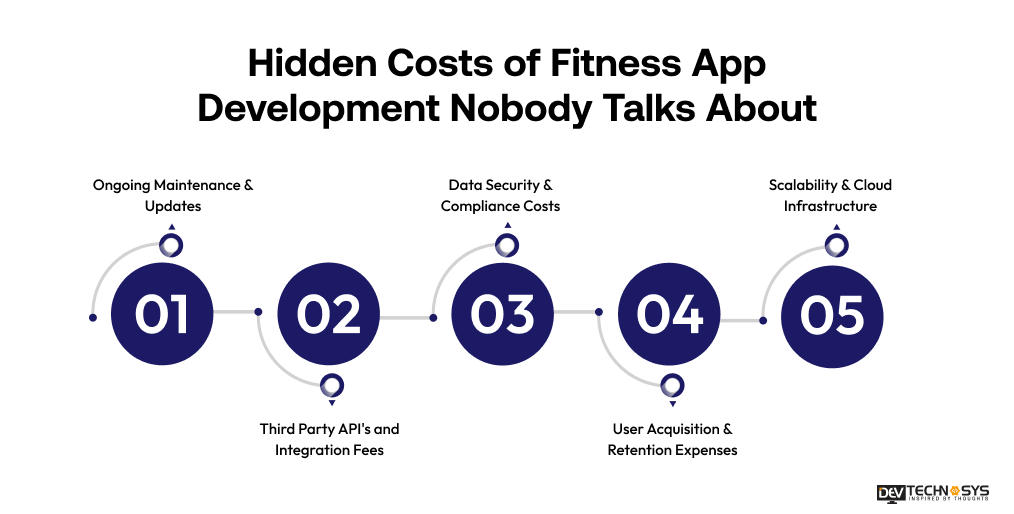
Although development budgets generally emphasize programming and design, there are many hidden costs that can dramatically increase total expenses. Ongoing upkeep of the fitness app, third-party software used in conjunction with the fitness app, security compliance, acquiring users to use your fitness app, and enlarging your server’s ability.
1. Ongoing Maintenance & Updates
Fitness Apps need to undergo ongoing development, delivering upgrades each time the OS changes. Ongoing maintenance can happen due to bugs discovered, performance enhancements that are necessary, and updating security features.
The expense of these ongoing maintenance issues can have a big impact on long-term budgets, and tends to be grossly underestimated in both pre-planning and estimating costs overview.
2. Third Party API’s and Integration Fees
Most Fitness Apps will work with other programs such as payment gateways, mapping services, wearable devices, analytics tools, and cloud platforms. The initial integration costs may appear to be reasonable, but the ongoing subscription or usage fees will quickly add to a business’s operating costs over time.
3. Data Security & Compliance Costs
When developing a Fitness App, there will be a great deal of expense needed to protect the user’s health and private information, including encryption, physical security, audit/testing, legal fees for consulting, and ensuring you are in compliance with all regulations. Since data security and complying with privacy laws can incur large amounts of costs, these will likely be hidden from you during development.
4. User Acquisition & Retention Expenses
Once your Fitness App is complete, there will be many costs incurred to grow your customer base. Building your app’s reputation, app store optimization, utilizing influencers to market your app, developing referral programs, and retention strategies; these costs can far exceed your expectations and often become a hidden expense for businesses.
5. Scalability & Cloud Infrastructure
As the number of users increases, additional server capacity, storage, bandwidth, database size, etc., will be needed for the app to continue to work properly.
The need to scale infrastructure to add new capacity to maintain high performance and reliability will lead to increased costs for cloud services. These costs will most likely not be considered during the development process.
AI Features in Fitness Tracking Apps: What They Cost and Why They’re Worth It
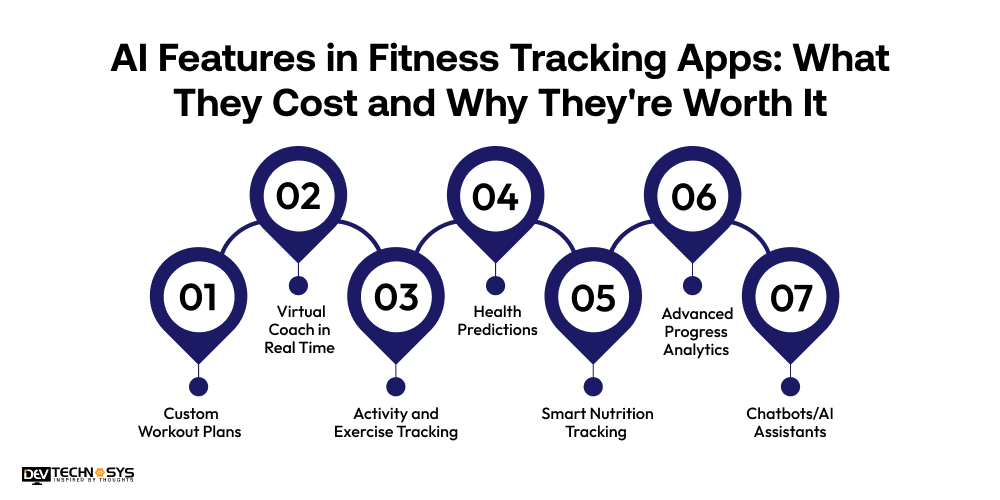
AI-based workout applications provide tailored experiences to users with increased levels of insight and engagement. Even though the inclusion of virtual coaching, exercise recommendations, predictive analysis, etc. It may lead to an increase in product development costs, but the resultant benefits make the money spent on these features worthwhile.
1. Custom Workout Plans
Estimated Cost: $1,000–$3,000
AI helps to create a personalized workout program for you based on your goals, fitness level, preferences, and previous workouts.
2. Virtual Coach in Real Time
Estimated Cost: $2,000–$6,000
AI provides immediate feedback, corrects your form, and gives you guidance on how to perform exercises during your workouts.
3. Activity and Exercise Tracking
Estimated Cost: $1,500–$4,000
AI will automatically identify exercises and activities using sensors found in your smartphone or other wearable devices and motion tracking technology.
4. Health Predictions
Estimated Cost: $1,000–$3,500
AI analyzes your health metrics and fitness trends to provide predictions of future health events, alerts about possible risk factors, and suggestions for improving your health.
5. Smart Nutrition Tracking
Estimated Cost: $800–$2,500
AI tracks your calories, evaluates your eating habits, and creates custom meal plans that align with your fitness objectives.
6. Advanced Progress Analytics
Estimated Cost: $700–$2,500
AI takes all the data collected from your fitness regimen and creates detailed reports and performance graphs that provide direction on your future training.
7. Chatbots/AI Assistants
Estimated Cost: $1,000–$3,500
24/7 access to an AI assistant to answer your questions about fitness-related issues, give you encouragement, and provide you with personalized support.
Planning a Fitness Project?
Get a tailored development cost estimate in a few simple steps.
- 3 quick steps
- 100% free
- Reply in 1 business day
2 Minutes Read
Does Your Fitness Tracking App Need HIPAA Compliance?
Depending on how a fitness app collects, uses, transmits, and shares PHI, it is subject to HIPAA regulations if it does any of these activities on behalf of a covered entity.
Therefore, if an app tracks workouts, calories burned, steps, or wellness goals for personal records, then HIPAA will likely not apply. Conversely, if the fitness application will interface with any healthcare system or telehealth application, or share any clinical data.
Then it’s necessary to establish a HIPAA compliance program to protect sensitive health data and avoid facing penalties from the federal government.
What is the Cost to Develop Popular Fitness Tracking Applications?
Do you want to make a similar fitness tracking app that already exists in the market? But you have no idea how much it costs? Then this section provides the estimated development cost of popular or best fitness tracking apps that have already achieved higher success.
1. Cost to Build an App Like Strava
Strava is the most famous social networking application for athletes to track their cycling, hiking, and running via GPS technology. Strava supports around 40+ sports like swimming, gym workouts, yoga, and many more. The cost to develop an app like Strava is around $10,000 to $24,000, mainly based on the customization level, features, services, integrations, and many more.
| Version | Estimated Cost (USD) | Features Included |
| Basic (MVP) | $10,000 – $14,000 | Core workout tracking, GPS, simple stats |
| Mid-Level | $14,000 – $20,000 | Social sharing, leaderboards, analytics |
| Advanced | $20,000 – $24,000+ | Real-time challenges, wearable integration, and advanced analytics |
2. Cost to Build an App Like Fitbit
The Fitbit is one of the most used applications as a fitness and health companion, and it is available on both platforms, such as Android and iOS. It includes premium features such as activity & health tracking, nutrition tracking, sleep & stress tools, tracking daily steps, and heartbeat monitoring.
Fitbit-like app development costs range from $15,000 to $25,000; it can be a higher budget for fitness mobile app development, as advanced features and services are integrated.
| Version | Estimated Cost (USD) | Features Included |
| Basic | $15,000 – $18,000 | Step counting, basic activity tracking |
| Mid-Level | $18,000 – $22,000 | Calorie tracking, heart rate, and sleep tracking |
| Advanced | $22,000 – $25,000+ | Wearable sync, detailed analytics, multi-device support |
3. Cost to Build an App Like MyFitnessPal
MyFitnessPal is an AI-powered fitness application that helps users to track their fitness activities and get personalized recommendations. This application has a massive database of food, around 14 million.
It enables users to track their water intake and micronutrients. The cost to develop an app like MyFitnessPal lies between $12,000 and $20,000, influenced by several types of factors.
| Version | Estimated Cost (USD) | Features Included |
| Basic | $12,000 – $15,000 | Food logging, calorie tracker, user profile |
| Mid-Level | $15,000 – $18,000 | Barcode scanner, meal suggestions, basic analytics |
| Advanced | $18,000 – $20,000+ | AI suggestions, recipes, community features, cloud sync |
4. Cost to Build an App Like Mindbody
Mindbody is a fitness marketplace where users can connect with local fitness trainers, gyms, spas, yoga studios, salons, wellness, and beauty businesses. It allows users to discover, book, and pay for appointments and classes.
There is a wide range of features that include booking & payment, scheduling, reviews, management tools, and marketing. The Mindboy-like mobile app development cost is around $13,000 to $23,000, or dependent on project requirements.
| Version | Estimated Cost (USD) | Features Included |
| Basic | $13,000 – $15,000 | Class booking, user profiles, and payments |
| Mid-Level | $15,000 – $18,000 | Calendar integration, push notifications, filters |
| Advanced | $18,000 – $23,000+ | Multi-location support, analytics, and an advanced admin panel |
5. Cost to Build an App Like ClassPass
ClassPass is a subscription-based app that allows users to access a wide variety of fitness studios, gyms, salons, spas, and more. Users can access 25,000+ popular or top-rated gyms in over the 2,500+ global cities.
It involves various types of features such as a credit system, wellness services, a variety of classes, and different workouts. The cost to develop an app like ClassPass starts from $8,000 with basic functionalities and ends at $25,000 with advanced features.
| Version | Estimated Cost (USD) | Features Included |
| Basic | $8,000 – $13,000 | Booking system, user accounts, basic class list |
| Mid-Level | $13,000 – $20,000 | Credit system, reviews, notifications, calendar sync |
| Advanced | $20,000 – $25,000+ | Multi-vendor support, subscription management, and AI recommendations |
Industry Insights: According to the imarcgroup.com, rising chronic lifestyle diseases significantly drive adoption, increasing demand for accessible, home-based digital fitness solutions.
Fitness App Data Privacy: GDPR, CCPA & FTC Rules Must Follow in 2026
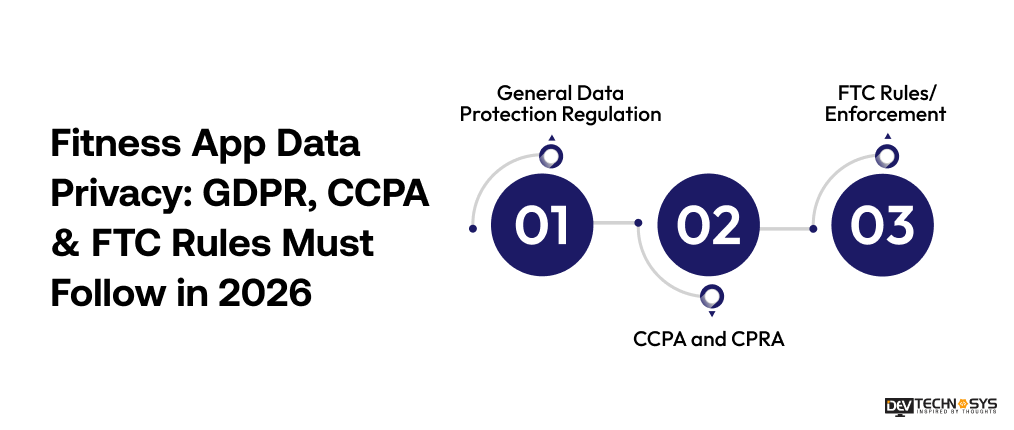
The fitness app industry is expected to comply with stringent privacy laws due to the growing amount of sensitive health data and behavioral information being captured. As of 2026, all developers of fitness apps will need to meet the requirements set forth within GDPR, CCPA, and Federal Trade Commission rules regarding user transparency, consent, data protection, and protecting the privacy of users.
1. General Data Protection Regulation
Under GDPR, fitness applications are required to obtain user consent, limit data collection to what is necessary, allow users access to their data, allow deletions of their data, provide lawful grounds for processing their data, timely report for data breaches, protect sensitive health-related information, and provide users with transparency with respect to use, sharing and retention of their data, as well as the use of automated decision making for their data.
2. CCPA and CPRA
Under CCPA and CPRA, fitness applications are required to disclose the categories of data collected, provide users access to their data, provide users with the ability to delete their data and correct inaccuracies in their data, provide users with the option not to have their data sold or shared, implement reasonable security measures for user data, and not discriminate against users who exercise their privacy rights.
3. FTC Rules/Enforcement
Privacy and data security in the United States is enforced by the FTC through actions with respect to unfair or deceptive acts or practices. Fitness applications are required to abide by their privacy promises to users, secure confidential user information, obtain proper consent for the collection of sensitive health-related information, provide truthful disclosures about the use of user information, and maintain safeguards to protect against unauthorized access to, and/or the misuse of, user information, etc.
How to Reduce the Fitness Tracking App Development Cost?
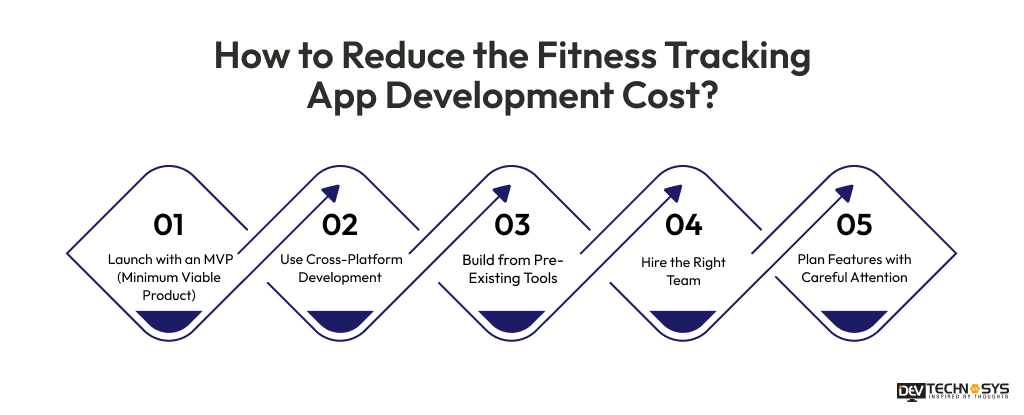
Developing a fitness tracking application can be done at an affordable price using the best method and a well-thought-out plan. To accomplish this, companies should use only the most important features, utilize lower-cost development technologies, and take advantage of pre-existing software products for development.
1. Launch with an MVP (Minimum Viable Product)
Develop a fitness app with only a minimum set of features at first, so you can get it up and running quickly and cheaply. Collect user feedback as you develop and then add features later, thus allowing you to avoid the high initial cost to build a fitness tracking app by spreading them out over multiple releases.
2. Use Cross-Platform Development
Build once and deploy across multiple platforms (Android and iOS). There are frameworks to build cross-platform applications, meaning that you only need to write and manage one set of code that can be reused on both platforms. This saves time and money while also getting you in front of more users for less overall cost of fitness AI app development services.
3. Build from Pre-Existing Tools
Use currently available tools, services, and third-party solutions rather than creating all of these capabilities from scratch. This means much less time and money for development. While still allowing you to build many of the key features of modern apps, such as payments, tracking, and authentication, into your app.
4. Hire the Right Team
First, be sure that you engage with a team of developers who have a complete understanding of your requirements. This will help you avoid development delays, mismatched expectations, and rework, increasing your fitness tracking app development cost substantially. You can also explore opportunities to outsource your work to countries with lower fitness app development costs for startups without compromising quality standards.
5. Plan Features with Careful Attention
Don’t rush into developing too many initial features. Concentrate on the most critical needs of your target customers. Careful planning and focusing your iOS and Android app development services efforts on the things that are truly important to your users can prevent wasted effort and make your application more manageable. It helps you maintain control over your budgets while giving you a well-developed and finished product.
Fitness App Development: Build vs. Buy vs. White-Label: Which Is Right for Your Budget?
The correct option for development is based on budget, timeline, and future objectives. Building means having total control, purchasing gives you quick access, and using a white-label provides balance across all three. Each of these options affects cost, degree of customization, scalability, and maintenance; therefore, the choice must be strategic to succeed.
Approach |
Build |
Buy |
White-label |
| Description | Fully custom app built from scratch with unique features and design | Ready-made app with standard features, used as-is | Pre-built app rebranded with minor customization |
| Cost | $20K–$200K+ | $5K–$50K | $8K–$80K |
| Time | 3–12 months | Days–2 weeks | 2–8 weeks |
| Scalability | High, designed for long-term growth | Low–moderate, limited by vendor | Moderate, depends on the platform |
| Customization | Full control over features and UX | Very limited changes | Branding + minor tweaks |
| Maintenance | In-house team required | Vendor managed | Shared with vendor |
| Best For | Scalable startups | Quick MVP launch | SMEs needing a fast branded app |
| Key Advantage | Maximum flexibility | Fastest launch | Balanced cost & speed |
| Key Limitation | High cost & time | Limited control |
Some vendor dependency |
What are the Monetization Models for Fitness Tracking Applications?
Apps that track fitness have many possible ways to make money, as there are many ways to generate income. For example, there are subscription-based business models, in-app purchases, advertising, and sponsorship agreements, among others. Each of these types of monetizing has its own unique advantages.
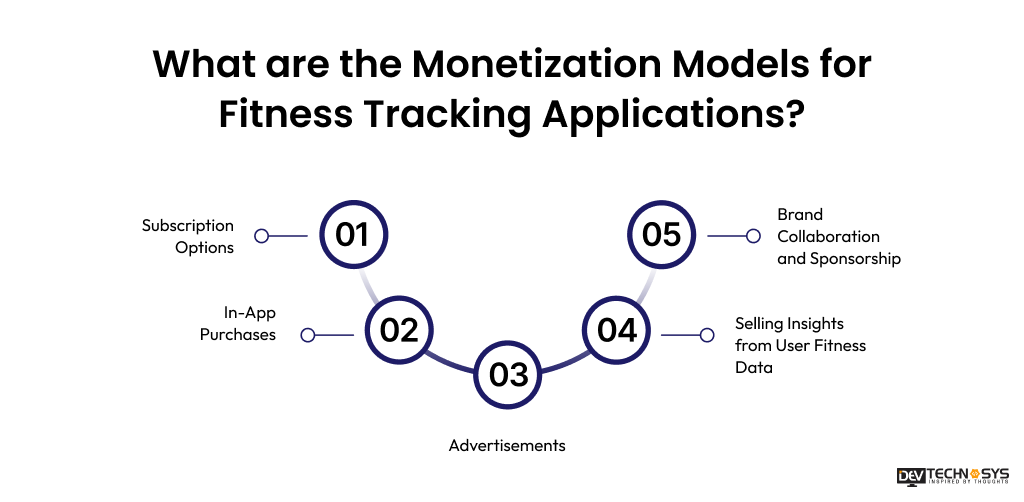
1. Subscription Options
Give users access to a no-cost version of your service with limited functionality and charge them a monthly or yearly fee for premium features. Premium subscriptions can include quality personal training assistance, in-depth analysis, ad-free access, and other features that will help you to achieve a steady stream of income over the long haul.
2. In-App Purchases
Sell digital features or content directly to your users inside the application, for example, providing custom training plans, nutritional information, and expert guidance. According to the healthcare app development company, users will pay for only what they need, and this flexibility will increase your overall income potential.
3. Advertisements
Generating income from advertising will depend on how much your users engage with these ads within the app via the use of banner, video, or sponsored advertisement types. As with anything, you may also need to establish the right balance between having enough ads present in your app and affecting your users’ experience negatively.
4. Selling Insights from User Fitness Data
With their consent, you may be able to analyze anonymized fitness-related data and share that information with a fitness app development firm. This may provide an additional revenue stream. It will be critical for all companies that wish to sell this type of information to adhere to strict privacy guidelines, ensuring that all user data is safe and secure and handled ethically.
5. Brand Collaboration and Sponsorship
Work with local or national companies in your community that provide consumer products or services in connection with health and fitness. Sponsored content, affiliate programs, and brand sponsorships provide additional sources of revenue for you to promote products or services to your customers and help your customers save money.
Conclusion
Now, we are standing at the last stage of this blog. In this informative blog, we discussed in detail the cost to develop a fitness tracking app and what factors actually affect the cost. We think that you have cleared all your doubts regarding the cost and have gotten the estimated cost of development.
Do you want to invest in the fitness industry? Then you have to get your own fitness tracking app. Reach out to a fitness app development company to receive high-quality applications for fitness with customization.
Frequently Asked Questions
Find answers to the most common questions related to this article.
The cost to develop a fitness tracking app is around $8,000 to $25,000, depending on the crucial factors. It can be changed because of several factors or elements, such as backend processes, API integrations, tech stacks, features, functions, development team, platform choice, and more.
The development timeline of a fitness tracking app is around 2 to 4 months for a basic application with limited features and services. The AI-powered or complex app can take around 3 to 6 months or longer. Many factors can affect the time, such as a higher number of features, services, integrations, design, and more.
The cost to hire fitness tracking app developers is around $15 to $25 per hour, depending on various factors. It involves the developer's experience level, rich skill set, the developer’s living location, and many other factors. The main factor that affects the hiring cost is the type of project businesses want to develop and which features need to be integrated.
The maintenance cost of a fitness tracking app is around 10% to 20% of the initial mobile app development cost. It includes various services, such as fixing bugs or glitches, optimizing performance, regular updates, upgrading OS versions, backups, and many more. These services can keep the application up-to-date and maintain the overall performance and speed.
There are various types of hidden cost factors that affect the cost of fitness app development:
Cloud infrastructure cost
Real-time data processing
Continuous feature updates
Third-party API licensing
Cross-platform compatibility