


















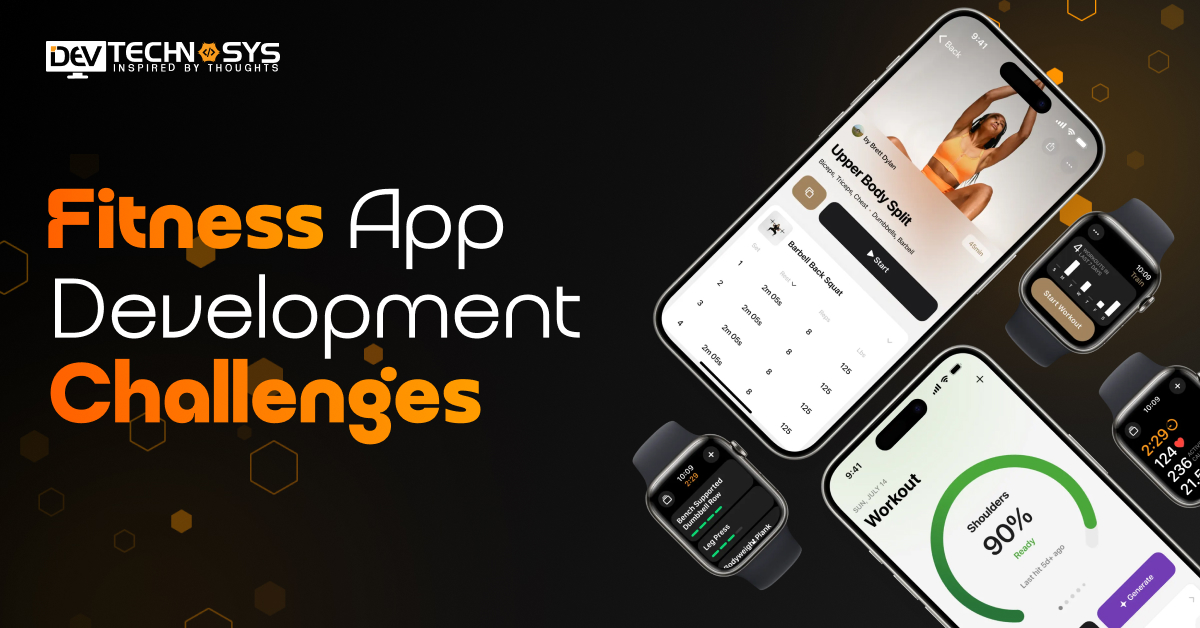
Do you think that building a fitness app is a straightforward process? No, there are various challenges that occur during the fitness app development. Before starting the development process, you must be aware of these challenges and get their solutions for a smooth process.
The crucial challenges are higher development cost, ensuring a user-friendly interface, data accuracy, security and privacy concerns, multi-platform support, and more.
Do you feel difficulty in finding the right solution to a specific challenge? Yes, it has.
Welcome to this informative blog. We will provide a detailed description of fitness app development challenges in 2026 and also offer a specific solution.
Stick this blog like a statue!
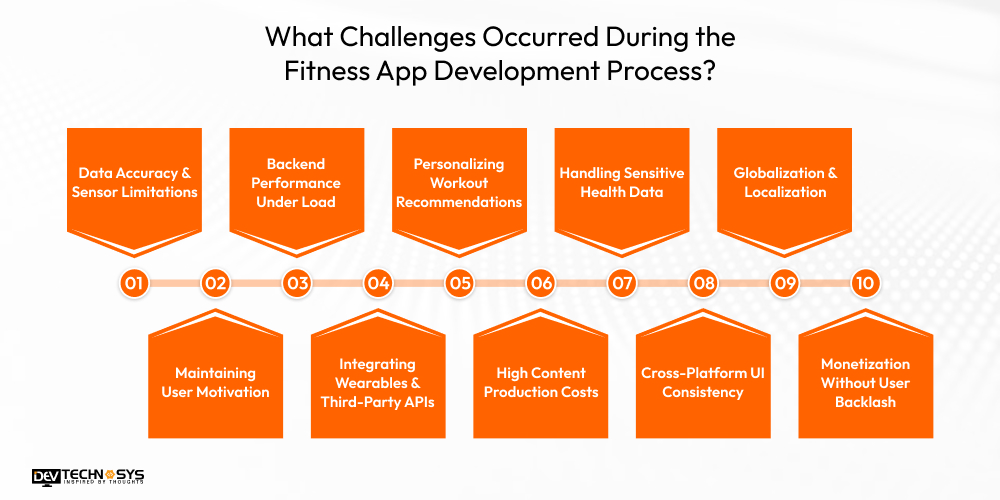
What Challenges Occurred During the Fitness App Development Process?
Finally, you begin to know the various challenges that are faced during the ongoing processes of fitness app development. It mainly includes data security and privacy concerns, higher development cost, simple UI/UX, third-party integrations, choosing the best tech stacks, and many more. So, let’s explore the wide variety of fitness app development challenges:
1. Data Accuracy & Sensor Limitations
Fitness apps heavily rely on sensors, accelerometers, gyroscopes, GPS, and heart-rate monitors, which vary by device quality. Inconsistent measurements create unreliable workout tracking and frustrate users expecting precision.
Environmental factors, signal loss, motion artifacts, sweat, or wrist placement further distort results. Fitness app data privacy concerns across thousands of hardware combinations become a major technical and QA challenge.
Solution:
Hire dedicated developers to add error correction algorithms, device calibration profiles, statistical smoothing, and many more. The application offers manual entry fallbacks and enables users to adjust or verify the overall result.
Users can input their prompts when the quality of the devices is low or down. This can easily make a trustworthy experience for users when they track their fitness reports.
2. Maintaining User Motivation
Maintaining user motivation is one of the common challenges. Most of the users download fitness apps, and after a few days, they delete the app due to a loss of motivation. It includes unrealistic goals, app fatigue, and a lack of instant results.
The fitness app’s long-term value decreases due to unsustained user engagement. These factors can lose the user’s fitness freak motivation, and it becomes an ongoing challenge.
Solution:
Introduce gamification, streak systems, progressive milestones, and timely encouragement. Use positive reinforcement and adaptive goal recommendations. Deliver personalized reminders that align with user habits rather than generic notifications, improving long-term engagement and habit formation.
3. Backend Performance Under Load
Moving to the third fitness app development challenge, peak morning usage, real-time data syncing, and traffic workout events can put a load on the backend system.
This can slow down the overall system and provide a slower response time on live fitness classes, data uploads, and social features. Handling the higher number of operations and users can be a challenge on fitness apps, and it can reduce the load times.
Solution:
Implement a strong or highly scalable backend infrastructure that can manage the higher number of operations and streamline the fitness app like Whoop, processes, and functionality. Businesses can use the performance monitoring to respond instantly during peak hours and ensure consistent and reliable responsiveness.
4. Integrating Wearables & Third-Party APIs
Integrate fitness app with different types of wearable devices such as Apple Watch, Samsung fitness band, fitbit, Garmin, and other smart scales, including permissions and data formats.
Wearable device integration challenges across system changes require continuous maintenance. Any broken sync damages user trust and can quickly reduce app ratings. Supporting multiple platforms without overwhelming development resources is complex.
Solution:
To solve this challenge, businesses need to create a modular integration with unified data schemas. First, prioritize major wearables that are most used as wearables, and then go for the next ones. Conduct the automated testing of third-party APIs and wearables, and provide clear fallback modes when external services fail.
5. Personalizing Workout Recommendations
Moving to another fitness app development challenge, developing truly personalized workout recommendations proved difficult because users varied dramatically in fitness level, goals, injury history, available equipment, and preferred training styles.
Fitness app like ClassPass personalization hurdles are often over-generalized, creating programs that feel irrelevant or too intense. Ensuring accuracy without requiring excessive user input was another barrier.
Solution:
We implemented a hybrid recommendation engine combining rule-based logic with machine-learning clustering. A short adaptive assessment updated user baselines automatically, while ongoing performance data refined difficulty and exercise selection. This reduced data-entry friction, improved relevance, and ensured safe progression using validated training models.
6. High Content Production Costs
Filming high-quality exercise videos, hiring trainers, securing studio time, and editing footage made content production expensive and slow. Maintaining fresh material to keep users engaged added ongoing costs.
Producing multiple variations for different skill levels and equipment constraints further increased the workload, making fitness app scalability issues is major concern for long-term sustainability and international expansion.
Solution:
We shifted to a modular content system: capturing reusable exercise clips, variations, and voiceovers that could be recombined into new programs. This reduced filming frequency and allowed automated generation of personalized workouts.
Partnering with certified trainers for periodic batch shoots and adopting remote recording tools further cut production costs and accelerated updates.
7. Handling Sensitive Health Data
Collecting heart rate, body measurements, injury history, and wellness data created significant fitness app security risks. Mismanaging this sensitive information risked legal issues and user distrust.
Complex regulatory requirements, such as GDPR, HIPAA, and regional data laws, required strict controls around storage, consent, access, and third-party integrations. Security vulnerabilities posed additional risks.
You can reach out anytime; we are available 24/7. Our team provides a quick response.

Solution:
We implemented end-to-end encryption, strict role-based access, and anonymized data pipelines in app like GymGennie. A transparent consent flow allowed users to control what they shared.
All data storage followed GDPR and HIPAA guidelines, with regular penetration testing and third-party audits to ensure compliance. Secure APIs and limited data retention minimized exposure risks.
8. Cross-Platform UI Consistency
Delivering a seamless experience across iOS, Android, tablets, and web proved challenging. Differences in native components, typography, animations, and screen ratios created inconsistencies.
Fitness app UX challenges tested well on one platform but felt awkward on another. Cross-platform fitness app development, maintaining two codebases, increased overhead and slowed releases, making UX fragmentation a recurring issue.
Solution:
We adopted a unified design system with shared components, tokens, and interaction patterns. Using a cross-platform framework for user engagement in fitness mobile app development solutions and logic reduced duplication while allowing platform-specific enhancements.
Continuous visual regression tests flagged inconsistencies early. Centralized documentation ensured designers and developers aligned on spacing, color, and accessibility rules.
9. Globalization & Localization
Expanding internationally required adapting not just language but also work norms, cultural expectations, measurement systems, and legal guidelines. Some exercise terminology lacked direct translations, and motivational styles differed across regions.
Supporting right-to-left formatting, local calendars, and multiple currencies further complicated scaling. Maintaining consistency across markets became increasingly resource-intensive.
Solution:
We built a localization pipeline supporting dynamic language packs, cultural adaptation layers, and region-specific workout libraries. Native translators ensured fitness terminology accuracy, while machine-assisted workflows sped updates. Features automatically adjust units, currencies, and formatting.
10. Monetization Without User Backlash
In the last fitness app development challenges, introducing subscriptions and premium features risked alienating users who expected free tools. Aggressive paywalls or intrusive ads damaged retention and trust.
Users often compared pricing to established competitors, increasing sensitivity. Balancing revenue growth with perceived value required careful timing, transparent communication, and a clear distinction between free and paid benefits.
Solution:
Hire mobile app developers to implement a value-first monetization strategy: essential tracking stayed free, while advanced analytics, personalized plans, and premium programs formed a compelling upgrade path.
Transparent in-app messaging clarified benefits without pressure tactics. Limited-time trials, loyalty discounts, and flexible monthly pricing increased acceptance. A/B tests optimized paywall placement and reduced friction.

Conclusion
We are standing at the last stage of this blog. We explored the fitness app development challenges that affect the development process and make it difficult for developers and businesses. We hope that you understand each challenge and know how to solve them and process the overall development process.
Do you want to fix your existing mobile fitness app bugs or glitches? You must connect with a custom fitness app development company to get affordable maintenance and development services.
Frequently Asked Questions
Find answers to the most common questions related to this article.
The fitness apps must use strong security and privacy measures such as two-factor authentication, edge processing, end-to-end encryption, secure API gateways, and many more. These security methods help to protect sensitive health and biometric data from unauthorized accessibility.
The real-time activity tracking and analytics require battery optimization, offline mode, low-latency data processing, and more. The developers have to design a system that interprets biometrics, motion, and environmental data without draining any resources.
Use scalable architectures (Flutter, React Native, Kotlin Multiplatform) and optimize user flows for both high-end and low-end devices. Fitness apps often rely on sensors and background activity, so developers must tune permissions, battery usage, and motion-tracking APIs for each platform.
Users expect more value for subscriptions due to rising competition from big tech and hardware-bundled fitness ecosystems. Flexible pricing models, micro-subscriptions, AI-driven upsells, and transparent plan tiers help retain users and reduce churn.