


Key takeaways:
-
- AI Agent Security is the practice of safeguarding business systems integrated with artificial intelligence technology.
- Core areas of AI agent security include prompt injection defense, tool control, agent memory management, and audit logging.
- Growing enterprises must regularly perform AI application security assessments to identify and resolve risks.
- AI agent security costs range from $500 to $15,000+ depending on factors such as business size, AI agent workflow, and solution complexity.
Tell me what an AI agent cannot do. From scheduling an appointment with a doctor to supporting a business’s sales operations, AI agents can handle multiple tasks at once. Businesses increasingly need AI agent security because these systems process large volumes of sensitive data.
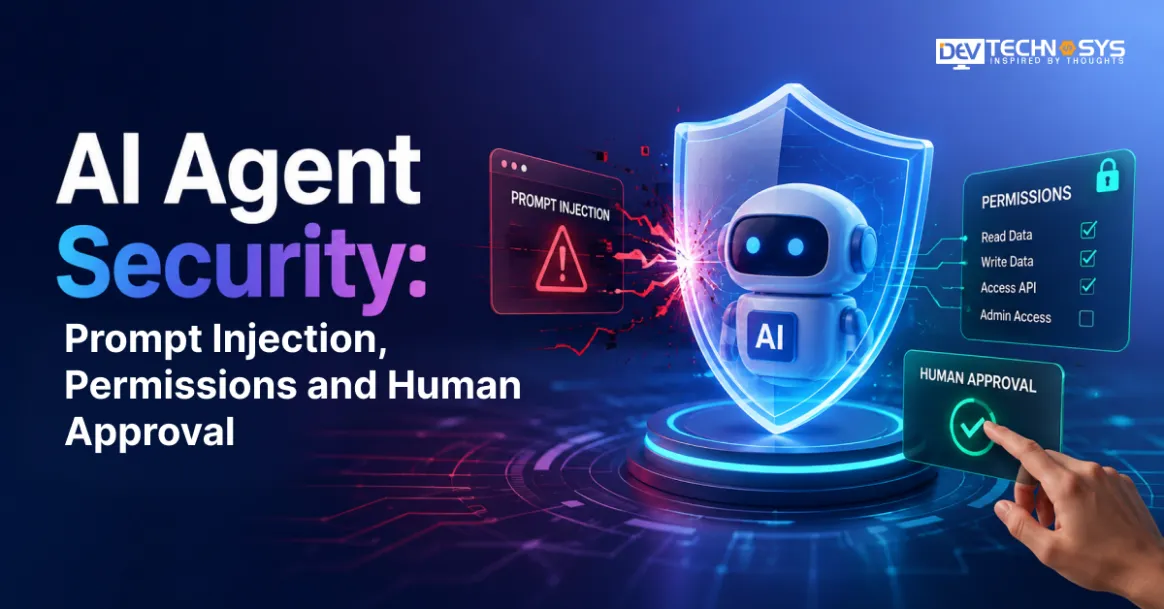
Some of the critical areas that need to be controlled include:
- What the agent can be influenced by
- What the agent is allowed to access or change
- When a human must approve an action
Because the technology can do a lot of work, it needs to be secured. There are two ways to achieve this. First, build a strong AI architecture with the necessary mechanisms and compliance. This will save costs. Second, choose AI agent security services to secure the existing application.
What This Blog Covers
- Security Risks
- Permissions Required for AI Agents to Work
- Human Approval Workflows
- AI Agent Security Cost
- How Prompt Injection Works
What are the Biggest Security Risks in AI Agents?
Planning to Build an AI Agent? Don’t skip understanding the security risks associated with it. The biggest risks include prompt injection, unauthorized access, sensitive data exposure, excessive permissions, insecure integrations, and insufficient human oversight.

1. Prompt Injection Attacks
In this type of attack, hackers send malicious instructions in user inputs to expose sensitive information or perform unauthorized actions. Inputs allow intruders to access the information they need. This attack is especially dangerous for businesses that handle customer data.
2. Excessive Permissions
AI agents are developed to manage operational workflow and not access sensitive business data. AI systems must be granted limited permissions to data. Businesses must build specific privacy policies to ensure that the data is protected whether it is accessed on any device or location.
3. Unauthorized Agent Actions
If an agent receives unauthorized access, then it might give inaccurate responses to users. Without clear rules, agents tend to act on their own. An agentic AI development company identifies such issues and resolves them using specific tools. Though these solutions are expensive, they resolve authorization-related issues.
4. Sensitive Data Exposure
One of the biggest risks is exposing sensitive customer information to intruders through chat and internal AI systems. Users share personal information, banking details, and location data that attackers can exploit. This happens when a solution has weak access controls or unplanned prompt handling.
5. Insecure Tools, APIs and Integrations
AI solutions are prone to threats because information moves through APIs, databases, SaaS platforms, plugins, and internal tools. If they receive invalid inputs, they can become an attack vector. That is the reason a project is handled by an expert. Businesses must avoid integrating too many features or using APIs to avoid security risks.
Planning to Build an AI Development Project?
Get a quick cost estimate based on your AI features, integrations, and development scope.
- 3 Quick Steps
- 100% FREE
- Hear Back Within 1 Business Day
2 Minutes Read
How Can Permissions Prevent Unauthorized AI Agent Actions?
Permissions mean the list of activities that an AI agent can perform when deployed in an environment. These are usually implemented to restrict unauthorized actions. For example, an AI agent can access and process CRM data but cannot delete or modify any records.
1. Apply Least-Privilege Access
In this model, an AI agent receives narrower permissions, such as executing business tasks. Engineers avoid sharing access to databases, cloud environments, APIs, and internal applications to secure the information.
It is possible that a third-party user may give a malicious command that will not be responded to due to least-privilege access. Businesses must choose an experienced artificial intelligence development company to prevent unauthorized AI agent actions.
2. Separate Read and Write Permissions
Most often, developers mistakenly grant the same permissions for read and write actions. Design capabilities around specific rules to reduce the impact of a security threat. This helps prevent data overwriting even if a prompt injection attack triggers the system.
3. Use Role-Based and Attribute-Based Controls
For industries such as food delivery apps, healthcare, or real estate, role-based access controls allow only specific users to access the system. Businesses that use AI-built app audit services don’t have to worry about these risks, as the teams already address them. The controls reject input related to transactions or high-risk operations.
4. Validate Every Tool Call
Excessive tool use without proper permissions is a major source of security vulnerabilities. Validating each tool before use prevents hallucinated authority and prompt injection exploits. This is especially important when an AI agent attempts to use internal system data. It must go through strict security protocols to access sensitive information.
5. Monitor Permission Usage
Abnormal behavior patterns of AI agents are tracked to ensure that data is protected.
Implementing AI consulting services is helpful for businesses to maintain system security. Monitoring keeps the system secure, as continuous logging keeps security threats visible to the team. Whenever the issue is identified, it is resolved quickly.
Industry Insight: According to The Business Research Company, the AI in security market is expected to grow to $96.42 billion in 2030. This data shows that companies have greater scope in cybersecurity as the adoption of artificial intelligence rises.
When Should AI Agents Require Human Approval?
The fact is, no matter how capable an AI agent is capable of working, it requires human approval at a certain stage. For example, when a financial transaction-related query needs to be solved. This is to ensure the safety of the data while a user wants to resolve a query.
1. Low-Risk Actions Can Remain Automated
Daily operations such as information retrieval do not require human approval because they have low risk. These actions do not involve sensitive information and can be automated.
2. High-Impact Actions Need Approval
In contrast to the above, this point is: actions that include data deletion, editing, financial transactions, or sensitive data disclosure require human approval. The conversation escalates to a human when these actions are required.
3. Set Risk-Based Approval Rules
This is specifically for financial transactions. Developers should include risk-based approval rules to set a transaction limit according to the user role. If a user tries to make an attempt that is not defined, then the action requires human approval.
4. Keep Approval Outside the Model
Businesses should create an approval workflow for any external interference with the AI agent. Though the agent will process the input, the data will move through a typical security architecture that will prevent any unauthorized action.
5. Maintain an Audit Trail
When an audit trail is performed, specific information requires human approval. For example, to upgrade a prompt request or to check whether the response is contextual. This process ensures that the system is verified by an expert, and the data will be processed securely.
Expert Advice: Based on my experience across projects, I recommend that businesses avoid giving an AI agent full autonomy. Over time, the workflow can be changed, but initially, the system should be assigned limited access. – Mohit Nag, AI Expert
How Much Does an AI Application Security Assessment Cost?
The AI agent development cost can be from $4999 to $70,000 or more, depending on the features required. If a business wants compliance, then it requires extra engineering effort, which costs more. But for AI application security, businesses can find a different budget.
Businesses should also understand the cost of an AI security assessment. It depends on solution complexity, integrations, and models used. The cost for an AI agent security assessment ranges from $500 to $15,000+ depending on the system size.
AI Application Security Assessment by Solution Complexity | Estimated Cost | What it Includes? |
| Basic AI Security Assessment | $500 – $1000 | AI app security review, OWASP LLM Top 10, prompt injection, authentication |
| AI Fraud Detection / Risk Integration | $10,000 – $30,000+ | Real-time risk scoring, predictive analytics, compliance and Governance frameworks for security |
| Standard AI Application Security Assessment | $1,000–$2,500 | Full AI application + API + LLM/RAG security + vulnerability report |
| Enterprise AI Security Assessment | $5,000–$15,000+ | Multiple AI systems, APIs, cloud, compliance mapping, detailed security assessment |
Note: This is a cost estimate, as the final price depends on a final discussion with the project team.
How Can Engineers Prevent Prompt Injection in AI Agents?
Preventing prompt injection is challenging and requires additional engineering effort. They need to design the system with strong security features to avoid model manipulation or unauthorized actions. Apply security checks on the agent’s backend or API to protect it from threats. Below are some ways experts can protect AI agents.
1. Use Allowlisted Tools and Actions
The best way to secure agents from prompt injection is to give them limited access. For example, a customer support agent can check orders or history but is not allowed to delete or modify database data.

2. Treat All External Content as Untrusted
Engineers should treat all inputs as ‘untrusted ’; this helps secure the agent against prompt injection. Even if any external command is given to the agent, it will consider it as untrusted.
3. Keep Permissions Outside the LLM
Engineers need to implement a backend authorization layer so the user is identified from the database when requesting sensitive data. If a sales employee wants to check the last transaction, then permission will be checked from the backend to provide the financial record.
Industry Insight: Tech Bullion listed Dev Technosys as one of the top artificial intelligence companies. They highlighted our capabilities in building AI agents, security, agentic AI workflows, and overall AI development.
How Should AI Agent Memory Be Secured?
AI agent memory stores customer, business, third-party, and other impactful data that needs protection. In 2026 and beyond, AI agent security is creating opportunities for cybersecurity experts and companies that are providing security services. Basic steps businesses can take include implementing retention policies and strong access controls.

1. Control Memory Access
This is the most important part of securing an AI agent’s memory because anyone can use the information for malicious purposes. Businesses can apply role-based access control or implement specific compliance standards to control who will access the saved data.
2. Avoid Storing Sensitive Information Unnecessarily
Data classification, masking, and filtering are some of the security measures that businesses can apply to an AI tool. This will protect the sensitive information that is stored in the memory.
3. Apply Retention Policies
The tools must follow specific data retention policies. For example, if a user provides information, the data should be stored for a few hours or days. But if the data relates to the company, it should be retained until a deletion command is given.
4. Protect Multi-Tenant Memory
AI agents for SaaS-based or large enterprises may access broader information that needs protection. The tool should not provide information to any user without valid authentication. Check a tool for key memory security requirements before deploying it.
How Can Businesses Secure AI Agent Tools and APIs?
AI agents become more powerful when connected to external tools. They provide users with actionable steps based on past interactions. That’s why businesses are rapidly adopting AI copilot development services. But these solutions must be secured against malicious activity, since they connect to ERP/CRM systems, customer support, accounting software, and other internal business systems.
1. Use Short-Lived Credentials
This is usually implemented for businesses that provide customer support services, using temporary credentials with limited permissions. Scoped tokens can also be used for specific APIs to reduce potential damage to the system.
2. Validate Agent-Generated Parameters
Let’s understand this with an example. If a customer wants a refund, the system first checks the ID, order details, transactions, and other details. The API should reject invalid values that don’t match the database.
3. Add Rate and Transaction Limits
Implement transaction and answer limits for sensitive queries to secure AI agent tools. These limits act as a barrier to an unlimited input loop. In case an intruder tries to fetch some details.
4. Isolate High-Risk Tools
Businesses should evaluate tools by risk level, such as those that transfer money, manage production systems, or modify user permissions. Isolating high-risk tools from the queue helps businesses to protect them from being hacked.
What Should AI Agent Security Monitoring Track?
Security does not end when an AI agent is deployed. Continuous monitoring can help organizations identify unusual behavior and investigate security incidents.
Important events to monitor include:
Security Event | What to Monitor |
| Prompt activity | Suspicious or repeated instruction patterns |
| Tool calls | Tools accessed and actions requested |
| Permission failures | Rejected or unauthorized operations |
| Sensitive data access | Records, documents, or fields accessed |
| API activity | Requests, errors, rate limits, and unusual volumes |
| Human approvals | Requested, approved, rejected, and executed actions |
| Agent behavior | Unexpected workflows or repeated failures |
Logs should capture enough information for investigation without unnecessarily storing sensitive customer or business data.
How Do You Test AI Agent Security Before Deployment?
Testing is an important phase to evaluate bottlenecks in the agent. If a business plans to build an AI Agent, it must consider security before deployment. Instead of implementing traditional architecture, use a multi-layered evaluation pipeline. This will identify an agent’s behavior, hallucinations, security risks, and performance.
A security assessment can include:
1. Prompt Injection Testing
This evaluates whether the AI agent can follow security policies or whether malicious activity can change its behavior. Experts test whether the system reveals secret data, fails validation, or follows the security architecture. Attack patterns and user inputs are both checked properly before the solution is deployed.
2. Access-control Testing
In this phase, experts test access control based on their roles and evaluate permissions. Testers check the permissions granted at the user, agent, tool, API, and data levels. A primary benefit of access control testing is that even if the prompt is manipulative, the AI agent responds smartly.
3. Tool-use Testing
This testing checks whether malicious user inputs are blocked. If they are not blocked, engineers need to secure the AI agent. Testing should include input validation checks. This means the system should not accept malicious user inputs. Either the chat moves forward for human approval or ends when it detects invalid input.
4. Data Leakage Testing
Most often, the agent shares data from logs, memory, and connected applications after receiving a user prompt. Testers check whether retrieval systems work according to business rules & permissions, or if they have any issues. It should be noted that the data should be masked when a third-party user tries to access the information.
5. API Security Testing
Businesses accessing multiple APIs need to ensure they test these for functionality, as attackers often use them to fetch sensitive data from AI agent platforms. Review API responses to ensure they don’t expose unnecessary sensitive information and that they protect sensitive data.
6. Agent Workflow Testing
An AI agent can be manipulated through multiple inputs. Testers need to ensure the workflow is robust and free of flaws. The assessment should verify that all the business rules, context, language, and controls are working systematically. For more complicated systems, experts need to check multi-step workflows.
7. Human Approval Testing
Before deployment of an AI agent, testers need to trigger actions such as to check whether the solution is processing human escalation for finance-related queries, deleting data, or answering restricted queries. If the system involves human approval, then it can be successfully deployed.
What Security Architecture Should an AI Agent Use?
An AI agent security architecture comprises multiple technical layers to manage workflow and prevent risks. AI model security testing is based on a simplified architecture that is:
User Input
↓
Input Validation & Threat Detection
↓
AI Agent / Orchestration Layer
↓
Policy & Permission Engine
↓
Human Approval for High-Risk Actions
↓
Tool / API Gateway
↓
Business Systems
This is the basic architecture that businesses can implement. Otherwise, they can discuss their specific project requirements with the experts who will recommend the best workflow.
The core security layer should comprise permissions, authentication, human approval, and prompt injection. Besides this, businesses should choose continuous monitoring services to keep the AI agent up to date.
Free App Idea Reality Check: Let's Stress-Test Your Concept
Share your app idea with us. Within 3 business days, we'll uncover UX gaps, feature opportunities, and potential development challenges, so you can build with confidence. No strings attached.
Which Compliance Standards Apply to AI Agent Security?
For U.S. businesses, an AI agent handling healthcare information may require controls aligned with HIPAA, while an application processing payment information may need to address PCI DSS requirements.
Organizations may also use frameworks and standards such as the NIST Cybersecurity Framework, the NIST AI Risk Management Framework, ISO/IEC 27001, SOC 2, CCPA/CPRA, or other applicable requirements. AI Governance platforms should be treated as an important part of solution development and security implementation.
Final Thoughts
The idea that AI systems are secure only through compliance is a myth. AI agent security is needed to check model responses and protect sensitive business and user information. In 2026 and beyond, you need to control an agent’s understanding. Do this by adding human approval and continuous solution monitoring.
US businesses that partner with an experienced AI development company can access periodic AI application security assessments. This helps businesses to identify vulnerabilities and resolve them before the system experiences any critical issue.
Frequently Asked Questions
Find answers to the most common questions related to this article.
AI agent security puts controls in the backend and APIs to manage the actions the tool can take. Most often users try to fetch details from an agent regarding sensitive data. The security layer checks whether the user is authorized to share information or whether the conversation needs to be closed. Applying security measures can be time-consuming, but it is effective.
When a user input requires high-impact actions such as financial transactions, sensitive data disclosure, account deletion, privileged access changes, or risk-based approval rules, the chat should be forwarded to a human agent. Human approval is important for an AI agent because the solution cannot be trusted as much as a human. Attackers can extract important details, like banking information, to commit fraud.
An AI agent's memory can create security risks if the controls are poorly designed. Experts at an AI development company should implement retention policies, encryption, and data minimization to limit exposure and reduce risk. Memory must be programmed correctly because AI systems handle sensitive conversations and user information.
Traditional application security testing was limited to checking for authentication, authorization, API, and injection weaknesses. While an AI agent security testing helps to identify and improve model behavior, tool misuse, excessive autonomy, RAG manipulation, agent memory, and unsafe decision-to-action workflows.
Businesses should use AI agent security services before and after solution deployment. Before deployment, test the agent for models, prompts, workflows, permissions, and more, as needed. After deployment, monitor it periodically for AI application security assessment.
One-time security audits for simulated attacks cost $5,000, while a full enterprise security assessment costs $75,000+. If a business requires ongoing maintenance, then it will be $500 per month. If you are looking for a developer, charges are $10 per month; for a team, $150 per month; and $1000 per month if you hire a company. Kindly note that this is a cost estimate. We will discuss the final price with our team.


