






Quick Summary:
The basic FAQ bot or simple AI agent development cost is around $30,000 to $150,000+ for basic to advanced solution. The final cost depends on the complexity, features, compliance, and other requirements of a business.
AI Agent Development Cost, Based on Complexity:
-
- Basic AI Agent ($30,000 – $50,000): It includes various functionalities like basic task automation, predefined responses, limited integrations, customer support, FAQs, and more.
- Mid-Level AI Agent ($50,000 – $100,000): This level of AI agent involves various features, such as contextual responses, API integrations, moderate automation, assisting in workflows, and dynamic queries.
- Advanced AI Agent ($100,000 – $150,000): Designed for complex capabilities such as predictive analysis, machine learning models, personalization, intelligent decisions, and multi-system integrations.
AI Agent Development Cost, Country-Wise:
-
- The cost to develop an AI Agent in San Francisco, USA, ranges from $35,000 to $150,000, depending on AI models, project complexity, labor cost, development team, and more.
- The AI agent development cost in Manchester, UK, lies between $32,000 to $130,000; it can fluctuate due to higher living expenses, developers’ hiring model, and project type.
- The cost to build an AI Agent in Melbourne, Australia, is around $30,000 to $120,000, usually it depends on several elements, such as the developer’s experience level, project requirements, and more.
AI Agent Development Cost, Type-Wise:
-
- Basic Chatbot: $30,000 – $50,000
- RAG Agent: $30,000 – $100,000
- Support Intelligent Agent: $50,000 – $110,000
- Generative Agent: $60,000 – $125,000
- Multi-Agent System: $80,000 – $200,000
- Enterprise AI Agent Ecosystem: $100,000 – $170,000
Additional Cost:
-
- Maintenance Cost: The maintenance cost of AI agents ranges from 10% to 20% of the initial AI agent development cost. It includes various services, adding new enhancements, solving security patches, bug fixing, and many more.
- Security Methods: Integrate strong security approaches to safeguard from the threats and third-party members. There are several types of security methods, such as firewalls, encryption techniques, multi-factor authentication, and biometrics.
Artificial Intelligence is no longer just something for the future; it’s now an everyday part of our business. Companies can now use advanced decision-making systems and smart chatbots to increase speed and efficiency.
However, one major question is: how much does it cost to create an AI agent?
The cost to build an AI agent may be anywhere from $30,000 to $150,000 and beyond. This is a broad price range because there are many different features and technologies available, along with varying degrees of complexity involved. For many people who have never developed an AI agent before, this can be overwhelming.
This blog will help you understand what those costs really are by simplifying the information. You will be able to better plan and make a smarter choice before investing in an AI Agent, whether you are starting your own business or have an existing business.
Present & Future Market Projections of Global AI Agents
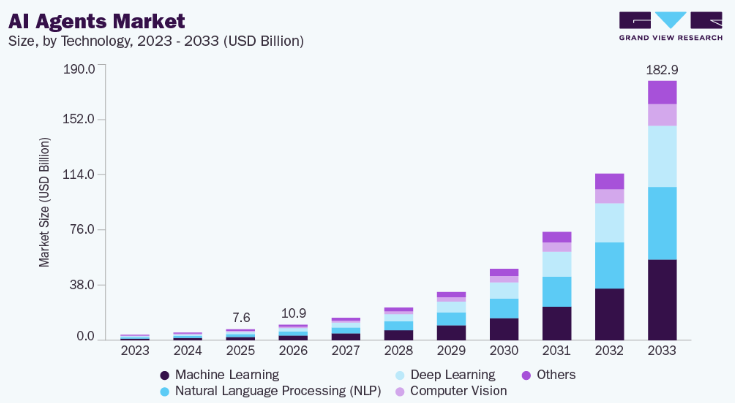
- According to Grand View Research, the worldwide AI agents market was valued at around $10.6 billion in 2026. This is projected to grow to around $182.97 billion by the end of 2030.
- Compared globally, North America dominates the AI agent market with the highest market revenue share of around 39.63% in 2026.
- As per Markets and Markets, the vertical AI agent segment is expected to register the largest CAGR of 62.7% during the forecast period.
- Looking at the technology-wise, the machine learning led the smart agent market and holds a share of around 30.56% in 2026-27.
- The global autonomous agent market is projected to grow with a CAGR of 49.6% from 2026 to 2030.
What is an AI agent?
An AI Agent is smart software, using artificial intelligence (AI) to perceive data, make decisions, and execute tasks independently from humans. The AI agent operates through different methods, such as learning through experience, reasoning through logical reasoning, using natural language to communicate, and providing applications with immediate information.
An AI Agent’s primary purpose is to interact with users and applications and the environment to automate processes and provide efficient solutions to real-life challenges.
Why Businesses Want to Develop an AI Agent in 2026?
Numerous businesses are seeking artificial intelligence development to automate processes, reduce costs, and enhance the user experience. The technology provides real-time interaction with users while assisting with their complex queries.
These interactions can increase productivity because they allow for the completion of tasks that support the user and make timely decisions, like performing analysis or providing support to users, and automating the workflow.
Because of the introduction of both Generative AI and Machine Learning technology into the market, any company that develops AI Agents will create an opportunity that is greater than their competitors.
What is the AI Agent Development Cost in 2026?
The cost to build an AI agent is around $30,000 to $150,000, based on project requirements and demands. It includes various types of factors that impact the cost, such as AI models, backend infrastructure, data requirements, technology stack, development team, UI/UX design, and more.
Basically, the cost can be affected by different types of AI agents, and every type has different functionality and services. In the table below, provide a detailed explanation of the AI agent development cost.
Component |
Low-End ($30k) |
Mid-Range ($75k) |
High-End ($150k) |
Notes |
| AI Model Licensing | $3,000 | $12,500 | $25,000 | Access to GPT, LLMs, or specialized models |
| Backend Development | $10,000 | $25,000 | $50,000 | API integration, server setup, and databases |
| Frontend / User Interface | $6,000 | $15,000 | $25,000 | Web or mobile interface for users |
| Testing & QA | $4,000 | $10,000 | $25,000 | Bug fixing, multi-step task validation |
| Deployment & Maintenance | $7,000 | $12,500 | $25,000 | Cloud hosting, updates, and monitoring |
| Total Estimated Cost | $30,000 | $75,000 | $150,000 | Varies with complexity, integrations, and features |
Industry Insights:
According to McKinsey, surveys show a majority of organizations are using AI and exploring agentic solutions, with many still early in scaling these technologies.
5 Different Types of AI Agents and Their Cost
Digital agents have many different types of agents that vary in form from basic rule-based systems to complex autonomous and learning agent systems; each type has a different cost involved with its use. Being able to identify the various types of AI agents and their respective costs will allow businesses to understand their optimal approaches and budget allocations.
1. Agents Based on Rules
This type of agent follows logic and decision trees that have been predetermined. As a result of these predictable aspects, they represent the least costly to create, as well as low development and infrastructure costs, although their scalability is limited. Maintaining rule sets over time will tend to increase the cost of artificial intelligence development services due to the growing complexity of systems or frequent manual changes.
Project Size |
Key Features |
Estimated Cost |
| Basic Rule-Based Agent | Predefined workflows, task automation, trigger-based actions | $30,000 – $50,000 |
| Advanced Workflow Agent | Multi-step processes, CRM/ERP integrations, custom business rules | $50,000 – $75,000 |
| Enterprise Automation Agent | Complex workflows, enterprise integrations, and reporting dashboards | $75,000 – $100,000 |
2. Chatbot Agents (Using NLP)
Chatbot agents utilize natural language processing in order to communicate with users. The cost for chatbot agents includes the cost of integrating the appropriate model, the cost of training data, API usage, etc. Initial setup and delivery of the service are relatively moderate in cost. However, the AI chatbot development cost will escalate due to costs associated with using cloud providers and handling large numbers of conversations.
Project Size |
Key Features |
Estimated Cost |
| Basic Customer Support Chatbot | FAQ handling, live chat, basic NLP understanding | $40,000 – $60,000 |
| Context-Aware NLP Chatbot | Intent recognition, contextual conversations, API integrations | $60,000 – $90,000 |
| Enterprise Conversational AI Assistant | Omnichannel support, multilingual capabilities, and advanced analytics | $90,000 – $120,000 |
3. Autonomous Agents
Autonomous agents function without human intervention and make their decisions based on the use of sophisticated models and real-time data. Because of the complexity of their development, training, and infrastructure, the costs to develop Autonomous agents are very high. Due to the dynamic nature of many industries, long-term operational costs to support autonomous agents.
Project Size |
Key Features |
Estimated Cost |
| Single-Task Autonomous Agent | Independent task execution, scheduling, and automated actions | $60,000 – $90,000 |
| Multi-Function Autonomous Agent | Goal-based decision-making, workflow orchestration, and data analysis | $90,000 – $120,000 |
| Enterprise Autonomous Decision Agent | Real-time decisioning, predictive intelligence, enterprise integrations | $120,000 – $150,000+ |
4. Multi-Agent Systems
A multi-agent system consists of several virtual agents that work together to accomplish tasks. The cost of operating these types of virtual agents will be impacted by development costs associated with coordinating agent-to-agent and agent-to-task communications, higher levels of processing requirements, and complexities related to developing and debugging the system.
Project Size |
Key Features |
Estimated Cost |
| Small Multi-Agent Workflow System | Agent collaboration, task delegation, process automation | $80,000 – $110,000 |
| Collaborative Multi-Agent Platform | Inter-agent communication, shared memory, workflow coordination | $110,000 – $140,000 |
| Enterprise Multi-Agent Ecosystem | Distributed intelligence, large-scale automation, and advanced monitoring | $140,000 – $200,000+ |
5. Learning Agents
A learning agent typically improves through reinforcement learning, a core approach in machine learning development. While reinforcement learning techniques can be very expensive because of the time required to train a model, long training cycles, and the need for simulation environments.
They also require a weight of computational power and fine-tuning by experts, which makes both development and continual optimization more expensive than simpler AI systems.
Project Size |
Key Features |
Estimated Cost |
| Basic Learning Agent | Pattern recognition, feedback-based improvements, recommendations | $70,000 – $100,000 |
| Adaptive Learning Agent | Continuous learning, personalized responses, predictive analysis | $100,000 – $130,000 |
| Advanced Self-Learning AI System | Reinforcement learning, autonomous optimization, advanced forecasting | $130,000 – $150,000+ |
Which Key Factors Impact the AI Agent Development Cost?
There are a number of critical factors that impact the cost of developing an smart assistant; these include complexity, data requirements, tech stack, integrations, team members’ expertise, design, and maintenance. All of these will impact the overall cost to create an AI app. Careful planning is critical to developing a cost-effective, scalable, and efficient AI solution.
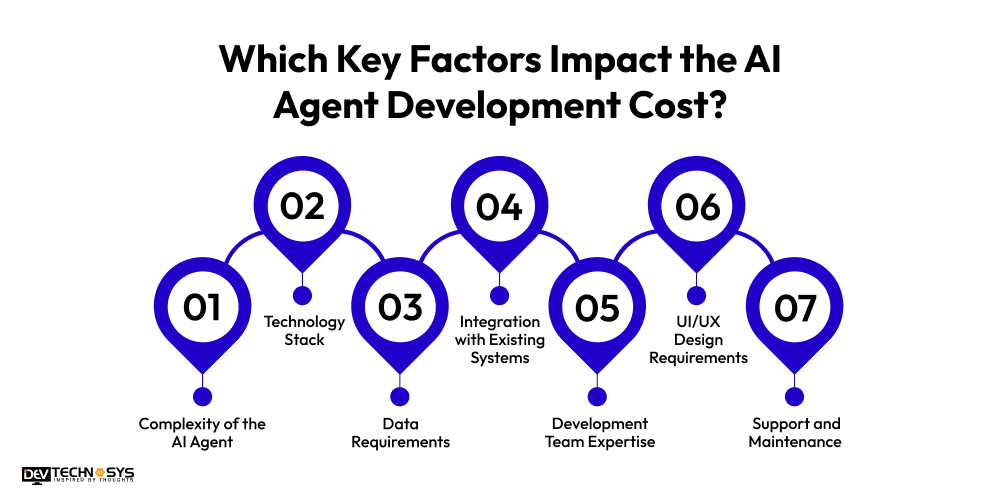
1. Complexity of the AI Agent
The complexity of AI agents correlates with development costs. Basic agents built with predetermined rules have lower costs associated with them than more advanced agents that employ machine learning, NLP, or autonomously make decisions because those types of agents require much more time. It increases the total amount of time, expense, and money associated with development.
Complexity Level |
Description |
Cost Impact |
| Basic Rule-Based Logic | Follows predefined rules and workflows with minimal decision-making. | +$5,000 – $12,000 |
| Context-Aware Decision Making | Understands context, analyzes inputs, and performs dynamic actions. | +$15,000 – $30,000 |
| Autonomous Goal-Oriented Agent | Independently plans, reasons, and executes multi-step tasks. | +$35,000 – $60,000 |
2. Technology Stack
The overall AI agent development services budget will also be affected by the selection of frameworks, tools, and platforms used to create the AI Agent. For example, if the AI Agent is built using advanced AI technologies such as Deep Learning, Cloud Computing, or a custom-built model, then the AI development pricing will be substantially higher than using the available APIs.
Technology Level |
Description |
Cost Impact |
| Open-Source Frameworks | Built using existing AI libraries and standard development tools. | +$2,000 – $8,000 |
| Premium AI APIs & Cloud Services | Utilizes commercial AI models, cloud infrastructure, and managed services. | +$8,000 – $20,000 |
| Custom Models & Enterprise Infrastructure | Includes custom model training, private deployments, and scalable architecture. | +$20,000 – $45,000 |
3. Data Requirements
AI Agents require a lot of data to be effective and trained properly, and without that data or with data that is not clean and labeled. They can’t function correctly, reducing their accuracy or providing an additional layer of risk as it pertains to reliability in real-world applications such as financial markets.
Data Requirement |
Description |
Cost Impact |
| Basic Data Processing | Uses small structured datasets with minimal preprocessing needs. | +$3,000 – $10,000 |
| Large-Scale Data Pipelines | Requires ingestion, transformation, and management of large datasets. | +$10,000 – $25,000 |
| Data Annotation & Model Training | Involves labeling data, training models, and continuous optimization. | +$25,000 – $50,000 |
4. Integration with Existing Systems
Integrating an AI Agent into an organization’s existing software, APIs, and enterprise systems will further increase the cost of AI chatbot development services. Each system may require custom-built APIs, development effort may be necessary for resolving compatibility issues, and data synchronization will require time and effort for testing. It ensures that the AI Agent functionality operates correctly in conjunction.
Integration Scope |
Description |
Cost Impact |
| CRM or Single-System Integration | Connects the AI agent with one business application or platform. | +$2,500 – $7,500 |
| Multiple APIs & Business Tools | Integrates with several third-party services and workflows. | +$8,000 – $20,000 |
| ERP, Legacy Systems & Custom Connectors | Requires custom integrations with enterprise-grade platforms. | +$20,000 – $40,000 |
5. Development Team Expertise
The knowledge of your development team has a big impact on the AI software development cost. More mature professionals typically have a higher price tag but also provide higher quality and efficiency. A less mature team will generally result in a lower upfront cost, but you will pay a much higher long-term cost due to mistakes, rework, and extended timelines.
Expertise Level |
Description |
Cost Impact |
| Standard Development Team | General software developers with AI implementation experience. | +$5,000 – $10,000 |
| Senior AI Engineers | Experienced professionals specializing in AI architecture and deployment. | +$15,000 – $25,000 |
| AI Architects & Domain Specialists | Experts in advanced AI systems, scalability, and industry-specific solutions. | +$30,000 – $55,000 |
6. UI/UX Design Requirements
A properly designed user interface can significantly improve usability and reduce costs. A basic, non-interactive user interface will be significantly less expensive than an interactive dashboard, conversational interface, or voice interface user interface, all of which require more design and development time. Other factors that will also impact overall NLP development services costs and time include customization, animation, and responsiveness.
Design Requirement |
Description |
Cost Impact |
| Standard Interface | Basic user interface with standard navigation and functionality. | +$2,000 – $6,000 |
| Custom Dashboards & Analytics | Interactive dashboards, reporting tools, and enhanced user experiences. | +$6,000 – $15,000 |
| Premium Enterprise Experience | Advanced personalization, responsive design, and enterprise-grade usability. | +$15,000 – $30,000 |
7. Support and Maintenance
The continuing effectiveness of AI agents depends on ongoing monitoring, updating, and retraining to maintain effectiveness. Maintenance includes fixing bugs in the system, updating the AI model, and continuing to adapt to new data. The cost of ongoing maintenance and support will be a significant factor in your total AI agent pricing.
Support Level |
Description |
Cost Impact (Annual) |
| Basic Maintenance | Regular bug fixes, security updates, and performance monitoring. | +$3,000 – $7,000 |
| Proactive Monitoring & Updates | Continuous optimization, feature enhancements, and system monitoring. | +$8,000 – $15,000 |
| Dedicated 24/7 Support Team | Round-the-clock support, incident response, and SLA-based maintenance. | +$15,000 – $30,000 |

What are the Hidden Costs of AI Agent Development?
Understanding the hidden costs of generative AI development is essential for effective budgeting. Beyond initial development, expenses like data preparation, system integration, ongoing maintenance, and security compliance can significantly impact overall costs. Proper planning and cost awareness help businesses avoid surprises, optimize resources, and ensure long-term success with scalable and efficient AI solutions.
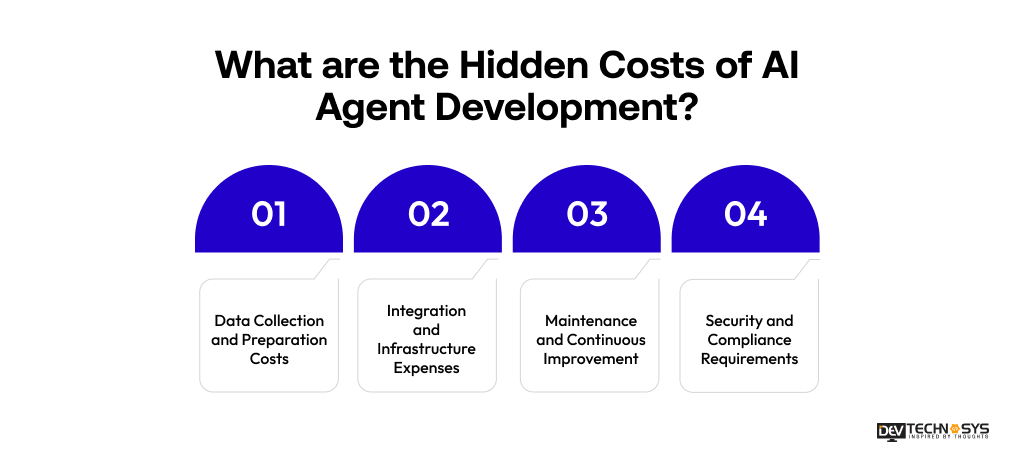
1. Data Collection and Preparation Costs
AI agents rely heavily on high-quality data, which is expensive to collect, clean, and organize. Businesses often underestimate the effort required for data labeling, validation, and storage. Ongoing updates are also necessary to maintain accuracy, making data management a continuous and costly investment throughout the lifecycle of the AI agent.
2. Integration and Infrastructure Expenses
Integrating an AI agent with existing systems, APIs, and third-party tools can increase costs significantly. Infrastructure expenses such as cloud storage, servers, and processing power add up over time. Scaling the system to handle more users or data also requires additional investment, which is often overlooked during initial planning stages.
3. Maintenance and Continuous Improvement
AI agents are not one-time solutions; they require regular updates, bug fixes, and performance improvements. Monitoring, retraining models, and adapting to new data trends involve ongoing costs. Without continuous maintenance, the agent’s performance may degrade, leading to poor user experience and reduced efficiency over time.
4. Security and Compliance Requirements
Ensuring data security and meeting regulatory compliance standards can be expensive. Implementing encryption, understanding guide to GDPR, secure access controls, and privacy measures requires additional resources. Businesses must also stay up to date with changing regulations, which may involve legal consultations and system modifications, adding to overall development and operational costs
AI Agent Development Cost by Industry (2026)
The cost of developing an AI agent varies greatly from industry to industry based on differences in their compliance requirements, data protection, difficulty integrating into an existing system, and the ability to scale the application. The health and finance industries will generally incur the highest costs in developing top AI agent platforms, as will e-commerce, education, and SaaS solutions.
1. AI Agents for Healthcare
Due to the tight regulations, confidentiality of patient records, and integration with EHRs, healthcare AI agents have a high level of complexity. They aid in tasks such as diagnosis, scheduling appointments, and patient engagement.
There are increased expenses in developing healthcare AI agents due to the various compliance regulations, security, integration, and accuracy requirements, as well as the importance of making correct decisions in the medical field.
2. AI Agents for E-Commerce
E- commerce AI agents help automate some customer support functions, make recommendations, track orders, and manage inventory. Due to the ease of complying with various regulations, the overall cost of developing e-commerce AI agents is average. However, they require a high level of integration with various technologies, such as Shopify and payment processing systems.
3. AI Agents for Finance & Fintech
Agentic AI in finance, or fintech, is used for fraud prevention, risk assessment, transaction monitoring, and providing financial advice. All fintech AI agents require high security, real-time processing, and compliance with financial laws and regulations in order to provide accurate and reliable decisions. There are substantial development costs related to data sensitivity, integration with banking APIs, and the accuracy and reliability of these systems.
4. SaaS Product AI Agents
SaaS product AI Services can take full advantage of platform capabilities via automated processes, customer service, analytics, and improved workflows. The varying levels of cost for these types of services depend on whether the AI agents are merely simple embedded functionality or sophisticated autonomous systems. Significant factors contributing to the cost of development and long-term maintenance expenses include API integrations.
5. Education & E-learning AI Agents
Education-related, AI-based services are available to help personalize individual learning experiences, enable automated grading, and offer students Tutoring support. These AI agents will also have the ability to interface with Learning Management Systems and Student data. The cost to develop and maintain these AI, education-focused solutions is moderate and driven by personalizing the learning content, creating multiple concurrent connections.
6. Real Estate AI Agents
Real estate provides many ways to utilize AI-based services. Examples include recommending properties based on user preferences, generating leads, providing virtual tours, or responding to customer inquiries.
The cost to implement real estate-based AI solutions is moderate. However, variables such as the level of criminal activity associated with CRM integration or the number of data sources will affect implementation costs.
7. Manufacturing & Industrial AI Agents
AI Agents employed in manufacturing optimize workflow, predictive maintenance, and supply chain management. AI Agents established for use in manufacturing require integration with Internet of Things (IoT) devices, Enterprise Resource Planning (ERP) software, and real-time monitoring tools. The infrastructure complexity of these systems increases the amount of money that needs to be invested in them because of the data processing requirements involved.
Industry |
Typical Cost Range |
Key Cost Drivers |
| Healthcare AI Agents | $20,000 – $80,000+ | Compliance (HIPAA/GDPR), EHR integration, data security, and clinical accuracy requirements |
| E-commerce AI Agents | $8,000 – $40,000 | Platform integration (Shopify, Magento), personalization, customer support automation, scalability |
| Finance & Fintech AI Agents | $25,000 – $100,000+ | Fraud detection, real-time processing, banking API integration, and strict regulatory compliance |
| SaaS Product AI Agents | $10,000 – $60,000 | Multi-tenant architecture, API integrations, workflow automation, scalability |
| Education & E-learning AI Agents | $8,000 – $35,000 | LMS integration, personalized learning models, multilingual support, and content generation |
| Real Estate AI Agents | $7,000 – $30,000 | CRM integration, lead generation, property data aggregation, and virtual assistant features |
| Manufacturing & Industrial AI Agents | $20,000 – $90,000+ | IoT integration, predictive maintenance, ERP systems, real-time monitoring, automation complexity |
5 Real-World AI Agents and Their Estimated Cost
In this section, you can get an idea of the cost of existing AI agents and help to make similar AI agents that you want to require. It includes various real-world examples such as Zendesk AI bots, JPMorgan Chase, OpenAI, Klarna, Mayo Clinic, and more.
1. Klarna
Klarna’s AI agents handle the customers’ queries about refunds, account queries, disputes, and more. It is a fintech company based in Sweden and offers a buy-now, pay-later service to users. The cost to develop a Klarna AI agent is around $10,000 to $22,000, based on the project complexity, customization level, design UI/UX, integration, multi-language support for global customers, and more.
Purpose |
Estimated Cost ($) |
Complexity |
| Customer support automation | $30,000 – $60,000 | Medium |
| Order tracking and issue resolution | $60,000 – $110,000 | High |
| Personalized shopping assistance | $110,000 – $180,000 | Very High |
2. Zendesk AI bots
The Zendesk AI bots are one of the most popular AI agents for answering FAQs and providing automated customer support services. It mainly integrates with CRM systems and multiple brands to manage their customer’s queries and offer instant response. The development cost ranges from $5,000 to $18,000, depending on bot complexity, multilingual capabilities, and more.
Purpose |
Estimated Cost ($) |
Complexity |
| FAQ and ticket automation | $30,000 – $50,000 | Medium |
| Omnichannel customer service agent | $50,000 – $120,000 | High |
| Enterprise conversational support platform | $120,000 – $200,000 | Very High |
3. JPMorgan Chase
JPMorgan Chase AI Agents help users to trade, manage financial services, risk management, fraud detection, and more. These agents observe or monitor real-time market data, execute trades, and raise flags on suspicious activity. The estimated cost of development is around $20,000 to $30,000; it can go to a higher cost due to the complexity level, number of integrations, designing, security measures, and more.
Purpose |
Estimated Cost ($) |
Complexity |
| Financial document analysis | $50,000 – $90,000 | High |
| Fraud detection and risk monitoring | $90,000 – $150,000 | Very High |
| Investment and decision-support systems | $150,000 – $200,000 | Enterprise |
4. OpenAI
OpenAI’s agents are among the most popular tools for assisting users with tasks such as research workflows, coding assistance, and the automation of multi-step processes. These agents work on a higher level and act autonomously within a connected system. The cost to develop an AI agent like OpenAI’s ranges from $15,000 to $28,000. The pricing can be influenced by ChatGPT integration services, real-time decision-making, and task complexity.
Purpose |
Estimated Cost ($) |
Complexity |
| AI-powered chatbot assistant | $30,000 – $70,000 | Medium |
| Workflow automation and content generation | $70,000 – $130,000 | High |
| Autonomous multi-agent AI platform | $130,000 – $200,000 | Very High |
5. Mayo Clinic
Mayo Clinic uses AI agents to maintain its operations of the clinic, such as patient monitoring, diagnostic assistance, and clinical documentation. These agents analyze the patient’s reports and help staff to make informed decisions. The development cost of an AI agent like Mayo Clinic is around $13,000 to $23,000; it can change because of medical compliance, integration with hospitals, and handling secure data.
Purpose |
Estimated Cost ($) |
Complexity |
| Clinical documentation automation | $30,000 – $70,000 | Medium |
| Patient monitoring and intelligent alerts | $70,000 – $140,000 | High |
| Diagnostic assistance and decision support | $140,000 – $200,000 | Very High |
Which is More Cost-Effective: Building or Buying an AI Agent?
Are you confused about which approach is best for your budget to buy or build an AI agent? This basically depends on your project requirements and personal preferences. The table clears all the confusion or doubts related to the selection of an approach between building or buying an AI agent.
Factor |
Build |
Buy |
| Cost | High upfront ($30k–$150k) | Moderate ($10k–$30k) |
| Time to Deploy | Weeks to months | Days to weeks |
| Customization | Fully customizable to your exact needs | Limited to vendor features |
| Maintenance | You handle updates, bug fixes, and scaling | Vendor handles updates and maintenance |
| Expertise Needed | AI engineers and developers are required | Minimal internal expertise needed |
| Integration | Can fully integrate with internal systems | May be limited by vendor APIs |
| Control & Security | Full control over data and processes | Limited control; depends on vendor policies |
| Scalability | Flexible, but needs planning and resources | Often built-in, but may have limits |
| Hidden Costs | Data prep, cloud, testing, training | Licensing, subscription, usage limits |
Want a chatbot demo or pricing? Fill the form and talk to our experts today.
Pick what you need below — you can select more than one — then tap Get detail to continue.
-
Chatbot demo dashboard
-
Cost to develop an app
-
Industry report
-
Case study
How Long Does it Take to Create an AI Agent in 2026?
The time it will take to create an AI agent varies depending on many factors, such as how complex the project you’d like to accomplish is, what other applications the AI Agent must integrate with, how much training is needed to use the AI Agent, and how large the AI Agent needs to be once implemented.
Development generally involves planning and selecting the model, training of the AI Agent, backend development, testing, and deploying the product to your environment. Beyond what is already stated, if your AI Agent has advanced functionality, it will also take longer to develop and optimize.
Development Phase |
Timeline |
Key Activities |
| Planning & Use Case Definition | 1–2 Weeks | Define goals, workflows, and AI capabilities |
| Data Collection & Preparation | 2–4 Weeks | Gather, clean, and structure training data |
| Model Selection & Training | 3–6 Weeks | Choose AI models, train, and fine-tune |
| Backend Development | 2–5 Weeks | APIs, logic, integrations, and database setup |
| Frontend/Interface Design | 2–4 Weeks | Chat interface, dashboard, user experience |
| Testing & Optimization | 2–4 Weeks | Accuracy checks, performance tuning, bug fixes |
| Deployment & Integration | 1–2 Weeks | Launch on cloud, connect systems |
| Total Estimated Time | 2–6 Months | Depends on complexity and features |
How to Reduce the AI Agent Development Cost?
Reducing AI agent development costs requires a smart and strategic approach. By focusing on MVP development, leveraging prebuilt tools, understanding the cost to hire AI developers, selecting cost-effective technologies, outsourcing wisely, and avoiding unnecessary features, businesses can optimize budgets without compromising quality.
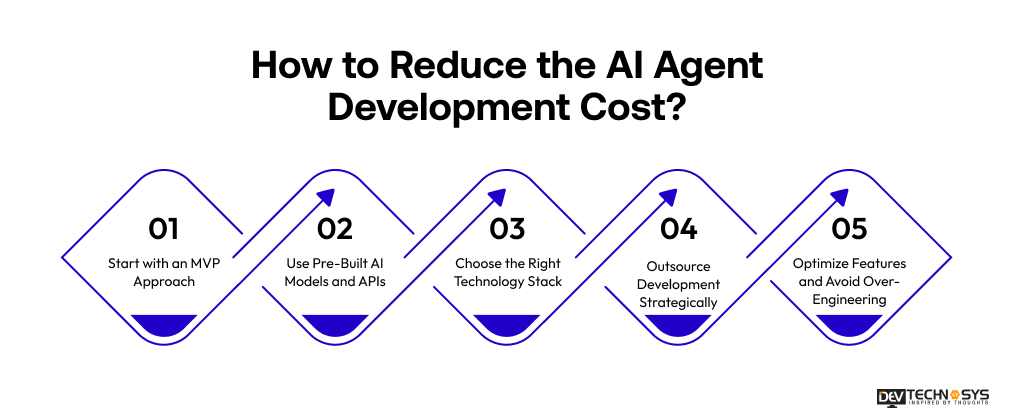
1. Start with an MVP Approach
Begin with a minimum viable product (MVP) to focus only on essential features. This helps reduce initial development costs and avoids unnecessary complexities. Once the core functionality is validated, you can gradually scale and add advanced features based on user feedback and business needs.
2. Use Pre-Built AI Models and APIs
Leverage existing AI models, frameworks, and third-party APIs instead of building everything from scratch. Tools like NLP libraries and cloud AI services significantly reduce development time, effort, and costs while still delivering reliable performance and scalability.
3. Choose the Right Technology Stack
Selecting cost-efficient and scalable technologies plays a major role in budget control. Open-source tools, cloud-based platforms, and flexible programming languages help minimize licensing and infrastructure expenses while ensuring high performance and easy future upgrades.
4. Outsource Development Strategically
Hiring experienced developers or outsourcing to reliable development companies can be more cost-effective than building an in-house team. It reduces hiring, training, and operational expenses while ensuring faster project delivery with professional expertise.
5. Optimize Features and Avoid Over-Engineering
Focus only on features that provide real value to users. Avoid adding unnecessary functionalities that increase development complexity and cost. A streamlined, well-planned feature set ensures faster development, lower expenses, and better overall product efficiency.
AI Agent Development Cost Calculator
Simple Formula
Estimated Cost = Base Cost ($30,000) × Complexity × Integrations × Data Size (normalized)
To keep results realistic, multipliers are scaled so the maximum never exceeds $150,000.
Complexity |
Integrations |
Data Size |
Estimated Cost |
| Basic | Low | Small | $30,000 |
| Medium | Moderate | Medium | $63,000 |
| High | High | Large | $124,416 |
| Very High | Enterprise | Massive | $150,000 |
Example Calculation
High-Level AI Agent
- Complexity = 1.6
- Integrations = 1.4
- Data Size = 1.3
Estimated Cost = $30,000 × 1.6 × 1.4 × 1.3 = $87,360
Note:
As per our CTO, Parmod Jangid, says that the overall AI agent development cost is based on the customization level, complexity, backend infrastructure, compliance, and security.
6 Real-World Questions to Ask an AI Agent Development Vendor
Q1. Have You Built AI Agents Before? Can I See Real Examples?
We have previously built AI agents for things such as automation, assistance, and workflow systems. In addition, we have many case studies showing our success in building AI agents that have changed businesses in new ways by delivering measurable results.
Q2. What Will It Cost Me Overall, Including Hidden Or Monthly Charges?
Costs are affected by development, access to API’s, hosting, etc. These costs differ with each AI solution, depending on the complexity of the AI architecture, how frequently it will be used, if there are any additional integration requirements, and the ongoing inference costs associated with the model.
Q3. How Will You Keep My Data Safe And Secure?
We provide AI consulting services to businesses and utilize multiple safety measures, including encryption, secure API’s, strict access control, and legal compliance (GDPR) to provide you with complete data security and privacy.
Q4. Can Your AI Agent Connect With My Existing Tools And Systems?
Of course! We integrate AI agents with the most popular business applications, such as Crm & ERP systems, API’s, or any third-party tool for seamless automation of business workflow processes.
Q5. How Long Will It Take To Build And Launch My AI Agent?
From the time we begin working together until the time your AI agent is ready for launch takes anywhere from 2 to 12 weeks, depending on the complexity of the AI architecture, the functionality requirements, and integration requirements.
Q6. What Support Will I Get After The Project Goes Live?
Once your system is operational, we will continue to maintain site innovation through system updates, bug fixes, performance optimization, and ongoing improvements. Thereby ensuring that your AI architecture remains stable over the long term.
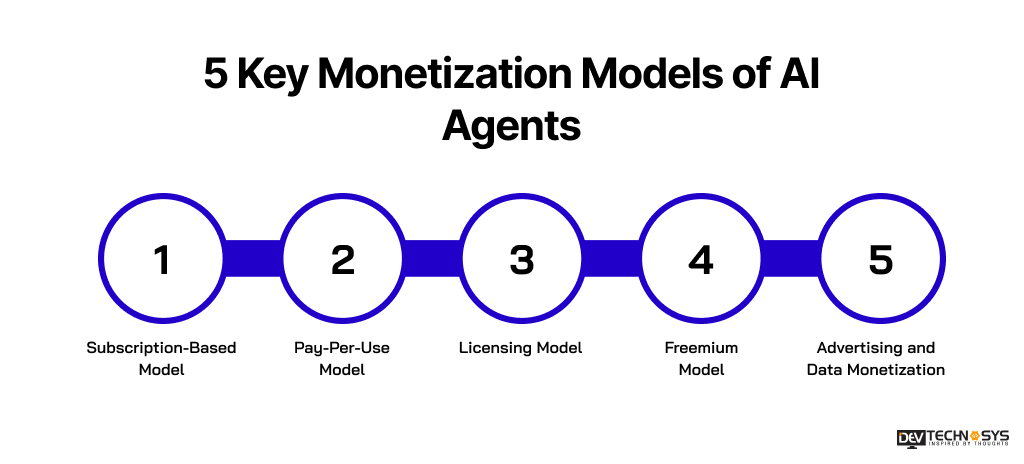
5 Key Monetization Models of AI Agents
There are many ways that an autonomous system can generate revenue through different types of monetization models. These include subscription, pay-per-use, licensing, and freemium. Each of these has varying levels of potential revenue generation and trade-offs associated with them.
1. Subscription-Based Model
Businesses pay a monthly or yearly fee to use an AI agent’s services. With predictable revenue and long-term customer relationships through the Subscription model, organizations also incur ongoing costs such as infrastructure, customer service, and continuous enhancements to maintain the value provided by their cognitive agent.
2. Pay-Per-Use Model
Users are charged based on how much they use the software agent. Pay-as-you-go models are very flexible; this means they will accommodate a larger audience than subscription models. Pay-as-you-go has the challenge of properly tracking the usage of the intelligent system and providing a scalable infrastructure. According to the AI copilot development company, revenue is variable in a pay-as-you-go model.
3. Licensing Model
Businesses buy licenses to use the automated agent for a fixed period at an agreed-upon upfront amount. Licenses are generally sold in enterprise environments. Though license fees can provide a large upfront revenue, costs associated with ongoing support, customization, and upgrades can all be hidden costs associated with the licensing model.
4. Freemium Model
The Freemium model provides basic functionality of the virtual assistant free of charge; premium functionality is charged for. Providing freemium models is a great way to establish a large user base in a short amount of time.
Converting free users to paid users provides the company with profitability. The challenge with the freemium model is to cover the costs of the group of free users while creating incentives for free users to upgrade to premium.
5. Advertising and Data Monetization
AI agents earn income from displaying ads & using their understanding of user data. For high-traffic environments, this is a good mechanism; however, it raises privacy and compliance concerns. Therefore, companies must invest time and effort into developing ethical ways of collecting and using data so they can continue to generate income from the use of AI agents over time.
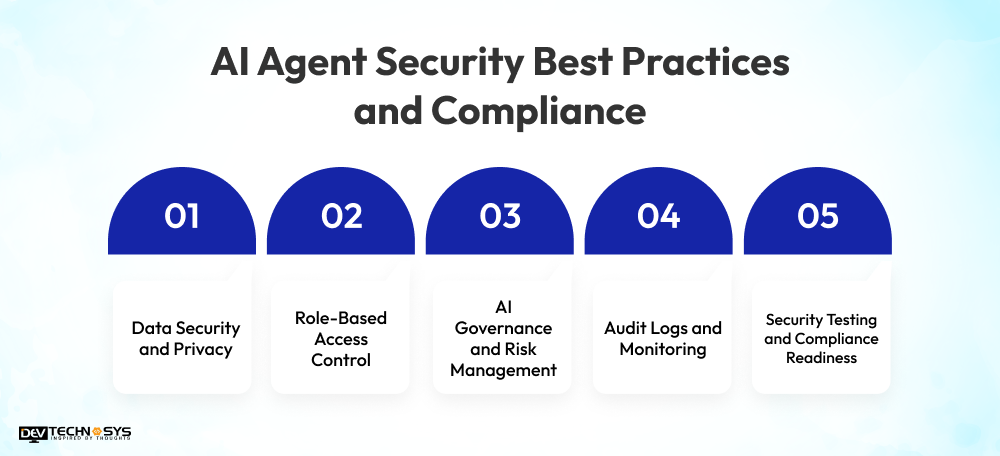
AI Agent Security Best Practices and Compliance
Security and compliance are critical factors that affect AI agent development costs because customer information, financial & business data need to be protected. Strong security measures prevent data breaches and build trust among users when accessing autonomous agents.
1. Data Security and Privacy
For agentic AI in healthcare, HIPAA compliance is used to protect medical data. SOC 2, ISO 27001, and CCPA compliance are specific to other industries and are used to secure data and provide privacy controls for users.
2. Role-Based Access Control
Modern businesses use cloud infrastructure in which information is shared among multiple users. Implementing RBAC ensures that only authorized users can access the data, preventing unauthorized access.
3. AI Governance and Risk Management
For businesses operating across multiple regions, the NIST AI Risk Management Framework and the EU AI Act are needed to build an AI agent to evaluate potential risks. These help organizations operate the solution without legal risk.
4. Audit Logs and Monitoring
Once the system is deployed to the client space, regular audit logs need to be performed to check user activity. Continuous monitoring supports accountability, keeps the solution up to date, and maintains compliance requirements.
5. Security Testing and Compliance Readiness
An AI agent development company performs vulnerability assessments, penetration testing, access reviews, model security testing, and compliance audits to ensure solutions are compliance-ready. This regulation helps to build a stronger system for businesses seeking long-term growth.
Planning a Mobile App?
Get a tailored development cost estimate in 3 simple steps — app basics, features, timeline, and your contact details.
- 3 quick steps
- 100% free
- Reply in 1 business day
2 Minutes Read
Conclusion
The enterprise AI agent cost in 2026 will typically vary from $30,000 to more than $150,000 based on how complex your project is, as well as which features are required and the scalability demands of the solution. Each component of the project, such as whether it will be a simple rule-based system or an advanced autonomous solution, will affect the total costs of building AI Agents.
If you partner with an established agentic AI Development company, you’ll be able to achieve successful planning, optimal use of resources, and swift deployment of your AI project.
Frequently Asked Questions
Find answers to the most common questions related to this article.
The cost to build an AI agent starts from $30,000 for FAQ bots and ends at $150,000 for a high-end capabilities AI agent. It includes various factors that can raise the cost, such as AI models, data requirements, integration with external systems, features, cloud, backend infrastructure, and more.
To make an AI agent in California, USA, it usually takes around 3 to 6 months or takes a longer time. The project timeline can fluctuate due to several elements, such as project type, complexity, number of functionalities, backend processes, API integrations, security measures, and more.
The cost to hire AI agent developers in USA ranges from $15 to $50 per hour or higher, depending on project requirements and preferences. The hiring cost can go up or down due to developers' experience level, location, rich skill set, onboarding cost, hiring model, and many other factors.
There are many hidden cost factors that exist in AI agent development. Here is the list:
Cloud Computing & GPU Usage
Model Training & Fine-Tuning
API & Third-Party Integrations
Security & Compliance
Maintenance & Updates
User Support & Documentation
The maintenance cost of an AI agent lies between 10% to 20% of the initial custom AI agent development cost. Maintenance services involve fixing bugs or glitches, regular updates, solving security issues, updating outdated features, adding design enhancements, optimizing performance, and many more.