




















Key Takeaways:
-
- Crypto Exchange Development Cost in 2027: A cryptocurrency exchange costs approximately $4,999–$110,000+, depending on exchange type, trading functionality, security requirements, and platform complexity
- Cost by Complexity: A basic crypto exchange MVP costs $4,999–$15,000, a mid-level exchange costs $15,000–$45,000, and an enterprise-grade cryptocurrency exchange can cost $45,000–$110,000+.
- Exchange Type Pricing: Centralized exchanges (CEX), decentralized exchanges (DEX), and peer-to-peer (P2P) exchanges have different development requirements. Their costs vary based on trading engines, smart contracts, liquidity integration, wallet infrastructure, and transaction management.
- Development Timeline: A basic crypto exchange may take 2–4 months, a mid-level platform 4–7 months, and an enterprise-grade exchange 8–12+ months, depending on integrations, testing, and compliance requirements.
- Major Cost Factors: Trading engine development, crypto wallet integration, liquidity APIs, KYC/AML verification, smart contract development, security audits, payment gateway integration, and infrastructure scalability significantly influence the overall development budget.
- Post-Launch Maintenance Costs: Ongoing expenses include cloud hosting, server monitoring, security updates, blockchain network fees, API subscriptions, compliance updates, and technical support. These should be included in the total cost of ownership.
According to Research and Markets, the global crypto exchange market is projected to grow with a CAGR of 19.29% from 2026 to 2034. Cryptocurrency’s transformation from a speculative experiment into a global phenomenon with far-reaching implications for how we trade and store value has happened in a relatively short period of time.
Increasing demand for digital assets has caused businesses worldwide to quickly create their own cryptocurrency exchanges to participate in this rapidly expanding market, but that raises one big question: How much will it cost to develop a cryptocurrency exchange? But that question does not offer a simple response.
Development costs for cryptocurrency exchanges can vary tremendously due to the expanse of potential delivery systems, technology stacks used, security compliance, regulatory compliance, and design experience. A business, regardless of its size or stage in the business lifecycle, needs to understand what factors influence the amount of money.
In this blog, we will also identify several best practices associated with developing a budget for your business’s cryptocurrency exchange.
What is a Crypto Exchange?
Crypto exchanges are websites that permit individuals to purchase, trade, and sell virtual currencies such as Bitcoin and Ether (ETH). In other words, a cryptographic trading exchange is like a digital marketplace where people can find buyers and sellers of digital currency, or other products, using tools such as financial instruments, wallets, and price charts.
There are multiple options to choose from; cryptographic exchanges can be decentralized and centralized, and they differ in how much control, security, and transparency they give to users.
Planning a Crypto Exchange Project?
Get a tailored development cost estimate in a few simple steps.
- 3 quick steps
- 100% free
- Reply in 1 business day
2 Minutes Read
Why Do Businesses Want to Invest in Crypto Exchange Development?
More businesses are now investing in developing cryptocurrency exchanges. This is due to the rapid expansion of the digital asset exchange and the growing global acceptance of cryptocurrencies as a result of the pandemic.
Crypto Exchanges have the potential to generate a large amount of income through trading fees, transactions, and the sale of their tokens (listing fees). Also, by creating a crypto exchange, it will give businesses an opportunity to access future finance ecosystems. Creating a crypto exchange will also help to establish a company’s brand value and give it control over how its business runs.
What Drives the Cost of Building a Crypto Exchange?
The cost of creating a cryptocurrency exchange ranges from $4,999 to $110,000 and relies significantly on the kind of platform being developed, how intricate the trading engine is, what cryptocurrencies it will accept, how much liquidity is needed, what level of security must be in place, and what the legal requirements are.
Additional costs come from designing the UI and UX of the product, the wallets, the processes for KYC and AML, the involvement of third-party APIs, the cloud hosting process, and the implementation of tests.
Development Type |
Estimated Cost |
Key Features Included |
| Basic / MVP Exchange | $4999 – $15,000 | User registration, wallet, basic trading, and admin panel |
| Mid-Level Exchange | $15,000 – $45,000 | Advanced trading, KYC/AML, better UI/UX, API integrations |
| Advanced / Enterprise | $45,000 – $110,000+ | High security, scalability, analytics, and multiple trading pairs |
Industry Insights:
In accordance with The Crypto Basic, total crypto trading volume reached $20.5T in Q1 2026, but the majority shifted heavily toward derivatives over spot trading.
Key Cost Drivers & Extra Expenses
Usually, when developing applications, the expenses of software development take precedence over operational charges:
- Security & Wallets: A couple of security features such as hot, warm, and cold wallet infrastructures; multi-signature and multi-party computations; protection against DDoS attacks, as well as smart contract auditing.
- Liquidity: Integrating with external markets like order management systems, liquidity venues, and market makers.
- Compliance & Licensing: Costs incurred from creating a local entity, obtaining licenses, KYC/AML verification (investigation), and other compliance duties.
- Continuous Maintenance: Cloud hosting, monitoring, updates, and customer service. The costs are expected to average about 10% of the cost of creating the application per year.
Basic vs Advanced Crypto Exchange: Features and Cost-Driver Matrix
Basic cryptocurrency exchanges take care of basic trading activities. Advanced exchanges, on the other hand, need a more sophisticated infrastructure, special security conditions, and several integrations in order to function properly. Below is a chart indicating the main factors that influence the cost of developing a trading platform.
Features |
Basic Crypto Exchange |
Advanced Crypto Exchange |
| Trading Engine | Basic buy/sell orders | High-frequency matching and derivatives |
| Wallet Integration | Standard crypto wallets | Multi-chain wallets and cold storage |
| Security | Encryption and 2FA | Advanced fraud detection and audits |
| Liquidity | Single liquidity provider | Multiple liquidity pools |
| KYC/AML | Basic identity verification | Automated compliance monitoring |
| Trading Features | Spot trading | Margin, futures, and OTC trading |
| Analytics | Basic reporting dashboards | Real-time predictive analytics |
| Cost Drivers | Limited customization and integrations | Complex architecture, integrations, scalability, and maintenance |
5 Different Types of Crypto Exchanges: Cost Breakdown
There are various kinds of crypto exchanges: centralized, decentralized, hybrid, P2P, and derivatives, all with their own unique-looking platform architecture and internal features. The amount you will spend to develop your platform will also be different depending on how complex, secure, and functional you want to be.
1. Centralized Exchange ($4,999 – $35,000)
Centralized exchanges (CEXs) are the most common type of exchange, where a central authority controls all aspects of the exchange. The centralized exchange development cost is lower because of the simplicity of the architecture, but due to the need for a strong backend.
A CEX requires much more in the way of backend systems than a decentralized exchange (DEX). CEXs incur additional costs for the integration of liquidity, compliance, and a high-performance order-matching engine.
2. Decentralized Exchange ($15,000 – $55,000)
Decentralized exchanges (DEXs) are platforms for trading without a middleman, using a smart contract on the blockchain. The decentralized exchange development cost are higher than CEXs because of the difficulty of writing smart contract code, adding autonomous AI agents in Blockchain, executing on-chain transactions, and integrating multiple wallets.
So, as well as setting up liquidity pools, conducting security audits, and providing an environment that is fast, scalable, and trustless.
3. Hybrid Crypto Exchanges ($25,000 – $75,000)
A hybrid exchange app like Bitstamp utilizes elements of centralized exchanges and decentralized exchanges. Using two different architectures increases the complexity of building a hybrid exchange and the time and cost to create it.
The hybrid model also adds expenses through the combination of on-chain (slow) and off-chain (fast) transactions while using multiple security layers, providing liquidity for multiple markets, and enabling trading across many platforms.
4. P2P Exchanges ($10,000 – $40,000)
P2P exchanges allow users to trade with each other without any direct third party. The costs associated with creating a P2P exchange are moderate since the primary function of the exchange is to match trades and provide escrow services.
The p2p crypto exchange development cost will increase as additional services, such as escrow smart contracts, dispute resolution, user verification, and integration of secure crypto payment gateways, are implemented.
5. Derivatives Trading Exchange ($40,000 – $110,000+)
Derivatives exchanges allow for some of the most advanced types of trading instruments available today, such as margin trading. A derivatives trading exchange would have the highest overall cost to build a crypto exchange because of the complexity involved with creating a derivatives trading exchange and meeting regulatory standards. As such, this type of trading exchange is more appropriate for an enterprise-level crypto platform.
Type of Crypto Exchange |
Cost Breakdown (USD) |
| Centralized Exchange (CEX) | $4999 – $35,000 |
| Decentralized Exchange (DEX) | $15,000 – $55,000 |
| Hybrid Crypto Exchange | $25,000 – $75,000 |
| P2P Exchange | $10,000 – $40,000 |
| Derivatives Trading Exchange | $40,000 – $110,000 |
Note: These are estimated costs within the overall crypto exchange development budget of $4,999–$110,000+.
7 Crucial Factors That Impact Crypto Exchange Development Cost
The cost to develop a crypto exchange can greatly differ depending on the features needed, security requirements, compliance, and type of exchange. As well as all other things related to the overall project.
By having a clear understanding of these key cost drivers, businesses will be able to effectively plan for the project and avoid costly surprises when developing their cryptocurrency trading platform.
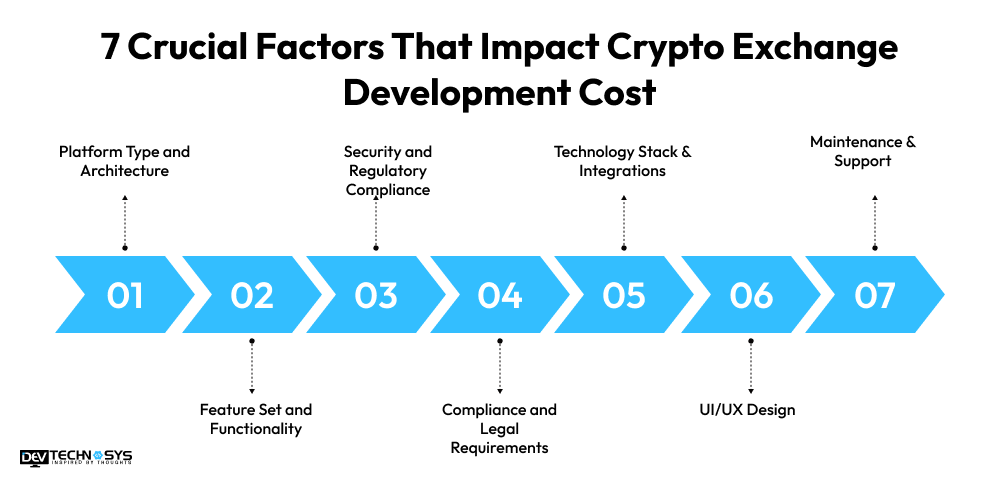
1. Platform Type and Architecture
Platform construction has a substantial impact on crypto exchange website development costs. A centralized exchange architecture allows for a less difficult build, but offers challenges with managing/control of the backend components.
Platform criteria, including architecture and functionality, will determine Scalability, Performance, and ongoing Maintenance expenses over the entire lifecycle of a platform and will ultimately affect the total custom crypto exchange development cost.
Type |
Cost Addition |
Reason |
| Centralized (CEX) | +$2,000 – $5,000 | Backend control and order matching engine |
| Decentralized (DEX) | +$5,000 – $10,000 | Smart contracts and blockchain integration |
| Hybrid | +$8,000 – $15,000 | Combines centralized and decentralized logic |
2. Feature Set and Functionality
As with all platforms, the number and complexity of functions on a platform are major driving factors that impact total trading engine development cost. The building of a basic exchange typically entails the addition of trading engines, wallets, etc., and while the development of an advanced exchange will typically require the addition of margin trading, staking, etc.
Therefore, driving up blockchain development services costs will directly correlate with the increased number of functions added to the platform.
Feature Level |
Cost Addition |
Reason |
| Basic Features | +$1,000 – $3,000 | Core trading and wallet features |
| Advanced Features | +$3,000 – $7,000 | APIs, charts, and enhanced trading tools |
| Premium Features | +$7,000 – $12,000 | Margin trading, staking, analytics |
3. Security and Regulatory Compliance
One of the key considerations when building a cryptocurrency exchange is security. Additional measures of security, like two-factor authentication (2FA), encryption, DDoS protection, and cold storage, will increase your P2P crypto exchange development cost.
However, you will also have to implement complex security methods, such as multi-sig wallets and frequent security audits, in order to properly protect your users’ funds and verify the integrity of your exchange.
Security Level |
Cost Addition |
Reason |
| Standard Security | +$1,000 – $2,500 | Basic encryption and authentication |
| Enhanced Security | +$2,500 – $6,000 | 2FA, anti-DDoS, anti-phishing security |
| Enterprise Grade | +$6,000 – $12,000 | Multi-sig, cold storage, audits |
4. Compliance and Legal Requirements
Along with implementing security, you must also be compliant with the regulations in your country. The crypto exchange app development cost will vary based on your country and any licensing requirements.
Although these measures are necessary to ensure compliance with the applicable laws, implementing legal compliance frameworks, identity verification systems, and reporting tools will complicate your project and will add to your overall white label crypto exchange cost.
Compliance Type |
Cost Addition |
Reason |
| Minimal Compliance | +$1,000 – $3,000 | Basic policies and limited checks |
| Moderate Compliance | +$3,000 – $7,000 | KYC/AML integration |
| Full Compliance | +$7,000 – $15,000 | Licensing, legal setup, reporting tools |
5. Technology Stack & Integrations
Choosing the programming language, framework, or third-party integration will affect the total white-label crypto exchange development cost. For instance, integrating a payment gateway, liquidity provider, or blockchain network into your system will take resources and knowledge about these services before you can accomplish that task.
In addition, a modern, scalable technology stack may have a higher crypto trading platform development cost.
Tech Level |
Cost Addition |
Reason |
| Basic Stack | +$1,500 – $3,000 | Standard frameworks |
| Modern Stack | +$3,000 – $7,000 | API Integration for Exchange, Blockchain Node Integration |
| Advanced Stack | +$7,000 – $12,000 | High scalability and performance systems |
6. UI/UX Design
A simple-to-use interface will draw in and hold onto traders. Development time will take a bit longer because there is an involved process of creating user-friendly dashboards, developing a responsive layout, and providing an effortless transition between the different areas of your app.
As you go up in the level of UI/UX design you choose, your RWA tokenization platform development cost will go up, and you will require more high-end designers to assist you.
Design Level |
Cost Addition |
Reason |
| Basic UI | +$1,000 – $2,500 | Simple layouts |
| Custom UI/UX | +$2,500 – $5,000 | Responsive and user-friendly design |
| Premium Design | +$5,000 – $9,000 | Interactive and high-end user experience |

7. Maintenance & Support
The costs of maintaining a website or application occur well beyond first launch time; necessary components include, but are not limited to, continual updates, bugs resolved, security that has been addressed, and enhancements in functionality.
It helps ensure that your website and application work correctly. Also included are ongoing support services provided via technology and servers that will assist in creating an experience for users that you expect will be reliable.
Support Level |
Annual Cost Addition |
Reason |
| Basic Support | +$1,000 – $2,500 | Occasional fixes and updates |
| Ongoing Support | +$2,500 – $5,000 | Monitoring and regular improvements |
| Dedicated Team | +$5,000 – $10,000 | Continuous upgrades and scaling |
Real Case Study: PAYCOINZ
A few times ago, a USA-based client, Robert, contacted us to build a crypto payment gateway with a budget of around $30,000. After that, the client wants to add some AI-based functionalities, so the total project budget is increased. We use technologies like Redis Streams, Python, Web3.js, and many blockchain integrations. Our blockchain developers faced many challenges during the development process, such as payment failures, operational inefficiency, and more.
Client Name: Robert
Timeline: 32 Weeks
Team Size: 12 PeopleNavneet Kumar – Project Manager
Hidden Integration and Ongoing Costs of Crypto Exchange
Continuous costs and hidden integrations of cryptocurrency exchanges consist of third-party integrations, payment gateway fees, fees charged for connecting providers with exchanges, KYC/AML costs, and blockchain fees. Recurring costs include advances in technologies like cybersecurity audits, cloud hosting, regulations on IT, and support services.
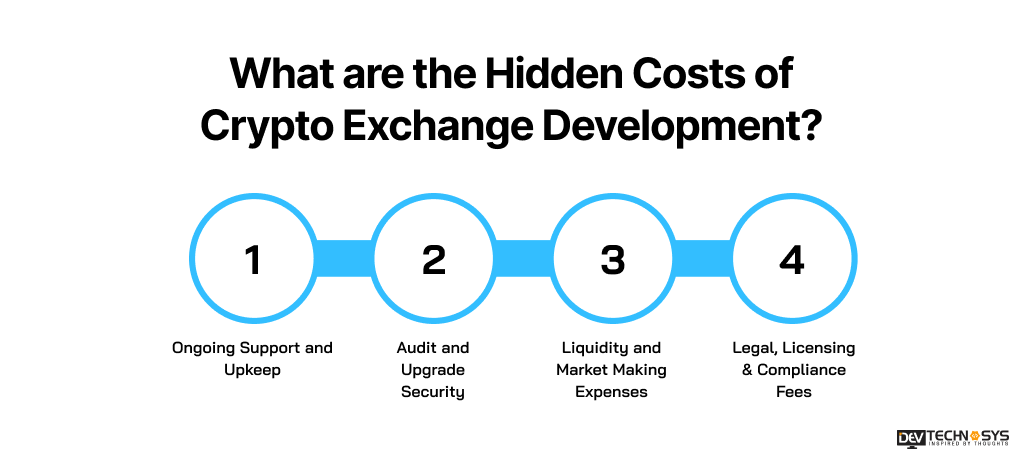
1. Ongoing Support and Upkeep
The platform requires ongoing support and upkeep, including debugging, performance enhancements, and new features. The expenses associated with ongoing upkeep are often underestimated, but are very important for the smooth functioning of the platform. Additional expenses include server optimization, database management, and upgrading to current standards.
2. Audit and Upgrade Security
Security continues to be a significant ongoing expense for the smart contract development services. The platform is required to undergo penetration testing, have smart contracts audited, and fix any vulnerabilities after every time a new hack occurs on the platform.
Continuing to provide resources to support sophisticated security systems, update encryption processes, and comply with previously established and newly adopted security protocols.
3. Liquidity and Market Making Expenses
Liquidity is essential for trading to be conducted without obstruction, and trading platforms frequently need partnerships with Liquidity Providers to manage market-making costs that may include liquidity incentives, APIs, and the management of trading depth in order to keep prices stable and continue to encourage traders to actively participate in trading.
4. Legal, Licensing & Compliance Fees
Legal and licensing requirements vary regionally, and many of these hidden costs incurred include Licensing fees, legal consultants, and the upgrade of systems to comply with regulations.
With continual updates of KYC/AML and other jurisdiction-specific regulations, compliance continues to be an ongoing financial burden and one of the highest long-term hidden costs of compliance.
Crypto Exchange Security and Compliance
The safeguarding of users’ capital, as well as their private information, wallets, and trades, is largely contingent on the security of the crypto exchange. In order to create a safe platform, many levels of protection are necessary, such as smart contract audit, private key security, encryption, two-factor authentication, DDoS protection, and legal restrictions.
1. Security of Smart Contracts
In smart contracts, the process of exchanging cryptocurrencies involves token transfers, buying and selling, and deposits and withdrawals of money. Secure programming, automated testing, vulnerability scans, code assessment, and independent audits can help detect loopholes that can be exploited. The stronger the security of contracts is, the lower the risk of losing money and being victimized by hackers.
2. Security of Wallets and Private Keys
Hot and cold wallets, private keys, and the process of signing transactions should be protected from possible attacks. Multi-signature, hardware security modules, wallet segmentation, withdrawal restrictions, and other secure systems of managing keys can significantly reduce risks of unauthorized access to the resources. These tools are unique for the exchanges providing custodial services.
3. Two-Factor Authentication
Using a two-factor authentication process allows users to protect their accounts by requiring them to verify their identity in addition to their password. Authentication programs, hardware security keys, or other identification systems can help clients prevent unauthorized access to their accounts and transaction processing.
4. Encryption
With regard to encryption, it enables the protection of confidential data that is stored and transferred through trading platforms. Information needs to be encrypted during transfer and at rest, along with efficient encryption standards and key usage that ensures the safety of all relevant credentials.
5. DDoS Protection
DDoS protection allows the exchange to remain accessible in times of malicious attack. Traffic filtering, traffic regulation, load balancing, firewall systems, CDN technology, and scalable infrastructure can enhance the reliability of the service by preventing disruptions during times of traffic surge.
5 Popular Crypto Exchange Platforms: Cost Breakdown
The complexity, features, and scalability of different exchanges vary widely in the services offered to users. Also, how much it may cost to build them varies greatly depending on how many different types of transactions or trades someone can make, and what type of security measures they have in place to keep customers safe.
1. Binance-like Exchange Platform ($25,000 – $110,000+)
Binance, similar platforms present a significant challenge due to complexity, cost, and scalability, along with liquidity engine scalability and complexity of advanced trading products.
Which will involve multiple levels of security. As a result of the huge amount of traffic that they generate, users will want immediate execution. There will also need to be fast multi-lingual support for automated execution and rapid order matching.
Industry Insights:
According to coingecko, Binance continues dominating global crypto exchanges with about 37% market share despite an overall trading volume decline across platforms.
2. Coinbase-like Exchange Platform ($15,000 – $65,000)
Coinbase-type platforms focus on ease of use, compliance with applicable regulations (KYC), and simple design. Overall cost will be impacted by the added expense of KYC/AML compliance, Fiat integration fees associated with supplying users with functioning, secure digital wallets, the costs of banking partnerships, insurance, and providing high levels of security to protect users’ funds.
3. Kraken-like Exchange Platform ($10,000 – $50,000)
Platforms that are built on a Kraken-like design include advanced features for traders to use, like advanced trading tools, margin trading options, and secure systems like those used by big-name institutions.
As you would expect, the cost to develop an app like Kraken increases with the complexity of components needed to properly handle the liquidity management system.
4. KuCoin-like Exchange Platform ($8,000 – $45,000)
Platforms that are built on a KuCoin-like design will concentrate on offering a large variety of tokens available to trade, offering several different types of trading, and having a wide geographical reach.
Therefore, costs associated with building these types of trading platforms will increase with all of the features that you need to offer, like multi-asset support and integration with APIs.
5. OKX-like Exchange Platform ($20,000 – $90,000)
A platform that is like OKX typically has many features, including spot trading, derivatives, Decentralized Finance (DeFi) tools, and integration with Web3 technology.
The cost to build a crypto exchange like OKX is expensive because they have advanced trading capabilities, blockchain exchange platforms, liquidity pools, and require security audits.
Crypto Exchange Platform Type |
Cost Breakdown (USD) |
| Binance-like Exchange Platform | $25,000 – $110,000+ |
| Coinbase-like Exchange Platform | $15,000 – $65,000 |
| Kraken-like Exchange Platform | $10,000 – $50,000 |
| KuCoin-like Exchange Platform | $8,000 – $45,000 |
| OKX-like Exchange Platform | $20,000 – $90,000 |
Note: These are indicative estimates for developing custom platforms inspired by the functionality of popular exchanges, not the actual development costs.
4 Tips to Reduce the Crypto Exchange Development Cost
To reduce the cryptocurrency exchange development cost, strategic execution planning will be needed. To cut down on costs while optimizing your budget, companies should take advantage of creating a minimum viable product by using open-source platforms, selecting scalable technology, and outsourcing correctly.
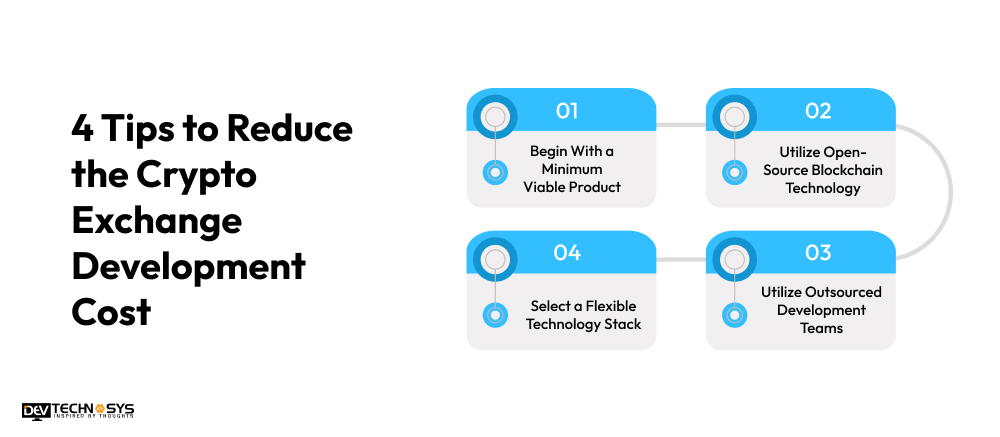
1. Begin With a Minimum Viable Product
The MVP cryptocurrency development services will help you save on your initial cryptocurrency exchange development cost. Since you will be limiting your scope to just your core functionality and will allow you to get your product out into the market and collect user feedback sooner.
To expand your functionality incrementally, thus avoiding unnecessary expenditures on complex functionalities and the beginning stages of development.
2. Utilize Open-Source Blockchain Technology
Utilizing open-source blockchain frameworks and protocols will greatly reduce your crypto exchange software development pricing. You will be able to leverage existing solutions already created versus creating the solutions from scratch, thus saving time and money.
You will be able to get your product to market faster while still retaining the flexibility, security, and scalability needed for continued enhancements and integrations into your product.
3. Select a Flexible Technology Stack
Choosing a flexible technology stack is key to minimizing costs associated with replacements later. By employing modern framework technologies, cloud-based infrastructure, and other advances.
There are many advantages to be gained, such as performance improvements, greater flexibility, and reduced ongoing crypto exchange maintenance costs. This will help reduce overall cost to create a cryptocurrency exchange platform.
4. Utilize Outsourced Development Teams
The use of outsourcing for blockchain development will significantly lower your business’s costs. It is also highly advisable to hire software developers to provide expertise in the field.
Developer expertise can reduce the number of errors made while developing an application, which leads to greater efficiency, reduces overall time-to-market, and ultimately saves on the cost of reworking the application.
How Long Does it Take to Create a Crypto Exchange Platform?
It usually takes 3-6 months for a developer to create a basic MVP with essential trading and wallet features on an exchange platform. Once additional features such as KYC verification, liquidity APIs, and an enhanced user interface (UI) or user experience (UX) are included, it can take about 6 months or more to complete a mid-level platform.
For higher security levels, scalability, and trading engine functionality, it typically will take 6 months plus to build a fully featured advanced exchange, based on how sophisticated the design is, and the number of developers.
Development Type |
Estimated Time |
Key Highlights |
| MVP / Basic Exchange | 3 – 6 months | Core trading, wallet integration, basic UI |
| Mid-Level Exchange | 6 – 9 months | KYC/AML, liquidity APIs, advanced features |
| Advanced / Enterprise | 9 – 12+ months | High security, scalability, and complex trading engines |
Build vs. White-Label vs. Custom Crypto Exchange
In this bit, we’ll look into three techniques to start a crypto exchange: full-on development, employing a white-label option, or relying on personalized development. Each option has its particularities when it comes to cost, time to launch the exchange, flexibility, scalability, ownership, security measures employed, and follow-up care measures.
Factor |
Build From Scratch |
White-Label |
Custom Development |
| Initial Cost | Highest | Lower | High |
| Launch Time | Longest | Fastest | Moderate–Long |
| Customization | Limited to your own build resources | Limited–Moderate | Very High |
| Scalability | High | Provider-dependent | Very High |
| Security Control | Full | Vendor-dependent | Full |
| Ownership | Full | Provider-dependent | Full |
| Maintenance | Your responsibility | Usually provider-supported | Your responsibility |
| Best For | Large-scale exchange operators | Startups & quick launches | Businesses needing unique features |
Not Sure Whether to Build or Upgrade Your Existing Crypto Exchange?
You don’t have to develop the solution from scratch. You can also upgrade your existing system, which can be more cost-effective.
Experts at Dev Technosys can help evaluate:
- Whether your current exchange architecture can support more users and trading volume.
- Whether your trading engine needs optimization.
- Whether additional blockchain networks or liquidity providers should be integrated.
- Whether your wallet infrastructure requires security improvements.
- Whether a custom-built platform offers better long-term flexibility.
How to Generate Revenue From Crypto Exchange Platforms?
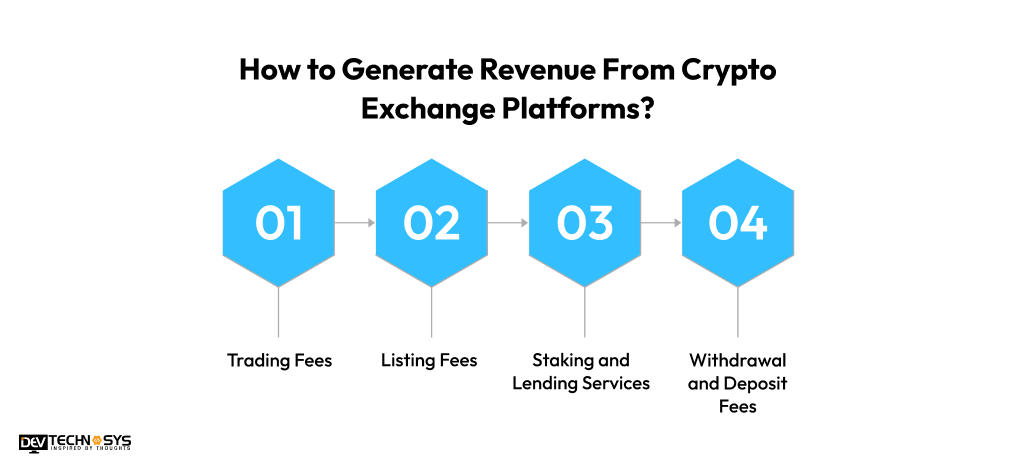
Cryptocurrency exchanges make money by utilizing different sources of income, including trading fee module, token listing fees, deposit and withdrawal fees, and staking or lending services. Following these income models helps an exchange maintain a stable operating profit, which will allow it to continue its operation.
1. Trading Fees
The crypto wallet app development solutions earn their revenue primarily from charging fees on trades made through their platforms. These fees can be collected from both makers and takers, which will provide a steady stream of income regardless of whether or how many trades are made in a given time period.
2. Listing Fees
Exchanges may charge an upfront listing fee to cryptocurrency projects to have their tokens listed for purchase at their exchange. By listing tokens on their exchange, exchanges give those tokens visibility and access to the trader community. Most of the time, premium or priority listings will have a higher upfront cost than standard listings.
3. Staking and Lending Services
Staking and lending services are additional means by which cryptocurrency exchanges earn revenue by providing users with the opportunity to lock their assets for the purpose of earning rewards.
While the platform receives commission revenues or spreads from the interest earned on the locked assets. According to the blockchain development company, this method of creating additional streams of income and interaction with the user base is particularly beneficial to both parties.
4. Withdrawal and Deposit Fees
Many cryptocurrency platforms generate revenue through the sale of small withdrawal fees and sometimes deposits as well. These fees provide the platform with funds to offset blockchain network costs and operational expenses.
Over time, as users engage with the platform, the cumulative effect of these micro-charges results in a consistent income source used to support infrastructure maintenance and transaction processing.
Why Every Business Needs a Well-Defined Project Budget Plan?
A fixed project budget is crucial for businesses because it provides financial clarity, controls unnecessary spending, and ensures resources are allocated efficiently. It helps organizations avoid cost overruns, make informed decisions, and maintain project profitability.
With a well-defined budget, teams can plan better timelines, prioritize essential features, and reduce financial risks during development. It also improves accountability among stakeholders and ensures smooth execution. Overall, a fixed budget creates discipline, enhances transparency, and supports successful project delivery within planned financial limits.
How Dev Technosys Will Be the Best Partner in Crypto Exchange Development?
Dev Technosys is a major tech company in San Francisco that provides services for developing crypto exchanges and blockchain systems. With more than 1,500 projects completed worldwide. We employ between 80 and 200 employees, all of whom specialize in different areas of blockchain development, including building blockchains, writing smart contracts, and creating trading engine architecture.
What Happens After You Contact Our Crypto Exchange Development Team?
Our team provides the next steps to move your project to deployment. This is what you can expect from the conversation:
- Requirement Discussion: Understand your exchange model, target audience, and business objectives.
- Technical Feasibility: Evaluate blockchain selection, trading engine requirements, integrations, and security architecture.
- Cost Estimation: Define the development scope, estimated timeline, and budget.
- Development Roadmap: Identify the MVP features, development milestones, and deployment requirements.
Conclusion
To summarise, due to the varying requirements in terms of features, complexity, security, and scalability, the cost of developing a crypto exchange will vary greatly between a simple Minimum Viable Product (MVP) and a fully-featured enterprise-level solution. Using a custom crypto exchange development company to assist in the development of a crypto exchange will provide you with professional advice on the appropriate level of security and scalability.
Frequently Asked Questions
Find answers to the most common questions related to this article.
The cost to develop a crypto exchange ranges from $4999 to $110,000+ and is based on function, complexity, security, and other features. Basic MVP-type exchanges cost less than advanced exchanges that may require a trading engine, liquidity integration, regulatory compliance systems, and ongoing operational costs.
Development of a crypto exchange normally takes 3 to 6 months, depending on the level of complexity. An MVP-type exchange takes approximately 2 to 4 months, a mid-range exchange takes approximately 4 to 6 months, and an advanced enterprise-grade exchange may take 6 or more months.
Crypto exchange development uses technologies like blockchain networks, Solidity for smart contract development, Node.js, Python, and React for the frontend. Microservices architecture, REST APIs, cloud platforms, and high-performance databases ensure scalability, real-time trading, security, and seamless integration with multi-signature wallets and liquidity providers.
A CEX (Centralized Exchange) is managed by a company, offering high speed, liquidity, and user-friendly features, but requires trust in a central authority. A DEX operates on blockchain via smart contracts, ensuring transparency and user control, but with lower speed and liquidity.
Launching a crypto exchange requires a trading engine, cold wallet security, liquidity integration, KYC/AML compliance, and a scalable backend infrastructure. Additionally, strong cybersecurity measures, legal approvals, UI/UX design, and continuous maintenance are essential for smooth, secure, and reliable platform operation.