












Nowadays, everyone uses online visibility to grow their business, such as creating websites to expand their business. But how can websites talk to visitors? Here, magic happened through chatbots; they respond to visitors instantly to their specific queries.
But suppose a visitor comes from another region and asks questions in their default language. Then what websites do?
A multilingual chatbot is useful for those kinds of visitors, as they can understand various languages and respond to them in human language, and welcomes visitors from every region.
Developing a multilingual chatbot for a website: Is it a turning point for businesses?
Yes, it can.
Let’s get ready to explore how to develop a multilingual chatbot for websites, why it is important to develop, core and advanced features, total development cost, and many more.
Ready to gear up!
What is a Multilingual Chatbot?
Multilingual chatbots are defined as AI-powered software applications. The primary role of this is to understand consumers’ queries and respond to them in multiple languages.
Multilingual chatbots allow businesses to communicate with customers from different locations around the world. To thrive in this competitive world, companies need to have a multilingual chatbot website. This helps them to respond to consumers’ queries in their native or local language.
Current and Future Statistics of the Global Chatbot Market
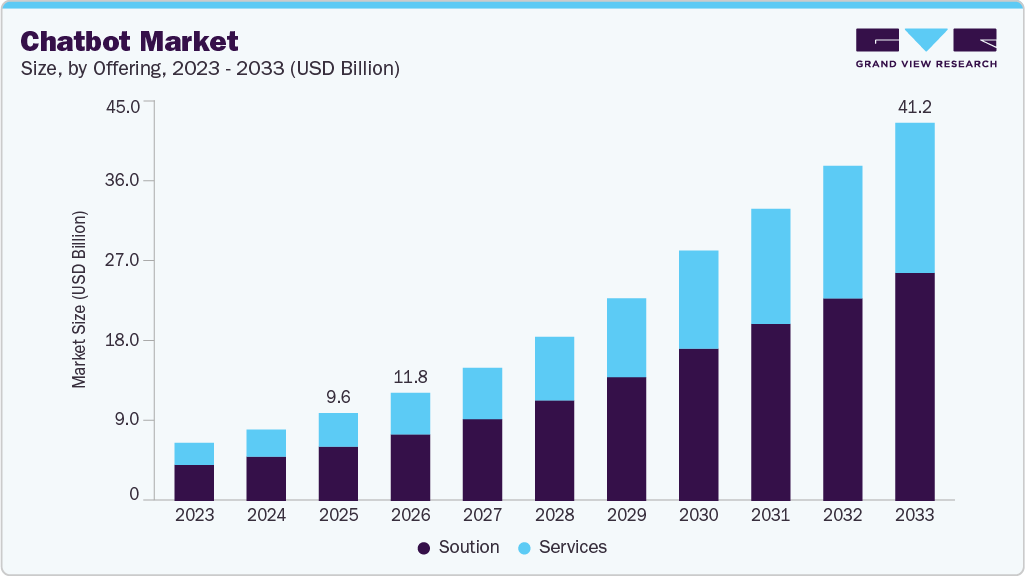
- As per the market report, the worldwide chatbot market is projected to reach USD 41,244.2 million by 2033, growing at a CAGR of 19.6% from 2026 to 2033.
- According to the region-wise, North America leads the chatbots industry with around 31.1% .
- Based on the offering-wise, the solution segment registers the highest revenue in the chatbot market, around 62.0% in recent years.
- The global chatbot market is expected to increase with a Compound Annual Growth Rate(CAGR) of around 23.3% from 2025 to 2030.
- As per the type-wise, standalone chatbots hold the market revenue share and generate revenue in recent years.
Why Do Businesses Invest in Multilingual Chatbots For Websites?
A multilingual chatbot for Business enables to connect with consumers from diverse linguistic backgrounds. Start-ups are investing in these chatbots for their websites to enhance consumer engagement and experience, aiming for more growth.

1. Expanding Market Reach
In today’s era, most businesses operate on a global scale, serving consumers worldwide. This enables them to have a multilingual chatbot through which they can cater to the needs of international consumers without any language barriers.
2. Better Customer Engagement
Consumers in today’s period seek a multilingual customer support chatbot to resolve queries, no matter the hours.
In several industries, companies are investing in multilingual chatbot for global customer support. The main motive behind this is to interact with consumers on ga lobal scale, regardless of language barriers. This allows them to reach customers worldwide and generate high revenue.
3. Reducing Operational Costs
Investment in multilingual chatbots for the website provides businesses with an opportunity to reduce operational costs, as manual labour requires a high price to offer 24/7 support to consumers. Multilingual chatbots provide round-the-clock support, irrespective of time zones, in a cost-effective manner.
4. Boosting Sales and Conversion Rates
Multilingual chatbot advantages include a continuous increase in sales and conversion rates. These chatbots offer on-time assistance and recommendations to consumers in their native language.
5. Data Insights
On a global scale, businesses are investing in multilingual chatbots to expand their revenue streams and increase profits. With machine learning development services, start-up businesses are leveraging the advantage of collecting data on consumers’ behaviour and offering them products accordingly. This helps in serving consumers as per their needs and requirements.
How AI Improves a Multilingual Chatbot?
- AI translates user inputs in real time, allowing the chatbot to understand and respond correctly in multiple languages, improving global communication and overall user experience.
- It helps the chatbot grasp context, slang, and regional expressions, enabling more natural and human-like conversations across different languages.
- AI analyzes user behavior and preferences, delivering personalized and relevant replies that increase engagement and satisfaction for users worldwide.
- The chatbot learns from interactions over time, improving accuracy, understanding, and response quality across all supported languages.
- AI detects user emotions and tone, allowing the chatbot to respond empathetically, enhancing trust and overall interaction quality.
- It processes queries quickly and accurately in multiple languages, reducing response time and increasing efficiency in customer support.
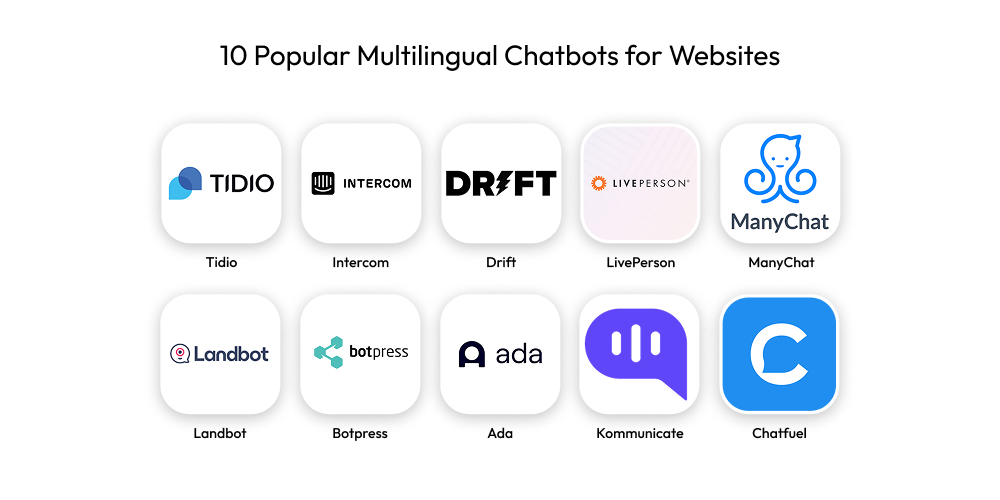
10 Popular Multilingual Chatbots for Websites
As the appointment booking market continues to expand, several companies offer facilities in the market. Let’s have a look at a popular multilingual chatbot website.
App Name |
Rating ⭐ |
Lunch Year |
Available Platforms |
| Tidio | 4.7 | 2016 | Web, Shopify, WordPress, iOS, Android |
| Intercom | 4.5 | 2011 | Web, iOS, Android |
| Drift | 4.4 | 2015 | Web, iOS, Android |
| LivePerson | 4.3 | 1995 | Web, iOS, Android |
| ManyChat | 4.3 | 2015 | Web, iOS, Android |
| Landbot | 4.7 | 2017 | Web, iOS, Android |
| Botpress | 4.6 | 2017 | Web, Self-hosted |
| Ada | 4.5 | 2016 | Web, iOS, Android |
| Kommunicate | 4.3 | 2017 | Web, iOS, Android |
| Chatfuel | 4.3 | 2015 | Web, iOS, Android |
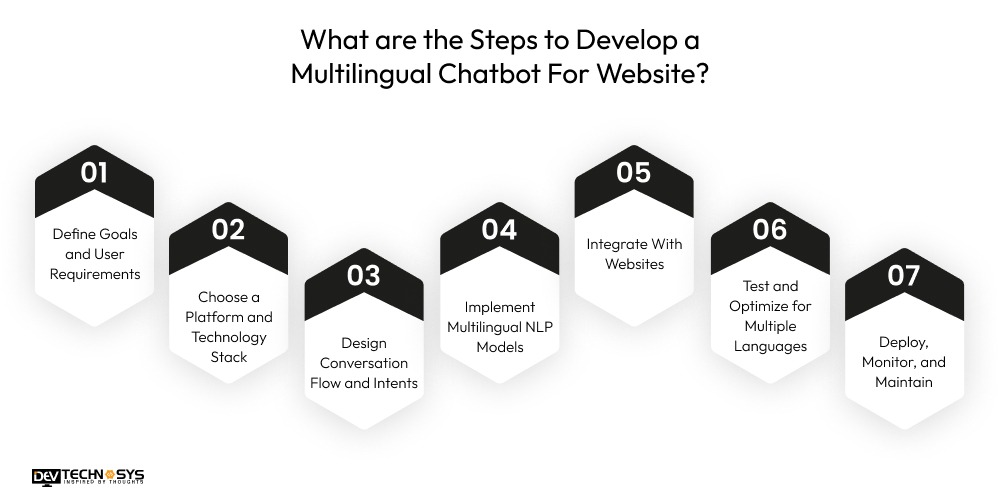
What are the Steps to Develop a Multilingual Chatbot For Website?
To develop a multilingual chatbot for websites, you will need to consider various steps that help businesses or developers to easily understand each process in detail. From market research and project requirement gatherings to publish and post-launch maintenance services. So, here we provide the step-by-step multilingual chatbot development process:
1. Define Goals and User Requirements
Let’s begin the first stage to create a chatbot and collect the project requirements, such as features, functions, and services. Businesses must clear the project goals and scope, which means what they offer and where they want to see their product in the future.
It includes various features such as lead generation, customer support, FAQs, language detection, AI-learning, voice-enabled multilingual chatbots, and more.
2. Choose a Platform and Technology Stack
In this second stage, to create a multilingual chatbot, choose the best platform for a chatbot that can gain higher popularity. Select the right tech stacks to build a high-quality chatbot, which involves various tech stacks like Python, Java, Node.js, SQL, NoSQL, C++, C#, Ruby, and many more.
There are many robust platforms available for chatbots, such as Microsoft Bot Framework, Dialogflow( dialog management systems), and customized NLP-based chatbot solutions.
3. Design Conversation Flow and Intents
Map out conversation pathways for each supported language. Identify user intents, sample queries, and corresponding responses. Hire chatbot development services provider to use flowcharts or tools like Botmock for visual planning.
Include error handling, fallback responses, and context management for smooth interactions. Designing separate flows for each language ensures cultural and linguistic nuances are respected while maintaining consistent functionality across languages.

4. Implement Multilingual NLP Models
In the fourth stage of the multilingual AI chatbot development process, integrate NLP models capable of understanding and generating responses in multiple languages. Options include Google Dialogflow’s multilingual support, transformer models (e.g., BERT, GPT), OpenAI’s language models, or custom-trained models.
Tokenize, preprocess, and train the model for domain-specific vocabulary. Ensure the system can detect language automatically or allow users to select a preferred language. Proper testing for each language avoids mistranslations and improves user experience.
5. Integrate With Websites
Connect the chatbot to your website using JavaScript widgets, iframe, or API integration (RESTful APIs, GraphQL). Ensure it interacts with backend systems such as CRM, databases, or e-commerce platforms for personalized responses.
Employ an professional AI chatbot development services provider to enable secure authentication if handling sensitive data. Optimize performance to ensure fast response times and smooth multilingual display across different devices, browsers, and screen sizes.
6. Test and Optimize for Multiple Languages
After completing the integration of the chatbot with websites. Hire multilingual chatbot developers to conduct testing techniques to test the functionalities and services of the chatbot to determine if they are working perfectly or not.
It includes various testing techniques such as functional, unit, security, integration, black-box, and white-box testing. Continuously update NLP models to handle slang, abbreviations, and regional variations.
7. Deploy, Monitor, and Maintain
Now, the time has come to publish the chatbot on your website and monitor the overall performance using the analytics tools to get the real-time data insights. Hire one of the top chatbot development companies in USA to conduct the maintenance services to keep up-to-date.
It includes various services such as fixing bugs or glitches, performance optimization, regular updates, backups, adding new enhancements, upgrading versions, and more.
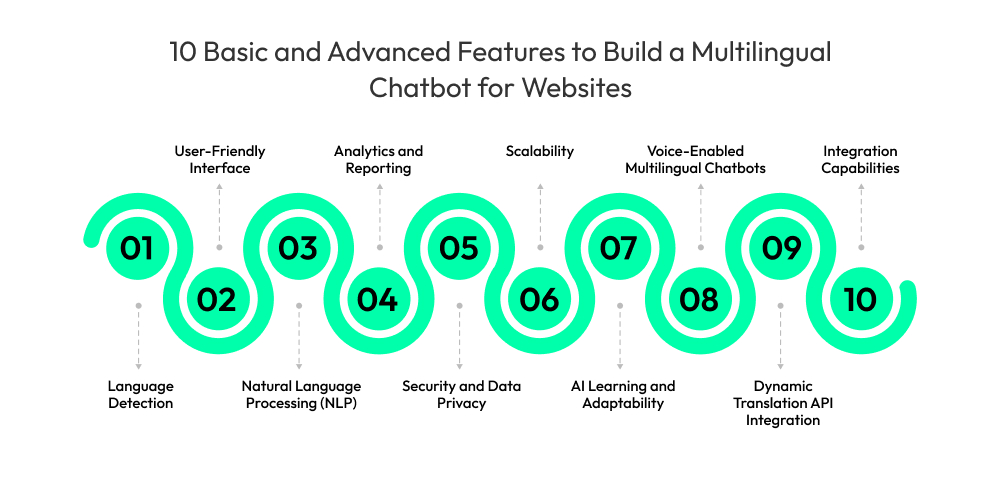
10 Basic Features to Build a Multilingual Chatbot for Websites
The integration of multiple features is crucial for developing a multilingual chatbot for a website. By focusing on the features discussed below, you can gain an understanding of the essential features that need to be in a multilingual chatbot.
-
Language Detection
To develop an AI chatbot platform like Poe,Language detection algorithms and features help you detect the preferred language of users. This can be easily done with the help of Browser language settings, IP geolocation, and Manual selection (dropdown or button).
-
User-Friendly Interface
To create a multilingual chatbot, a user-friendly interface is vital as it offers an easy-to-navigate design. Key features to design effective chatbots include drag-and-drop functionality, a visual flow builder, and a template library.
-
Natural Language Processing (NLP)
The integration of NLP helps build a chatbot for the travel industry, enable queries to be resolved naturally. Multilingual chatbot benefits include NLP, which allows your multilingual chatbots to analyze and interpret human language, resulting in improved query recognition.
-
Analytics and Reporting
Chatbot analytics and performance tracking is a crucial feature in multi-lingual chatbot development. To track the performance of multilingual chatbots, robot analytics and reporting play a crucial role in evaluating their effectiveness. User interaction examination helps you identify patterns and trends that can lead to future improvements. Important metrics to track are user engagement, common queries, and resolution rates.
-
Security and Data Privacy
To develop an AI chatbot for e-commerce, it is crucial to focus on data privacy and security. You need to safeguard users’ data to build their trust. Adhering to certifications like ISO 27001 and multi-factor authentication (MFA) helps to handle users’ data responsibly.
-
Scalability
A common question that arises in the minds of entrepreneurs when developing a chatbot is how to make a multilingual chatbot that can handle an increasing number of users in the future.
Through this feature, you can experience consistent performance. To test scalability, common aspects like load testing, elastic infrastructure, and performance monitoring are necessary.
-
AI Learning and Adaptability
Consumers’ needs and demands keep on changing, which makes businesses adapt. Tools like machine learning and adaptive algorithms enable learning from every interaction, allowing multilingual chatbots to anticipate users effectively.
-
Voice-Enabled Multilingual Chatbots
AI chatbots with multilingual support help businesses reach a broad consumer base. However, integrating voice-enabled support into your chatbot for the website enables you to have text-to-speech (TTS) and speech-to-text (STT) capabilities in multiple languages.
-
Dynamic Translation API Integration
Multilingual chatbots for businesses need to have real-time translations, through which you can offer seamless localisation facilities to users. This can be done with the help of integrating API support, such as Google Cloud Translation, DeepL API, and Microsoft Translator.
-
Integration Capabilities
By integrating a multilingual chatbot with a CRM system, such as Salesforce, you can easily access consumers’ data in real-time. It is vital to ensure that the app supports different channels for which advanced API flexibility is essential.
Advanced or Premium Features of Multilingual Chatbot For Websites
After knowing the core or simple features, now you have to know about the advanced features that must be added to increase the user engagement and gain a competitive advantage over other chatbots. So, let’s take a look at the advanced features of multilingual chatbots for websites:
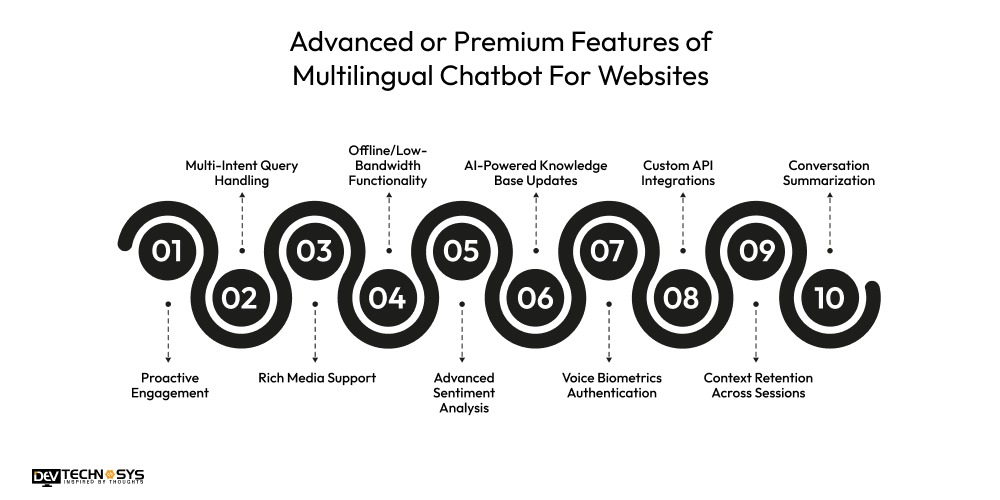
1. Proactive Engagement
The multilingual AI chatbots automatically start the conversation based on the users’ behaviours, browsing patterns, abandoned carts, and engage without waiting for users to reach out.
2. Multi-Intent Query Handling
A chatbot integration for websites with different languages help understand and process multiple intents in a single message, providing precise, context-aware responses instead of handling queries sequentially.
3. Rich Media Support
The multilingual chatbots support rich media such as images, PDFs, carousels, videos, and more to delivers visitors to make chat more engaging and visually appealing chat experience.
4. Offline/Low-Bandwidth Functionality
The best platforms for multilingual chatbots allow users with poor internet connectivity to interact with the chatbot in a limited mode, ensuring accessibility even in remote regions.
5. Advanced Sentiment Analysis
Detects user emotions like frustration, happiness, or urgency, allowing the bot to adapt tone or escalate to human agents when needed.
6. AI-Powered Knowledge Base Updates
Conversational AI platforms automatically updates FAQ or knowledge content based on common queries, keeping multilingual responses accurate without manual intervention.
7. Voice Biometrics Authentication
Adds security by recognizing users’ voice patterns during voice interactions, enhancing trust and secure access in multiple languages.
8. Custom API Integrations
NLP model for multilingual chatbot platforms connects with external services like booking engines, payment gateways, or inventory systems to handle complex transactions within conversations.
9. Context Retention Across Sessions
Remembers user preferences, previous conversations, and ongoing tasks to provide continuity across multiple sessions and devices.
10. Conversation Summarization
The multilingual support chatbots generates concise summary of long conversations for user support to quickly understand the exact query and improve readability.
Want a chatbot demo or pricing? Fill the form and talk to our experts today.
Pick what you need below — you can select more than one — then tap Get detail to continue.
-
Chatbot demo dashboard
-
Cost to develop an app
-
Industry report
-
Case study
How Different Industries Use Multilingual Chatbots: Real-World Examples
Businesses are using multilingual chatbots to deliver a smooth customer experience worldwide. Healthcare, banking, retail, traveling, education, and insurance businesses have already deployed chatbots to provide automation for customer support engagements. Increase the number of interactions with customers, eliminate language barriers, and provide personalized customer assistance.
1. Healthcare
Providers in the medical field use multilingual chatbots for many tasks, including booking appointments, answering inquiries, and providing access to information about treatments.
The use of different languages allows the chatbots to enhance the accessibility of facilities for patients and increase patient participation with their healthcare providers, thereby creating more positive experiences for all patients involved.
2. Banking and Financial Services
Multilingual chatbots are also frequently used by banks and financial technology firms for answering questions, providing account updates, facilitating loan applications, and navigating the onboarding process.
These multilingual chatbot applications can provide financial services businesses with access to 24-hour-a-day, 7 days-a-week secure customer service. They provide a means for financial service businesses to service their international customers as well.
3. eCommerce and Retail
Multilingual chatbots have become popular tools used by retail and eCommerce businesses for assisting consumers in creating product recommendations, tracking merchandise orders, processing product returns, resolving payment disputes, and so forth.
By using multilingual chatbots, retail and eCommerce businesses can gain access to consumers from every country around the world and improve the overall customer experience.
4. Travel and Hospitality
Travel-related businesses, such as airlines, travel agencies, and hotels, have implemented multilingual chatbots to help with booking travel arrangements and answering questions related to travel.
Providing information about travel-related cancellations and responding to customer inquiries. These chatbots help facilitate communication between international travelers and travel-related businesses and significantly improve customer satisfaction.
5. Education and E-Learning
Multilingual chatbots are utilized in educational institutions and by online learners to facilitate admissions, course selection, enrollment, and supporting learning.
These multilingual chatbots allow educational organizations to provide access to their educational resources and provide a way for organizations to engage their learners across different languages and cultures.
6. Real Estate
Multilingual chatbots can assist real estate agencies in qualifying leads, provide fast responses to property-related inquiries, schedule site visits, and provide information about real estate markets. Providing multilingual chatbots to the agency will help the real estate agency build much better relationships with potential international buyers and investors.
7. Insurance
Insurance providers use multilingual chatbots to provide policy-related information, inquiries, claims assistance, and premium calculations, and customer service.
By using multilingual chatbots, insurance providers are able to create clearer communication with their policyholders in different regions and increase the efficiency of their overall service delivery while reducing operating costs.
The Cost to Build a Multilingual Chatbot for Websites
The Cost to build a Chatbot differs based on several elements. Basic multilingual chatbot development for a website ranges from $8,000 to $25,000.
However, if you want to customize your app according to updates, refer to the table below.
App Type |
Estimated Cost |
Development Time |
| Basic MVP App | $8,000 – $12,000 | 2 – 3 Months |
| Standard App | $13,000 – $20,000 | 3 – 5 Months |
| Feature-Rich App | $20,000 – $25,000 | 5 – 6 Months |
| Custom Enterprise-Grade App | $26,000 – $30,000 | 6 – 8 Months |
Factors Affecting the Cost of Multilingual Chatbots for Websites
To develop a chatbot from scratch, several factors are involved, including chatbot features and maintenance tools, which impact the cost. You need to have a proper evaluation of the factors given below to identify the cost of multilingual chatbot development.
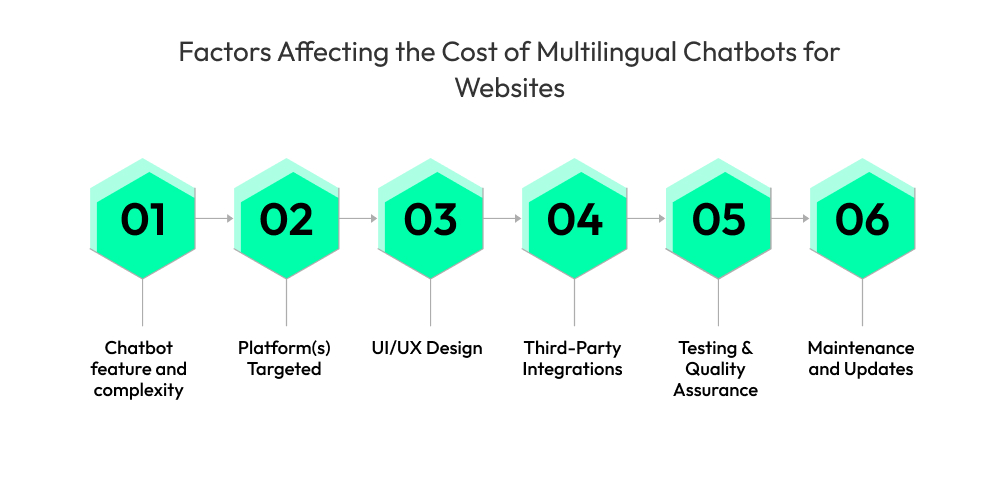
1. Chatbot feature and complexity
To develop a multilingual chatbot, the quality of conversions plays an important role. Building multilingual chatbots is influenced by tools such as AI voice assistants and Natural Language Processing services (NLP), machine learning (ML) algorithms, and deep learning models.
The cost to develop a multilingual chatbot also varies based on your expectations related to the personalized demand for deploying basic, intermediate, and advanced facilities.
Feature Complexity |
Development Cost |
Timeline |
| Basic Listings & Search | $3,000 – $5,000 | 1 – 1.5 Months |
| Intermediate (Chat, Filters, Profile) | $6,000 – $10,000 | 2 – 3 Months |
| Advanced (AI, AR, Blockchain) | $6,000 – $10,000 | 3 – 4 Months |
2. Platform(s) Targeted
Planning to launch your multilingual tool, then you must know that every website or platform has a unique set of functionalities and features. This creates differences in the multilingual chatbot development cost. With the help of a breakdown of costs, you can understand the total cost of developing a chatbot website tailored to your personalized needs.
Platform type |
Development Cost |
Timeline |
| No-code tools and NLP platforms | $3,000 – $5,000 | 1 – 1.5 Months |
| Both (Native) | $6,000 – $10,000 | 2 – 3 Months |
| Cross-Platform | $6,000 – $10,000 | 3 – 4 Months |
3. UI/UX Design
Webflow, Figma, Miro, Marvel, Treejack, and Sketch are some of the UI/UX design tools for website design that can help to increase the attractiveness and reach of multilingual chatbots.
You can collaborate with an AI Chatbot Development Company, where designers integrate basic custom and high-end chatbot UX design and personalization as per your needs and cost, which differ from each other and affect the overall cost to create a multilingual app.
UI/UX Complexity |
Development Cost |
Timeline |
| Basic UI | $1,500 – $2,500 | 2 – 3 Weeks |
| Custom & Responsive UI/UX | $3,000 – $5,000 | 1 – 1.5 Months |
| High-End Interactive Design | $6,000 – $8,000 | 2 Months |
4. Third-Party Integrations
With the help of a plugin and an iframe, you can increase the efficiency of your chatbot. By seeking support from Android app development services firms, you can have custom ChatGPT integration services, which can be done with or without a pre-made API.
Third-party integration Complexity |
Development Cost |
Timeline |
| Basic Backend (CRUD APIs) | $2,500 – $4,000 | 2 – 3 Weeks |
| Scalable Backend + DB | $5,000 – $8,000 | 1 – 1.5 Months |
| Third-party Integrations | $4,000 – $7,000 | 1 – 2 Months |
5. Testing & Quality Assurance
For seamless multilingual chatbot operations, functionality and reliability are crucial. There are several reliable quality testing tools, such as Selenium, Appium, and Cypress, that web app development companies often integrate.
Collaborating with these companies will help you to test your website’s efficiency. The integration of these tools may impact your overall cost of multilingual chatbot app development.
Testing Complexity |
Development Cost |
Timeline |
| Manual Testing Only | $1,000 – $2,000 | 2 Weeks |
| Manual + Automated Testing | $2,000 – $4,000 | 3 – 4 Weeks |
| Advanced Testing + Security Audits | $4,000 – $6,000 | 1 Month |
6. Maintenance and Updates
Website maintenance helps in identifying bugs and issues at the initial stage. There are specific tools, such as GoWP, Maintainn, and WPScan, that can initially identify vulnerabilities. Regular maintenance of these tools comes in different price ranges, which tend to increase your costs.
Updates Complexity |
Development Cost |
Timeline |
| Basic (Bug Fixes, Minor Updates) | $2,000 – $3,000 | Ongoing Monthly |
| Standard (Feature Updates, Monitoring) | $4,000 – $6,000 | Ongoing Monthly |
| Premium (24/7 Support) | $7,000 – $10,000 | Ongoing Monthly |
Planning a Mobile App?
Get a tailored development cost estimate in 3 simple steps — app basics, features, timeline, and your contact details.
- 3 quick steps
- 100% free
- Reply in 1 business day
2 Minutes Read
Why Translating Your Chatbot Isn’t Enough: The Case for True Localization
Chatbot is understandable with translation. However, it only becomes effective with localization. True localization provides the language, culture, tone, regional preferences, format, and user expectations required for creating meaningful interactions through the delivery of contextually relevant experiences.
1. Translation vs. Localization
While translating chatbot text merely changes its language, localizing the full chatbot experience to match a region’s culture, communication style, user expectations, and local customs will create a more natural and relevant experience for users.
An HTML page that is translated into your target language may have words that are understandable by people in your target country, but there will still be differences in how those words are used and understood.
2. Cultural Relevance Matters
When chatbots reflect their users’ local culture, social conventions, etiquette, jokes, etc., it results in better engagement and satisfaction with the service. If a phrase can be directly translated, there may be problems with the sound of the phrase or whether it is appropriate.
With localization, chatbots will use words and phrases familiar to users, ensuring improved interaction and comfort with the entire chat experience, thereby increasing both user satisfaction and trust in the service.
3. Regional Formats and Preferences
Localization also includes adapting the way we display date and time formats, currency formats, units of measurement, payments, and contact information. Users expect information to be formatted in a manner they are comfortable with.
By using the correct regional formats, users will not experience confusion. Designing chatbots using regional formats will make the entire chat experience more user-friendly and efficient.
4. Better Business Outcomes
When a chatbot is localized, users typically experience more engagement, conversion, and retention than when using only a translated chatbot. When the experience they receive, via any medium, matches their understanding and experience, it increases the likelihood that they will use the recommended product or service, complete their purchase, and/or remain a loyal customer.
Global Data Protection Standards for Multilingual Chatbots: GDPR, CCPA, and Beyond
IRC Global Standards for multilingual chatbot data protection cover global data privacy regulations regulating how personal user data is captured, retained, and handled globally.
Global Data Protection Frameworks include GDPR, CCPA, and other regionally applicable laws, which require transparency, consent, data security, and user control for multilingual AI applications that function worldwide.
1. Global Data Protection Standards
Global Data Protection Standards are the international standards and laws relating to how personal information should be collected, used, stored, and shared worldwide.
They require organizations to collect, use, and store personal data worldwide in a transparent way, with consent from the user, that is safe, and with accountability of the organization collecting, using, and storing the personal data.
2. Multilingual Chatbots
Multilingual chatbots are AI-powered chat applications that can communicate with users in multiple languages. By providing the same message in multiple languages to users, they can make products and services available to all consumers. They must also comply with thousands of differing data protection and privacy laws.
3. GDPR
GDPR (General Data Protection Regulation) is an EU law that protects the privacy of personal data of EU residents. GDPR requires an organization to obtain informed consent before collecting personal information, limit the amount of personal information that is collected to the minimum amount necessary to fulfill the intended purpose, give individuals the right to access and delete their personal information from an organization’s records, and implement reasonable security standards to ensure the safety of the personal information collected.
4. CCPA
CCPA (California Consumer Privacy Act) is a California state law that provides certain rights to residents of California, including the right to know what personal information has been collected about them, to request deletion of their personal information, and to opt out of the sale of their personal information.
CCPA requires an organization to be transparent about the collection of personal data and provides consumers with the ability to control their personal information.
Rule-Based vs. AI-Powered vs. Hybrid: Which Multilingual Chatbot Architecture Is Right for You?
Determining which type of multilingual chatbot architecture works best for your company will depend on your company’s goals, budget, and what your users expect from an interaction with a chatbot.
Examples of different types of multilingual chatbots include rule-based, AI-based, and hybrid architectures, all providing scalable, accurate, and personalized multilingual customer service.
Feature |
Rule-Based Chatbot |
AI-Powered Chatbot |
Hybrid Chatbot |
| Technology | Predefined rules and decision trees | NLP, ML, and Generative AI | Rules + AI combined |
| Language Understanding | Limited to scripted inputs | Understands context and intent | Handles both structured and complex queries |
| Multilingual Support | Requires manual language setup | Supports multiple languages dynamically | AI-driven with rule-based fallbacks |
| Response Accuracy | High for predefined scenarios | High, but may generate unexpected responses | High accuracy with controlled flexibility |
| Personalization | Minimal | Advanced user-specific responses | Moderate to advanced personalization |
| Scalability | Limited | Highly scalable | Highly scalable |
| Development Cost | $5,000–$15,000 | $20,000–$100,000+ | $15,000–$60,000+ |
| Maintenance Effort | Frequent rule updates | Model training and monitoring | Balanced maintenance requirements |
| Best For | FAQs, support workflows, simple tasks | Customer support, sales, and virtual assistants | Enterprises needing automation and reliability |
| Key Advantage | Affordable and predictable | Smart, conversational, and adaptive | Best balance of cost, control, and intelligence |
| Key Limitation | Cannot handle unexpected queries | Higher cost and complexity |
More complex implementation than rule-based systems |
How To Make Money From Multilingual Chatbots for Websites?
The automated chat development process has a high cost, as it requires you to invest in AI tools, hire developers with expertise in building chatbot for eCommerce / SaaS websites, and conduct testing. However, there are several ways discussed below through which you can earn money from multilingual chatbots for websites.
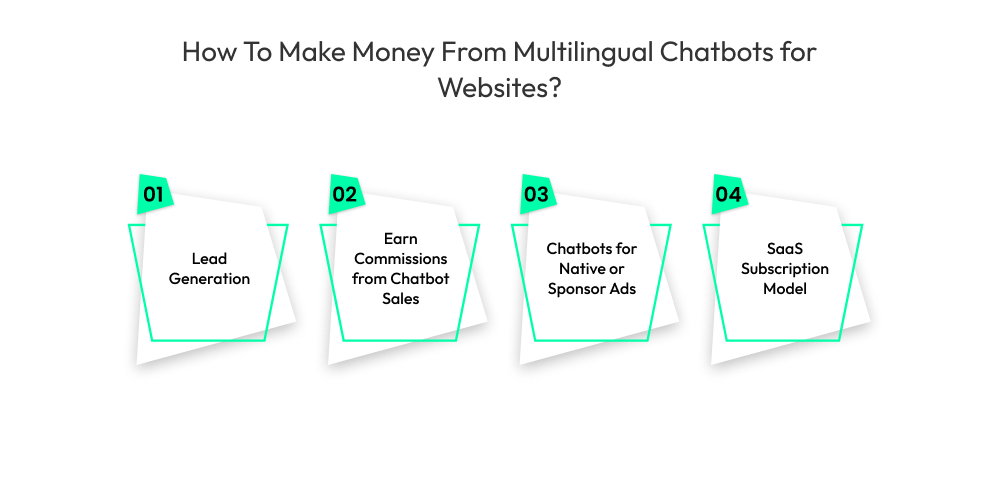
1. Lead Generation
Building cross-language chatbot solution enable businesses to connect with consumers on a global scale, allowing them to automate lead generation. Multilingual AI assistant offers companies the opportunity to convert leads into potential sales and generate revenue.
2. Earn Commissions from Chatbot Sales
Businesses in today’s era are embracing AI development services as the future of online consumer services. Investing is a multilingual chatbot for websites that increases the instant interaction rate. This, in turn, provides a business opportunity to boost the conversion rate.
Your multilingual chatbot will allow you to interact with requests and find the most requested items seamlessly. In this chatbot, it directly refers users to links, and when a purchase is made, you can earn commission.
3. Chatbots for Native or Sponsor Ads
Native ads are less intrusive and more difficult to ignore. Through a multilingual chatbot, you can create a personalized experience for users. These bots help users find sponsored links that offer answers to their questions. With the help of sponsor ads, you can experience additional earnings froma multilingual chatbot.
4. SaaS Subscription Model
This is a subscription model in which users pay recurring fees on an annual or monthly basis to have easy access to the software. Build a chatbot for the travel industry, which operates on a SaaS model primarily on a pay-as-you-go basis.
Through this, you can allow your users to subscribe to the software. You can offer the freemium model and the tiered pricing model to your users to generate income.
Conclusion
As discussed above, it has been concluded that in today’s business environment, businesses are recognizing the importance of reaching a diverse base of consumers. Companies across various industries frequently utilize multilingual chatbots on their websites.
To create an AI app, businesses need to have an in-depth understanding of the elements that affect the cost of chatbot development. For start-ups, it is necessary to identify how you can generate income from a multilingual chatbot.
The above discussion also reflects the growth rate of the multilingual chatbot market. It has been identified that businesses are capitalizing on this market growth by investing in various multilingual chatbot technologies.
Frequently Asked Questions
Find answers to the most common questions related to this article.
The cost to build a multilingual chatbot for websites is around $8,000 to $25,000, or based on the project complexity. The cost can fluctuate due to crucial factors such as development team, backend infrastructure, third-party integrations, tech stacks, features, functions, project size, and more.
To build a multi-language Chatbot with simple features and services, it mainly takes around 2 to 4 months. On the other hand, making a multilingual chatbot with advanced functionalities, it takes around 3 to 6 months. The total development time is based on the various factors such as developers' working hours, project complexity and size, and number of features.
The chatlayer handles multilingual chatbot deployment by enabling businesses to build a chatbot with a single logic and extend it across multiple languages. This platform supports the language-specific intents, training phrases, and responses efficiently while maintaining the conversational flow. This method ensures consistency, quick maintenance, and scalable multilingual support.
There are various types of challenges that occur during the multilingual chatbot app development process. Here is the list of challenges:
Language ambiguity and nuances
Accurate intent mapping
Cultural context differences
Translation consistency issues
Multilingual testing complexity
Robust tech stacks are used to build a multilingual chatbot for websites. It includes various types of tech stacks:
Java
Python
C++
C#
Ruby on Rails
Several platforms offer chatbot builders with multilingual website support. Popular options include Dialogflow, Microsoft Bot Framework, Rasa, IBM Watson Assistant, Ada, Tidio, Chatfuel, and Botpress. These tools allow businesses to create chatbots that understand and respond in multiple languages, integrate easily with websites, and scale across global audiences without rebuilding chatbot logic for each language.