

















Key takeaways:
-
- The digital banking apps capabilities make the application scalable, profitable, reliable, and seamless for customer use.
- A banking platform combines core and some advanced features, making users’ banking experience effortless.
- Several emerging features, integrated with AI, AR, Blockchain, or voice assistants, can reshape banking apps and make them more advanced.
- A feature-rich banking app delivers seamless transactions, advanced security, personalized insights, and convenient financial management.
In this digitalized world, even financial services are transformed into smart solutions for this tech-savvy generation. Online or digital banking has made getting these services easier with a few taps on your smartphone.
The intelligent banking applications allow users to access traditional banking services online. It includes payments, fund transfers, account opening, and account management. It has given rise to the adoption of mobile banking apps among smartphone users.
But do you know what makes these banking apps? It is the banking app’s features!
Digital banking platforms consist of features that offer security, automation, and personalization to users. It also provides them convenience, real-time access, and control over their finances. These banking app features enhance user experience and build trust.
These mobile banking apps features also help financial institutions and fintech companies stay competitive in this ever-changing digital landscape. Through this blog, we will let our readers understand the essential features a banking app should incorporate.
What Features Do Banking Apps or Digital Banking Platforms Have?
A modern, custom banking app development must offer something beyond normal transactions. It allows users to enjoy secure, intelligent, and seamless banking services with its features. From basic and core features to AI-powered innovations, we are discussing the must-have features in banking apps.
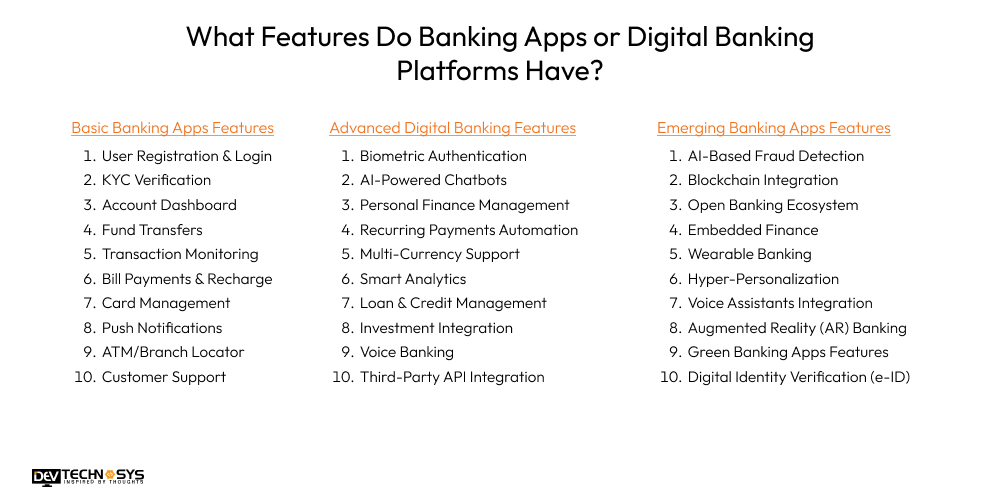
1. Basic Banking Apps Features
We are going to discuss the core, essential banking app features that form its foundation. These basic app features smooth the day-to-day banking operations. Here is the list of key features of a banking mobile app.
i. User Registration & Login
Allow users to log in and get registered to start using the banking app. People can get registered using email, mobile number, or other credentials. For more security, the login process also includes OTP or biometric verification.
ii. KYC Verification
KYC or Know Your Customer verification confirms a customer’s identity by accessing their ID proof or biometrics. This way, banks can easily comply with the regulations and even stop fraud while allowing safe onboarding of customers.
iii. Account Dashboard
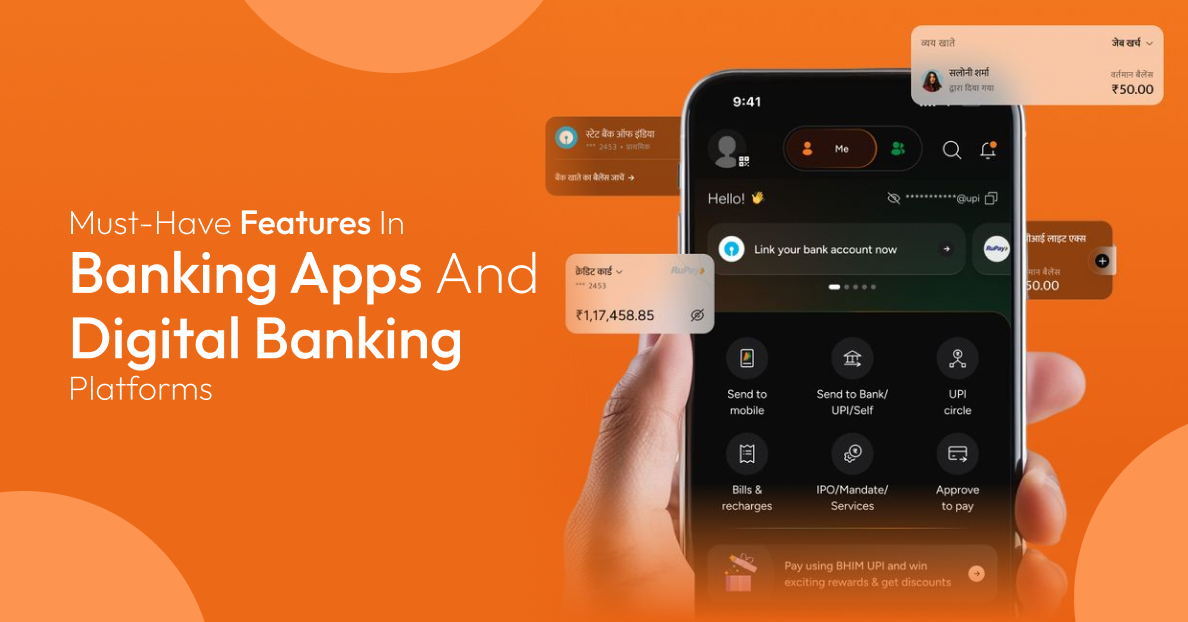
The banking app development services also add an account dashboard feature where customers can monitor their finances. Here, users can view their account balance, recent transactions, financial summaries, and access banking services in one place.
iv. Fund Transfers
Another basic banking app functionality, fund transfer, enables users to send and receive money instantly. For this, people use modes like NEFT, RTGS, IMPS, or UPI. It brings the convenience of making seamless and secure digital payments anytime, anywhere.
v. Transaction Monitoring
To allow users to access their previous transactions like payments, transfers, and deposits, the transaction history feature is added. Through this features, customers can track their spending, manage finances efficiently, and maintain transparency.
vi. Bill Payments & Recharge
Banking app features have made utility bill payments, like electricity, water, etc., and mobile recharge easier and more direct. It helps in reducing the manual efforts of standing in long queues by giving timely reminders for bill payments.
vii. Card Management
Card management is an essential feature integrated when businesses create a mobile app for banking services. It lets users control debit or credit cards by blocking or unblocking, setting spending limits, and managing usage preferences.
viii. Push Notifications
Push notifications give timely information to customers about transactions, account activity, and important updates. Real-time payment updates enhance transparency and security awareness. Its main purpose is to keep users updated about their finances.
ix. ATM/Branch Locator
With this feature, users can easily find ATMs or bank branches, utilizing GPS. It helps users with directions and even informs them about working or opening hours and availability. It becomes easier for customers to reach physical banks.
x. Customer Support
Providing customer support 24/7 and resolving issues in less time makes users feel heard. It is an important feature of banking or e-wallet app development. The support can be accessed through chat, email, or call within the app.
2. Advanced Digital Banking Features
The advanced digital banking features highly present users with value-driven enhancements. The advanced features focus on enhancing user engagement and functionality. Have a look at the advanced and essential features for banking app development guide that make your app scale more.
i. Biometric Authentication
With biometric authentication, users can access the banking app using fingerprint or face recognition, rather than passwords or PIN-based methods. This is a great feature to enhance security and offer a more convenient login experience to customers.
ii. AI-Powered Chatbots
To resolve common issues, guide users to navigate the app, and answer queries, banking apps are integrating chatbots. AI in banking industry improves response time and reduces dependence on human agents, while ensuring 24/7 assistance.
iii. Personal Finance Management
This is among the advanced digital banking features where users can track expenses, categorize spending, and set budgets. By offering insight into financial habits, it helps customers in better money management and making informed decisions.
iv. Recurring Payments Automation
The recurring payment automation feature allows users to schedule fixed or monthly payments, removing manual efforts. It ensures timely payments for bills, EMIs, rent, SIP, or subscriptions. It reduces the chances of payment delays and forgetfulness.
v. Multi-Currency Support
With multi-currency support, digital banking platforms let users hold, send, and receive money in various currencies. It is among the useful banking apps features for people in international businesses, ensuring seamless cross-border payments.
vi. Smart Analytics
A hybrid application development company integrates smart analytics and fintech app features into banking apps. It provides an understanding of user behaviour, their spending, and financial trends. With smart analytics, banks provide users with personalized recommendations.
vii. Loan & Credit Management
This feature helps customers apply for loans, check eligibility, track application status, and manage repayments. It makes the borrowing process simple while offering transparency in repayment schedules, credit usage, and managing the loan processes.
viii. Investment Integration
The investment integration feature allows users to invest in mutual funds, stocks, or other financial instruments. Within the app, this feature provides portfolio tracking, real-time updates, and insights. It helps users to expand their wealth efficiently.
ix. Voice Banking
Voice banking is one of the helpful digital banking features where users can perform banking tasks with voice commands. It brings accessibility and convenience in making quick decisions. It enables customers to check their balance and make payments hands-free.
x. Third-Party API Integration
A fintech app development company adds third-party API integration, allowing banking apps to connect with external services. It expands functionality, improves user experience, and enables seamless data exchange across platforms.
3. Emerging Banking Apps Features
Apart from basic and advanced features, there are some emerging features too. The emerging digital banking features focus on innovation, security, and personalization. They are built in an intuitive way to meet ever-evolving market changes and user demand.
i. AI-Based Fraud Detection
Machine learning algorithms are used by AI-based fraud detection, which thoroughly monitors transactions and detects suspicious activity immediately. Such AI development services reduced unauthorized access and financial risks while strengthening the security systems of banks.
ii. Blockchain Integration
Blockchain integration is highly preferred by banks to ensure secure and transparent transactions. Its purpose is to reduce processing time by eliminating intermediaries. It builds user trust by maintaining a decentralized ledger for all financial activities.
iii. Open Banking Ecosystem
With an open banking ecosystem, data can be shared between banks and third-party providers with security through APIs. This online banking feature provides customers with multiple financial services in one place. It improves convenience and innovation in the financial ecosystem.
iv. Embedded Finance
Embedded finance is like integrating financial services into non-banking platforms like food apps, ecommerce, etc. Through this banking app features, customers can access payments, lending, or insurance services without any hassle within the platform.
v. Wearable Banking
As this generation is always ready for something new, wearable banking is truly something exceptional. It enables users to perform transactions and receive notifications through wearable devices like smartwatches. It offers convenience and accessibility for users on the go.
vi. Hyper-Personalization
Hyper-personalization is taking over every industry; there is no chance banking can stay away. It uses AI and data analytics to deliver tailored financial recommendations, offers, and insights. These banking software features understand user behavior to improve user experience.
vii. Voice Assistants Integration
In the coming years, the integration of voice assistants in banking apps will become common. It allows users to interact with banking apps through tools like Alexa or Google Assistant. This integration can make tasks easy by using natural voice commands.
viii. Augmented Reality (AR) Banking
Augmented reality (AR) features in banking upgrade the user experience by presenting them with interactive and visual financial data. Through this, customers can easily locate ATMs, visualize spending, or access services. This makes banking services more engaging and intuitive.
ix. Green Banking Apps Features
Green banking is included in the modern banking app features list that promotes sustainable practices. It tracks carbon footprints, encourages eco-friendly spending, and offers digital statements. It focuses on users to make environmentally conscious financial decisions.
x. Digital Identity Verification (e-ID)
Digital identity verification enables fast and secure user onboarding through electronic IDs. It reduces paperwork, speeds up verification processes, and enhances security by using advanced technologies. The technology it uses includes biometrics and encrypted identity validation systems.

Conclusion
Last but not least, banking features are the foundation of banking applications. These apps scale well because of their feature selection. Deciding on features that a banking app should have is the essential step when you develop a banking website.
We hope the information provided in this blog about the digital banking features helps you understand the essential functionalities. Selecting the right features will build a secure banking app like chase, scalable, and user-friendly banking application.
Frequently Asked Questions
Find answers to the most common questions related to this article.
To build a banking app, the average cost can be estimated from $8,000 to $30,000. The final development budget is determined by the app’s complexity and other factors. These factors include the app’s security, backend, third-party APIs, design, tech stack, and so on.
AI in modern banking apps becomes an essential component that improves user experience, data security, and operational efficiency. It also provides users with services like hyper-personalization, 24/7 customer service, and fraud detection. It strengthens the backend tasks like credit scoring, loan approvals, and regulatory compliance, while reducing cost and risk.
A simple banking app with basic features and an MVP structure has less complexity due to fewer integrations. So, it can be developed within 4 to 6 months. Whereas a highly advanced application has more integrations, increasing the app’s complexity. That’s why it takes 6+ months to get developed.
Banking apps contain a large amount of personal, sensitive data of the users. So, to protect the data, security is really essential in mobile banking platforms. This is necessary to build and maintain customer trust in the application. A highly secured platform prevents financial losses, fraud, breaches, and complies with regulations.
Some of the most essential features of a banking app include:
User Registration & Login
KYC Verification
Transaction History
Biometric Authentication
Multi-Currency Support
Voice Banking
AI-Based Fraud Detection
Open Banking Ecosystem
Hyper-Personalization
Digital Identity Verification (e-ID)
These features not only upgrade the functions of the banking app but also generate user trust and bring ease.