














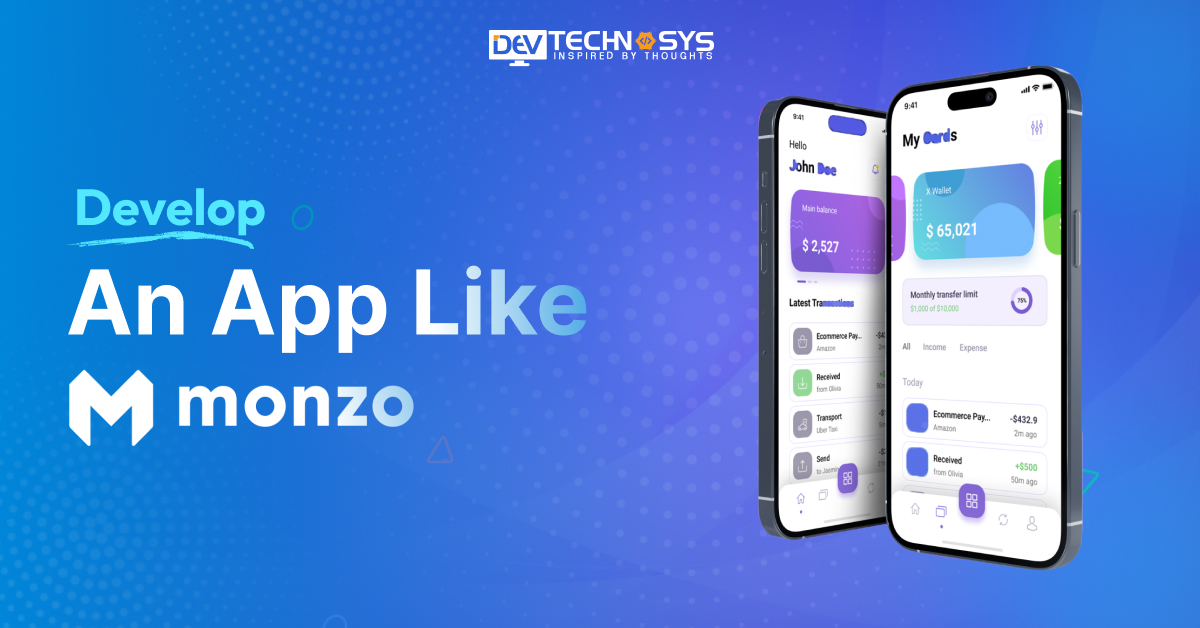
Millions of people throughout the world are managing their finances with an app like Monzo. Digital financial management means no branch visits, no paperwork, and no waiting. Users can check balances, freeze cards, send money, and track spending in just a few taps.
This level of user experience is now the benchmark every new banking app is measured against. As per the recent survey, the global banking applications market was valued at around $1.34 billion in 2024. It is expected to increase to around $4.26 billion by the end of 2032.
The above figures show that investing in banking application development is a massive opportunity for entrepreneurs to expand their business to the next level. In this blog, we provide detailed information about how to develop an app like Monzo, features, cost, money-making strategies, and much more.
Keep Connected!
What is Monzo App?
Monzo is a mobile-only, UK-based digital bank dedicated to making money management simple and transparent. It includes features such as quick spending notifications, smart budgeting tools, savings accounts, and fee-free international shopping.
Apps like Revolut or Monzo allow users to rapidly freeze or unfreeze their cards, obtain real-time analytics, and get 24-hour customer service. Monzo’s slick software and straightforward design give you ultimate control over your funds.
- Instant account setup
- Monthly budget setting
- Biometric login (Face ID, Touch ID)
Market Analysis of Mobile Banking Applications
The mobile banking market is witnessing strong growth in this digital world. This expansion is driven by rising smartphone penetration, digital banking adoption, and increasing consumer preference. We will understand the market analysis according to Straits Research.
- The global mobile banking market was valued at USD 964.41 million in 2024.
- The market size is projected to grow to USD 1077.25 million globally by 2025.
- By 2033, the mobile banking market is expected to reach USD 2610.61 million.
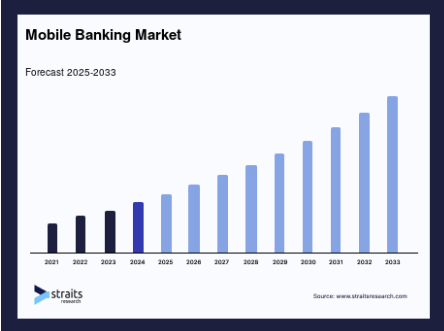
- The market is forecasted to grow at a strong CAGR of 11.7% during 2025 to 2033.
- North America leads the market, while 41% of internet users access financial services via mobile devices.
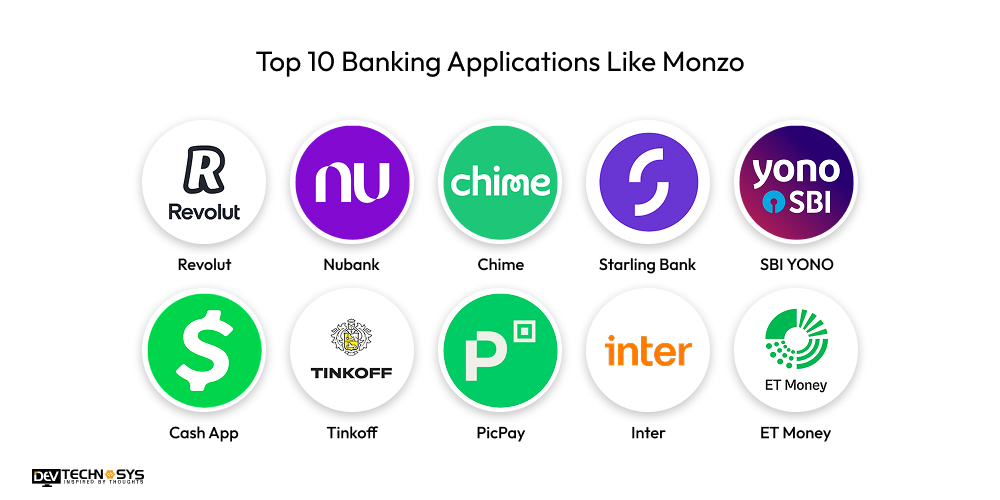
Top 10 Banking Applications Like Monzo
Discover the top 10 digital banking apps like Monzo, offering smart money management, real-time spending insights, seamless payments, and modern financial tools, all in one place.
App Name |
Downloads |
Stores Ratings |
Launch Year |
Platform Availability |
| Revolut | 21M+ | 4.7 | 2015 | iOS, Android |
| Nubank | 50M+ | 4.8 | 2013 | iOS, Android |
| Chime | 14M+ | 4.6 | 2014 | iOS, Android |
| Starling Bank | 2M+ | 4.7 | 2014 | iOS, Android |
| SBI YONO | 50M+ | 3.9 | 2017 | iOS, Android |
| Cash App | 57M+ | 4.6 | 2013 | iOS, Android |
| Tinkoff | 16M+ | 4.8 | 2006 | iOS, Android |
| PicPay | 20M+ | 4.6 | 2012 | iOS, Android |
| Inter | 15M+ | 4.7 | 2015 | iOS, Android |
| ET Money | 5M+ | 4.3 | 2015 | iOS, Android |
Why Businesses Invest in Mobile Banking App Development?
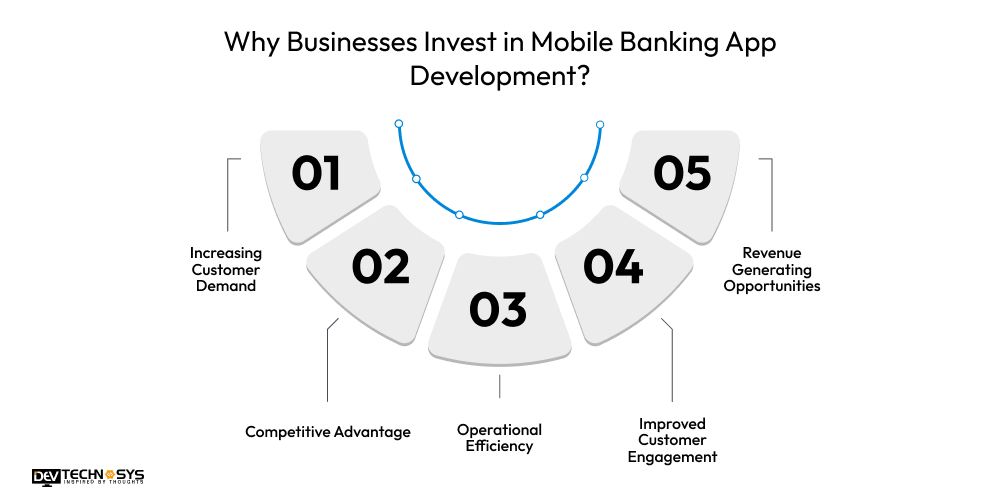
In today’s fast-paced digital economy, mobile banking is no longer a luxury—it’s a requirement. Businesses in the financial and technology industries are spending extensively on mobile banking app development to remain competitive and satisfy changing client expectations. There are five strong reasons why:
1. Increasing Customer Demand
Customers demand banking at their fingertips. As smartphones become the dominant form of internet access, individuals choose mobile applications for everything from checking accounts to making fast transactions. Businesses are reacting to this need by developing intuitive, feature-rich applications that provide ease and real-time financial management.
2. Competitive Advantage
A well-designed Monzo bank app may help a company stand out. Real-time notifications, rapid card locking, spending analytics, and an easy-to-use interface all improve the consumer experience. Apps similar to Monzo, Revolut, and Chime have used mobile-first tactics to threaten traditional banks and attract younger, tech-savvy customers.
3. Operational Efficiency
The banking app development solutions automate a variety of traditional activities, including customer care, KYC, and transaction processing. This lowers the need for physical infrastructure and manual intervention, lowering costs and increasing efficiency. Businesses can service more clients with fewer resources, which improves scalability and profitability.
4. Improved Customer Engagement
Push alerts, tailored analytics, in-app messaging, and loyalty schemes keep users interested. As we discussed earlier with the Monzo app development company, mobile applications provide constant consumer touchpoints, allowing businesses to create connections, enhance engagement, and collect vital behavioral data for future personalization.
5. Revenue Generating Opportunities
The fintech app development solutions provide additional income sources through premium features, subscription models, loan services, and affiliate relationships. Integrated financial services, cross-selling insurance, and investment possibilities within the app offer further development opportunities.
How AI Can Help Banking Applications Like Monzo?
- AI analyzes spending patterns to provide personalized budgeting advice and financial insights, helping users manage money smartly daily.
- Chatbots powered by AI offer instant, 24/7 customer support, resolving queries quickly without needing human intervention, enhancing the user experience.
- AI development detects fraudulent transactions in real-time by analyzing behavior anomalies, protecting users from unauthorized access and financial loss.
- Automated loan and credit risk assessments use AI algorithms, speeding up approval processes while minimizing errors and bias.
- AI-driven predictive analytics forecast cash flow needs and recommend savings strategies, empowering users to reach financial goals efficiently.
Planning a Payment App Project?
Get a tailored development cost estimate in a few simple steps.
- 3 quick steps
- 100% free
- Reply in 1 business day
2 Minutes Read
How Monzo App Delivers Value to Modern Users: Business Model Explained
Understanding the business model is like knowing the target customers, value proposition, and delivery methods. It also explains how the app operates and its structure, services, and market approach. Here we will learn about the business model of a fintech app like Monzo.
1. Digital-Only Banking Approach
Monzo clone app development is entirely operated by a virtual bank that eliminates the requirement for physical branches. It helps in lowering the infrastructure cost and improves the efficiency of mobile banking services. Through a secure app, users can access banking services anytime, anywhere.
2. Partnership-Driven Ecosystem
A mobile banking app development, such as Monzo, offers value by partnering with multiple platforms. It includes collaboration with payment processors, card issuers, a loan management system, fintech providers, and third-party services. This can expand th app’s capabilities, enhance user experience, and deliver seamless digital financial services.
3. Customer-Centric Financial Services
The banking apps are especially designed according to customer needs. It must include simple account setup, instant payments, budgeting tools, real-time notifications, and spending insights. The user-focused approach brings transparency, control, and convenience in P2P lending and cross-border payments.
4. Multi-Service Banking Platform
A money transfer app development like Monzo provides users with multiple bank-related services in a single platform. It includes services like making payments, savings, budgeting, transferring money, managing cards, and digital asset management. This all-in-one experience increases user engagement and improves convenience.
5. Scalable and Compliance-Focused Operations
The business model of a neobank app like Monzo primarily depends on secure and scalable technologies. These technologies support the increasing customer demand while maintaining the app’s performance. Simultaneously, strict compliance with financial regulation and data protection laws builds user trust.
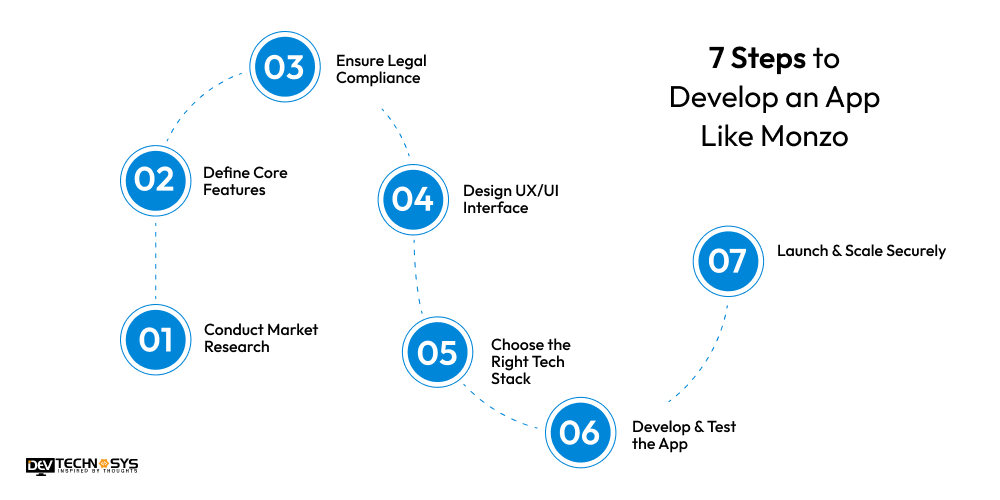
7 Steps to Develop an App Like Monzo
Developing an app like Monzo means creating a secure, user-friendly digital banking platform with real-time spending insights, smart budgeting tools, instant payments, and compliance with financial regulations. So, here we provide the mobile wallet app development process:
1. Conduct Market Research
Start by analyzing the digital banking market, competitors like Monzo, and user expectations. Identify gaps, compliance requirements, and trends. Hire mobile app developers to gather insights into customer pain points, features in demand, and regulatory frameworks. This foundation helps define a strong value proposition and guides your product roadmap before investing in design or development. Monzo also studied common problems users face with traditional banks. It includes issues like hidden fees, slow customer support, and a lack of spending visibility.
2. Define Core Features
List essential features: account creation, instant transactions, spending insights, card controls, savings pots, and security tools. Include must-haves like biometric login, in-app chat support, and real-time notifications. Prioritize MVP features to validate your idea quickly while planning scalable infrastructure for future upgrades and banking functionalities.
After analyzing the users’ problems and validating user demand, Monzo leaves its initial MVP development. It introduces current accounts, savings options, loans, and investment features.
3. Ensure Legal Compliance
Hire a professional mobile app development company to understand financial regulations in your target market—such as PSD2 (Europe), GDPR, and FCA licenses (UK). Partner with legal advisors to obtain necessary banking licenses, ensure data protection, implement KYC/AML policies, and build trust. Compliance is crucial to operate legally and protect users’ data, funds, and privacy from day one.
To work like a fully-regulated bank, Monzo obtained authorization from the Financial Conduct Authority (FCA). It also implemented the strict Know Your Customer (KYC) verification processes during onboarding.
4. Design UX/UI Interface
Create an intuitive, minimalist, and mobile-first user interface. Focus on easy navigation, clear financial visualizations, and delightful micro-interactions. Design wireframes, then build clickable prototypes to validate with users. Accessibility, speed, and consistency across devices enhance user trust and satisfaction. A clean design mirrors the transparency your brand represents.
Monzo is widely known for its simple and user-friendly dashboard. It categorizes spending automatically and displays transactions instantly. It becomes helpful for users in understanding their finances.
5. Choose the Right Tech Stack
Let’s move to the fifth stage of mobile banking application development, select scalable and secure technologies: React Native or Flutter for mobile apps, Node.js or Python for backend, and PostgreSQL for databases. Use APIs for payments, identity verification, and integrations (e.g., Plaid). Build with cloud platforms like AWS or Azure to ensure reliability, uptime, and data encryption compliance.
Online banking platforms like Monzo integrate cloud-based infrastructure and API-driven architectures. It is beneficial to process millions of transactions securely. The right tech stack maintains performance and scalability.
6. Develop & Test the App
Start with the MVP—core banking, authentication, and transaction features. Use Agile methodology for iterative development. Continuously test for security, usability, and performance across devices. Conduct thorough QA, including penetration testing and UAT. Gather feedback, fix bugs, and refine. Ensure all systems are stable before public launch.
Before introducing new features like loans or savings accounts, Monzo tested them with selected user groups. It helps identify bugs, improve user experience, and ensure regulatory compliance before wider deployment.
7. Launch & Scale Securely
In the last stage of banking app development, soft-launch to a limited user base, collect usage data, and iterate fast. Scale gradually with robust customer support. Launch marketing campaigns and referral programs.
Continue compliance audits and implement user-requested features. Invest in user education, proactive support, and performance monitoring to ensure long-term engagement, trust, and app stability.
Monzo initially launched through a waiting-list strategy, which creates demand while collecting user feedback. As adoption increased, the company scaled its infrastructure and introduced premium subscription plans to drive revenue growth.
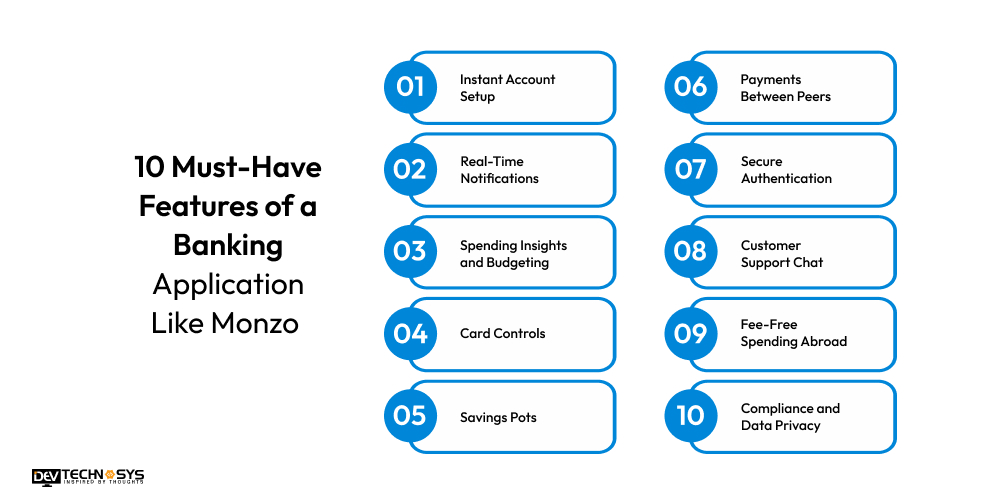
10 Must-Have Features of a Banking Application Like Monzo
Creating a successful bank similar to Monzo requires a combination of security, usability, and innovative features that put users in control of their finances. Here are ten essential features every banking app like Monzo must include:
1. Instant Account Setup
Monzo alternatives allow users to anticipate quick and simple onboarding with minimum paperwork, allowing them to establish accounts in minutes via mobile.
2. Real-Time Notifications
The Monzo cash app offers push alerts for each transaction, enabling customers to track spending instantly, spot fraud early, and stay updated about their account activities.
3. Spending Insights and Budgeting
Automatic expenditure categorization, visual graphs, and monthly budgets enable customers to manage their money more effectively and minimize overspending.
4. Card Controls
The Monzo clone app offers features such as quick card freezing, spending restriction settings, and virtual card creation to improve security and user spending management.
5. Savings Pots
Separate “pots” or sub-accounts empower users to effortlessly save for their objectives, with possibilities for round-ups and scheduled transfers.
6. Payments Between Peers
Seamless, quick transfers to friends and family via phone contacts or app connections improve convenience and social connection.
7. Secure Authentication
Biometric login (Face ID, fingerprint) paired with multi-factor authentication offers the greatest level of security. To integrate this feature in your app, connect to an e-wallet app development company.
8. Customer Support Chat
Monzo alternatives provides quick help and builds trust by offering real-time assistance without needing phone calls.
9. Fee-Free Spending Abroad
Competitive foreign exchange rates and no hidden fees make the app ideal for travelers and international transactions.
10. Compliance and Data Privacy
The Monzo clone app offer strict adherence to financial regulations, data encryption, and transparent privacy policies protect user information and builds confidence.

What Is the Best Tech Stack to Build an App Like Monzo?
Selecting the right tech stack is essential for building a secure and scalable virtual bank like Monzo. A proper tech stack combines technologies of frontend, backend, cloud, database, and security. This combination ensures smooth transactions, regulatory compliance, and an outstanding user experience.
Layer |
Technologies |
| Frontend (iOS) | Swift |
| Frontend (Android) | Kotlin |
| Cross-Platform | Flutter / React Native |
| Backend | Node.js / Python / Java |
| Database | PostgreSQL / MySQL / MongoDB |
| Cloud Infrastructure | AWS / Google Cloud / Microsoft Azure |
| APIs | RESTful APIs / GraphQL |
| Payment Integration | Stripe / Plaid / PayPal APIs |
| Security | OAuth 2.0 / JWT / SSL Encryption / MFA |
| Real-Time Notifications | Firebase Cloud Messaging / Twilio |
| Analytics | Google Analytics / Mixpanel |
| DevOps & CI/CD | Docker / Kubernetes / Jenkins / GitHub Actions |
What is the Cost to Develop an App Like Monzo?
The cost to build an app like Monzo varies greatly depending on features, complexity, and area. Basic banking apps typically cost between $30,000 and $70,000 for MVP versions that include key services such as account registration, transactions, and alerts.
More sophisticated features like real-time analytics, AI-powered insights, security layers, and integrations can cost $1,50,000 or more. Ongoing costs include compliance, maintenance, and upgrades. Choosing skilled developers and scalable technology is critical to long-term success and cost-effectiveness.
| App Version | Features Included | Estimated Cost (USD) |
| Basic Fintech App | User registration, KYC, account dashboard, transfers, transaction history | $30,000 – $60,000 |
| Medium Complexity App | Virtual cards, budgeting tools, notifications, bill payments, analytics | $60,000 – $100,000 |
| Advanced App Like Monzo | AI insights, savings pots, card controls, fraud detection, open banking integrations, and premium accounts | $100,000 – $150,000+ |
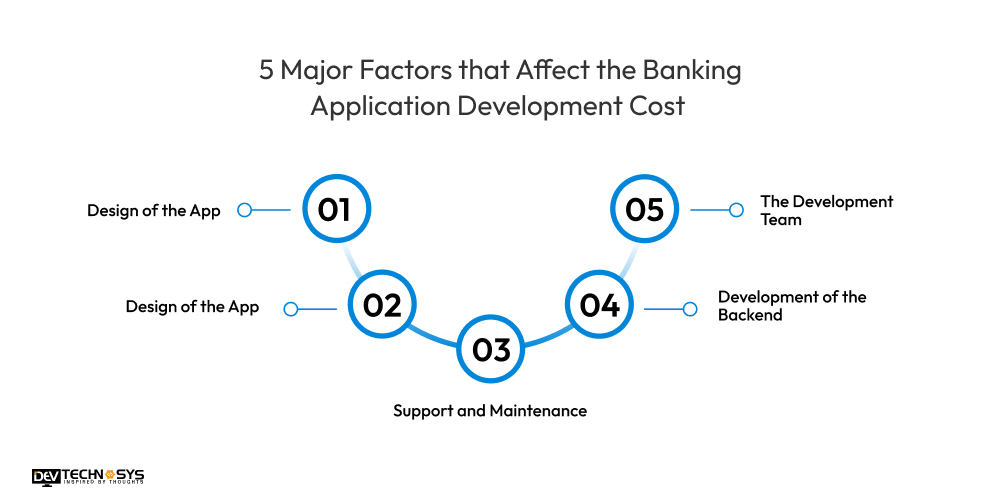
5 Major Factors that Affect the Banking Application Development Cost
Several key factors influence the cost to develop an app like Monzo, including app complexity, number of features, security requirements, platform choice (iOS, Android, or both), design quality, regulatory compliance needs, and developer location. Each element impacts time, resources, and budget, ultimately shaping the overall investment in NFC payment app development.
1. Design of the App
A well-crafted UI/UX design increases user engagement and trust. Custom, intuitive designs with nice animations are more expensive than standard templates. The complexity of displays, interactions, branding components, and responsiveness across devices has a direct impact on design time and mobile banking app development cost.
| Design Type | Description | Estimated Cost (USD) |
| Basic Design | Standard layouts, simple navigation, limited customization | $5,000 – $8,000 |
| Custom UI/UX Design | Personalized user flows, branded interfaces, enhanced usability | $8,000 – $15,000 |
| Premium Banking Design | Advanced animations, micro-interactions, and a highly intuitive user experience | $15,000 – $20,000 |
2. Simple vs Premium Features
Basic features like transactions and balance checks are less expensive, but premium tools like AI-driven insights, biometric security, and multi-currency compatibility need sophisticated development.
Each extra feature requires more time, testing, and resources. Choosing between a basic MVP and a full-featured software has a substantial influence on total Monzo app development cost and future scaling plans.
| Feature Level | Features Included | Estimated Cost (USD) |
| Simple Features | Account creation, transaction history, balance tracking, notifications | $6,500 – $9,000 |
| Moderate Features | Card management, bill payments, budgeting tools, savings goals | $9,000 – $12,000 |
| Premium Features | AI-powered insights, fraud detection, open banking APIs, premium subscriptions | $12,000 – $14,000 |
3. Support and Maintenance
The Monzo mobile app maintenance services include bug fixes, updates, server monitoring, and security patches. Ongoing maintenance guarantees the app’s reliability and customer satisfaction.
These recurrent expenditures, which are typically 15-20% of the original budget every year, are required to maintain the app functioning, safe, and competitive in response to user feedback and regulatory changes.
| Maintenance Level | Services Included | Estimated Cost (USD) |
| Basic Support | Bug fixes, security patches, performance monitoring | $2,500 – $3,500 |
| Standard Maintenance | Regular updates, feature enhancements, and server monitoring | $3,500 – $5,000 |
| Premium Maintenance | 24/7 support, advanced security monitoring, continuous optimization | $5,000 – $6,000 |
4. Development of the Backend
Backend infrastructure drives all user actions, including login, payments, alerts, and data storage. Building a safe, scalable, and compliant backend using APIs, encryption, and cloud integration necessitates specific skills.
Backend systems that are more robust and configurable take longer and raise Monzo app development cost, especially when it comes to providing real-time performance and regulatory data protection standards.
| Backend Complexity | Description | Estimated Cost (USD) |
| Basic Backend | User management, account storage, basic APIs | $10,000 – $15,000 |
| Medium Backend | Payment gateways, transaction processing, third-party integrations | $15,000 – $20,000 |
| Advanced Backend | Real-time banking operations, fraud detection, scalable cloud architecture | $20,000 – $25,000 |
5. The Development Team
The location, experience, and structure of the team all have a significant impact on expenses. Hiring an in-house staff, freelancers, or outsourcing to agencies results in differing price structures.
Developers in North America and Europe charge more than those in Asia. Senior-level personnel may be more cost to fintech app development, but it assures higher quality, faster delivery, and scalable architectural decisions.
| Team Type | Team Composition | Estimated Cost (USD) |
| Small Team | UI/UX Designer, 1-2 Developers, QA Engineer | $12,000 – $16,000 |
| Mid-Sized Team | Project Manager, Designers, Frontend & Backend Developers, QA Team | $16,000 – $21,000 |
| Dedicated Fintech Team | Senior Developers, Security Experts, DevOps Engineers, QA Specialists | $21,000 – $25,000 |

What Are the Revenue-Generating Methods of Banking Application like Monzo?
Many banking apps like Monzo provide free, user-friendly banking services. They also deploy sophisticated monetization tactics to make a money transfer app profitable and sustainable. Here are the important ways through which a banking app makes recurring revenue.
1. Interchange Fees
Every time a user pays with their Monzo card, the retailer pays a tiny interchange charge. A percentage of this cost is paid to the card’s issuing bank. With an increasing user base making regular, real-time payments, interchange fees become a reliable source of income.
2. Loan Services
Apps like Monzo generate money by giving loans and overdrafts. Users are charged interest when they borrow money through planned overdrafts or personal loans. The interest rates are competitive, but the number of borrowers makes this a significant revenue source.
3. Foreign Exchange and ATM Fees
While most customers enjoy fee-free international spending, fintech app development solutions like Monzo charge fees. This fees are for high-volume cash withdrawals or currency conversions that exceed predetermined restrictions. These fees are tiny, but they contribute to income streams.
4. Subscription Plans
A Monzo alternative app offers premium services through the Monzo Plus and Monzo Premium programs. Subscription-based financial services include premium facilities like virtual cards, insurance, higher savings, lower interest rates, and credit monitoring.
5. Marketplaces and Partnerships
Monzo’s in-app marketplace connects third-party services such as insurance providers, energy companies, and investment platforms. As customers sign up for these services, the firm receives referral fees or commissions, generating revenue without direct product ownership.
Challenges That Appear During FinTech App Development
A mobile banking app like Monzo handles users’ sensitive financial data, digital payments, banking credentials, and real-time transactions. Due to this, fintech app development has to face multiple challenges that we will discuss now.
1. Increasing Cyberattacks
When you build an app like PayPal or Monzo, the biggest concern remains cyberattacks. It includes phishing, ransomware, malware, account takeovers, and API-based attacks. This can harm the highly valuable financial information at a higher level.
2. Data Privacy Risks
Users can go through data privacy risks if the app lacks proper protection and security measures. It can harm customer records, transaction monitoring, and payment details severely. This can lead to financial losses, legal complications, and a decrease in user trust.
3. Lack of Authentication
When there is poor authentication, the fintech apps can get unauthorized access, credentials theft, and other fraud. It can affect the user’s trust in the app, as financial security is a primary concern.
4. Compliance Challenges
Businesses in the Fintech industry have to meet strict legal and security standards. It includes PCI DSS compliance, GDPR, Know Your Customer, and Anti-Money Laundering. Throughout the development, regulatory compliance remains a constant challenge.
5. Service Disruption
Cyber-related incidents can disturb essential banking operations, such as transaction delays and reduced app availability. It develops a bad user experience that damages the reputation of the app. Also, it leads to operational losses and less trust in the fintech platform.
Case Study: UABPay
We have developed UABPay, a feature-rich digital payment platform at Dev Technosys. It is beneficial for users to manage their finances, make secure transactions, and perform everyday payment activities. The app’s features include paying bills, transferring money, recharging mobile accounts, managing virtual wallets, and tracking spending patterns.
The initial development cost was determined at $70,000. However, advanced architecture, optimized performance, and robust security measures increased the development expenses.
Challenge Faced: We have to maintain the app’s performance to handle large traffic. This had to be done while keeping security, simplifying user onboarding and identity verification, and creating an intuitive interface.
Project Highlight
- Project Name – UABPay
- About Client – Gary Chen
- Industry – Fintech / Digital Payments
- Client Location – Canada
- Development Timeline – 34 Weeks
- Team Size – 6 Professionals
- Platform Type – Mobile Payment & Digital Wallet Application
Conclusion
In conclusion, develop a mobile banking app like monzo requires a clear strategy, robust technology, strong security, and full regulatory compliance. From intuitive design and smart budgeting tools to real-time notifications and seamless payments, each feature must enhance the user experience.
Choosing the right mobile banking app development company is crucial to turn your vision into a secure, scalable, and user-centric product. With expert guidance, you can create a modern banking solution that meets customer needs and stands out in a competitive fintech market. Start building the future of banking today.
Frequently Asked Questions
Find answers to the most common questions related to this article.
The cost to build an app like Monzo ranges from $8,000 to $25,000, depending on features, design complexity, compliance needs, and the mobile banking app development company’s location and expertise.
To create an app like Monzo usually takes 3 to 6months, depending on app complexity, feature set, compliance requirements, and team size involved in the mobile banking app development process.
Technologies used to make an app like Monzo include React Native or Flutter for mobile, Node.js or Python for backend, PostgreSQL for databases, AWS for cloud, and banking APIs for integrations.
Yes, you need a banking license if you're managing customer funds directly. Alternatively, you can partner with a licensed bank or use Banking-as-a-Service (BaaS) providers to operate legally and compliantly.
Yes, you can integrate third-party services like insurance and investments via APIs. This expands your app’s offerings, enhances user experience, and creates additional revenue streams through partnerships and referral commissions.