











Key Takeaways:
- According to McKinsey & Company, around 78% of organizations report using AI in at least one business function, reflecting rapid enterprise adoption.
- AI in SaaS development performs various advanced operations, such as analysis of requirements, design of software, generating code, quality assurance & testing, customer support integration, project management support, and security improvement.
- AI integration enables scalable growth without proportionally increasing operational resources or workforce requirements.
- AI automation in SaaS can improve employee productivity by 20-40%, depending on workflow complexity and implementation maturity.
The SaaS industry has experienced sweeping change due to artificial intelligence (AI), changing how software is conceived, built, deployed, supported, and improved through CRM.
According to research from Gartner, the total amount of money used to purchase AI-based software worldwide is projected to increase from $35 Billion in 2026 to nearly $298 Billion by the year 2027. The increase in demand for automation, predictive analytics, and intelligent business applications from enterprises will continue to be the driving force behind this growth.
To be able to provide more efficient, personalized experiences to users, AI has become a foundational piece of any modern SaaS product development effort.
AI enables SaaS vendors to leverage advanced technologies to provide more intelligent, innovative, and scalable solutions.
Those businesses that have successfully implemented AI in SaaS development will be positioned to achieve substantial competitive advantages in the form of improvements in productivity, customer satisfaction, and ultimately innovative product offerings in 2026 and beyond.
The State of AI in SaaS: Numbers That Prove Why This Matters Now
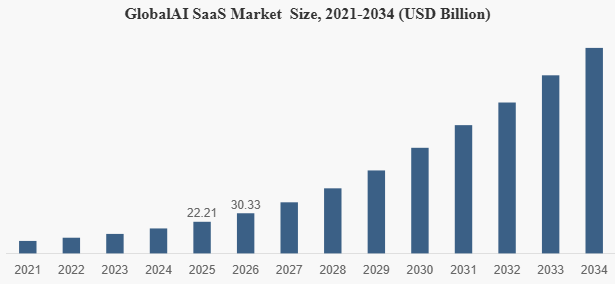
- According to Fortune Business Insights, the worldwide AI-based SaaS products market size was valued at around $30.33 billion in 2026, and it is projected to grow to around $367.6 billion by the end of 2035.
- As per the cloud type, the public cloud deployment accounts hold the highest market revenue share, around 46%, in the SaaS market.
- Look at the region-wise, North America holds 38% market revenue share in 2026, which is expected to increase in the upcoming years.
- Business type, the small and mid-sized enterprises are large revene holding businesses around 42% in 2026.
- By industry, BFSI is named as one of the most data-intensive sectors and records a revenue share of around 22% in 2026.
What is AI in SaaS Development?
Artificial intelligence for saas development is using AI (automated intelligence) in saas to create smarter, more automated, more data-driven products. Using AI-powered SaaS applications makes it possible to have predictive analytics, personalization, chatbots, recommendation engines & workflow automation, used within saas platforms.
It provides a better user experience, decreases manual effort on the part of users, and improves the ability to make real-time business decisions. By 2026, AI-enhanced saas applications will integrate autonomously managed workflows, self-updating systems, and industry-specific solutions within a single application solution that is efficiently scalable.
Layer 1: AI in the Development Process
Internal company applications of Artificial Intelligence to enhance & improve the speed and efficiency of SaaS application development through its support of developers performing coding, testing, and debugging tasks, documenting their work, and designing applications. AI is not likely to be seen by the end customer, as the AI tools are used to reduce overall costs and improve the quality of products produced.
Layer 2: AI as a SaaS Feature
The inclusion of Artificial Intelligence (AI) functionality in the SaaS solution enhances the user experience by providing users the ability to utilize any of the AI capabilities, including chatbots, recommendation engines, content-creation tools, or analytics, in addition to their usual usage of the SaaS product. While the SaaS solution can still be used without the addition of the AI functionality, using the AI functionality provides significantly greater value.
Layer 3: AI-Native SaaS Architecture
The entire AI SaaS solution is built on top of an AI platform designed to provide AI as the primary functionality, intelligence, and operational workflow. Removing the AI from the SaaS solution would remove the primary value and usefulness of the SaaS solution. Examples of fully AI-Native SaaS solutions include Autonomous Agents, AI Research Assistants, and AI-First Business Automation Solutions.
Layer |
AI Role |
Who Uses It? |
Example |
| Layer 1 | Development tool | Internal team | AI coding assistant |
| Layer 2 | Product feature | End users | AI chatbot in SaaS |
| Layer 3 | Core product engine | End users | AI agent platform |
Industry Insights: As per McKinsey & Company, more than 80% of SaaS leaders expect AI capabilities to become a core product differentiator in the coming years.
AI’s Role in the SaaS Development Process
AI in SaaS development is created by improving speed, accuracy, and innovation across all stages of development, analysis of requirements, analysis of market viability, design, testing of software, development of code, security, project management, customer service and support, personalized user experience, and analytics. Development teams can deliver higher-quality, more scalable, and user-focused SaaS products.
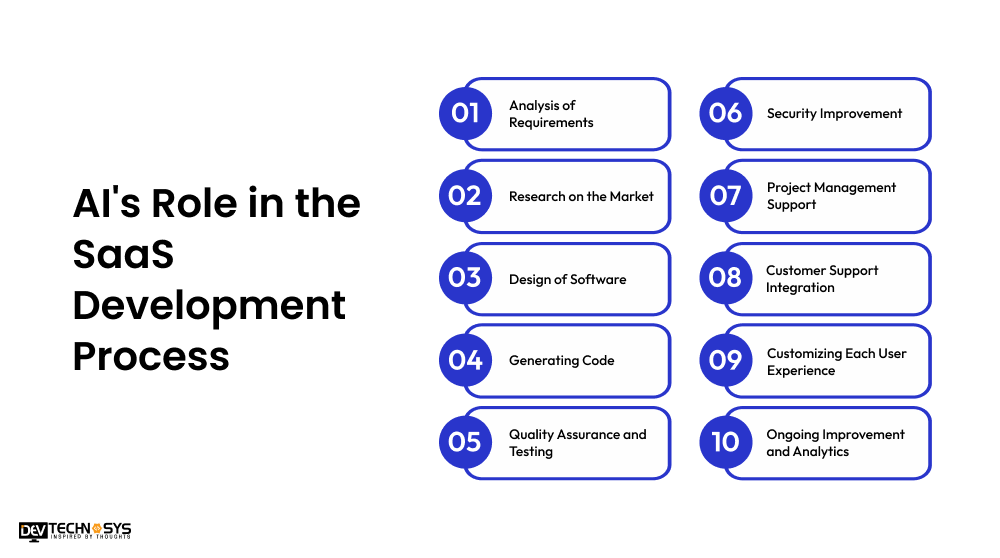
1. Analysis of Requirements
By leveraging AI consulting services, teams can analyze their customers’ needs, feedback, and market trends in order to clarify the required features for a product development process. AI systems can analyze several terabytes of data to identify patterns and prioritize features, which minimizes guesswork for SaaS developers. This way, developers can create features that are more aligned with end-users’ needs and broader business objectives.
2. Research on the Market
SaaS companies utilize AI-powered tools to gather and analyze data on competitors, their customers, and their industries. This helps them better make choices about where to position their products, what features to put into their products, and what customers want.
Being able to obtain insights faster increases the chances of finding opportunities, minimizes the risk of making poor decisions, and enables companies to remain competitive in high-speed market changes.
3. Design of Software
AI in SaaS development helps design systems (architecture), structure databases, and propose design ideas for user interfaces. AI helps develop best practices for system design while also identifying possible weaknesses in a design before developers start executing it.
AI benefits will be seen in the overall success of future SaaS projects through improved scalability, improved performance and usability of all products, and improved efficiency/time spent on SaaS system(s) during the planning and design stages.
4. Generating Code
AI-assisted coding tools assist developers in writing, reviewing, and optimizing the source code for applications. Additionally, these tools assist developers in generating reusable code snippets, improving existing code, and eliminating repetitive coding tasks. AI tools increase productivity, decrease time to market with software, and enable developers to concentrate on addressing complex business and technical challenges.
5. Quality Assurance and Testing
Automated test case creation, bug detection, and performance testing are performed with the use of AI technologies that can also monitor applications for quality and identify issues that would be hard to identify using a manual testing method. As a result of this continuous monitoring, software release cycles are shorter, the reliability of the software is higher, and customers using SaaS will have an improved experience.
6. Security Improvement
AI in SaaS development will improve the security of SaaS applications by detecting irregular activity within the system, identifying areas that may be compromised, and automatically responding to possible threats in real time.
AI helps developers in creating more robust built-in security into the development process, along with lowering the risk of being attacked. Because of the use of continuous monitoring systems, applications will remain secure from ever-evolving cyber threats and attacks.
7. Project Management Support
AI-driven SaaS platforms help in project management through the estimation of how long a project will take to complete, closely monitoring the progress of a project, and utilizing resources in a productive and efficient manner.
By analyzing project data, AI can also predict possible delays and provide suggestions for actions that may remedy the situation. This enhances team collaboration, improves productivity, and increases the chance for SaaS projects to be completed in a timely manner.
8. Customer Support Integration
The use of AI-powered chatbots, virtual assistants, etc., provides customers with instant customer service, answers to common questions, and resolves issues quickly and automatically. Providing instant assistance lowers the cost of customer support and reduces customer response time. Additionally, by allowing customers to have the ability to assist themselves, human support staff can focus their efforts on complex requests.
9. Customizing Each User Experience
Artificial intelligence in SaaS development will evaluate how users interact with the service and their likes and dislikes in order to provide tailored suggestions, content, and features. This offers users a more enriching and enjoyable experience, resulting in increased customer loyalty. These customized interactions enable SaaS companies to have better connections with their users, resulting in higher levels of overall user satisfaction.
10. Ongoing Improvement and Analytics
AI for SaaS businesses consistently checks how applications are performing, collecting and analyzing user feedback, operational data, and other metrics. From this, AI creates data that allows teams to enhance their services, optimize performance, and make informed decisions. Because of this constant evaluation, intelligent SaaS solutions will continue to evolve to be competitive, relevant, and aligned with the emerging needs of their customers.
Industry-Specific Use Cases: How AI in SaaS Plays Out by Vertical
Artificial intelligence in SaaS development are changing the way many different industries operate. They allow for the AI automation of multiple processes, improved decision-making, and enhanced customer experience. AI is benefiting companies in areas such as HR, financial services, health care, education, marketing, and development operations by increasing operational efficiency and reducing costs.
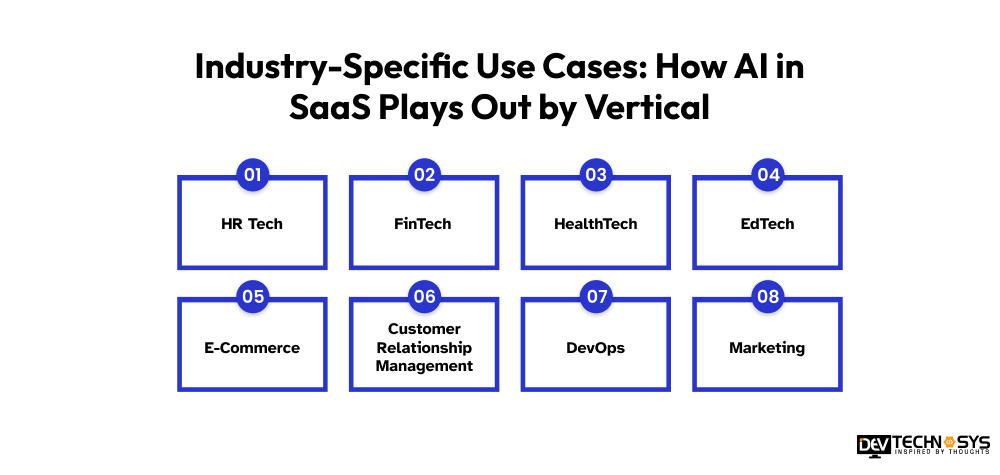
1. HR Tech
AI is transforming HR technology through automated candidate screening, predicting employee turnover, and optimizing employee schedules. AI also analyzes resumes, performance, and engagement, ultimately helping companies hire faster and keep top employees. With these capabilities, hiring time can be reduced by as much as 60%, while also improving the quality of candidates hired.
2. FinTech
AI is changing the face of the FinTech sector through fraud detection, automating compliance and regulatory requirements, and assessing risk. Machine learning in SaaS continuously analyzes transactions for suspicious behaviors, allowing financial institutions to cut back on fraud losses, to be compliant with regulatory requirements, and to make quicker and more accurate lending decisions.
3. HealthTech
Artificial intelligence in SaaS development is helping transform the healthcare industry by supporting diagnostics, automating the patient journey, and streamlining administrative processes. AI is also assisting medical practitioners by analyzing patient health records and offering potential diagnoses earlier.
By automating scheduling, documentation, and patient care communication, AI is removing administrative burden from healthcare providers, allowing them to spend more time delivering quality care to patients.
4. EdTech
AI is improving educational technology by creating personalized learning experiences and developing intelligent tutors. AI measures student learning performance and can provide personalized content to meet the specific needs of each student.
As per the discussion with the Generative AI development company, This level of personalization increases student engagement, promotes better learning outcomes, and helps educational providers effectively increase quality instruction at scale.
5. E-Commerce
Artificial intelligence (AI) is driving e-commerce growth through personalized product recommendations, optimized pricing strategies, and sentiment analysis of customer purchasing behavior. By gaining insights from previous purchases and customers’ preferences, e-commerce businesses can deliver the right products at the best prices. These capabilities lead to increased customer satisfaction, increased conversion rates, and frequently result in a substantial increase in average order value.
6. Customer Relationship Management
In CRM and sales, AI improves lead scoring capability, sales forecasting, and automated outreach. AI can identify high-profile prospects by using historical data and predict the behaviors of potential purchasers. As a result, sales teams can focus on higher-potential opportunities, resulting in higher conversion rates and greater revenue growth.
7. DevOps
In the area of DevOps, cloud-based AI solutions enhance the ability to monitor system performance through the detection of anomalies and automating the efficient response to incidents. By consistently monitoring the performance of the IT Infrastructure and continuously analyzing it, AI solutions are able to identify issues before they develop into wider problems or incidents.
8. Marketing
AI is transforming marketing by enabling the automation of content creation, campaign optimization, and the identification of signals of intent from customers. By analyzing the behavior of target audiences, AI solutions provide businesses with the ability to create targeted messaging for all marketing campaigns. Businesses benefit from data-driven decisions that increase the engagement rate with customers.
The Real Challenges: What Nobody Tells You About AI in SaaS
SaaS companies must consider that while AI has the potential to create tremendous value for their business, the challenges associated with implementing AI will include: cost, accuracy, shortage of talent and skilled resources, data privacy, information bias, security issues, and governance concerns.
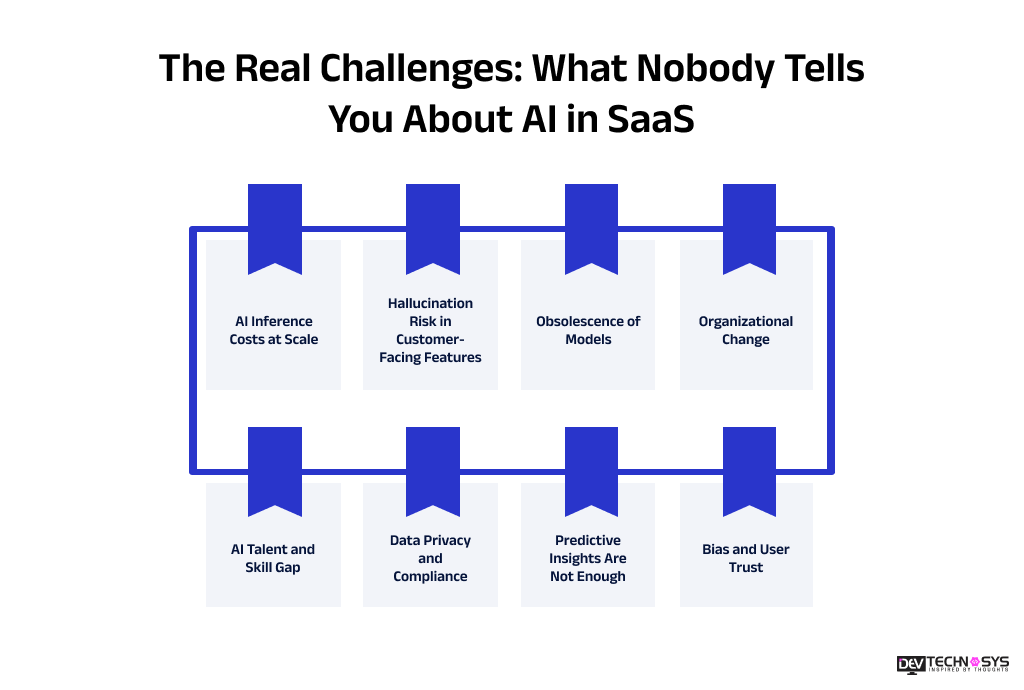
1. AI Inference Costs at Scale
When users begin utilizing an AI-powered SaaS platform, the usage of large language models requires resources that may easily overwhelm computing resources. As usage increases, the company incurs ever-increasing costs for each inference generated by its models. This increasing cost has an adverse impact on profit margin. To ensure sustainable growth, the company needs to optimize its usage of the models.
2. Hallucination Risk in Customer-Facing Features
A common occurrence and failure of AI models generating content is the generation of incorrect, misleading, or fabricated information, which is called a hallucination. This kind of failure to generate accurate content creates a lack of credibility and trust with end users in customer-facing applications. SaaS providers reduce this risk through human oversight, retrieval-augmented generation, and employing fact-checking systems.
3. Obsolescence of Models
With the rapid evolution of the AI landscape, there are frequently new models and capabilities that provide companies with new options for their businesses. The models that are integrated into a SaaS product today may become obsolete within months. Companies need to continuously evaluate developments in AI and update their AI infrastructure, as well as update their features to remain competitive.
4. Organizational Change
As a result of the rapid change in how companies conduct their business with SaaS powered AI, in particular in the areas of engineering, customer success, sales, and support, many of these companies have undergone an organizational transformation and have restructured various key roles and workflows. It is incumbent upon Company leaders to carefully lead their organizations through this process of organizational change.
5. AI Talent and Skill Gap
In many instances, SaaS companies experience an undersupply of qualified professionals with experience in AI technologies, including machine learning engineers, data scientists, and AI architects.
The challenge of supplying the above-mentioned qualified professionals is a limiting factor in designing, implementing, and maintaining advanced AI solutions. Many organizations are subsequently required to invest in either training current employees, strategically hiring, or creating partnerships with external organizations.

6. Data Privacy and Compliance
AI personalization requires the use of user information. This has created compliance obligations stemming from laws such as the General Data Protection Regulation (GDPR), California Consumer Privacy Act (CCPA), and SOC 2. As such, SaaS businesses must have appropriate privacy policies that govern how data is collected, used, and stored, as well as mandated security protocols to protect data and provide voluntary disclosure of users’ consent.
7. Predictive Insights Are Not Enough
While AI can accurately predict issues such as customer churn or purchasing habits and operational risk, simply having a prediction does not guarantee a favorable outcome. Organizations need to supplement their predictive analytics in SaaS with sound strategies and timely actions that will yield value from their predictions.
8. Bias and User Trust
Artificial intelligence in SaaS development utilizes data to develop AI algorithms that make predictive recommendations and provide a means to support various processes in businesses today. Many times, the historical data is biased, and thus the recommendations made may inadvertently favor one group over another. As a result, organizations should take steps to establish processes for identifying and mitigating bias as a means to ensure that their AI products are fair.
Planning a Mobile App?
Get a tailored development cost estimate in 3 simple steps — app basics, features, timeline, and your contact details.
- 3 quick steps
- 100% free
- Reply in 1 business day
2 Minutes Read
How to Integrate AI Into Your SaaS: A Practical Roadmap
To incorporate AI integration in SaaS, develop a logical and actionable roadmap: Identify which workflows will have the greatest impact. Identify whether to create SaaS applications. Establish a strong data infrastructure, and begin with a small number of users and a phased approach. To enable your AI solution to enhance performance, user experience, and business results over time.
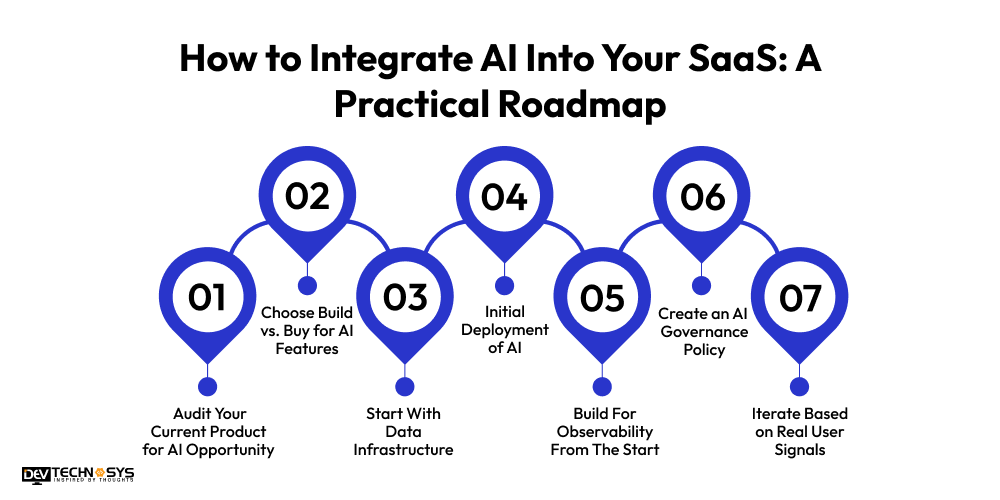
1. Audit Your Current Product for AI Opportunity
Begin by mapping out all the significant user workflows in your SaaS offering. Find areas of repetitive tasks or decision-making processes, as well as various points where customers experience friction. Once the map is complete, focus on identifying the three ways you could use AI to either save time and improve accuracy or to offer customers new value. Your emphasis should be placed on how to solve real customer problems, not to add AI for the sake of adding AI.
2. Choose Build vs. Buy for AI Features
Determine if AI development will take place internally or if third-party solutions will be integrated into your service. Build your own AI for those situations where it provides a unique competitive edge or utilizes proprietary data. Use or integrate existing AI solutions to support operational functions such as customer support, onboarding, data analytics, and content assistance.
3. Start With Data Infrastructure
Reliable and well-structured data are critical to the success of any AI system you deploy. Ensure that your data processes are mature before implementing language models and predictive models, as high-quality data improves the performance of your AI models, reduces error rates, and prepares you to scale in the future. The quality of your underlying data infrastructure is often more important than the type of AI model you use.
4. Initial Deployment of AI
Don’t deploy AI features for all customers right away. Only deploy to a small group of users, and run controlled tests to monitor how well the product is performing. Retention, engagement, customer satisfaction, and the adoption of your feature need to be measured. Early tests will uncover bugs and help you validate your assumptions and reduce risk before going live with your AI software.
5. Build For Observability From The Start
Your monitoring system must be in place prior to the AI product launch. This includes tracking how people interact with the product, tracking the output of the model through various metrics like latency, and tracking your operational costs associated with running your AI models. Monitoring these parameters early will allow you to effectively detect model drift, unexpected behaviors, and performance degradation as you scale the use of your AI product.
6. Create an AI Governance Policy
Create clear rules around how your AI systems operate, what decisions they make, and when human intervention is required. Governance also needs to include security, privacy, fairness, compliance, accountability, and ethical considerations. According to the AI development companies, clearly defined AI governance policies help minimize risk by establishing how your organization will use AI while ensuring that AI remains in alignment with governing laws and regulations.
7. Iterate Based on Real User Signals
Implementing AI is a continual effort rather than a one-off project; therefore, you will want to continually look at product usage data and use this information to improve the way users experience your applications through changes in prompts, models, workflows, and other parts of your application. Continuous updates/iterations help you adapt your AI-based solution to changing customer and organizational needs over time.
Conclusion
To sum up, artificial intelligence (AI) has become an essential component of all Software-as-a-Service (SaaS) products today and will remain so in the future. There are three layers of AI: one that assists the development process; one that is embedded within products as a feature; and finally, one that comprises entirely new AI-native architectures. The biggest strategic challenge facing SaaS execs by 2026 will be figuring out whether to enhance their current SaaS offerings with AI features or to develop new SaaS applications from a SaaS application development company, totally built on an AI platform.
Frequently Asked Questions
Find answers to the most common questions related to this article.
Artificial Intelligence (AI) is utilized in many areas of a software as a service (SaaS) business, including automating workflows, personalizing the user experience, aiding with decision making, and improving overall productivity for the business. AI also provides functions such as predictive analytics, intelligent recommendations, chatbots, and AI-powered automation. Thus, allowing companies to create smarter products while reducing their operational costs and maximizing customer satisfaction.
Artificial Intelligence will continue to change how businesses offer SaaS solutions by 2026 through enhanced automation, real-time data processing, predictive insights, and the ability to perform tasks autonomously. The use of AI will enable companies to have AI-based training and to use AI to automate the workflows of employees, enable faster decision-making processes, facilitate a more intuitive user experience for customers, reduce manual effort, and improve overall productivity in the customer experience.
AI native software as a service (AI Native SaaS) is considered the next generation of SaaS solutions because its foundation was built around using AI as the core component of its product; therefore, AI is central to the product experience. AI-enabled (traditional SaaS) have also added AI functionality to their respective traditional software solutions, but are architecturally different than the AI Native SaaS solutions.
SaaS businesses can leverage AI to better analyze their users and find out which of their customers are most likely to leave by looking at their usage stats, how engaged they are, and their customer support interactions. By using predictive models to help determine which customers will leave early. Companies are able to implement proactive retention solutions like customized recommendations, targeted support, and automated customer success programs in advance of losing those customers.
In the SaaS ecosystem, agentic AI systems are autonomous software agents that can plan, reason, and perform tasks with limited human assistance. They can automate complicated workflows, oversee repeating workflow activities, align actions across various applications, and assist individuals in achieving their goals with increased productivity.
The cost of implementing AI technology into your SaaS application will depend on the level of complexity, the amount of data required, and the types of models chosen. For example, implementing simple AI integrations can be done for only a couple of thousand dollars. However, implementing highly sophisticated custom-built solutions with machine learning capability, intelligent workflow automation, or hosting infrastructure can cost your company anywhere from tens of thousands to hundreds of thousands of dollars.