







Key takeaways:
-
- The global autonomous AI agents market is valued between $7.5 billion and $11.8 billion and is projected to skyrocket to $180-$250 billion by 2033 to 2034.
- Autonomous AI agents operate within a layered architecture including smart contracts, multi-agent systems DeFi, autonomous execution, layer 2 scaling, and real-world data sources.
- Failures in autonomous AI agents can disrupt blockchain systems, leading to incorrect decisions, security risks, and cascading protocol failures.
- Autonomous AI agents blockchain can automatically execute smart contracts when predefined conditions are met.
Ever wondered how fun it’d be if your crypto wallets started making smart financial decisions by themselves? Or if a blockchain could negotiate, trade, and do transactions without manual input? It’s not a far-fetched dream but a groundbreaking reality of today’s blockchain industry. Decentralized AI agents have transformed the blockchain world, presenting endless opportunities like automated trading, AI in DeFi management, supply chain optimization, and DAO governance.
However, great innovations like automated AI agents come with bigger challenges regarding security, accountability, and regulation. In this blog, we will dissect every crucial aspect of autonomous AI agents in blockchain. From their functionality to real-world application, from potential risks to future opportunities, let’s explore this revolutionary technology.
What Are Autonomous AI Agents?
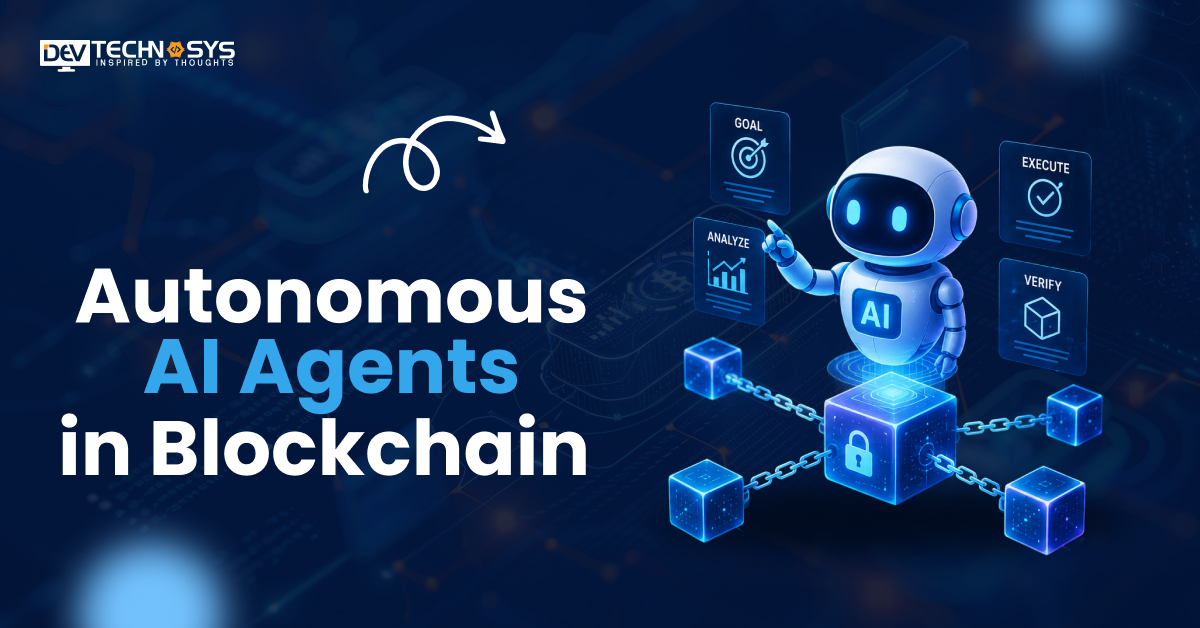
Autonomous AI agents are intelligent software systems that can analyze information, make smart decisions, and multitask with minimal to no human input. Where traditional AI models often respond only to prompts, automated AI agents independently observe their environment, create action plans, utilize APIs and databases, perform tasks, and constantly adapt to the outcomes.
The ability of automation, smart contracts, using external tools, and refining real-time decisions makes tokenized AI agents a powerful tool for blockchain, DeFi, automation, and enterprise apps.
How AI Agents Differ from Traditional Bots?
AI agents are intelligent, adaptive systems that evolve with data and market changes. Traditional bots are rule-based tools that execute predefined actions without learning or adaptation.
Aspect |
AI Agents |
Traditional Bots |
| Decision Making | Learn from data and adapt to market conditions in real time. | Follow fixed, pre-programmed rules without learning ability. |
| Flexibility | Can handle multiple tasks like DeFi, trading, and governance. | Limited to specific, single-purpose trading or execution tasks. |
| Improvement | Continuously improve using machine learning and feedback loops. | Static behavior unless manually updated by developers. |
What Is Blockchain’s Role in Autonomous AI Systems?
According to AI agent development experts, Blockchain is the foundation for autonomous AI agents to operate securely, transparently, and independently on multiple decentralized ecosystems. Autonomous AI agents in blockchain eliminate the need for human mediation.
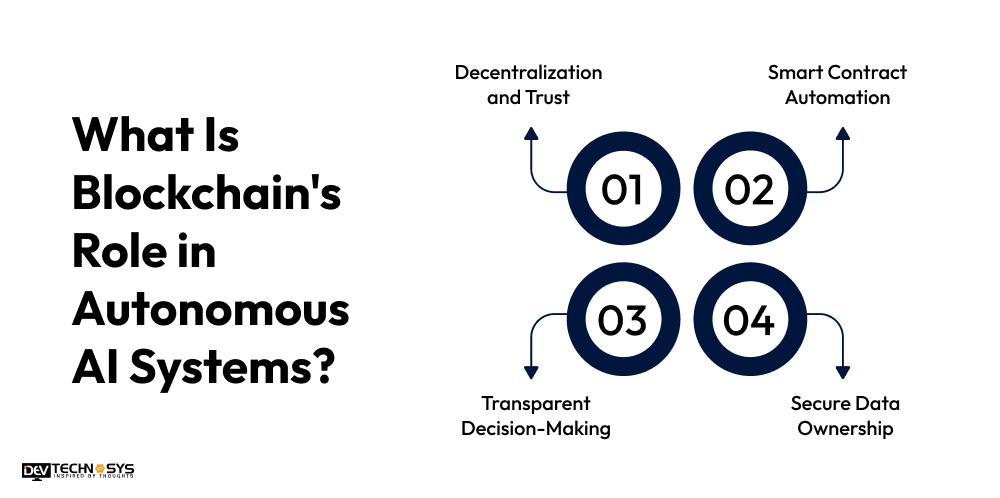
1. Decentralization and Trust
Can AI agents run autonomously on decentralized networks? That’s what people usually wonder about, and the answer is Yes! Not only Ai agents run smoothly on decentralized networks, but AI in decentralized orgs also provides a transparent, tamper-resistant environment that removes centralized intermediaries. The autonomous AI agents can operate securely, reducing single points of failure and increasing trust.
2. Smart Contract Automation
Autonomous agents crypto platforms can automatically execute smart contracts when predefined conditions are met. Smart contract automation enables blockchains to provide faster transactions and automated workflows. They reduce operational costs without human intervention.
3. Transparent Decision-Making
Blockchain records every action performed by AI agents on an immutable ledger. Autonomous AI agents in blockchain allow stakeholders to verify decisions, track accountability, and improve system transparency.
4. Secure Data Ownership
Blockchain AI integration enables users to retain ownership of their data through cryptographic security and decentralized storage, ensuring privacy while allowing AI agents to access authorized information securely.
Blockchain Capability |
Benefit for AI Agents |
| Smart Contracts | Automated execution |
| Immutable Ledger | verifiable AI computation |
| Decentralization and DeFi Protocols | Trustless operations |
| Tokenization | Autonomous payments |
| Digital Identity | Secure agent authentication |
Planning a Bnpl Project?
Get a tailored development cost estimate in a few simple steps.
- 3 quick steps
- 100% free
- Reply in 1 business day
2 Minutes Read
Architecture of Autonomous AI Agents in Blockchain
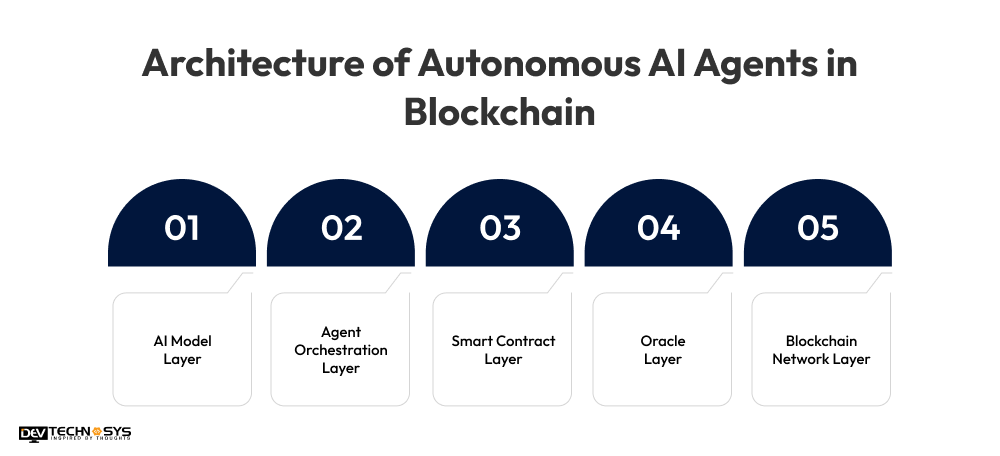
Autonomous AI agents operate within a layered architecture. It combines smart contracts, multi-agent systems, an execution layer for AI agents, and real-world data sources. This autonomous AI agent frameworks enable intelligent and secure decision-making across decentralized ecosystems.
Core Components Are:
1. AI Model Layer
Reinforcement learning algorithms, machine learning models, or Large Language Models (LLMs) fuel the system’s intelligence engine. It generates decisions, processes data, and rationalizes duties.
2. Agent Orchestration Layer
Facilitates the coordination of agent operations, task planning, memory management, tool usage, and decision execution. This layer facilitates the efficient execution of intricate multi-step operations by autonomous agents.
3. Smart Contract Layer
Crypto trading bot development involves self-executing contracts that automatically enforce predefined rules and implement transactions when specific conditions are met, thereby eliminating the need for intermediaries.
4. Oracle Layer
Provides real-world data, including market prices, meteorological conditions, financial information, and IoT data, to serve as a conduit between blockchain networks and external systems.
5. Blockchain Network Layer
It offers decentralized infrastructure for transaction validation, data storage, digital asset management, and transparent execution of agent-driven activities.
Workflow: User Request → AI Agent → Oracle → Smart Contract → Blockchain Execution → Verified Outcome. This architecture enables AI agents to make data-driven decisions and execute actions without manual work.
Key Use Cases of Autonomous AI Agents in Blockchain
Autonomous AI agents in blockchain enable self-executing systems that manage trading, governance, security, and financial operations without human intervention.
They combine smart contracts, real-time data, and AI reasoning to improve efficiency, transparency, and scalability across Web3 ecosystems. Here are some of the top AI blockchain use cases to look out for:
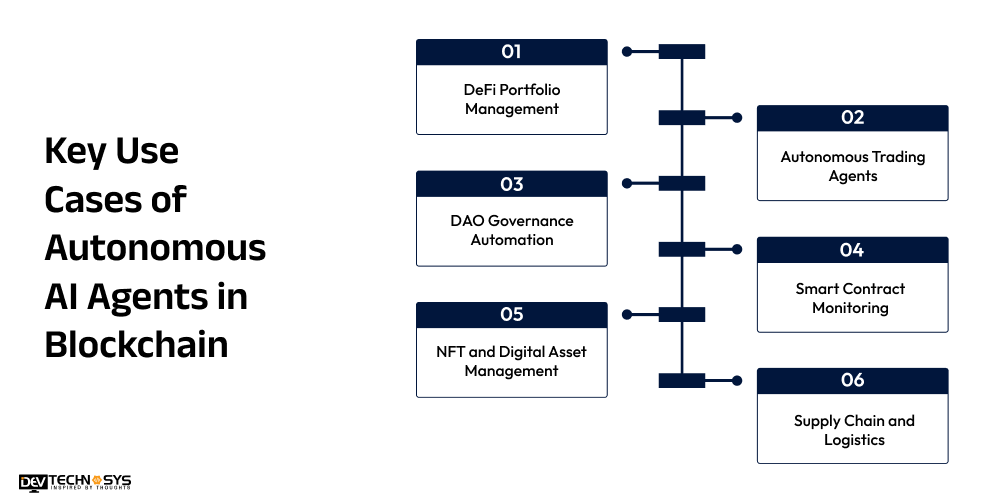
1 DeFi Portfolio Management
DeFi (Decentralized Finance) portfolio management involves tracking, optimizing, and securing your digital assets across various on-chain protocols. It replaces traditional brokers with self-custodial tracking, allowing you to monitor yield farming, liquidity pools, lending, and governance tokens in real-time without surrendering control of your funds.
- Automated Asset Allocation using real-time yield/APY signals
- Yield Farming Optimization across multiple protocols (e.g., liquidity mining shifts)
- Risk Management via liquidation prediction and volatility modeling
Industry Insight:
The McKinsey Digital Assets Report states that DeFi protocols often integrate AI-driven vault strategies (similar to Yearn-style automation) as TVL competition intensifies and yield volatility increases.
2 Autonomous Trading Agents
Autonomous trading agents are AI systems that independently analyze financial markets, formulate trading strategies, and execute trades without human intervention.
Unlike older trading bots that only follow rigid commands, autonomous agents mimic human financial analysts, utilizing several advanced capabilities like information synthesis, autonomous reasoning & memory, and execution authority.
- Real-Time Market Analysis using on-chain AI inference + sentiment data
- Cross-Chain Arbitrage across Ethereum, Solana, and Layer-2 networks
- Automated Strategy Execution with MEV-aware routing

3 DAO Governance Automation
AI agents reduce governance inefficiencies in DAOs by filtering noise and improving decision-making quality. It uses smart contracts, AI agents, and token-based voting to replace traditional management with programmable, transparent decision-making. Key tools like Snapshot, Aragon, and Tally manage proposal creation, off-chain signaling, and on-chain execution.
- Proposal Scoring & Summarization using NLP models
- Voting Recommendations based on historical governance behavior
- Treasury Management with automated fund allocation
4 Smart Contract Monitoring
AI systems continuously scan smart contracts for vulnerabilities, compliance issues, and anomalies. According to analysis by Cirtik Blockchain security, with billions lost in DeFi hacks, real-time AI auditing tools are becoming a standard layer in Web3 security stacks, similar to “runtime firewalls.”
- Vulnerability Detection (re-entrancy, overflow, logic flaws)
- Compliance Checks for regulatory and protocol rules
- Automated Auditing using static + dynamic analysis
5 NFT and Digital Asset Management
AI agents manage NFT ecosystems by tracking valuation trends and automating marketplace interactions. AI agents track NFT valuations, monitor collection trends, and automate marketplace activities. They help shift NFT markets from speculation-driven cycles toward utility-based valuation models supported by real-time sentiment and rarity analysis.
- NFT Valuation using rarity + social sentiment models
- Collection Monitoring for floor price and liquidity shifts
- Automated Marketplace Operations (listing, bidding, bundling)
6 Supply Chain and Logistics
Supply chain management is the end-to-end process of planning, sourcing, manufacturing, and delivering goods to consumers, while logistics is a specific subset focused solely on the physical movement and storage of those items. The overarching network that handles strategic, long-term decisions regarding supplier relationships, production, and competitive advantage.
- Inventory Optimization using predictive demand modeling
- Shipment Tracking with real-time blockchain updates
- Smart Contract-Based Settlements for automated payments
Real-World Examples of AI Agent Projects in Blockchain
Here are some of the real-world examples of AI agent projects in blockchain. These examples of autonomous crypto trading agents showcase how intelligent automation is transforming DeFi, decentralized AI networks, and emerging Web3 ecosystems.
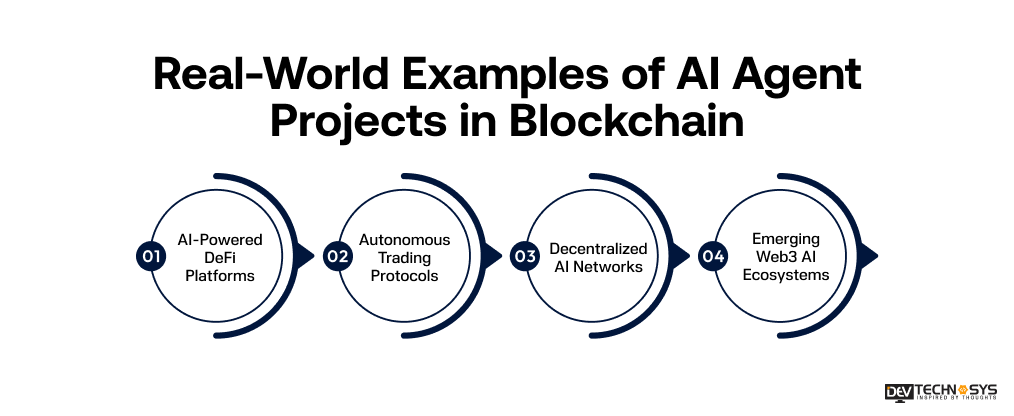
1. AI-Powered DeFi Platforms
Platforms like Yearn Finance and emerging AI-driven vault protocols that use automation to optimize yield strategies, rebalance portfolios, and reduce manual DeFi management for users.
2. Autonomous Trading Protocols
Projects such as dYdX and AI-enhanced trading bots leverage algorithmic execution, cross-chain arbitrage, and predictive analytics to enable high-speed, non-custodial trading strategies.
3. Decentralized AI Networks
Networks like Fetch.ai and Singularity NET combine blockchain with AI agents to perform tasks such as data sharing, prediction markets, and autonomous economic coordination across distributed systems.
4. Emerging Web3 AI Ecosystems
New ecosystems such as Bittensor and AI-agent frameworks in Web3 integrate decentralized machine learning, incentive-driven model training, and collaborative intelligence across blockchain infrastructure.
Category |
Example Projects |
| AI-Powered DeFi Platforms | Yearn Finance, AI Vault Protocols |
| Autonomous Trading Protocols | dYdX, AI Trading Bots |
| Decentralized AI Networks | Fetch.ai, SingularityNET |
| Emerging Web3 AI Interoperability | Bittensor, Ocean Protocol AI integrations |
Risks and Challenges of Autonomous AI Agents
According to experts who provide enterprise blockchain development services, there are big risks of AI on blockchain at the technical, operational, and security levels.
The challenges of deploying AI agents on blockchain, listed below, underscore the importance of robust security systems and human oversight for open AI-powered systems.
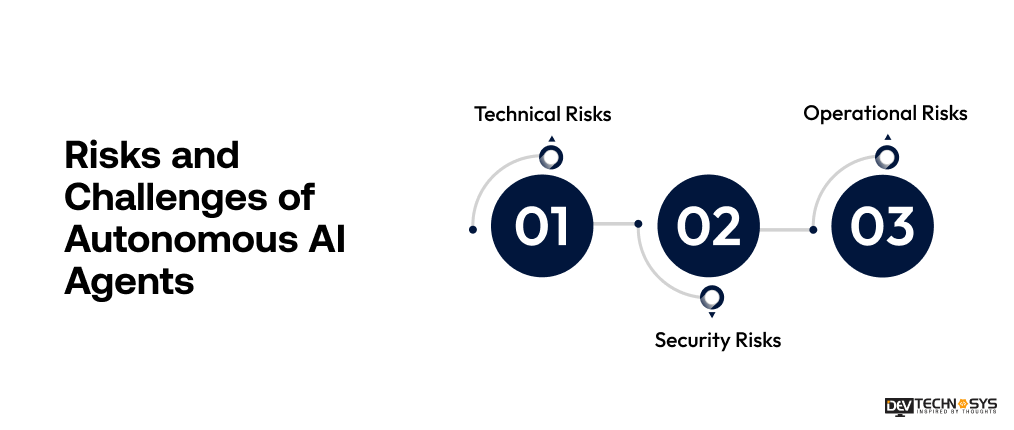
1. Risks in Technology
- Smart Contract Vulnerabilities: In order to steal money or cause the system to crash, scammers can use bugs or logical flaws in contracts.
- Model Hallucinations: AI may make bad choices or outputs due to false reasoning or because of the limitations in training.
- Manipulating Oracles: AI agents act on false information if external data feeds (oracles) are hacked or messed up.
- Data Poisoning Attacks: Bad people can add bad data to training sets, which hurts the performance and dependability of the model.
2. Risks to security
- Agent Hijacking: Attackers can take over AI bots and change what they do to do bad things.
- Threats to Wallet Security: If entry controls aren’t strong, AI-controlled wallets can be hacked.
- Private Key Mismanagement: If you don’t store or handle keys properly, you could lose an item forever.
3. Risks in Operations
- Unpredictable Agent Behavior: In complex environments, autonomous systems may act in ways that were not planned.
- Governance Coordination Problems: It’s hard to get separated parties to work together, which slows down the decision-making process.
- Scalability Limitations: Managing big multi-agent systems on-chain can slow things down.
Regulatory and Ethical Concerns
Regulatory and ethical concerns are key challenges to crypto arbitrage bot development. As adoption grows, ensuring accountability, transparency, compliance, and privacy becomes increasingly important.
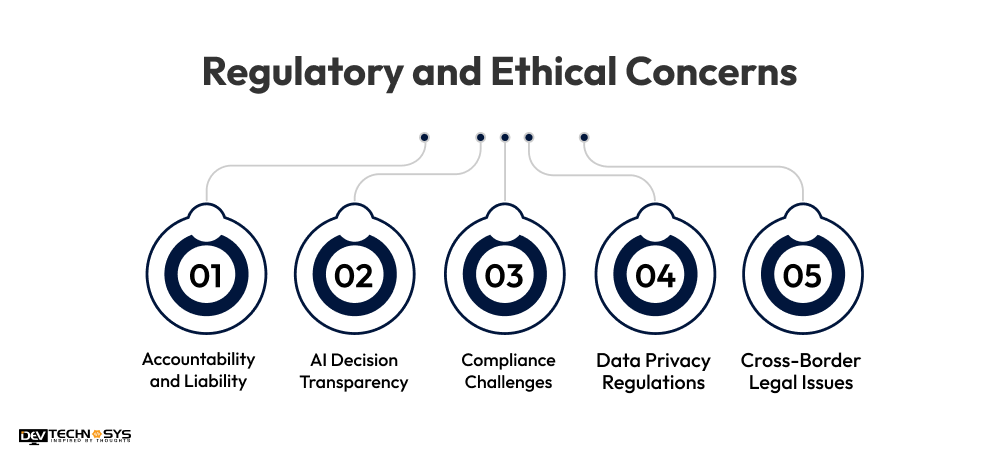
- Accountability and Liability: It’s not clear who is responsible when autonomous agents cause governance or financial losses for DAOs, developers, users, and protocol layers.
- AI Decision Transparency: In decentralized systems, black-box models make it hard to check trading, voting, or treasury choices because they make auditability less possible. This is why people prefer running AI models on blockchain.
- Problems with compliance: Actions taken by the global blockchain that are driven by AI often go against AML/KYC laws, securities laws, and regulatory systems that change quickly.
- Data Privacy Rules: Working with agents with on-chain identity and off-chain data brings up GDPR and user consent problems, especially when using AI memory systems that remember things for a long time.
- Cross-Border Acceptable Issues: When blockchains are used without borders, they can create problems between different jurisdictions because the same AI action might be acceptable in one area but not allowed in another.
Industry Insights:
According to PwC Global Crypto Regulation Report, GDPR-related enforcement, fines have exceeded €4+ billion cumulatively in Europe, increasing concerns for AI systems processing user and financial data.
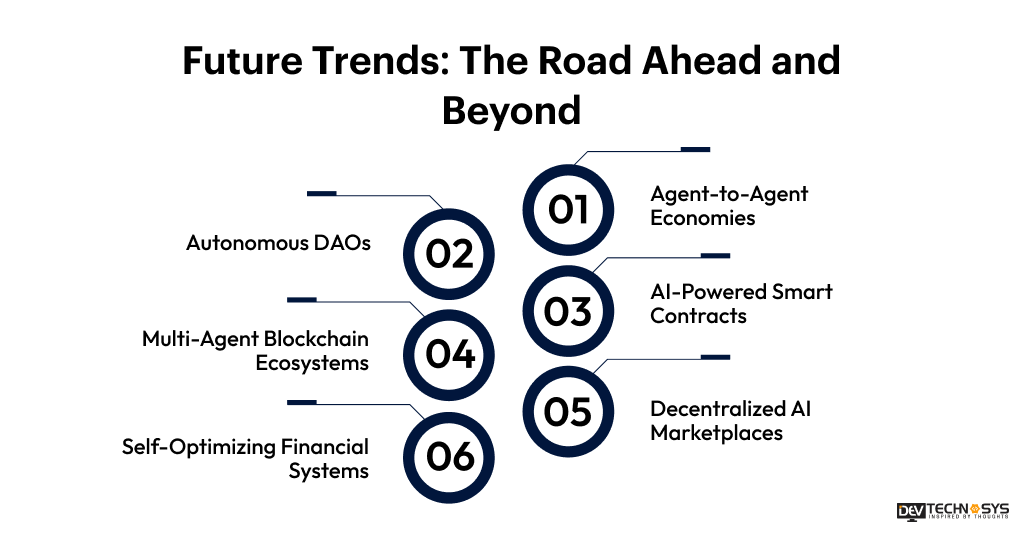
Future Trends: The Road Ahead in 2025 and Beyond
Future blockchain systems are moving toward AI-driven automation and autonomous decision-making. In 2026 and beyond, AI agents will manage, optimize, and execute decentralized processes with minimal human input.
Trend |
Description |
Impact |
| Agent-to-Agent Economies | AI agents autonomously trade and interact on-chain. | Enables machine-driven economies with zero human latency. |
| Autonomous DAOs | AI manages governance, treasury, and execution. | Faster, always-on decentralized decision-making. |
| AI-Powered Smart Contracts | Contracts adapt using AI-driven logic. | Dynamic execution based on real-time conditions. |
| Multi-Agent Blockchain Ecosystems | Multiple AI agents collaborate across blockchain functions. | Higher efficiency through coordinated AI in finance and other industries. |
| Decentralized AI Marketplaces | Tokenized AI models, data, and compute on-chain. | Open, permissionless access to AI infrastructure. |
| Self-Optimizing Financial Systems | AI continuously adjusts liquidity and risk. | Maximized yield with automated risk control. |
AI Agent Failure Scenarios: What Happens When Things Go Wrong?
While learning how to build an AI agent for blockchain applications, you should also know that AI agent failures in blockchain can trigger financial loss, security breaches, and system-wide instability across decentralized ecosystems.
Failures in autonomous AI agents can disrupt blockchain systems, leading to incorrect decisions, security risks, and cascading protocol failures. Let’s take a closer look at these missteps.
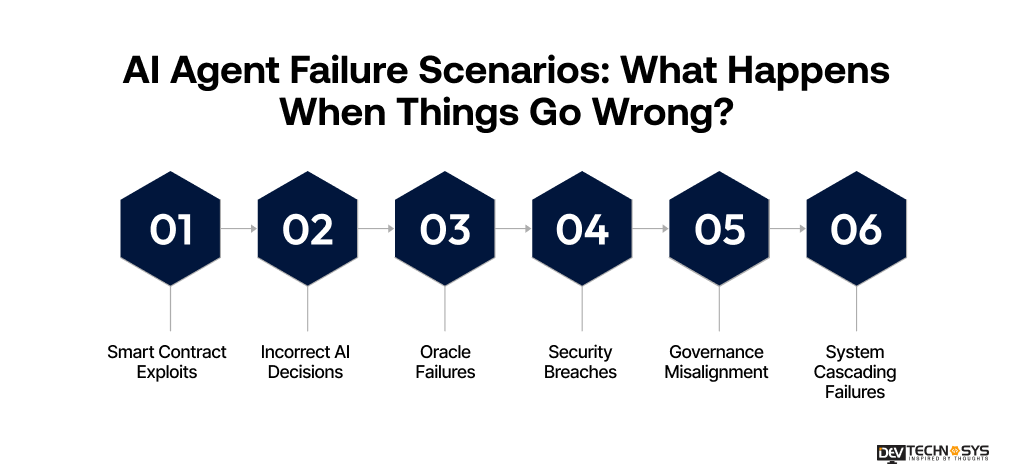
i. Smart Contract Exploits:
Bugs or logic flaws in smart contracts can be exploited by AI agents or attackers, leading to fund loss, protocol manipulation, and irreversible on-chain damage across DeFi systems.
ii. Incorrect AI Decisions:
Poor training data, hallucinations, or flawed models can cause agents to execute wrong trades, governance votes, or treasury actions, resulting in financial losses and inefficient protocol behavior.
iii. Oracle Failures:
Faulty or manipulated oracles feed incorrect external data to AI agents, causing inaccurate pricing, bad trading decisions, and cascading errors across decentralized financial applications and smart contracts.
iv. Security Breaches:
Compromised AI agents or wallets allow attackers to hijack control, execute unauthorized transactions, drain funds, and disrupt blockchain operations through stolen private keys or weak access controls.
v. Governance Misalignment:
AI agents may misinterpret DAO intent or optimize incorrectly, leading to decisions that conflict with community goals, reducing trust, participation, and overall governance effectiveness in decentralized systems.
vi. System Cascading Failures:
A single agent malfunction can trigger chain reactions across interconnected protocols, amplifying losses, destabilizing liquidity, and causing widespread disruption in multi-agent blockchain ecosystems.
Can Autonomous AI Agents Be Held Legally Responsible?
- AI agents are not legal entities and cannot be held responsible under current laws.
- Liability falls on humans such as developers, deployers, or DAO governance members.
- Platform operators may also share responsibility for agent behavior.
- Decentralized systems make accountability difficult to trace and enforce.
- Cross-border execution complicates legal jurisdiction and enforcement.
- Regulators are still developing frameworks for AI + blockchain accountability.
Conclusion
Autonomous AI agents are revolutionizing blockchain with intelligent automation, speedier decision-making, and enhanced efficiency. Despite the security and regulatory hurdles, their acceptance will increase and lead the next generation of decentralized and self-operating Web3 ecosystems.
If you are a business wanting to invest in Autonomous AI agent development, contact Dev Technosys, a leading AI development company with 15+ years of expertise in secure, scalable, and intelligent AI solutions tailored to modern business needs.
Frequently Asked Questions
Find answers to the most common questions related to this article.
Autonomous AI agents are self-operating software programs that perform tasks on blockchain networks without continuous human control. They use smart contracts, machine learning, and real-time data to make decisions and execute actions automatically.
This is how AI agents interact with smart contracts:
AI agents read on-chain data to keep track of contract statuses and circumstances.
They employ oracles/APIs to bring off-chain data into blockchain systems
The investigation suggests they initiate smart contract functions such as swaps or transfers.
Smart contracts automatically execute actions when conditions are satisfied.
This allows for autonomous execution in DeFi, trading, and governance
Yes, AI agents can be fully autonomous on the blockchain. These agents, by combining the reasoning powers of machine learning with the infrastructure of decentralized networks, operate as independent economic actors that may retain funds, execute code, and interact with other machines 24/7.
Fetch.ai: Autonomous agents for DeFi automation and machine-to-machine coordination.
SingularityNET: Decentralized AI marketplace for deploying and monetizing AI services.
Bittensor: An incentivized network for decentralized AI model training and collaboration.
Autonolas (Olas): AI agents for DeFi automation, governance, and on-chain workflows.
dYdX: AI-assisted algorithmic trading in decentralized derivatives markets.
Ocean Protocol: Enables AI agents to access and trade data for model training.
AI optimizes yield farming, liquidity allocation, and portfolio rebalancing using real-time market data. It enhances risk management by predicting volatility, liquidation risks, and market anomalies. AI enables automated trading strategies with faster and more accurate execution across protocols.
The difference between AI agents and trading bots in crypto is:
AI Agents: LLM blockchain applications learn from data, adapt to market changes, and make dynamic decisions.
Trading Bots: Follow predefined rules and execute trades based on fixed strategies.
AI agents can handle DeFi, trading, and governance, while bots focus mainly on trade execution.
Blockchains can offer transparency, immutability, and smart contract security, all of which are useful for autonomous AI agents. However, they are prone to dangers such as smart contract vulnerabilities, oracle manipulation, wallet breaches, and improper data inputs. Total security relies on strong audits, sound models, good key management, and constant monitoring.
Oracles are the bridges between blockchains and other data sources. They offer AI agents with real-time data such as market prices, weather conditions, events, and financial data. It enables them to take informed decisions and perform smart contract actions according to real-world conditions.
AI agents will form the operational layer of Web3, automating DeFi, AI-driven DAO governance, trading, security monitoring, and digital asset management. They will enable self-managing ecosystems that make faster judgments, eliminate manual intervention, and enhance efficiency across decentralized applications.