



















Key Takeways:
The cost of stablecoin development in 2026 generally ranges from $30,000 to $150,000+, depending on the stablecoin model, blockchain infrastructure, compliance requirements, security standards, and third-party integrations. A basic Stablecoin implementation cost with core token functionalities will be less, while enterprise-grade stablecoin ecosystems with reserve management, audits, and regulatory compliance require a higher cost.
Cost Breakdown of Stablecoin Development Based on Complexity:
-
- Basic Stablecoin MVP ($30,000 – $60,000+): Stablecoin MVP development cost is with basic features like token creation, smart contract deployment, token minting and burning mechanisms, wallet integration, admin dashboard, and basic security testing cost lower.
- Mid-Level Stablecoin Platform ($60,000 – $110,000+): Stablecoin deployment cost fo mid-level projects are higher then the basic due to KYC AML integration, minting engine, multi-wallet support, transaction monitoring, blockchain explorer integration, and reporting dashboards.
- Enterprise Stablecoin Solution ($110,000 – $150,000+ ): Includes multi-chain deployment, institutional-grade security, compliance automation, liquidity management systems, oracle integration, advanced analytics, and enterprise administration controls.
Major Factors Affecting Stablecoin Development Costs:
-
- Stablecoin Type: The stablecoin creation cost vary depending on whether the project is fiat-backed, crypto-backed, commodity-backed, or algorithmic.
- Blockchain Network Selection: Building on networks such as Ethereum, BNB Chain, Solana, or Polygon affects development complexity, scalability, transaction costs, and long-term maintenance expenses.
- Smart Contract Complexity: Advanced functions such as Stablecoin governance, collateral management, treasury system, transaction controls, supply adjustments, and multi-signature authorization increase stablecoin development budget.
- Compliance & Regulatory Requirements: Implementing KYC, AML, sanctions screening, reporting systems, and regional compliance frameworks can substantially increase project budgets.
- Security & Auditing: Stablecoin development pricing afecs due to security audits, stablecoin regulations, penetration testing, formal verification, and continuous monitoring are essential for stablecoin projects.
Cost Variation by Country:
-
- North America: $40 – $90/hr
- Western Europe: $35 – $60/hr
- Eastern Europe: $40 – $70/hr
- India/Southeast Asia: $15 – $25/hr
The stablecoin market is growing by a large margin, becoming a backbone of digital payments, DeFi platforms, cross-border transactions, and tokenized finance. From fintech startups to banks and enterprises, businesses from around the globe are now exploring and investing in stablecoin development to unlock faster settlements, lower transaction costs, and global financial accessibility.
However, one question that always stands between the development is: How much does stablecoin development cost in 2026? Usually, the cost to build a stablecoin ranges from $30,000 to $1,50,000. The final cost depends on various factors, including the type of blockchain selection, compliance requirements, stablecoin, smart contract complexity, and third-party integrations.
In this comprehensive guide, we will discuss the cost breakdown of stablecoin development, involving the factors affecting cost, factors reducing the cost to launch a stablecoin exchange, types of stablecoin, how long the development takes, and more. So, let’s jump in and learn everything you need to know about stablecoin development cost.
What is Stablecoin?
Being tied to assets like real currency, commodities, or other cryptocurrencies, a stablecoin is a form of cryptocurrency that is meant to keep its value stable. Along with supporting trading and DeFi apps, it makes transactions quick and cheap and lowers volatility. There are risks with all stablecoins, whether they are backed by cash, crypto, commodities, or algorithms. For example, reserve shortages and depegging are two concerns.
Since the blockchain is immutable, even a tiny mistake in smart contract development can bring huge consequences. Funds can be frozen, wallets drained, or functionality broken. There’s simply no “undo” button, and errors can be exploited immediately.
Why Budgeting is Crucial in Stablecoin Development?
When making a stablecoin, it’s important to make a budget to pay for the high costs of smart contract checks, legal compliance, and managing reserves on a regular basis.
With proper financial planning, you can be sure that your cryptocurrency development company will take 6 to 12+ weeks to create and keep up the strict financial reserves needed to keep the currency pegged to real-world assets.
Key Cost Centers Requiring Strict Budgeting Include:
- Smart Contract Audits
- Regulatory Compliance
- Reserve Attestations
- Oracle Infrastructure
- Liquidity Bootstrapping
Consequences of Poor Budgeting Are:
- Loss of the Peg:
- Security Compromises:
- Regulatory Shutdowns:
How Much Does Stablecoin Development Cost on Average?
The cost to build a stablecoin is between $30,000 to $1,50,000, depending on features, UI/UX, platform type, location of development team, and more. The cost to develop a stablecoin with basic features and functionalities is around $30,000 to $70.000. The cost to launch a stablecoin for mid-level complexity lies between $70,000 to $ 1,10,000.
The Stablecoin development services involving advanced technology lik AI automation, blockchain infrastructure, smart contracts, MiCA compliance, and real-time analytics require more development time and effort, which increases the stablecoin token development cost to $1,50,000 and higher. Here’s the table highlighting the cost to create a stablecoin.
Project Type |
Cost (USD) |
Timeline |
| Basic Stablecoin MVP | $30,000 – $70,000 | 2 – 3 months |
| Mid-Level Stablecoin Platform | $30,000 – $70.00 | 3 – 6 months |
| Enterprise Stablecoin Solution | $1,10,000 – $1,50,000 | 6 – 10 months |
Planning a Stablecoin Project?
Get a tailored development cost estimate in a few simple steps.
- 3 quick steps
- 100% free
- Reply in 1 business day
2 Minutes Read
Types of Stablecoin and Their Development Costs
When considering stablecoin development, you need to know that costs vary based on the type of stablecoin platform you want to develop. To present a clear picture, here we provide different types of stablecoins that you can consider building, along with the cost to create a stablecoin. Each type offers different decentralization, transparency, and risk management levels.
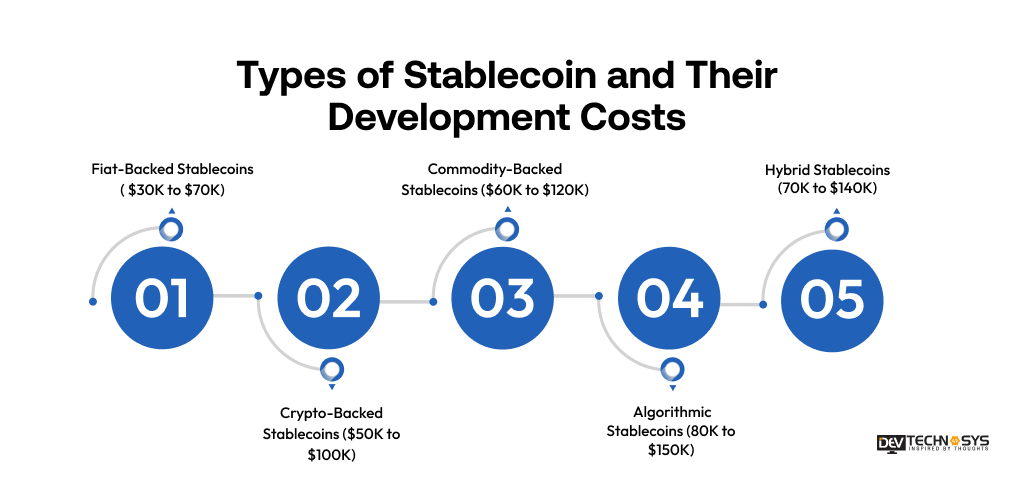
1. Fiat-Backed Stablecoins ( $30K to $70K)
Traditional currencies like USD, EUR, or GBP held in reserve accounts power fiat-backed stablecoins. They are one of the most popular stablecoins among businesses due to their simplicity, regulatory compliance, and predictable value. Contact expert development provider to know the exact fiat-backed stablecoin software development cost.
- Examples: USDT, USDC, PYUSD
- Best For: Fintech startups, payment platforms, remittance solutions
- Complexity: Medium
Project Type |
Cost (USD) |
Timeline |
| Basic MVP | $30,000 – $45,000 | 2 to 3 Months |
| Mid-Level Platform | $45,000 – $60,000 | 3 to 4 Months |
| Advanced Solution | $60,000 – $70,000 | 4 to 6 Months |
Industry Insight:
Our developers have built 40+ stablecoin projects and based on their analysis, Fiat-backed stablecoins are generally the quickest and most cost-effective to develop.
2. Crypto-Backed Stablecoins ($50K to $100K)
Crypto-backed stablecoins use digital assets as collateral and rely on smart contracts for Stablecoin collateral management and liquidation. Due to volatility risks, they require over-collateralization and sophisticated risk controls. If you are a business thinking of building a crypto-based stablecoin, then approach an experienced smart contract development services provider.
- Examples: DAI, LUSD
- Best For: DeFi platforms and decentralized lending ecosystems
- Complexity: High
Project Type |
Cost (USD) |
Timeline |
| Basic MVP | $50,000 – $70,000 | 3 – 4 Months |
| Mid-Level Platform | $70,000 – $85,000 | 4 – 5 Months |
| Advanced Solution | $85,000 – $100,000 | 5 – 7 Months |
3. Commodity-Backed Stablecoins ($60K to $120K)
The stablecoin project cost estimation will increase if you wish to build commodity backed stablecoins. Commodity-backed stablecoins derive their value from physical assets such as gold, silver, or oil reserves. They provide users with blockchain-based ownership of real-world assets.
- Examples: PAX Gold (PAXG), Tether Gold (XAUT)
- Best For: Asset tokenization and investment platforms
- Complexity: High
Project Type |
Cost (USD) |
Timeline |
| Basic MVP | $60,000 – $80,000 | 3 – 5 Months |
| Mid-Level Platform | $80,000 – $100,000 | 5 – 6 Months |
| Advanced Solution | $100,000 – $120,000 | 6 – 8 Months |
4. Algorithmic Stablecoins (80K to $150K)
Algorithmic stablecoins maintain price stability through supply-adjustment mechanisms and economic incentives rather than direct collateral reserves. They require advanced smart contract engineering and extensive testing.
- Examples: FRAX, Ethena USD
- Best For: Advanced DeFi development and experimental financial protocols
- Complexity: Very High
Project Type |
Cost (USD) |
Timeline |
| Basic MVP | $80,000 – $100,000 | 4 – 6 Months |
| Mid-Level Platform | $100,000 – $125,000 | 6 – 8 Months |
| Advanced Solution | $125,000 – $150,000 | 8 – 10 Months |
5. Hybrid Stablecoins (70K to $140K)
Hybrid stablecoins combine reserve-backed collateral with algorithmic stabilization mechanisms. Cex development company adds this model to improve capital efficiency while reducing dependence on a single stability mechanism.
- Examples: FRAX, USDJ
- Development Cost: $70,000–$140,000
- Best For: Enterprise-grade blockchain finance platforms
- Complexity: High
Project Type |
Cost (USD) |
Timeline |
| Basic MVP | $70,000 – $90,000 | 4 – 5 Months |
| Mid-Level Platform | $90,000 – $120,000 | 5 – 7 Months |
| Advanced Solution | $120,000 – $140,000 | 7 – 9 Months |
Essential Features of a Stablecoin Platform With Their Costs
Stablecoin platforms need a strong set of features. To ensure stability and trust, you need to ensure security, compliance, and liquidity management. Adding the right features not only enhances platform performance.
1. Core Features:
Multi-chain stablecoin development, reserve management, and exchange connections is usually the most expensive integration. Wallet, oracle, and KYC integrations cost less, but it’s no less crucial for security, compliance, and stablecoin operations.
Feature |
Integration Cost (USD) |
| Smart Contract Engine | $5,000 – $15,000 |
| KYC/AML Verification | $3,000 – $10,000 |
| Oracle Integration | $2,000 – $8,000 |
| Custody & Reserve Management | $5,000 – $15,000 |
| Wallet Integration | $2,000 – $8,000 |
| Payment & Banking APIs | $3,000 – $12,000 |
| Multi-Chain Support | $8,000 – $20,000 |
| Liquidity & Exchange Integration | $5,000 – $15,000 |
| Security & Monitoring System | $4,000 – $12,000 |
| Admin Dashboard & Analytics | $3,000 – $10,000 |
2. Advanced Features:
Developers who offer Dapp development services create advanced stablecoin platforms that support AI-driven risk management, cross-chain interoperability, automatic reserve verification, and institutional-grade compliance systems.
It makes them safer, more scalable, and ready for regulation. These features can have a big effect on the general budget for development while also making people trust and use the app more.
Advanced Feature |
Integration Cost (USD) |
| AI-Powered Fraud Detection | $5,000 – $15,000 |
| Automated Reserve Attestation | $4,000 – $12,000 |
| Cross-Chain Interoperability | $8,000 – $20,000 |
| Real-Time Risk Monitoring | $5,000 – $15,000 |
| Programmable Payments & Escrow | $4,000 – $10,000 |
| Yield-Bearing Stablecoins & Staking Integration | $5,000 – $15,000 |
| Institutional Custody Management | $6,000 – $18,000 |
| Advanced Compliance & AML Screening | $5,000 – $15,000 |
| Stablecoin treasury management & Liquidity Management Dashboard | $4,000 – $12,000 |
| CBDC & Banking Infrastructure Integration | $8,000 – $20,000 |
What are the Factors Affecting the Cost to Build a Stablecoin?
The total stablecoin development cost depends on a number of factors. It includes a stablecoin model, blockchain infrastructure, security requirements, legal compliance, and third-party integrations for stability, scalability, and trust.
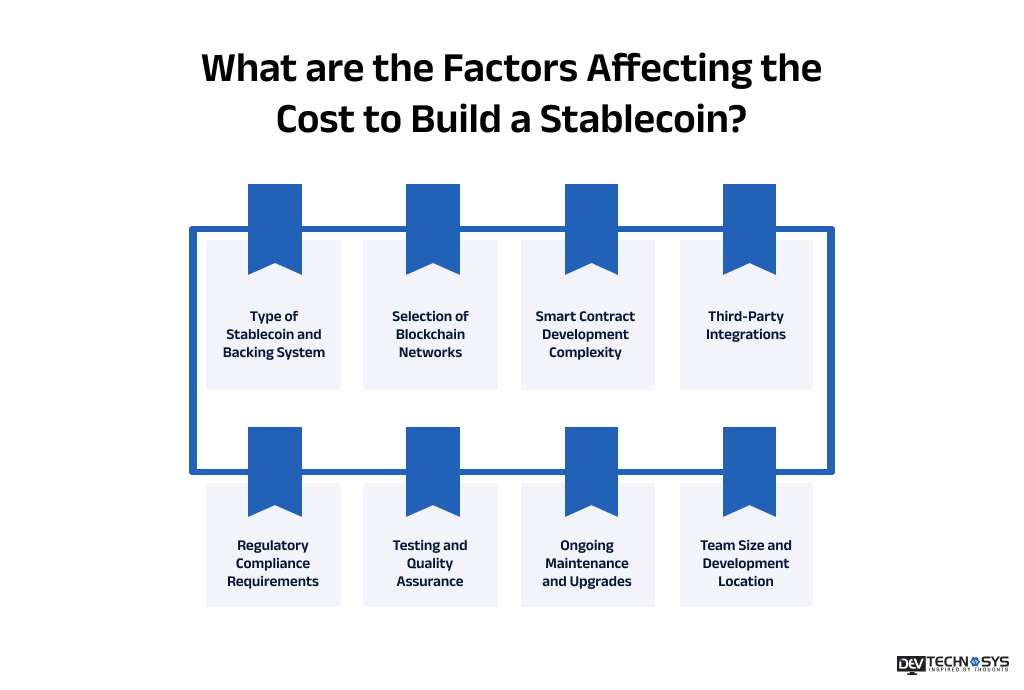
1. Type of Stablecoin and Backing System
The complexity and expense of development are directly impacted by the kind of stablecoin you select. Different reserve management methods, collateralization models, and stabilizing processes are needed for fiat-backed, cryptocurrency-backed, commodity-backed, and algorithmic stablecoins.
2. Selection of Blockchain Networks
Experts who provide enterprise blockchain development services state that the choice of blockchain network significantly impacts the total cost to create a stablecoin. Networks with varying degrees of scalability, transaction speed, ecosystem support, and gas prices include Ethereum, BNB Chain, Solana, and Polygon.
3. Smart Contract Development Complexity
Any stablecoin platform is built around smart contracts. Advanced smart contract engineering is needed for features like stablecoin minting and burning, collateral management, stablecoin governance protocols, transaction monitoring, supply adjustment methods, and role-based permissions.
Industry Insights:
According to CoinMarketCap.com, Tether (USDT) and USD Coin (USDC) together account for hundreds of billions in annual transaction volume.
4. Third-Party Integrations
Third-party integrations like banking APIs, custodial platforms, KYC/AML verification providers, and liquidity providers can impact the cost to build a stablecoin. Stablecoin development company integrates API configuration, testing, and licensing fees. Adding them requires more effornt an time, which impacts costs. It can significantly increase the stablecoin development costs.
5. Regulatory Compliance Requirements
Stablecoin initiatives must abide by financial laws in various regions. Constant assurance of third-party integrations and knowledge of the stablecoin legal framework are important for implementing KYC(Know Your Customer), AML (Anti-Money Laundering), sanctions screening, transaction monitoring, and reporting systems. The stablecoin regulatory compliance cost adds to the total stablecoin development budget
6. Testing and Quality Assurance
To guarantee the performance, security, and stability of a stablecoin platform, extensive testing is necessary in Web3 development. Functional testing, penetration testing, load testing, regression testing, smart contract auditing, and user acceptance testing (UAT) are all included in this.
Industry Insights:
DeFiLliama.com states that smart contract exploits caused over $1.8B in losses in 2023 alone. Formal verification and audit cycles are now standard for institutional stablecoins.
7. Ongoing Maintenance and Upgrades
Launching a stablecoin is only the beginning. Continuous maintenance is required to monitor smart contracts, apply security patches, optimize infrastructure, and support evolving blockchain standards. Regular feature enhancements and system upgrades ensure long-term performance and regulatory compliance, adding to the overall lifecycle cost.
8. Team Size and Development Location
The cost of Stablecoin development solutions is heavily influenced by the expertise, size, and geographical location of the team. Projects handled by experienced blockchain developers, security specialists, DevOps engineers, and compliance experts typically require a larger budget.
Factor |
Estimated Cost Impact |
Development Timeline |
| Type of Stablecoin & Backing System | $5,000 – $50,000+ | 1 – 3 weeks |
| Blockchain Network Selection | $8,000 – $40,000 | 1 – 2 weeks |
| Smart Contract Development Complexity | $15,000 – $80,000 | 3 – 6 weeks |
| Regulatory Compliance Requirements | $10,000 – $60,000 | 2 – 5 weeks |
| Third-Party Integrations | $8,000 – $45,000 | 2 – 4 weeks |
| Testing & Quality Assurance | $6,000 – $30,000 | 2 – 4 weeks |
| Team Size & Location | $20,000 – $120,000+ | 4 – 10 weeks |
| Ongoing Maintenance & Upgrades | $2,000 – $15,000/month | Continuous |
Key Insights:
Our developers have built 50+ stablecoin projects for businesses of all scales. According to their analysis, the Stablecoin maintenance cost is around 12% to 20% of the total development budget.

Security and Compliance for Stablecoin Development
Security and compliance are very important for creating a reliable stablecoin. Such things as auditing smart contracts, verifying reserves, ensuring secure wallets, applying KYC/AML procedures, monitoring transactions, protecting data, and conducting regulatory evaluations can contribute to asset security, transparency, prevention of financial crime, and legalization of activities.
1. Security of Smart Contracts
Smart contracts related to stablecoins are crucial in aspects such as the issuance, transfer, burning, and supply of tokens. Various methods, including expert auditing, automated testing, access control tools, and regular vulnerability checks, can help determine possible exploits, unauthorized minting, reentrancy attacks, and other logic weaknesses that can put user funds at risk.
2. Reserve & Asset Management
There must be a well-defined procedure in place to manage reserves that support the value of the stablecoins. Companies must implement a secure guardianship process, keeping assets separate from each other, going through an auditing process, monitoring reserves, and providing all necessary attestations.
3. KYC & AML Regulations
If stablecoin platforms engage in any kind of financial services, it is crucial for them to apply the KYC and AML regulations depending on their jurisdiction and the business model being followed. Verification of identity, checking possible sanctions, and monitoring transactions can allow doing anything possible to prevent financial crimes from happening in the future.
4. Securing Wallets and Private Keys
Ensure the safety of treasury wallets, administrative accounts, and customer assets through methods like MPC, multi-signature technology, encryption, hardware infrastructure security, permissioning according to roles, and a transaction approval process. It is known that proper key structure practices will reduce the possibility of a third party breaking in and compromising important stablecoin operations.
5. Compliance with Regulations
Stablecoins have different regulations in various jurisdictions. The rules depend on the structure of tokens, issuers, reserves’ management, and services rendered. It would be a good practice for companies to analyze payment, financial, digital assets, consumer protection, taxation, and reporting requirements before launching operations.
6. Transaction monitoring
Establish continuous tracking to reveal irregular movements of funds, red flags from wallets, risks regarding sanctions, and inconsistent transaction behavior of the transactions. Automation of notifications, analysis of the blockchain, scoring of risks, and investigations will improve reliability of the reliability of the company’s operations.
Planning a Mobile App?
Get a tailored development cost estimate in 3 simple steps — app basics, features, timeline, and your contact details.
- 3 quick steps
- 100% free
- Reply in 1 business day
2 Minutes Read
How Long Does It Take to Build a Stablecoin?
ICO token development services providers take 6 to 12+ months or more to create a unique stablecoin that complies with all regulations. However, depending on your strategy, the stablecoin development timeline changes significantly:
- 1 to 2 months: Using a white-label or custom-branded stablecoin solution (wrapping current liquidity like USDC) will take one to two weeks.
- 2 to 6 Months: Creating a smart contract for a simple, unregulated utility on a network (such as Ethereum or Solana) will take two to six months.
- 1 to 2 Years: Building a stand-alone, institution-grade stablecoin with proprietary reserve management will take one to two years.
Phase |
Estimated Duration |
| Requirement Analysis & Planning | 1 to 2 weeks |
| Blockchain Selection & Setup | 1 to 2 weeks |
| Smart Contract Development | 3 to 6 weeks |
| Backend & Wallet Integration | 2 to 5 weeks |
| Third-Party Integrations | 2 to 4 weeks |
| Security Auditing & Testing | 2 to 4 weeks |
| Compliance & Legal Setup | 2 to 6 weeks (can overlap) |
| Deployment & Launch | 1 to 2 weeks |
Common Mistakes That Increase Stablecoin Development Costs
Stablecoin development can quickly become expensive when teams overlook technical, regulatory, and architectural fundamentals. Many cost overruns happen not because of coding itself, but due to poor planning, weak security design, and late-stage compliance fixes.
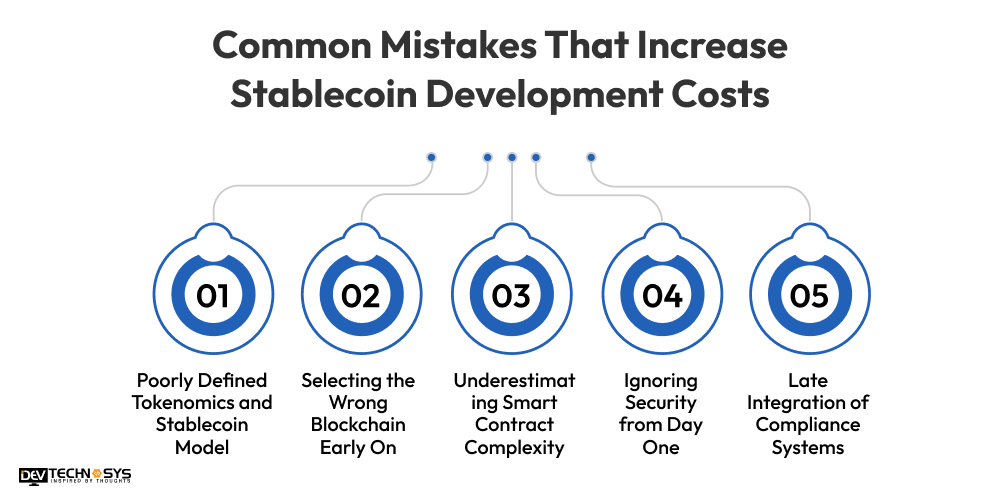
1. Poorly Defined Tokenomics and Stablecoin Model
Choosing between fiat-backed, crypto-backed, or algorithmic models without a clear economic design leads to redesign cycles later. This often requires rebuilding smart contracts and reserve logic, significantly increasing costs.
2. Selecting the Wrong Blockchain Early On
Picking a blockchain like Ethereum without evaluating gas fees, scalability needs, or ecosystem fit can create long-term cost inefficiencies. Migrating later to networks like Solana or Polygon often requires full redeployment and re-auditing, which increases Ethereum development cost.
3. Underestimating Smart Contract Complexity
Simple token contracts rarely meet real stablecoin requirements. Missing features like mint/burn controls, reserve tracking, or governance layers lead to multiple rewrites, increasing both development and audit expenses.
4. Ignoring Security from Day One
Skipping early security practices results in expensive rework later. Without proper audits, penetration testing, and formal verification, vulnerabilities can force emergency fixes or even total contract replacement.
5. Late Integration of Compliance Systems
Adding KYC/AML and regulatory reporting systems late in development is one of the costliest mistakes. Dex development company should incorporate compliance tools into the architecture early to avoid redesigning backend workflows.
Are There Any Hidden Costs Involved?
Yes. After launch, stablecoin initiatives frequently have unstated expenses, particularly in the areas of compliance, security, and scalability. Long-term budgeting is more complicated than original development planning since these costs typically increase with adoption, regulation, and transaction volume.
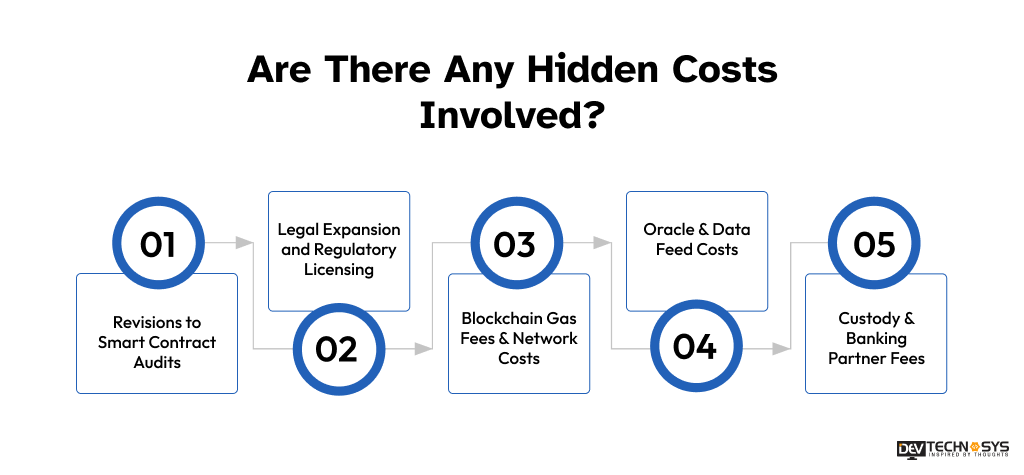
1. Revisions to Smart Contract Audits
Due to flaws in intricate token logic, audit repairs and re-audits are frequent. Costs can rise by 30% to 60% with each subsequent audit cycle, and initial AI token development and testing budgets may be greatly exceeded by emergency security fixes.
2. Legal Expansion and Regulatory Licensing
Additional licensing, legal reorganization, and compliance updates are necessary when expanding into new areas. Costs differ greatly between jurisdictions, and if global stablecoin legislation continues to change quickly, continuing legal consultations may become a significant ongoing expense.
Industry Insights:
According to IMF Digital Currency Research, over 60+ countries are actively regulating stablecoins (IMF & BIS 2024–2025 trends).
3. Blockchain Gas Fees & Network Costs
Gas costs for deployments, upgrades, and transactions are ongoing while using networks like Ethereum. Costs can rise several times during network congestion, greatly raising operating costs for high-volume stablecoin systems.
4. Oracle & Data Feed Costs
Oracles are used by stablecoins in order to confirm reserves and provide price feeds. High-reliability data services raise costs, and integration and subscription fees add ongoing costs. These systems are necessary, but as the frequency of transactions and updates rises, they become more expensive.
5. Custody & Banking Partner Fees
Custody & Banking Partner Fees Regulated custodians are needed to safely store reserves for fiat-backed stablecoins. Onboarding fees, monthly custody costs, and transaction-based commissions are among the fees that are a major long-term operational expense because they scale directly with total reserves.
Hidden Cost Area |
Estimated Cost Impact |
% of Total Project Cost |
| Smart Contract Audit Revisions | $10,000 – $100,000+ per cycle | 10% – 18% |
| Regulatory Licensing & Legal Expansion | $20,000 – $200,000+ + monthly retainers | 15% – 25% |
| Blockchain Gas Fees & Network Costs | $1,000 – $50,000+ annually (can spike during congestion) | 5% – 15% |
| Oracle & Data Feed Costs | $5,000 – $25,000 setup + monthly fees | 5% – 10% |
| Custody & Banking Partner Fees | 0.1% – 0.5% of reserves annually | 10% – 20% |
How to Reduce Stablecoin Development Expenses?
If you build a stablecoin with careful planning, effective architecture design, and early compliance and security system integration, it can help reduce stablecoin development costs. Let’s find out how to lower the overall cost of development.
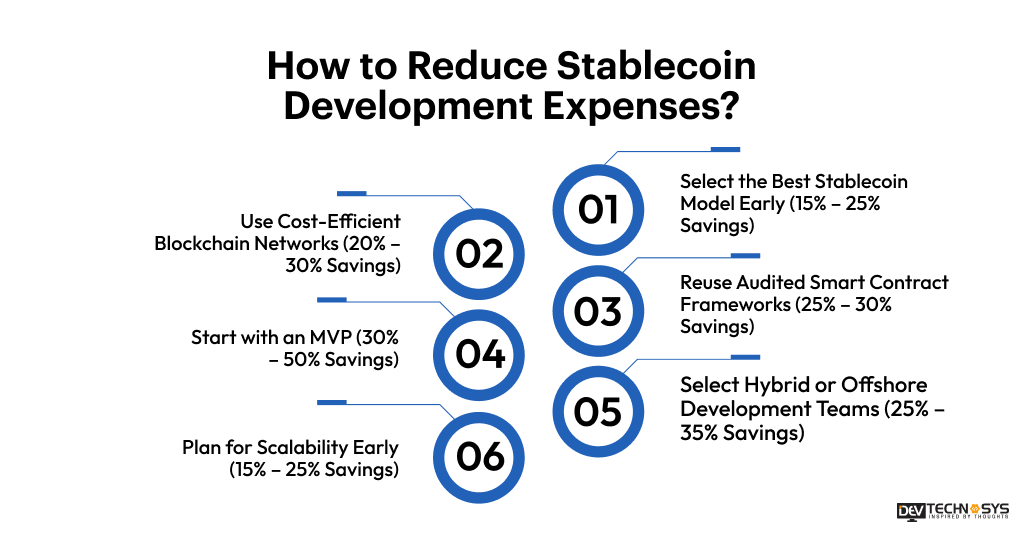
1. Select the Best Stablecoin Model Early (15% – 25% Savings)
Costly redesigns later on are avoided by choosing the right structure (fiat-backed, crypto-backed, or hybrid) from the outset. During scaling, a clear tokenomics approach minimizes reserve modifications, compliance restructuring, and smart contract rewrites.
2. Use Cost-Efficient Blockchain Networks (20% – 30% Savings)
Deployment and transaction costs are decreased by selecting scalable, low-cost networks like Polygon or BNB Chain rather than high-gas settings. Additionally, reduces long-term operating costs during periods of high demand.
3. Reuse Audited Smart Contract Frameworks (25% – 30% Savings)
Development time and Stablecoin security audit costs are decreased by using pre-audited libraries like OpenZeppelin. It lessens security risks, minimizes vulnerabilities, and eliminates the need for numerous costly audit cycles.
4. Start with an MVP (30% – 50% Savings)
Prior to adding more sophisticated features, a minimum viable product should be launched in order to confirm fundamental stablecoin functionality. Early in the project lifetime, this staged strategy avoids over-engineering and lowers the initial capital outlay.
5. Select Hybrid or Offshore Development Teams (25% – 35% Savings)
Development costs might be cut by 40% to 60% by hiring seasoned blockchain engineers in economically disadvantaged areas. Quality and cost are balanced in a hybrid paradigm that combines offshore execution with onshore strategy.
6. Plan for Scalability Early (15% – 25% Savings)
By creating scalable architecture early on, costly infrastructure rewrites are prevented. Long-term operating costs are decreased via modular smart contracts, improved backend infrastructure, and effective node management.
Real World Examples of Stablecoin Development With Cost Analysis
The top five real-world examples of stablecoins, ranked by liquidity, adoption, and market share, include:
1. Tether (USDT)
USDT is a stablecoin that is backed by cash and other fiat currencies. It is the most traded stablecoin and is used for crypto trading, money transfers, and liquidity on all major markets around the world.
2. USD Coin (USDC)
USDC is a US dollar-backed stablecoin that was created by Circle and is fully backed by U.S. dollar funds. Because it is open, can be audited, and has great institutional trust, it is used a lot in DeFi and fintech.
3. Dai (DAI)
MakerDAO is in charge of DAI, a decentralized crypto-collateralized stablecoin. It keeps the value of the USD fixed by using smart contracts backed by many crypto assets. This prevents control and keeps the decentralized economy stable.
4. Ethena USDe (USDe)
USDe is a fake stablecoin that was made by Ethena Labs. It helps with peg management by using delta-neutral hedging strategies with crypto derivatives instead of fiat funds. This gives it scalable and new ways to expose the dollar to the market.
5. PayPal USD (PYUSD)
PYUSD is a stablecoin backed by real money that was created by Paxos and is now used in PayPal and Venmo. It is fully backed by deposits in U.S. dollars and lets Stablecoin payment Infrastructure work smoothly in standard fintech ecosystems.
Stablecoin |
Development Cost |
Complexity Level |
| Tether | $60K – $90K | Medium |
| USD Coin | $90K – $125K | High |
| Dai | $100K – $130K | Very High |
| Ethena USDe | $105K – $135K | Very High |
| PayPal USD | $110K – $150K | Enterprise |
Case Study: PAYCOINZ
Paycoinz is a blockchain-based crypto payment gateway developed by Dev Technosys for a U.S.-based fintech entrepreneur in the FinTech industry. the clients reviwewd our portfolio and selected the services they wanted. this project was built over 32 weeks by a 12-member development team, the platform enables secure and fast digital transactions.
It is designed as a scalable blockchain payment solution supporting global cryptocurrency adoption and payments. clients can contact us for further expert guidence regarding the maintainance of their project.
- Project Name: Paycoinz – Crypto Payment Gateway Platform
- About Client: Robert, fintech entrepreneur focused on global crypto transactions
- Industry: FinTech / Cryptocurrency Payments
- Client Location: United States
- Development Timeline: 32 Weeks
- Team Size: 12 Members
ROI and Revenue Model of Stablecoin Platforms
Stablecoin platforms generate revenue through infrastructure usage, financial services, and ecosystem participation. Their ROI depends on adoption scale, transaction volume, reserve management efficiency, and integration with DeFi and fintech systems.
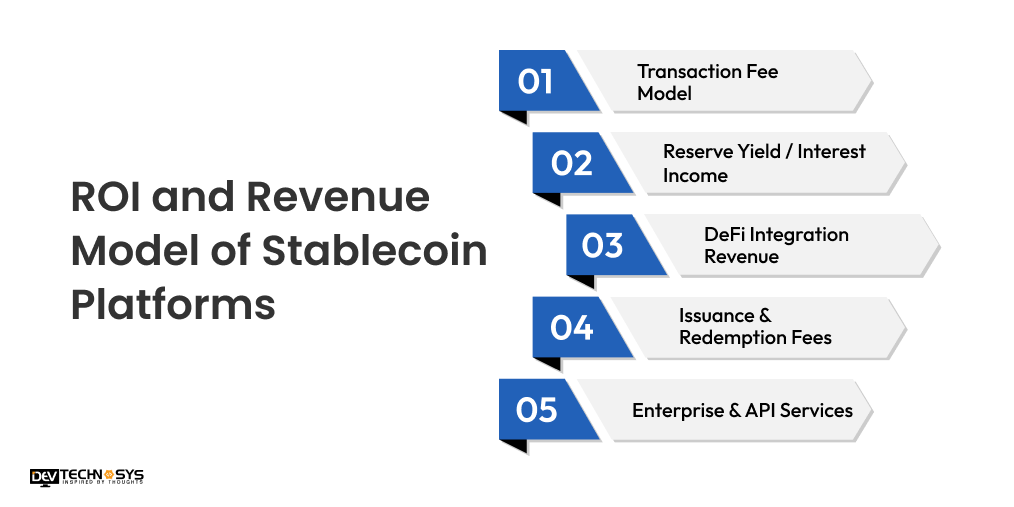
1. Transaction Fee Model
Stablecoin platforms earn revenue by charging small fees on transfers, conversions, and cross-chain transactions. Even micro-fees become significant at scale due to high transaction volume across global users and exchanges.
- ROI Impact: High scalability potential with low marginal cost per transaction
- Market Insight: Major stablecoins process billions in daily transaction volume globally
2. Reserve Yield / Interest Income
Your RWA tokenization development company uses this method to generate institutional-grade yield. Fiat-backed stablecoins generate revenue by investing reserves in low-risk assets like treasury bills and money market instruments. The interest earned on large reserve pools becomes a major income source.
- ROI Impact: RWA-Backed Stablecoins ensure a stable and predictable long-term revenue stream
- Market Insight: Large issuers manage billions in reserves, generating institutional-grade yield
3. DeFi Integration Revenue
Stablecoins integrated into DeFi ecosystems earn through lending stablecoin protocol, Stablecoin liquidity pool, staking mechanisms, and yield farming infrastructure. They act as foundational liquidity assets in decentralized finance.
- ROI Impact: High growth potential with ecosystem expansion
- Market Insight: Stablecoins dominate DeFi liquidity and trading pairs across major protocols
4. Issuance & Redemption Fees
Some platforms charge fees when users mint or redeem stablecoins, especially for institutional or large-volume transactions. These fees help cover operational, banking, and compliance costs.
- ROI Impact: Direct revenue tied to supply expansion
- Market Insight: Institutional stablecoin flows are increasing due to cross-border settlement demand
5. Enterprise & API Services
Stablecoin providers offer APIs, white-label solutions, and blockchain payment infrastructure to fintech companies. These B2B services generate high-margin recurring revenue.
- ROI Impact: Strong enterprise-level recurring income model
- Market Insight: Growing demand for stablecoin-as-a-service (SCaaS) solutions in fintech and payments
You can reach out anytime; we are available 24/7. Our team provides a quick response.

Top Blockchains Powering Modern Stablecoins
Stablecoins are typically built on high-performance blockchains like Ethereum, Tron, BEP-20, BNB Chain, and Solana, with multi-chain deployment becoming the standard to ensure scalability, low fees, and global accessibility.
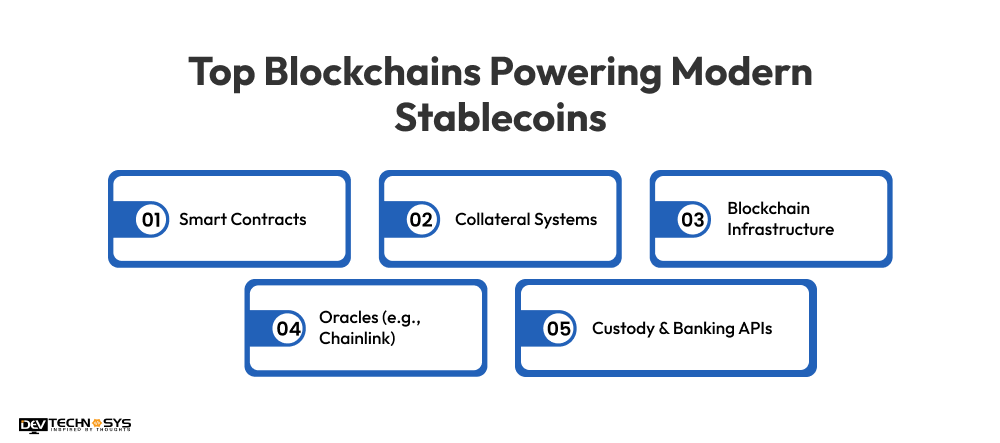
1. Smart Contracts
ERC-20, TRC-20, and BEP-20 standards power stablecoin issuance, transfers, and automation across blockchain networks.
- Purpose: Enables programmable minting, burning, and secure peer-to-peer transactions without intermediaries.
- Best Feature: Fully automated transactions with transparent and trustless execution.
2. Collateral Systems
Stablecoins use fiat-backed, crypto-backed, or algorithmic reserve models to maintain value stability.
- Purpose: Keeps the token pegged to assets like USD or other stable benchmarks.
- Best Feature: Price stability with flexible backing mechanisms for different financial models.
3. Blockchain Infrastructure
A decentralized distributed ledger records all transactions securely and immutably, ensuring transparency, trust, and tamper-proof financial records.
- Purpose: Ensures transparency, auditability, and prevents fraud or double-spending.
- Best Feature: Tamper-proof transaction history with full traceability.
4. Oracles (e.g., Chainlink)
Oracles deliver real-world data such as price feeds, interest rates, and reserve verification to smart contracts, enabling accurate execution of blockchain logic.
- Purpose: Connects blockchain systems with external financial and market data.
- Best Feature: Real-time, reliable external data integration for accurate decision-making.
5. Custody & Banking APIs
Custody & Banking APIs connect blockchain networks with traditional financial systems, asset storage, and regulatory compliance for stablecoins.
- Purpose: Supports issuance and redemption of fiat-backed stablecoins.
- Best Feature: Seamless fiat on-ramp and off-ramp integration.
Conclusion
In 2026, the cost of developing a stablecoin varies widely based on its architecture, compliance requirements, blockchain choice, and operational scale. A basic stablecoin MVP can start at around $30,000 to $60,000, while more advanced systems with security, integrations, and governance features can range from $100,000 to $1,50,000+.
If you are a business wanting a stablecoin platform developed by professionals, contact Dev Technosys. We are a leading crypto exchange development company with the strength of 250+ developers and 15+ years of expertise in delivering enterprise-grade digital asset platforms.
Frequently Asked Questions
Find answers to the most common questions related to this article.
On average, the cost to develop a stablecoin starts from $30,000 to $1,50,000. The total budget depends highly on features, technologies added, third-party integration, testing and QA, and team size and location. The basic version costs less, while and advanced version can cost up to $1,50,000.
Absolutely. Compliance with KYC, AML, and regional financial regulations adds legal consultation, licensing fees, reporting systems, and integration costs, often accounting for 15% to 20% of total project cost.
The cheapest way is to launch a basic ERC-20 stable token using pre-audited frameworks, use low-cost chains like Polygon, and avoid complex compliance and multi-chain architecture in the initial phase.
Costs increase due to scaling infrastructure, regulatory expansion, liquidity management, and repeated security audits. As transaction volume grows, operational and compliance expenses increase significantly.
Yes. Banking APIs, custodial services, and fiat reserve management are major cost components, especially for fiat-backed stablecoins like USD Coin and Tether.
It can be highly profitable if the stablecoin achieves adoption and liquidity. Revenue typically comes from transaction fees, reserve yield (interest on assets), and ecosystem services, but profitability depends on regulatory and operational efficiency.