















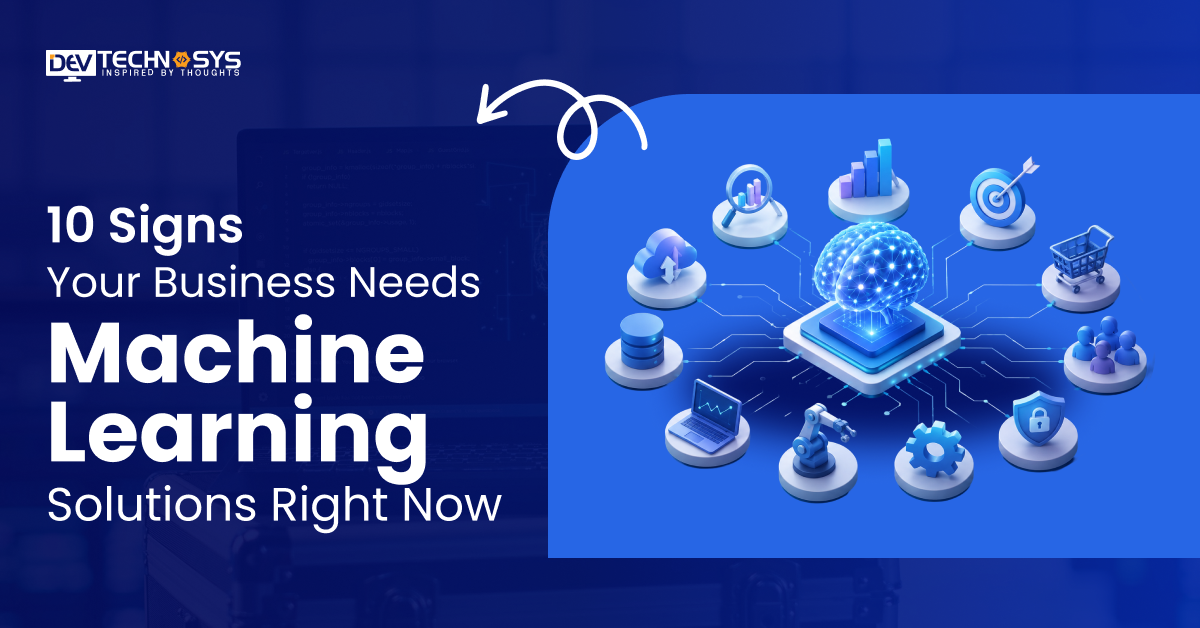
Businesses generate massive amounts of data every day, but turning that data into valuable insights is the real challenge. This is where machine learning solutions can make a significant difference. From improving customer experiences to automating repetitive tasks and predicting future trends, machine learning helps companies make smarter decisions faster.
Companies using machine learning solutions for businesses are growing faster than their rivals, yet many business owners wait until technical bottlenecks become actual emergencies before they seek help. This blog identifies 10 clear signs that your business needs a machine learning system right now.
What Are Machine Learning Solutions and Why Do Businesses Need Them Now?
ML solutions are computational systems that identify patterns in data to automate decisions or generate predictions. These systems differ from traditional software because they do not follow rigid rules. Standard code requires a human to write every step of a process: a method that fails when data becomes complex. Machine learning technologies learn from examples; they improve their own logic as they process more information.
Success in 2026 requires a disciplined model training lifecycle. This is the iterative process of defining a problem, collecting data, engineering features, and validating models before they reach production. Organizations currently see a 5.8x average return on investment within 14 months of production deployment. Waiting to adopt these tools creates a permanent disadvantage as competitors become more efficient.
Machine learning development focuses on solving specific pain points, while traditional business tools often look at the past to tell you what happened. Modern intelligence looks at the present to tell you what is likely to happen next.
1: Your Business Is Drowning in Data but Starving for Insights
Modern organizations collect massive amounts of data from websites, sales systems, and sensors. Most of this information is never used because human analysts cannot read through millions of records. Industry reports indicate that over 80% of enterprise data remains unanalyzed. This unused data contains valuable information about what customers want and where money is being wasted.
To extract value, technical teams use feature engineering. This is the practice of transforming raw data into meaningful input variables to enhance algorithm performance. For example, a store owner can use min-max scaling to rescale sales figures to a range between 0 and 1.
This ensures that a particular variable does not disproportionately influence the model logic. It clarifies why a specific product disappears from stores in one city while remaining undisturbed in another.
Transforming data into intelligence requires a clear pipeline. Many businesses find that their data is messy or stored in different places. Custom machine learning solutions for businesses automate the work of cleaning and organizing this information.
2: Manual Processes Are Slowing Down Your Core Operations
Repetitive manual tasks create bottlenecks that stop a business from growing. If your team still spends hours sorting invoices or routing customer emails, you are losing time. Manual work also introduces human errors that lead to expensive mistakes. Machine learning technologies act as a force multiplier by learning how experienced employees make decisions.
Modern firms are moving away from traditional Extract, Transform, Load (ETL) pipelines that clean data on secondary servers. Instead, organizations adopt Extract, Load, Transform (ELT) architectures. This approach loads raw data directly into cloud warehouses to leverage massive parallel processing power.
Firms using these modernized data pipelines for document classification report a 50 -60% reduction in processing time. These improvements let employees focus on creative work that adds more value to the company. Moving away from manual entry is necessary to maintain a high speed of operation.
3: Customer Churn Is High, and You Can’t Predict Who Will Leave
Customer churn describes the rate at which people stop doing business with you. Losing a client is costly since you have to pay more to find a new one. It costs more to acquire new clients than to retain current ones. Only after a user has made the decision to depart does reactive management attempt to save them.
Machine learning development teams build propensity models that calculate a risk score for every customer. These models track how often a user logs in and if they have stopped using certain features.
Early intervention based on these automated prediction systems can reduce annual churn significantly, often resulting in millions of dollars in retained revenue for subscription services. Identifying why users leave helps fix the root cause of the problem.
4: Fraud and Anomaly Detection Is Reactive, Not Proactive
Traditional security systems use simple rules to catch fraud. These rules often fail because fraudsters change their tactics every day. Static limits also block legitimate customers, which causes frustration and lost sales. Business fraud losses are growing day by day, and this growing threat requires a system that can adapt in real time.
Machine learning solutions for businesses to identify anomalies by creating a statistical baseline for normal behavior. Developers often implement neural networks: deep learning algorithms modeled after the human brain that process enormous data streams for clustering and fraud detection.
The software flags any transaction that looks suspicious based on location, timing, or spending habits. This technology is the standard for safety in banking and e-commerce.
5: Your Demand Forecasting and Inventory Planning Are Inaccurate
Poor forecasting leads to having too much or too little stock. Overstocking ties up cash and costs money for storage. Stockouts mean loss of a sale and a disappointed customer. Traditional planning relies on previous years’ averages, which do not work in a volatile market.
Machine learning models include data on local weather, social media trends, and competitor prices to generate accurate product predictions. Businesses can reduce inventory levels by 20 to 50% by using these systems in warehouse management.
This minimizes holding expenses and frees up working capital. Manufacturers use these tools to ensure parts arrive exactly when needed.
6: Personalization at Scale Is Beyond Your Current Technology
Modern shoppers expect an experience that fits their specific needs. Generic advertisements and static websites are often ignored. Nearly 71% of organizations now use machine learning to tailor their digital interactions. Delivering this level of service to millions of users is impossible without automated engines.
Custom machine learning solutions for businesses power recommendation engines that rearrange app interfaces based on specific user behavior. These personalization systems are estimated to account for 35% of Amazon’s revenue and 75% of Netflix’s watch time.
Personalized products earn more revenue than their competitors. Tailored solutions or services often increase the chance of a customer making a purchase.
7: Your Competitors Are Making Faster, Smarter Decisions Than You
The economy of 2026 is moving rapidly; competitors who react to market changes faster likely have an intelligence layer in their operations. Historical reports are lagging indicators; they only tell you what happened in the past. Your business must use leading indicators to stay ahead.
AI development can monitor news cycles and social media sentiment automatically. These systems can even track competitor product launches using computer vision. These agents optimize prices and stock levels without human help. Custom intelligence gives your leadership team the confidence to make big moves. Knowing what is coming next allows you to outmaneuver the competition.
8: Predictive Maintenance Could Save You Millions, but You’re Still Reacting
Unplanned equipment failure is a massive cost for industrial firms. The average cost of downtime in manufacturing is huge. Reactive repairs happen after a machine breaks, which stops production and costs more for emergency parts. Machine learning technologies can save this money.
Predictive models analyze data from sensors, such as temperature and vibration. These systems predict a failure days before it happens.
Maintenance is then scheduled during a time when the factory is already quiet. Organizations using these tools often see maintenance costs drop significantly compared to traditional methods.
9: Your Customer Support Is Overwhelmed and Response Times Are Suffering
Slow support drives customers away in a world of instant answers. High ticket volumes cause agent burnout and low satisfaction scores. Poor service puts high revenue at risk. AI and machine learning solutions for businesses solve this by routing and answering queries intelligently.
Conversational interfaces now resolve most of the routine questions without a human. These systems understand what the user wants and provide a personalized reply. Agent assist tools give human operators the information they need in seconds. This speed reduces handling time while making the customer happier.
10: You’re Making High-Stakes Decisions With Incomplete or Stale Data
Strategic decisions made on old data carry high risks. Reports from last month are often outdated in a fast global market. Firms that rely on batch reporting are always reacting to the past. ML solutions provide decision intelligence by using live data streams.
To ensure reliability, firms implement MLOps. It is the framework that applies DevOps principles like version control and automated testing to machine learning. This includes containerization with tools like Docker to package model code and dependencies for consistent performance across different environments.
Moving to real-time intelligence ensures your strategy is always based on the latest facts. A unified system provides a single source of truth for the entire company.

How Dev Technosys Delivers Custom Machine Learning Solutions That Drive Real Business Outcomes?
We specialize in building custom machine learning solutions for businesses that solve operational problems. The team uses over 15 years of experience to deliver high returns for clients. Our approach turns experimental models into scalable business tools through a structured development process, including project analysis, strategy planning, and rigorous testing.
Our proven technical depth is demonstrated through measurable proof points across various industries:
- Healthcare: Achieved an X% accuracy rate in treatment recommendations using algorithms that analyze patient histories.
- SaaS Management: Reached a Y% task autonomy index by building agentic systems that run workflows without human input.
- Industrial: Reduced equipment downtime by Z% for manufacturing clients through predictive sensor analytics.
- Financial Services: Implemented real-time transaction monitoring and secure multi-layer authentication for ABC users.
We utilize a modern tech stack featuring Python, TensorFlow, and PyTorch to build bespoke models. Our developers integrate these systems using RestAPI-based URLs, allowing your existing mobile or web apps to access machine learning predictions instantly. We build solutions that connect directly to your existing business logic to ensure long-term growth.
Conclusion
The move towards an intelligence-first business is a necessary step for success in 2026. The signs discussed here show that machine learning is no longer a luxury for most firms. Organizations must act on data obesity, manual delays, and high customer loss to stay relevant. Predictive maintenance and decision intelligence save capital that would otherwise be lost to inefficiency.
Winning companies turn their data into a permanent competitive edge. Every month spent without a machine learning strategy allows your competitors to grow their lead. Reach out today and get a quote to start your journey toward intelligence-driven growth.
Frequently Asked Questions
Find answers to the most common questions related to this article.
When your data is organized, it becomes consistent and pertinent to the issue. It must be voluminous enough, with labels where necessary. When datasets require extensive cleaning or are out of context, some preparation work becomes essential prior to any model development.
The cost depends on the complexity of the problem, the quality of the data, and the requirements of integrating the data. Clean data and clarity of goals are aspects that enable projects to run faster. More complicated use cases involving many data sources, real-time processing, or system integration take more time, resources, and continuous refining after deployment.
Its greatest advantage lies in industries that produce large amounts of complex data. It is used in healthcare in imaging, finance in the detection of fraud, retail in the identification of suggestions, manufacturing in the identification of defects, and the media in the identification of content, where pattern recognition is crucial.
Timelines are based on the availability of data and extent. With prepared data, a focused use case can require a number of months. Bigger implementations with many systems, data pipelines, and testing cycles typically last a few months before stable deployment.