















Key takeaways:
-
- Overall Cost Range: Mobile app maintenance cost in 2026 typically ranges between $4,500 and $30,000+ annually, calculated at 15–20% of the original development cost.
- Cost Breakdown by Maintenance Level:
- Basic Maintenance: $4,500 – $12,000/year (bug fixes, minor updates, basic monitoring)
- Standard Maintenance: $9,000 – $20,000/year (OS updates, security patches, performance optimization)
- Advanced Maintenance: $15,000 – $30,000/year (complex enhancements, scalability, 24/7 monitoring)
- Key Cost Factors: App complexity, platform type, security requirements, third-party integrations, backend infrastructure, and update frequency.
- Maintenance Frequency: Most apps require updates every 4–6 weeks, with security patches applied as soon as they’re released.
- Additional Cost Factors: AI-assisted maintenance tooling, compliance updates, cloud hosting, emergency support, and third-party API licensing.
The annual mobile application maintenance cost for 2026-2027 typically ranges from $4,500 to $30,000. This price is based on 15-20% of the initial development cost. Usually, companies plan their budgets for app development very carefully. But they unexpectedly find they also need to spend on maintaining it.
In fact, once created, the app should not be considered a finished product. It requires regular updates, bug fixes, security improvements, and several more updates. These factors change constantly alongside operating systems, devices, and users’ preferences.
Businesses that ignore the seriousness of app maintenance face failure within a few months of app launch. If the app is not well-maintained regularly, it leads to crashes, lack of security, and outdated features.
The following guide will provide all information related to the mobile app maintenance cost in 2026-2027.
What is Mobile App Maintenance?
The mobile app maintenance is an ongoing process to keep an app properly functional and trustworthy in the long term after launch. For example, there is a busy restaurant where the kitchen and dining area need daily cleaning, inventory restocked, and menus or dishes adjusted according to customer feedback.
Similarly, a mobile app maintenance demand for bug fixes, feature updates, new versions, speed enhancements, security updates, and so on. The mobile app maintenance and support services also include server management, third-party API updates, and the app’s behavior monitoring via analytics.
With the advancement of technologies in 2026, the expectations of the users also rise. Therefore, regular maintenance is needed to keep the app smooth, secure, and effective in the long run. This even prevents major issues in the future by identifying vulnerabilities early.
Why Mobile App Maintenance is Important in 2026?
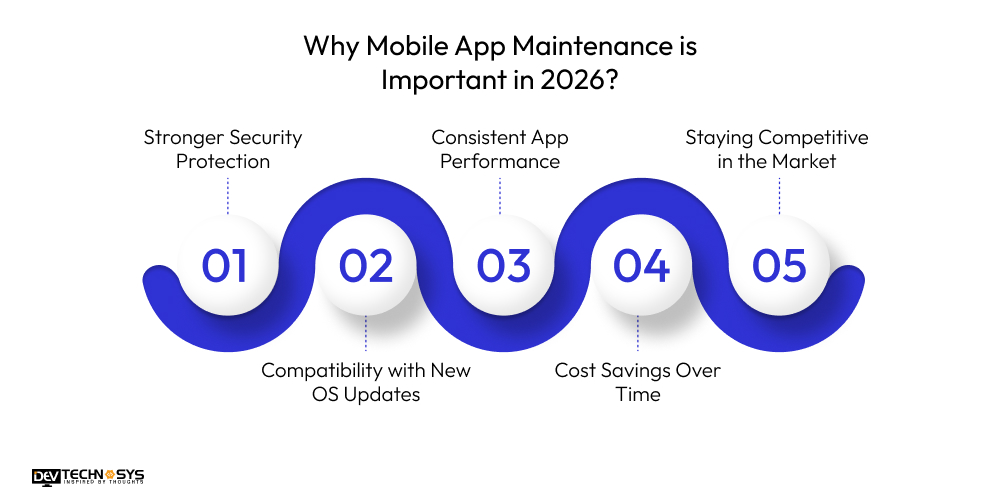
To stay competitive, removing increasing security threats, maintaining performance, reducing higher maintenance costs in the future, etc., app maintenance is important. In this section, we will learn about the importance of mobile app maintenance in 2026.
1. Stronger Security Protection
With the technological advancement in 2026, the cyber threats are also becoming advanced. So, regular maintenance comes with high security patches and encryption that fixes security issues in no time. It protects user data from multiple security breaches to maintain the trust and reputation of the application.
2. Compatibility with New OS Updates
The affordable mobile app maintenance services also evolve with rapidly changing operating systems. It even makes sure the app stays compatible with the latest versions of iOS and Android. Along with that, it lowers the chances of crashes, broken features, and poor user experiences.
3. Consistent App Performance
The ongoing mobile app maintenance services help promote speed and stability while reducing bugs. It works to provide smooth performance on various devices, increasing user satisfaction and retention. When the app’s performance is consistent, the app will never slow down or show unreliable behaviour.
4. Cost Savings Over Time
Continuous maintenance and updates help in fixing small issues early at a lower cost. It is a better option than having major, unexpected, and unbearable failures in the future. It even minimizes technical debt and emergency fixes. When proper maintenance is done on time, it lowers the cost to maintain a mobile app.
5. Staying Competitive in the Market
In this highly technological world, users expect something extraordinary every time, making maintenance really essential. It lets the app stay competitive and evolving with the latest trends in the crowded app market. With maintenance, new features get integrated according to the users’ feedback.
How Much Is The Average Mobile App Maintenance Cost in 2026?
The average app monitoring and maintenance expenses can commonly be estimated between $800 and $5000. This cost covers:
- OS versions
- Fixing bugs
- Security enhancements
- Performance improvements
- Server support
- Small feature tweaks
Generally, the early app maintenance services cost might be higher due to immediate fixes, according to user feedback. But over time, this cost becomes more predictable and affordable because apps get stabilized. For continuous trustworthiness, security, and an amazing user experience, the budgeting of the cost of maintaining an app after launch is necessary.
Here we will explain this through an app maintenance cost breakdown table:
| Maintenance Level | Description | Estimated Annual Cost |
| Basic Maintenance | Routine bug fixes, minor UI adjustments, basic performance monitoring, small updates | $4,500 – $12,000 |
| Standard Maintenance | OS compatibility updates, security patches, performance optimization, server support, moderate features | $9,000 – $20,000 |
| Advanced Maintenance | Complex feature enhancements, scalability improvements, emergency handling, continuous monitoring | $15,000 – $30,000 |
What Are The Types of Mobile App Maintenance?
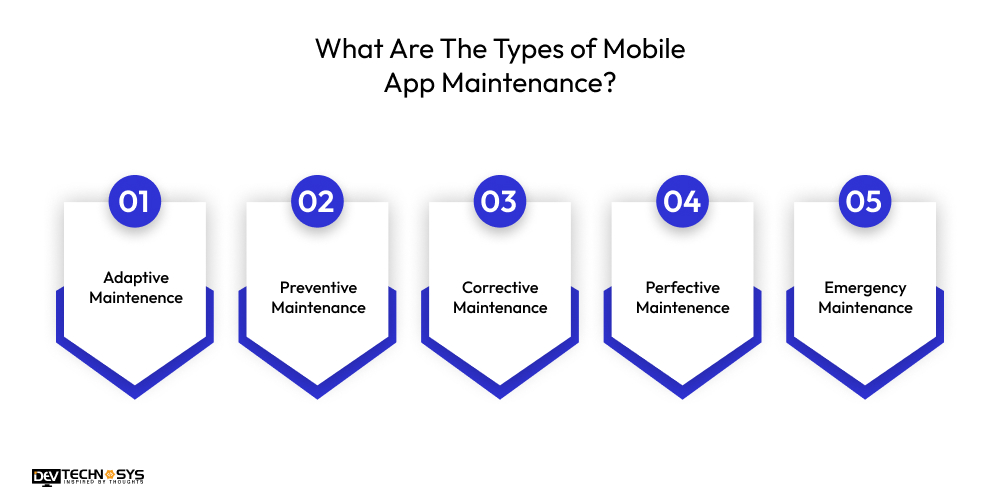
Adaptive, corrective, preventive, perfective, and emergency are the types of mobile app maintenance. These types make sure the app continues to be functional, secure, and relevant for users over time. Here, we will explain the types of mobile app maintenance.
| Maintenance Type | Estimated Annual Cost |
| Adaptive Maintenance | $7,000 – $24,000 |
| Preventive Maintenance | $6,000 – $18,000 |
| Corrective Maintenance | $5,000 – $15,000 |
| Perfective Maintenance | $9,000 – $30,000 |
| Emergency Maintenance | $12,000 – $30,000 |
1. Adaptive Maintenance
Adaptive maintenance updates the app in such a way that it remains compatible with the changes in the modern technology ecosystem. This type of maintenance is required when updates are made to operating systems, devices, screen sizes, APIs, or third-party services.
| Factor | Details |
| Maintenance Type | Adaptive Maintenance |
| Primary Purpose | Keep the mobile app compatible with the latest operating systems, devices, screen sizes, browsers, APIs, and third-party integrations. |
| Common Activities | OS version updates, SDK upgrades, API integration updates, cloud compatibility improvements, device optimization, and framework migration. |
| When It’s Required | Whenever Apple, Google, or third-party service providers release updates that impact app functionality. |
| Business Impact | Prevents compatibility issues, improves user experience, and extends the application’s lifespan. |
| Estimated Annual Cost | $7,000 – $24,000 |
2. Preventive Maintenance
Preventive maintenance is mainly accepted when you have to do code optimization, refactoring, and security updates. This type of maintenance is mainly preferred to avoid future risks and potential failures, like under- or over-maintenance, lack of parts, improper scheduling, and more.
| Factor | Details |
| Maintenance Type | Preventive Maintenance |
| Primary Purpose | Reduce future technical issues through proactive improvements and code optimization. |
| Common Activities | Code refactoring, database optimization, security patches, dependency updates, performance monitoring, and infrastructure improvements. |
| When It’s Required | Regularly throughout the year as part of scheduled maintenance. |
| Business Impact | Improves app stability, security, scalability, and long-term performance while reducing future maintenance expenses. |
| Estimated Annual Cost | $6,000 – $18,000 |
3. Corrective Maintenance
In corrective maintenance, hire dedicated developers for bug fixing, crashes, and errors found after app launch. This maintenance makes sure the app works as seamlessly by resolving issues related to performance, functional defects, and user-reported problems.
| Factor | Details |
| Maintenance Type | Corrective Maintenance |
| Primary Purpose | Fix bugs, crashes, and unexpected application issues after deployment. |
| Common Activities | Bug fixing, crash resolution, UI issue correction, database fixes, API troubleshooting, and functionality improvements. |
| When It’s Required | Whenever users report issues or system monitoring detects application errors. |
| Business Impact | Improves reliability, minimizes downtime, and maintains customer satisfaction. |
| Estimated Annual Cost | $5,000 – $15,000 |
4. Perfective Maintenance
Perfective maintenance helps in enhancing the features, user interface, and performance of the application. All these changes are made according to the user feedback and analytics. The purpose of this maintenance is to improve usability, speed, and overall user experience.
| Factor | Details |
| Maintenance Type | Perfective Maintenance |
| Primary Purpose | Enhance application performance and user experience by adding new features and improving existing functionality. |
| Common Activities | UI/UX redesign, feature enhancements, workflow improvements, performance optimization, analytics-driven updates, and customer-requested improvements. |
| When It’s Required | Based on user feedback, market trends, and evolving business requirements. |
| Business Impact | Increases user engagement, customer retention, and overall application value. |
| Estimated Annual Cost | $9,000 – $30,000 |
5. Emergency Maintenance
Emergency maintenance is widely accepted in case of immediate fixes for critical, unexpected failures that can even stop the app. It includes app crashes, security breaches, or server failures that majorly affect the app’s functionality. It protects users and businesses from serious losses.
| Factor | Details |
| Maintenance Type | Emergency Maintenance |
| Primary Purpose | Resolve critical issues immediately to restore normal application operations. |
| Common Activities | Security breach response, server recovery, production hotfixes, outage resolution, data recovery, and critical vulnerability patching. |
| When It’s Required | During unexpected incidents that severely affect application availability or security. |
| Business Impact | Reduces downtime, protects sensitive data, and minimizes financial and reputational losses. |
| Estimated Annual Cost | $12,000 – $30,000 |
What Factors Drive Maintenance Costs Up or Down in 2026 – 2027?
App complexity, operating system updates, security requirements, backend infrastructure, and performance optimization are among the factors affecting the mobile application maintenance cost. Now, we will learn how these factors influence the enterprise mobile application maintenance cost.
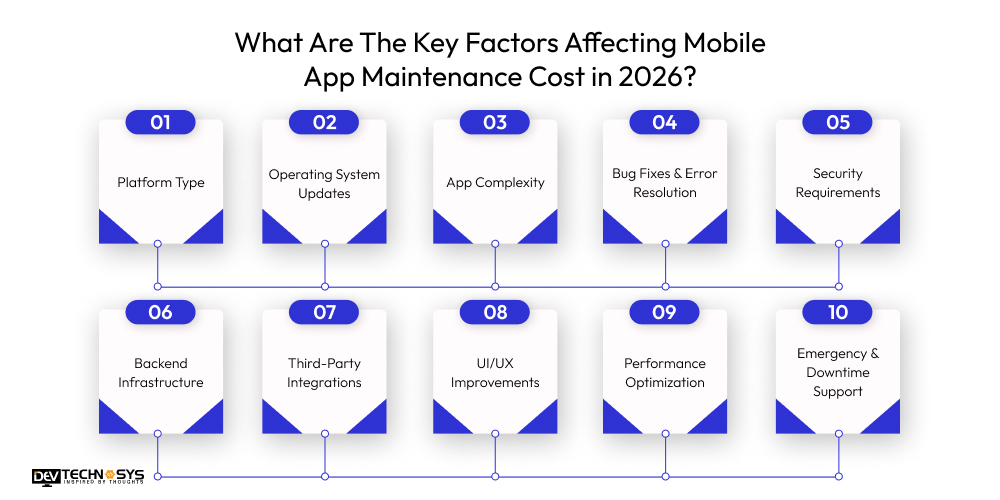
1. Platform Type
iOS, Android, or both are the platforms that significantly influence the app maintenance cost for startups and large businesses. It is because each platform has its own separate programming language, design guidelines, testing requirements, and app store policies. It even includes separate bug fixes and platform-specific updates, which adds to the costs.
| Maintenance Level | Description | Estimated Cost |
| Single Platform (Android or iOS) | Maintenance limited to one platform, fewer compatibility checks | $5,000 – $9,000 |
| Dual Platform (Android & iOS) | Parallel updates, testing, and optimization for both platforms | $9,000 – $18,000 |
| Cross-Platform App | Shared codebase with platform-specific fixes and framework upgrades | $18,000 – $24,000 |
2. Operating System Updates
Operating systems generally release updates with new features, security policies, or functions frequently. These updates require proper code adjustments, UI redesigns, regression testing, and performance optimization. If OS updates are not done seriously, it leads to a higher emergency cross-platform app maintenance cost.
| Maintenance Level | Description | Estimated Cost |
| Minor OS Updates | Small changes to ensure compatibility with minor OS patches | $5,000 – $7,000 |
| Major OS Releases | Adjustments for new Android/iOS versions with UI and API changes | $7,000 – $18,000 |
| Continuous OS Adaptation | Ongoing monitoring and quick fixes across multiple OS versions | $18,000 – $27,000 |
3. App Complexity
Multiple features, complex business logic, advanced animations, offline capabilities, or heavy data processing increase the complexity of the application. These require thorough testing, careful monitoring, and the need to hire mobile app developers. All these reasons are enough to impact the cost to maintain a mobile app.
| Maintenance Level | Description | Estimated Cost |
| Basic App | Simple functionality with minimal workflows and logic | $5,000 – $8,500 |
| Medium Complexity App | Multiple features, user roles, and integrations | $8,500 – $18,000 |
| High Complexity App | Advanced workflows, real-time data, heavy backend logic | $18,000 – $30,000 |
4. Bug Fixes & Error Resolution
There is an essential need to identify, analyze, and resolve the bugs and errors within the application. This incorporates efficient and continuous monitoring, focused debugging, patch deployment through texting, and other resolution processes. It will become an ongoing contributor to the bug-fixing cost for mobile apps.
| Maintenance Level | Description | Estimated Cost |
| Minor Bug Fixes | UI glitches and small functional errors | $5,000 – $9,000 |
| Moderate Issue Resolution | Feature-level bugs affecting usability | $9,000 – $15,000 |
| Critical Bug Handling | App crashes or issues impacting core functionality | $15,000 – $27,000 |
5. Security Requirements
For the apps that handle sensitive personal and financial data of users, maintaining security is a top priority. It incorporates proactive security measures, encryption updates, authentication improvements, regulatory compliance, and immediate threat response. These measures require specialized experts, tools, and time, which raises the app security and maintenance cost.
| Maintenance Level | Description | Estimated Cost |
| Basic Security Updates | Routine security patches and monitoring | $5,000 – $12,000 |
| Enhanced Security Measures | Data encryption updates and compliance checks | $12,000 – $21,000 |
| High-Security Maintenance | Advanced threat monitoring and security audits | $21,000 – $30,000 |
6. Backend Infrastructure
As we know backend is the powerhouse of the app’s functionality that helps in managing databases, servers, APIs, and cloud services. Therefore, there is a need for regular monitoring, load balancing, and infrastructure upgrades. This is a critical and essential part that escalates the app updates and maintenance cost.
| Maintenance Level | Description | Estimated Cost |
| Basic Server Maintenance | Server monitoring, backups, and uptime checks | $5,000 – $9,000 |
| Scalable Backend Support | Cloud optimization and load balancing | $9,000 – $21,000 |
| Complex Infrastructure | Microservices, databases, real-time processing | $21,000 – $30,000 |
7. Third-Party Integrations
Multiple apps integrate third-party APIs, SDKs, payment gateways, analytics tools, and cloud services. That’s why maintaining compatibility with several external services requires proper time, effort, and resources. This makes the management of third-party integration a significant factor influencing the mobile app performance optimization cost.
| Maintenance Level | Description | Estimated Cost |
| Limited Integrations | Payment or analytics tools with minimal updates | $5,000 – $8,000 |
| Multiple Integrations | CRM, marketing, or messaging APIs | $8,000 – $18,000 |
| Complex API Ecosystem | Frequent API version changes and dependency management | $18,000 – $27,000 |
8. UI/UX Improvements
The expectations of users and design trends are evolving rapidly, leading to the need for periodic updates of the app’s interface and user experience. It includes redesigning layouts, improving navigation, adding accessibility features, and optimizing for new device screen sizes. This requires skilled designers, contributing to the monthly mobile app maintenance cost.
| Maintenance Level | Description | Estimated Cost |
| Minor UI Enhancements | Small design tweaks and layout adjustments | $5,000 – $9,000 |
| UX Optimization | User flow improvements based on analytics | $9,000 – $18,000 |
| Redesign Support | Continuous UI refinement to match trends | $18,000 – $30,000 |
9. Performance Optimization
Optimizing and maintaining the app’s performance is really essential for an outstanding user experience. Due to this load time is improved, ensuring the app responds to multiple devices. It even reduces memory consumption and optimizes battery usage. All these things can directly impact the long-term iOS and Android app maintenance cost.
| Maintenance Level | Description | Estimated Cost |
| Basic Performance Tuning | Speed fixes and memory optimization | $5,000 – $11,000 |
| Advanced Optimization | Load time reduction and API performance tuning | $11,000 – $21,000 |
| High-Traffic Optimization | Scaling for peak usage and real-time performance | $21,000 – $30,000 |
10. Emergency & Downtime Support
Sometimes, unexpected issues occur, like server crashes, app downtime, or security breaches, which require instant fixing. If not handled quickly, these issues can cause severe damage to the finances and the app’s reputation. So, a proper contingency plan, monitoring tools, and rapid response capability is needed, which, however, surges the mobile application maintenance cost.
| Maintenance Level | Description | Estimated Cost |
| On-Demand Support | Issue resolution during business hours | $5,000 – $10,000 |
| Priority Support | Faster response times and partial monitoring | $10,000 – $18,000 |
| 24/7 Emergency Support | Round-the-clock monitoring and instant issue resolution | $18,000 – $30,000 |
What Is The Mobile App Maintenance Cost By App Category?
Knowing the mobile app maintenance cost according to different app categories explains how long-term expenses are influenced in various industries. It reveals how factors like functionality, user expectations, security needs, and update frequency affect the final mobile app development cost.
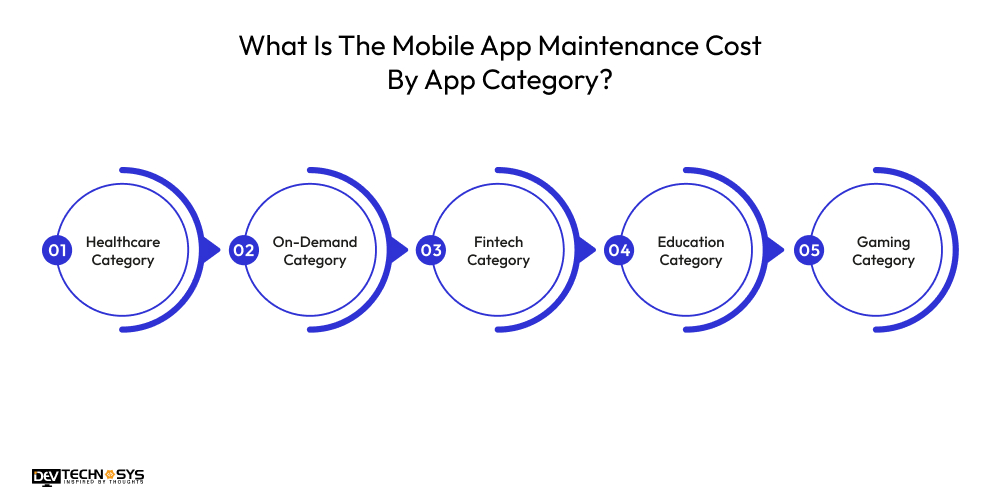
1. Healthcare Category
A healthcare app comes with strict compliance, such as data privacy laws, security updates, and integration with medical databases. That’s why regular bug fixes, UI/UX improvements, and performance optimization are mandatory. However, this makes the healthcare app maintenance cost higher.
2. On-Demand Category
On-demand apps, like ride-hailing, food delivery, or others, require constant backend monitoring, real-time updates, server scalability, and frequent feature enhancements. Such apps have high user interaction and dynamic content that makes their maintenance more complex and cost-intensive.
3. Fintech Category
Fintech apps hold a large amount of users’ personal and financial data. Therefore, it demands high security, encryption, regulatory compliance, and continuous monitoring. Due to this, fintech apps require regular updates, bug fixes, and performance tuning. This results in the higher Fintech Android or iOS app maintenance cost.
4. Education Category
Education apps need continuous content updates, feature enhancement, and interactive elements. It also requires checking the app’s compatibility with various devices. Its mobile app maintenance pricing model improves user experience by adding new learning tools and ensuring stability.
5. Gaming Category
Gaming apps mainly require frequent updates, graphics optimization, bug fixes, and server maintenance. For great user engagement, analytics, new levels, and performance optimization are required. All these things increase the ongoing maintenance cost, especially for high-traffic or interactive games.
| App Category | Why Cost Differs | Estimated Annual Cost |
| Healthcare | Strict compliance, data privacy, integration with medical databases | $15,000 – $30,000 |
| On-Demand | Constant backend monitoring, real-time updates, server scalability | $9,000 – $24,000 |
| Fintech | High security, encryption, regulatory compliance, continuous monitoring | $18,000 – $30,000 |
| Education | Content updates, feature enhancements, device compatibility checks | $5,000 – $15,000 |
| Gaming | Frequent updates, graphics optimization, server maintenance, engagement analytics | $12,000 – $30,000 |
Planning a Mobile App?
Get a tailored development cost estimate in 3 simple steps — app basics, features, timeline, and your contact details.
- 3 quick steps
- 100% free
- Reply in 1 business day
2 Minutes Read
Mobile App Maintenance Cost by Region: Global Price Comparison (2026-2027) (After cost by category section)
The location where your development team resides will directly affect your yearly maintenance cost. There are considerable differences in hourly rates of developers between regions. Since maintenance is charged monthly, any difference in hourly rates adds up to a significant amount over a year. This is how much each type of maintenance will cost you in different outsourcing locations.
| Region | Average Hourly Rate | Estimated Annual Maintenance Cost* |
| United States & Canada | $100 – $180/hr | $20,000 – $45,000+ |
| United Kingdom & Western Europe | $80 – $150/hr | $16,000 – $38,000 |
| Australia & New Zealand | $70 – $140/hr | $14,000 – $35,000 |
| Middle East (UAE, Saudi Arabia) | $50 – $110/hr | $10,000 – $27,000 |
| Eastern Europe (Poland, Ukraine, Romania) | $40 – $80/hr | $9,000 – $20,000 |
| Latin America (Brazil, Mexico, Argentina) | $35 – $70/hr | $7,500 – $17,500 |
| India & Southeast Asia | $20 – $50/hr | $4,500 – $15,000 |
| Africa (Nigeria, South Africa, Egypt) | $20 – $45/hr | $4,500 – $12,000 |
Many businesses choose a hybrid approach to save money and maintain quality. Their in-house or local team oversees the project, while an offshore development partner handles routine maintenance, updates, and bug fixes. This provides reliable support at a lower cost than hiring a fully local maintenance team.
Expert Insight:
These are estimated costs for a typical mobile app. The actual maintenance cost will depend on the app’s complexity, features, and the level of support required.
– Narayan Das (Project Manager)
What Are The Hidden Costs in Mobile App Maintenance?
The hidden costs of mobile app maintenance include cloud hosting, third-party API fees, OS compatibility updates, and more. Now we will learn about these hidden costs and how it impacts the overall app maintenance budget if not planned in advance.
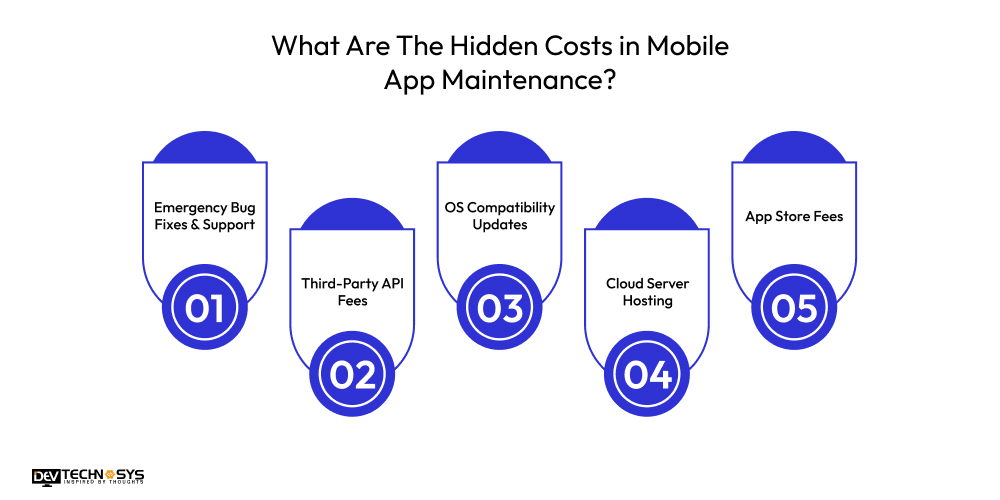
1. Emergency Bug Fixes & Support
Oftentimes, unexpected bugs appear after launch that need to be fixed immediately. This emergency support usually costs more because it includes extra efforts, development time, testing, and quick updates.
2. Third-Party API Fees
There are many apps that rely on third-party APIs for analytics, payment, and maps. These tools usually charge monthly or per-use fees. Therefore, as the app’s usage grows, the fees also grow over time.
3. OS Compatibility Updates
A mobile app development company updates the operating system to make it compatible with new OS versions. This update prevents crashes and supports new features; however, it requires continuous development and testing effort.
4. Cloud Server Hosting
Cloud servers are used to store app data and manage traffic as the number of users increases. It even gives rise to hosting, storage, security, and bandwidth costs. This can be along-term but an underestimated maintenance cost.
5. App Store Fees
To keep the app listed, updated, and available to users on the app store, app owners have to pay an account fee. This is a recurring, long-term maintenance cost that is mandatory and depends on the platform.

Cost of App Maintenance vs. Cost of App Redevelopment: What Will Be The Difference?
Knowing the comparison between app development and app redevelopment helps enterprises select a strategy according to their budget. Be it app maintenance or app redevelopment, both can improve performance, scalability, security, and long-term user experience. Without any further delays, let us understand the difference.
| Cost Factor | App Maintenance Cost | App Redevelopment Cost |
| Base Cost Calculation | 15–20% of original development cost, annually | 80–100%+ of original development cost, one-time |
| Estimated Cost Range
(on a $30,000–$150,000 build) |
$4,500 – $30,000 per year | $24,000 – $150,000+ one-time |
| Cost Frequency | Recurring — billed annually or monthly | One-time, though may recur every 3–5 years for legacy apps |
| Cost Predictability | High — costs scale gradually with defined maintenance tiers | Low — scope creep is common once rebuilding begins |
| Hidden Cost Risk | Low — mostly limited to emergency fixes or compliance updates | High — data migration, retraining, downtime, and re-testing add up |
| Cost per Feature Change | Lower — incremental updates cost less per change | Higher — even small changes require full-stack rework |
| Cost of Delay | Low — postponing a minor update rarely compounds cost | High — delaying redevelopment on outdated architecture increases technical debt and future cost |
| Cost-Efficiency Window | Most cost-efficient for the first 2–4 years post-launch | Becomes cost-justified once maintenance costs approach 40–50% of original build cost |
| Long-Term Cost Value | Lower total spend if app architecture stays current | Higher upfront cost but resets technical debt for better long-term ROI |
How AI Is Changing Mobile App Maintenance Costs in 2026-2027?
Maintenance through AI is increasingly becoming the most significant means of managing costs in the long run. The team reviewing logs, testing updates, and fixing bugs individually can all be managed with AI tools. This will make the maintenance budget not only smaller but different too.
How AI Helps Save on Maintenance Costs?
-
Automation of bug detection
With the help of monitoring systems, bugs can be identified instantly. This allows minimizing the time required to check the logs and perform QA manually.
-
Predictive maintenance
With machine learning tools, failure risks can be predicted. For example, when an API comes close to its deprecation date.
-
Code review and testing using AI
Generative AI and computer vision automate test suites, minimizing the time a developer spends performing regression tests after each update.
-
Chatbot-based customer support
LLMs (Large Language Models) understand customer complaints in natural language. They can answer common support questions through chatbots.
AI-Assisted Maintenance: When Does It Actually Pay Off?
To understand what AI-assisted maintenance pays off, we have taken an example of a mid-level complex app. Here is how the cost curve will look for a medium-complexity application, with and without AI-powered maintenance support, in three years.
| Timeline | Traditional Maintenance | AI-Assisted Maintenance | Net Difference |
| Year 1 (incl. setup) | $14,000 | $16,500 (incl. $5,000 setup) | +$2,500 more expensive |
| Year 2 | $14,000 | $10,000 | −$4,000 savings |
| Year 3 | $14,000 | $9,500 | −$4,500 savings |
| 3-Year Total | $42,000 | $36,000 | −$6,000 saved overall |
This curve remains constant for most medium to high complexity applications. Here, AI-based maintenance tools cost more in the first year due to deployment and maintenance costs. But break even from month 14-16 onwards and keep making more savings thereafter. This is primarily due to reduced manual QA efforts and preventing problems from becoming urgent fixes. In simple, less-used applications, such a break-even does not occur within 3 years. This is why AI-powered maintenance is relevant only for applications with regular updates and high daily active users.
How to Reduce Mobile App Maintenance Cost in 2026?
By implementing cross-platform development, third-party APIs, MVP launch, proactive monitoring, and so on, the app server maintenance cost can be decreased. Here, we will explain the ways to lower the mobile app maintenance costs.
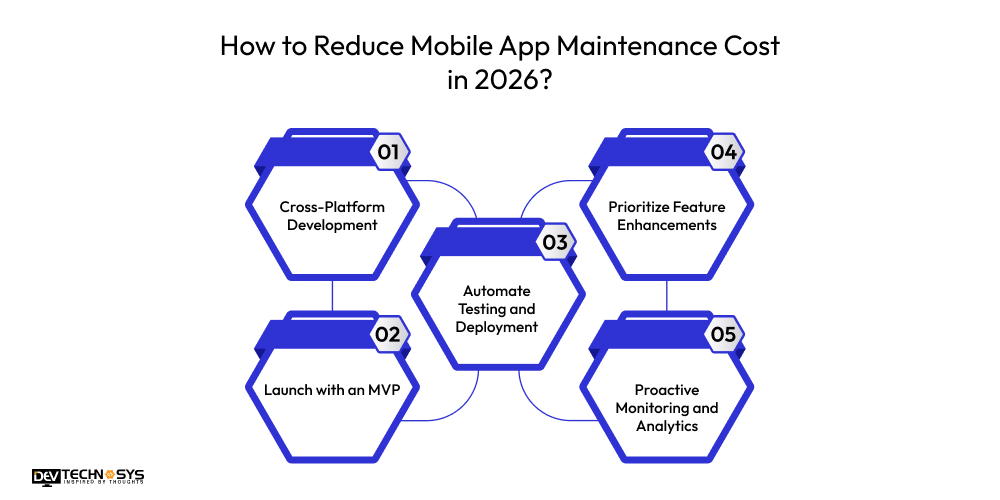
1. Cross-Platform Development
One of the best ways to reduce the development and maintenance costs is to make an app that works on both Android and iOS. In cross-platform development, a single codebase is used, which means fewer bugs, faster updates, and less effort.
2. Launch with an MVP
Rather than spending money on maintaining unused functionalities of the app, it is better to focus on the core ones initially. This measure helps you reduce unnecessary development costs and allows you to improve the app gradually as per the user feedback.
3. Automate Testing and Deployment
Take advantage of automation tools to test the app and automatically release the updates. It reduces the manual work and chances of human errors. Automated testing and deployment not only save time but also lower the mobile app maintenance cost.
4. Prioritize Feature Enhancements
Focus on updating features that are actually valuable for the users instead of updating everything. This prevents unnecessary work, rework, efforts, time, and expense. This measure ensures development time and budget are spent where they bring real impact.
5. Proactive Monitoring and Analytics
Monitoring tools track app performance, crashes, and user behavior in real time. It fixes issues early, prevents major problems, reduces emergency fixes, and helps keep maintenance costs predictable and under control.
Real Maintenance Cost Data From Dev Technosys Projects
Industry benchmarks are a useful starting point, but they don’t always reflect what maintenance actually costs. Once an app is live and handling real users, maintenance requirements depend on its complexity, usage, infrastructure, and update frequency. Here’s what we’ve seen across recent projects at Dev Technosys:
| Project Type | Development Investment | Actual Annual Maintenance Spend | What Drove the Cost |
| Mid-size e-commerce app | $65,000 | $11,500/year | Seasonal traffic spikes, payment gateway updates, quarterly UI refreshes |
| On-demand service app | $85,000 | $16,000/year | Real-time tracking maintenance, third-party API changes, driver-app sync issues |
| Enterprise SaaS platform | $140,000 | $27,000/year | Compliance updates, scalability improvements, 24/7 monitoring requirement |
Note: Since many of our projects are protected by non-disclosure agreements (NDAs), we can’t share exact client costs. The figures above are based on our experience managing similar mobile app maintenance projects and are intended to give you a realistic estimate. – Mohit Nag (CTO)
Final Words
In 2026, the maintenance of mobile or web apps is no longer a one-time expense. It has become a continuous and important investment in quality and user trust. When an app is maintained regularly, it remains secure, offers better performance every time, and even adapts to changing technologies.
Ongoing updates and maintenance are affected by several factors and even come with some hidden costs. However, with the right mobile app maintenance company, everything will become easy to extend your app’s lifespan.
In a nutshell, maintenance is something that keeps your app healthier and competitive after launch. It quietly works backstage to give your app long-term success in this dynamic landscape.
Frequently Asked Questions
Find answers to the most common questions related to this article.
Usually, the average mobile application maintenance cost per year can be commonly estimated from $800 to $5,000. However, the final cost depends on the server & hosting, security & compliance, AI integration, bug fixes, UX upgrades, and so on.
Some of the key factors that drive the app maintenance cost in 2026 include:
● App Complexity
● Operating System Updates
● Bug Fixes & Error Resolution
● Backend Infrastructure
● UI/UX Improvements
● Performance Optimization
No, the development expenses do not include maintenance costs. Development cost only covers building an app, whereas maintenance cost is separate and an ongoing expense. Most development quotes do not include maintenance unless explicitly stated in the contract. So it is important to budget the maintenance separately.
If you don’t maintain your app properly, you will have to face many consequences. Without maintenance, your app will give poor performance, which can lead to rising security issues and decreased user retention and satisfaction. Even though Apple and Google can aggressively remove or hide your app in 2026 without updates.
Generally, most of the apps need an update every 4 to 6 weeks. It is essential to stay current with OS changes, security patches, and minor bug fixes. If the feature updates are large, they are rolled out quarterly. Whereas critical updates related to security should be a top priority and must be updated as soon as possible.
Yes, maintenance is inexpensive for Flutter and React Native aps. It is because Flutter and React Native apps share a single codebase across iOS and Android. That’s why updates and bug fixes only need to be made once rather than twice. This typically reduces maintenance costs by 20–30% compared to maintaining two separate native codebases.
Yes, an ongoing monthly or annual subscription model would be much less expensive compared to an hourly pay-as-you-go model. It is based on a stable and predictable workload, while pay-per-use implies urgent and unpredictable requests. The exception is when the app has minimal maintenance needs.
Yes, Apple and Google periodically change the App Store and Play Store policies. This is due to data privacy requirements, in-app purchases, and deprecated API. It is necessary to ensure the application complies with the latest policies. This means each new release usually involves updating the app to reflect policy changes.