














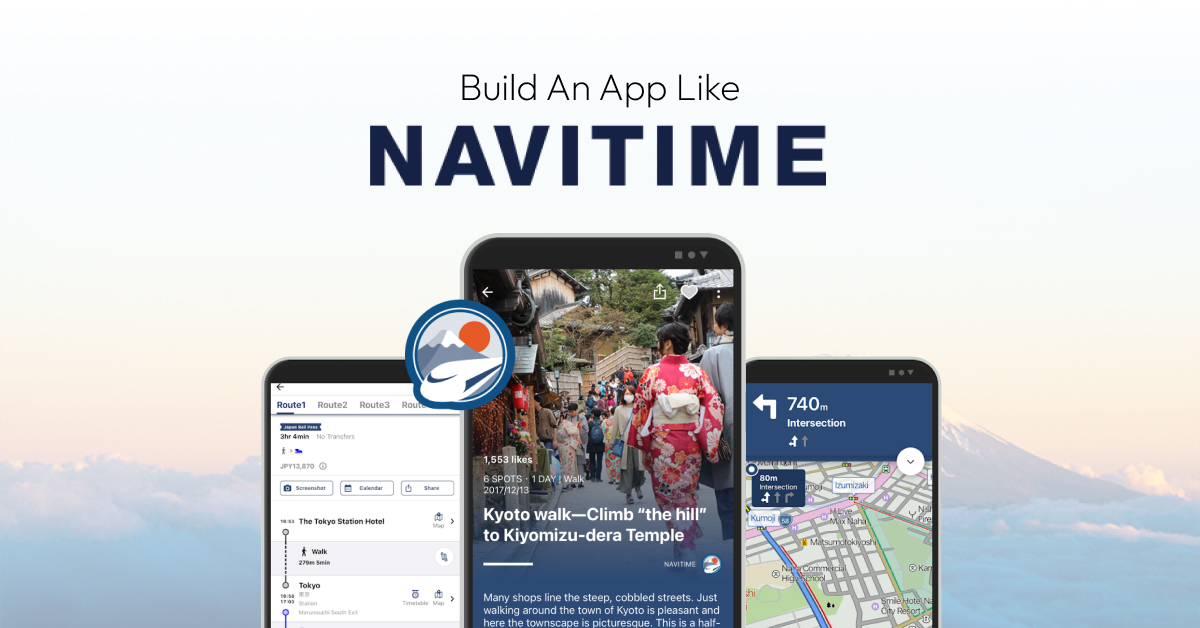
Exploring NAVITIME, one of Japan’s most loved travel applications that assists with examining routes, train schedules. It offers travel suggestions and is one of the best ways for travelers to make the most out of their travel experience in Japan.
If you’ve ever wanted to build an app like NAVITIME, you should check this out!
Creating a NAVITIME-type application might be easier than you thought.
In this blog, we will take you through the simplest and basic steps to aid in the planning, design, and construction of an application that users will find invaluable in their travels.
If you’re an entrepreneur or an individual who holds rare knowledge, this will demonstrate the steps of shaping a concept into an actual application that will provide its users with a seamless experience.
Market Statistics of Global Navigation Apps
- The global navigation applications market is valued at around $1.62 billion in 2024, this is projected to increase to around $5.4 billion by the end of 2034.
- In 2024, the consumer electronics segment will dominate the market and hold a revenue share of around 62.8% of the navigation apps market.
- As per the ground-level research, the mobile phones segment led the market and recorded a 49.5% share of the navigation application market in 2024.
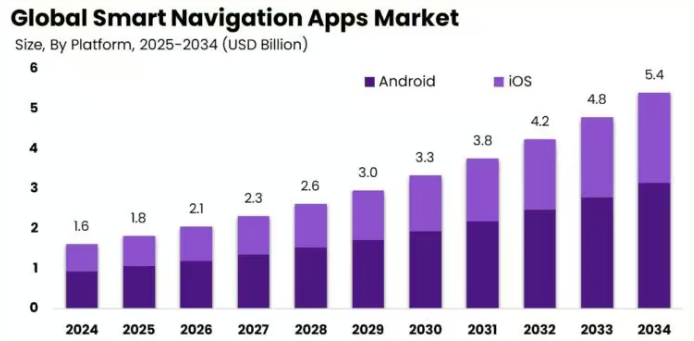
- In a study, the smart navigation apps market is expected to grow with a CAGR of 12.80% from 2025 to 2034.
- North America is one of the most revenue-generating countries in smart navigation apps around $0.52 billion in 2024.
What is NAVITIME?
NAVITIME is one of the most popular navigation platforms in Japan. It offers information on route planning for buses, trains, bicycles, cars, and walking, helping users to easily get around.
Users can also see the real-time transit information, such as delays, cancellations, travel time, and transfers. NAVITIME offers maps to view the real-time traffic and get the fastest routes.
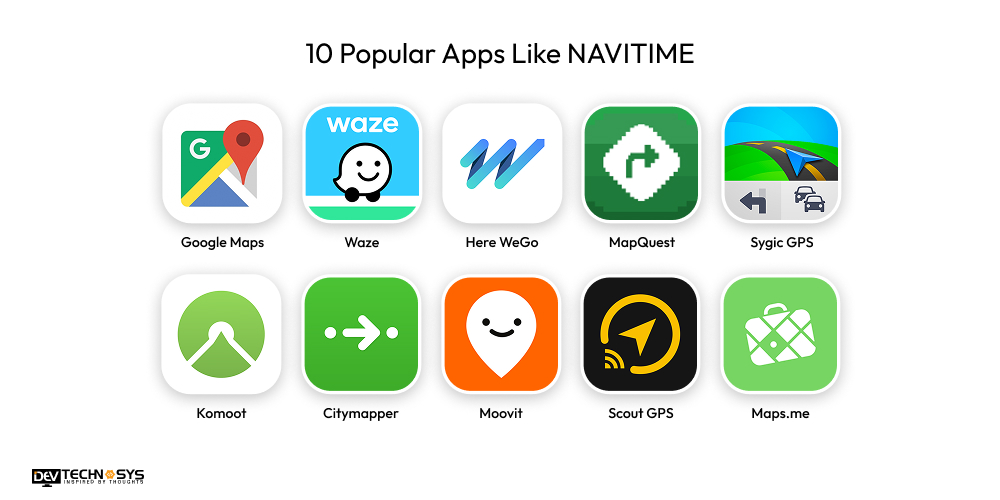
10 Popular Apps Like NAVITIME
Before creating a navigation app, you must look at the best navigation apps that help businesses to get an idea of what features must be implemented. So, here we provide the list of location-based app development like NAVITIME alternatives:
App Name |
Approx. Downloads |
Ratings |
Launch Year |
Platform Availability |
| Google Maps | 10B+ | 4.3 | 2005 | Android, iOS, Web |
| Waze | 500M+ | 4.4 | 2006 | Android, iOS |
| Here WeGo | 100M+ | 4.1 | 2012 | Android, iOS, Web |
| MapQuest | 50M+ | 4.0 | 1996 | Android, iOS, Web |
| Sygic GPS | 50M+ | 4.2 | 2004 | Android, iOS |
| Komoot | 10M+ | 4.6 | 2010 | Android, iOS, Web |
| Citymapper | 10M+ | 4.5 | 2011 | Android, iOS, Web |
| Moovit | 100M+ | 4.4 | 2012 | Android, iOS, Web |
| Scout GPS | 10M+ | 4.1 | 2007 | Android, iOS |
| Maps.me | 100M+ | 4.5 | 2011 | Android, iOS |
Why Today’s Businesses Invest in Navigation App Development?
Investing in the route planner app development is a lucrative opportunity for businesses and can easily reach a global audience. As we look at the market statistics, we see how rapidly it grows and audiences use it regularly for their traveling and flexibility. So, here we provide the benefits for businesses:
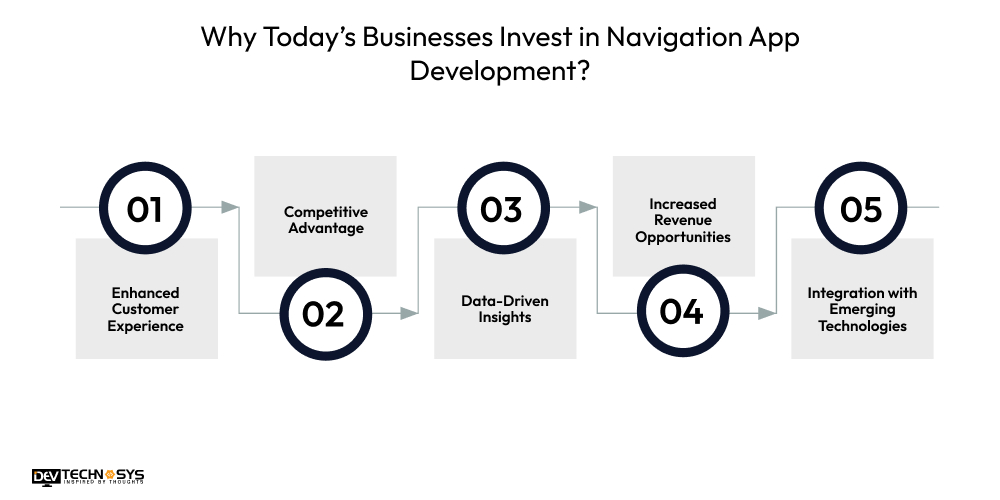
1. Enhanced Customer Experience
Based on customer journeys, businesses build a GPS tracking app like Geo Tracker, and provide real time navigation directions and messages about traffic.
Customers love the stress reduction of travel and appreciate the time-efficient planning services. Customers engage with businesses and build loyalty with the business’s digital services.
2. Competitive Advantage
Businesses gain a strategic advantage with the use of navigation applications. Geolocation technologies enable personalized and value-added services.
Businesses can differentiate their offerings by establishing a digital presence, which leads to market leadership and brand ownership. Businesses can gain authority within the competitive landscape of real-time services.
3. Data-Driven Insights
Businesses gain a competitive advantage through develop a GPS tracking app like Glympse. Businesses optimize service delivery, marketing, and operational effectiveness through travel geography and pattern analytics. Predictive analytics create value for businesses and service users through business performance enhancement.
4. Increased Revenue Opportunities
Businesses create strategic partnerships, monetizing traffic data through in-app advertising and premium navigation services. These data-driven strategic partnerships improve user experience, provide real-time offers to users, and drive business growth through sustainable profitability. Continuous monetization of offers through digital services drives business profitability.
5. Integration with Emerging Technologies
Businesses capitalize on the combined use of Artificial Intelligence, Augmented Reality, and the Internet of Things in navigation apps, offering more intelligent and interactive experiences.
Predictive navigation, real-time hazard detection, and seamless smart-device connectivity are innovatively integrated with operational efficiencies and customer satisfaction in businesses.
Step-by-Step Process to Build an App Like NAVITIME
To make an app like NAVITIME, you need to analyze the simple steps that enable businesses to easily understand every process. It includes market analysis, identifying functionalities, technologies, designing, and many more. Here we provide the navigation app development process:
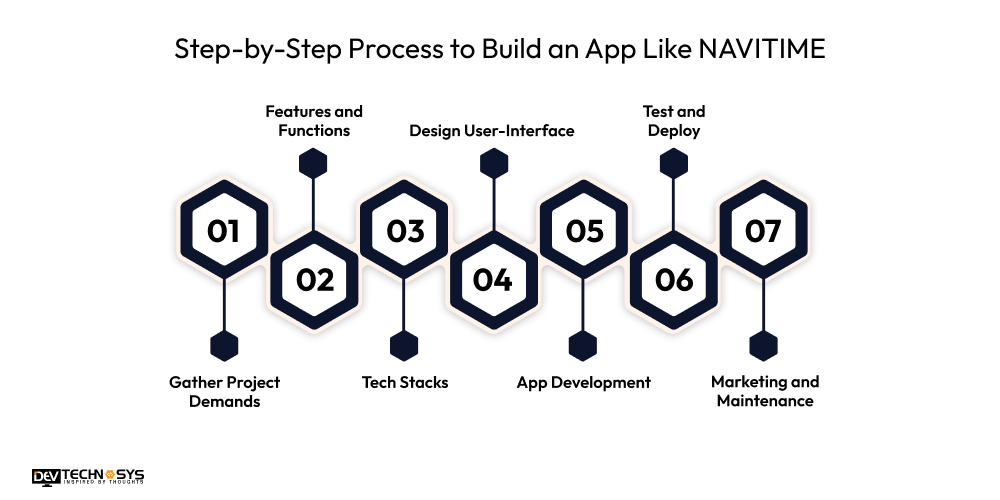
1. Gather Project Demands
Before starting the project, you must identify the future goals and what the project requirements and demands are. Make a list of requirements to reduce data duplication and misunderstandings.
After that, observe similar apps like NAVITIME and find out their success rates and working criteria. You can also identify your app’s ideal users from the targeted audience.
2. Features and Functions
Select the best features and functions for your navigation app. You can hire developers from a mobile app development company to create an organized sheet of features and observe the NAVITIME clone app’s features to implement some useful features. There are various features such as real-time tracking, traffic updates, route optimization, and more.
3. Tech Stacks
In the third stage, to make an app like NAVITIME, choosing tech stacks for a reliable and efficient transit navigation app development. Technologies such as HTML, CSS, JavaScript(For Frontend), Java, Python, PHP(For Backend), Google Cloud, AWS (Cloud Storage), SQL, PostgreSQL(Database), and Figma, Marvel(Designing Tools).
4. Design User-Interface
Let’s move to the fourth stage to develop a location-based app, design a user-friendly interface that allows users to quickly access the navigation bars and understand each functionality. There are various types of UI elements that exist, such as themes, wireframes, layouts, fonts, templates, styles, prototyping, and texture.
5. App Development
Coming to the fifth step to create an app like NAVITIME, it’s time to begin the real coding for backend processes. It also includes various types of third-party integrations such as analytics, CRM, social media logins, ERP, payment gateways, and many more. Backend developers need to manage or handle the server-side data and create new APIs.
6. Test and Deploy
In the second last stage of the GPS tracking app development process, test the application under various conditions to find bugs and errors. It includes integration, security, functional, and unit testing.
After successful testing, launch the app on the selected platforms such as Android and iOS. Make sure that all deployment phases are successfully released.
7. Marketing and Maintenance
Do you think it’s over after the launch? But it’s not; you need to promote the app around the world. Various marketing techniques include digital marketing, blogs, advertising, content marketing, affiliate marketing, and email marketing.
To keep the app up-to-date, you need to start the maintenance services like fixing bugs, regular updates, designing enhancements, and more.
You can reach out anytime; we are available 24/7. Our team provides a quick response.

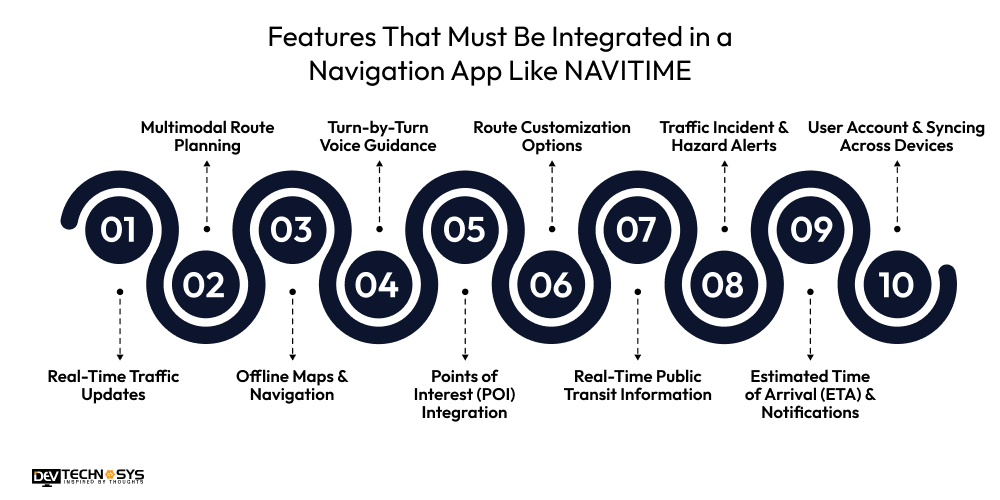
Features That Must Be Integrated in a Navigation App Like NAVITIME
Let’s explore the real-time navigation app features that help businesses get an idea of which type of feature must be integrated.
-
Real-Time Traffic Updates
The real-time traffic updates navigation app provides live traffic conditions, congestion alerts, and accidents to dynamically adjust routes, minimizing travel time and avoiding delays.
-
Multimodal Route Planning
The offline maps navigation app supports driving, walking, cycling, and public transport options, integrating schedules and transfers for seamless, optimized travel between locations.
-
Offline Maps & Navigation
The indoor navigation app allows downloading maps for offline use, ensuring reliable navigation without an internet connection, essential for remote areas or international travel.
-
Turn-by-Turn Voice Guidance
Provides clear spoken directions, lane guidance, and notifications for upcoming turns, enhancing safety and convenience during driving or walking.
-
Points of Interest (POI) Integration
The location-based services app displays nearby restaurants, gas stations, hospitals, and attractions with ratings, distances, and directions for easier trip planning.
-
Route Customization Options
Let’s users avoid tolls, highways, or ferries, select scenic routes, and prioritize fastest, shortest, or eco-friendly options.
-
Real-Time Public Transit Information
Shows train, bus, subway schedules, delays, platform numbers, and transfer guidance for accurate and convenient public transportation navigation.
-
Traffic Incident & Hazard Alerts
Location-based app like NAVITIME notifies users of road closures, accidents, weather hazards, and construction work to prevent delays and enhance safety proactively.
-
Estimated Time of Arrival (ETA) & Notifications
The mobile mapping technology app calculates dynamic ETA based on traffic, sending arrival reminders or route updates to help manage schedules effectively.
-
User Account & Syncing Across Devices
Location tracking apps like Life360 enable saving favorite places, recent routes, and preferences, syncing across smartphones, tablets, or wearables for a personalized navigation experience.
The Cost to Build an App Like NAVITIME
The cost to develop an app like NAVITIME ranges from $8,000 to $25,000+, based on the personalized requirements. Businesses need to integrate a higher number of features for a navigation app that looks different from others.
There are various types of factors that can also affect the cost, such as functions, complexity, backend infrastructure, premium features, size, and more. Here, we provide the detailed information about the cost:
Description |
Estimated Cost (USD) |
| Basic MVP (Single Platform): Simple map with GPS tracking and basic routing | $8,000 |
| Basic MVP (Cross-Platform): Same as Tier 1, for iOS + Android | $10,000 |
| Core App (Single Platform): Add route search, points of interest, and a cleaner UI | $12,000 |
| Core App (Cross-Platform): Both platforms with a route planner and real-time map updates | $15,000 |
| Advanced Features (Single Platform): Includes offline maps, favorite routes, and user accounts | $18,000 |
| Advanced Features (Cross-Platform): Adds analytics, notifications, and improved UI/UX | $22,000 |
| Full Launch Package: Both platforms + admin panel, analytics, and app store launch support | $25,000 |
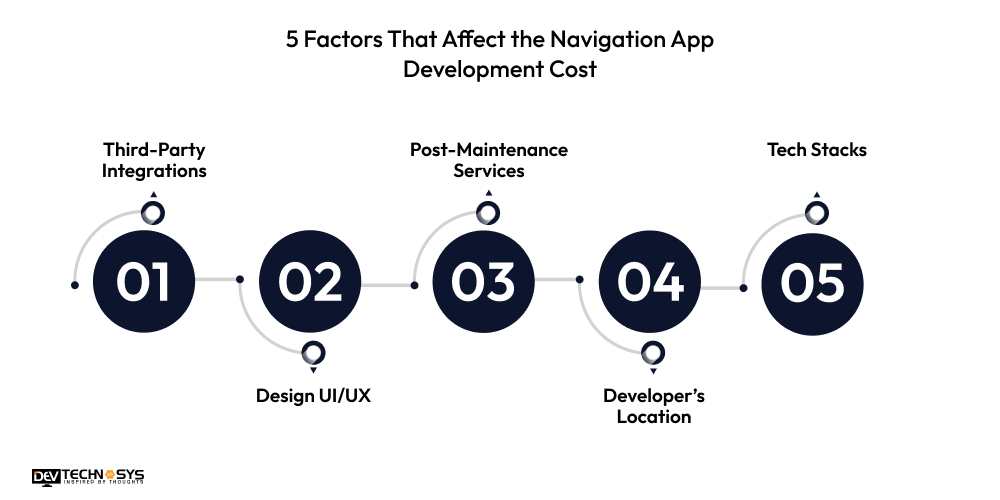
5 Factors That Affect the Navigation App Development Cost
Several factors influence NAVITIME clone app development costs, including app complexity, platform choice (iOS, Android, or both), UI/UX design quality, third-party integrations, and developer location or hourly rates. Let’s take a look at the factors below:
1. Third-Party Integrations
In the second cost-affecting factor, integrating third-party tools and applications is most important. It includes various types of tools such as weather data, payment gateways, analytics tools, authentication, map services, GPS APIs, traffic & transit data, push notifications, and more. But some of them have higher licensing fees, which can increase the cost to build an app like GeoZilla.
2. Design UI/UX
The quality and complexity of a navigation app’s UI/UX design significantly affect the cost to build an app like NAVITIME. Intuitive layouts, interactive maps, and smooth animations require skilled designers.
A well-designed interface enhances user engagement, accessibility, and overall satisfaction, but increases design hours, testing, and iteration cycles, raising the total navigation app development cost.
3. Post-Maintenance Services
After launch, ongoing maintenance ensures app stability, updates, and compatibility with new OS versions or map APIs. Regular bug fixes, performance optimization, and server monitoring are essential.
These services typically cost 15-20% of the initial NAVITIME app development cost annually, ensuring long-term functionality and a seamless user experience.
4. Developer’s Location
There are various locations that have higher living expenses, such as the USA, the UK, Russia, and more; their developers demand higher costs. This can directly impact the overall fleet management app development cost. Businesses need to hire developers from those regions which has lower living expenses.
5. Tech Stacks
The chosen technology stack, frameworks, programming languages, and third-party tools greatly impact cost. Native development (Swift, Kotlin) offers high performance but costs more, while cross-platform frameworks (Flutter, React Native) reduce expenses. Additional integrations like mapping APIs, cloud hosting, and backend infrastructure also influence the total cost to develop an app like NAVITIME.
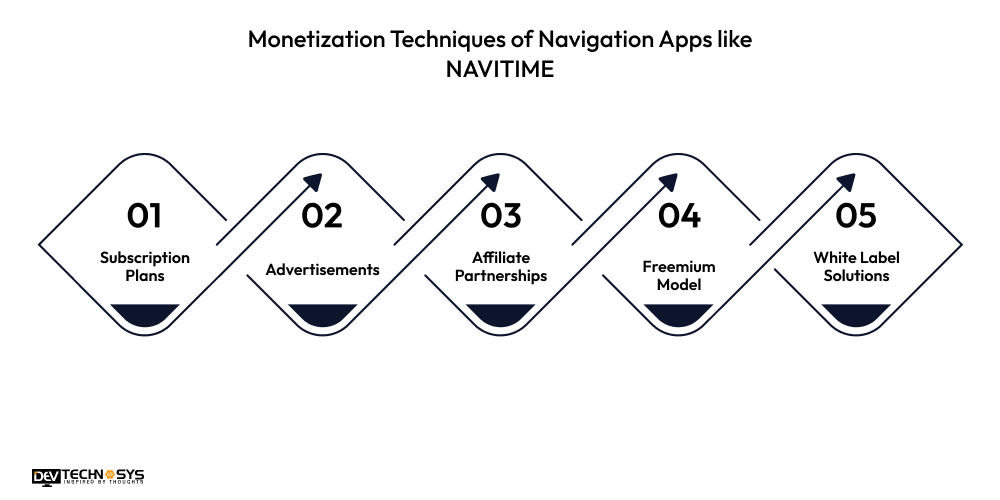
Monetization Techniques of Navigation Apps like NAVITIME
Now, it’s the right time to make money from navigation applications like NAVITIME. But most businesses don’t know how to generate revenue streams through right way. So, here we provide the best techniques to find income sources:
1. Subscription Plans
The travel app development solutions offer paid subscription plans for users to easily access the premium functionalities and services. Users need to buy the premium plan on a monthly or yearly basis. So, these subscription plans can generate new revenue streams for businesses.
2. Advertisements
The best navigation apps for travelers can display ads for relevant businesses, such as hotels, gas stations, and more. Ads can appear as banner ads, native ads, image ads, video ads, pop-up window ads, and display ads. You can charge a fee for every advertisement, and this can be another income source.
3. Affiliate Partnerships
Integrate with travel services, like booking platforms, car rentals, and ride-sharing apps. When users book through the app, NAVITIME earns commissions.
This approach monetizes user intent and enhances user experience by offering convenient one-stop solutions for planning entire trips within the navigation ecosystem.
4. Freemium Model
The best GPS tracking apps offer basic navigation features for free, while premium users pay for extras like 3D maps, offline access, and advanced route planning. The large free user base ensures high engagement and ad revenue, while a smaller premium segment contributes substantial recurring income.
5. White Label Solutions
License the app’s navigation engine to third parties, automakers, delivery services, or travel agencies, under their branding. NAVITIME earns from licensing fees or per-user royalties while expanding its technology footprint and B2B partnerships without additional consumer marketing costs.

Conclusion
In conclusion, build an app like NAVITIME requires strategic planning, robust design, and advanced navigation features tailored for Japan’s market. From integrating real-time transit data to ensuring precise location accuracy, each step demands technical expertise and user-centric development.
Partnering with a professional GPS tracking software development company can help ensure seamless performance, scalability, and compliance with local standards, ultimately delivering a reliable, intuitive navigation solution.
Frequently Asked Questions
Q1. How to Integrate Public Transportation into a Navigation App?
A. Integrate public transportation into a navigation app by connecting to official transit APIs, importing schedules and routes, enabling real-time updates, optimizing routes, and ensuring accurate GPS synchronization for seamless user navigation.
Q2. What Tools are Needed to Develop a Route Planner App?
A. To create an app like NAVITIME requires map integration APIs (Google Maps, Mapbox), GPS modules, geolocation SDKs, databases, cloud servers, UI frameworks, analytics tools, and programming languages like Swift, Kotlin, or Flutter.
Q3. Can I Create a Multi-Modal Transport App?
A. Yes, you can create a multi-modal transport app by integrating APIs for buses, trains, taxis, and bikes, combining real-time data, route optimization algorithms, and seamless payment or booking systems.
Q4. How to Add Real-Time Traffic Data to an App?
A. Add real-time traffic data by integrating traffic APIs like Google Maps or HERE, processing live vehicle speeds, incidents, and congestion, and updating routes dynamically to provide accurate, real-time navigation for users.
Q5. What is the Difference Between NAVITIME vs Google Maps?
A. NAVITIME focuses on Japan, offering detailed local transit options, JR Pass integration, and offline maps. Google Maps is global, with broader coverage, POI data, and general navigation, but fewer Japan-specific transit features.