-
The global logistics market was priced at $16.32 billion in 2025 and is predicted to reach $34.68 billion by 2035.
-
Out of the total European fleet management market share, Germany holds approximately 24% share due to its strong logistics network.
-
German businesses are increasingly integrating logistics solutions, with the market estimated to reach USD 5.24 billion by 2032.
-
More than 60% of German logistics enterprises are focusing on improving their warehouse management.
14-Day Money-Back Guarantee — Not satisfied? Cancel within 14 days for a full refund.Explore Our Money-Back Guarantee
14-Day Money-Back Guarantee — Not satisfied? Cancel within 14 days for a full refund.Explore Our Money-Back Guarantee




Lets talk AI
Dev Technosys
Ship smarter products with AI that fits
your roadmap.
Get a quote
Explore AI solutions
AI services & solutions
View AI hub- Generative AI Development
- Predictive Analytics Services
- Natural Language Processing Services
- Chatbot Development
- AI Voice Assistant Development
- Machine Learning Development
- Chatgpt Integration Services
- Neural Network Development
- AI Copilot Development Services
- AI Consulting Services
- Deep Learning Development Company
- Agentic AI Development Company
- AI Development Services in Canada
Advanced AI services
View AI hubRecommended AI reads
View category- AI in Fintech Support and Document Review: Use Cases, Benefits, Costs
- AI Governance Implementation: From Inventory to Operating Controls
- AI App Audit vs AI App Rescue: Which Service Do You Need?
- AI Agent vs AI Chatbot: Which Fits Your Business Workflow?
- AI Application Security Assessment: What is Actually Tested?
- How Much Does It Cost To Build an Artificial Intelligence Project in 2026?
- How to Integrate a Flight API with GDS Platforms Like Amadeus, Sabre & Travelport?
- How to Build an AI-Powered Vibe Coding Platform
- How to Measure AI Cost per Successfully Completed Business Task
- What a Paid AI Feasibility Sprint Should Answer Before Development
- Demand Forecasting Data Readiness: What to Check Before a Pilot
- When LLM Fine-Tuning Is Worth Testing—and When It Is Not
- RAG vs Fine-Tuning for Company Knowledge: How to Choose?
- AI-Generated Code Audit Checklist: Essential Security and Quality Checks Before Launch
- Role of Generative AI in HR Industry: Benefits, Use Cases & Future Trends
- All insights & thought leadership
Logistics Software Development Services in Germany

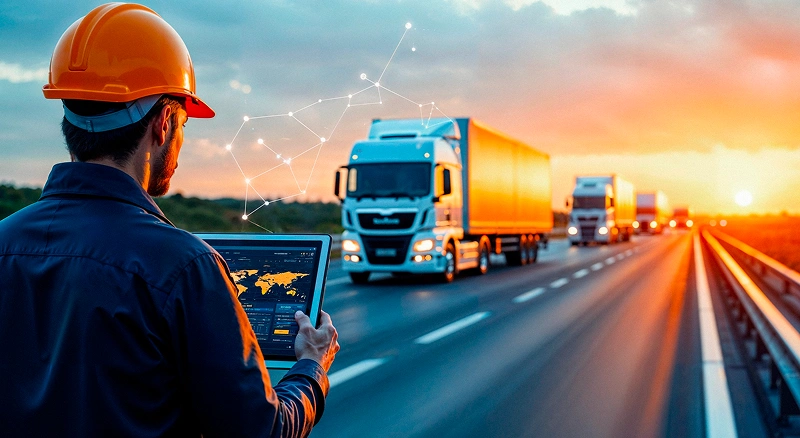
Germany is one of the leading digital logistics hubs in Europe, getting reshaped by advanced technologies. Be it AI-powered supply chains or smart warehouses, adopting technological logistics software solutions in Germany is business-critical.
Achieving higher efficiency and profits in 2026 demands proper automation and tracking of logistics management processes. Businesses in Germany are also looking for a solution to coordinate and manage logistics and fleet operations.
At Dev Technosys, enterprises can discover seamless logistics software development services in Germany. These solutions can effortlessly manage logistics or fleet services from the factory to the customer's doorstep.
By identifying potential risks, whether warehouse mismanagement or driver shortage, we accelerate digital expansion in logistics.
Digital Logistics and Fleet Software Market Overview
The increased adoption of logistics and transportation management software in Germany is evident. This is going to increase more in 2026 and beyond, streamlining the logistics, transportation, and fleet management.
End-to-End Logistics Software Development Services in Germany
Logistic businesses in Germany ask for services to keep their software, operations, and functionality competitive. Dev Technosys, a software development company, is serving its clients with logistics software development services in Germany.
-
Logistics Consulting Services
We are helping our clients by offering expert logistics, fleet, and supply chain software consulting services. Understanding business needs, suggesting suitable solutions, and guiding proper implementations for better efficiency in operations.
-
Logistics MVP Development Services
For basic and low-budget supply chain software development in Germany, we offer MVP development services. In MVP development, simple but core integrations are added to test and later upgraded as per user feedback.
-
AI-Powered Logistics Development Services
As AI is transforming every industry, logistics and supply chain management software development is no exception. Our AI logistics software development services in Germany enable data-driven operations and real-time decision-making.
-
Logistics API Integration Services
To drive productivity and growth in custom logistics software development in Germany, we present API integration services. These services are largely preferred to enhance functionality and synchronize logistics and supply data.
-
Hire Logistics Software Developers
Our highly qualified, experienced developers can provide simplified logistics automation software in Germany according to business requirements. Businesses can hire dedicated developers to create scalable, secure logistics software to improve management and visibility.
-
Logistics Software Maintenance Services
By providing time-to-time updates, bug fixes, and 24/7 assistance, we deliver maintenance support to clients. The ongoing upgrade and maintenance of the application can enhance the smooth functioning and user experience.
Innovative Logistics Software Solutions for the German Market
The development team at Dev Technosys offers supreme, innovative, and highly advanced logistics software development solutions in Germany. These solutions will surely improve logistics services, streamline complex tasks, and reduce the chances of human errors.
Specialized automotive software solutions designed to support different sectors of the automotive ecosystem and help businesses adopt digital mobility technologies.
-
Supply Chain Management Solution
Supply chain and logistics SaaS development in Germany is a digital tool that optimizes goods, data, and financial flows. We make such solutions to identify insufficiencies and reduce risk, adapt to demand fluctuations, and enhance inventory accuracy.
-
Warehouse Management Solution
Our warehouse management software development in Germany organizes and controls warehouse operations daily. It keeps a check on stock levels and stock fulfilment, from picking, packing, to shipping. These solutions also standardize workforce productivity and warehouse storage.
-
Inventory Management Solution
To track, manage, and optimize the business stocks, we create an inventory management solution. Such a solution manages stock, gives real-time information, and prevents overstocking or understocking, from purchasing to distribution. It increases sales, improves accuracy, and reduces costs.
-
Transportation Management Solution
We develop a transportation management solution to help enterprises plan, execute, and optimize the stock movement. These solutions can easily choose perfect carriers, track shipments, automate freight billing, and ensure compliance. It is usually a part of a large-scale logistics and supply chain management.
-
Fleet Management Solution
Our fleet management software development in Germany helps organizations monitor, manage, and optimize commercial vehicle operations. It is commonly preferred in logistics, transportation, and field service industries. It offers real-time tracking and telematics, operational efficiency, and data-driven insights.
-
Supplier Relationship Management Solution
The supplier relationship management (SRM) solution helps businesses manage, evaluate, and collaborate with suppliers. It centralizes the operations like vendor onboarding, risk management, and performance tracking. For a long-term partnership, it can turn the vendor’s data into actionable insights.
Key Business Segments Adopting Logistics Softwares in Germany
The logistics management system development in Germany is widely spread among different industry segments. Whether in the e-commerce, healthcare, or automotive industries of Germany, businesses are adopting logistics software development solutions. It helps them streamline operations, delivery, and supply chain visibility.
At Dev Technosys, we create custom automotive software solutions help German businesses deliver next-gen mobility experiences. From enhancing vehicle performance to streamlining operations, custom automotive solutions help businesses build modern automotive systems.
-
Retail & E-Commerce
Logistics platform development in Germany is common in the retail and e-commerce industry to meet elevating consumer demand. It manages same-day deliveries, high online order volumes, and warehouse efficiency. AI and automation in the industry are ignited by the demand for real-time tracking and reduced labor costs.
-
Food & Beverages
Food and beverage industries in Germany hire software developers to build logistics and supply chain services. It is mandatory for operational efficiency, strict regulatory compliance, and time-sensitive deliveries. It is beneficial for sustainable and resource management to avoid wastage and address labour shortage with automation.
-
Healthcare & Pharmaceuticals
The adoption of cloud-based logistics software development in Germany in the healthcare and pharmaceutical industries is necessary. It helps enterprises manage regulatory compliance (GDP/GMP) and on-time delivery of heat-sensitive pharmaceuticals. The software upgrades the performance of operations by integrating automation services.
-
Automotive
To enhance the vehicle supply chain and boost efficiency, the automotive industry is adopting freight management software in Germany. The country is leading in the automotive industry and utilizing AI-powered logistics for predictive maintenance. Logistics is also important to track inventory and shipments in real-time to prevent production stops.
-
Energy & Chemicals
In the energy and chemicals industry, enterprise logistics software solutions in Germany are highly accepted. This shift is typically to maintain safety and competitiveness in this complex market environment. Logistics software is also needed in this industry to optimize hazardous material transport.
Why Select Dev Technosys for Logistics Software Development Services in Germany?
-
16+ Years of Technology Expertise
Talking about Dev Technosys, its 16+ years are enough to attract businesses for Logistics web and mobile app development.
-
Custom Logistics Software Solutions
This logistics software development company in Germany made customized logistics, supply chain, freight, and fleet softwares. These softwares can match particular business requirements and workflow.
-
Expert Logistics Software Developers
Our highly-qualified, skilled development teams have strong expertise and experience in creating logistics, fleet management, and supply chain platforms.
-
User-Centric Development Approach
We understand the enterprise needs and deliver solutions to achieve operational goals, values, and efficiency.
-
Reliable Delivery & Proven Track Record
We have a proven record of delivering successful, high-quality solutions for global businesses across multiple industries.
Step-by-Step Logistics Software Development Process
Following a strategic process and delivering clients with reliable, scalable solutions is the expertise of Dev Technosys. From market research to after-launch maintenance, every stage of logistic software development is followed to improve efficiency and visibility.
-
Requirement Analysis & Industry Research
Conduct thorough research of the market, including the target audience, competitors, and latest trends. After understanding the business objective, we prefer the right logistics solution required for the platform.
-
System Architecture & UI/UX Design
This step designs wireframes and system architecture for smooth, seamless, and user-friendly logistics operations. We create intuitive dashboards, efficient workflow management, and seamless navigation for logistics managers, drivers, and administrators.
-
Logistics Software Development
Our core logistics platform is made with fleet management, shipment tracking, route optimization, and inventory management modules. The main focus always remains on a scalable and high-performance logistics ecosystem.
-
Third-Party Integrations & Data Connectivity
The logistics software we built is integrated with GPS tracking systems, payment gateways, ERP platforms, and cloud infrastructure. These integrations will help enterprises improve operational efficiency.
-
Testing & Performance Optimization
Before offering solutions to businesses, we always recommend and make it mandatory to ensure thorough testing. It includes functional testing, security checks, and performance optimization to maintain operational accuracy.
-
Deployment & Ongoing Support
As the app is tested successfully, the logistics software development company in Germany can seamlessly deploy it on app stores. To maintain the software’s security and efficiency, ongoing performance monitoring, adding security patches, and bug fixing continue.
Logistics Software Development Cost Breakdown
The average logistics management software development cost ranges from EUR 6,900 to EUR 25,800. The overall development budget depends on the app’s complexity and multiple other factors. These factors include the application’s features, development team, backend infrastructure, third-party APIs, security, UI/UX standard, and others. Have a look at the cost breakdown table to clearly understand the logistics app development budget.
| Solution Type | Estimated Cost (EUR) |
|---|---|
| Basic Logistics Software | EUR 6,900 – EUR 11,000 |
| Mid-Level Logistics Management System | EUR 11,000 – EUR 18,500 |
| Advanced Logistics Software Platform | EUR 18,500 – EUR 25,800 |
Frequently Asked Questions
-
What Is Logistics Software Development?
The process to build a digital tool for planning, managing, and optimizing the flow of goods is logistics software development. This also includes moving, storing, and delivering goods with proper management and operations. This development improves logistics accuracy, reduces operational costs, and enhances customer satisfaction.
-
How Much Does Logistics Software Development Cost In Germany?
Generally, the cost to build logistics software can commonly be estimated from EUR 6,900 to EUR 25,800. The final development expenses depend on the software’s complexity, features, integrations, security level, backend, design, and more. A simple app with basic integration is less costly than an advanced one.
-
What Features Should A Logistics Management Software Include?
The common features include cloud-based, centralized inventory control, warehouse management integration (WMS), carrier management system, analytics & reporting, and automated billing. Whereas, AI-powered demand forecasting, dynamic route optimization, real-time IoT tracking, and automated and multi-channel order management are some advanced features a logistics app should have.
-
How Long Does It Take To Develop Logistics Software?
A simple logistics application with simple but important integrations and follow MVP structure takes 4-7+ months. While an advanced app with high-level additions will be developed in 7 to 12+ months. The development timeline depends on the number of integrations, features, APIs, technologies, security patches, and complexity.
-
Why Do Businesses Need Custom Logistics Software Solutions?
AWorldwide businesses demand logistics software solutions to eliminate inefficiencies, reduce operational costs, and gain a competitive edge. They prefer customized solutions rather than pre-built ones for more secure and scalable operations. The custom solutions streamline inventory management and enhance customer service with personalized tracking.
-
What Technologies Are Used In Logistics Software Development?
The technologies used in logistics software development include Artificial Intelligence (AI), Machine Learning (ML), and Internet of Things (IoT). Other technologies are blockchain, Big Data Analytics, Robotic Process Automation (RPA), GPS & Telematics, and Computer Vision & AR/VR. These technologies help businesses scale well and stay competitive in this industry.
-
How Can Logistics Software Improve Supply Chain Efficiency?
By streamlining manual processes, achieving real-time visibility, and managing routing and inventory management, logistics software improves supply chain efficiency. From procurement to final delivery, logistics softwares reduce operations costs and lowers the chances of errors. It leads to data-driven decision-making and improved communication between partners.
-
Is AI Used In Modern Logistics Software Solutions?
AI is getting implemented in every industry in 2026 and will continue to be beyond it. AI in modern logistics solutions optimizes routes, manages warehouses, and forecasts demand efficiently. AI-powered solutions reduce costs and increase efficiency. They also improve supply chain visibility and decision-making.
-
What Are The Key Challenges In Logistics Software Development?
Logistics software development has to deal with multiple challenges to become the market king. Some of the potential challenges they have to face are related to legacy system integration, security, regulations & compliance, and real-time visibility. The list of challenges also includes technical & operational drawbacks and talent management.
-
How Do Logistics Software Solutions Help Reduce Operational Costs?
The operational costs generally get reduced by logistics software solutions as they automate the operations. These solutions also optimize transportation routes, improve inventory accuracy, and increase visibility across the supply chain. It centralizes the data for faster, secure, and accurate coordination, leading to lower costs and higher profits.