





















Real estate applications are those that are used by every person who needs to rent an apartment or house and sell or buy property. These apps help to find the perfect house or property as per people’s or users’ requirements and demands.
But these apps can’t be useful until you know what functionalities they have. Are you ready to explore the key features of real estate applications?
There are various premium functionalities, but some of the popular ones include virtual property tour, advanced search, filter, location maps, and property listings.
Get ready to reveal the key features of real estate applications with a detailed description, which helps users to enjoy the full potential of the app.
Make yourself comfortable to read more!
Why Real Estate Apps are Popular Across the Globe?
There are various reasons why real estate apps are becoming more popular and in demand worldwide. It includes convenience, flexibility, accessibility, expanding global reach, and many more. So, let’s take a look at the following points:
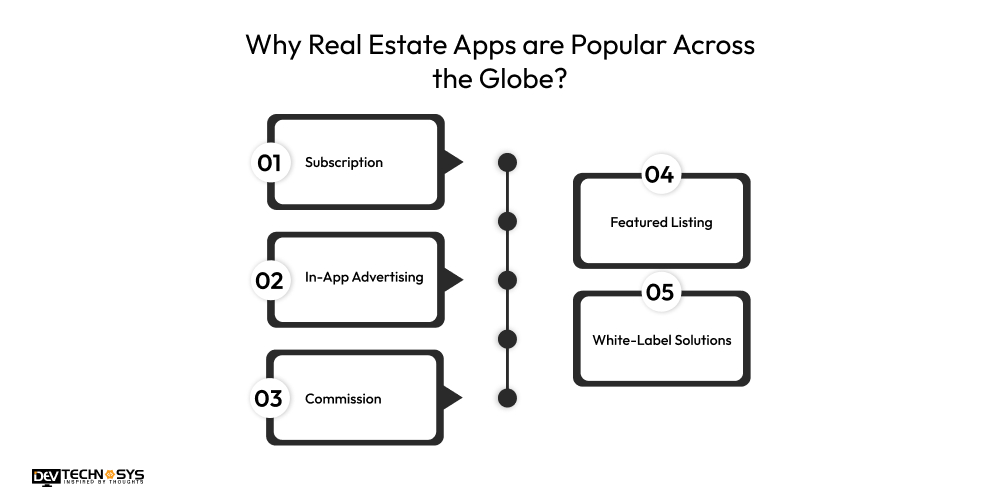
1. Convenience and Accessibility
The real estate applications provide convenience to users; they can search, browse, compare, and shortlist properties from anywhere and anytime. Mobile accessibility eliminates the property visits and physical tours.
From property searching and shortlisting to connecting with agents and scheduling visits, everything is done with just one click. Real estate apps have a user-friendly interface that enables quick navigation.
2. Transparency and Trust
The real estate apps offer transparency by showing the detailed description of properties, such as pricing, location, neighbourhood insights, images, and more.
Also Read: What Is Real Estate App Development?
The verified listings and agents can reduce the misinformation about properties and uncertainty. This trust and transparency help buyers and sellers to make confident decisions, and it can increase the overall experience of users.
3. Time-Saving Property Search
The search and filter features in real estate apps help users to quickly and easily find their perfect property based on their demands and requirements.
Instead of searching properties in thousands of listings, set filters such as budget, location, property type, and many more. This streamlined approach saves valuable time and reduces decision fatigue.
4. Global Reach
The real estate applications connect buyers, sellers, and investors across the world. It includes various advanced features such as multi-language support, virtual property tours, and currency conversion, enabling users to easily access international properties remotely.
This can eliminate the geographical barriers and expand investment opportunities. It helps to achieve the global real estate market and make cross-border transactions.
5. Cost-Effective Marketing for Agents
For agents and developers, real estate apps provide a cost-effective marketing platform with wide visibility. They reduce traditional advertising expenses while generating high-quality leads.
Also Read: How To Build A Real Estate App From Scratch?
Built-in analytics, featured listings, and subscription models help professionals track performance, reach targeted audiences, and close deals efficiently in competitive property markets across regional, national, and global levels.

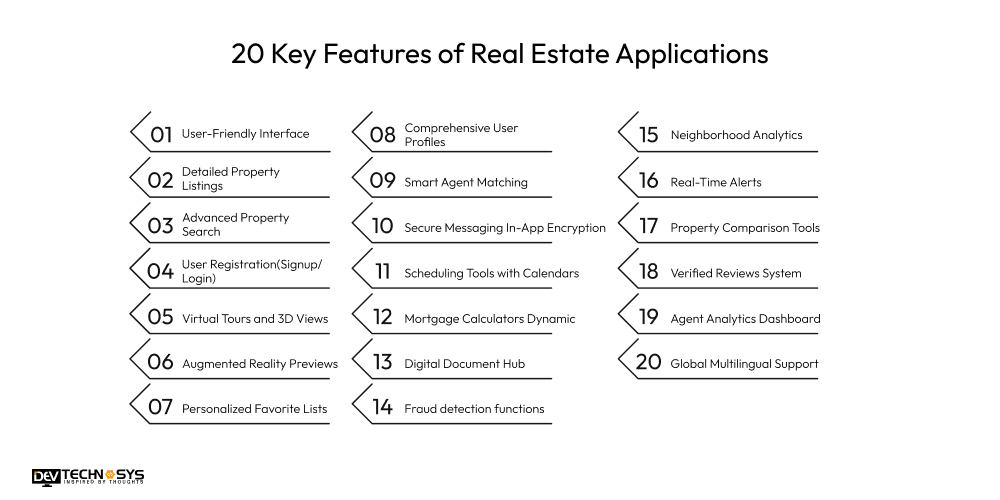
20 Key Features of Real Estate Applications
In this digitization world, 5 out of 3 use real estate applications to find property to buy, sell, and rent. But knowing about features is very important to use the full potential of real estate apps. So, let’s explore the wide variety of key features of real estate applications:
1. User-Friendly Interface
The clean and user-friendly interface enables users to navigate all functionalities and services of real estate apps. It involves simple UI elements, smooth transitions, and clear icons, which increase usability for all age groups. The user-friendly interface directly increases the overall user engagement, reduces bounce rates, and motivates users to explore property listings.
2. Detailed Property Listings
The real estate on-demand app development solutions provide detailed property listings such as floor plans, exact location, pricing, ownership status, property size, and amenities. This detailed information about properties helps users to understand the property valuation and more.
The detailed description reduces unnecessary inquiries, improves transparency, and helps users make informed decisions before contacting agents or scheduling visits.
3. Advanced Property Search
Advanced search functionality allows users to quickly find properties based on location, budget, property type, size, and preferences. Smart filters help narrow results efficiently.
This feature saves time, improves accuracy, and ensures users find properties that closely match their requirements without unnecessary effort or frustration. The advanced property search enhances the user experience to get their output quickly.
4. User Registration(Signup/Login)
The real estate app development solutions enable users to register their own accounts via various ways, such as social media logins, email addresses, phone numbers, and more.
It is one of the most basic features in every type of mobile app. With the help of these ways, users can create an account and verify their identity. It will provide a simple process of signup and offer flexibility for users.
5. Virtual Tours and 3D Views
Virtual tours is one of the advanced features of real estate app that allow users to explore properties digitally from anywhere. 3D walkthroughs create immersive experiences that showcase interiors accurately.
Read Also: How To Choose the Right Real Estate App Development Company?
This feature benefits remote buyers and international investors, saving time and travel costs while improving property evaluation and user confidence before scheduling physical visits.
6. Augmented Reality Previews
Augmented reality (AR) tools overlay virtual furniture, colors, and renovations over live camera feeds of empty rooms. Users can experiment with layouts, appliances, and decor in real-time, personalizing the space. This boosts confidence in purchase decisions by providing virtual staging customization options.
7. Personalized Favorite Lists
Users can bookmark properties for custom watchlists and keep track of view history. Users can set alerts for property changes, while organized folders tiered by budget or location allow for quick, streamlined revisit. User analytics is one of the best features of real estate mobile app that reveals patterns to improve search and recommendations.
8. Comprehensive User Profiles
Profiles capture user preferences, budget, search history, past interactions, and alerts set by role (Buyers, Sellers, Agents). Sellers can manage listings, and Agents build client dossiers. Role-specific dashboards provide tailored views and hyper-personalized experiences across sessions and devices.
Want a chatbot demo or pricing? Fill the form and talk to our experts today.
Pick what you need below — you can select more than one — then tap Get detail to continue.
-
Chatbot demo dashboard
-
Cost to develop an app
-
Industry report
-
Case study
9. Smart Agent Matching
Automated algorithms match users with agents based on expertise, location, ratings, and deal history. Profiles include testimonials about response speed, success rates, and overall performance. Users can instant chat or call agents for quicker consultations to improve closing times and overall results.
10. Secure Messaging In-App Encryption
End-to-end offers secure chat with text, voice notes, files, and video calls. Timestamps, read receipts, and threaded messages keep conversations organized. Encryption protects offers, negotiations, and personal data, allowing secure, compliant, and efficient conversations without external email concerns.
11. Scheduling Tools with Calendars
Automated bookings and sync with inspection and appraisal real-time availability. Automated SMS reminders and virtual, along with rescheduling, options keep everyone on the same page.
Also Read: Types of Real Estate Apps
Integrated video tours, along with waitlists, optimize agent availability and reduce no-show/ghosting while ensuring all users actively engage with properties.
12. Mortgage Calculators Dynamic
Enter income, down payment, and interest. Periods and calculate payment, affordability, and amortization. Compare lenders. Spotlight long-term costs with visual charts and empower more informed financing decisions, even for pre-approvals, within the app. Simulate scenarios and include tax and insurance.
13. Digital Document Hub
Securely upload, e-sign, and track documents from contracts, disclosures, inspections, and title. Workflow automation takes care of deadlines, approvals, and audits. Cross-platform app development solutions include cloud version control and paperless compliance from offer to closing stages.
14. fraud detection functions
Split payments encourage trust and transparency through instant payment settlements globally. Real-time payments and escrow services guarantee seamless transactional trust.
Integrated payments for transactions with vendors, deposits, escrow services, rent payments, and ACH wallets. fraud detection, receipts, and refunds operate PCI-compliant.
15. Neighborhood Analytics
Insights of the integrated reviews, the user walks through the place and better evaluates the place, for lifestyle evaluation beyond the sticks and bricks, informed lifestyle, future-proof rent or buy decisions. To integrate this feature in your real estate app, connect with a mobile app development company.
16. Real-Time Alerts
received alerts on new matches, status updates, and price decreases. Alerts can be customized so notifications can be less annoying, and users can stay informed. Alerts for promotions near your location. Users are more motivated to engage because of the competition.
17. Property Comparison Tools
This module enables users to create a mobile app feature for comprehensive property analysis. It includes value comparison, appreciation forecasting, highlighting pros and cons, calculating long-term value, predicting appreciation trends, estimating value per square foot, evaluating extendability, and supporting collaborative systems for informed property decisions.
18. Verified Reviews System
Other users can leave reviews after a transaction, including photos, and specifics about the transaction, including reviews about the property, the agent, and the services rendered. Badges labeled “Verified” ensure that the reviews are not fake, and performance metrics are used to filter the best reviewers.
19. Agent Analytics Dashboard
Metrics are established for different parameters such as views, leads, and conversions, as well as for pricing the dashboards. There are also heat maps for pricing.
Also Read: Real Estate App Development Process
Custom market reports help forecast trends in the market and optimize listings. The dashboards also enhance ROI through on-the-go adjustments and real-time competitive benchmarking using data ROI.
20. Global Multilingual Support
Users can edit and translate interfaces, chat, and listings into different languages. Users can also use their voice to edit and translate. Currency, unit, and date converters are available for foreign users.
Inclusive access to tools, such as screen readers, is added to help cross borders and enable easy access for users from different backgrounds and with different abilities within the community.

Conclusion
In this blog, we will explore the various types of key features of real estate applications that help users to use the full potential of the app and easily operate every task. It involves user registration, virtual tours, augmented reality previews, scheduling tools with calendars, real-time alerts, a verified review system, and more.
Do you also want to integrate these types of features in your real estate application? Then, directly consult with a real estate app development company to integrate futuristic functionalities.
Frequently Asked Questions
Find answers to the most common questions related to this article.
There are various real estate app features for buyers. Here is the list:
Property listing
Advanced search filters
Interactive maps
Secure messaging
Appointment scheduling
It includes many advanced real estate application features for agents:
Listing creating & editing
Property management
Lead management
Analytics & reporting
Pricing & marketing insights
Third-party integrations
Various top real estate apps exist:
Zillow
Trulia
Redfin
NoBroker
HotPads
Augmented reality enhances real estate apps by overlaying digital information onto physical spaces, enabling virtual staging, interactive property walkthroughs, accurate space visualization, and improved buyer engagement, helping users better understand layouts, design potential, and property suitability before visiting in person.