


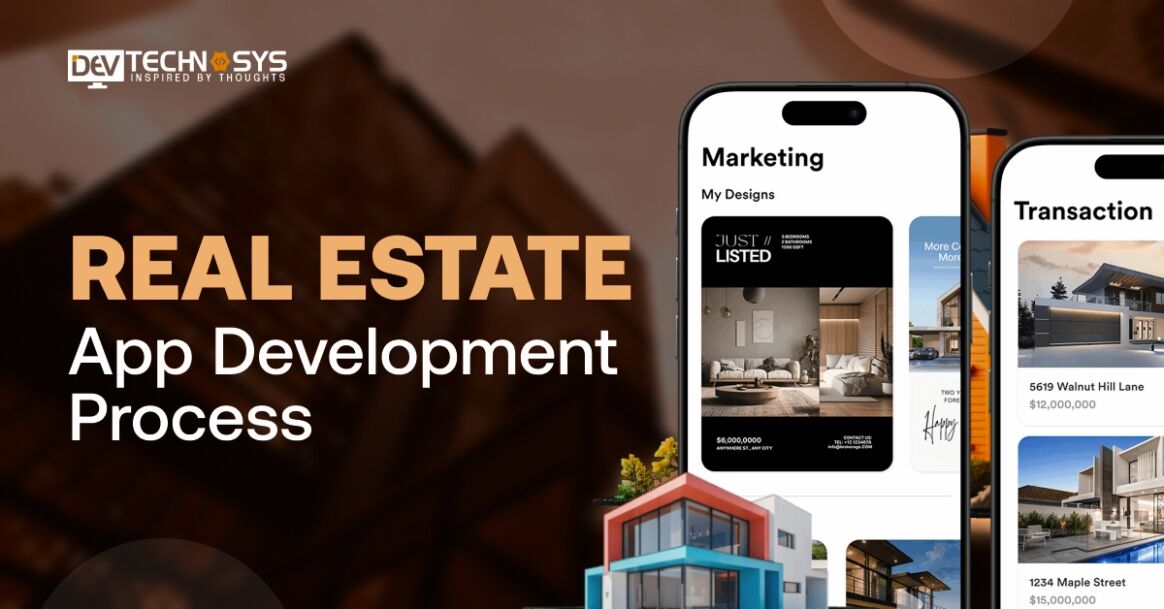
The real estate app development progress in 2026 is shaped by rapid technological advancement, evolving user expectations, and increasing digital adoption across the property sector. Modern real estate apps go far beyond simple listings, integrating AI-powered recommendations, AR/VR property tours, smart analytics, blockchain-based transactions, and IoT-enabled property management.
In this blog, we will discuss how to build a real estate app in 2026, covering all its essential steps, features, benefits, and cost analysis. The journey to the top trending real estate app development process 2026 begins with in-depth market research and requirement analysis, followed by user-centric UI/UX design, robust backend architecture, and seamless third-party integrations.
Also, a strong focus on security, testing, and launch strategies. So, let’s dive straight into the blog and learn about the real estate app development lifecycle in detail.
Real Estate App Development Market Size
- The Real Estate Software Market was valued at 7.879 USD Billion in 2024.
- The market is projected to reach a valuation of 22.71 USD Billion by 2035.

- The expected CAGR for the Real Estate Software Market during the forecast period 2025 – 2035 is 10.1%.
- The on-premise deployment segment is projected to reach 11.3555 USD Billion, while the cloud segment is expected to reach 11.3545 USD Billion by 2035.
What is a Real Estate App?
A real estate app is a mobile or web-based digital platform designed to help users buy, sell, rent, manage, or invest in properties efficiently. These apps connect buyers, sellers, renters, landlords, agents, and investors in one centralized ecosystem, offering tools such as property listings, advanced search filters, virtual tours, pricing insights, and in-app communication.
Characteristics of a Real Estate App:
- User-friendly and intuitive interface
- Advanced property search and filters
- Detailed listings with images and videos
- AI-powered recommendations and pricing
- Interactive maps and location insights
What are the Top 10 Real Estate Apps to Explore in 2026?
Take a look at the top real estate apps that users can explore in 2026; these 10 amazing apps are the future of real estate technology in the palm of your hand. All the apps mentioned in this list are designed to enhance your property searching, buying, or selling experience.

App Name | Launch Year | Avg. Rating | Downloads | Platforms |
| Zillow | 2006 | 4.7 | 100M+ | iOS, Android, Web |
| Realtor.com | 1995 | 4.5 | 50M+ | iOS, Android, Web |
| Redfin | 2004 | 4.8 | 10M+ | iOS, Android, Web |
| Trulia | 2005 | 4.8 | 10M+ | iOS, Android, Web |
| Homes.com | 1993 | 4.4 | 5M+ | iOS, Android, Web |
| HomeSnap | 2008 | 4.8 | 1M+ | iOS, Android |
| LoopNet | 1995 | 4.8 | 1M+ | iOS, Android, Web |
| Curb Hero | 2019 | 4.5 | 500K+ | iOS, Android |
| LandGlide | 2014 | 4.2 | 1M+ | iOS, Android |
| DealMachine / PropStream | 2016 | 4.8 | 1M+ | iOS, Android, Web |
What are the Stages of the Real Estate App Development Process?
Want to know the stages of real estate app development? There are many real estate app development steps you need to consider to build a tech-advanced, feature-rich application. Here is the step by step real estate app development process explained.

Step 1: Research and Market Analysis
The end-to-end real estate app development process in 2026 begins with in-depth market research and competitor analysis. See what your competitors are doing well and identify their weaknesses and strengths.
Use this knowledge while creating a concept or strategy for your real estate app. Do market research to identify the latest trends and technologies.
Step 2: Find Your USP
The next step in our 2026 real estate app development guide 2026 is identifying your USP. Once you are done with the competitor and market research part, you need to come up with your unique selling proposition.
Defining your USP is a crucial aspect of the cross-platform app development process for real estate. Provide what your competitors failed to provide, and implement the latest functionalities to make your real estate app stand out in the competitive market.
Step 3: Accumulate Property Listings
It is the most crucial part of real estate software development process. Various MLS databases that contain different information regarding selling and buying properties. Such a platform can be integrated with your mobile app, allowing for listing collection.
According to a top on-demand app development solutions provider, this integration ensures accurate data, multi-currency support, broader property coverage, faster updates, and a seamless browsing experience for users, ultimately increasing engagement and trust in your real estate application.
Step 4: UI/UX Design Development
Now, let’s progress towards the next stage of the real estate app design and development process, which is creating an excellent real estate app UI/UX design. Your app should be both visually appealing and highly functional.
Focus on real estate app wireframing and prototypes, ensuring smooth navigation. Also, ensure the visual and interactive elements of a product, and choose color palettes, typography, layouts, animation, graphics, and icons to make it engaging.

Step 5: Build a Real Estate App
This step of the property search app development process for startups begins with the selection of a top mobile app development company that provides top-notch real estate app development services. Their skilled experts will craft an MVP, which is an initial version of the final application to put your unique idea to test in the real world.
In this step of the custom real estate app development process, developers assemble components such as design, features, and functionality. After the successful launch of this version, gather valuable user input, and the development team can then proceed to build a comprehensive, fully-featured mobile app. The tech stack generally used in real estate mobile app development is as follows:
Layer | Technologies |
| Frontend (Mobile) | Flutter, React Native, Swift (iOS), Kotlin (Android) |
| Frontend (Web) | React.js, Next.js, Angular |
| Backend | Node.js, Django, Ruby on Rails |
| Database | PostgreSQL, MongoDB, Firebase |
| APIs & Integrations | MLS APIs, Google Maps API, Stripe, Twilio |
| Cloud & Hosting | AWS, Google Cloud, Microsoft Azure |
| AI & Analytics | Python, TensorFlow, Google Analytics |
| Security | OAuth 2.0, JWT, SSL Encryption |
Step 6: Test The App
After the real estate app development process with features and functionalities is completed, it’s time to test the app on multiple devices and platforms under different pressure levels.
Testers will perform functional testing, UI/UX testing, performance testing, security testing, and compatibility testing to identify and fix bugs and optimize the performance of the app.
Step 7: Launch and Promote
In this step to customize the real estate app development process, developers who create a mobile app will devise a launch and promotion strategy. They will launch th app on either or both Android and iOS stores. Focus on marketing prep, initial analytics setup, and user feedback.
Step 8: Post Launch Maintainanace
Post-launch support is an ongoing service that involves providing maintenance services like bug fixes, security patches, and performance optimization to keep the app relevant and up-to-date with the latest trends and technologies.
This service may or may not be included in the app development package, so it’s better to select providers who also provide maintenance services after launch.
Business Benefits of Investing in Real Estate App Development
Before knowing what is real estate app development? let’s check out the benefits for businesses. Investing in end-to-end real estate app development in America offers long-term strategic advantages for businesses aiming to stay competitive in a technology-driven property market. Now let’s see what these benefits are:

1. Expanded Market Reach:
Mobile apps allow businesses to reach a wider audience of buyers, sellers, renters, and investors across multiple cities and regions. With location-based targeting and smart notifications, companies can significantly improve visibility, lead generation, and customer acquisition.
2. Improved Customer Experience:
Features such as AI-powered property recommendations, immersive virtual tours, real-time alerts, and instant in-app communication create a seamless and engaging user experience, increasing customer satisfaction and retention.
Check our guide to features of real estate applications to see which features businesses should implement in their real estate app to improve customer experience.
3. Operational Efficiency
Automation of property listings, user inquiries, rent collection, payments, documentation, and maintenance workflows significantly reduces manual intervention. This streamlining minimizes human errors, speeds up daily operations, and lowers overall operational and administrative costs for real estate businesses.
4. Data-Driven Decision Making
Smart contract compatibility, Advanced analytics, and AI-powered insights help businesses gain a deeper understanding of user behavior, market demand, pricing fluctuations, and performance metrics. These insights enable smarter forecasting, optimized pricing strategies, improved marketing decisions, and more confident long-term planning.
5. New Revenue Streams
Redfin like app development in USA open multiple monetization opportunities and strategic brand partnerships, helping businesses diversify and scale their revenue sources. This is why businesses should carefully choose the right real estate app development company to add multiple monetization models to the app, increasing revenue-generating opportunities.
Want a chatbot demo or pricing? Fill the form and talk to our experts today.
Pick what you need below — you can select more than one — then tap Get detail to continue.
-
Chatbot demo dashboard
-
Cost to develop an app
-
Industry report
-
Case study
Features to Incorporate During Real Estate App Development
Features play a crucial role in real estate app development process. If you want to develop a real estate app that leads the industry, you need the right set of features. All the features mentioned below make

1. User Registration & Profiles
One of the ruial features for Zillow clone app development is secure sign-up and login with role-based access. It allow users to create personalized dashboards, manage preferences, track activities, save favorite properties, and receive relevant notifications for a tailored real estate experience.
2. AI-Powered Recommendations
AI in real estate app helps by sending personalized recommendations after analyzing user behavior and market trends to deliver personalized property suggestions and price alerts, improving engagement and accelerating decision-making.
3. Advanced Property Search
Powerful search functionality with advanced filters for location, budget, property type, amenities, size, and lifestyle preferences, enabling users to discover properties that match their specific requirements quickly.
4. Property Listings & Details
Detailed property listings showcase high-quality images, videos, floor plans, pricing history, availability status, and comprehensive descriptions to help users make informed property buying or renting decisions.
5. Interactive Maps & Location Insights
Map-based property search offering real-time location insights, nearby schools, hospitals, transport options, shopping areas, and neighborhood data for better property evaluation and comparison.
6. AR/VR Virtual Tours
The real estate software development process can be enhanced with immersive AR and VR experiences. Hybrid app development with AR and VR enables users to take realistic 3D virtual property tours, visualize interiors, stage rooms, and preview renovations without physically visiting the site.
7. In-App Communication
Another crucial feature of a real estate app is in-app communication. The Integrated communication tools enable real-time chat, call scheduling, document sharing, and push notifications between buyers, sellers, agents, and property managers for seamless collaboration.
8. Mortgage & Payment Tools
Built-in mortgage calculators, EMI estimators, secure payment gateways, and financing integrations simplify affordability checks, loan planning, and transaction processes within the real estate app.
How Artificial Intelligence Enhances Real Estate App Development?
Use of Artificial Intelligence enhances real estate app development by creating highly personalized user experiences, offering smart property recommendations, and automating repetitive tasks like lead management through intelligent chatbots. AI in real estate apps also ensures powerful predictive analytics for pricing trends, market demand, and investment potential.
This analysis helps buyers, sellers, and agents make faster, data-driven decisions. Major real estate apps include personalized property search, predictive property valuation, virtual tours with AI insights, and streamlined operations for agents and brokers. By incorporating AI technology into real estate apps, you can ensure
- Personalized Experiences: AI recommends properties based on user preferences, search behavior, and location.
- Predictive Analytics: Helps forecast pricing trends, market demand, and investment opportunities.
- Automation: Chatbots and AI tools efficiently manage leads, inquiries, and repetitive tasks.
- Virtual Insights: AI enhances virtual tours and valuations for faster, more accurate property decisions.
- Streamlined Operations: Simplifies workflows for agents, brokers, and property managers.
What is the Real Estate App Development Cost?
The cost to develop a real estate app in USA wil be around $8,000 to $25,000. The basic cost of the custom property app development process is around $12,000. There are various factors that can influence the cost of real estate app development process for startups, including biometric security features, platform choice, design, and third-party integrations.
Adding advanced features and functionalities such as AR/VR, Mortgage and Payment Tools, Two-Factor Authentication (2FA), and AI and ML integrations can significantly affect the cost to build a real estate app in USA to over $25,000. Here’s a table showing the cost to develop a real estate app, along with a development timeline. The real estate app development timeline genrally depends on complexity level of the app.
App Type / Complexity | Estimated Cost (USD) | Development Timeline |
| Basic App | $8,000 – $12,000 | 6 – 8 weeks |
| Standard App | $12,000 – $18,000 | 10 – 14 weeks |
| Advanced App | $18,000 – $25,000 | 16 – 20 weeks |
Conclusion
The real estate app development process in 2026 focuses on delivering secure, scalable, and user-centric solutions powered by AI, advanced analytics, and seamless integrations.
A well-executed real estate MVP development approach ensures higher user engagement, long-term growth, and a strong competitive edge. If you are a business looking for a top real estate app, you need to hire a top real estate app development company like Dev Technosys. Stay tuned with us for more informative updates.
Frequently Asked Questions
Find answers to the most common questions related to this article.
The real estate app development cost typically ranges from $8,000 to $25,000+, depending on app complexity, features, platform choice (iOS, Android, or both), UI/UX design, security requirements, and post-launch maintenance.
The cost to develop a real estate app can be influenced by advanced features like AI-based property recommendations, virtual tours (AR/VR), map integrations, real-time chat, payment gateways, and CRM dashboards.
Developing for both iOS and Android costs more than a single platform. Cross-platform frameworks (such as Flutter or React Native) can reduce costs by 20–30% compared to native development.
Real estate app Development timelines usually range from 8 to 24 weeks. However, addition of features, design complexity, integrations, testing requirements, and compliance standards can impact the cost significantly. Additionally, the expertise and experience of developers also impacts the development timeline.
Real estate apps handle sensitive user data and financial transactions. Implementing data encryption, secure authentication, GDPR compliance, and fraud protection increases costs but ensures legal safety and user trust.


