







By 2026, businesses will contend with an AI-driven threat landscape that evolves at a pace far beyond traditional security playbooks. Cybercriminals will use AI-powered tools such as phishing and deepfake fraud, as well as automated vulnerability scanning, among others, to exploit their targets, essentially using the same technology that companies themselves use for business growth.
The silver lining here is that here AI will not just represent a threat vector; quite the opposite, it will also be one of the defense’s most powerful tools. In fact, industry reports by WeForum predict that AI-related cybercrime costs could exceed $10 trillion annually by 2026, highlighting the growing urgency for stronger security measures. AI in their security systems will be enabled to detect threats more quickly, have shorter response times, and secure the most critical data with higher effectiveness than ever before.
This blog outlines, with expert guidance, a handful of strategies for secure business with AI in 2026. We explain the technologies you should consider, how to implement them properly, and which approaches reflect the reality of security standards today.
Why Is AI Security a Business Imperative in 2026?
With the rise of AI adoption driving many industries, some of the biggest challenges organizations are facing include increasingly sophisticated cyber threats, higher compliance requirements, and stronger AI data protection solutions. Secure business with AI is the only option for operations, ensuring security, customer trust, and long-term business resilience.
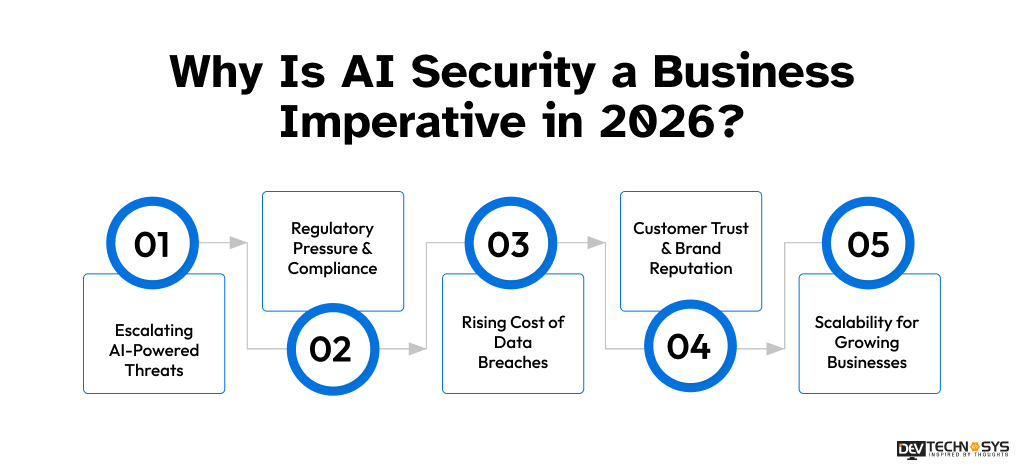
1. Escalating AI-Powered Threats
Catching up with Cybercriminals, who are now exploiting AI to automate phishing, deepfake generation, and mass vulnerability exploitation, is impossible for traditional defenses, which will, therefore, require AI-driven security in order to identify and safely eliminate the threats as they occur.
2. Regulatory Pressure & Compliance
With global governments adopting stringent data protection and AI governance regulations, companies failing to implement AI-enhanced compliance monitoring could face severe penalties, litigation risks, and reputational damage for non-compliance with these rapidly changing standards.
3. Rising Cost of Data Breaches
The average cost of a data breach continues to rise year after year, with AI-enabled attacks being far more damaging. By using AI network security tools to detect attacks faster and with less financial impact, a company can receive quantifiable returns on investment compared to a reactive, manual security system.
4. Customer Trust & Brand Reputation
Customers are looking into a company’s security measures before submitting their data. A single breach can have a permanent effect on customer trust. AI-based security proves a company’s responsibility for security, enhances a company’s brand image, and builds customer loyalty in competitive markets.
5. Scalability for Growing Businesses
Once an organization outgrows itself beyond manual AI security monitoring, it becomes unmanageable. AI is easily scalable and capable of monitoring countless endpoints, transactions, and user activities simultaneously, enabling an enterprise-level of security without a comparable rise in security staff costs.
Planning a Mobile App?
Get a tailored development cost estimate in 3 simple steps — app basics, features, timeline, and your contact details.
- 3 quick steps
- 100% free
- Reply in 1 business day
2 Minutes Read
The 2026 AI Threat Landscape: What’s New & What’s Worse
The threat landscape has expanded and has even changed. Here is what businesses are facing this year:
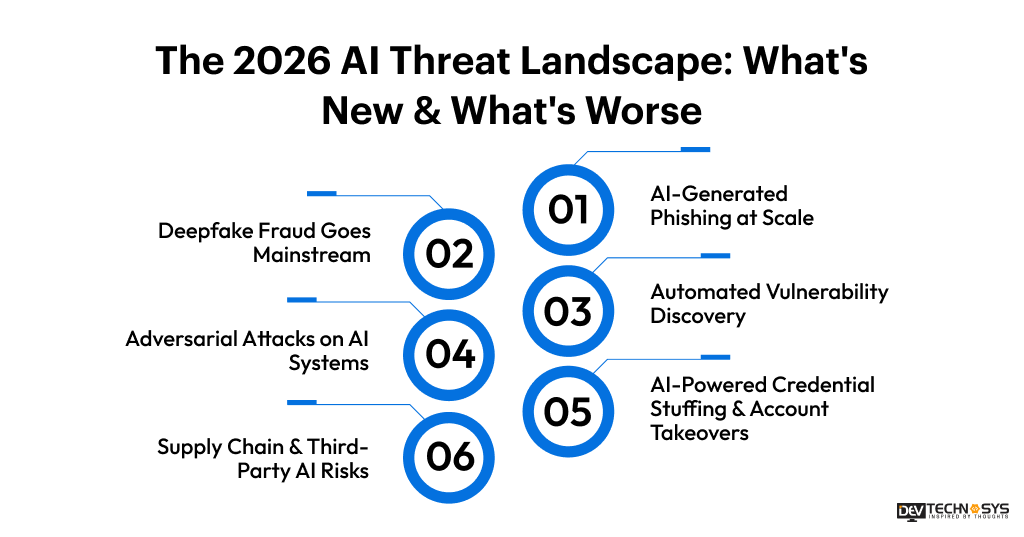
1. AI-Generated Phishing at Scale
Poorly worded scam emails are now obsolete. AI can generate very personalized phishing messages that appear to be from legitimate employees, referencing real details about the company and adapting to what you have said throughout your interactions with it, making them impossible to discern from real communication.
2. Deepfake Fraud Goes Mainstream
Voice cloning and deepfake videos are no longer simply new technologies but rather tools used for attacks. Businesses have seen voice and video attacks by impersonating individuals on the phone to wire funds in video conference calls, an entirely new type of social engineering that has been difficult for companies to defend against.
3. Automated Vulnerability Discovery
While these AI tools were initially developed to find bugs in the code, these programs are now being used by attackers to discover exploits that can compromise business systems, significantly shortening the window of opportunity between when the exploit was developed and when it is discovered and utilized.
4. Adversarial Attacks on AI Systems
As companies implement their own AI models, they themselves become the target. The attacks, like data poisoning, prompt injection, or model manipulation, exploit weaknesses within your AI systems, a completely novel attack vector that most companies have yet to encounter.
5. AI-Powered Credential Stuffing & Account Takeovers
Machine learning-powered bots now adapt to CAPTCHA systems and rate-limiting protections in real time, making brute-force and credential stuffing attacks quicker and harder to detect than rule-based legacy systems could.
6. Supply Chain & Third-Party AI Risks
As companies start to adopt third-party AI tools and APIs, their vulnerabilities cascade to your environment, often with little visibility into how that vendor application or API manages and protects your data.
Core AI Security Risks Every Business Must Understand
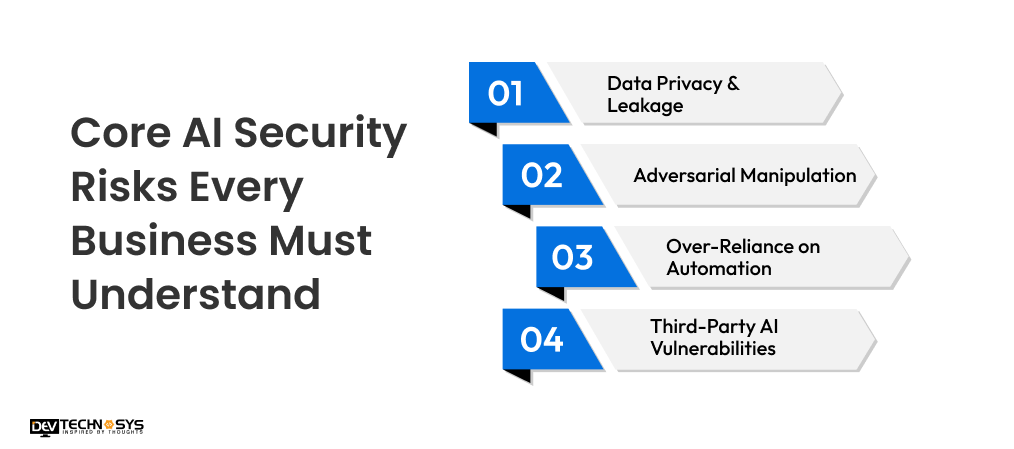
The critical risks of adopting AI, from data exposure to model manipulation and third-party risks, must be understood before creating a cohesive AI security strategy.
1. Data Privacy & Leakage
Secure business with an AI process sensitive to information at high volumes, increasing risks of exposure. Mishandling sensitive information could result in breaches, fines, and loss of customer confidence.
2. Adversarial Manipulation
Attackers leverage AI models by attempting data poisoning, prompt injection, or malice to corrupt models from the inside, through unexpected inputs, to influence outputs, decisions, and overall system integrity.
3. Over-Reliance on Automation
AI security automation has the potential for many blind spots when too heavily relied on with no human input, such as failure to recognize errors, bias, or actual faults until it is too late.
4. Third-Party AI Vulnerabilities
Risks can occur due to poor third-party vendor tools and APIs, leading to an attack on your entire infrastructure due to vulnerabilities within their systems.
The 7 Pillars of a Secure AI Business Strategy
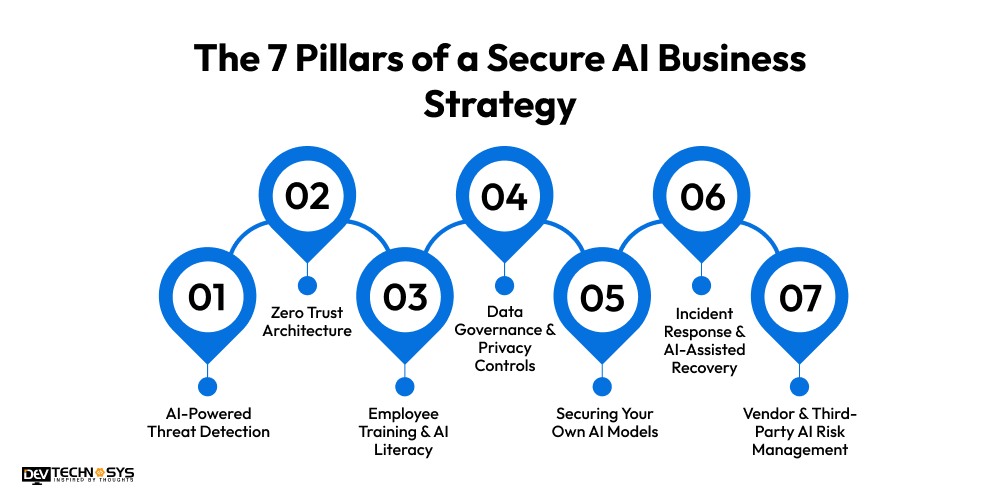
A robust AI security framework is multilayered; there are seven important pillars to guide businesses in minimizing risk, building resilience, managing compliance, and enhancing the security of AI-powered systems.
1. AI-Powered Threat Detection
Utilize ML-powered systems to monitor endpoints, user behavior, and traffic data to catch any abnormalities and potential breaches in real time, far quicker than was ever possible with manual, rule-based analysis or signature-based malware detection systems.
2. Zero Trust Architecture
Implement a “never trust, always verify” security model on your network; all user activity, endpoint devices, and applications are continuously authenticated and authorized to reduce the impact of compromised credentials or internal threats.
3. Employee Training & AI Literacy
Educate personnel in detecting phishing, deepfakes, and other social engineering scams powered by AI. Since human error is still the main cause of breakdowns in security, continuous education converts employees from liabilities into the most effective security element of the company.
4. Data Governance & Privacy Controls
Set up strong systems for defining data categories, controlling user permissions, and encrypting data. Make certain AI systems that are involved in processing private data have the necessary features to meet the standards of privacy laws, which in turn will limit the possibility of data breaches and legal consequences to a great extent.
5. Securing Your Own AI Models
Safeguard your unique AI technologies from data poisoning, unauthorized directives, and AI security strategies that could distort the system. Mobile app developers for hire check the behavior of the model, confirm the origins of the training data, and put security measures in place to prevent unwanted inputs or outputs.
6. Incident Response & AI-Assisted Recovery
Create incident management strategies using AI to efficiently control threats, automatically separate infected systems, and shorten the time for restoration, thus reducing the impact of security incidents in terms of downtime, losses, and damages to reputation.
7. Vendor & Third-Party AI Risk Management
Scrupulously inspect the AI compliance solutions and external services you plan to adopt. So that your working relationships are secure, define artificial intelligence security standards strictly, carry out audits regularly, and keep control over the ways in which your partners use, store, and safeguard your company data.

Top AI Security Tools and Platforms for 2026
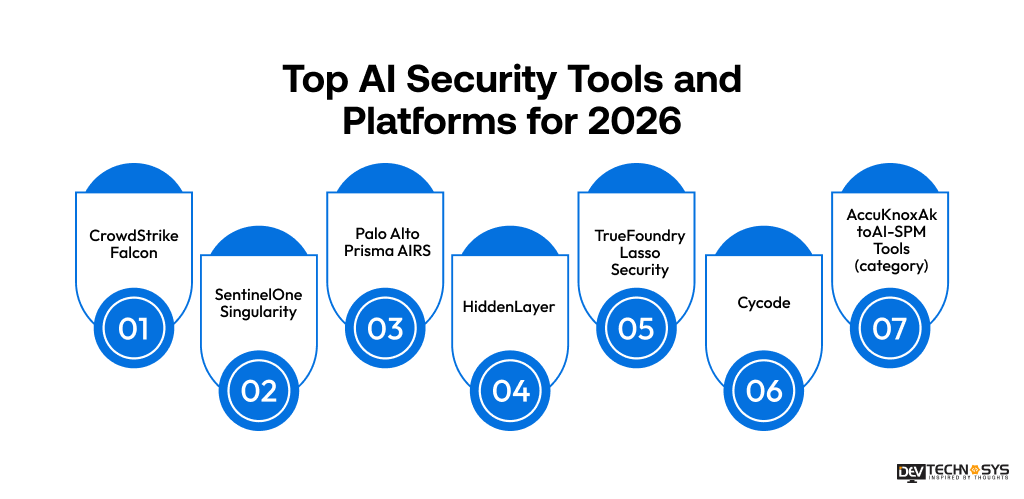
The secure business with AI market is a rapidly changing industry, where dedicated solutions are assisting enterprises in identifying threats, securing models, governing, and defending critical infrastructure against new cyber risks.
Tool |
USP |
Best For |
| CrowdStrike Falcon | AI-driven endpoint & cloud threat detection | Large enterprises, SOC teams |
| SentinelOne Singularity | Autonomous AI response & remediation | Businesses wanting auto-isolation of threats |
| Palo Alto Prisma AIRS | Full AI lifecycle security in Palo Alto ecosystem | Existing Palo Alto customers |
| HiddenLayer | Specialized AI/ML model protection | Companies with proprietary AI models |
| TrueFoundry | Infrastructure-layer AI governance, RBAC, audit logs | Teams managing LLMs/AI agents at scale |
| Lasso Security | LLM & MCP-specific security | Businesses deploying conversational AI |
| Cycode | Code-to-cloud traceability + exploitability triage | DevSecOps teams |
| AccuKnox | Cross-platform AI workload security | Multi-cloud/hybrid deployments |
| Akto | Full-lifecycle agentic AI security | Enterprises using AI agents/MCP servers |
| AI-SPM Tools (category) | Visibility + posture management framework | Businesses starting their AI security journey |
1. CrowdStrike Falcon
A highly ranked security platform for endpoints that makes use of AI to detect and react to threats. Falcon is constantly surveilling devices, enabling the instantaneous identification of malware, ransomware, and other suspicious activities in environments both cloud and on-premise.
2. SentinelOne Singularity
An automated endpoint defense system integrating AI threat detection, automatic reaction, and rollback functions. Singularity can detect threats in different areas, such as endpoints, cloud-based workloads, and identities, with hardly any human assistance.
3. Palo Alto Prisma AIRS
Provides a comprehensive security solution for the entire AI lifecycle within the Palo Alto environment, securing models, data, and applications during the development and deployment phases. It is a good choice for the enterprises that are already using the broader security suite of Palo Alto.
4. HiddenLayer
Focuses on model security by shielding proprietary AI models from theft, adversarial attacks, and manipulation. It is a significant gap that businesses are increasingly using custom machine learning systems internally.
5. TrueFoundry
Governance of the infrastructure layer for LLM inference, AI agents, MCP tools, VPC-native deployments, etc., including identity-aware execution, role-based access controls, and audit logs from one centralized control plane. They make it possible to work.
6. Lasso Security
Concentrates on LLM and MCP security measures to defend against prompt injection and unauthorized data access. This solution is perfect for companies that build their own AI applications and need strong protection and governance at runtime.
7. AccuKnox
Protects AI-related data, models, APIs, agents, and runtime environments comprehensively with no exposure to unprotected elements at any stage of deployment or framework. Offering accessible auditability and full protection to all AI components, AccuKnox
8. Cycode
This technology deploys a Context Intelligence Graph that captures the relationships between code, infrastructure, identities, and runtime environments, enabling end-to-end traceability from code to cloud. Along these lines, it includes an AI Exploitability Agent that automatically ranks vulnerabilities, with a strong focus on those that pose the greatest risks.
9. Akto
Agentic AI Security platform to protect your AI agents, MCP servers, and GenAI applications throughout the discovery, continuous red teaming, and runtime enforcement stages. Provide your teams with full visibility into agent behavior and access with Akto.
10. AI-SPM Solutions (AI Security Posture Management)
Secure business with AI provides visibility through AI-SPM as your first move, followed by shift left model scanning and AI Firewall protection for live applications- a layered, proactive defense.
AI Governance & Compliance Frameworks You Can’t Ignore
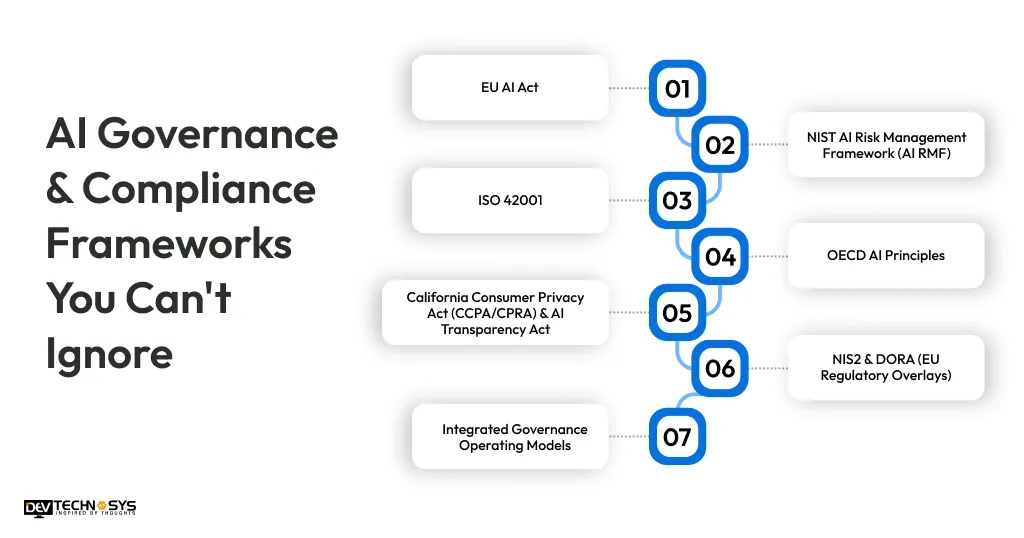
With growing global AI regulation, organizations must adapt to governance frameworks and compliance standards that ensure responsible AI deployment, minimize legal exposure, and boost operational accountability.
1. EU AI Act
Violations related to the list of prohibited AI practices face fines up to 7% of global annual turnover, depending on severity. Most provisions become fully enforceable on 26 August 2026; vital for any organization serving EU customers.
2. NIST AI Risk Management Framework (AI RMF)
Secure business with AI offers voluntary guidance for organizations that seek to develop more trustworthy AI systems; adopted broadly by US organizations as a framework for a systematic approach to AI risk identification, assessment, and mitigation.
3. ISO 42001
The main international standard specifying guidelines for the design, implementation, and monitoring of AI; increasingly being specified in enterprise vendor contracts and used to establish sophisticated and auditable AI governance.
4. OECD AI Principles
Setting global standards for trustworthy AI, including human-centricity, transparency, and accountability, is critical for organizations that operate internationally, often across multiple regulatory jurisdictions.
5. California Consumer Privacy Act (CCPA/CPRA) & AI Transparency Act
CCPA regulates how organizations utilize personal information within AI systems, and California’s AI Transparency Act, effective on 1 January 2026, mandates specific disclosure requirements for AI-generated content; important for organizations operating in the US.
6. NIS2 & DORA (EU Regulatory Overlays)
These regulations do not introduce new obligations but reveal shortcomings in static, siloed security programs and incentivize organizations with proof of continuous supervision and measured results, crucial for organizations serving EU clients.
7. Integrated Governance Operating Models
Leading organizations merge NIST CSF, ISO 27001, cyber risk quantification, NIST AI RMF and ISO 42001; these combine to form an integrated approach that surpasses isolated compliance checklists.
Industry-Specific AI Security Considerations
AI and machine learning cybersecurity requirements differ by sector. Organizations must understand industry-specific risks, compliance obligations, and challenges in order to protect data, systems, and business processes.
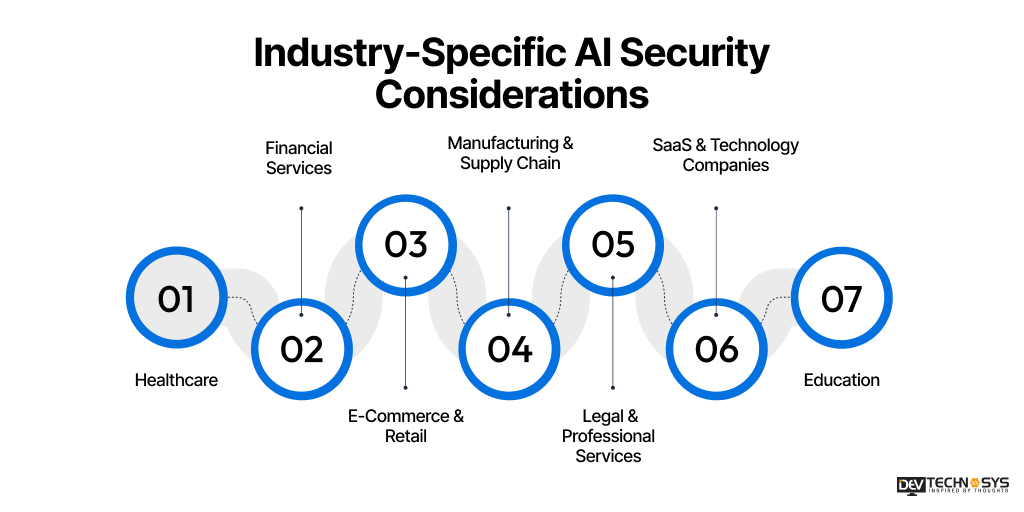
1. Healthcare
Any AI dealing with patient data needs to be compliant with HIPAA and similar regulations. Encryption, access controls, and audit logs should be at the forefront of diagnostic AI to maintain patient data integrity while continuing to ensure the accuracy of AI-assisted clinical decision-making.
2. Financial Services
In AI fraud detection, AI needs to be accurate and fast; false positives may impact honest business transactions. Due to high scrutiny, algorithmic trading risks, and high-value targets, strong governance is also a must for financially driven AI.
3. E-Commerce & Retail
Protection against manipulation of customer payment data and personalization algorithms is also essential, and an AI-driven recommendation engine or chatbot handling customer purchase history and other personal data needs high access control, particularly during high-traffic sale events.
4. Manufacturing & Supply Chain
If compromised, AI-controlled industrial and IoT systems pose physical risks. Securing operational technology networks from AI-driven attacks ensures no interruption in production or a cascading supply chain effect.
5. Legal & Professional Services
Confidentiality agreements, data exposure through AI solutions is especially damaging. Hire dedicated developers to conduct thorough checks on AI providers, and ensure client data is neither used for model training nor exposed due to insufficient access controls.
6. SaaS & Technology Companies
The security of your proprietary AI models and customer data is of the utmost importance, and because they are AI-focused products with huge attack surfaces, tech firms are prime targets for adversarial attacks, model theft, and API weaknesses.
7. Education
Student data privacy requirements like FERPA will apply to AI tutoring systems and administrative solutions. These applications, like all others mentioned, need careful risk assessment in order to avoid student data being put at risk or misused.
Building an AI Security Roadmap: Step-by-Step
Developing a security road map specifically for AI is one of the most valuable approaches to identifying vulnerabilities, implementing defenses, building governance, and defining a long-term plan for risk management.
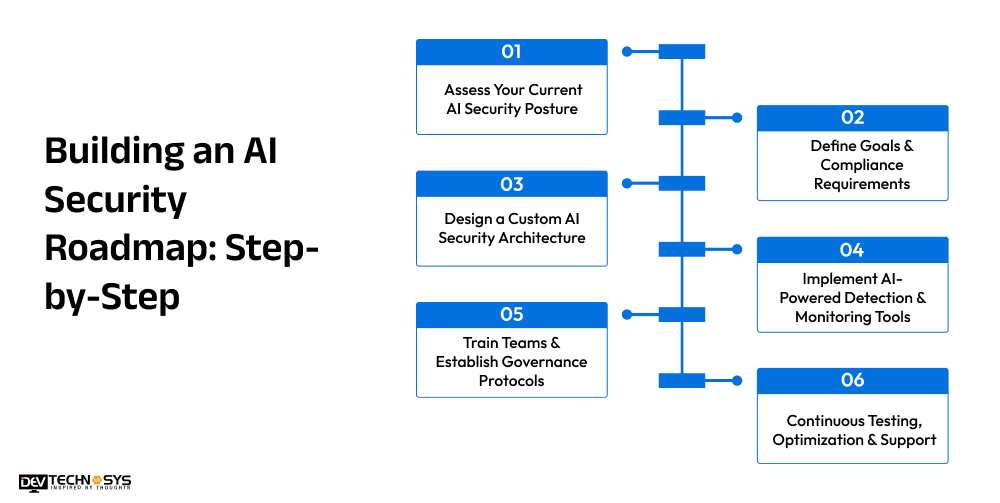
1. Assess Your Current AI Security Posture
Partner with a business app development company to conduct a thorough review of your current systems, data flows, and vulnerabilities. Experts in the field can highlight weaknesses that may otherwise go unnoticed by the internal team, compare your AI security best practices against the best in class and prioritize the identified risks by their probable business impact and likelihood.
2. Define Goals & Compliance Requirements
Work with development consultants to interpret and map out all the legal regulations (GDPR, EU AI Act, HIPAA, etc.) that are relevant to your specific industry. They can translate abstract legal concepts into specific, actionable technical requirements so that your enterprise AI security roadmap considers all potential legal vulnerabilities while also working alongside your larger business plan and growth strategy.
3. Design a Custom AI Security Architecture
A specialized AI development services company can design the ideal security frameworks, whether for data encryption, access control, or model protection, unlike a one-size-fits-all generic solution. They will consider and account for how your unique architecture fits into the technology stack, ensure scalability for when the system is growing, and minimize costly reworks or compatibility problems.
4. Implement AI-Powered Detection & Monitoring Tools
AI consulting firms offer practical experience in the setup and configuration of threat detection systems, SIEM, and behavioral analytics tools. This means their knowledge and implementation will speed up the installation and reduce any errors in configuration or integration into your systems. This will ensure that all tools are set up effectively from day one.
5. Train Teams & Establish Governance Protocols
The Generative AI development company also supports this by providing employee training regarding AI threats and deepfakes, as well as the proper procedures of incident reporting. This will help create governance documentation, audit trails and an accountable structure – key for compliance as well as the internal security awareness across departments.
6. Continuous Testing, Optimization & Support
The long-term engagement with the AI consulting firm ensures constant penetration tests, model audits, and system upgrades as the threats emerge and continue to develop. This cycle of constant improvements is supported externally and ensures that the business security with AI remains at the highest level, eliminating the need for additional in-house staff for all emerging threats.
Real-World Examples & Lessons Learned
The most recent security breaches associated with AI have clearly demonstrated the rapid development of threats and offered crucial lessons to businesses that wish to bolster their Start an AI Business security posture:
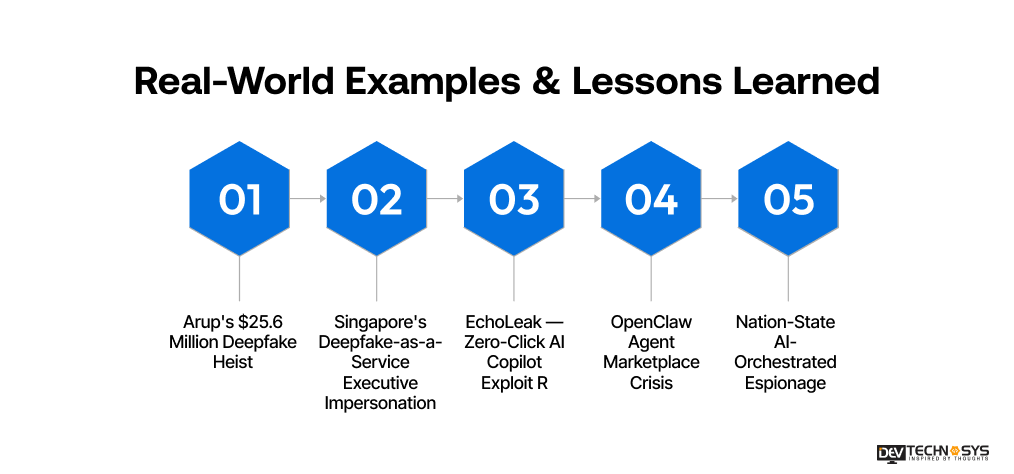
1. Arup’s $25.6 Million Deepfake Heist
In one specific incident, attackers utilized a spear-phishing campaign combined with deepfake video and audio to impersonate the company CFO of Arup and authorized 15 fraudulent wire transfers of $25.6 million on the same day.
Lesson: verbal authorization is no longer secure enough.
2. Singapore’s Deepfake-as-a-Service Executive Impersonation
A prompt for employees to move millions of dollars to fraudulent accounts was made by spoofed corporate executives using accessible deepfake-as-a-service software.
Lesson: even security systems have their limitations when human reliance and trust are manipulated.
3. EchoLeak — Zero-Click AI Copilot Exploit R
Researchers announced a zero-click exploit targeting Microsoft Copilot slated for mid-2025.
Lesson: AI assistants embedded in business workflows can be exploited as attack vectors without any user interaction.
4. OpenClaw Agent Marketplace Crisis
A popular open-source AI model that attracted more than 135, 000 stars on GitHub was the catalyst for a very large security breach in 2026 when more than 21, 000 instances of its critical vulnerabilities were exploited to get user data in corporate systems such as Slack and Google Workspace.
Lesson:
Make sure to carefully control what permissions you allow AI agents.
5. Nation-State AI-Orchestrated Espionage
Anthropic has been able to halt what is believed to be the first instance of an AI-directed cyber espionage campaign November 2025 when state-sponsored agents leveraged Claude to gain access to the systems of critical organizations.
Lesson:
By using AI, attackers can more easily execute complicated, large scale attacks.
Want a chatbot demo or pricing? Fill the form and talk to our experts today.
Pick what you need below — you can select more than one — then tap Get detail to continue.
-
Chatbot demo dashboard
-
Cost to develop an app
-
Industry report
-
Case study
Common Mistakes Businesses Make with AI Security
The security efforts of AI can be undermined by organizations. On the other hand, many are making mistakes that could have been easily prevented. Knowing what these common mistakes are will help businesses strengthen their defenses and at the same time they will be able to reduce the risk exposure to preventable risks
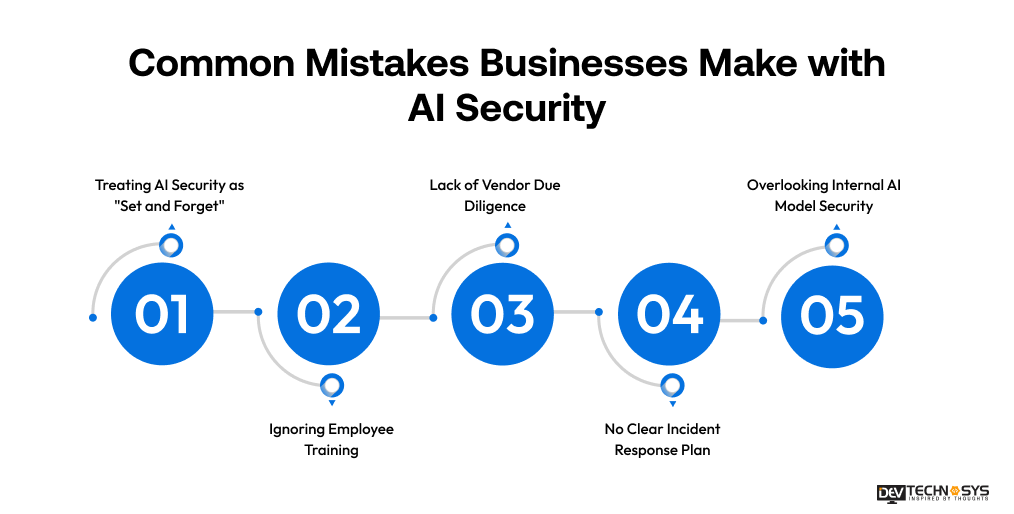
1. Treating AI Security as “Set and Forget”
Organizations introduce AI solutions and expect to be secured against any attack for the life of AI tools. While threats keep changing at fast pace, it is only through regular update, retraining, and auditing that you can have your system secured. Apart from that, static configurations will become very quickly outdated and at the same time quite exploitable.
2. Ignoring Employee Training
Even when AI development companies spend millions on AI tools, they often forget about human factors, such as employees who are still incapable of detecting deepfakes or phishing emails generated by AI. These human vulnerabilities, in effect, render the best technical defenses useless.
3. Lack of Vendor Due Diligence
By failing to conduct proper security audits and scrutinize data handling and compliance standards, businesses may unwittingly expose themselves to serious risks as a result of adopting third-party AI technologies.
4. No Clear Incident Response Plan
Many organizations are without documented protocols for AI-related breaches or failures, resulting in delayed responses, exacerbated damage, and confusion when rapid action is of paramount importance.
5. Overlooking Internal AI Model Security
Most companies are concerned with external threats but are neglecting the risk to their own AI models from within, making them vulnerable to data poisoning, adversarial manipulation, and in-house attacks.
Future-Proofing: What’s Coming Beyond 2026
The future of AI security will be characterized by autonomous defense systems, emergent technologies, evolving regulatory landscapes, and dynamic threat environments that require forward-thinking preparations today.
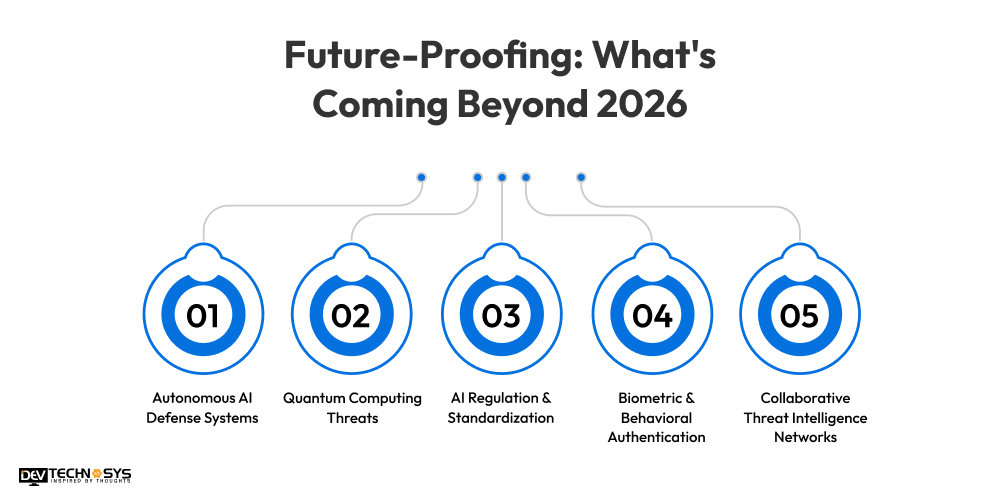
1. Autonomous AI Defense Systems
Security platforms will increasingly become self-healing, and begin to respond to threats without human intervention, automatically patching systems, isolating breaches, and dynamically reconfiguring defenses based on emerging attack patterns.
2. Quantum Computing Threats
As quantum computing develops, current cryptographic standards will likely become compromised. Businesses need to monitor quantum-resistant cryptography developments and initiate mitigation strategies well before quantum capabilities fall into the hands of malicious actors.
3. AI Regulation & Standardization
You can expect further business website development services of a global AI governance framework, mandating specific security certifications and compliance requirements; organizations proactive in adapting now will avoid the difficulties and potential setbacks of retrofitting later on.
4. Biometric & Behavioral Authentication
Traditional passwords will eventually be replaced by constant biometric verification and behavioral analysis (e.g., typing patterns, movement, user behavior), further securing individual accounts from impersonation.
5. Collaborative Threat Intelligence Networks
Businesses will increasingly implement the sharing of AI-detected threat intelligence across industries in real-time, establishing a community-wide defense that strengthens all entities against threats instantly upon detection.
Conclusion
In 2026, secure business with AI is not merely a choice; it is essential for business viability. With threats ranging from deepfake fraud to adversarial attacks on your own AI models, proactive and multi-layered defenses are required, along with appropriate security tools, governance structures, and personnel.
Businesses that succeed will embrace a forward-thinking approach to AI security, viewing it as an ongoing initiative rather than a one-off solution.
Is your business prepared with AI-powered security solutions specifically tailored to your industry? Dev Technosys has extensive expertise in AI in enterprise product development, and we are dedicated to assisting businesses in creating robust and future-proof security architectures. Get in touch with us today to embark on your AI security journey.
Frequently Asked Questions
Find answers to the most common questions related to this article.
The rise of deepfake fraud and AI-generated phishing are of particular concern, with attackers now using hyper-realistic voice and video impersonations of executives to dupe employees into authorizing unauthorized wire transfers, underscoring the growing importance of human verification protocols.
The cost associated with these tools and services can vary greatly, from inexpensive, cloud-based AI security platforms suitable for small and medium-sized businesses to comprehensive enterprise AI cybersecurity solutions. Most vendors offer flexible pricing that can be tailored to the size and budget of any company.
No, any organization utilizing AI for recruitment, customer service, operations, or any other purpose is subject to the requirements for documentation and governance. Regulations such as the EU AI Act or the California AI Transparency Act are applicable depending on your use case and data handling practices, regardless of your business size.
Conducting regular simulation-based training enables employees to identify red flags such as urgent requests, unfamiliar communication channels, and pressured overrides of standard procedures. Coupled with the implementation of verification protocols (such as callback confirmations), this greatly reduces the success rate of social engineering attacks.
Begin by conducting a thorough audit of your existing AI systems, data flows, and vulnerabilities. Collaboration with experienced AI consulting firms can assist in pinpointing blind spots, prioritizing risks, and establishing a plan that aligns with your business objectives.