


















Key takeaways:
-
- Commuting anywhere, without the hassle and overcrowding, is easier in 2026 with taxi booking platforms.
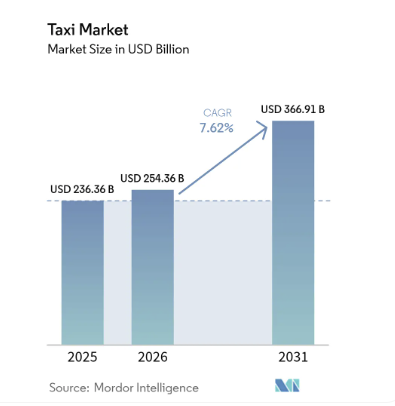
- The market size of the taxi booking applications globally is expected to reach USD 366.91 billion by 2031.
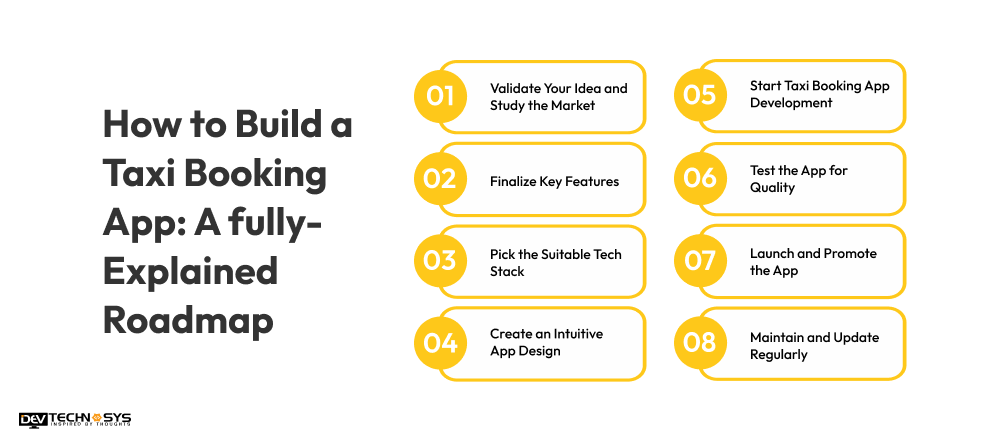
- To develop a taxi booking app, a proper development strategy from market research to app deployment should be followed.
- Generally, an on-demand taxi app development can cost somewhere between $12,000 and $28,000.
The way people are moving from one place to another in 2026 is becoming smarter, faster, and more connected. This transformation is primarily due to the rise of intelligent ride-hailing platforms. These apps come with advancements from AI-powered routing to seamless user experiences.
Due to this, ride-hailing app development has evolved into a strong business opportunity for entrepreneurs. Are you also the one who wants to launch an intelligent mobility solution? It is the ideal time to learn how to build a taxi booking app.
Whether you are a startup founder or an established firm looking for digital expansion, this guide is for you. It will show exactly how to create a cab booking app as per today’s market to meet modern demands.
Get ready to make a taxi booking app in 2026 that scales efficiently and competes with industry leaders.
What is a Taxi Booking App?
A platform that connects passengers to riders for on-demand transportation is known as a taxi booking or ride-hailing app. These apps facilitate the entire process from booking, tracking, payment, to rating through smartphones.
A taxi booking application has made it easier for people to move anytime, anywhere with a few taps. It makes traveling more seamless by eliminating the need to call taxi services or hail rides on the street. Some of the common and widely used ride-hailing apps in US are Uber, Lyft, and Grab.
By witnessing the success of these apps, many taxi service providers also search for taxi booking app development services.
7 Types of Taxi Booking Apps You Can Develop in 2026-2027 Explained
When we talk about the taxi booking app, the first thought that comes to mind is Uber and Ola. But the taxi booking industry in 2026-2027 is something beyond apps like Uber. Entrepreneurs are investing in developing niche, AI-powered, and region-specific mobility solutions. Their main purpose is to target different user segments and revenue models. Have a look at the essential types of taxi booking apps.
1. Ride-Hailing App
A ride-hailing taxi booking platform connects users with nearby drivers instantly. The common elements of such apps include GPS tracking, dynamic pricing, and instant booking features. It supports urban mobility by providing passengers with fast, convenient, and scalable on-demand transportation services.
- Example: Uber, Lyft
- Target Market: Urban commuters, daily travelers, tourists
- Development Cost: $30,000 – $150,000
2. Taxi Dispatch App
A centralized system through which traditional taxi businesses manage bookings digitally is a taxi dispatch app. It is helpful in automating ride assignments, improving efficiency, and reducing manual coordination. These apps modernize existing taxi fleet operations for better customer service.
- Example: Local city taxi fleet apps
- Target Market: Local taxi operators, small fleet owners
- Development Cost: $25,000 – $90,000
3. Carpooling & Ride-Sharing App
A ride-sharing platform where multiple passengers can travel in the same direction is a carpooling application. This platform allows users to share a ride and split costs. Such applications reduce traveling expenses, lower traffic congestion, and promote eco-friendly transportation solutions.
- Example: BlaBlaCar
- Target Market: Intercity travelers, budget commuters
- Development Cost: $40,000 – $120,000
4. Corporate Taxi App
A corporate taxi app is a platform dedicated to managing the transportation of corporate employees. It is connected to one organization with centralized billing, ride tracking, and fleet management. It improves operational efficiency, reduces travel costs, and ensures safe, reliable commuting for employees.
- Example: Enterprise transport systems used by large IT companies
- Target Market: Corporations, IT firms, logistics companies
- Development Cost: $50,000 – $140,000
5. Women-Only Ride App
By its name, it is clear that the women-only ride app is targeted at female passengers for their safety. Such apps even come with multiple emergency features, live tracking, and strict driver screening. The platform focuses on security and comfort for women commuters.
- Example: Shebah, women’s ride services in India & the Middle East
- Target Market: Women commuters, safety-conscious users
- Development Cost: $35,000 – $110,000
6. EV Taxi App
An EV taxi platform is primarily developed to manage electric vehicle fleets seamlessly. These apps come with charging station integration, route optimization, and eco-friendly ride options. It even supports sustainable transportation goals while reducing carbon emissions in modern smart cities.
- Example: Tesla fleet concepts, BYD-based mobility solutions
- Target Market: Eco-friendly cities, government EV programs, smart cities
- Development Cost: $60,000 – $150,000
7. Bike Taxi App
A bike taxi app offers affordable and fast two-wheeler rides for short-distance travel. It is a perfect solution in congested metropolitan cities. It helps users avoid traffic, reduce travel time, and provides a low-cost mobility alternative for daily commuters.
- Example: Rapido
- Target Market: Traffic-heavy cities, short-distance commuters
- Development Cost: $30,000 – $100,000
Comparison Table: Types of Taxi Booking Apps (2026-2027)
| Type of Taxi App | Best Market | Revenue Model | Complexity Level |
| Ride-Hailing App | Global urban cities | Commission per ride, surge pricing | High |
| Taxi Dispatch App | Local taxi operators | Subscription + booking fees | Medium |
| Carpooling App | Intercity travelers | Seat-sharing commission | Medium |
| Corporate Taxi App | Enterprises & IT companies | Monthly contracts, fleet subscriptions | High |
| Women-Only Ride App | Safety-focused markets (India, Middle East) | Commission + premium safety fees | Medium-High |
| EV Taxi App | Smart cities, government EV programs | Ride fare + charging ecosystem revenue | Very High |
| Bike Taxi App | Dense traffic cities in Asia | Low commission per ride | Medium |
How Ride-Hailing Apps Work: Understanding the Ecosystem
A ride-hailing app works differently for the main user groups: passengers, administrators, and drivers. It is more than just a mobile app connecting users with drivers.
That’s why we call it an entire ecosystem that brings passengers, drivers, and admins together. We will now understand how this unified system works for different users.
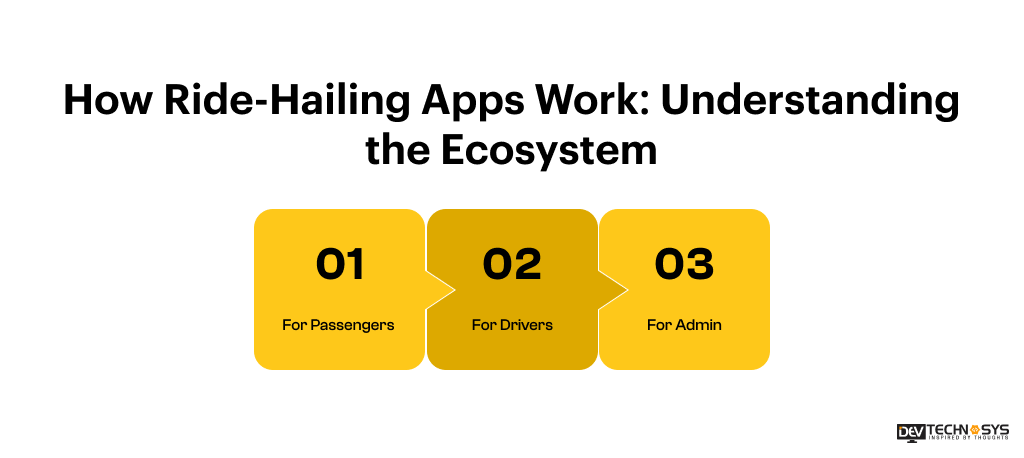
1. For Passengers
A taxi booking app allows passengers to book rides and check estimated fares. It also enables them to track the driver’s location and make secure payments. These facilities should be simple and user-friendly because these are the prime features through which users interact.
2. For Drivers
A multi-city taxi booking app development enables drivers to accept a ride and navigate to the pickup location using GPS. Also, a driver can track their daily earnings and manage their availability. It allows drivers to stay connected with passengers through communication and notifications.
3. For Admin
The admin panel is considered the control center of the platform. It lets business owners or operational teams manage trips, drivers, payments, performance, and offer data-driven decision-making. It allows the overall taxi booking apps to run smoothly.
Market Size & Growth of Taxi Booking Platforms
People prefer convenience in traveling from one place to another, whether daily or occasionally. This convenience has given rise to taxi booking applications, and this market is expanding constantly. Have a look at the market predictions examined by Mordor Intelligence.
- The global taxi market was valued at USD 236.36 billion in 2025, showing strong growth potential.
- It is projected to reach USD 366.91 billion by 2031, growing at a 7.62% CAGR.
- Passenger cars dominated with 60.58% market share in 2025, while two-wheelers showed steady growth trends.
- Internal-combustion vehicles held 71.35% share, while electric taxis are expected to grow rapidly by 2031.
- Asia-Pacific led with 37.42% share, while the Middle East and Africa markets are growing consistently.
Why Build a Taxi Booking App in 2026: Opportunities for Startups & Businesses
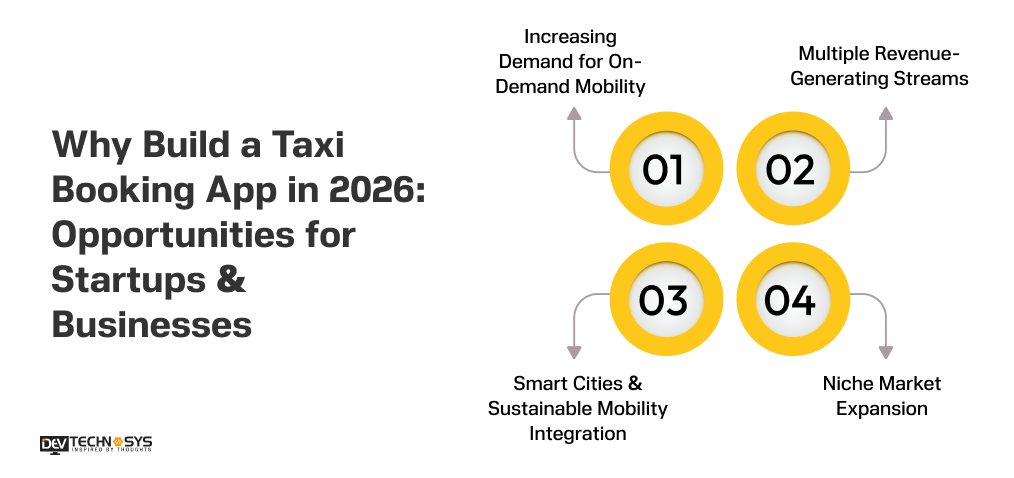
The taxi mobile app development is observing a rise in 2026 due to the global shift towards on-demand mobility. This is giving a prime opportunity to entrepreneurs looking for a startup.
With the growing demand for smart transportation, investing in taxi app development for Android and iOS is a strategic move. Here, we will discuss the opportunities to build a taxi booking app like 13cabs today.
1. Increasing Demand for On-Demand Mobility
People expect immediate services available at their fingertips, be it food/grocery delivery or ride-hailing. On-demand mobility is really common in urban and semi-urban areas. An entrepreneur can invest in a cab booking app development to tap into this growing and competitive market.
2. Multiple Revenue-Generating Streams
When a taxi booking app is well-designed, it can generate recurring revenue. For this, ride commissions, surge pricing, subscriptions, in-app ads, and partnerships can be implemented. It becomes easier for startups or businesses to scale while sustaining profitability. This does not affect the pricing for users.
3. Smart Cities & Sustainable Mobility Integration
The government is heavily investing in the smart infrastructure of urban cities with eco-friendly transportation. Investing in EV taxi booking app development, with features like carpooling and smart traffic data, is a great option. It aligns your business with the future regulations and attracts environmentally conscious users.
4. Niche Market Expansion
Custom taxi app development for niche markets like bike taxis, electric vehicles, and women-only rides is becoming popular. It targets specific but large audiences by differentiating services. They can build a strong brand loyalty as the market is less saturated. This approach offers less competition and more profitability to entrepreneurs.
5. AI-Powered Dispatch and Automation
Like every other industry, AI is also transforming the ride-hailing operations. It automates multiple functionalities, including driver-passenger matching, route optimization, and demand forecasting. AI-powered dispatch systems can reduce driver wait times, improve fleet utilization, and enhance customer satisfaction.
6. Super App Integration Opportunity
The success of mobility-focused super apps demonstrates how ride-hailing can become part of a broader digital ecosystem. Businesses can follow the model of WeChat or Careem by integrating taxi services with:
- Food delivery
- Payments
- E-commerce
- Logistics
- Other on-demand services
Planning a Taxi Project?
Get a tailored development cost estimate in a few simple steps.
- 3 quick steps
- 100% free
- Reply in 1 business day
2 Minutes Read
How to Build a Taxi Booking App: A fully-Explained Roadmap
Developing a ride-hailing or taxi booking app requires a proper roadmap to be strategically followed. From market analysis to app release, everything requires proper planning, execution, and optimization. Here is completely explained taxi app development step-by-step guide that helps you make a scalable app.
1. Validate Your Idea and Study the Market
The first stage to build an app like Uber starts with market research and idea validation. Here, businesses understand the market demand along with their target audience and competitors.
Then, validate your idea by identifying the gaps in existing taxi apps and finding real user requirements. This step guarantees the app resolves real-world traveling-related problems of users with efficiency and reduces risks.
2. Finalize Key Features
Entrepreneurs should decide on the essential features that different panels, passenger, rider, or admin, should have. The essential features include user registration, fare estimation, ride request management, navigation & route optimization, user & driver management, and analytics & reports.
The focus of the businesses should be on the features that help you build a scalable MVP. When the features are finalized earlier, it avoids unnecessary development costs.
3. Pick the Suitable Tech Stack
Selecting the tech stack is the next most important step in the taxi booking app development process. These technologies are essential for strengthening the app’s frontend, backend, database, and APIs.
When enterprises choose scalable and reliable technologies, it ensures smooth performance and faster development. It leads to fewer and easier future upgrades, which are crucial for long-term success.
4. Create an Intuitive App Design
If the organization wants to build a taxi app like Uber, it must prioritize the app design’s intuitiveness. They must create a user-friendly interface with simple navigation that smoothens the booking flow.
When the UI/UX of th app is clean, it enhances user engagement and retention rates. An easy-to-use, highly interactive taxi booking platform design offers a seamless experience for riders and drivers.
5. Start Taxi Booking App Development
The final AI-powered taxi booking app development begins with making strong frontend and backend components with modern frameworks. The APIs should be developed to manage user authentication, ride requests, payments, and notifications.
Here, developers integrate a scalable database to optimize user and ride data efficiently. This step also includes clean coding practices and agile development methodologies to build an app that works across devices.
6. Test the App for Quality
Entrepreneurs hire dedicated developers to conduct detailed testing of the app and guarantee quality assurance. It includes identifying bugs, performance issues, and security vulnerabilities.
It also ensures the app’s performance on different devices, internet speeds, and various operating systems. This stage is really crucial for a seamless and consistent user experience before the app is launched.
7. Launch and Promote the App
After completing development and testing, launch the app on platforms like Google Play Store and Apple App Store. Focus on strong marketing strategies such as SEO optimization, social media campaigns, paid advertisements, influencer marketing, and referral programs. This helps attract early users, build brand awareness, generate downloads, and establish a strong presence in the competitive market.
8. Maintain and Update Regularly
Post-launch maintenance is crucial to ensure long-term success and smooth performance. Regularly fix bugs, enhance app speed, and introduce new features based on user feedback and market trends.
Continuous updates improve user experience, strengthen security, and increase retention rates. Also, it helps your taxi booking app remain competitive, scalable, and aligned with evolving user expectations.
Top Essential Features Every Taxi Booking App Must Include
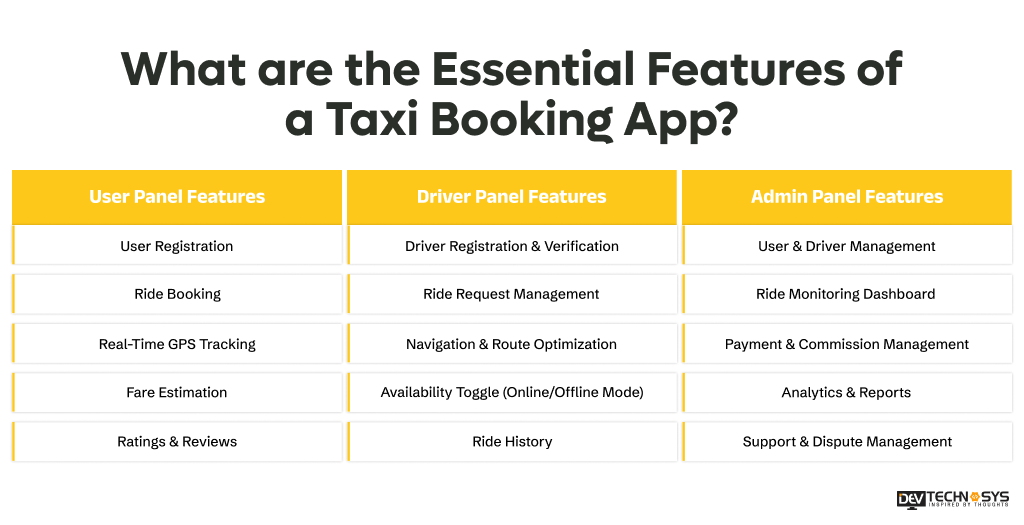
User, Driver, and Admin are the 3 most essential panels of a taxi booking application. These panels have specific but highly essential features of their own. Such features support smooth ride booking, efficient management, and seamless communication between users and drivers. Here are the ride-sharing app features for startups, categorized by user, driver, and admin panels.
1. User Panel Features
i. User Registration
Allows users to sign up, log in, and manage personal details easily. A smooth onboarding process improves user experience and ensures quick access to app features without unnecessary delays.
ii. Ride Booking
Enables users to book rides instantly or schedule them for later. This feature offers flexibility and convenience, making it easier for users to plan their trips according to their time and availability.
iii. Real-Time GPS Tracking
Real-time tracking in taxi apps helps users track the driver’s live location and estimated arrival time. It enhances transparency, builds trust, and ensures users are always informed.
iv. Fare Estimation
Provides an approximate cost of the ride before booking confirmation. This helps users make informed decisions, avoid surprises, and compare pricing with other ride-hailing platforms.
v. Ratings & Reviews
Allows users to rate drivers and share feedback after each ride. This feature helps maintain service quality and builds trust by promoting accountability among drivers.

2. Driver Panel Features
i. Driver Registration & Verification
Drivers can register and upload necessary documents for verification. This process ensures only authorized and trusted drivers are onboarded, improving platform safety and reliability.
ii. Ride Request Management
Allows drivers to receive, accept, or reject ride requests based on availability. This gives drivers flexibility and helps them manage their trips efficiently.
iii. Navigation & Route Optimization
Provides real-time navigation and optimized routes using GPS. It helps drivers reach destinations faster, reduce travel time, and improve overall ride efficiency.
iv. Availability Toggle (Online/Offline Mode)
Allows drivers to switch their availability status anytime. This flexibility helps them manage working hours according to personal preferences and availability.
v. Ride History
Stores details of past and ongoing trips, including routes, earnings, and ride duration. It helps drivers keep track of their activity and performance.
3. Admin Panel Features
i. User & Driver Management
Admins can manage all users and drivers, including onboarding, verification, and account status. This ensures smooth platform operations and helps maintain service quality.
ii. Ride Monitoring Dashboard
Provides a real-time overview of all ongoing and completed rides. It helps admins track performance, detect issues, and ensure efficient ride management.
iii. Payment & Commission Management
Allows admins to control fare pricing, commissions, and payment transactions. This ensures accurate financial operations and revenue management.
iv. Analytics & Reports
Offers detailed insights into user behavior, ride trends, and revenue. It helps in making data-driven decisions and improving business strategies.
v. Support & Dispute Management
Allows handling of user complaints, ride issues, and disputes efficiently. It improves customer satisfaction and builds trust in the platform.
Legal & Compliance Requirements for Taxi App Development 2026-2027
To develop a taxi booking app, there is something more than just development strategy and integrations. Entrepreneurs and enterprises should comply with the legal and compliance requirements, such as:
- Transportation laws
- Data protection regulations
- Payment security standards
- Insurance requirements
These obligations help reduce risks, avoid penalties, and ensure smooth market entry. However, each country has its own legal requirements that we will discuss below:
1. USA Compliance
Taxi booking apps working in the US are obliged to comply with federal and state transportation regulations. The requirements generally involve operator licensing, accessibility standards, driver screening procedures, and passenger safety measures. This will be beneficial in legally providing ride-hailing services across different markets. It includes:
- Transportation Network Company (TNC) License
- CPUC License (California)
- ADA Compliance
- Driver Background Checks
2. UK & Europe Compliance
Ride-hailing businesses in the UK and Europe should comply with the regulations related to transportation, privacy, and payment. Getting compliant with licensing requirements, data protection laws, and secure transaction standards helps businesses avoid penalties. This is also necessary to build trust among passengers and regulators. It includes:
- Private Hire Vehicle (PHV) License
- GDPR Compliance
- Uber’s Legal Challenges
- PSD2 Payment Regulations
3. UAE & Middle East Compliance
The digital mobility services in the Middle East have to meet transportation authority requirements and local data regulations. These are the mandatory approvals for MaaS (Mobility as a Service) for sustainable expansion opportunities. They guarantee smooth market entry, regulatory compliance, and legal business expansion. It includes:
- RTA Dubai License
- Careem’s Regulatory Journey
- Data Localization Requirements
4. India Compliance
Even before launching the taxi booking platform in India, businesses should comply with national and state transportation regulations. Businesses should follow aggregator guidelines, licensing requirements, and driver welfare standards. It is important to maintain compliance and support long-term operational growth. It includes:
- State-Level Aggregator Licenses
- Motor Vehicle Aggregator Guidelines 2020
- Driver Welfare Regulations
5. Universal Compliance Requirements for Taxi Apps
Despite regional regulations, every taxi booking app has to prioritize some universal compliance requirements. Passenger safety, secure payment processing, data protection, driver verification, and adequate insurance coverage should be upheld worldwide. It helps businesses minimize legal risks, maintain operational reliability, and strengthen customer confidence. It includes:
- GDPR / data protection for passenger data
- PCI DSS for payment security
- Insurance requirements for passengers, drivers, and vehicles
Quick Compliance Checklist
| Compliance Area | Requirement |
| Transportation Licensing | TNC, PHV, RTA, or State Aggregator License |
| Driver Verification | Background Checks & Identity Validation |
| Data Privacy | GDPR & Local Data Protection Laws |
| Payment Security | PCI DSS & PSD2 Compliance |
| Accessibility | ADA & Inclusive Transportation Standards |
| Insurance Coverage | Passenger, Driver & Vehicle Protection |
Best Tech Stack for Taxi Booking App Development in 2026
Selecting a powerful tech stack is necessary for taxi app development for startups and enterprises. It guarantees the app’s scalability, real-time tracking, and effortless performance.
When the right technologies are chosen to develop a taxi booking app, it becomes smart and fast. Now, we have explained the tech stack a ride-hailing app should incorporate.
Component |
Technologies/Tools |
Purpose in Taxi App Development |
| Frontend (User Apps) | Flutter, React Native, Swift, Kotlin | Build high-performance, user-friendly mobile apps for Android and iOS |
| Backend | Node.js, Django, Ruby on Rails | Manage APIs, ride logic, and server-side operations efficiently |
| Database | PostgreSQL, MongoDB, Firebase | Store and manage user data, bookings, and ride history securely |
| Real-Time Tracking | Google Maps API, Mapbox, WebSockets | Enable live GPS tracking and accurate route navigation |
| Payment Integration | Stripe, PayPal, Razorpay | Ensure secure and smooth in-app payment processing |
| Cloud & Hosting | AWS, Google Cloud, Microsoft Azure | Provide scalable infrastructure for growing taxi app businesses |
| Authentication | OAuth, Firebase Auth, JWT | Secure user login and protect sensitive data |
| Push Notifications | Firebase Cloud Messaging, Twilio | Send real-time ride updates, alerts, and promotional messages |
| DevOps & Deployment | Docker, Kubernetes, Jenkins | Automate deployment, scaling, and continuous integration |
How Much Does it Cost to Build a Taxi Booking App?
The average cost to develop a mobile app for taxi booking can be estimated from $30,000 to $1,50,000. The final development budget is determined according to the level of complexity it has. We explain it like this:
- A basic app follows an MVP structure, so it has limited integrations and less development complexity. Therefore, the cost to create a taxi booking app can be between $30,000–$65,000.
- A mid-level taxi booking app combined basic and advanced development. It makes the development cost range from $75,000–$1,15,000.
- A fully-featured, advanced app is built with highly upgraded and modern integrations. This makes the development cost range between $1,15,000–$1,50,000.
We will explain this taxi app development cost structure through a breakdown table.
| App Complexity | Best For | Key Features Included | Estimated Development Cost (USD) |
| Basic Taxi Booking App (MVP) | Startups and Small Taxi Businesses | User registration, ride booking, GPS tracking, fare estimation, payment integration, ride history | $30,000–$65,000 |
| Mid-Level Taxi Booking App | Growing Transportation Companies | All MVP features, ride scheduling, ratings & reviews, multiple payment options, driver dashboard, promotions | $75,000–$115,000 |
| Advanced Taxi Booking App | Enterprises and Multi-City Operations | AI-powered dispatching, dynamic pricing, fleet management, loyalty programs, business accounts, and advanced analytics | $115,000–$150,000 |
However, there are multiple factors that influence the final taxi booking app development cost. These factors include platform choice, UI/UX, security & compliance, backend infrastructure, third-party APIs, and more. We will now explain some of the most influential factors with separate cost breakdown structures.
1. Platform Choice
Selecting whether to launch the app on Android, iOS, web, or cross-platform can affect the development cost. Developing a scalable taxi app architecture for separate platforms requires different codebases, efforts, development teams, and time. This can increase the overall cost to develop a taxi app like Uber.
| Platform Strategy | Business Value | Cost Range (USD) |
| Android or iOS Single Platform | Best for MVP launch and budget validation | $10,000 – $18,000 |
| Native Dual Apps (Android + iOS separately) | High-performance, scalable user experience | $18,000 – $25,000 |
| Cross-Platform (Flutter/React Native) | Faster development with a shared codebase | $15,000 – $30,000 |
2. Development Team’s Location
The geographical location from which entrepreneurs hire mobile app developers affects the development cost. Hiring developers from North America, Western Europe, Australia, and New Zealand costs more. These regions are expensive because they have higher per-hour development rates.
| Team Location | Why It Matters | Cost Range (USD) |
| Asia-Based Teams | Most cost-effective for startups and MVP builds | $10,000 – $14,000 |
| Eastern Europe Teams | Balanced quality, strong technical expertise | $14,000 – $18,000 |
| US/UK-Based Teams | Premium quality, enterprise-grade execution | $18,000 – $23,000 |
3. Security & Compliance
Maintaining strong security of the taxi app is really important to build user trust. It includes measures like data encryption, secure payment gateways, and compliance with regulations such as GDPR. These are important to protect user data and prevent fraud, but they increase the development expenses.
| Security Level | Core Inclusions | Cost Range (USD) |
| Basic Security Layer | OTP login, user authentication, basic encryption | $5,000 – $8,000 |
| Standard Security Setup | Secure payments, fraud detection, and encrypted data flow | $8,000 – $15,000 |
| Enterprise-Grade Compliance | GDPR, PCI-DSS, and advanced threat protection systems | $15,000 – $20,000 |
4. UI/UX Design
If the UI/UX of a taxi booking application is well-designed, it enhances user engagement. It offers custom designs, animations, and intuitive navigation that improve user satisfaction and retention. It requires more development time and resources, but raises the budget to build a taxi booking app like Arro.
| Design Tier | User Experience Focus | Cost Range (USD) |
| MVP UI Design | Simple interface focused on core booking flow | $7,000 – $9,000 |
| Growth UI/UX Design | Optimized user journey, modern design system | $9,000 – $15,000 |
| Premium UX System | High-end animations, branding, and interactive design | $15,000 – $21,000 |
Taxi App Development Timeline in 2026: From Idea to Launch
Each development stage of a taxi booking app, from idea validation to after-launch services, influences the timeline. The taxi app development timeline depends on the app’s complexity, features, and integrations. Here, we are explaining the development time according to development phases through a table.
Stage |
Mobile App (Android/iOS) |
Web App |
Key Factors Influencing Timeline |
| Idea Validation & Planning | 1–2 weeks | 1–2 weeks | App complexity, business goals, target audience, and feasibility |
| Market Research | 1–2 weeks | 1–2 weeks | Competitor analysis, user expectations, and market trends |
| Feature Finalization | 1–2 weeks | 1–2 weeks | Feature scope, MVP vs advanced functionalities |
| Technology Stack Selection | 2–3 weeks | 1–2 weeks | Frameworks, integrations, and scalability needs |
| UI/UX Design | 2–4 weeks | 1–3 weeks | Responsiveness, navigation flow, platform guidelines |
| Development (Frontend + Backend) | 6–10 weeks | 4–8 weeks | APIs, real-time features, platform requirements |
| Testing & QA | 2–4 weeks | 1–3 weeks | Device/browser compatibility, performance, security |
| Deployment & Launch | 2–4 weeks | 1–2 weeks | App store approvals, hosting setup, release strategy |
| Post-Launch Support | Ongoing | Ongoing | Updates, bug fixes, feature upgrades |
What are the Top Taxi-Booking Apps used Worldwide in 2026?
Here we are showing some of the real-world examples of taxi booking apps. These apps are widely used in 2026 and are becoming a scalable benchmark for entrepreneurs investing in them. This tabular description of popular taxi booking platforms helps startups understand market leaders and trends.
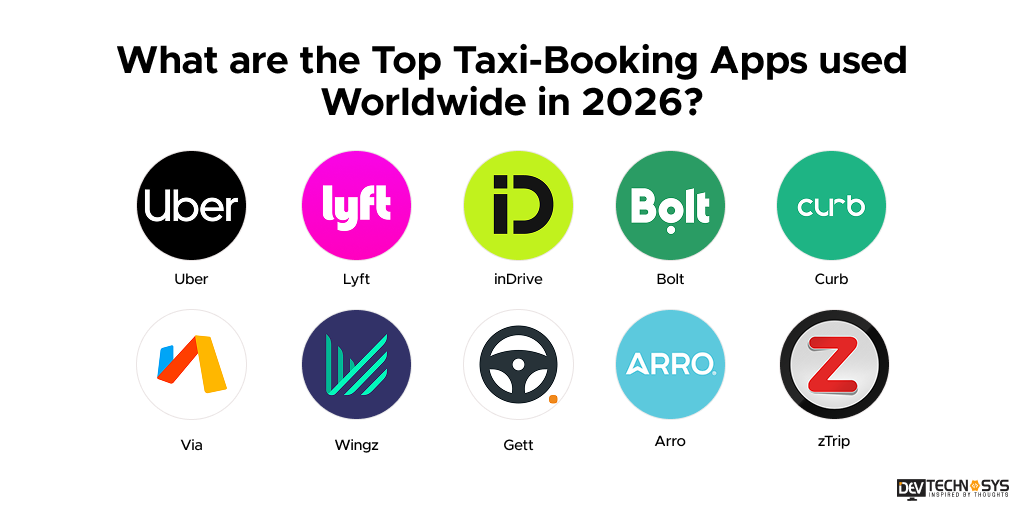
App Name |
Launch Year |
Downloads |
Rating |
Platform Availability |
| Uber | 2009 | 500M+ | 4.7 | Android, iOS |
| Lyft | 2012 | 50M+ | 4.5 | Android, iOS |
| inDrive | 2013 | 360M+ | 4.3 | Android, iOS |
| Bolt | 2013 | 50M+ | 4.1 | Android, iOS |
| Curb | 2007 | 1M+ | 4.8 | Android, iOS |
| Via | 2012 | 10M+ | 4.3 | Android, iOS |
| Wingz | 2011 | 500K+ | 4.9 | Android, iOS |
| Gett | 2010 | 10M+ | 4.2 | Android, iOS |
| Arro | 2015 | 1M+ | 4.3 | Android, iOS |
| zTrip | 2015 | 1M+ | 4.2 | Android, iOS |
We will now describe some of these top real-world examples of taxi booking apps. These apps are widely used worldwide and have transformed the way people travel. Have a look at the top 5 ride booking apps.
1. Uber
Uber is a global platform for transportation networking that connects passengers with drivers. It is a mobile app that offers ride-hailing and freight services. It offers budget-friendly to luxury services, including standard (UberX), premium (Lux), carpooling, and electric scooter/bike rental.
2. inDrive
InDrive is also an international on-demand ride-booking app that allows users to book taxis by negotiating fares. This negotiation is done directly with drivers and helps passengers avoid surge pricing. This app is also offering courier and freight services.
3. Curb
Another popular taxi booking app is Curb, which is known for its low-cost services. It lets users connect with licensed and professional drivers in major US cities. This app also allows passengers to either book a ride immediately or for later.
4. Wingz
Wingz is a specialized ride-hailing application that enables users to make bookings in advance. It is mainly preferred for airport rides, non-emergency medical transportation (NEMT), and senior care. People can select “favorite drivers” for a personalized and reliable experience.
5. Arro
Arro is a free taxi booking mobile app that is available on Android and iOS platforms. It lets users book yellow and green taxis in several major US cities and London. The best part is, it does not increase prices during high demand or bad weather.
Which Monetization Models are Used in Ride-Hailing Apps for Steady Income Flow?
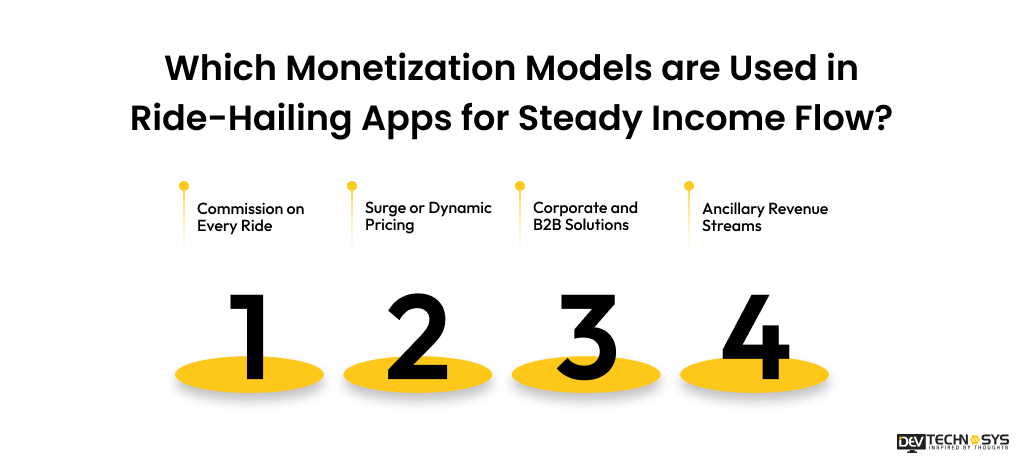
One thing that matters the most is how the ride-booking app makes recurring revenue. It can implement monetization models like commission, subscription, surge pricing, ancillary revenue streams, in-app advertisement, and more. We will now discuss the taxi booking app business model that increases profitability.
1. Commission on Every Ride
The most common way to make money for ride-booking apps is through commissions. The platform charges a small amount as commission from drivers on every completed trip. When the ride gets booked at high frequency, it automates the flow of micro-transactions.
2. Surge or Dynamic Pricing
When demand is high in rush hours or the weather is bad, the platform increases ride fares. This model is also important to balance the demand and supply. However, it increases the revenue by encouraging drivers to be available in such scenarios.
3. Corporate and B2B Solutions
By partnering with corporate businesses for employee transportation, ride-hailing apps can make continuous profits. Companies can pay for daily transportation for their employees in bulk. A white-label taxi booking app solution generates consistent revenue.
4. Ancillary Revenue Streams
The earnings from in-app advertisements, premium services, and cancellation fees are included in ancillary revenue streams. Through these additional sources, the taxi booking apps can diversify revenue. It even increases profitability beyond just standard ride fares.
You can reach out anytime; we are available 24/7. Our team provides a quick response.

How to Launch and Market Your Taxi Booking App Successfully?
Businesses wanting to launch and market the taxi booking app need a strategic plan. This strategy should balance not drivers and passenger demand and supply from the very beginning. If the launch is strong, it can lead to city-wise expansion, referral-driven growth, and partnerships. Similarly, digital marketing ensures consistent ride-booking and long-term scalability. We will discuss some points that are really important to Marte and launch taxi booking app development solutions.
1. Solve Driver-First Challenge Before Launch
Initially, the taxi booking app development services include onboarding enough drivers before the user’s arrival. It ensures immediate ride availability for an amazing user experience.
2. Uber Solving the Chicken-and-Egg Problem
Uber smartly solves the issue by attracting drivers through incentives and guaranteed earnings. Later on, it increases the rider demand via promotions in new cities.
3. Referral Marketing Growth Hack
A taxi booking app solution involves referral programs offering users free rides and rewards. This way, taxi apps acquire users quickly, reducing acquisition costs.
4. Build Strategic Partnerships
The taxi booking app script includes partnering with hotels, airports, and corporations. It guarantees consistent ride bookings and helps taxi apps secure stable early revenue streams.
5. Optimize App Store Presence (ASO)
A taxi booking app software must optimize keywords, screenshots, descriptions, and ratings. This will improve visibility and drive organic installs from app stores.
6. Social Media Advertising Strategy
Almost every taxi booking app development company in USA suggests Facebook and Instagram ads to target local audiences. It helps taxi apps increase app downloads during launch.
7. Press and PR Strategy
Local media coverage builds trust and awareness by highlighting innovation, job creation, and community benefits during the taxi app launch.
City-by-City vs National Launch: Which One Should You Choose?
Startups and small businesses with limited budgets focusing on on-demand taxi booking app development typically prefer a city-by-city launch strategy. In contrast, large enterprises investing in real-time taxi booking app development often choose a national launch. It is for faster expansion and broader market reach. We will understand the clear difference between city-by-city vs national launch.
| Factor | City-by-City Launch | National Launch |
| Market Focus | Focuses on one city at a time for stronger control and optimization | Targets multiple cities simultaneously for rapid expansion |
| Investment Requirement | Lower initial cost with controlled marketing spend and operations | High investment required for infrastructure and marketing at scale |
| Risk Level | Low risk due to testing and optimization in a single market | High risk due to operational complexity across multiple regions |
| Driver Acquisition | Easier to build a strong local driver network with incentives | Difficult to manage a consistent driver supply across all cities |
| Customer Growth | Gradual but stable user acquisition with localized campaigns | Fast but inconsistent user adoption across regions |
| Operational Control | High control over pricing, service quality, and support | Lower control due to multi-city management challenges |
| Scalability | Scales step-by-step based on performance insights | Scales quickly but may face inefficiencies without optimization |
| Best For | Startups and early-stage taxi apps are testing market fit | Large enterprises with strong funding and existing infrastructure |
Challenges in Taxi App Development & How to Overcome Them
Online taxi booking app development is not just about adding features and following development stages strategically. It requires solving complex marketplace, operational, and technical challenges. So here we have explained some challenges that startups must carefully tackle.
Challenge 1: The Chicken-and-Egg Problem
The biggest struggle to build a taxi booking app is to balance drivers and passengers. It is crucial because both customers and riders are dependent on each other. If an app fails in balancing both, it can slow down the growth at the early stage.
Solution: Adopt a supply-first approach by onboarding 50+ active drivers before launching the passenger side. To get riders, businesses should offer guaranteed earnings or incentives during the initial phase.
Challenge 2: Competing with Uber and Local Giants
As the ride-hailing landscape is highly competitive with established players, it becomes difficult for a new app to start. Working on strong brand trust, large fleets, and massive marketing like market leaders is an obstacle. It becomes difficult to acquire users directly.
Solution: Businesses should focus on niche markets such as women-only rides, EV taxis, corporate transport, or hyperlocal services. It will save you from competing directly with global ride-hailing giants.
Challenge 3: Driver Retention
Drivers prefer to work for the platform offering better incentives, lower commissions, or higher ride demand. For new taxi apps, it will lead to inconsistent supply and operational instability. Even a small drop in driver engagement can directly impact ride completion rates.
Solution: To avoid this, businesses should implement loyalty programs and reduce commission rates for the first 3–6 months. This helps them build strong driver communities with rewards and performance-based bonuses.
Challenge 4: Real-Time Scalability Issues
During peak demand hours like rush hours, weather changes, or events can slow down the taxi app. This can significantly and negatively impact user experience and trust. This happens if the backend is not optimized for dynamic traffic loads, which increases the operational costs.
Solution: Businesses must use cloud-based auto-scaling infrastructure, conduct load testing before launch, and optimize backend architecture. This can easily handle sudden spikes in ride requests efficiently.
How to Make Your Taxi Booking App Stand Out?
By focusing on innovation, niche targeting, and seamless user experience, businesses can make the taxi booking app stand out. To make the app build long-term brand value, a combination of advanced features, safety, and personalization is needed. Here, we will understand some key strategies that make your app different from others.
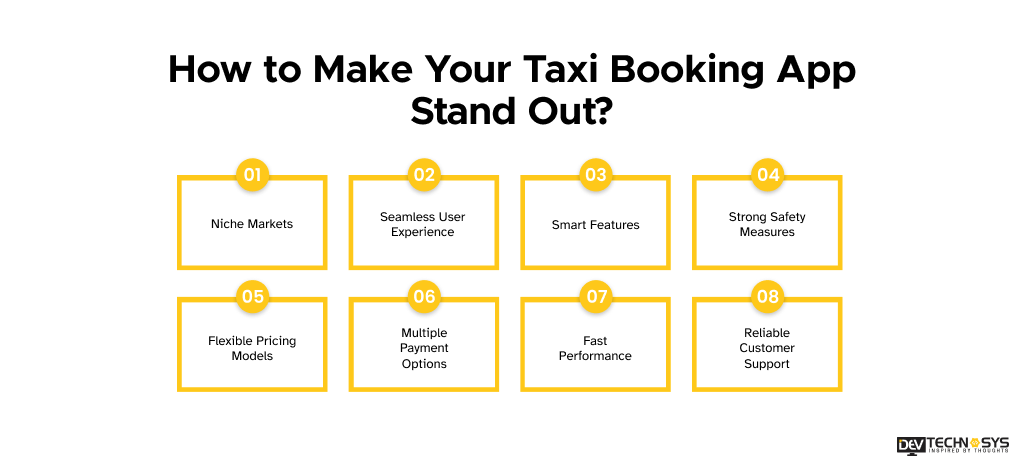
- Niche Markets: Businesses can target developing specific EV taxis, bike taxis, or women-only ride services.
- Seamless User Experience: The app must offer a simple booking process with an intuitive UI/UX design.
- Smart Features: Add advanced features such as AI-based route optimization and real-time tracking.
- Strong Safety Measures: Make sure the app provides an SOS button, driver verification, and secure payments.
- Flexible Pricing Models: The ride fare must offer amazing discounts, subscriptions, and loyalty programs.
- Multiple Payment Options: Allow users to make payments via multiple options like wallets, cards, UPI, and cash support.
- Fast Performance: The application must have a low loading time, real-time responsiveness, and avoid performance issues.
- Reliable Customer Support: Users should get 24/7 assistance to resolve their issues quickly and offer an outstanding user experience.
Case Study: Navivo Ride
Dev Technosys has developed a ride-booking platform named Navivo Ride. It is an AI-powered taxi booking platform that enhances urban mobility through smart dispatching, real-time tracking, and predictive analytics. We built this app for our client’s motto to improve driver efficiency and passenger experience. We integrate scalable cloud architecture, dynamic pricing, and automation to ensure reduced wait times and optimized fleet utilization.
Product Highlights
- Project Name: Navivo Ride
- About Client: Miller Jones
- Industry: On-demand Taxi Booking & Mobility
- Client Location: USA
- Development Timeline: 6 Months
- Team Size: 10 Members
- Platform Type: Cross-platform Mobile App (Android & iOS) + Web Admin Panel
Final Words
In this world, where convenience is just a few taps away, developing a taxi booking app is a great option. People are looking for ease at every step, and the comfort of booking rides anytime, anywhere can’t be missed.
This is what attracts entrepreneurs to build a taxi booking app in this highly advanced and mobile-first generation. For this, they search for a top-class taxi booking app development company. It will offer you a scalable, feature-rich, and customized solution tailored.
One of the top names that appears for taxi app development services is Dev Technosys. It is the best mobile app development company serving different industries with amazing digital solutions for more than 15 years.
Frequently Asked Questions
Find answers to the most common questions related to this article.
To create a taxi booking app, 8 stages need to be followed strategically and carefully. These steps are:
Idea Validation and Market Analysis
Decide Essential Features
Select the Tech Stack
UI/UX Design Standard
Taxi Booking App Development
Testing and Quality Monitoring
App Launch and Promotion
Post-Launch Support and Maintenance
The overall cost to develop a taxi booking app in 2026 can range from $8,000 to $30,000. The final price is determined by the app’s complexity and several other factors. These factors include UI/UX, backend infrastructure, development team & location, security & compliance, platform choice, third-party APIs, and more.
Yes, making a taxi booking app in 2026 is considered profitable due to several reasons. These are:
Increasing Demand for On-Demand Mobility
Multiple Revenue-Generating Streams
Smart Cities & Sustainable Mobility Integration
Niche Market Expansion
In 2026 and beyond, these factors can make taxi booking apps a highly scalable and profitable opportunity.
Even when everything is developed properly, there are some obstacles that might appear during the development process. Some of the common challenges include:
Driver Retention
User Safety
Real-Time Tracking Accuracy
Intense Market Competition
Safety and Regulatory Compliance
Addressing these challenges can lower the chances of project delays, cost overruns, security risks, and poor user adoption.
Ride-hailing apps incorporate several money-making models to earn recurring profits. These models include:
Commission on Every Ride
Surge or Dynamic Pricing
Corporate and B2B Solutions
Ancillary Revenue Streams
Implementing these monetization strategies can help taxi businesses stay profitable in this competitive market.
The average time required to develop a taxi booking app ranges between 4 and 7+ months. The timeline is determined by the platform’s complexity, integrations, and security requirements. Developing an MVP taxi booking app takes 4 to 6 months. Whereas a fully-featured, advanced ride booking app can be developed in 7+ months.
Yes, you can build a taxi booking app without technical expertise by partnering with an experienced development company. A reliable team can handle planning, design, development, testing, and deployment while helping you focus on business strategy, operations, customer acquisition, and long-term growth.
The best tech stack depends on your business goals, scalability requirements, and budget. Many startups choose Flutter or React Native for cross-platform development, Node.js for backend services, and cloud infrastructure for scalability, ensuring faster development, lower costs, and smooth performance.
Yes, most regions require taxi booking businesses to obtain transportation or aggregator licenses before operating commercially. Licensing requirements vary by country and state, so it is important to review local regulations early to avoid legal issues, penalties, or launch delays.
To attract drivers, offer competitive commission rates, onboarding bonuses, referral rewards, and flexible earning opportunities. Many successful taxi startups build driver communities and provide incentives during the launch phase to ensure strong driver availability and reliable service from day one.
Cross-platform apps are often the preferred choice for startups because they reduce development costs and launch time while supporting both Android and iOS. Native apps are better suited for businesses that require maximum performance, advanced features, and long-term scalability.