


















Quick Summary:
The taxi booking app development cost starts from $8,000 to $25,000 or based on the project complexity. The MVP-based taxi app development cost is $8,000 to $15,000, and a mid-complex app ranges from $15,000 to $25,000. The fully-featured application cost is around $25,000 or higher.
Cost Impacted by Project or Development Complexity:
-
- Simple/MVP-Based Apps($8,000 – $15,000): Include features like user & driver registration, ride booking & cancellation, and basic GPS tracking.
- Mid-Complex Apps($15,000 – $20,000): Features available such as push notifications & SMS alerts, multiple payment gateways, and more.
- Complex/Enterprise Applications($25,000+): Involve functionalities like AI-based route optimization, fleet management system, and dynamic surge pricing.
Cost Based on Taxi Booking App Types:
-
- Local Taxi Booking App: $10,000 to $18,000
- Ride-Sharing App: $13,000 to $22,000
- Corporate / Enterprise Taxi App: $15,000 to $24,000
- Premium Chauffeur Booking App: $14,000 to $23,000
- On-Demand Multi-Service Mobility App: $8,000 to $17,000
Cost Based on the Different Regions/Countries:
-
- Cab booking app development cost in USA is around $10,000 to $30,000 or based on the app type and features.
- Taxi booking application development cost in Australia ranges from $9,000 to $27,000, depending on integrations and tech stacks.
- Ride-hailing booking app development cost in Canada lies between $8,500 to $25,500; it can fluctuate due to crucial factors.
Additional Cost:
-
- Maintenance Services: The cost to maintain an app is around 10% to 20% of the initial app development cost.
- Security Measurements: Integrating strong security methods is important, and the cost can be higher due to compliance and legal audits.
The urgency with which taxi booking applications have been integrated into daily life is especially evident in transport to educational institutions, offices, shopping, and the like. Taxi app bookings are especially convenient, accelerating the transport process. Businesses are particularly interested in taxi booking app development costs and associated taxonomies as we approach the year 2026.
The number of variables increases with the complexity of the question. In this case, we are referring to the untraceable variables associated with the app function, the complexity of the design, the associated technological advancements, and, of course, the level of the developer. Extremely sophisticated attributes will, of course, enhance the user experience, but at significantly greater operational costs. This will be the primary expense in the operation of the app.
In this blog, we will analyze and explore the taxi booking app development cost in 2026, what factors affect the cost, and different cab booking apps with their cost.
Let’s go to the destination!
Market Statistics of Global Taxi Booking Applications
Let’s take a look at the current and future market stats of global taxi booking applications through market.us.
- As per the recent survey, the global taxi booking applications market was valued at around $272.2 billion in 2025; it is expected to increase to around $468.4 billion in 2033.
- Look at the segment-wise, the ride-hailing segment is leading the taxi booking market and accounting for around 52% in 2025.
- Compared platform-wise, the Android platforms dominate the global chauffeur service app market with around 65% share in 2025.
- According to a study, the car hire apps market is projected to grow with a CAGR of 7% during the forecast period from 2025 to 2033.
- As per the region-wise, the Asia-Pacific region holds the highest market revenue share, around 34% in 2025.
How Much Does Taxi Mobile App Development Cost to in 2026?
The cost to build a taxi booking app is around $8,000 to $25,000 or based on the project requirements and complexity. There are various types of key factors that can fluctuate the cost, such as features, functions, backend infrastructure, tech stacks, third-party integrations, development team, platform choice, and many more. If businesses develop a highly complex taxi booking application with rich functionality, it can incur a higher taxi booking app development cost.
| Cost Component | Description | Estimated Cost (USD) |
| UI/UX Design | App layout, user flows, wireframes for rider & driver apps | $1,000 – $3,000 |
| Frontend Development | Passenger app + Driver app (Android/iOS or cross-platform) | $2,500 – $7,000 |
| Backend Development | Server, APIs, database, real-time ride management | $2,000 – $6,000 |
| Admin Panel & Dashboard | Admin controls, driver management, ride monitoring | $1,000 – $4,000 |
| Testing, Deployment & Maintenance | QA testing, app store deployment, and initial support | $1,500 – $5,000 |
What is the Cost of Different Taxi Booking Applications?
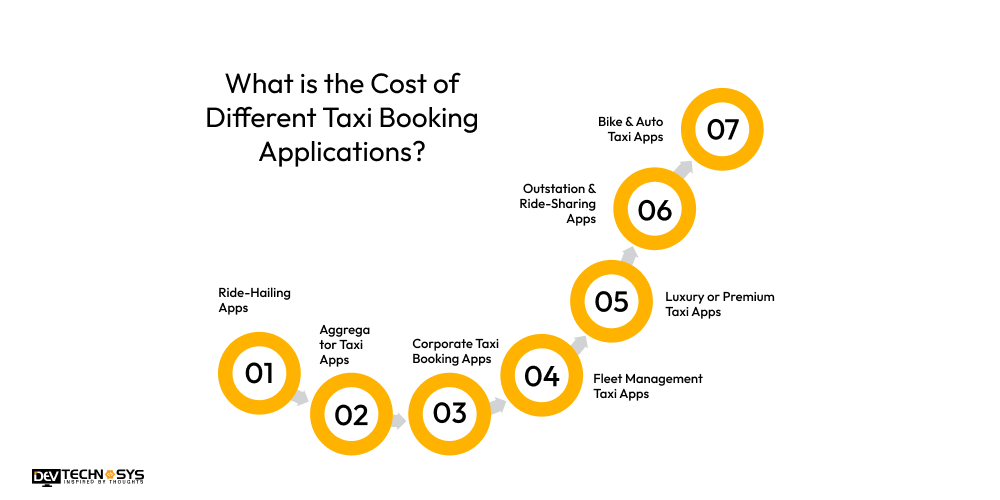
The cost of developing taxi booking apps varies widely based on type, features, and complexity. Ride-hailing, aggregator, corporate, fleet management, luxury, outstation, and bike/auto taxi apps each have unique requirements. Factors like GPS tracking, payment integration, admin panels, and multi-platform support influence development budgets and determine the final investment needed.
1. Ride-Hailing Apps
Costs include driver commissions (15–30%), booking fees, dynamic pricing during peak hours, and customer service charges. There are also expenses for app maintenance, payment gateway fees, and marketing. Surge pricing increases fares temporarily based on demand patterns.
| Feature / Complexity | Description | Estimated Cost |
| Basic Booking & GPS Tracking | Core booking, ride tracking, simple UI | $10,000 |
| Advanced Ride Features | In-app payments, notifications, and fare calculation | $16,000 |
| Full-Scale Multi-City App | Dynamic pricing, admin panel, analytics | $22,000 |
2. Aggregator Taxi Apps
Aggregators charge commission from partner taxis (10–25%) and sometimes a subscription for visibility. Riders pay base fare, distance/time charges, and service fees. Costs vary widely by city, taxi type, and regulatory levies imposed on operations.
| Feature / Complexity | Description | Estimated Cost |
| Simple Aggregator | Connects multiple taxis with basic booking | $9,000 |
| Enhanced Aggregator | Payment integration, ratings, reviews | $14,000 |
| Enterprise Aggregator | Multi-platform support, reporting dashboards | $20,000 |
3. Corporate Taxi Booking Apps
These taxi booking apps charge subscription or per‑ride administrative fees, integration fees with company systems, and usage‑based charges. Discounts often apply via corporate contracts. Additional costs include reporting, payroll integration, and priority support for businesses.
| Feature / Complexity | Description | Estimated Cost |
| Basic Corporate | Employee login, ride booking | $8,500 |
| Mid-Tier Corporate | Admin dashboard, invoicing, reporting | $15,000 |
| Advanced Corporate | Multi-location support, analytics, priority booking | $23,000 |
4. Fleet Management Taxi Apps
Costs include software licensing or monthly subscriptions, GPS tracking, driver and vehicle management modules, and analytics. Additional fees may apply for customization, advanced reporting, maintenance, and hardware (telemetry units, tablets).
| Feature / Complexity | Description | Estimated Cost |
| Simple Fleet Tracking | GPS monitoring, driver panel | $9,500 |
| Mid-Level Management | Scheduling, trip history, basic analytics | $14,500 |
| Advanced Fleet Suite | Vehicle telematics, advanced reporting, notifications | $24,000 |
5. Luxury or Premium Taxi Apps
Higher base fares and per‑kilometer rates reflect upscale vehicles and services. These apps typically charge higher commissions (20–35%) and include premium service fees. Add‑ons include wait time, airport fees, and luxury surcharges.
| Feature / Complexity | Description | Estimated Cost |
| Basic Premium | Booking & premium vehicle selection | $11,000 |
| Enhanced Premium | In-app payment, luxury vehicle filtering, reviews | $17,000 |
| Full Luxury Suite | Multi-city, VIP support, advanced notifications | $25,000 |
6. Outstation & Ride-Sharing Apps
Outstation car booking apps use distance‑based pricing with minimum trip charges, driver allowances, and toll charges. Ride‑sharing has lower per‑ride costs, splitting fares among passengers, plus small service or platform fees. Dynamic pricing may apply on busy routes.
| Feature / Complexity | Description | Estimated Cost |
| Basic Outstation | Distance-based booking, driver matching | $8,500 |
| Enhanced Outstation | Payment integration, fare splitting, notifications | $14,000 |
| Full Ride-Sharing | Multi-passenger matching, route optimization, analytics | $21,000 |
7. Bike & Auto Taxi Apps
Lower base fares with shorter distance and time charges. Apps take a commission (10–20%) per ride. Extra charges may include safety gear fees, wait time fees, and small booking charges. Costs vary greatly by city and vehicle type.
| Feature / Complexity | Description | Estimated Cost |
| Basic Bike/Auto Booking | Quick booking, GPS tracking | $8,000 |
| Mid-Level Features | Payments, ratings, notifications | $12,500 |
| Advanced Multi-Vehicle | Fleet management, analytics, surge pricing | $18,500 |
What Factors Affect the Taxi Booking App Development Cost in 2026?
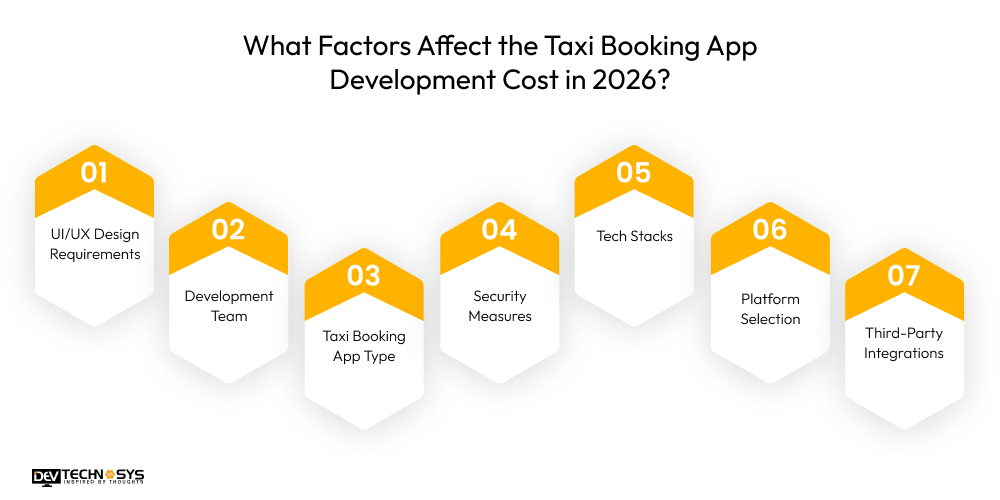
Several factors influence the development cost of cab-hailing apps in 2026. These include UI/UX design complexity, the size and expertise of the development team, app type and features, security measures, technology stack, platform choice, and third-party API integrations. Each factor directly impacts development time, resources, and overall investment.
1. UI/UX Design Requirements
High‑quality, intuitive UI/UX increases design hours and transportation app development cost. Custom animations, user journeys, accessibility features, and multi‑language support require more effort. Prototyping, user testing, and iterative redesign elevate cost further. Simple templates are cheaper, but unique, brand‑aligned designs demand specialized designers and longer development time.
| Design Level | Description | Cost Impact |
| Basic Design | Standard templates, simple screens | $1,000 |
| Intermediate Design | Custom UI elements, animations | $2,500 |
| Advanced Design | Full custom branding, multi-language support, user testing | $4,000 |
2. Development Team
The ride-booking app development costs depend on team size, expertise, and location. Senior developers, UI/UX designers, QA testers, and project managers cost more than juniors. Hire mobile app developers from high‑wage regions increases budgets; offshore teams reduce expenses. Efficient teams reduce bugs and time‑to‑market. Team structure affects communication overhead and delivery speed, impacting the overall ride-sharing app development cost.
| Team Setup | Description | Cost Impact |
| Small Team | 2-3 developers, minimal QA | $1,500 |
| Mid-Sized Team | Full-stack developers, UI/UX designers, testers | $3,500 |
| Large Team | Senior developers, project manager, QA, support staff | $5,000 |
3. Taxi Booking App Type
Different app types (ride‑hailing, corporate, luxury, on-demand taxi app) have varying features. Complex workflows, advanced pricing engines, multi‑city support, and custom modules increase development time. More app variations (customer, driver, admin panels) and advanced features like AI dispatch or ride‑sharing further raise AI-powered taxi app development cost compared to basic transportation apps.
| App Complexity | Description | Cost Impact |
| Basic App | Single city, simple booking | $1,500 |
| Mid-Level App | Multi-city, ride tracking, payment integration | $3,000 |
| Advanced App | Multi-vehicle types, dynamic pricing, analytics | $5,000 |
4. Security Measures
Robust security protects data and builds trust. Implementation of encryption (SSL/TLS), secure authentication (OAuth, biometrics), data protection compliance (GDPR/PDPA), secure APIs, and regular security audits increases the taxi dispatch software development cost. Anti‑fraud systems, secure payment processing, and user privacy safeguards are essential but require time and resources.
| Security Level | Description | Cost Impact |
| Basic Security | Standard login, SSL | $800 |
| Moderate Security | Payment encryption, OTP authentication | $1,800 |
| Advanced Security | Biometric login, GDPR compliance, anti-fraud systems | $3,000 |
5. Tech Stacks
Choice of programming languages, frameworks, databases, cloud services, and backend structure affects licensing, scalability, and developer cost. Cutting‑edge stacks (e.g., Rust, AI services) may demand specialized developers. Scalable, maintainable stacks cost more initially but save in the long term. Serverless vs traditional architecture also impacts total cost to build a taxi booking app like Arro.
| Stack Type | Description | Cost Impact |
| Basic Stack | Simple backend, standard database | $1,000 |
| Modern Stack | Cloud support, scalable backend | $2,500 |
| Advanced Stack | AI-based routing, real-time analytics, microservices | $4,000 |
6. Platform Selection
Developing for iOS, Android, or both increases cost. Cross‑platform frameworks (Flutter, React Native) can reduce price but may limit platform‑specific optimization. Native apps offer better performance but add to development hours and testing. Tablet or web versions further escalate taxi app development pricing and budget.
| Platform | Description | Cost Impact |
| Single Platform | iOS or Android only | $1,500 |
| Cross-Platform | Flutter/React Native | $2,500 |
| Multi-Platform Native | Separate iOS + Android apps | $4,000 |
7. Third-Party Integrations
Hire dedicated developers to start integrations with maps (Google/Here), payment gateways, SMS/OTP services, push notifications, analytics, and telematics APIs increase both development and maintenance costs. Each API may require licensing fees, compliance with provider policies, and additional testing, directly affecting project budgets and timelines.
| Integration Level | Description | Cost Impact |
| Basic | Maps & basic payment gateway | $1,000 |
| Moderate | SMS/OTP, notifications, and advanced payment options | $2,000 |
| Advanced | Analytics, fleet telematics, multiple APIs | $3,500 |
Cost of Popular Taxi Booking Applications in 2026
Developing taxi dispatch apps in 2026 varies based on features, complexity, and platforms. Apps like Uber, Bolt, Gett, Curb, and InDrive differ in functionality, scalability, and integrations. Costs fluctuate depending on ride types, GPS tracking, payment systems, user dashboards, and admin panels, shaping total development budgets.
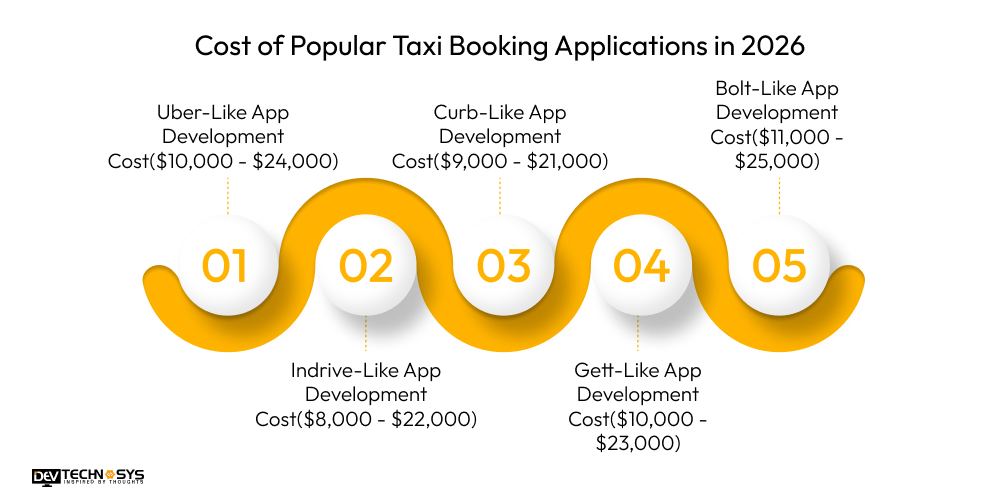
1. Uber-Like App Development Cost($10,000 – $24,000)
A full-featured Uber-style app includes rider, driver, and admin panels, GPS tracking, dynamic pricing, in-app payments, notifications, and analytics. It supports multi-platform deployment, AI-powered route optimization, and surge pricing, suitable for large-scale ride-hailing operations or multi-city expansions.
| Feature | Estimated Development Time | Cost Impact |
| User Registration & Profile | 60 – 100 hours | $1,000 – $1,800 |
| Ride Booking & Scheduling | 100 – 160 hours | $1,800 – $3,000 |
| GPS & Real-Time Tracking | 90 – 150 hours | $1,500 – $2,800 |
| Payment Integration | 60 – 120 hours | $1,200 – $2,200 |
| Driver & Rider Dashboard | 80 – 140 hours | $1,500 – $2,500 |
| Ratings & Reviews | 50 – 90 hours | $900 – $1,500 |
| Push Notifications & Alerts | 40 – 80 hours | $700 – $1,200 |
| Ride History & Receipts | 50 – 90 hours | $900 – $1,500 |
| Surge Pricing & Dynamic Fare | 60 – 110 hours | $1,000 – $1,800 |
| Admin Panel & Analytics | 100 – 160 hours | $2,000 – $3,500 |
2. Indrive-Like App Development Cost($8,000 – $22,000)
A taxi booking app like Indrive focuses on fare-bidding between riders and drivers. Features include real-time ride tracking, secure payments, user dashboards, and notifications. Multi-platform support and administrative tools for managing trips, analytics, and user interactions enhance functionality for flexible ride-hailing operations.
| Feature | Estimated Development Time | Cost Impact |
| Fare Negotiation / Bidding | 80 – 140 hours | $1,500 – $2,500 |
| Ride Matching | 70 – 120 hours | $1,200 – $2,000 |
| GPS & Real-Time Tracking | 60 – 110 hours | $1,000 – $1,800 |
| Payment Gateway Integration | 50 – 90 hours | $900 – $1,500 |
| Driver & Rider Profiles | 50 – 90 hours | $800 – $1,400 |
| Ratings & Reviews | 40 – 70 hours | $700 – $1,200 |
| Trip History & Receipts | 40 – 70 hours | $600 – $1,200 |
3. Curb-Like App Development Cost($9,000 – $21,000)
The taxi booking app like Curb provide straightforward taxi booking with GPS tracking, ride history, and in-app payments. They typically include rider and driver panels and admin tools. Ideal for small to medium-scale operations, they focus on efficiency, user-friendly interfaces, and fast deployment for local markets.
| Feature | Estimated Development Time | Cost Impact |
| Basic Ride Booking | 60 – 100 hours | $1,000 – $1,800 |
| GPS & Route Navigation | 70 – 120 hours | $1,200 – $2,000 |
| Payment Integration | 50 – 80 hours | $900 – $1,400 |
| Simple Driver Dashboard | 40 – 70 hours | $700 – $1,200 |
| Ride History | 40 – 70 hours | $600 – $1,200 |
| Push Notifications | 30 – 60 hours | $500 – $900 |
| Ratings & Feedback | 30 – 60 hours | $500 – $900 |
4. Gett-Like App Development Cost($10,000 – $23,000)
The taxi booking app like Gett emphasizes reliability and corporate solutions, with features like ride booking, in-app communication, analytics dashboards, and admin control. They often include multi-city support, fleet management, and enterprise-focused reporting for business clients, making them suitable for larger, professional operations.
| Feature | Estimated Development Time | Cost Impact |
| Corporate Booking System | 80 – 140 hours | $1,500 – $2,500 |
| Multi-City Ride Support | 90 – 150 hours | $1,800 – $2,800 |
| Real-Time GPS Tracking | 60 – 110 hours | $1,200 – $2,000 |
| Payment & Invoicing | 60 – 100 hours | $1,200 – $2,000 |
| Admin Panel & Analytics | 100 – 160 hours | $2,000 – $3,500 |
| Driver Management | 70 – 120 hours | $1,200 – $2,000 |
| Ride History & Reporting | 50 – 90 hours | $900 – $1,500 |
5. Bolt-Like App Development Cost($11,000 – $25,000)
Bolt-style apps support multiple vehicle types, ride-hailing, secure payments, real-time tracking, and notifications. Additional features can include surge pricing, fleet management, and user-friendly dashboards. Designed for efficient daily operations, these apps cater to urban mobility solutions with flexible service options.
| Feature | Estimated Development Time | Cost Impact |
| Quick Ride Booking | 60 – 100 hours | $1,000 – $1,800 |
| Multi-Vehicle Support | 70 – 130 hours | $1,400 – $2,400 |
| Surge Pricing / Dynamic Fare | 50 – 90 hours | $900 – $1,500 |
| GPS & Real-Time Tracking | 60 – 110 hours | $1,200 – $2,000 |
| Payment Integration | 50 – 90 hours | $900 – $1,500 |
| Driver Ratings & Reviews | 40 – 70 hours | $700 – $1,200 |
| Push Notifications & Alerts | 30 – 60 hours | $500 – $900 |
Planning a Taxi Project?
Get a tailored development cost estimate in a few simple steps.
- 3 quick steps
- 100% free
- Reply in 1 business day
2 Minutes Read
How to Reduce the Taxi Booking App Development Cost in 2026?
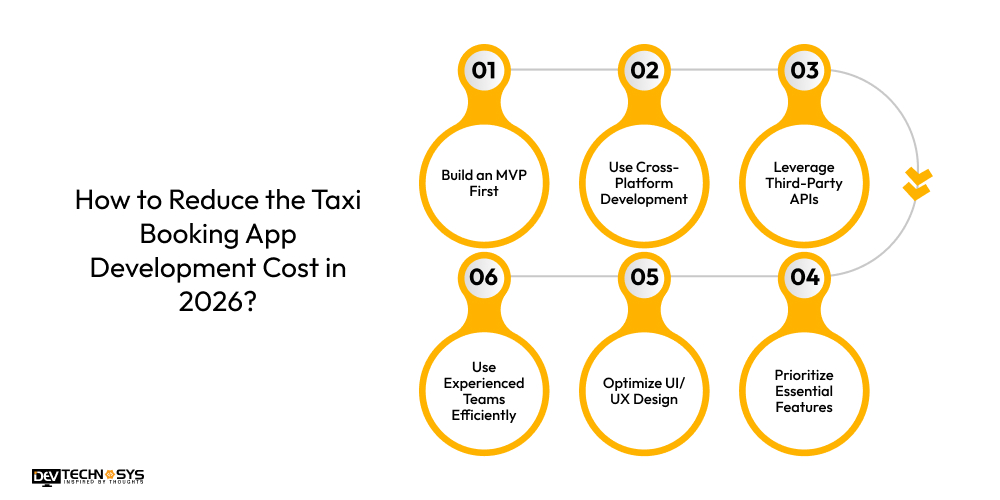
Reducing development costs involves building a Minimum Viable Product (MVP) to test core features, leveraging cross-platform frameworks like Flutter or React Native, and integrating reliable third-party APIs for maps, payments, and notifications. These approaches save time, resources, and ensure scalable, efficient app development.
1. Build an MVP First
Develop a Minimum Viable Product (MVP) with core features like booking, payments, and tracking to test market demand. This approach minimizes initial development effort, reduces risk, and allows iterative improvements based on user feedback. Advanced features can be added later, saving both time and resources while ensuring the app meets actual user needs.
2. Use Cross-Platform Development
Using cross-platform frameworks like Flutter or React Native allows a single codebase to run on both iOS and Android. This reduces development time, testing, and maintenance compared to separate native apps. It ensures faster deployment, consistent functionality across platforms, and easier updates, making it a cost-effective approach without compromising user experience or app performance.
3. Leverage Third-Party APIs
Integrating reliable third-party APIs for maps, payment gateways, notifications, and analytics avoids building complex systems from scratch. This accelerates development, reduces maintenance effort, and ensures secure, tested functionality. Choosing well-documented and widely used APIs helps lower development risk, improves reliability, and provides scalable solutions without incurring the cost of custom feature development.

4. Prioritize Essential Features
Focus on core functionalities like ride booking, tracking, and payments first. Avoid adding advanced features during initial development. Prioritizing essential features reduces development hours, simplifies testing, and decreases resource requirements. Advanced or optional features can be implemented later, allowing phased development and cost-effective scaling of the app as user demand grows.
5. Optimize UI/UX Design
Use clean, intuitive designs without excessive custom animations or graphics in the early stages. A simple, user-friendly interface reduces design hours and development complexity. Later, enhancements can be added based on user feedback. Optimizing UI/UX design early prevents unnecessary redesigns and minimizes costs while maintaining an appealing and functional app.
6. Use Experienced Teams Efficiently
Hiring skilled, reliable development teams from cost-effective regions can reduce labor costs without compromising quality. Efficient team management, clear requirements, and communication reduce errors and rework. Strategic outsourcing balances expertise and budget, helping to maintain high-quality development while lowering overall taxi-hailing platform costs in 2026.
What are the Common Ways to Make Money From Taxi Booking Apps in 2026?
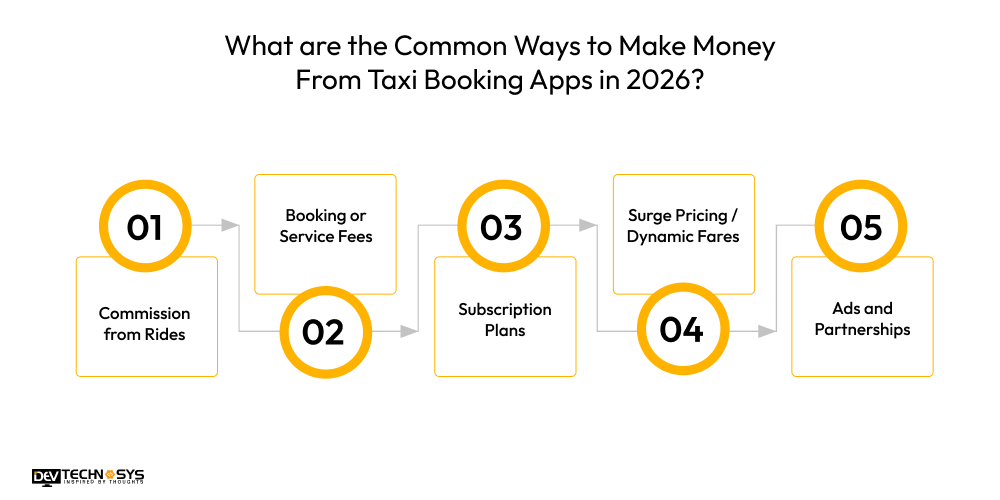
Private car service apps earn money through multiple channels, including commissions on rides, booking or service fees, subscription plans for premium features, dynamic surge pricing during peak demand, and partnerships or in-app advertisements. These strategies create diverse, scalable revenue streams while supporting sustainable platform growth.
1. Commission from Rides
Ride service platforms earn a percentage of each completed ride from drivers. This commission model is the primary revenue stream, allowing the platform to profit from every transaction while incentivizing drivers to join and maintain high service quality.
2. Booking or Service Fees
A small fixed fee is charged to riders per booking. This covers platform maintenance, support, and operational costs. It ensures consistent revenue regardless of ride distance, and can vary based on city, demand, or ride type.
3. Subscription Plans
Drivers or riders can pay monthly or annual subscriptions for premium benefits, such as priority bookings, reduced commissions, or access to corporate features. According to the mobile app development company, subscription revenue provides predictable cash flow and loyalty incentives for both users and drivers.
4. Surge Pricing / Dynamic Fares
During high-demand periods, fares increase temporarily through dynamic pricing. This boosts revenue while balancing supply and demand. Surge fees benefit both drivers and the platform, encouraging more drivers to operate during peak times.
5. Ads and Partnerships
The transportation booking apps generate income by displaying advertisements, promoting services, or partnering with local businesses. Sponsored listings, in-app promotions, and affiliate deals provide alternative monetization without increasing user ride costs, creating multiple revenue streams.
What Tech Stacks are Used to Build a Taxi Booking App?
Knowing about the tech stacks is very important to build a successful ride request app, we provide a detailed description of the tech stacks:
| Layer / Component | Technology Options | Purpose / Notes |
| Frontend (Rider & Driver Apps) | React Native, Flutter, Swift (iOS), Kotlin (Android) | Mobile app development; Flutter & React Native allow cross-platform apps; Swift & Kotlin for native performance |
| Backend / Server | Node.js, Python (Django/Flask), Java (Spring Boot), Ruby on Rails | Handles business logic, ride requests, dispatch, and notifications |
| Database | PostgreSQL, MySQL, MongoDB, Firebase Realtime DB | Store user data, ride history, payments, and driver info; MongoDB/Firebase for real-time tracking |
| APIs / Integrations | Google Maps / Mapbox, Stripe / PayPal, Twilio / Firebase Cloud Messaging | Maps & navigation, payment processing, SMS/notifications |
| Cloud & Hosting | AWS, Google Cloud, Microsoft Azure, DigitalOcean | Scalable hosting, storage, push notifications, cloud functions, and real-time updates |
| Analytics & Monitoring | Google Analytics, Mixpanel, Firebase Analytics, Sentry | User behavior tracking, performance monitoring, and error logging |
| Security | OAuth 2.0, JWT, SSL/TLS, AES Encryption | Secure authentication, token-based access, encrypted data transfer |
| DevOps & CI/CD | GitHub Actions, GitLab CI/CD, Docker, Kubernetes | Automated deployment, containerization, scaling, and continuous integration |
Final Thoughts!
Yes, this blog is coming to an end. Before that, we share final thoughts about the taxi booking app development cost in 2026. We hope that you have cleared all your issues regarding the cost of app development, and we also provide the popular taxi reservation apps cost. This blog also provides cost-reducing ways to help businesses to maintain their fixed budget.
Do you want to build a taxi booking app? You must connect with an experienced taxi booking app development company to receive affordable and customized solutions.
Frequently Asked Questions
Find answers to the most common questions related to this article.
The cost to develop a taxi booking app in California lies between $8,000 and $25,000, or higher. The final cab booking app development cost can fluctuate due to various factors such as features, project complexity, backend infrastructure, size, tech stacks, and more.
To make a taxi booking app with basic functionalities takes around 2 to 4 months, and a fully-featured taxi app can take around 3 to 6 months. The timeline is based on the key elements such as project size, number of features, and design UI/UX.
The taxi app maintenance cost is around 10% to 20% of the initial ride-hailing app development cost. It involves various services such as fixing security patches, performance optimization, adding new enhancements, upgrading OS versions, and many more.
Hire taxi app developers cost starts from $15 to $25 per hour, depending on project requirements and demand. The cost of hiring can fluctuate due to crucial factors like developers' experience level, living location, skill set, and project complexity.
There are various key factors that impact the taxi booking app development cost. Here is the list.
● Development Team
● Features and Functions
● Security Measures
● Design UI/UX
● Tech Stacks