




















Quick Summary:
The cost to hire a software developer typically ranges between $20 to $80 per hour. The final price depends on the developer’s experience, the hiring model you choose, and the complexity of your technology stack.
By understanding these pricing drivers, business owners and startups can build a flexible development budget. This helps them balance high-quality code with a strong return on investment (ROI).
Cost Affected by Developer’s Experience Level:
-
- Junior Developers ($20 – $35/Hour): Best for basic tasks, simple UI layouts, bug fixing, and helping an existing development team.
- Mid-Level Developers ($35 – $60/Hour): Ideal for building scalable mobile or web apps, managing databases, and setting up core API integrations.
- Senior Developers ($60 – $80+/Hour): Best for complex system design, platform architecture, team leadership, and advanced software features.
Cost of Hiring Software Developers Based on Different Regions:
Instead of just looking at experience, the actual type of software you are building plays a huge role in your hourly budget:
-
- Web & Frontend ($10 – $15/Hour): Standard web development using popular frameworks like React, Angular, or Vue.js.
- Mobile & Full-Stack ($20 – $25/Hour): Building complete end-to-end features or native mobile apps (iOS/Android) using Flutter or Swift.
- AI, ML & DevOps ($35 – $45+/Hour): High-demand specializations involving cloud infrastructure setup (AWS/Kubernetes) or integrating custom AI models.
In 2026, hiring a software developer is something beyond just a cost decision. It is a strategy for business growth that can either make or break your business. Whether you are launching a new app or scaling a business digitally, one question is common: how much does it cost to hire a software developer?
The price of the software developer hugely impacts the development timeline, quality, and success. What’s interesting is that the cost to hire software developer depends on their skills, experience, and location.
Be it an AI specialist or a low-cost remote developer, the custom software development price landscape is transformed. In this blog, we will break down the cost structure to hire a software developer in 2026. After all, it is not just about budgeting, but making the right investment with confidence and trust.
Software Developer Hiring Trends in 2026-2027 That Are Changing Development Costs
The final software development cost estimation in 2026-2027 depends not only on experience or geographic location. However, it is also affected by the skill set of engineers. Businesses interested in developing a digital product need developers capable of creating:
- AI-driven applications
- Cloud-based systems
- Scalable digital products
Many companies in this era are increasingly opting to hire remotely or use hybrid recruitment models. This way, businesses benefit from an international talent pool while keeping development costs low.
Another significant trend is increasing requests for developers who are proficient in:
- Automation
- Cybersecurity
- Cloud technology
There is a high demand for these skills and a shortage of specialists with them on the market. That’s why specialists with such skills usually have higher hourly rates. Businesses will be able to plan their budget better when considering this market trend.
| Trend | Impact on Hiring Cost | Business Benefit |
| AI-first development | Higher demand for AI/ML engineers increases hourly rates by 20–40% | Faster automation and smarter applications |
| Remote global hiring | Expands talent pool but creates pricing variations across regions | Access to cost-efficient global expertise |
| Cloud-native development | Requires advanced DevOps and cloud specialists, increasing costs | Improves scalability and system performance |
| Cybersecurity-focused projects | Security experts charge premium rates due to compliance demand | Reduces data breach and compliance risks |
| Dedicated development teams | Reduces long-term cost per hour due to stable engagement models | Ensures faster and consistent delivery |
Industry Insight: Many businesses hire dedicated software developers from Dev Technosys. One thing that we have observed is that businesses are increasingly prioritizing AI and cloud expertise over basic development skills. In 2026-2027, it is directly reshaping global software engineering hourly rates and hiring strategies.
Who are Software Developers?
The skilled and creative individuals who offer designing, building, and software testing services are known as software developers. These professionals use programming languages to maintain software apps and systems.
Software developers are the architectural geniuses that handles computer programs, mobile apps, and operating systems. They efficiently control the complete app development lifecycle, from pinpointing user needs to deploying the product.
Important Roles and Responsibilities of a Software Developer:
- Transform ideas into fully functional softwares
- Writing code that is clean and efficient
- Solving development-related problems and removing bugs
- To collaborate with teams that are cross-functional
- Conduct thorough testing to ensure quality assurance
- Continuous maintenance and upgrades after app launch
- Learning and adopting new technologies as per trends
- Always focus on enhancing user experience
- Guaranteeing security to protect user data
- Managing tasks and meeting deadlines
What is the Average Cost to Hire a Software Developer in 2026 – 2027?
The average cost to hire a software developer in 2026 typically ranges between $20 and $80 per hour, depending on the developer’s experience, technical expertise, location, and hiring model.
- Junior developers are ideal for basic software development, bug fixing, and maintenance projects. Their hourly rates typically range from $20–$35 per hour.
- Mid-level developers are suitable for building scalable applications, backend systems, and API integrations. Their rates generally range from $35–$55 per hour.
- Senior developers specialize in enterprise software, cloud architecture, AI, DevOps, and complex system design. They typically charge $55–$80+ per hour.
| Experience Level | Hourly Rate (2026) | Best For Use Cases | Key Skills & Expertise |
| Junior Developer (0-2 years) | $20–$35/hour | Basic projects, bug fixing, UI development | HTML, CSS, JavaScript, APIs |
| Mid-Level Developer (2-5 years) | $35–$55/hour | Scalable software, backend systems | React, Node.js, Databases, Cloud |
| Senior Developer (5+ years) | $55–$80+/hour | Enterprise software, architecture, and AI solutions | Cloud, DevOps, AI, System Design |
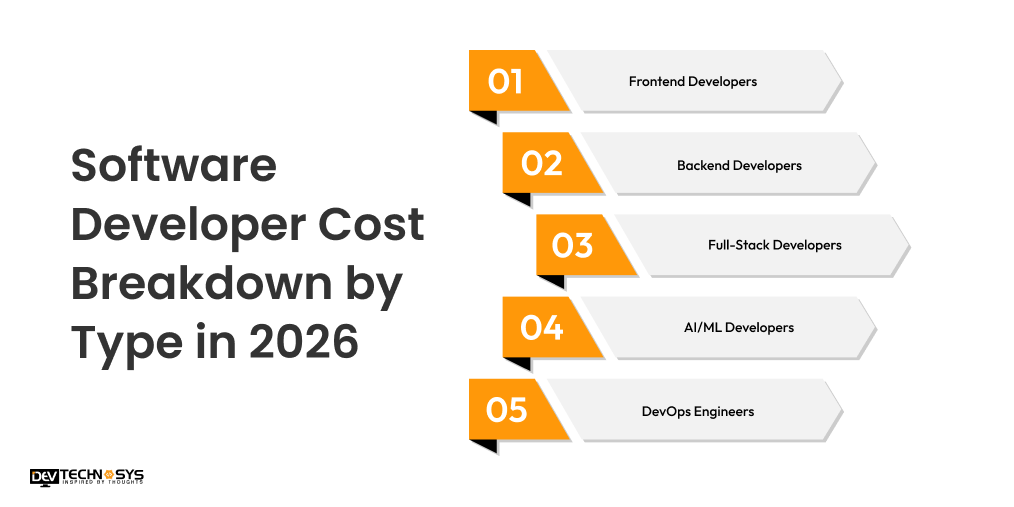
Software Developer Cost Breakdown by Type in 2026
You will be shocked to know that the developer’s cost is also determined by selecting the right expertise. Whether you want to manage complex backend systems or build AI-driven solutions, each developer type has unique value and price. We are discussing the cost breakdown as per the developer’s type to make smart decisions.
1. Frontend Developers
Everything a user sees or interacts with in a website or app is developed by frontend developers. They mainly work on the app’s design, responsiveness, and usability. These developers make sure the users have an amazing experience on different devices and browsers.
| Complexity Level | Hourly Cost | Description |
| Junior (Basic UI) | $20–$30/hour | Handles responsive layouts and UI implementation |
| Mid-Level (Interactive UI) | $30–$50/hour | Builds dynamic interfaces and API integrations |
| Senior (Advanced UI/UX) | $50–$70/hour | Optimizes performance, animations, and accessibility |
2. Backend Developers
The team that works behind the scenes of a software is the backend developers. They generally manage servers, databases, and application logic. Backend developers ensure every function, from data flow to system performance, works reliably and smoothly under different conditions.
| Complexity Level | Hourly Cost | Description |
| Junior (Basic Logic) | $22–$35/hour | Basic APIs, CRUD operations, database handling |
| Mid-Level (Scalable Systems) | $35–$55/hour | Authentication, APIs, scalable backend services |
| Senior (High Complexity) | $55–$80/hour | Microservices, enterprise architecture, optimization |
3. Full-Stack Developers
The professionals that manages the work of both frontend and backend development are considered full-stack developers. They are highly versatile because they have the ability to work on the entire software. Full-stack developers build complete solutions without relying on multiple developers.
| Complexity Level | Hourly Cost | Description |
| Junior (Basic Full-Stack) | $25–$35/hour | Basic frontend and backend development |
| Mid-Level (End-to-End Development) | $35–$60/hour | Complete application development |
| Senior (Architecture Level) | $60–$80/hour | Enterprise architecture and scalability planning |
4. AI/ML Developers
AI/ML developers build smart solutions that learn from the data to make informed decisions. They focus on adding automation, predictive models, and advanced features to the modern apps. By making the app as per 2026 standards, AI/ML developers enhance user experience.
| Complexity Level | Hourly Cost | Description |
| Junior (Basic Models) | $30–$40/hour | Data preprocessing and simple ML models |
| Mid-Level (Applied ML) | $40–$60/hour | Predictive models and ML pipelines |
| Senior (Advanced AI Systems) | $60–$80+/hour | LLMs, Generative AI, Computer Vision, NLP |
5. DevOps Engineers
DevOps developers are highly recommended to fill the gap between development and operations. Their main focus always remains on deployment, automation, and system reliability. DevOps engineers ensure faster app releases, smoother workflows, and stable application performance.
| Complexity Level | Hourly Cost | Description |
| Junior (Basic Deployment) | $25–$35/hour | Basic CI/CD and deployments |
| Mid-Level (Automation & Scaling) | $35–$60/hour | Cloud infrastructure and automation |
| Senior (Infrastructure Architect) | $60–$80/hour | Enterprise DevOps, Kubernetes, cloud architecture |
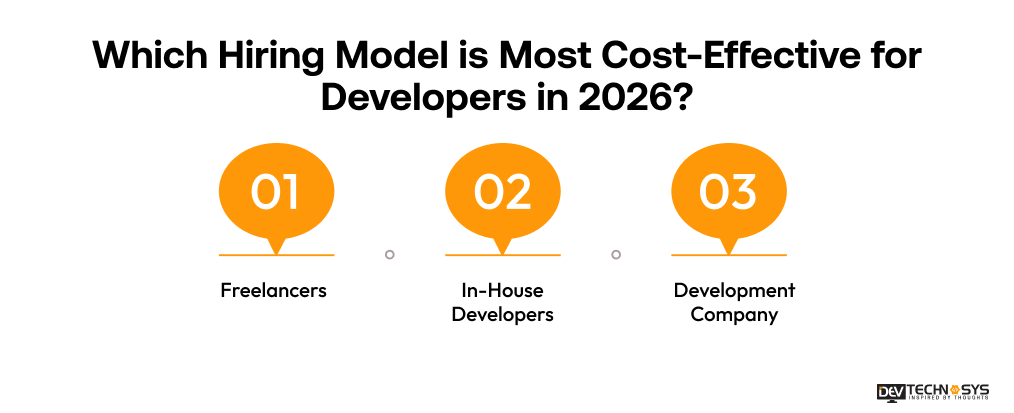
Which Hiring Model is Most Cost-Effective for Developers in 2026?
The key to balancing the app’s cost, flexibility, and success depends on selecting the right hiring model in 2026. Whether you opt for freelancers, in-house teams, or development agencies, each offers unique advantages. Here, we will understand these models to hire mobile app developers who help optimize the development budget.
1. Freelancers
Freelancers should be the preferred option for very short-term projects and specialized projects. They provide flexibility and lower up-front costs, allowing start-ups or small businesses to use their services. There is an absence of long-term commitment or full-time development assistance with freelancers.
2. In-House Developers
In-house development personnel are assigned solely to you and your business. Therefore, they provide superior control, communication, and overall alignment with your organizational goals. They are also considerably more expensive in the long-term. In-house developers serve an important function for businesses.
3. Development Company
A development company handles large projects entirely while delivering desired results faster. This model reduces hiring and operational overhead, making it cost-effective for businesses. Those who are looking to scale quickly without managing an internal development team, a development agency is the best option.
| Factor | Freelance Developers | In-House Developers | Development Company |
| Hiring Cost | $20–$50/hour | $40–$80/hour | $20–$80/hour |
| Expertise Level | Specialized individual skills | Dedicated internal expertise | Multi-domain expert team |
| Scalability | Limited team expansion | Slow workforce scaling | Rapid resource scaling |
| Project Management | Self-managed projects | Managed internally | End-to-end management |
| Development Speed | Depends on availability | Team-dependent delivery | Faster structured delivery |
| Reliability & Support | Limited ongoing support | Consistent internal support | Long-term technical support |
| Flexibility | Highly flexible engagement | Fixed resource allocation | Flexible hiring models |
| Communication | Direct client contact | Internal team coordination | Dedicated project manager |
| Technology Coverage | Limited tech expertise | Team skill dependent | Full-stack technology team |
| Best For | Short-term projects | Long-term business products | Startups, SMEs & Enterprises |
True Cost of Ownership (TCO): What Hiring a Developer Really Costs in 2026-2027?
All organizations measure the cost of recruiting developers by the hourly rate or salary. However, the amount includes just one side of the cost of the engagement. The TCO model shows the ownership of each layer for each of the three models for hiring developers. This allows one to make a comparison before allocating money to recruit developers.
In-House Developer: Full Ownership Responsibility
With in-house developers comes total control, but also total liability for the process. All the expenses associated with the hiring process will be fully borne by the business.
| Cost Layer | What It Includes |
| Compensation | Base salary + raises + bonuses |
| Recruitment | Job boards, agency fees, HR time |
| Statutory obligations | Payroll taxes, employer FICA |
| Benefits | Health, dental, 401k match, paid leave |
| Infrastructure | Hardware, licenses, security tooling |
| Productivity ramp | Months before full output is reached |
| Turnover risk | Full cycle restarts if the developer leaves |
The ownership reality: All layers are the responsibility of the busines. It includes financial, legal, operational, and risk management. The salary amount listed in the offer letter covers approximately 55-65% of the first-year cost.
Freelancer: What the Simplicity Conceals?
The freelance option is quite flexible due to the working model and a very simple rate system, which simplifies budgeting. However, behind this simplicity, certain operational issues become visible only when the problem arises.
| Cost Layer | What It Includes |
| Platform markup | Added on top of the quoted rate |
| Management overhead | Coordinating each contractor |
| IP & legal | Ownership transfer contracts |
| Rematching cost | Full restart if freelancer exits |
| Knowledge continuity | Context is lost when engagement ends |
The ownership reality: Freelancers take off the financial risk of employment from the enterprises. But it can put businesses at full risk of operations, continuity, and IP.
Development Company: What the Model Absorbs?
An offshore development firm transfers the majority of ownership liabilities off the business’s shoulders. They receive a team of specialists, clear deliveries, and clear budgeting without having to deal with any employer issues.
| Cost Layer | What It Includes | Who Carries It |
| Recruitment & vetting | Sourcing, screening, testing | Agency |
| Payroll taxes & benefits | All employer obligations | Agency |
| Infrastructure & tooling | Dev environment, licenses | Agency |
| Project management | Dedicated PM | Agency |
| QA & testing | Built into delivery | Agency |
| Senior oversight | Architect review | Agency |
| Turnover replacement | No project restart | Agency |
The ownership reality: The development company includes a single engagement rate, where the client pays one consolidated cost. All layers in the process, including development, project management, quality assurance, deployment, and support, come under the umbrella of the agency.
TCO Responsibility Comparison
| Responsibility | In-House | Freelancer | Dev Company |
| Recruitment burden | High | Medium | None |
| Legal & compliance | High | Medium | None |
| Day-to-day management | Low | High | Low |
| Knowledge retention risk | Low | High | Low |
| Scalability effort | High | Medium | Low |
| Budget predictability | Low | Medium | High |
| Overall TCO burden | Highest | Medium | Lowest |
Cost to Hire Software Developers As Per the Regions
Regional differences greatly affect hiring software developers in 2026. Each region presents its own unique labor costs, skill level, demand, and economic conditions. Knowing the regional cost to hire developers for startups and businesses helps match the talent pool, budget, and project quality.
1. North America (USA & Canada)
In North America, you will find software developers highly proficient in working with advanced technology. However, the cost to hire laravel developers from here is high. The reason for this is the high demand for software developers, their cost of living, and the standard of innovation.
| Experience Level | Hourly Rate (USD) | Estimated Monthly Cost (USD) |
| Junior Developer | $20–$35/hour | $3,200–$5,600/month |
| Mid-Level Developer | $35–$55/hour | $5,600–$8,800/month |
| Senior Developer | $55–$80/hour | $8,800–$12,800/month |
2. Europe (Western & Eastern)
Europe offers the perfect blend of price and quality when hiring software developers. Generally, the software developer hourly rate in Western Europe is higher because of the high level of technical standards. Whereas Eastern Europe rates are more affordable but provide developers with the same level of expertise.
| Experience Level | Hourly Rate (EUR) | Estimated Monthly Cost (EUR) |
| Junior Developer | €18–€31/hour | €2,880–€4,960/month |
| Mid-Level Developer | €31–€49/hour | €4,960–€7,840/month |
| Senior Developer | €49–€71/hour | €7,840–€11,360/month |
3. Asia (India, Southeast Asia)
The countries of Asia, notably India is the cheapest country to hire software developers. That’s why they are the cost-effective locations to hire developers, perfect for businesses with a limited budget. They offer competitive rates, a wide range of skill sets, and flexibility in how they engage developers.
| Experience Level | Hourly Rate (INR) | Estimated Monthly Cost (INR) |
| Junior Developer | ₹1,700–₹3,000/hour | ₹2.72L–₹4.80L/month |
| Mid-Level Developer | ₹3,000–₹4,700/hour | ₹4.80L–₹7.52L/month |
| Senior Developer | ₹4,700–₹6,800/hour | ₹7.52L–₹10.88L/month |
4. Middle East & Africa
Countries in the Middle East and Africa are emerging as software development markets. In these countries, the cost to hire dedicated developers who are proficient in development is high. The availability of highly specialized development talent will vary depending on the country and the type of project.
| Experience Level | Hourly Rate (AED) | Estimated Monthly Cost (AED) |
| Junior Developer | AED 73–129/hour | AED 11,680–20,640/month |
| Mid-Level Developer | AED 129–202/hour | AED 20,640–32,320/month |
| Senior Developer | AED 202–294/hour | AED 32,320–47,040/month |
5. Latin America
Countries in Latin America offer affordability, skilled developers, and a time zone that conveniently aligns with North America. As such, Latin America is increasingly becoming the region of choice for nearshore outsourcing, especially for development projects. It allows for good communication, cultural fit, and competitive pricing.
| Experience Level | Hourly Rate (BRL) | Estimated Monthly Cost (BRL) |
| Junior Developer | R$110–193/hour | R$17,600–30,880/month |
| Mid-Level Developer | R$193–303/hour | R$30,880–48,480/month |
| Senior Developer | R$303–441/hour | R$48,480–70,560/month |

Dev Technosys Cost Benchmarks: What Our Clients Actually Paid?
The theoretical hourly rate has limited means to assist the business in determining its projects’ expenses. Therefore, it is critical to determine the total expense to take a complete product to market. For complete transparency, we examined our internal project information for software applications we have created and implemented on behalf of our clients over the past year. The following matrix shows the breakdown of our team members, the timing for completion of each phase of functionality, and the actual project cost for a major industry:
| What We Built (Real 2026 Projects) | The Development Team Used | Time to Build | Total Project Cost |
| On-Demand Service App | 1 UI/UX Designer, 1 Mobile Developer, 1 QA Tester | 10 – 12 Weeks | $30,000 – $70,000 |
| Multi-Vendor E-Commerce Platform | 1 Product Manager, 2 Full-Stack Developers, 1 QA Engineer | 14 – 18 Weeks | $70,000 – $1,10,000 |
| Healthcare CRM & Telemedicine Portal | 1 Software Architect, 3 Dedicated Developers, 1 DevOps Engineer, 1 QA | 20+ Weeks | $1,10,000 – $1,50,000+ |
Behind the Numbers: The Dev Technosys Efficiency Blueprint
For complete transparency, we examined our internal project information for software applications we have created and implemented on behalf of our clients over the past year.
1. Pre-Built Core Capabilities:
Whenever we bill for project development, we will not be spending time creating fundamental components (e.g., user registration, SMS authentication, etc.) from scratch. We will instead use secure, pre-vetted code snippets, which means that the overall expenditure can be highly correlated with custom components.
2. Dedicated Test Automation:
We always perform automated quality checks in parallel within each development sprint (prior to production). We will identify defects early enough in the life cycle to effectively minimize the project’s development cost.
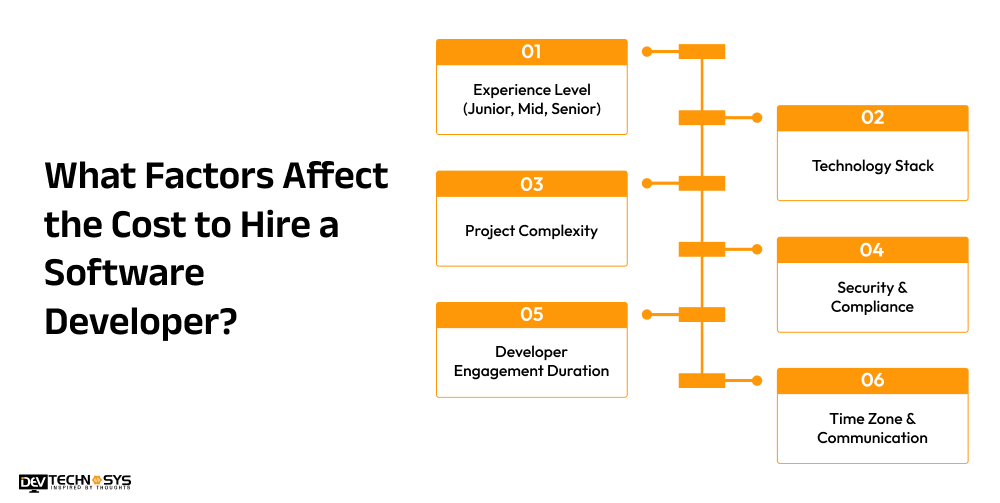
What Factors Affect the Cost to Hire a Software Developer?
The developer’s experience, industry needs, technologies, time zone, and project complexity are among the factors influencing hiring costs. When any enterprise learns about these factors, they can plan ther budget properly and efficiently. It helps them choose the right software development provider that balances quality with affordability.
1. Experience Level (Junior, Mid, Senior)
Developers that has more experience come with advanced skills, fast development speed, and problem-solving abilities. That’s why they charge higher rates compared to mid-level and junior. Although junior developers ask for lower per-hour prices, they need proper supervision.
| Experience Level | Developer Expertise | Business Impact | Additional Hourly Cost |
| Junior | Basic programming and debugging skills | Suitable for MVPs, maintenance, and minor feature updates | Up to $10/hour |
| Mid-Level | Strong development and problem-solving capabilities | Ideal for scalable business applications and API integrations | Up to $25/hour |
| Senior | Enterprise architecture and technical leadership | Best for complex software, AI solutions, and mission-critical systems | Up to $45/hour |
2. Technology Stack
Selecting programming languages, tools, frameworks, databases, etc., impacts the cost to hire dedicated remote developer team. Highly advanced technologies demand higher-paid developers who are experienced in stacking. Whereas integrating common technologies can be handled by budget developers.
| Technology Stack | Examples | Development Requirement | Additional Hourly Cost |
| Basic Technologies | HTML, CSS, PHP, WordPress | Standard business websites and simple applications | Up to $10/hour |
| Modern Technologies | React, Node.js, Flutter, .NET | Scalable web and mobile application development | Up to $20/hour |
| Advanced Technologies | AI, Blockchain, DevOps, Cloud, LLMs | Enterprise software and next-generation digital products | Up to $35/hour |
3. Project Complexity
More complex projects demand higher expertise, longer development time, and possibly a larger team. Features like integrations, scalability, security, and custom functionalities increase costs, while simple applications with basic requirements are quicker and more affordable to build.
| Project Complexity | Project Scope | Development Effort | Additional Hourly Cost |
| Basic | Landing pages, MVPs, internal tools | Low development effort with minimal integrations | Up to $10/hour |
| Moderate | Business software, SaaS platforms, and eCommerce | Medium complexity with third-party integrations | Up to $20/hour |
| Complex | Enterprise software, AI platforms, FinTech solutions | Advanced architecture, security, and scalability requirements | Up to $40/hour |
4. Security & Compliance
The next factor influencing expenses to hire web developers is industry security and compliance. Some industries require compliance with strict regulations, data protection, and best development processes. This needs developers with domain-specific knowledge that charges more.
| Security Level | Compliance Requirements | Industries | Additional Hourly Cost |
| Basic | Standard authentication and encryption | Small businesses and startups | Up to $8/hour |
| Standard | GDPR, PCI-DSS, SOC 2 compliance | SaaS, eCommerce, enterprise applications | Up to $18/hour |
| Advanced | HIPAA, ISO 27001, financial-grade security | Healthcare, Banking, Government | Up to $35/hour |
5. Developer Engagement Duration
Usually, the project duration affects the developers’ engagement, which impacts the cost of hiring a software developer. Short-term projects have higher hourly rates due to lower developer engagement. Limited engagement reduces negotiation flexibility due to tight deadlines.
| Project Duration | Hiring Model | Business Advantage | Cost Impact |
| Short-Term | Project-based hiring | Fast onboarding for urgent requirements | Up to $20/hour |
| Medium-Term | Dedicated resource model | Better collaboration and predictable delivery | Up to $10/hour |
| Long-Term | Extended development partnership | Lower hourly rates with long-term commitments | Custom discounted pricing |
6. Time Zone & Communication
Working across different time zones can affect productivity and coordination. Developers in convenient time zones or with strong communication skills may charge higher rates. It offers seamless collaboration, real-time updates, and fewer delays, adding value to projects.
| Collaboration Model | Communication Style | Project Efficiency | Additional Hourly Cost |
| Offshore Teams | Scheduled communication | Cost-effective with flexible coordination | Up to $5/hour |
| Partial Time Overlap | Daily collaboration windows | Balanced communication and affordability | Up to $10/hour |
| Same Time Zone | Real-time collaboration | Faster decision-making and immediate support | Up to $20/hour |
What are the Hidden Cost to Hire a Software Developer?
Despite everything being planned well, there are some hidden costs that might affect the software development prices. From recruitment efforts to project delays can significantly impact the budget to hire dedicated software developers. Understanding some hidden costs can help businesses plan accurately without financial tension.
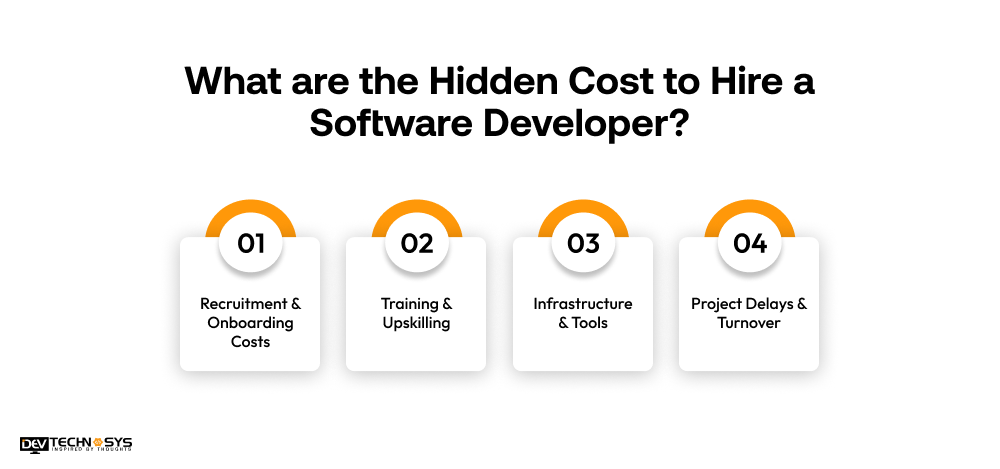
1. Recruitment & Onboarding Costs
When businesses hire a developer, it involves job postings, recruiter fees, interviews, and technical assessments. These add to the final offshore software developers’ price and the software developer monthly cost. This increases the hiring cost beyond the salaries of the developers.
2. Training & Upskilling
To smoothly work with the company’s tools, workflow, and technologies, developers require training. It includes paid learning time, course expenses, or mentorship that can temporarily lower a developer’s productivity. It increases the offshore software development rates but ensures efficiency and skill enhancement.
3. Infrastructure & Tools
The cost to hire developers in India or other regions includes hardware, software licenses, cloud services, and collaboration tools. Offering these tools and a secure environment to developers can raise the cost. Infrastructure and tools expenses increase with the growing team size.
4. Project Delays & Turnover
Whether the requirement is unclear or due to developer turnover, the delays can significantly increase the budget. It involves rehiring, retraining, and lost productivity that elevates the timelines. This makes the project continuity and retention critical for controlling hidden expenses.

How to Reduce the Cost of Hiring Software Developers?
With smart decision-making and strategic planning, a software development company can reduce the cost of hiring developers. They can optimize hiring models, select low-cost regions, use agile methodology, and more measures. Understanding the ways to reduce the expenses to hire app developers.
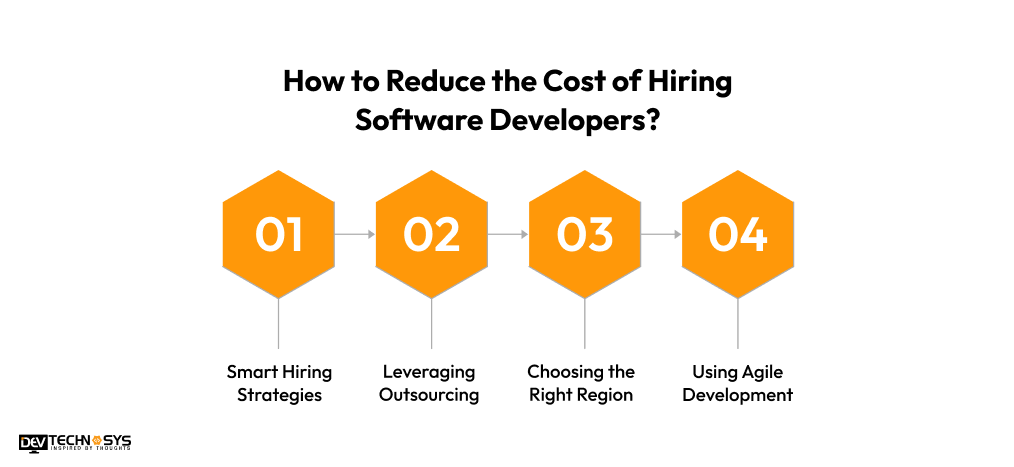
1. Smart Hiring Strategies
Businesses must be clear about the job requirements to avoid unnecessary costs to hire mobile app developers. By using skill-based assessments, they can hire the developers who are well-needed in the firm. To lower the cost, enterprises can even consider freelancers or part-time developers.
2. Leveraging Outsourcing
Hiring a custom software development firm helps businesses reduce infrastructure, recruitment, and operational costs. With this measure, enterprises can access highly experienced developers with no long-term commitments. Integrating this measure, companies can scale resources efficiently with a limited budget and the requirements of the project.
3. Choosing the Right Region
The rate of software developer demand varies according to regions. The software developer hiring cost by country can be a great option to decrease development costs as well. Lowering cost doesn’t mean the quality suffers. Countries in Asia and Eastern Europe offer skilled developers at competitive prices.
4. Using Agile Development
By leveraging agile methodology, organizations can focus on efficient use of resources. It is widely preferred to minimize waste, reduce rework, and identify issues early. It controls the cost to hire team of software developers while improving productivity. Also, this measure guarantees fast delivery of high-quality solutions.
Case Study / Example Cost Estimation to Hire Software Developers
We will now better understand the software development pricing models in 2026 with the real-world examples. Here, we have specifically taken the example of developing a SaaS-based project management platform. This case study includes estimated development costs, resource allocation, and timeline-based pricing.
1. Case Study 1: Developer Cost Breakdown: An Hourly-Based Estimation
Role |
Hourly Rate |
Estimated Hours |
Total Cost |
| Frontend Developer | $18 – $22 | 160 hours | $3,000 – $3,500 |
| Backend Developer | $20 – $25 | 180 hours | $3,500 – $4,500 |
| UI/UX Designer | $15 – $20 | 120 hours | $2,000 – $2,500 |
| QA Engineer | $15 – $18 | 100 hours | $1,500 – $2,000 |
| Total Developer Cost | — | — | $10,000 – $12,500 |
What it Explains:
This breakdown table to hire SaaS developers explains how it affects the total development cost. When you hire an experienced and highly professional developer, it increases the upfront expenses. It also enhances the development speed, scalability, and code quality.
2. Case Study 2: Timeline vs Budget Analysis
Timeline |
Team Size |
Estimated Cost |
| 2–3 Months (Fast Delivery) | 4–5 Developers | $25,000 – $35,000 |
| 3–5 Months (Standard Timeline) | 2–3 Developers | $18,000 – $28,000 |
| 5–7 Months (Extended Timeline) | 1–2 Developers | $12,000 – $22,000 |
What it Explains:
This table displays that the project developed in a shorter timeline raises the cost to hire software developers. Whereas a project with a longer timeline decreases the monthly expenses but may delay the product launch.
True Price of Cheap Code: What a Sub-$20/Hour Developer Really Costs Businesses?
Offshore development is a great option for many companies. Still, many businesses go for development options based on the lowest possible hourly rate. Typically, a low upfront price carries with it a lot of technical debt. It will increase the cost to fix buggy, poor-quality code later. The following lists contain the costs of real-world repairs that a low hourly rate developer will incur for businesses
1. The Spaghetti Code Trap (Cost to Fix: $5,000 – $15,000)
- The Issue: Low-cost developers typically hard-code values directly into the code. They do not write substantial documentation for their software application. Therefore, the application may appear to work on day one. But when enterprises go to add a new integration, they will find the entire system to be broken.
- Reality: A qualified mid-level or senior developer builds software using modular architecture. This means every feature is isolated, clean, and documented. It allows enterprises to scale or modify the app easily without rebuilding it from scratch.
2. Zero Database Indexing (Cost to Fix: $4,000 – $10,000)
- The Issue: The majority of database designs constructed by novice programmers are improperly built. When an app has only 10 test users, the speed of the application is really fast. However, when 1,000 users access the same application, it will exceed the server’s limits and ultimately crash.
- Reality: Experienced engineers run simulated load testing and properly optimize data queries before the product ever goes live. It saves businesses from catastrophic downtime during a launch.
3. Open API Security Vulnerabilities (Cost to Fix: $8,000 – $25,000+)
- The Issue: Market-based game developers typically short-change their budget by not using secure protocols. It includes setting up encryption, using token authentication, or validating data at the data source. This exposes their user information unnecessarily to commonly exploited malicious attacks via the open API endpoints.
- Reality: True software experts build applications with a Security-First mindset. They integrate automated code scans and strict access tokens directly into the development pipeline.
Conclusion
Picture this: There are two companies, each hire a developer for a project. The main focus of the first company remains on the hourly rates of developers. Whereas the other hired developers, according to their development strategy. The first one ends up overspending due to hidden costs, delays, and mismatched talent. The other one finishes with savings by selecting the right region, agile methodology, and clear requirements.
The above story tells us that a developer’s hiring cost is not just about the numbers or money. But it is a strategy that protects the company from overspending and other blunders. The main purpose of the companies is more than giving salaries. They can bring efficiency and scalability with smart hiring.
Why Dev Technosys is the Best Option to Hire a Software Developer?
Dev Technosys is the top mobile app development company, with a global reputation. They have been in this industry for more than 15 years and have worked with over 35 industries. It has delivered 3500+ outstanding and highly scalable digital products.
Dev Technosys has a strong and well-qualified team of expert coders, problem solvers, and tech architects. If you want to hire a software developer, Dev Technosys is the perfect one-stop solution.
Frequently Asked Questions
Find answers to the most common questions related to this article.
The average cost to hire a software developer can be somewhere from $15 to $25 per hour. Several factors that affect the hiring cost of a software engineer include their ability to:
Choose the right technologies
Secure the project with compliance
Deal with complex projects
Communicate without hiding anything
Some of the factors that influence the hiring budget of a developer include:
Experience Level (Junior, Mid, Senior)
Technology Stack
Project Complexity
Security & Compliance
Developer Engagement Duration
Time Zone & Communication
These factors can be the reason for higher developer hiring costs.
The expenses to hire software developers are higher because of the high demand and technical skills. Software developers are mainly hired for their expertise in coding, problem-solving, and system design. Simultaneously, their experience level, geographical location, and knowledge in advanced technologies increase the developer hiring costs.
Requirement Discussion: Share project needs and goals takes 1 day.
Consultation & Finalization: Define scope, budget, and hiring model, take 1–2 days
Developer Matching: Getting pre-vetted developer profiles takes 1–2 days
Interview (Optional): Quick technical discussion/interview takes 1–2 days
Developer Onboarding: Final selection and project kickoff takes 1 day
= Total Time to hire a developer takes 3 to 7 days
Yes, outsourcing software development is way cheaper than in-house teams. It terminates the salary, infrastructure, and employee benefit expenses. By opting for outsourcing development, businesses can save approximately 40–60%. This makes it a perfect and cost-efficient solution for startups and large enterprises.