
















Key Takeaways:
-
- Choose the Right GDS: Compare Amadeus, Sabre, and Travelport based on airline coverage, target markets, APIs, and business requirements.
- Follow the Integration Process: Cover API access, authentication, flight search, booking, PNR creation, testing, certification, and go-live
- Support Core Booking Features: Include fare validation, seat maps, ancillary services, NDC content, PNR management, and multi-GDS data normalization.
- Prioritize Security and Costs: Plan for encryption, authentication, PCI DSS, privacy requirements, setup costs, transaction fees, and ongoing maintenance.
Travel businesses today can’t compete on inventory alone. Customers expect real-time fares, instant seat availability, and a booking flow that never stalls, and that means connecting your platform directly to the systems airlines actually use to distribute seats. This is where flight API integration with GDS platforms comes in. Amadeus, Sabre, and Travelport remain the backbone of global airline distribution, giving travel agencies, OTAs, and startups access to hundreds of carriers through a single connection point.
This guide walks through how GDS integration actually works, what separates Amadeus, Sabre, and Travelport from one another, the technical steps involved in getting connected, and the security standards a production-ready integration needs to meet.
Whether you’re evaluating GDS providers for the first time or planning a new booking platform, this breaks down what to expect at every stage.
What is GDS and Why It Matters for Flight Booking?
A Global Distribution System (GDS) is a centralized platform that connects travel agencies and booking engines to real-time flight, hotel, and car rental inventory from hundreds of suppliers worldwide. Instead of building separate connections to every airline, a travel platform integrates once with a GDS like Amadeus, Sabre, or Travelport and gains access to consolidated fares, schedules, and availability.
GDS is different from an Internet Distribution System (IDS), which pushes inventory to consumer-facing sites like OTAs rather than connecting agents to suppliers. It’s also distinct from a Central Reservation System (CRS), which is typically supplier-specific (an airline or hotel chain’s own booking system) rather than a multi-supplier aggregator. For travel agencies that hire dedicated developers, Flight API Integration with GDS Platforms remains the standard route to broad airline coverage, especially where NDC-only or aggregator-only strategies still leave coverage gaps.
Amadeus vs Sabre vs Travelport: Choosing the Right GDS
Amadeus, Sabre, and Travelport are the three major GDS providers, and each is better suited to different markets and business models. Amadeus API integration is typically strongest in European and Asia-Pacific markets, Sabre API integration has deeper penetration in North America, and Travelport API integration (unifying Apollo, Worldspan, and Galileo) offers a single access point across three legacy systems at once.
GDS |
Airline coverage |
Best fit |
API format |
| Amadeus | 700+ airlines, strong in Europe/APAC | OTAs and agencies with global/EU-heavy traffic | REST and SOAP |
| Sabre | ~400 airlines, strong in North America | US/NA-focused travel platforms and TMCs | REST and SOAP |
| Travelport | Unifies Apollo, Worldspan, Galileo | Platforms needing broad legacy GDS coverage in one connection | SOAP (Universal API), REST (lightweight) |
Choosing between them isn’t purely about coverage.
Sabre API authentication, contract minimums, certification timelines, and existing commercial relationships all factor into which flight API integration with GDS platforms path makes sense for a given business.
Step-by-Step Flight API Integration Process
Flight API integration with GDS platforms typically involves five stages, from provider onboarding and authentication to testing, certification, and production deployment. Experienced travel app development services follow a particular process that varies by GDS provider, API product, and business model.
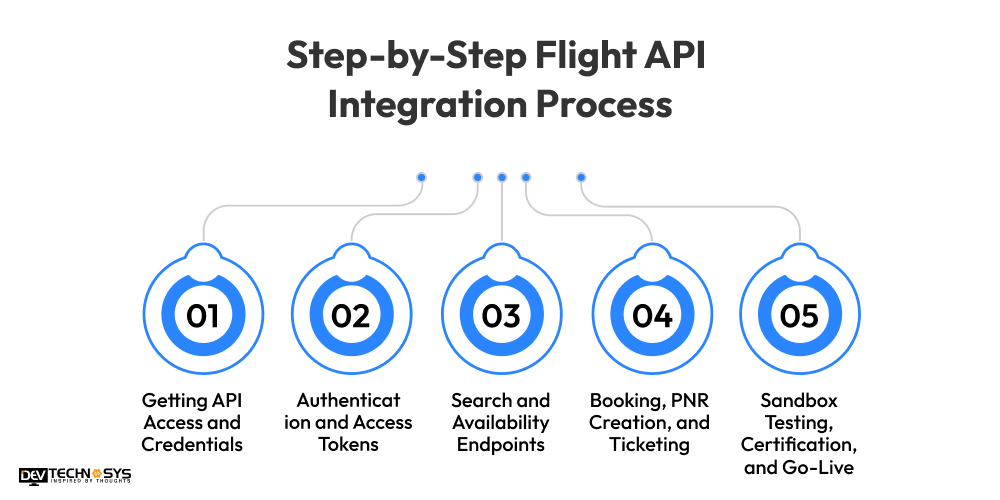
1. Getting API Access and Credentials
GDS providers typically require a partner or developer onboarding process before issuing production credentials. This may involve business verification, the intended use case, technical requirements, and commercial or transaction-volume considerations.
Once approved, the provider supplies the credentials and documentation required to access its APIs. Development usually begins with sandbox credentials before moving to production access.
2. Authentication and Access Tokens
Authentication varies by GDS and API product. Many modern APIs use OAuth 2.0 to obtain an access token before authorized requests can be made.
A simplified illustrative token request may look like:
POST /v1/security/oauth2/token
grant_type=client_credentials
client_id={your_api_key}
client_secret={your_api_secret}
The integration securely stores the credentials, requests an access token, and attaches the token to subsequent API calls. The exact authentication flow, endpoint, and credential format depend on the selected GDS.
3. Search and Availability Endpoints
After authentication, the flight booking system can connect to search and availability endpoints to retrieve flight schedules, fares, cabin classes, availability, and related offer information.
A simplified illustrative REST request could look like:
GET /v2/shopping/flight-offers
?origin=DXB
&destination=LHR
&departureDate=2026-11-10
The API response may contain flight segments, fare conditions, baggage information, pricing, and availability. Some GDS platforms and legacy integrations use SOAP and XML instead of REST and JSON, so the integration layer may need response transformation and data mapping.
Illustrative example only. Endpoint names, parameters, authentication methods, and response formats vary by GDS provider.
4. Booking, PNR Creation, and Ticketing
After a traveler selects a suitable fare, the integration moves from shopping to booking. The system submits passenger details, selected flight segments, and required payment or billing information to the appropriate booking endpoints.
The GDS then creates or confirms the PNR (Passenger Name Record). Depending on the provider and workflow, additional steps may include fare revalidation, payment authorization, ticket issuance, and booking confirmation.
Hybrid app development services can build production-ready integration that also handles failed bookings, fare changes, cancellations, refunds, timeouts, and other supplier-side errors.
5. Sandbox Testing, Certification, and Go-Live
Before production deployment, the integration is tested against the GDS sandbox or test environment. Testing should cover the complete booking lifecycle, including flight searches, fare selection, passenger data, PNR creation, ticketing, cancellations, and error handling.
Some GDS providers also require formal certification before production access is enabled. After certification, the integration can move to production with appropriate logging, monitoring, security controls, and error-handling mechanisms in place.
Key Technical Components of GDS Flight API Integration
A production-ready flight API integration with GDS platforms connects flight inventory, fares, passenger records, seat availability, ancillary services, and ticketing through a unified integration layer. The system must also handle supplier-specific response formats, fare changes, booking errors, and real-time availability throughout the booking journey.
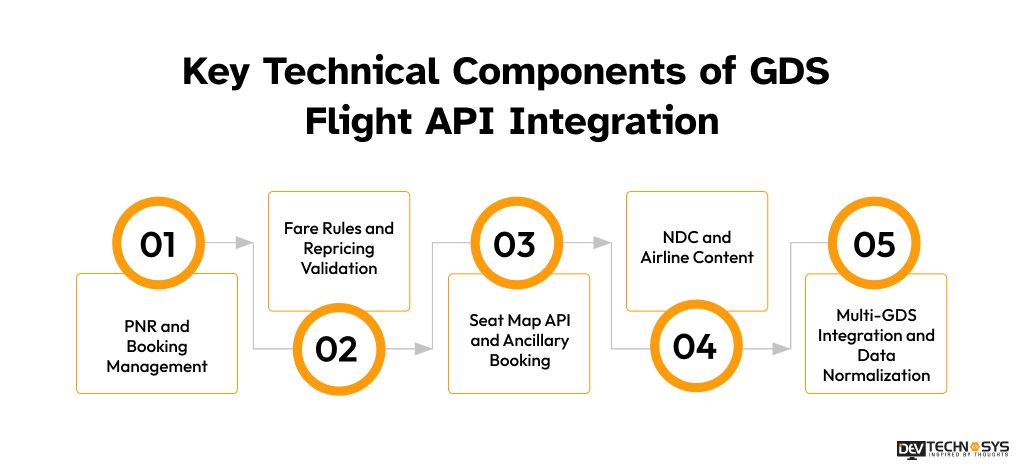
1. PNR and Booking Management
The integration creates and manages PNRs (Passenger Name Records) containing passenger, itinerary, and booking information. It should support retrieval, modification, cancellation, and synchronization of booking data across the travel platform and GDS.
2. Fare Rules and Repricing Validation
Displayed fares are not always guaranteed until the booking is confirmed. Repricing validation checks the selected offer immediately before booking, while fare rules determine cancellation, refund, change, baggage, and other restrictions. This helps reduce price mismatches at checkout.
3. Seat Map API and Ancillary Booking
A seat map API allows travelers to view and select available seats. Ancillary booking can extend the workflow to baggage, meals, priority services, upgrades, and other airline extras, depending on supplier capabilities.
4. NDC and Airline Content
NDC (New Distribution Capability) can provide richer airline offers, dynamic pricing, and ancillary content alongside traditional GDS inventory. Supporting both content types can broaden the range of flight products available through a travel platform.
5. Multi-GDS Integration and Data Normalization
A multi-GDS integration connects multiple suppliers through a common orchestration layer. Because providers may use different schemas, fare structures, response formats, and error codes, data normalization is essential for presenting consistent results while preserving supplier-specific booking rules.
Benefits and Challenges of GDS Integration
GDS integration gives travel platforms access to airline content, fares, availability, and booking capabilities through established distribution networks. However, the benefits come with GDS transaction fees, setup costs, technical complexity, and ongoing maintenance requirements. Understanding both sides helps businesses estimate the investment before implementation.
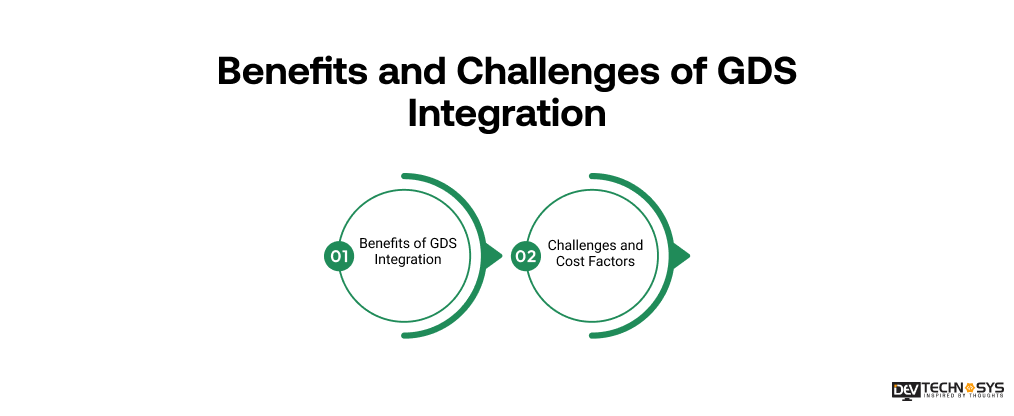
Benefits of GDS Integration
- Real-time inventory access: GDS connectivity can provide access to current flight schedules, availability, fares, seat information, and booking content, depending on the supplier and API.
- Broader airline content: Instead of developing separate integrations for every airline, a GDS can provide access to content from multiple participating carriers through a common platform.
- Faster booking operations: Search, fare validation, PNR creation, ticketing, cancellations, and other workflows can be integrated into a single booking experience.
- Scalable distribution: Travel agencies, OTAs, corporate booking platforms, and travel apps can use GDS connectivity to expand inventory without building every supplier relationship from scratch.
Challenges and Cost Factors
- GDS setup cost: Initial expenses can include technical implementation, certification, infrastructure, testing, and provider-specific onboarding requirements.
- GDS transaction fees: Costs may vary according to the provider, contract, booking volume, market, and transaction type. Businesses should confirm the commercial terms directly with their selected GDS.
- Technical complexity: Authentication, data mapping, fare rules, repricing, PNR synchronization, ticketing, error handling, and multiple supplier formats can make implementation complex.
- Integration timeline: A basic integration may take weeks, while multi-GDS, NDC, payment, ancillary, and custom booking workflows can require several months. The actual timeline depends on scope, certification, APIs, and testing requirements.
For a broader investment estimate, businesses can also evaluate travel app development cost alongside GDS licensing, transaction, infrastructure, and maintenance expenses.
Security and Compliance in Flight API Integration
Security is a core requirement when implementing flight API integration because GDS-connected platforms can process passenger information, travel itineraries, payment data, authentication credentials, and booking records. A mobile app development company follows a secure architecture that protects data across API requests, application servers, databases, payment systems, and third-party integrations.
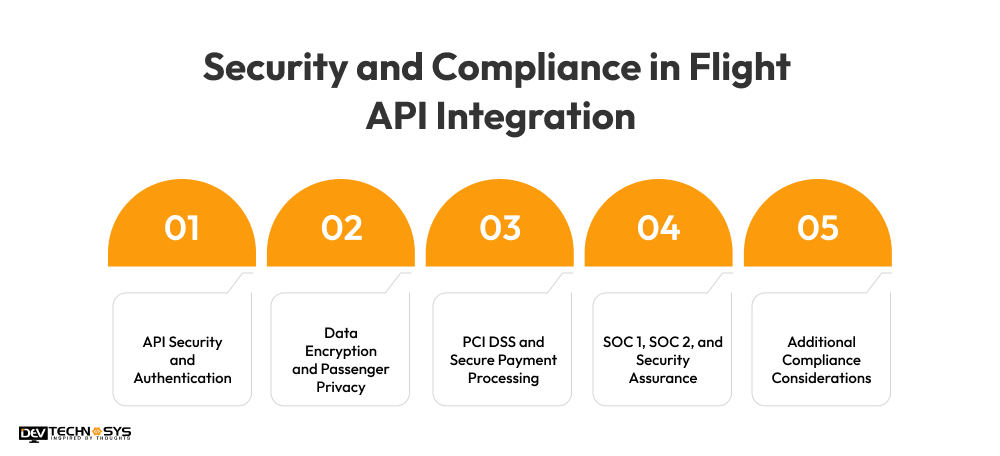
API Security and Authentication
Use OAuth authentication, short-lived access tokens, secure secret management, API gateways, rate limiting, input validation, and role-based access controls to protect GDS connections. Credentials should never be exposed in mobile applications, browser code, logs, or publicly accessible repositories.
Data Encryption and Passenger Privacy
Sensitive passenger and booking data should be encrypted in transit using TLS and protected at rest using appropriate encryption controls. Depending on the markets served, privacy obligations may include GDPR, CCPA/CPRA, UK GDPR and Data Protection Act requirements, UAE PDPL, or other applicable local data-protection laws.
PCI DSS and Secure Payment Processing
If the platform stores, processes, or transmits payment card data, PCI DSS requirements become relevant. Using a compliant secure payment gateway and tokenization can reduce the amount of cardholder data handled directly by the travel application. Payment compliance should be assessed according to the actual payment architecture and business role.
SOC 1, SOC 2, and Security Assurance
SOC 1 focuses primarily on controls relevant to financial reporting, while SOC 2 evaluates controls related to areas such as security, availability, processing integrity, confidentiality, and privacy. These reports may be relevant when evaluating GDS, cloud, payment, and technology vendors, but they are not substitutes for an application’s own security controls.
Additional Compliance Considerations
Depending on the platform, market, and data handled, teams may also need to consider ISO/IEC 27001,ISO/IEC 27701, PCI DSS, NIST security practices, OWASP API Security, accessibility requirements such as WCAG, and applicable aviation or regional data regulations.
Security requirements should therefore be mapped to the application’s data flows, suppliers, payment model, operating countries, and contractual obligations rather than treated as a one-size-fits-all checklist. Ongoing monitoring and mobile app maintenance costs should also account for API security patches, dependency updates, credential rotation, vulnerability testing, and compliance changes.
Conclusion
Flight API integration with GDS platforms connects travel apps with airline content, fares, availability, booking workflows, and supporting services through established distribution networks. But successful integration involves more than connecting an API. Provider selection, authentication, fare validation, PNR management, NDC and ancillary support, multi-GDS data handling, testing, security, compliance, cost, and ongoing maintenance all influence implementation.
For travel agencies, OTAs, and travel app businesses, the right approach depends on airline coverage, target markets, booking workflows, technical architecture, and growth plans. A well-designed integration can create a connected booking experience while supporting future supplier expansion.
If you plan to connect Amadeus, Sabre, Travelport, NDC, or multiple flight suppliers, a travel app development company can help define requirements and design a reliable architecture for long-term growth.