










Key Takeaways:
-
- Choose RAG when company knowledge changes frequently, and answers need current, retrievable information.
- Choose fine-tuning when the main requirement is consistent behavior, terminology, formatting, or task performance.
- Fine-tuning vs RAG comes down to behavior adaptation versus knowledge retrieval.
- Choose hybrid RAG when your AI needs both up-to-date company knowledge and specialized model behavior.
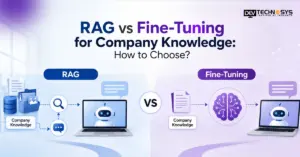
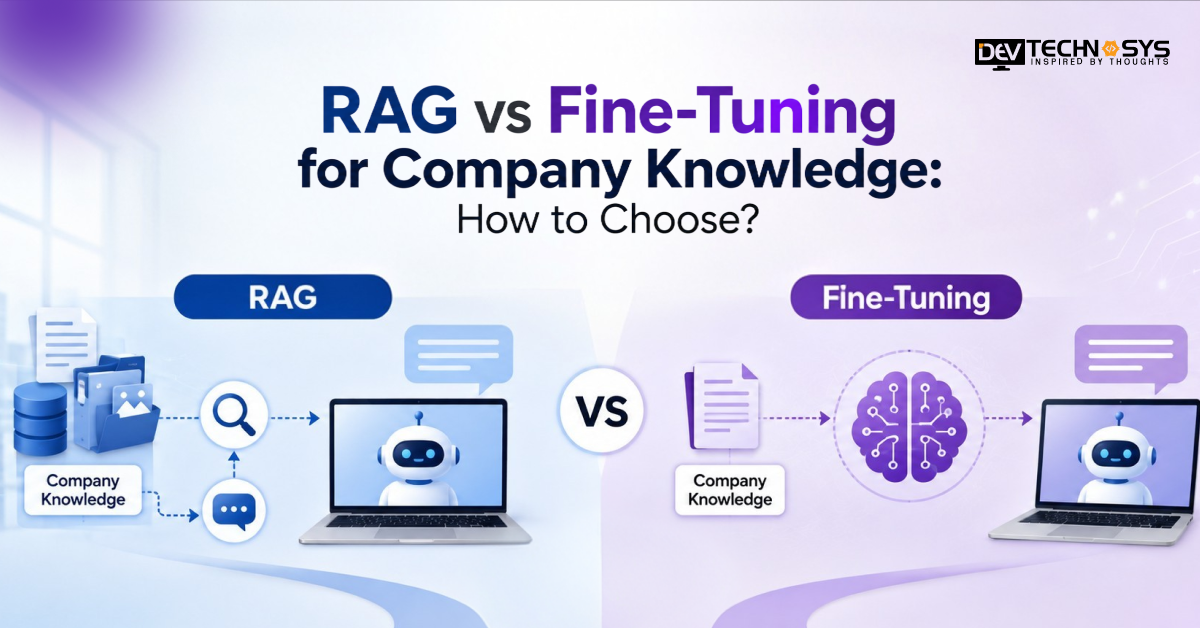
All teams to build AI based on company knowledge ultimately arrive at a fork in the road. You have documents, policies, product data, etc. somewhere, and you need the model to get a look at them. There are two ways to do this: retrieval-augmented generation (RAG), which allows the model to look something up as it is generating its response. Fine-tuning, which involves retraining the model so that the knowledge is permanently part of it.
The key to understanding RAG vs fine-tuning is knowing what problem you are solving.
When the knowledge changes often, RAG is frequently the initial step. Fine-tuning can be preferable if the model requires any specific behavior, formatting, or task pattern. If both are required, a hybrid solution can be used that integrates the two.
The “best” choice is not as much about which is better, but is a function of data characteristics, frequency of change, and what you’re actually trying to fix. Here are the steps on how to decide.
RAG vs Fine-Tuning: The Basic Difference
RAG and fine-tuning solve different AI problems for companies. One provides access to relevant knowledge, while the other adapts how an LLM performs.
What is RAG?
Retrieval-augmented generation (RAG) connects an LLM to external knowledge sources and retrieves relevant information when generating a response.
- Retrieves content from company documents, policies, FAQs, SOPs, and product documentation.
- Keeps frequently changing knowledge outside the model’s weights.
- Can support source-backed answers when the retrieval system is properly designed.
What is Fine-Tuning?
Fine-tuning trains a base LLM on curated examples to improve its performance on specific tasks, behaviors, or response patterns.
- Helps create consistent tone, terminology, formatting, or task behavior.
- Works well for specialized and repetitive workflows.
- Does not simply upload company documents into an LLM as a searchable knowledge base.
The simple distinction: RAG gives the model access to relevant information. Fine-tuning adapts how the model responds.
How RAG and Fine-Tuning Handle Company Knowledge
RAG and fine-tuning can both support company AI systems, but they handle proprietary information in fundamentally different ways.
RAG for Company Knowledge
RAG connects an LLM with a searchable company knowledge base. When someone asks a question, the system retrieves relevant content and provides it to the model as context before generating the answer.
RAG architecture:
Company Documents → Document Chunking → Embeddings → Vector Database → Semantic Search → Retrieved Context → LLM → Response
RAG System Development approach works well when company information changes regularly.
- New policies, product documents, or support content can be indexed without retraining the model.
- Permission-aware retrieval can restrict responses to information a user is authorized to access.
- Retrieved content can support source attribution and more auditable answers.
- Retrieval quality still depends on chunking, ranking, semantic search, and context selection.
Fine-Tuning for Company Knowledge
Fine-tuning uses curated examples to adapt an LLM for specific tasks, response patterns, or domain requirements. Instead of retrieving documents at runtime, the training process adjusts the model’s weights.
Fine-tuning workflow:
Training Data → Fine-Tuning → Evaluation → Specialized Model → User Request → Response
It can be useful when the company needs consistent behavior across repeated interactions.
-
-
- Teaches specialized terminology, tone, formatting, or response structures.
- Supports task-specific workflows such as classification or structured output.
- Supervised fine-tuning can use labeled examples to teach desired responses.
- LoRA can provide a parameter-efficient approach for adapting models.
-
develop an LLM model for the broader model development workflow.
Industry Insight
AWS’s current guidance: for company-knowledge question answering, it recommends starting with RAG; fine-tuning becomes relevant when you need additional behaviors such as summarization or specialized output.
What are the Key Differences: RAG vs Fine-Tuning
The right approach depends on whether your company needs better access to information, more consistent model behavior, or both.
Factor |
RAG |
Fine-Tuning |
| Primary purpose | Provides access to external knowledge | Adapts model behavior |
| Company documents | Retrieved at runtime | Used as training examples when relevant |
| Changing information | Easy to update the knowledge source | Requires additional training |
| Source citations | Can provide retrieved sources | Not inherently source-based |
| Model weights | Usually unchanged | Adjusted during training |
| Data updates | Update and re-index the knowledge base | Retrain or update the model |
| Best suited for | Policies, documentation, internal knowledge | Specialized tasks and response patterns |
| Access control | Can support permission-aware retrieval | More complex for document-level access |
| Maintenance | Retrieval and knowledge pipeline maintenance | Training and evaluation maintenance |
| Main limitation | Retrieval quality and context selection | Training data quality and update cycle |
Planning a Mobile App?
Get a tailored development cost estimate in 3 simple steps — app basics, features, timeline, and your contact details.
- 3 quick steps
- 100% free
- Reply in 1 business day
2 Minutes Read
When Should You Use RAG?
RAG is useful when an AI system needs access to external company information that changes over time or must be retrieved for each request.
RAG makes sense when…
- Company information changes frequently: Policies, pricing, product documentation, and procedures can be updated without retraining the model.
- AI needs internal knowledge: A company knowledge base can support answers about HR policies, products, processes, or support documentation.
- Answers need source attribution: Retrieved documents can provide supporting sources and improve answer traceability.
- Users have different access permissions: Permission-aware retrieval can help ensure users only receive information they are authorized to access.
- You are building an enterprise knowledge assistant: RAG works well for internal search, employee assistants, customer support, and other knowledge management AI applications.
For example, an HR assistant can retrieve the latest leave policy from a company knowledge base. When the policy changes, the document can be updated and re-indexed, allowing the system to retrieve the newer information without retraining the LLM. Companies building AI copilots around internal knowledge can also explore AI copilot development services for retrieval, context, and enterprise workflow integration.
When Should You Use Fine-Tuning?
Fine-tuning is more suitable when the main challenge is how an LLM responds, rather than giving it access to frequently changing company information.
Fine-tuning makes sense when…
- You need consistent response formats: A support model can follow a fixed structure such as Issue, Diagnosis, Recommended Action, and Escalation.
- The model needs specialized terminology or tone: Fine-tuning can reinforce industry-specific language and communication patterns.
- The task is repetitive and well-defined: Classification, structured extraction, tagging, and similar workflows can benefit from task-specific adaptation.
- Prompting is not producing consistent behavior: Training examples can reinforce the response patterns you want the model to follow.
- You have quality training data: Supervised fine-tuning depends on relevant, clean, and representative examples that reflect the desired output.
For example, a customer support AI may need to format every response consistently. If the main problem is response behavior rather than retrieving the latest product information, fine-tuning can help establish that pattern.
RAG vs Fine-Tuning vs Prompt Engineering
Prompt engineering can influence an LLM through carefully written instructions, but it works differently from RAG and fine-tuning.
Approach |
What It Changes |
Best For |
| Prompt Engineering | Instructions given to the model | Task guidance and immediate response behavior |
| RAG | Information available to the model | Current company and external knowledge |
| Fine-Tuning | Learned model behavior | Consistent specialized tasks and response patterns |
Think of it simply: prompt engineering gives instructions, RAG provides knowledge, and fine-tuning adapts behavior.

5 Questions to Help You Choose Between Fine-Tuning vs RAG
Choosing between fine-tuning vs RAG becomes easier when you identify whether your company needs current information, specialized behavior, or both.
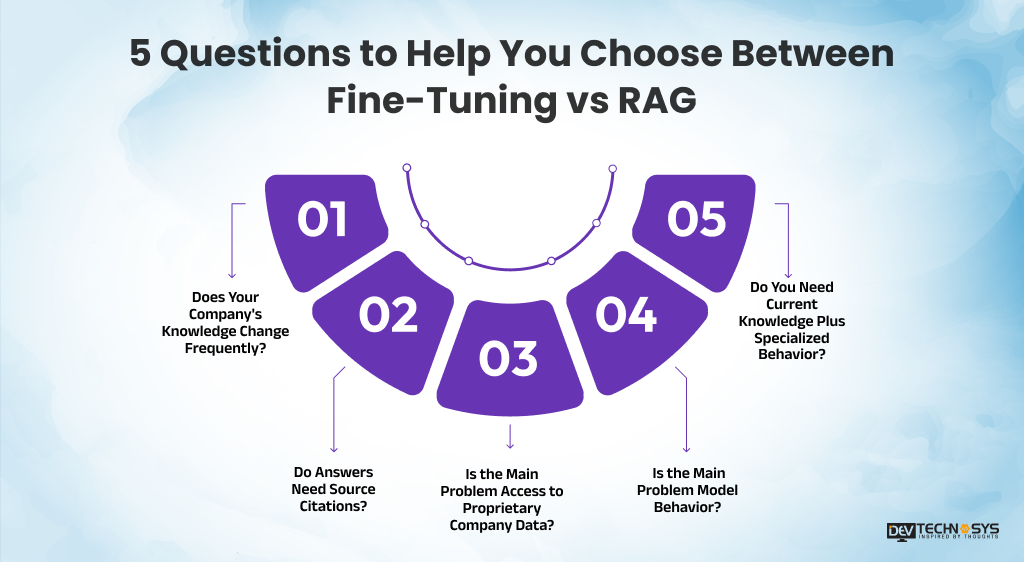
1. Does Your Company’s Knowledge Change Frequently?
If policies, pricing, product documentation, or procedures change regularly, RAG is generally more suitable. You can update the knowledge source and re-index the content without retraining the model.
2. Do Answers Need Source Citations?
If users need to verify answers against approved company documents, RAG can retrieve relevant sources and provide supporting context.
3. Is the Main Problem Access to Proprietary Company Data?
When an LLM needs access to internal documents, FAQs, SOPs, or other enterprise knowledge, RAG addresses the knowledge retrieval problem directly.
4. Is the Main Problem Model Behavior?
If you need consistent terminology, tone, formatting, classification, or task-specific response patterns, fine-tuning may be more appropriate.
5. Do You Need Current Knowledge Plus Specialized Behavior?
If you need both, a hybrid RAG and fine-tuning approach can combine current company knowledge with specialized model behavior.
The decision framework:
Knowledge problem → RAG
Behavior problem → Fine-tuning
Knowledge + behavior problem → Hybrid
For complex enterprise requirements, AI consulting services can help evaluate the data, model, retrieval, and application architecture before implementation.
Industry Insight
McKinsey found 54% of organizations with $1 billion or more in revenue are scaling AI enterprise-wide, compared with roughly one-third of smaller organizations.
Can RAG and Fine-Tuning Work Together?
Yes, RAG and fine-tuning can work together when an AI system needs both current company knowledge and consistent, specialized behavior.
A hybrid approach separates these responsibilities:
Fine-tuning -:- Specialized Behavior
RAG -:- Current Company Knowledge
Hybrid RAG Architecture
User Query → Fine-Tuned Model → RAG Retrieval → Company Knowledge → Grounded Response
For example, a customer support AI can use fine-tuning to follow a consistent response structure and terminology, while RAG retrieves the latest product documentation, troubleshooting guides, and approved policies.
Security Considerations for Company Knowledge
Connecting AI to the data of a company is a process that needs to be controlled to ensure that data is safeguarded and yet can be retrieved, accessed, and responded to in an auditable fashion.
Protecting Company Knowledge
Security should be considered across the entire RAG and AI workflow:
- Access control: Permission-aware retrieval helps ensure users only receive information they are authorized to access.
- Data protection: Encryption, secure storage, and controlled data handling help protect sensitive company information.
- Governance and privacy: Clear policies should define how company data is collected, processed, retained, and used by AI systems.
- Auditability and testing: Source attribution, data lineage, monitoring, and AI model security testing can improve visibility into how AI systems use company knowledge.
These controls can be supported through practices and frameworks such as ISO/IEC 27001, SOC 2, and the NIST Cybersecurity Framework.
Conclusion: RAG or Fine-Tuning for Company Knowledge?
Choosing between RAG vs fine-tuning depends on what your AI system actually needs. If your company works with frequently changing documents, policies, product information, or internal knowledge, RAG can provide access to relevant information at runtime. If the bigger challenge is consistent behavior, terminology, formatting, or specialized task performance, fine-tuning may be more appropriate.
For systems that need both current knowledge and specialized behavior, a hybrid RAG and fine-tuning architecture can combine the two approaches. The right implementation also needs strong data governance, access controls, evaluation, and ongoing monitoring. Working with an experienced AI development company can help align the architecture with your data, workflows, security requirements, and long-term AI goals.
Knowledge problem → RAG | Behavior problem → Fine-tuning | Knowledge + behavior → Hybrid
If a system requires both knowledge and special behavior, a hybrid RAG + fine-tuning architecture can be used. Strong data governance, access controls, evaluation, and continuous monitoring are also essential for the successful implementation. Partnering with an experienced AI development company can enable the architecture to meet your data needs, workflow processes, security protocols, and future AI objectives.
Knowledge problem → RAG | Behavior problem → Fine-tuning | Knowledge + behavior → Hybrid
Frequently Asked Questions
Find answers to the most common questions related to this article.
There is no one right or wrong answer. RAG is often used for changing company-specific information that needs to be accessed at runtime, whereas fine-tuning can be developed using specific behavior, terminology, formatting, and repetitive task patterns.
Yes, fine-tuning can be used in conjunction with RAG to define specific behaviors, and RAG can be used to access up-to-date company knowledge. This may be helpful in the event that an enterprise A.I. system must have the same replies and current proprietary data.
RAG is something that companies might consider when they need AI access to changeable policies, product documentation, SOPs, FAQs, or internal knowledge. Whenever there are changes in the underlying company information, documents can be updated and re-indexed without retraining the model.
Fine-tuning adjusts the parameters of the model to fine-tune specific behaviors or tasks using curated training examples. It's not the same as building a company knowledge base that is searchable. It is more appropriate to use RAG for information that changes often.
There is no standard cost difference. Costs are related to the amount of data, the use of the model, retrieval infrastructure, training needs, evaluation, update frequency, and maintenance. Businesses need to evaluate the overall operational needs of both methods based on their AI application case.