

















Key takeaways:
-
- The cost to build a real estate app like Housing ranges as low as $30,000 and as high as $150,000+, depending on features and functionalities.
- The Global Rental Apps for Real Estate Market size is expected to be worth around USD 38.4 Billion By 2034, as stated by Market.us.
- To create multiple revenue streams, the housing marketplace app development experts combine premium listings, featured ads, subscription plans, lead-selling services, and promotional packages.
- Building a real estate app MVP typically includes user registration, property listings, search filters, map integration, property details, inquiry management, and an admin panel to validate market demand before scaling.
These days, real estate mobile app development is not limited to property listings; it’s a high-performance, AI-powered real estate ecosystem that gives users accurate search results, verified listings, personalized recommendations, and instant communication between users and agents.
PropTech is quickly becoming one of the most competitive and fast-growing digital markets. More and more people want hyperlocal search, virtual property tours, and decisions based on data.
The comprehensive guide to end-to-end housing like app development for 2026 will teach you everything, including how these platforms work and who utilizes them, as well as the planning of architecture, the development process, cost estimates, ways to make money, and upcoming trends in real estate technology.
Whether you are the founder of a startup, the owner of a product, or a developer, this housing app development guide will help you learn how to make a real estate app that is scalable, full of features, and ready for the market. This app will help you fight in today’s changing digital world.
What is Housing App?
Housing is a real estate and property finder app that makes buying, renting, and selling properties easier through 1M+ listings. It includes flats, villas, plots, PGs, and new projects.
It offers verified leads, smart search filters, shortlist features, real property photos, and owner dashboards for user convenience. The app also enables users to pay rent via credit card while helping property owners manage listings, analytics, and tenant communication efficiently.

How Does App Like Housing Works?
According to a proptech software development company, the housing app follows a clear structure:
Search → filter → shortlist → inquiry → visit → deal closure
- Search: Users browse properties based on location, budget, and property type.
- Filter: Advanced filters help narrow down search results quickly.
- Shortlist: Users save properties that caught their eyes and fit in their budget, and draw comparisons between them.
- Inquiry: People who want to buy or rent properties can get in touch with the owners and agents directly.
- Visit: Property visits and virtual tours are available.
- Deal Closure: Final negotiations, agreements, and payments are done.
Buyer vs Renter Journey
- Buyers pay more attention to property value, its potential for investment, and how long they can maintain the authority.
- Renters always prefer affordable properties, nearby facilities, and immediate availability.
Admin & Agent Interaction Flow
- Admins manage listings, user verification, analytics, and platform activities, while agents and property owners handle inquiries, update listings, communicate with users, and track leads through dedicated dashboards.
Global Rental Apps for the Real Estate Market Stats
- The Global Rental Apps for Real Estate Market size is expected to be worth around USD 38.4 Billion By 2034.
- It is growing at a CAGR of 12.30% during the forecast period from 2026 to 2034.
- North America led the global real estate rental applications market, capturing over 36.1% market share, with revenues of approximately USD 4.3 billion.
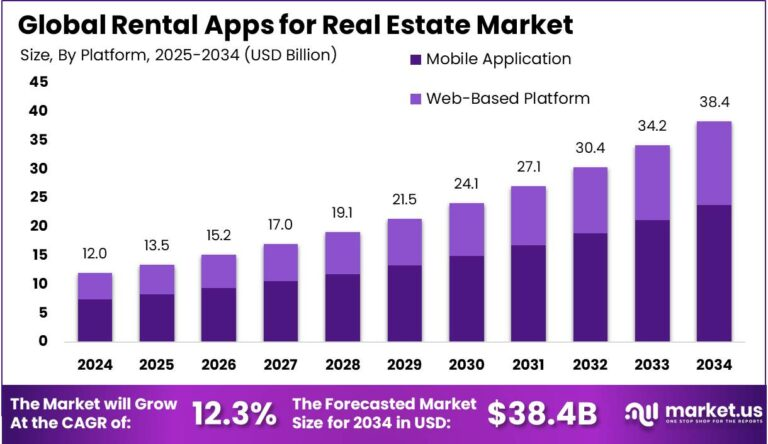
- The Short-Term Rentals segment led the real estate rental apps market, commanding a market share of over 76.4%.
- The Residential segment dominated the rental apps for the real estate market, holding more than 65.3% of the market share.
Key User Groups of Property Listing App like Housing
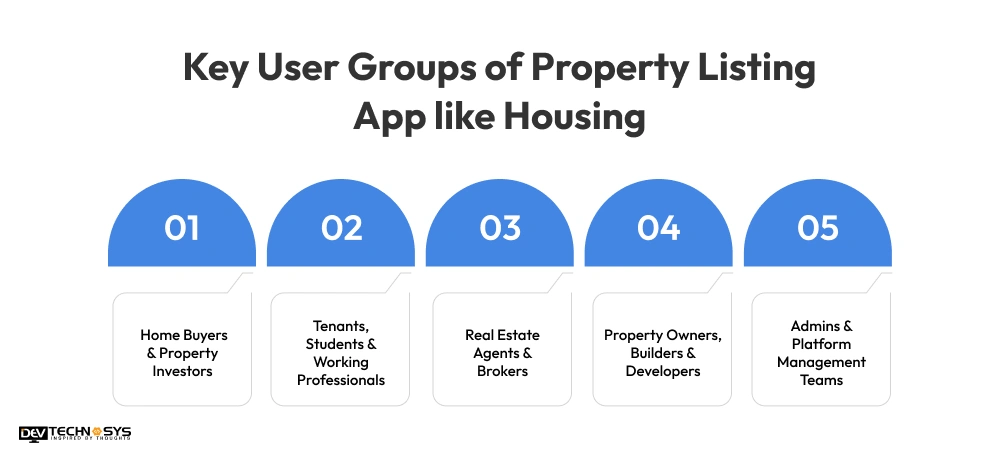
Before deciding you want housing like app development, first learn about your target user base. There are different types of real estate users who use property listing apps like Housing for different reasons, like searching for properties, managing properties, or making deals.
- Property buyers
- Renters
- Real estate agents & brokers
- Property owners & developers
- Admin & platform managers
1. Home Buyers & Property Investors
These people look for apartments, villas, plots, and projects that are still being built by comparing prices, locations, expected property values, and living choices. Before making a long-term investment choice, they usually go through different options.
2. Tenants, Students & Working Professionals
People looking to rent can use the platform to find cheap apartments, shared living spaces, and PGs that are close to work, educational institutions, public transportation, and other daily conveniences. Their journey is faster and budget-focused.
3. Real Estate Agents & Brokers
From a central dashboard, agents can use the platform to post listings, get qualified leads, talk to buyers or renters, plan visits, and handle multiple property deals.
4. Property Owners, Builders & Developers
Property owners want housing like app development to sell residential or commercial properties, make them more visible, get verified inquiries, and keep a real-time track of how well listings are doing.
5. Admins & Platform Management Teams
The admin panel controls the whole ecosystem, which involves property approvals, verifying users, analytics, advertisements, and lead management. It makes sure that the platform is safe and that operations run smoothly.
Behind the Scenes: Architecture Setup for a Housing-Like App
If you are a business thinking of housing like app development, then don’t forget to add a scalable architecture. Build a real estate app with strong architecture that can handle larger property data, real-time updates, and seamless user interaction.
It is important to ensure the app performs well and gives faster search results. A well-made architecture ensures smooth integration across mobile and web platforms, ensuring long-term business growth in the competitive market.
1 Microservices vs Monolithic Structure
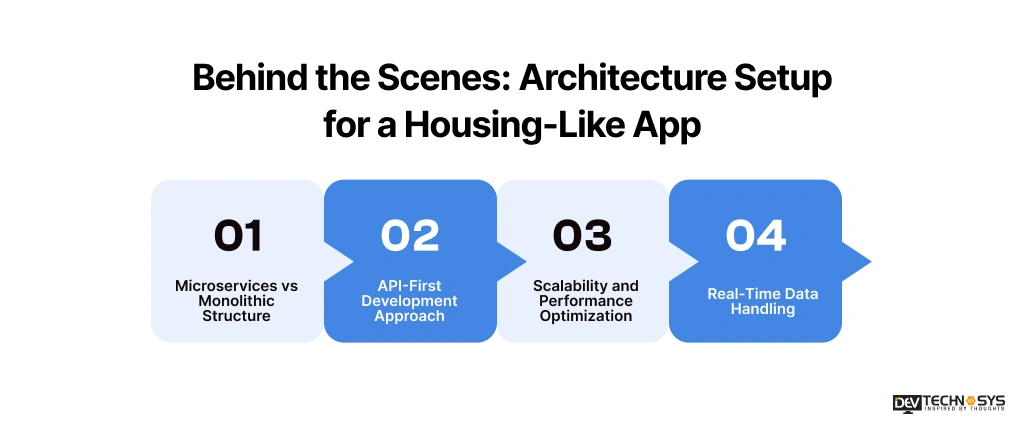
Housing-like apps need a flexible architecture that can handle a large amount of data and increasing user traffic. The system will be divided into independent modules by microservices architecture.
The modules include listings, search, and payments for better scalability, faster updates, and fault isolation. On the other hand, the monolithic architecture is much simpler but harder to scale and maintain as complexity increases.
Aspect |
Microservices Architecture |
Monolithic Architecture |
| Structure | Application is split into small, independent services | The entire application is built as a single unified system |
| Scalability | Highly scalable, as each service scales independently | Limited scalability; the entire system must scale together |
| Development Speed | Faster updates for individual modules | Slower updates due to a tightly coupled codebase |
| Maintenance | Easier to maintain and debug individual services | Difficult to manage as the project size increases |
| Deployment | Independent deployment of services | Single deployment for the whole application |
| Technology Flexibility | Different technologies are used for different services | Uses a single technology stack |
| Fault Isolation | Failure in one service does not affect others | A single failure can impact the entire system |
| Best For | Large, complex housing platforms with high traffic | Small to medium applications with simple requirements |
2. API-First Development Approach
Choosing an API-first approach for housing like app development ensures all features (e.g, property search, map integration, user login, and payments) communicate through well-defined APIs.
This leads to seamless integration with mobile apps, web platforms, and third-party services. At the same time, it improves speed, consistency, and system flexibility in property listing app development in the long run.
3. Scalability and Performance Optimization
Housing apps have to deal with a lot of users, a lot of property listings, and search requests that come in at the same time. Scalability is achieved by using cloud infrastructure, load distribution, caching mechanisms, and optimized databases. This ensures that users always have a smooth experience, even during peak usage periods.
4. Real-Time Data Handling
Real estate platforms depend on real-time updates for property availability, price changes, and user inquiries. Housing rental app development company creates platforms using technologies like WebSockets, event-driven systems, and real-time databases to help ensure instant data synchronization, allowing users to see the most accurate and up-to-date listings without delays.
Want a chatbot demo or pricing? Fill the form and talk to our experts today.
Pick what you need below — you can select more than one — then tap Get detail to continue.
-
Chatbot demo dashboard
-
Cost to develop an app
-
Industry report
-
Case study
How to Develop an App Like Housing From Scratch?
Wondering how to build a housing app in 2026? Well, to build an app like Housing, experts need to define their goals, features, and target users, design a simple UI/UX, choose a scalable tech stack, and develop a strong backend with APIs and cloud support. Take a look at the expert-approved guide to build an end-to-end housing like app, explained in simple steps:
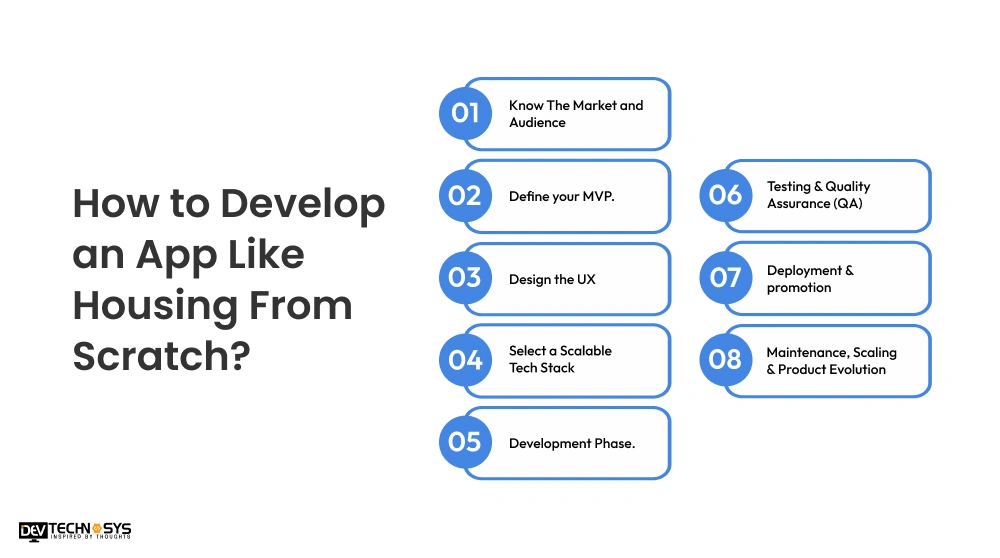
Step 1: Know The Market and Audience
Who are you making the app for? Buyers? Renters? Agents? Pick your niche and solve its main issue first. Compare the real estate app like Zoopla, Zillow, and Realtor.com to know what they are doing right and what can be done better.
Evaluate loopholes like old listings, lack of verification, and poor search accuracy. This step helps decide a USP, feature priorities, and monetization plan(ads, premium listings, commissions).
Step 2: Define your MVP.
Don’t attempt to make “Housing 2.0” from the beginning. Start housing like app development with the MVP version first, then expand. Build an app like Housing with core features first and get product validation.
Core features for apartment rental app development may include listing management, advanced search filters, user authentication, and inquiry/lead generation. Avoid using advanced AI and automation at this stage. Use agile development to release incremental updates and test user response based on real-world usage data.
Step 3: Design the UX.
Users won’t like a clunky design and hence won’t stay. Don’t skip on a good designer. Using tools like Figma or Adobe XD to create a mobile-first, conversion-focused interface. Create user journeys such as search → filter → view property → contact agent.
Follow the guidelines of material design or iOS human interface. Your real estate app development firm should focus on keeping clicks minimal, faster navigation, and high visual clarity to improve engagement and reduce bounce rates.
Key Insights:
According to 49 UI Design Statistics (2026), 75% of users judge a company’s credibility based on design quality, and 94% of first impressions are design-related.
Step 4: Select a Scalable Tech Stack
The next step in the real estate app development process is choosing the right tech stack. For the front end, use React Native or Flutter. For the back end, use Node.js or Python (Django/FastAPI), and for databases, use PostgreSQL or MongoDB.
For serving in the cloud, use AWS/GCP and Redis for caching. For better scalability and maintainability, use a microservices design to separate modules like search, listings, payments, and messaging.
Step 5: Development Phase.
In this step of buy and sell property app development, everything will fall into place. Frontend and backend work together to make features available in real time. The backend handles APIs, databases, authentication, and business logic.
The frontend takes care of UI features like chat, property cards, filters, and maps. For communication, use REST or GraphQL. These languages offer features like real-time search, Google Maps integration, JWT login, and Firebase alerts.
6. Testing & Quality Assurance (QA)
After the tenant management app development is done, you need to test all of the modules’ functionality, speed, security, and ease of use. Check the precision of searches, the uploading of listings, the flow of payments, and the message systems.
For testing APIs, use Postman, Selenium, and JMeter. For testing load, use JMeter. Make sure you follow the OWASP security guidelines to stop problems like SQL attacks and data leaks.
7. Deployment & promotion
For automatic delivery, use CI/CD systems like GitHub Actions or Jenkins to deploy. Load sharing, auto-scaling, and containerization with Docker and Kubernetes can be done on AWS, Azure, or Google Cloud.
When you first start out, you should focus on paid ads, app store ASO, and SEO for property listings. Join forces with companies that provide real estate app development services to get more properties.
8. Maintenance, Scaling & Product Evolution
Using analytics tools like Google Analytics, Mixpanel, or New Relic to keep an eye on speed all the time. Improve the speed of APIs, database searches, and the server itself.
Add more advanced features, such as apps, AI-based property suggestions, and models that can predict future prices. Regular changes make sure that the platform can grow as needed while also keeping users safe and improving their experience.
Key Insights:
Research indicates that 52% of users are less likely to engage with a business after a poor mobile experience. Our QA analysts ensure maintenance using their years of technical expertise. The maintenance cost for housing like app will range between 15% to 20% of the total annual budget.
What External Tools are Needed to Create a Housing Like App?
According to a housing app development company, modern housing apps rely on multiple external tools and third-party integrations, such as:
- Google Maps API for location services
- Cloud infrastructure (AWS/Azure/GCP)
- Notification systems (SMS/email/push)
- Payment gateway integration
- CRM tools for agents
These external tools will offer smooth functions, real-time communications, secure transactions, and better performance. These tools make things easier for users, improve the user experience, and help the platform grow in the long run.
External Tool |
Purpose |
| Google Maps API | Property location search and map integration |
| Payment Gateway | Secure online payments and subscriptions |
| CRM Tools | Lead and agent management |
| Cloud Infrastructure | Scalable hosting and data storage |
| Notification Systems | SMS, email, and push alerts |
| Analytics Tools | User tracking and performance monitoring |
What features are required to Build an App Like Housing?
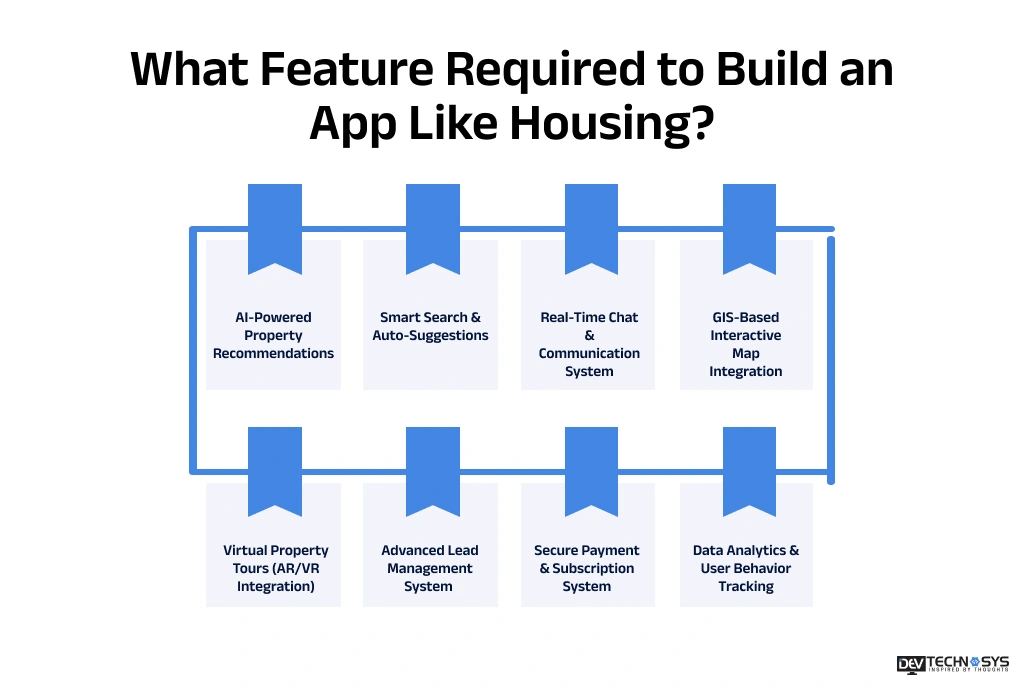
Features are the most crucial part of housing app development. Here are some of the essential and advanced features of real estate applications that ensure smooth property search, communication, and user experience.
User Panel Features |
Agent/Owner Panel Features |
Admin Panel Features |
| User registration & login | Property listing management | User and agent management |
| Property search with filters | Upload images & videos | Property approval & moderation |
| Map-based property discovery | Lead and inquiry management | Content and banner management |
| Save/favorite properties | Real-time chat support | Analytics and reporting dashboard |
| Property comparison tool | Property performance analytics | Payment and subscription control |
| Virtual property tours | Subscription/package management | Push notification management |
| Chat with agents/owners | Schedule property visits | Fraud detection & monitoring |
| Push notifications & alerts | CRM integration support | Complaint and support handling |
1. AI-Powered Property Recommendations
AI analyzes user behavior, budget, search behavior, and preferences to provide property listings that are highly relevant to them and therefore dramatically enhances engagement, conversions, and overall user experience.

2. Smart Search & Auto-Suggestions
Advanced search helps customers find properties quickly with location filters, price range, property type, and predictive suggestions to get faster and more accurate results. You must choose the right real estate marketplace app development company to add these features to your app.
3. Real-Time Chat & Communication System
AI analyzes user behavior, budget, search behavior, and preferences to give them more relevant property listings, substantially improving engagement, conversions, and overall user experience.
4. GIS-Based Interactive Map Integration
GIS-enabled maps allow users to pin homes, find other nearby facilities, calculate distances, and understand areas better, to make more informed choices and improve the property discovery experience.
5. Virtual Property Tours (AR/VR Integration)
Virtual tours using AR/VR allow consumers to inspect properties remotely by doing 3D walkthroughs. This increases engagement and reduces the number of physical visits during the early phases of decision-making.
6. Advanced Lead Management System
Mobile app development firm utilizing CRM-integrated lead management, agents can categorize inquiries, set up automatic follow-ups, rank prospects, and increase conversion rates by means of structured sales pipeline management.
7. Secure Payment & Subscription System
Payment methods that are encrypted and safe make it easy to buy premium listings, featured ads, and subscription plans. This makes sure that all financial transactions on the platform are safe, reliable, and easy.
8. Data Analytics & User Behavior Tracking
Develop an app like Realtor that incorporates real-time analytics to track user activity, listing performance, and market trends. It allows businesses to constantly fine-tune tactics and enhance platform performance.
Why Businesses Should Invest in Housing Like App Development?
Investing in property-focused apps (PropTech) gives businesses a competitive edge by boosting sales and streamlining operations. Key strategic advantages include:
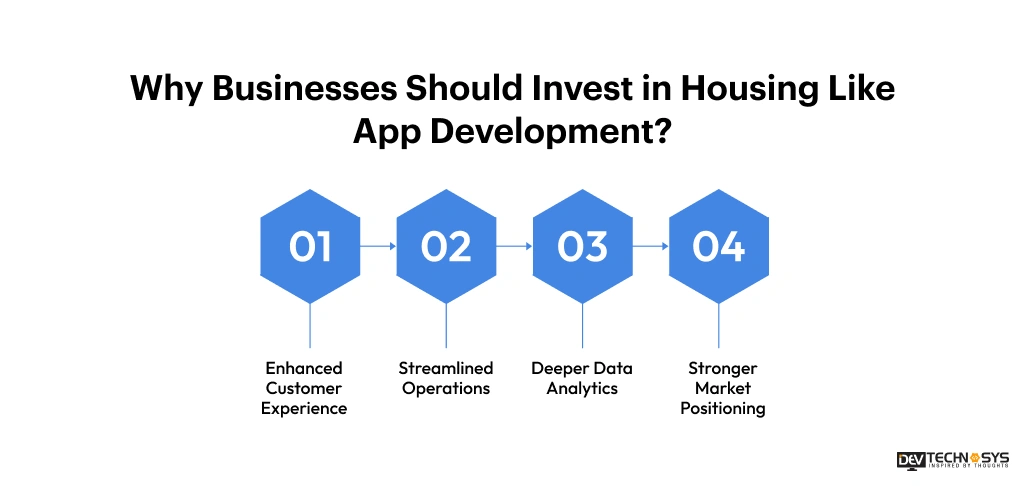
- Enhanced Customer Experience: Modern users demand 24/7 access to listings, virtual property tours, and instant communication with agents right from their mobile devices.
Key Insights:
A study by Grand View Research shows that 88% of users are less likely to return after a poor digital experience, making user-centric real estate apps a key differentiator.
- Streamlined Operations: Apps automate routine tasks like security deposits, maintenance requests, and vendor management, freeing up valuable staff time.
- Deeper Data Analytics: Mobile platforms allow businesses to collect and analyze user behavior, allowing for targeted marketing and highly personalized recommendations.
- Stronger Market Positioning: Investing in custom housing app development services secures a seamless, digital-first experience, establishes your brand as an industry innovator, which prevents clients from turning to tech-savvy competitors.
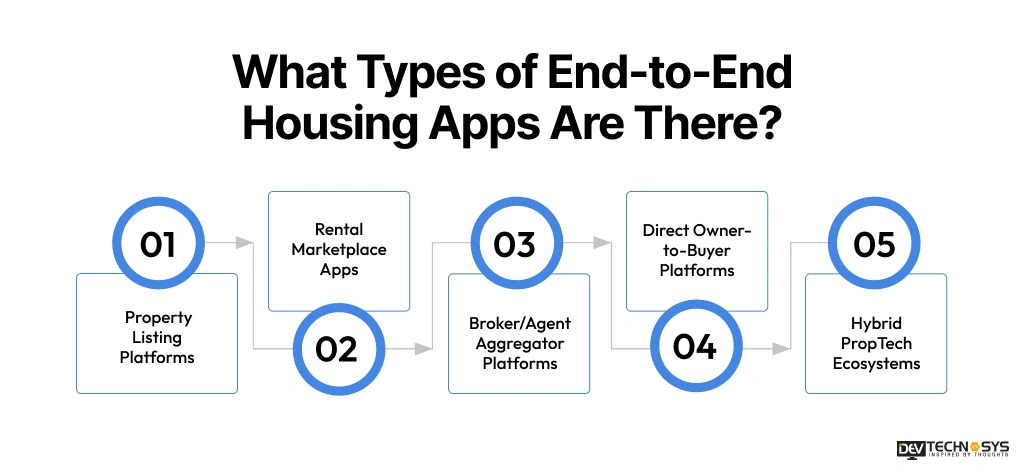
What Types of End-to-End Housing Apps Are There?
Apps like Housing are changing the prop-tech business by bringing buyers, renters, and managers on the same platform. There are different types of real estate apps that make it easier to find properties and make things clearer, all while making digital technology allow for faster, more efficient real estate deals.
1. Property Listing Platforms
Apps with filters, pictures, prices, and area information that let you look at homes and businesses. They make it simple for people to look at many listings at once and pick the best one.
2. Rental Marketplace Apps
There are websites where people looking to rent apartments, houses, or PGs can directly make requests to each other. They help people find places to rent, talk to each other, and quickly sign leases.
3. Broker/Agent Aggregator Platforms
Apps that connect with the real estate agents who can help them search for properties and negotiate deals. They help build trust, make things clearer, and speed up real estate deals.
4. Direct Owner-to-Buyer Platforms
Allow property owners and buyers to communicate with each other directly without any middleman involvement. They cut down on marketing fees, make things clearer, and close deals a lot faster.
5. Hybrid PropTech Ecosystems
Platforms that offer rentals, listings, agents, payments, and analytics all in one platform. They offer a full, advanced, and scalable digital system for real estate. If you are looking for end-to-end real estate app development for both iOS and Andriod, contact a skilled app development firm.
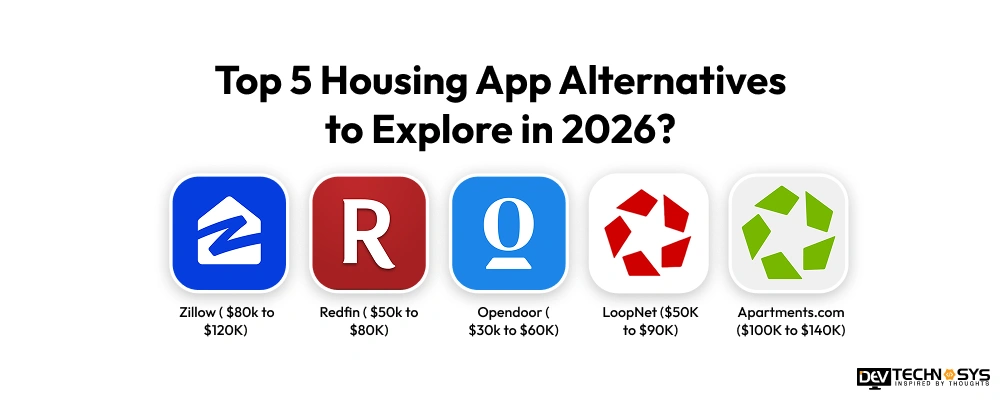
Top 5 Housing App Alternatives to Explore in 2026?
Real estate apps like Zillow, Redfin, and Opendoor are reshaping how people buy, sell, and rent properties. They offer advanced features, trusted listings, and data-driven insights for faster and smarter property decisions.
App |
Launch Year |
Platform Availability |
User Ratings |
Estimated Development Cost |
| Zillow | 2006 | Android, iOS, Web | 4.7/5 | $80,000 – $120,000 |
| Redfin | 2006 | Android, iOS, Web | 4.8/5 | $50,000 – $80,000 |
| Opendoor | 2014 | Android, iOS, Web | 4.6/5 | $30,000 – $60,000 |
| LoopNet | 1995 | Android, iOS, Web | 4.5/5 | $50,000 – $90,000 |
| Apartments.com | 1992 | Android, iOS, Web | 4.8/5 | $100,000 – $140,000 |
1. Zillow ( $80k to $120K)
Zillow is a market leader in U.S. real estate. It has tools for finding homes for sale, renting, and getting a mortgage. With AI-driven insights, strong brand trust, and one of the biggest property databases in the business, it helps buyers, renters, and dealers. Want to build a real estate app like Zillow? Contact a top mobile app development company.
2. Redfin ( $50k to $80K)
Real estate platform Redfin is known for its lower commission plan and data-rich property insights. Additionally, it provides virtual tours, real-time updates on listings, and direct agent help. Focusing on affordability and openness, it has a strong place in the competitive U.S. housing market.
3. Opendoor ( $30k to $60K)
Digital real estate website Opendoor lets people buy and sell homes right away. For quick cash offers and faster transfers, it uses data analytics. Traditional real estate sales are changing because of its iBuyer model, which makes it popular with buyers who want speed and ease.
4. LoopNet ($50K to $90K)
The LoopNet platform is the best for business real estate. It focuses on office, retail, and industrial properties. It gives detailed information about properties, advice on investments, and listings with a lot of worth. In North America, it leads the business market and is widely used by investors and brokers.
5. Apartments.com ($100K to $140K)
Apartments.com is one of the best platforms to search for houses (rent or buy), which has verified ads, virtual tours, and advanced search filters. With a lot of users, detailed property data, and tools for tenants, landlords, and property managers, it has a strong place in the rental market.

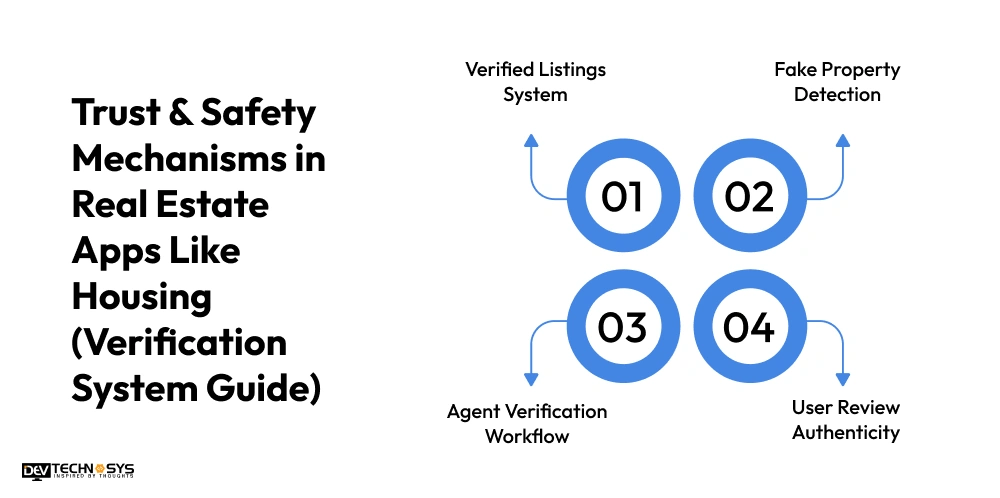
Trust & Safety Mechanisms in Real Estate Apps Like Housing (Verification System Guide)
Trust and safety are critical for the success of real estate platforms, where users share personal information and make high-value property decisions. Here’s how you can ensure trust and safety in your real estate applications.
1. Verified Listings System
Property listings are validated using KYC documents, title deed verification, geotagging, and admin approval workflows. Backend validation APIs and rule-based engines ensure only authenticated listings enter the database.
2. Fake Property Detection
AI/ML-based fraud detection models analyze listing patterns, image similarity (computer vision), and price anomaly detection. NLP tools scan descriptions for suspicious content, while moderation queues flag risky listings in real time.
3. Agent Verification Workflow
Agents are verified through KYC/AML checks, government ID validation, and license verification APIs. RBAC (Role-Based Access Control) and JWT/OAuth authentication restrict system access to verified users only. This is used to ensure only legitimate real estate professionals operate on the platform.
4. User Review Authenticity
Review systems use transaction-linked verification, database constraints, rate limiting, and sentiment analysis to detect fake or spam feedback. Moderation pipelines further validate user-generated content. It maintains credibility of ratings, ensures genuine user feedback, and helps buyers make informed property decisions based on real experiences.
What is the Cost to Build an App Like Housing?
Stating the exact real estate app development cost is difficult because it varies with the platform, design complexity, features, developer expertise, and location. The general estimate will be $30,000 to $150,000.
If you build a housing app with basic features and functionalities, the property rental app development cost will be $30,000 to $50,000. But AI-powered housing app development with advanced features and functionalities will cost more than $150,000.
Development Level |
Estimated Cost |
Ideal For |
| Basic MVP App | $30,000 – $50,000 | Startups validating a property listing platform with essential features |
| Mid-Level App | $50,000 – $80,000 | Businesses requiring advanced search, chat, notifications, and admin panels |
| Advanced App | $80,000 – $120,000 | Platforms with AI recommendations, payment systems, analytics, and enhanced security |
| Enterprise-Grade App | $120,000 – $150,000+ | Large-scale real estate ecosystems with high scalability, custom integrations, and a microservices architecture |
There are various factors like features, UI & UX design, Platform type, and developer location that can influence the real estate app features and cost significantly. Let’s discuss these factors in detail.
1. Feature Complexity
The number and sophistication of features significantly impact the costs of broker app development services. Basic functionalities such as property listings and search filters cost less than advanced features like AI-powered recommendations, virtual tours, and real-time messaging.
2. Platform Selection
Building a native app for both iOS and Android, along with a web platform, requires more resources than developing for a single platform or using a cross-platform framework. Additional platforms require platform-specific features and compatibility optimization.
3. Third-Party Integrations
Integrations with Google Maps, payment gateways, CRM systems, cloud storage, analytics tools, and notification services add to development and maintenance costs. Advanced features rely heavily on seamless third-party service integrations.
4. Security & Compliance
Features such as user verification, data encryption, secure payment processing, fraud detection, and compliance with privacy regulations increase development complexity and cost. Security-focused features require continuous monitoring and regular compliance updates.
5. Developer Location
The geographical location of your development team significantly impacts the overall project cost. Hourly rates vary across regions such as North America, Europe, and Asia. Businesses often choose offshore or dedicated development teams to optimize costs while maintaining quality and development efficiency.
6. Post-Launch Maintenance
Regular updates, bug fixes, performance optimization, security patches, cloud hosting, and feature enhancements contribute to ongoing expenses and should be factored into the total development cost.
Key insights:
According to our QA analysts with 7+ years of expertise in budding real estate apps, the cost to maintain the app will be 12% to 20% of the total cost.
Development Timeline For Housing App
A Housing-like app typically takes 4 to 8 months to build, depending on features, complexity, and team size. An MVP with essential property search and listing functionalities takes less time to develop. But that’s not the case with a full-scale platform.
An advanced platform with AI recommendations, virtual tours, payment integrations, and advanced analytics demands more development time. On average, the time taken to build an app like Housing generally lies between 4 and 8 months. Here’s a structured, realistic development timeline:
Development Stage |
Estimated Timeline |
| Discovery & Requirement Analysis | 1–2 Weeks |
| UI/UX Design & Prototyping | 2–4 Weeks |
| Backend & Architecture Setup | 3–5 Weeks |
| Core App Development | 6–10 Weeks |
| Advanced Feature Integration | 4–6 Weeks |
| Testing & Quality Assurance | 2–4 Weeks |
| Deployment & Launch | 1–2 Weeks |
Key Insights:
We have developed more than 30+ projects in the real estate industry, and analyzed that developing an app like Housing takes around 2 to 6+ months.
How Do Apps Like Housing Make Money?
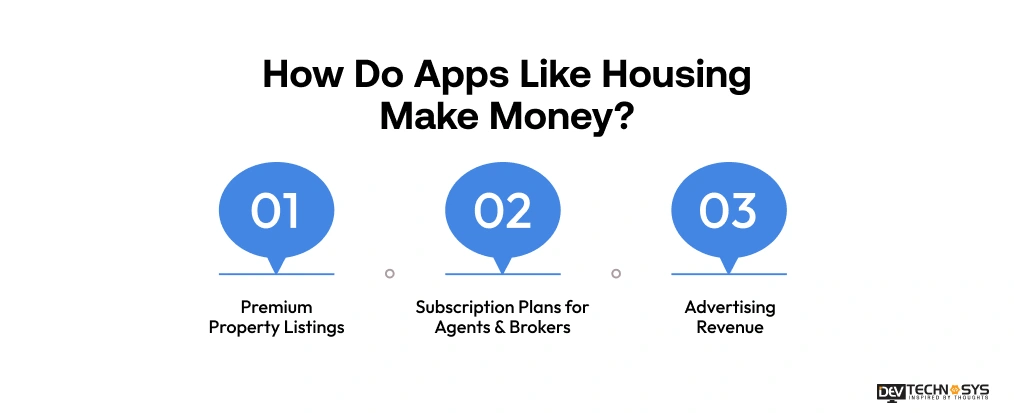
Apps like Housing generate revenue through a mix of listings, subscriptions, and premium services offered to agents, developers, and property owners. These platforms monetize both user engagement and real estate transactions within the ecosystem.
1. Premium Property Listings
Real estate platforms charge agents and owners to boost their listings for higher visibility in search results. These promoted listings use ranking algorithms and ad placements to generate revenue while increasing lead conversions for sellers.
2. Subscription Plans for Agents & Brokers
Agents subscribe to monthly or yearly plans to access advanced CRM tools, lead management systems, analytics dashboards, and unlimited property postings. This recurring revenue model ensures steady income for the platform.
3. Advertising Revenue
Apps earn money through targeted ads from banks, builders, and real estate service providers. Programmatic advertising and CPC/CPM models are used to display relevant ads to high-intent users.
You can reach out anytime; we are available 24/7. Our team provides a quick response.

Conclusion
Developing an app like Housing is more than just listing properties; it’s about building a safe, expandable, and user-focused real estate community. Housing society management app development involves advanced search tools, reliable verification systems, up-to-date architecture, and smart revenue-generating features. Companies can build a platform that makes buying and selling properties easier and supports long-term growth in the constantly changing PropTech landscape.
If you are a business looking for a top real estate app development company, Dev Technosys would be your best bet. With 15+ years of expertise and support of 250+ developers, we create real estate apps that help businesses streamline property management.
Frequently Asked Questions
Find answers to the most common questions related to this article.
The on-demand housing app development cost typically ranges from $30,000 to $150,000+, depending on feature complexity, platform selection, security requirements, third-party integrations, and the development team's location.
They use listing verification workflows, agent authentication, AI-powered fraud detection, content moderation systems, and user reporting mechanisms to maintain platform trust and listing authenticity.
Housing-like platforms generate revenue through premium listings, featured advertisements, subscription plans, lead generation services, developer promotions, and value-added services such as rent payment solutions.
Success depends on verified listings, intuitive search filters, location-based recommendations, virtual tours, and a seamless user experience that simplifies property discovery and communication.
A property listing app focuses on showcasing properties, while a real estate marketplace facilitates end-to-end interactions. It includes inquiries, agent communication, payments, and value-added services.
Yes. Modern real estate mobile app solutions and platforms can manage residential, commercial, rental, luxury, and under-construction properties through dedicated categories and customized search experiences.