

















Key takeaways:
-
- Zillow forecasts typical single-family rents to increase 2.9% and multifamily rents by 1.6% by December 2026, indicating continued but more moderate rental-market growth.
- The typical cost to develop a real estate app like Zillow ranges between $30,000 and $150,000. The final pricing depends on numerous factors.
- To build an app like Zillow, businesses have to include features such as virtual property tours, AI search filters, a mortgage calculator, and maps.
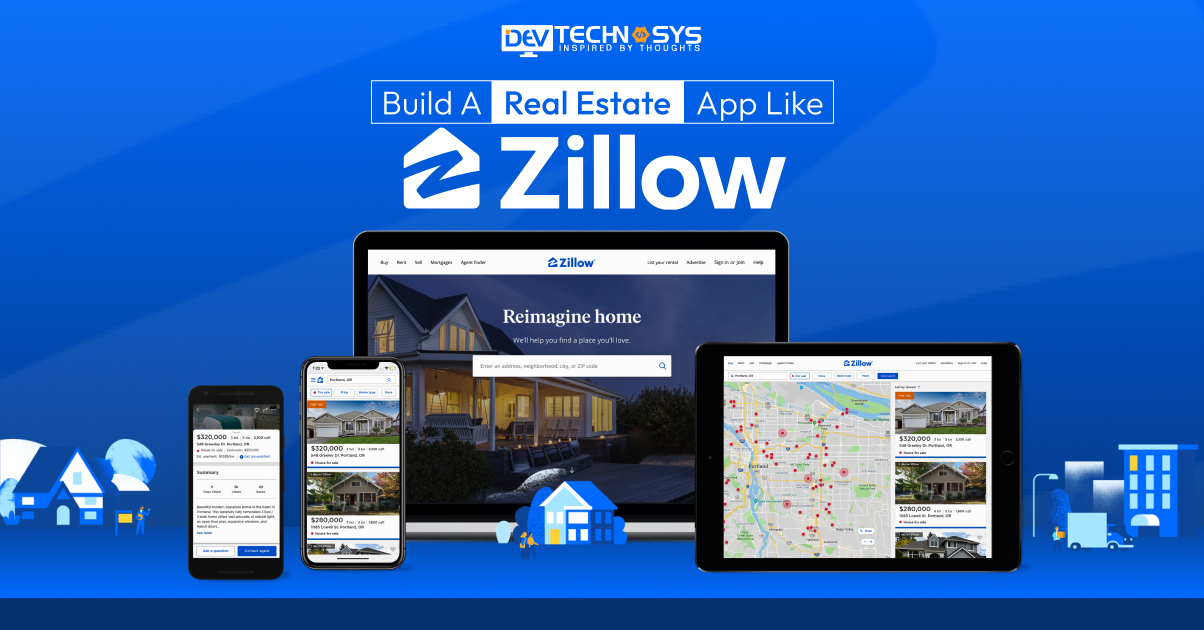
From buying homes to renting apartments, Zillow has become a dominant real estate platform. According to Wikipedia, Zillow lists 160+ million U.S. homes, making it one of the largest property marketplaces. Every startup is looking to build a real estate app like Zillow to stay ahead in the growing competition. Being the most trusted application, it offers massive opportunities to address the market’s challenges.
But to make a real estate app like Zillow from scratch comes with potential hurdles. What is the Zillow clone app development process? And what is the cost? What are the features of a Zillow-like real estate app? Well, in this blog, we’ll answer all these questions and help you build an app like Zillow.
What Is Zillow App?
Zillow is a real estate marketplace founded by Rich Barton in 2006. It offers an extensive range of services like buying, selling, renting, and financing properties. The main goal of the app is to help locate and acquire their dream place.
It provides an accurate estimate of a house’s value in the form of a Zestimate. The value is determined by analyzing current property prices, demand, area, neighborhood, and other factors. You can use Zillow on both the website and the mobile app.
Let’s take a quick glance at the market achievements of the Zillow App:
- According to the Zillow Group, revenue reached 2.3% in July 2026, continuing growth in the rental market.
- The app captures over 50% of all visits to real estate portals.
- Real Estate News confirms that 21% of users used bundled super app services.
How Does A Real Estate App Like Zillow Actually Work?
Zillow simplifies the property search and provides users with millions of property listings. It comprehends your unique scenario and connects you with a local real estate professional. Allowing for making an informed housing decision in 2026.
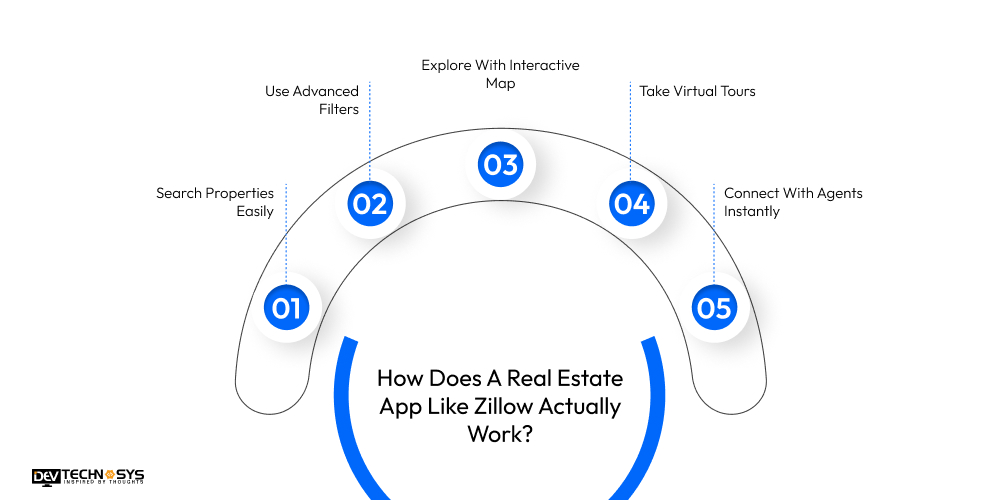
1. Search Properties Easily
By entering the preferred location, budget, and type, you can quickly search for homes. Zillow shows related listings with photos, descriptions, and prices. You can easily compare and shortlist properties accordingly.
2. Use Advanced Filters
To refine your search process, you can use the advanced filter in the application. You can apply filters like price range, bedrooms, bathrooms, home type, and amenities. This allows you to focus only on listings that meet your requirements.
3. Explore With Interactive Map
The app’s interactive map highlights nearby schools, hospitals, restaurants, and transit options. You can evaluate neighborhoods more effectively and choose locations that align with your lifestyle.
4. Take Virtual Tours
You can explore your desired house in a high-quality virtual tour. The 3D walkthrough makes it easy to narrow down the options. It also helps with a better understanding of property layouts before buying.
5. Connect With Agents Instantly
In the Zillow mobile application, you can contact agents more quickly. You can ask questions, schedule tours, or negotiate offers with real estate agents. Throughout the buying and renting process, you will receive professional guidance.
Global Real Estate Market Insights
Driven by digital transformation and changing consumer preferences, the real estate market is skyrocketing. The demand for residential and commercial properties increases the development of real estate apps like Zillow.
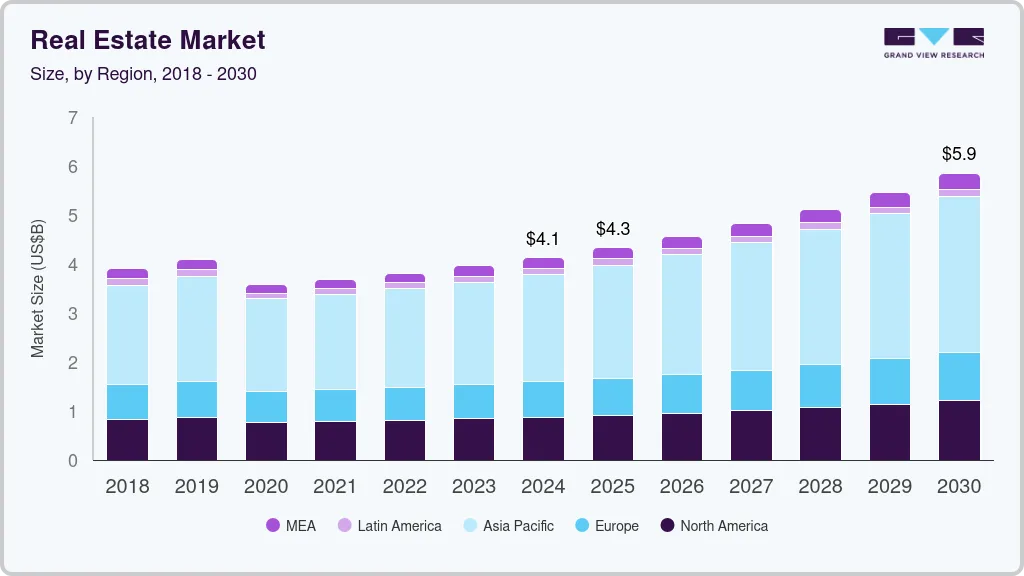
Below is the insight of global real estate market provided by Grand View Research.
- The market is projected to reach $5,852.02 billion by 2030.
- From 2025-2030, it is predicted to grow at a CAGR of 2%.
- With a 8% revenue share, Asia Pacific dominates the market.
- By segment, residential property ranked first in the market.
- By type, rentals accounted for4% of revenue.
Our Development Approach to Build a Real Estate App Like Zillow
What makes us a trusted real estate development partner is our structured approach. We focus on building privacy-first solutions that ensure security and an AI-ready real estate marketplace. We take the product from initial discovery to continuous optimization through a structured development lifecycle. Our approach focuses on five key activities:
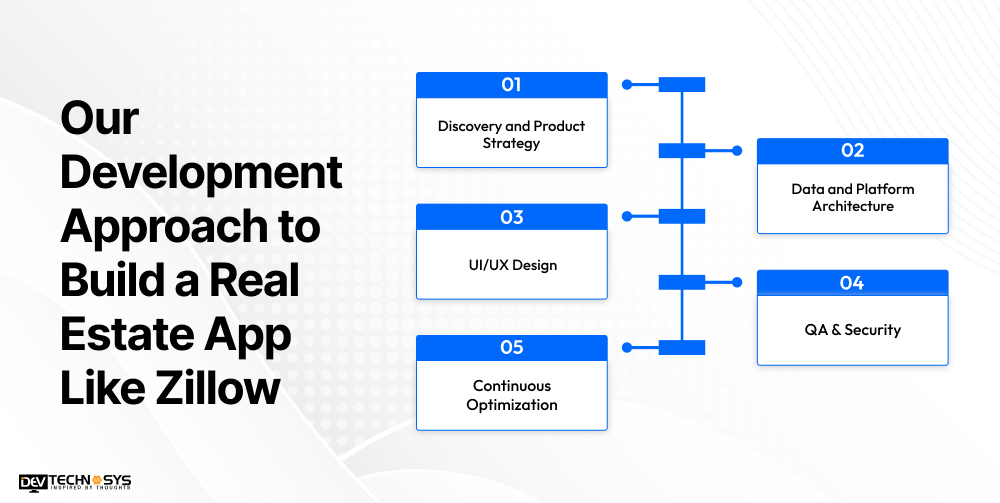
1. Discovery and Product Strategy
We believe in discussing the project in detail with the client to understand the goals and target audience. Then our in-house team creates a roadmap outlining technical aspects, team size, timeline, and budget for an MVP.
2. Data and Platform Architecture
After taking feedback on the MVP, we design a scalable architecture so that users can easily retrieve data when they enter a query. Also, this includes strong backend development with API integration to manage peak hours.
3. UI/UX Design
Although creating intuitive experiences for seaport users is challenging, our team uses advanced techniques to incorporate controls, maps, filters, and other elements. We ensure that each panel is easily accessible through a user-friendly interface.
4. QA & Security
For real estate applications, testing & security are the critical aspects that we consider. We implement industry-specific regulations and laws to encrypt the data. After proper testing and vulnerability checks, we deploy the solution.
5. Continuous Optimization
Our team implements CI/CD pipelines, monitors API performance, updates AI capabilities, and improves the app experience to meet evolving user needs. Even after the app launch, we support USA businesses in managing the application.
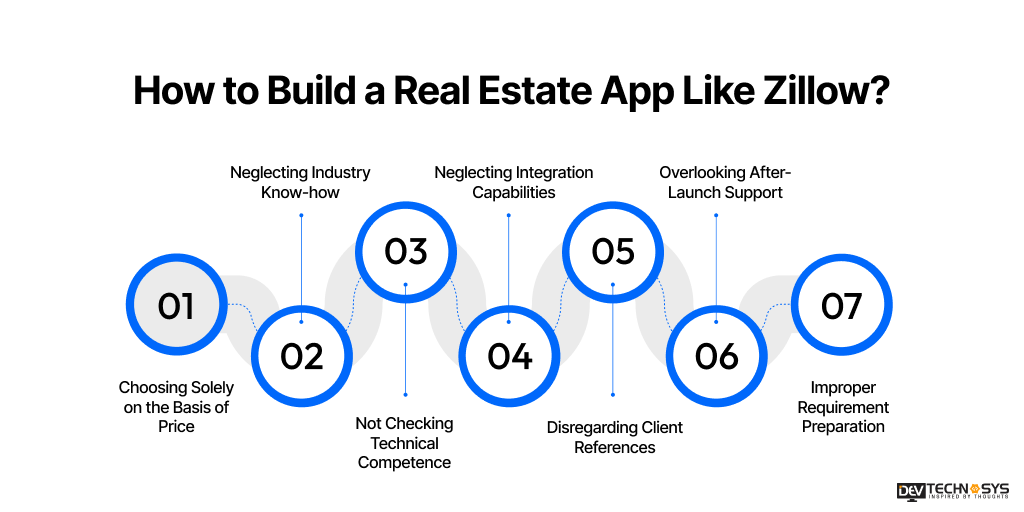
How to Build a Real Estate App Like Zillow?
Businesses that are willing to get an app like Zillow must know that developers need to follow specific steps to build strong architecture. The real estate marketplace app is designed with essential features and functionality in mind.
1. Validate Preliminary Requirements
Before project development, our team discusses the requirements, workflow, property category, revenue model, feature priorities, development timeline, and conducts a competitor analysis. The real estate app development process begins once clear communication is established with the client.
2. Plan Property Data and API Integrations
We plan the best strategy for integrating APIs and architecture with our development team to start working on the project. We ensure that the essential security features are included from this step of development.
3. Design the User Experience and Interface
The project manager coordinates with the designer to include designs for different dashboards. The must-have designs include map-based search, seller, admin, agent, and buyer dashboards, and property listing pages.
4. Build the Scalable Technical Architecture
Architecture layers that we use:
Presentation: React/Next.js, iOS, Android
↓
API & Security: API Gateway, authentication, RBAC
↓
Application Services: User, Property, Search, Agent, Messaging, Payment, Notification
↓
Data Infrastructure: PostgreSQL, Elasticsearch/OpenSearch, Redis, object storage
↓
External Services: MLS/RESO, Maps, Mortgage, CRM, Analytics
5. Develop and Integrate the Core Features
Build the MVP around the most important marketplace functions, then connect the required third-party services.
Core functionality includes:
- Property search and filters
- Map-based discovery
- Property profiles
- Favorites and saved searches
- Listing management
- Agent profiles
- Lead management
- Messaging
- Notifications
- Admin controls
6. Add AI and Advanced Real Estate Intelligence
Once the infrastructure is built, we introduce AI capabilities such as insights, NLP-based property search, recommendations, assistants, lead scoring, and more, as required by the business. This step might increase the total development cost because it requires additional expertise.
7. Test, Secure, Launch and Scale
After completing the real estate app development, our QA team tests the solution for speed, accuracy, security, and other features. We also provide real estate app maintenance services for US businesses to maintain app performance and keep it up to date with industry trends.
Testimonial
Dev Technosys delivered a scalable platform that improved transaction speed, security, and transparency. The team adhered to timelines, responded to needs, provided weekly updates, and demonstrated outstanding project management. Their expertise, knowledge, and creativity impressed the client.
Recommended Technology Stack for a Real Estate App Like Zillow
We believe that the right technology stack improves overall app performance. It is not essential that the business include exact features like Zillow. Thus, discussing preliminary requirements is important to include the technology stack accordingly.
Technology Layer |
Recommended Technologies |
| Frontend | React.js, Next.js, TypeScript |
| Mobile App | React Native, Swift, Kotlin |
| Backend | Node.js, Python, Java |
| Database | PostgreSQL, MongoDB, Redis |
| Search Engine | Elasticsearch, OpenSearch |
| Cloud Infrastructure | AWS, Microsoft Azure, Google Cloud |
| Maps Location | Google Maps Platform, Mapbox |
| AI Machine Learning | Python, TensorFlow, PyTorch, OpenAI APIs |
| APIs Integrations | REST APIs, GraphQL, MLS APIs, RESO Web API |
| Authentication | OAuth 2.0, OpenID Connect, JWT |
| Payments | Stripe, PayPal |
| Notifications | Firebase Cloud Messaging, Twilio, SendGrid |
| DevOps | Docker, Kubernetes, GitHub Actions, Terraform |
| Monitoring | AWS CloudWatch, Datadog, Sentry |
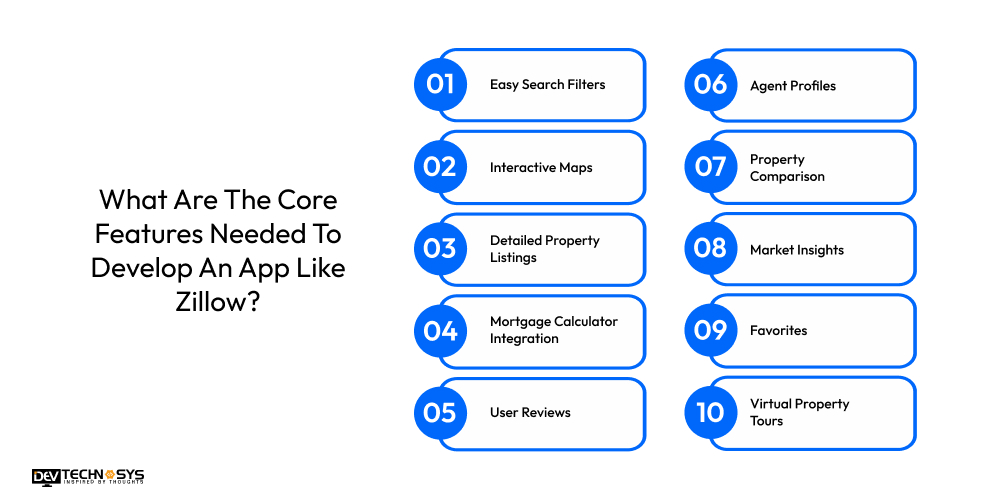
What Are The Core Features Needed To Develop An App Like Zillow?
For a robust Zillow clone app development, you will require extensive features. They are the backbone of any real estate platform. Understanding the core features is important to build a real estate app from scratch. Below are some top features of Zillow-like real estate app to include in your app.
1. Easy Search Filters
Going through thousands of listings to find a home is no fun, right? But an advanced search filter is the game-changer. It narrows down options by location, price, property type, number of bedrooms, and more.
2. Interactive Maps
When it’s about house hunting, people just love maps. An interactive map is an essential component for apps like Zillow. It provides users with a bird’s-eye view of property locations and nearby amenities.
3. Detailed Property Listings
Every listing has a description, images, videos, cost information, local locations, landmarks, owner data, etc. A detailed property listing will make your application more productive.
4. Mortgage Calculator Integration
A mortgage calculator is another core component to add to on-demand real estate app development. It helps the user determine whether a property is within their budget. They can calculate their monthly mortgage payments.
5. User Reviews
Before making any decision about a property, people love to read reviews. Adding this feature to apps like Zillow lets users see property or agent reviews right on the platform. It provides more credibility to the application.
6. Agent Profiles
An agent profile makes it easier for buyers to reach out to professionals. Add things like the agent’s contact details, experience, and client reviews. It will help the users to connect with the right real estate agents.
7. Property Comparison
Most of the time, people are confused between two options. A property comparison tool helps users compare properties side by side. Users can weigh factors such as price, square footage, etc., to make a decision.
8. Market Insights
To build an app like Zillow, you need to provide market insights within the app. You can offer insights like average prices, neighborhood trends, and future forecasts. Users can understand the market better.
9. Favorites
Sometimes people just love browsing properties rather than buying. The favorite features of Zillow-like real estate apps allow users to save properties for later. The user can easily access the shortlisted houses at any time.
10. Virtual Property Tours
Virtual property tours are the USP when you make a real estate app like Zillow in Seattle. Users can take a virtual tour of the property of interest without visiting it in person. It enhances users’ experience.
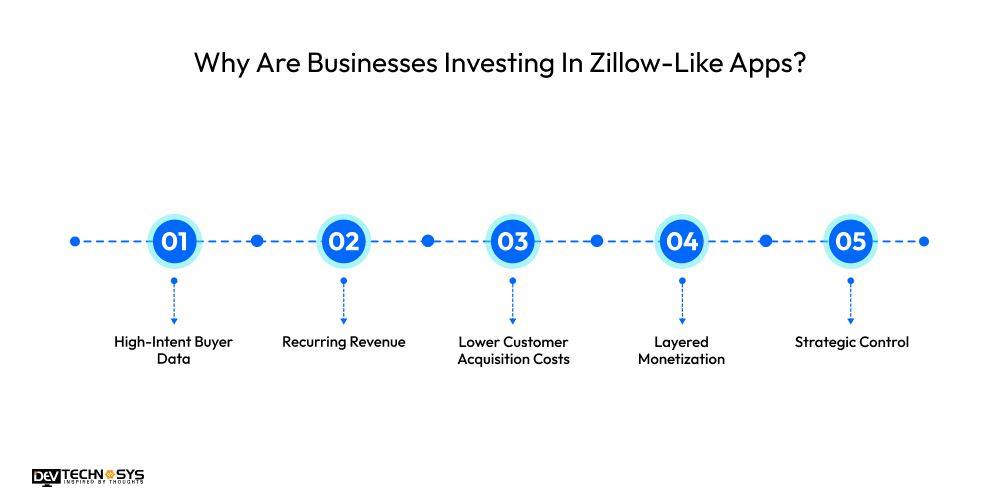
Why Are Businesses Investing In Zillow-Like Apps?
The real estate industry is swiftly shifting toward data-driven, on-demand digital experiences. Businesses and entrepreneurs are betting big on scalable real estate applications. Apps similar to Zillow are reducing reliance on traditional brokerage models. Which makes these apps a steady, long-term asset.
1. High-Intent Buyer Data
People are actively searching for properties online. Allowing Zillow-like apps to gather high-intent behavioral data. It supports dynamic pricing and marketing strategies. Companies analyze budget ranges, neighborhoods, and property types. Proprietary datasets create a durable competitive advantage, improving the conversion rates.
Industry Insight: A recent 2025 ZIPDO report found that 92% of homebuyers used a mobile device during their home search process.
2. Recurring Revenue
Startups are investing in different types of real estate apps to monetize agent relationships. Instead of relying on one-time revenue, companies are leveraging apps like Zillow to generate recurring revenue. Subscription tiers, featured listings, and performance-based advertising are ways to make cash from the agent ecosystem.
3. Lower Customer Acquisition Costs
Through the marketplace effect, Zillow clone apps are lowering customer acquisition costs. The paid advertising is replaced by referral traffic. As new listings improve search relevance and user engagement. Businesses do not have to increase their marketing budget. Which allows them to invest in AI capabilities and geographic expansion.
4. Layered Monetization
Mortgage pre-approvals, home insurance, and property valuation tools enable layered monetization. This allows businesses to capture revenue from the entire homeownership cycle. It also increases average revenue per user and strengthens Zillow’s market hold for similar apps. Companies can position themselves as an end-to-end real estate solution.
5. Strategic Control
Investment in proptech app development is increasing to gain strategic control over digital infrastructure. By choosing to build an app like Zillow, businesses gain direct control over technology and branding. This enables faster feature deployment and tailored compliance workflows. It also helps startups in securing long-term strategic independence.
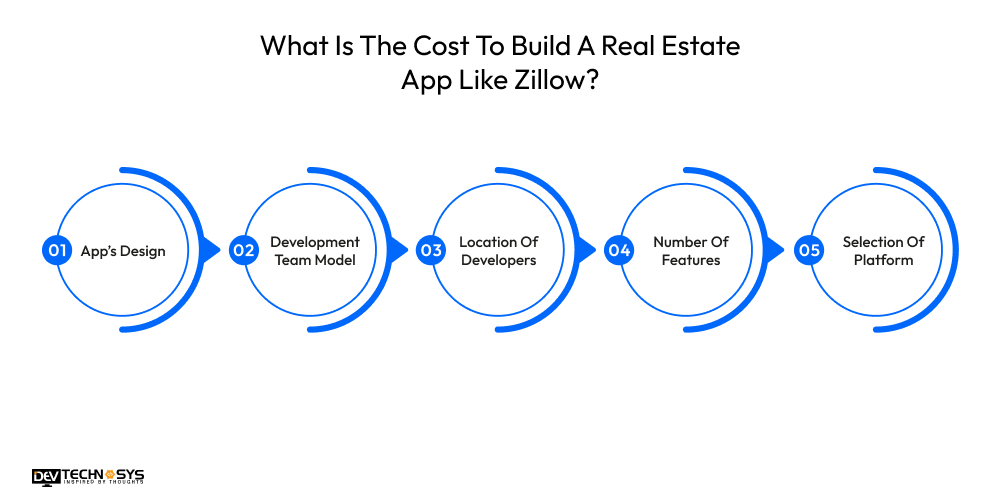
What is the Cost to Build a Real Estate App Like Zillow?
The real estate app development cost varies depending on the complexity and features you want to include. The standard cost to create an app like Zillow ranges from $8,000 to $20,000 for a basic/intermediate app. For more complex apps like Zillow, the cost will range from $20,000 to $30,000. Experts advise starting with an MVP to validate your app idea.
However, numerous variables determine the overall development costs of the property search platform. The location of the development agency, the app’s complexity, team size, functionalities, etc are the primary variables.
Development Level |
Best For |
Estimated Cost |
| Basic App (MVP) | Startups are testing the market with essential features like property listings, search filters, user registration, and map integration. | $8,000 – $12,000 |
| Mid-Level App | Businesses need advanced search, agent dashboards, push notifications, and payment integrations for better engagement. | $12,000 – $20,000 |
| Advanced App | Enterprises looking for AI recommendations, virtual tours, analytics dashboards, and high scalability. | $20,000 – $30,000 |
To keep the Zillow clone app development cost in check, you must consider the cost-affecting factors. Here is a detailed explanation of the key factors, along with a cost breakdown table.
1. App’s Design
Developing an app like Zillow with a custom UI/UX design will significantly increase the development cost. A simple app design with pre-built templates will cost you less than a custom application. Using templates may limit the application’s uniqueness. Advanced interactive elements will enhance the user interface but will cost extra dollars.
Design Level |
Description |
Estimated Cost |
| Basic UI Design | Simple layouts with limited customization and standard components. | $2,000 – $4,000 |
| Custom UI/UX | Interactive design, optimized user journeys, and branded visuals. | $4,000 – $7,000 |
| Premium Design | Advanced animations, micro-interactions, and high-end visual experiences. | $7,000 – $10,000 |
2. Development Team Model
The choice of the hiring model will largely impact the real estate app development cost. Every hiring model varies in expertise, collaboration, and operational overhead. Offshore developers are the best choice for building an app like Zillow, as they balance affordability and technical expertise. The in-house team will require higher long-term investment in salaries.
Team Model |
Best For |
Estimated Cost |
| Freelancers | Small projects with limited features and flexible timelines. | $3,300 – $5,000 |
| In-House Team | Businesses seeking full control and long-term collaboration. | $5,000 – $9,500 |
| Offshore Agency | Companies need diverse expertise and faster scalability. | $10,000 – $13,000 |
3. Location Of Developers
The cost to build a real estate app like Zillow depends on the team’s location. Developer hourly rates vary by region. For instance, the per-hour rate for hiring developers from Western or European countries is higher than that for developers from Asian countries like India. So choose the right location without affecting the quality of your project.
Region |
Average Expertise Level |
Estimated Cost |
| Asia / Eastern Europe | Cost-effective developers with strong technical capabilities and flexible engagement models. | $1,000 – $3,000 |
| Middle East | A growing tech ecosystem offering moderate pricing and reliable development standards. | $2,000 – $4,000 |
| North America / Western Europe | Premium services with advanced expertise, higher compliance standards, and strategic consulting. | $4,000 – $6,000 |

4. Number Of Features
The more advanced features you choose to add, the higher the development cost. On the other hand, if you integrate basic property search features, then the cost will be less. Primary features like user accounts, payments, and integrations affect the budget. So, prioritize must-have features to keep costs under control.
Feature Scope |
Examples |
Estimated Cost |
| Essential Features | Property listings, search filters, and user profiles. | $1,000 – $3,000 |
| Moderate Features | Payment integration, agent dashboards, push notifications. | $3,000 – $6,000 |
| Extensive Features | AI recommendations, virtual tours, and advanced analytics. | $6,000 – $8,000 |
5. Selection Of Platform
There are multiple platforms you can choose to deploy your real estate application, like Zillow. Building a real estate marketplace app for a single platform is less expensive than developing for both. If you wish to release your app on both iOS and Android. Then, a cross-platform solution is the approach to go with.
Platform Type |
Description |
Estimated Cost |
| Single Platform (Android or iOS) | Faster development with lower upfront investment. | $8,500 – $15,000 |
| Cross-Platform | Shared codebase reduces long-term costs while expanding reach. | $15,000 – $20,000 |
| Native Multi-Platform | Separate apps with superior performance and scalability. | $20,000 – $30,000 |
AI Use Cases In Real Estate Apps Like Zillow
If you’re planning to develop real estate app like Zoopla, AI enables highly personalized interactions. From actionable insights to predictive analytics, Artificial intelligence is redefining the property search experience.
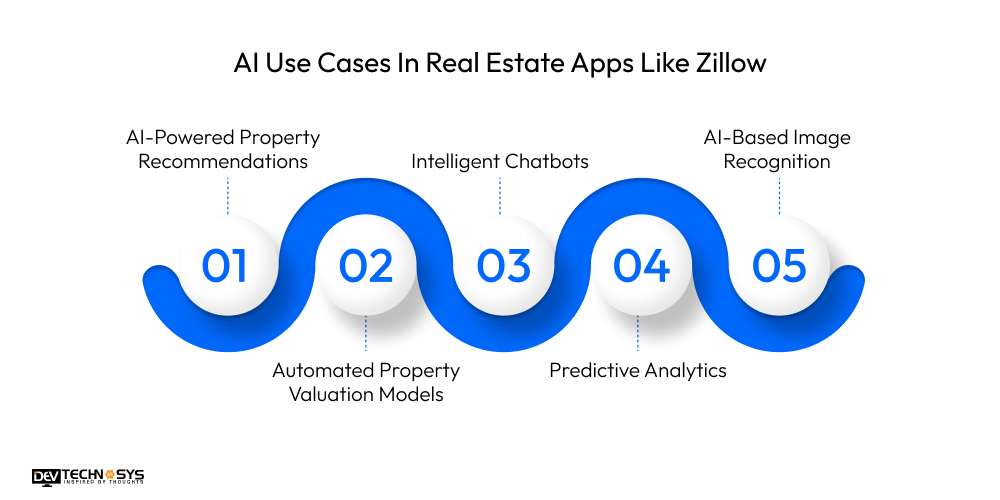
1. AI-Powered Property Recommendations
AI in Zillow similar apps reduces search fatigue with AI-powered recommendations. It analyzes user behavior, saved searches, budget patterns, and browsing history. Implementing AI ensures listings adapt dynamically to user preferences, thereby increasing conversion rates. It keeps users engaged longer within the platform.
2. Automated Property Valuation Models
Automated property valuation provides a real-time estimate of property prices. A Zillow-like app uses this model to analyze property features, market demand, and neighbourhood trends. The accurate pricing estimation attracts serious users and enhances transparency. AI valuation tools position the app as a trusted real estate platform.
3. Intelligent Chatbots
For user queries, the AI chatbot provides an immediate response. The chatbots improve responsiveness without increasing operational costs. It also guides buyers through a property search and enhances user satisfaction. These virtual assistants accelerate sales funnels. It ensures that potential leads are qualified.
4. Predictive Analytics
Artificial intelligence in Zillow clone apps forecasts shifts in property values, rental demand, and emerging neighborhoods. Market insights and analytics help users search for property more strategically. By processing large datasets and economic indicators, AI turns a listing platform into a decision-support tool.
5. AI-Based Image Recognition
Apps like Redfin and Zillow are partnering with an AI development company. for image recognition technology. It automatically analyzes property photos. When users use a filter for specific amenities, search accuracy improves. When you develop an app like Zillow, integrating AI-powered visual analysis reduces manual data entry. Users find suitable properties more quickly.
Monetization Models For Real Estate Apps Like Zillow
Most successful real estate apps, like Zillow, earn millions by following clever monetization models. By adapting right approach, your Zillow clone app can become a revenue-generating powerhouse. To name a few ways: lead generation, subscriptions, commission-based fees, listings, and advertising.
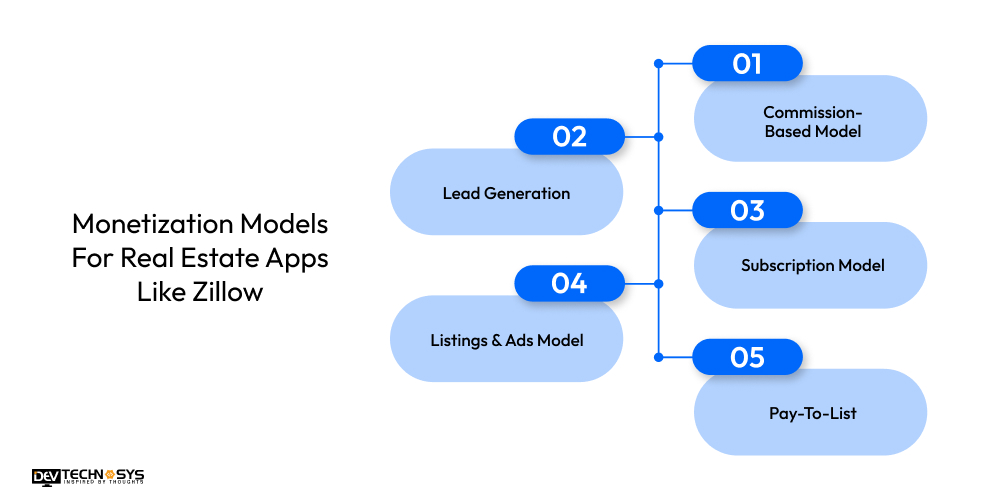
1. Commission-Based Model
This model generates revenue by charging a fixed fee from the app’s transactions. The income earned through this way depends on the value delivered to users. It encourages partnership with agents and builds strong trust. Real estate transactions in the Zillow similar app are usually high, so there is high revenue potential.
2. Lead Generation
One more way to make money from the Zillow clone app is to connect serious buyers, sellers, and renters. This strategy operates on a per-lead basis or a monthly subscription. It is a performance-driven strategy and works well for renter and buyer leads. As the user base grows, the number of leads naturally increases, resulting in a very high ROI.
3. Subscription Model
It is one of the most effective monetization strategies for Zillow clone app development. Users pay a monthly, quarterly, or annual recurring fee to access the platform’s paid features. This model works best for real estate development services that consistently deliver value over time. Unlike one-time purchase models, it generates predictable and recurring revenue streams.
4. Listings & Ads Model
The listings-and-ads model generates revenue by boosting users’ visibility. Sellers pay for premium placement of their listings to stand out in a crowded market. This increases the likelihood of catching the eye of potential buyers or renters. It also offers sponsored content and sells advertising space to businesses.
Industry Insight
As per Business Of Apps, Zillow generated about $2.23 billion in total revenue, with a significant portion coming from advertising and agent-focused services.
5. Pay-To-List
Commonly known as the listing fee model, it charges users a fee to post their property listings on the platform. It is one of the simplest and most effective ways to earn from your real estate application like Zillow. Pay-to-list appeals to professionals with recurring listing needs. This approach is easy to implement and manage.
Security and Compliance for a Zillow-Like Real Estate App
Real estate apps should be built while keeping regulatory compliance and privacy in mind. If the business has specific requirements, then they can discuss it with the project managers; otherwise, the development team includes the important laws according to the project.
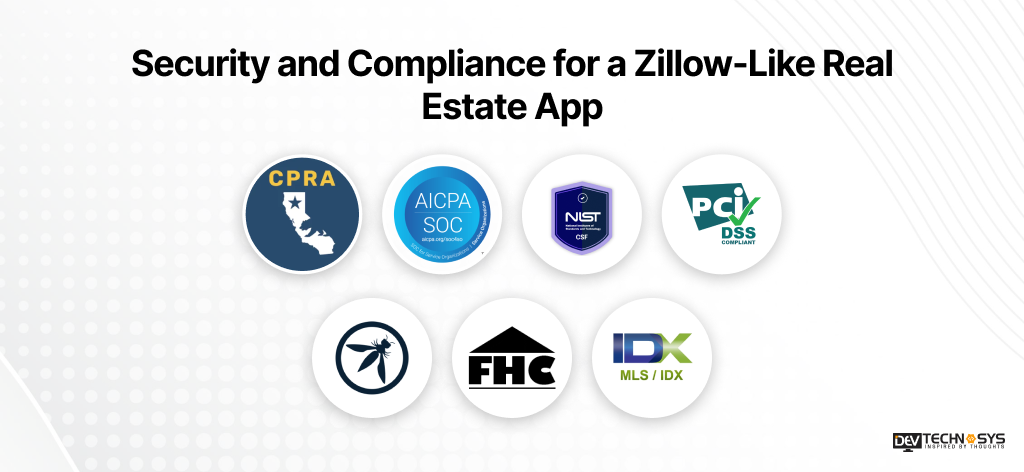
1. CCPA/CPRA
The privacy of customers’ and businesses’ personal information is protected by this compliance. The developers design data access and deletion workflows, as well as disclosure mechanisms, to handle data. Businesses will definitely collect user information, but they must also have a policy for deleting data when required.
2. SOC 2
Businesses’ information needs to be protected from unauthorized access, which is why development teams implement SOC 2. This compliance reduces the risk to the overall system through secure configuration management, incident response procedures, and backup controls. For property search app development, SOC 2 is a must.
3. NIST CSF
Property search applications, when developed with AI capabilities, become vulnerable. Hackers want to extract sensitive payment and customer data, which is why NIST CSF is implemented. This helps to identify, resolve, respond to, and recover the system from security events.
4. PCI DSS
Businesses mostly prioritize this compliance because it safeguards cardholder data. This regulation reduces the risk of unauthorized users accessing the information on the real estate app. Therefore, credit or debit card holders can rest assured that their details will be stored securely in the app.
5. OWASP ASVS
Even after testing, some vulnerabilities might remain hidden, which is addressed by this compliance. This even handles human errors when validating user responses for Zillow app development. Specifically for a real estate application, this compliance is mandatory.
6. Fair Housing Considerations
Real Estate CRM Software Development is incomplete without considering this regulation. AI models might produce discriminatory outcomes unintentionally that need to be controlled. Developers consistently monitor the solution to detect and resolve issues at the earliest opportunity.
7. MLS/IDX Compliance
This compliance includes listing attribution, caching policies, display restrictions, and authorized API access, all of which are essential for fetching and displaying listing data. Real estate application development must comply with MLS/IDX requirements, including caching restrictions and other legal policies.
Real-World Case Study: Real Estate Application “Shree State”
At Dev Technosys, we developed “Shree State” which allowed users to sell or rent their properties. The solution included advanced capabilities accessible on both iOS and Android. Map-based browsing, paid advertisements, subscription plans, and property management capabilities were included.
Challenges Faced: The major challenge was building the solution with security and compliance requirements specific to US real estate regulations.
Project Highlights
Project Name: Shree State
About Client: Vivek Videra
Industry: Real Estate
Development Timeline: 6 Months
Team Size: 5 People
Platform Type: Real Estate Property Listing Platform for Sale and Rental
Technology: React Native, Laravel
Key Features: Property Listings, Advanced Search, Map View, Featured Listings, Paid Advertisements, Subscription Plans, Property Management
Planning a Real Estate App Project?
Get a tailored development cost estimate in a few simple steps.
- 3 quick steps
- 100% free
- Reply in 1 business day
2 Minutes Read
Final Thoughts
Hiring a real estate app development company will ensure you build a property search app with smooth functionality. With the right blend of market insights, core features, and development cost, you can create a real estate app like Zillow. If you decide to go into digital real estate, now is the time to invest in a future-ready marketplace solution.
Developing a Zillow clone platform will provide customers with fast search, rich listings, and immersive tours. Balancing criteria such as a simple interface and a massive property database is crucial to building an app like Zillow.
Frequently Asked Questions
Find answers to the most common questions related to this article.
The real estate app development cost ranges from $30,000 to $150,000+, depending on whether the app is Zillow-like or offers more features, security & compliance, and AI capabilities businesses want to add. The final cost must be decided after a thorough discussion with the project managers.
The total development time to build an app like Zillow can range from 6 to 12+ months, depending on its complexity and the engineering effort required.
MLS and IDX integration are essential for a real estate app to search and fetch the relevant property data. When a user places a query, these integrations display useful information within a few seconds.
Yes, AI capabilities can be added to an existing or a new app. If changes are required to an MVP, they can be made at an early stage of development. If the existing application needs to be updated, then developers integrate AI property assistants, AVM, lead scoring, and predictive analytics.
For a specific country, developers need to add capabilities that support local users. For example, currencies, regulations, and listings according to the local audience. If AI agents are integrated, then they also communicate only in the regional language.