










Key takeaways:
-
- The global ERP market is rapidly evolving due to the digital transformation across industries. Businesses are driven by Generative AI in ERP adoption and cloud computing, leading to a secure digital transformation.
- Regulatory compliance and data privacy laws are shaping ERP development in 2026–2027, requiring businesses to implement security controls, audit trails, and industry-specific compliance features.
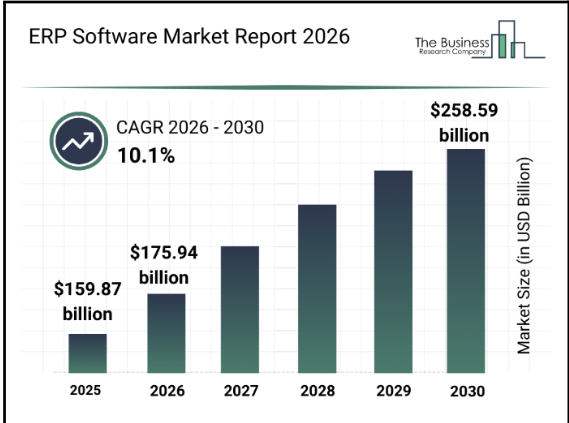
- According to The Business Research Company, the ERP software market is projected to exceed $165 billion in 2025, highlighting the growing demand for intelligent and cloud-based business management solutions.
- Industry-specific ERP solutions are gaining momentum, enabling healthcare, manufacturing, retail, logistics, and financial organizations to meet unique operational and compliance requirements.
The impact of emerging technologies such as cloud computing, AI, automation, and data-driven technologies is extensively observed for enterprise resource planning systems. Major industries are rapidly adopting ERP trends to improve operational efficiency.
Enterprises can automate workflow, saving long-term investments. Latest ERP software innovations are allowing businesses to upgrade systems with regulatory compliance, leading to a complete digital transformation. AI-powered analytics, embedded business intelligence, and cloud-native ERP platforms are widely accepted by organizations.
This guide explores the emerging ERP trends, compliance requirements, implementation strategies, and future technologies that are expected to shape the next generation of enterprise resource planning systems.
ERP Market Statistics and Growth Outlook (2026–2027)
By carefully analyzing data from The Business Research Company, we have found that ERP digital transformation trends are being rapidly adopted across industries. To improve operational efficiency and enable data-driven decision-making, many modern businesses are investing more in custom software development services.
Some key market findings include:
- ERP trends for 2026 and 2027 are being widely adopted by retail and ecommerce to manage inventory, supply chain operations, and customer relations in real-time.
- North America is the fastest-growing region because ERP implementations help businesses streamline workflows and improve productivity.
- The ERP software market is expected to grow at a CAGR of 10.1% by 2030. This highlights the consistent demand for AI-powered ERP platforms.
- Organizations are choosing manufacturing software development services to improve operational efficiency and quality control.
Planning a Mobile App?
Get a tailored development cost estimate in 3 simple steps — app basics, features, timeline, and your contact details.
- 3 quick steps
- 100% free
- Reply in 1 business day
2 Minutes Read
6 Top ERP Trends to Watch in 2026 – 2027
Enterprise Resource Planning (ERP) has become a strategic investment for businesses to reduce operational costs. Organizations across manufacturing, healthcare, retail, logistics, and finance are investing in modern ERP solutions to streamline workflow.
Businesses often partner with an ERP software development company to implement these technologies. The following ERP trends are expected to shape the market throughout 2026 and 2027.
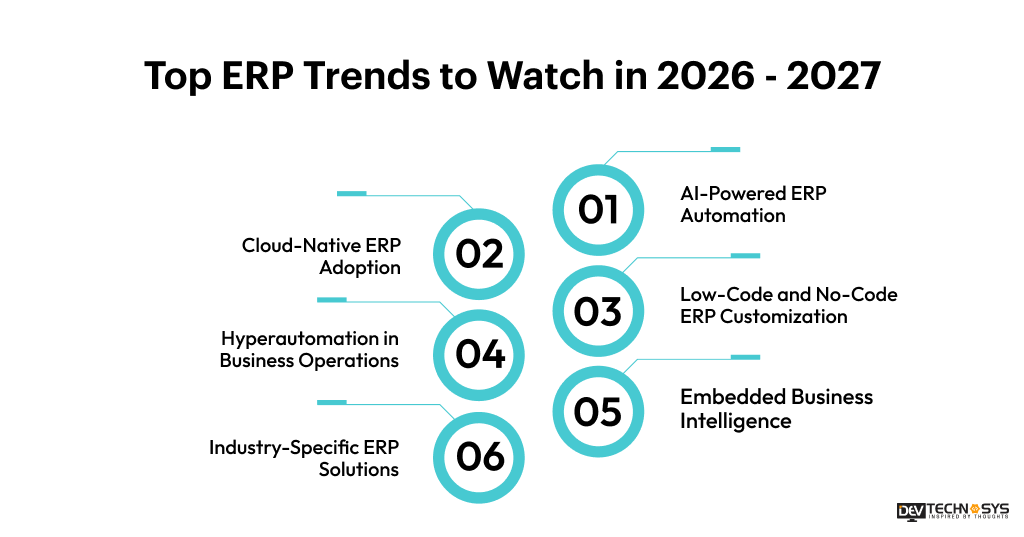
1. AI-Powered ERP Automation
Existing systems work on manual data entry that often leads to errors. Enterprises with large datasets must build AI-powered systems to improve decision-making.
- ERP Data Analytics: Businesses can now analyze historical data to predict customer demand, prevent supply chain disruptions, and target the right audience. Automated workflows help businesses to manage repetitive tasks and identify potential system failures.
- Intelligent Reporting: AI-powered ERP systems that automatically generate reports. Advanced tools provide helpful insights and recommendations. Businesses can maintain consistency across departments. Notifications and approvals allow different teams to maintain consistency.
2. Cloud-Native ERP Adoption
For organizations asking what is ERP must know that this should be in the checklist of businesses to upgrade these legacy systems. These offer better flexibility, scalability, and security than legacy systems.
- SaaS ERP Growth: SaaS ERP allows businesses to upgrade features without investing too much. Regular updates and security patches eliminate the need for extensive hardware and related infrastructure investments.
- Scalability and Remote Accessibility: Employees can either work in a hybrid or remote environment with the cloud-native ERP adoption. This improves data recovery, service continuity, and ensures minimal downtime during unexpected disruptions.
3. Low-Code and No-Code ERP Customization
Businesses are rapidly adopting such customization to eliminate the need for extensive programming expertise. Organizations should implement this trend to reduce development time.
- Faster Deployment: The systems allow drag-and-drop modules that allow users to build a system, skipping the long development cycles. Companies can launch new features and can easily adapt to frequent changes in the market.
- Reduced Development Costs: Businesses reduce their dependence on specialized development teams. This lowers overall costs while accelerating digital transformation.
4. Hyperautomation in Business Operations
This helps to automate complex business operations such as invoice processing, customer onboarding, employee leave, and payroll management. The system leverages critical thinking by combining AI, robotic process automation, and machine learning.
- RPA Integration: This enables businesses to accomplish rule-based tasks such as data entry, human resources, and onboarding. The software bots are reducing operational costs by automating the workflow.
- Automated Approvals and Workflows: This replaces the traditional approval processes. For example, an employee can apply for leave and get approval online without human intervention.
5. Embedded Business Intelligence
Organizations can directly analyze data within ERP applications. This is effective in making informed decisions while ensuring better ROI. Analytics provide accurate data to support business decisions.
- Real-time Dashboards: The businesses can analyze the data using graphs, bar charts, key performance indicators, and manage inventory levels. Most organizations inquire about the cost and features to build software like SAP ERP to build dashboards.
- Data-driven Decision Making: Decision-makers have to analyze manual reports that used to take a lot of time. With Embedded Business Intelligence (BI), businesses can make decisions with accurate data.
6. Industry-Specific ERP Solutions
The supreme part of implementing the ERP systems is that they are designed to meet industry-specific requirements. Businesses should adopt the latest ERP software innovations to improve efficiency.
Industry Insight:
According to The Business Research Company, AI in the ERP market is projected to increase by $5.54 billion in 2026. This data shows the rapid adoption of AI-driven ERP solutions, automation, and predictive analytics.
i. Healthcare ERP
This stems from his build using regulatory compliance, such as HIPAA and GDPR. The system helps healthcare organizations to improve operational efficiency. Advanced ERP software can be integrated with electronic health records and telehealth systems.
ii. Retail ERP
Larger retailers can effectively manage inventory, sales, customer relationships, and supply chains. The growth of ecommerce and the demand for digital shopping have increased the demand for intelligent Retail ERP solutions.
iii. Logistics & Supply Chain
ERP solutions for logistics and supply chain management allow real-time visibility to warehouse and distribution operations. These systems help businesses to track inventory, shipping, and enhance demand forecasting.
iv. Manufacturing ERP
Businesses have to look for quality control, production planning, and equipment maintenance. ERP software integrated with ERP trends improves operational efficiency, reduces downtime, and optimizes production processes through intelligent automation and data analytics.
Why are Enterprises Rethinking ERP Architecture with Composable and Two-Tier ERP Strategies?
Traditional ERP systems often struggle to meet evolving digital ecosystems. Adopting two-tier ERP architectures improves flexibility to add multiple features. Organizations can add multiple functionalities instead of relying on monolithic systems.
Two-tier ERP strategies allow large enterprises to simply operations centrally. They can now integrate regulatory compliance into the systems, avoiding any legal issues. As cloud ERP trends 2026 continue to evolve, organizations are embracing these architectures to improve integrations.
Trusted by Global Businesses for Enterprise Software Development
Real feedback from real clients who trust us to deliver results.
The project was based on ERP and CRM. The team has successfully fixed bugs in the frontend and backend.
Why Businesses are Choosing Custom ERP Systems?
Businesses today are intensely focusing on growth objectives. The rise of predictive analytics in ERP and AI has further increased demand for tailored solutions. These trends help businesses to replace manual work with automation.
This is helping businesses to respond to customers’ queries instantly, manage inventories, and gain a competitive advantage. The adoption of emerging technologies is helping businesses automate repetitive tasks and generate valuable business insights.
Why Should You Hire Dedicated Developers for ERP Projects?
ERP implementation is not just a simplified process; it requires long-term planning and maintenance. Businesses that hire dedicated developers can build, customize, and integrate ERP systems to meet operational requirements.
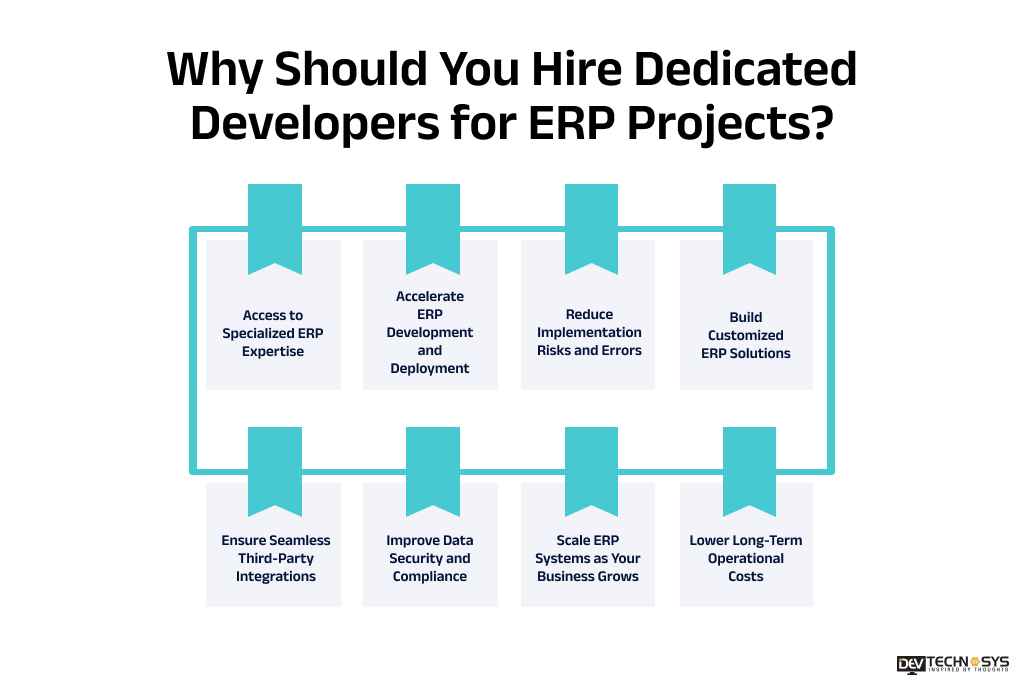
1. Access to Specialized ERP Expertise
Developers have industry-specific knowledge of ERP architecture API’s, databases, and business workflows that properly align with business goals. Working with a CMMI Level 3-certified development company ensures standardized development processes and effective risk management.
2. Accelerate ERP Development and Deployment
ERP projects are accomplished with custom workflows and suitable modules. Developers utilize proven development practices and modern ERP solutions in 2026 – 2027 to shorten the development timeline.
3. Reduce Implementation Risks and Errors
Many ERP systems fail because of inadequate technical expertise, unclear requirements, or improper configurations. Tailored ERP modules are integrated according to the business size and model. This ensures that the system is built with scalability.
4. Build Customized ERP Solutions
Most businesses require an AI-based analytics dashboard to understand customer behavior. Dedicated developers analyze the system’s requirements and build customized dashboards according to specific operational requirements.
5. Ensure Seamless Third-Party Integrations
Without third-party integration, an ERP system might not work as required. Modern ERP systems must integrate with CRM platforms, accounting software, HR systems, inventory tools, payment gateways, and third-party applications. Dedicated developers build secure APIs and integration frameworks to eliminate data silos.
6. Improve Data Security and Compliance
Businesses that want to adopt ERP modernization trends must hire software developers with knowledge of regulatory compliance. Organizations should work with developers and companies that offer NDA-protected development processes.
7. Scale ERP Systems as Your Business Grows
Developers design scalable architectures for ERP systems and provide ongoing maintenance, performance management, encryption, and backup strategies. This allows organizations to scale their systems whenever required in teh future.
8. Lower Long-Term Operational Costs
Dedicated developers attentively analyze risks and operational inefficiencies while optimizing workflows. Their expertise helps organizations to minimize downtime and ensure long-term ERP performance and to adopt the latest ERP trends conveniently.
Want a chatbot demo or pricing? Fill the form and talk to our experts today.
Pick what you need below — you can select more than one — then tap Get detail to continue.
-
Chatbot demo dashboard
-
Cost to develop an app
-
Industry report
-
Case study
How Businesses Can Prepare for Emerging ERP Market Trends?
Organizations have to be prepared with their infrastructure and technology strategies. They have to continuously evolve with cloud computing, automation, and advanced analytics. These strategies help to gain a competitive edge.
1. Assess existing ERP infrastructure
Initially, it is important to analyze the system. The complexities of the system will help developers to plan an effective strategy for the future. An ERP audit analyzes data quality issues, checks for performance bottlenecks, and outdated modules. This gives a clear roadmap for the developers to execute a successful ERP modernization.
2. Invest in cloud technologies
Cloud ERP is in trend because of its flexibility, demand for lower infrastructure, and better accessibility. Cloud adoption supports integration with the emerging technologies such as AI, real-time reporting, and disaster recovery.
3. Prioritize data security
With the increase in the adoption of ERP trends, the systems are prone to security issues. Organizations have to implement robust frameworks to secure sensitive data. This is crucial for healthcare, finance, and banking industries that comprise customer data. Multi-factor authentication, role-based access control, regular security audits, and compliance monitoring are mandatory.
4. Build a scalable architecture
Smart ERP solutions are built with a scalable architecture, meaning that the features and functionalities can be added later without disrupting the existing system. This is essential to save maintenance costs.
5. Work with experienced ERP partners
Working with experienced ERP partners allows businesses to reduce deployment risks and improve customization capabilities. Partners collaborate and communicate effectively to make suitable changes in the ERP systems.
How Regulations Compliance Standards Data Privacy Laws Shape ERP Development in 2026 – 2027?
Compliance-first ERP development is becoming a major trend across industries. In 2026 – 2027, modern businesses should comply with regulatory compliance. They must prioritize ERP cybersecurity to avoid financial penalties and reputational damage.
1. Data Privacy Laws Driving ERP Development
Organizations must hire dedicated developers who have extensive knowledge to build privacy-by-design architectures.
i. General Data Protection Regulation (GDPR)
ERP systems must support:
- Data consent management
- Right to access data
- Data deletion requests
- Data portability
- Privacy controls
- Audit trails
ii. California Consumer Privacy Act (CCPA)
Businesses operating in California must support the following privacy laws:
- Data access requests
- Consumer data deletion
- Opt-out mechanisms
- Data tracking transparency
iii. Emerging Global Privacy Regulations
Businesses operating internationally require ERP systems that can adapt to:
- Regional data residency requirements
- Cross-border data transfer regulations
- Consent management policies
- Data retention requirements
2. Financial Compliance Standards
i. SOX Compliance
ERP systems support SOX compliance through:
- Financial audit trails
- Transaction logging
- Approval workflows
- Access controls
- Segregation of duties
ii. IFRS and GAAP Standards
Global businesses often follow financial reporting standards such as:
- International Financial Reporting Standards (IFRS)
- Generally Accepted Accounting Principles (GAAP)

3. Industry-Specific Compliance Standards Shaping ERP Development
i. Healthcare: HIPAA and HITECH
Healthcare organizations manage sensitive patient information and must comply with regulations such as:
- HIPAA
- HITECH
Healthcare ERP systems require:
- Patient data protection
- Access restrictions
- Encryption
- Audit logging
- Secure data sharing
ii. Manufacturing: ISO Standards
Manufacturing companies increasingly adopt ERP systems that support:
- ISO 9001 (Quality Management)
- ISO 14001 (Environmental Management)
- ISO 45001 (Occupational Health and Safety)
iii. Retail and Payment Processing: PCI DSS
Retail businesses handling card payments must comply with:
- Payment Card Industry Data Security Standard (PCI DSS)
- ERP systems used in retail environments support
- Secure payment processing
- Transaction monitoring
- Data encryption Access management
iv. Logistics and Supply Chain Compliance
ERP solutions for logistics and supply chain management must be integrated with global supply chain operations, as they face increasing regulations involving:
- Import and export controls
- Trade compliance
- Customs regulations
- Transportation safety standards
v. Food and Beverage Industry
Food manufacturers and distributors must comply with:
- FDA regulations
- HACCP standards
- Food traceability requirements
vi. Pharmaceutical Industry: FDA 21 CFR Part 11
Pharmaceutical companies require ERP systems that support:
- Electronic records management
- Electronic signatures
- Validation processes
- Audit trails
Industry Insight:
At Dev Technosys, we have worked on multiple ERP projects and have understood that it is mandatory for businesses to build systems with regulatory compliance. Regulations such as GDPR, HIPAA, SOC 2, and industry-specific compliance standards have to be implemented.
4. AI Governance and Compliance in ERP
As artificial intelligence becomes integrated into ERP platforms, organizations must address additional concerns involving:
- Algorithm transparency
- Data bias
- Explainable AI
- Responsible automation
- AI governance policies
5. Data Residency and Cloud Compliance
Modern ERP platforms increasingly provide:
- Regional data centers
- Data localization options
- Backup policies
- Compliance certifications
The Hidden Reasons ERP Projects Fail and How Expert Partners Prevent Them
The primary reason that many ERP projects fail is the unclear requirements and lack of technical expertise. These issues often lead to budget overruns and delayed deployments. ERP failure affects business productivity. By combining technical expertise with industry knowledge, expert ERP partners reduce implementation failures and help businesses maximize the long-term value of their ERP investments.
Hidden ERP Failure Risk |
How Expert ERP Partners Prevent it |
| Unclear requirements cause scope changes and delays | Conduct requirement analysis and align ERP goals with business needs |
| Poor change management reduces user adoption | Provide user training and change management strategies |
| Legacy integrations create data silos | Build secure APIs and integration frameworks |
| Excessive customization increases costs | Recommend scalable and future-ready customization |
| Weak planning causes budget overruns | Establish timelines, milestones, and risk plans |
| Data migration errors affect reporting accuracy | Perform data validation and migration testing |
| Security gaps expose sensitive data | Implement encryption, access controls, and compliance measures |
| Lack of support impacts system performance | Provide maintenance, optimization, and technical support |
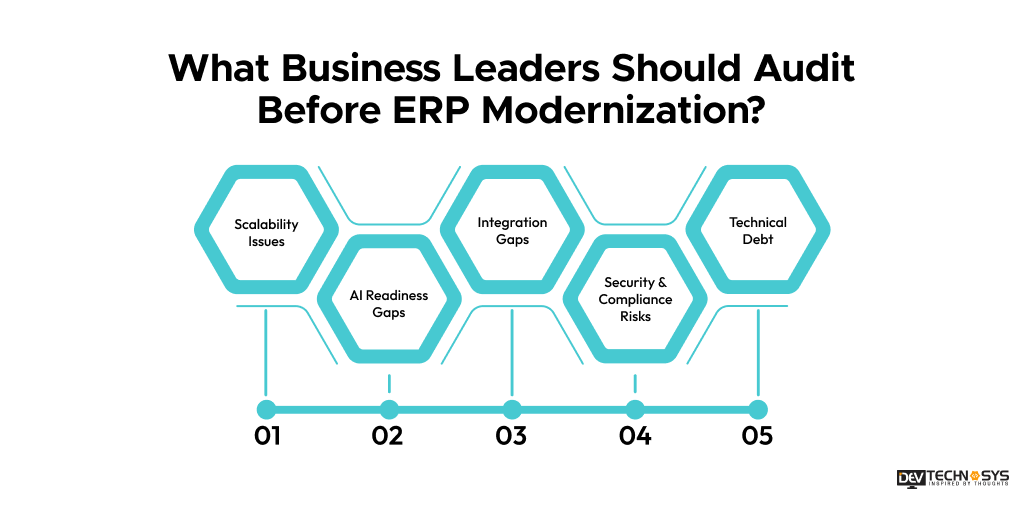
What Business Leaders Should Audit Before ERP Modernization?
Before investing in a new ERP system, business leaders should conduct a thorough audit of their existing processes, technology infrastructure, and operational challenges.
Many ERP implementations fail because organizations focus on software features rather than identifying underlying business problems. Evaluating the following areas can help companies make informed ERP investment decisions.
Business Challenge |
What to Audit |
Recommended Solution |
| Scalability Issues | System performance, user limits, multi-location support, future growth requirements | Adopt a cloud ERP platform that supports higher workloads, additional users, and business expansion |
| AI Readiness Gaps | Data quality, reporting capabilities, analytics maturity, and historical data availability | Implement AI-enabled ERP systems with predictive analytics, automation, and intelligent reporting |
| Integration Gaps | Existing software, API compatibility, data synchronization, and manual processes | Use API-first ERP solutions that connect CRM, HRMS, finance, and third-party applications |
| Security & Compliance Risks | Access controls, encryption, backup policies, and regulatory requirements | Deploy ERP platforms with MFA, role-based access, encryption, and compliance capabilities |
| Technical Debt | Legacy systems, maintenance costs, vendor support, and software lifecycle | Modernize outdated systems with cloud ERP, low-code tools, and scalable architecture |
Industry Insight:
According to Grand View Research, the global ERP market software size is expected to grow at a CAGR of 9.5% from 2026 to 2033. The demand for streamlined workflows is a result of this adoption.
ERP Investment Audit Checklist for Business Leaders
Conducting these audits before investing in ERP software helps organizations reduce implementation risks, improve ROI, and ensure the selected ERP system aligns with long-term business objectives and digital transformation goals.
Audit Area |
Common Business Problem |
Recommended Solution |
| Scalability | System performance issues during growth | Cloud-native scalable ERP |
| AI Readiness | Poor data quality and limited insights | AI-enabled ERP with analytics |
| Integration Gaps | Data silos and manual processes | API-driven ERP integrations |
| Security | Cybersecurity and compliance risks | Secure ERP with advanced controls |
| Technical Debt | High maintenance costs and outdated systems | Modern cloud ERP migration |
Conclusion
Businesses are rapidly evolving through emerging ERP technologies to simplify business operations. These systems have become the foundation of digital transformation.
It is mandatory to build ERP systems with regulatory compliance. Businesses should hire software developers or partner with an ERP software development company to avoid system limitations and increase operational efficiency.
At Dev Technosys, all ERP projects are supported by transparent privacy policies, secure development practices, and NDA agreements. This ensures data protection throughout the development lifecycle.
Frequently Asked Questions
Find answers to the most common questions related to this article.
The cost of ERP solutions depends on project type and business size.
Basic ERP solutions cost up to $50,000
Mid-level Custom ERP ranges between $50,000 to $100,000
Advanced Enterprise ERP costs $150,000+
Application Programming Interfaces enable ERP systems to communicate effectively with other applications, such as accounting and CRM systems. These reduce manual errors and support workflow automation. With these API-driven architectures, businesses can improve flexibility and scalability.
Robotic Process Automation automates repetitive tasks such as invoice processing, payroll management, and data entry. These bots can analyze large volumes of data, allowing businesses to handle routine tasks without human intervention.
Enterprises are adopting composable ERP and two-tier ERP architectures to improve flexibility, scalability, and integration capabilities. Two-tier ERP enables large organizations to maintain a central ERP, while other branches can use independent systems.
A monolithic ERP comprises frontend and backend as an all-in-one suite model, whereas a Headless ERP separates logic for both of these. This allows businesses to build custom ERP applications catering to modern operational challenges.
Dedicated developers typically use extract, transform, and load to avoid technical challenges:
Data Mapping
Minimizing system downtime
Cleansing redundant data
Data Loss
Data is protected using a zero-trust architecture, ensuring verified access from any user and device.
Traditional cloud ERPs experience latency while processing massive data. Edge computing solves this challenge by processing IoT data locally, which assures zero latency in real-time.