













Key takeaways:
-
- Agentic AI has revolutionized the traditional rule-based automation system into real-time decision-making.
- Multiple financial institutions use AI agents for fraud detection, compliance monitoring, and credit risk assessment.
- The integration of multi-agent systems with a proper strategy improves operational efficiency and reduces costs
- By 2030, Agentic AI will become core infrastructure powering trading, compliance, and digital financial ecosystems.
The financial industry is entering a new era in 2026-2027 where AI works beyond just analyzing data. It offers intelligent decisions, automates complex workflows, and works according to the evolving financial markets.
This shift is being driven by Agentic AI, a new generation of autonomous AI systems. It helps banks, fintechs, insurance companies, and investment organizations boost their efficiency, detect fraud, and comply with regulations.
Agentic AI in finance also provides its users with a highly personalized experience. The growing competition and rising operational costs are forcing businesses to quickly consider Agentic AI in finance. It creates more efficient, fast, and robust financial ecosystems.
In this blog, we will cover everything you need to know about Agentic AI in finance. It includes how Agentic AI in Finance works, its use cases, deployment challenges, future trends, and more.
What Is Agentic AI?
The autonomous systems that can make decisions and take actions independently are known as Agentic AI. The decisions and actions taken by Agentic AI are completely without constant human input. The Agentic AI can adapt, learn, and take steps by analyzing real-time data.
The key differences of traditional, generative, and agentic AI are:
- Traditional AI generally follows preset algorithms to solve problems.
- While Generative AI develops content (e.g., text, images) from inputs.
- Agentic AI makes real-time decisions and autonomously executes actions.
AI automation in software development is really common in 2026 because it streamlines decision-making. It even improves user experiences and decreases operational costs, making it an essential asset in the finance sector.
How Agentic AI Works in Financial Ecosystems?
The AI workflow automation in finance is extremely streamlined. It includes data collection, autonomous decision-making, immediate actions, and continuous learning. By automating key tasks, autonomous AI in finance enhances operational efficiency. With real-time data processing and AI-driven insights, here is how Agentic AI works.
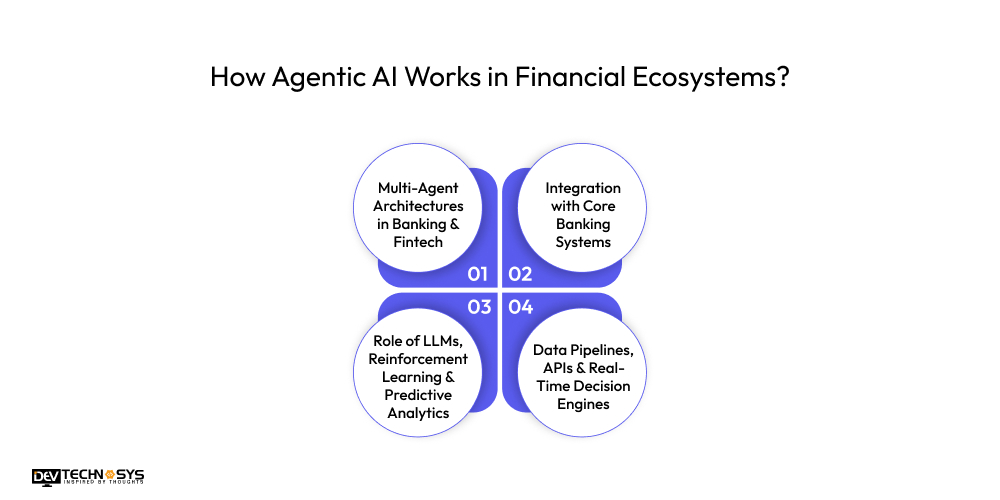
1. Multi-Agent Architectures in Banking & Fintech
Multi-agent systems allow various AI agents to interact and collaborate in financial services and decisions. They optimize tasks like risk analysis, trading, and customer service. It is because each agent has some unique specifications for a particular operation. These agents work together to streamline financial processes.
2. Integration with Core Banking Systems
Agentic AI flawlessly integrates with fundamental banking systems to upgrade decision-making, be it transaction management or account services. This allows AI-driven financial automation to access real-time data and take actions. These decisions and actions are based on the financial details that are up-to-date.
3. Role of LLMs, Reinforcement Learning & Predictive Analytics
A fintech software development company integrates LLMs, Reinforcement learning, and Predictive analytics in smart AI assistants for banks and finance
- Large Language Models interpret complex data and help in automating conversations with customers.
- Reinforcement learning optimizes strategies over time and improves decisions via trial and error.
- Predictive analytics in finance predicts trends and helps financial institutions make data-driven decisions.
4. Data Pipelines, APIs & Real-Time Decision Engines
To enable rapid action, AI-driven data and APIs feed decision engines with real-time data. These engines give instant decisions related to trade execution or fraud detection. The data in these decision engines is processed autonomously. They also offer quick responses according to the dynamic market conditions.
Key Applications of Agentic AI in Finance
Agentic AI in finance is used for real-time fraud detection, compliance tracking, wealth management, loan underwriting, and financial reporting. It has transformed the financial workflows and simple automation into detailed decision-making. The key applications of intelligent AI agents for finance include:
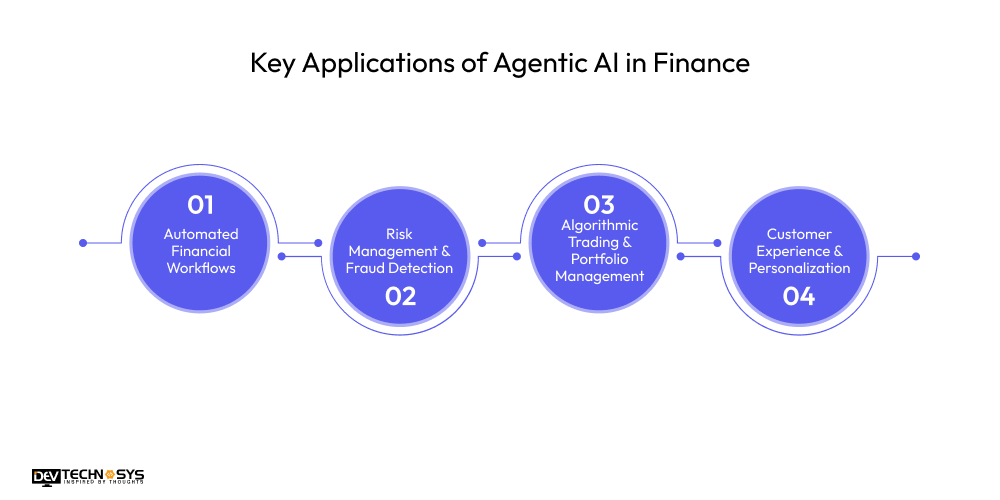
1. Automated Financial Workflows
-
Loan Processing & Credit Approvals
With Agentic AI, loan approvals and credit scoring become easier and quicker while reducing human biases.
-
Claims Management Automation
AI for financial operations (FinOps) ensures faster and more accurate claim management processing, from submission to settlement.
-
Accounts Payable & Receivable Automation
It is also used to optimize accounts management by automating invoicing, payments, and receivables.
-
Treasury & Liquidity Management
AI-driven agents help manage cash flow and liquidity with real-time data, while optimizing treasury functions and financial stability.
2. Risk Management & Fraud Detection
-
Real-Time Fraud Monitoring
Agentic AI helps in protecting assets and minimizing financial crime by detecting fraudulent activities immediately.
-
Credit Risk Scoring Enhancement
AI agents allow financial institutions to improve risk assessments for loans and credit as it analyzes data insights deeply.
-
Market Risk Forecasting
With this, banks can predict market fluctuations, potential risks, and even enable proactive decision-making.
-
Regulatory Risk & Compliance Automation
Autonomous agents ensure financial institutions stay compliant by automating regulatory checks.
3. Algorithmic Trading & Portfolio Management
-
Autonomous Trading Agents
AI-driven agents make users take real-time trading decisions. They optimize strategies based on recent market conditions.
-
Dynamic Asset Allocation
To maximize returns and minimize risks, Agentic AI dynamically distributes the assets in real-time.
-
AI-Driven Investment Advisory
People can get personalized investment suggestions from AI agents. These suggestions are based on real-time market data and trends.
-
Real-Time Market Sentiment Analysis
Intelligent agents analyze market sentiments that help in predicting market trends. Due to this, investors can make informed trading decisions.
4. Customer Experience & Personalization
-
AI-Powered Financial Assistants
Intelligent assistants offer 24/7 support to users in handling issues and financial tasks without any interruptions or delays.
-
Hyper-Personalized Financial Recommendations
These AI agents provide financial recommendations as per the goals, preferences, and spending behaviors of the user.
-
Omnichannel Engagement Automation
With this, Agentic AI ensures consistent and personalized customer interactions throughout the communication channels.
-
Predictive Customer Behavior Modeling
By examining the needs and actions of customers, AI offers them proactive and relevant product offerings.
What Are the Major Benefits of Agentic AI in Financial Services?
Agentic AI comes with many transformative benefits for financial services. It drives innovation, efficiency, and seamlessness in operations across sectors. We will elaborate on these advantages that improve decision-making and market competitiveness.
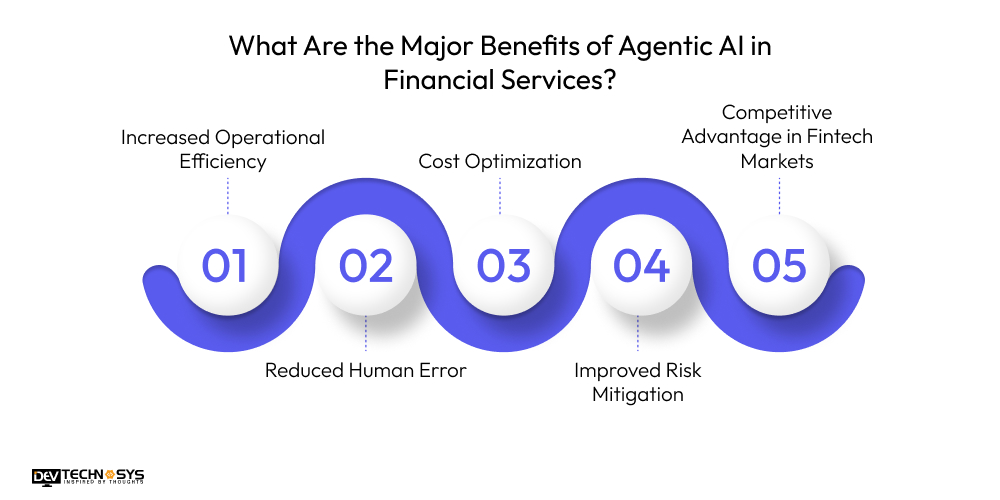
1. Increased Operational Efficiency
By leveraging autonomous decision-making in banking, Agentic AI automates repetitive tasks by optimizing workflows. With this, operational efficiency increases and manual efforts are reduced. AI agents allow financial institutions to streamline operations and focus on strategic expansion.
2. Reduced Human Error
Using AI agents for fraud detection and AI-based compliance automation can potentially reduce human errors. As AI agents manage tasks like a credit scoring system and risk assessment, it turns down the manual efforts. It helps in accurate financial operations and enhances decision-making in critical areas.
3. Cost Optimization
Generative AI development services with Agentic AI help in reducing operational costs. Its AI-powered risk management and AI credit scoring systems automate complex processes with accuracy. By implementing these measures, financial institutions save time and money while ensuring security.
4. Improved Risk Mitigation
Agentic AI with risk management tools allows financial institutions to manage risks proactively. Whether it’s about fraud detection, credit risk evaluation, or portfolio monitoring, AI agents examine data to predict. This helps mitigate financial threats while boosting mitigation efforts.
5. Competitive Advantage in Fintech Markets
Financial institutions are gaining competitive advantages in the fintech markets by adopting AI-driven innovations. According to the AI Agent development company, these technologies offer them the flexibility to adapt to market changes effortlessly. It helps institutions improve customer experiences and lead in digital transformation.
Pick what you need below — you can select more than one — then tap Get detail to continue.Want a chatbot demo or pricing? Fill the form and talk to our experts today.
Chatbot demo dashboard
Cost to develop an app
Industry report
Case study
Real-World Examples of Agentic AI in Finance
Many financial institutions across the world are integrating Agetic AI for seamless operations. It helps them in fraud detection, compliance monitoring, risk analysis, and customer experience. Throughout the financial ecosystems, autonomous AI is reshaping operational efficiency and strategic decision-making. Whether it’s global banks or fintech startups, here are some real-world examples using Agentic AI in finance.
Global Financial Institutions Using Agentic AI
Many banks internationally have incorporated advanced Agentic AI. Their main purpose behind this is to automate workflows and strengthen risk management. Here are some real examples:
1. J.P. Morgan Payments
- How they use it: J.P. Morgan utilizes bounded autonomous agents to power digital twins of corporate liquidity ecosystems. It enables the system to independently reconcile fractured data across ERP platforms. It also executes cross-border treasury routing within strict policy-as-code boundaries.
2. Mastercard
- How they use it: Mastercard deployed its “Agent Pay” protocol, which uses specialized AI agents. They autonomously authenticate transactions, evaluate tokenized session provenance, and verify consent freshness in real time. It prevents fraud during programmatic machine-to-machine commerce.
3. Goldman Sachs
- How they use it: Goldman Sachs has deployed autonomous AI agents built on Anthropic’s Claude models. It is deployed directly into its process-heavy back-office operations to independently manage trade reconciliations. It also manages client onboarding data mapping and deep document compliance checks.
These systems are no longer basic automations but have evolved into intelligent tools. These can help businesses make instant financial decisions and support complex reasoning.
Fintech Startups Using Autonomous AI Agents
Startups entering the fintech industry are adding Agentic AI systems into their highly digitalized platforms. Have a look at some of these examples:
1. Stripe
- How they use it: Stripe developed its Agentic Commerce Suite natively integrated with Anthropic’s Model Context Protocol (MCP). It allows AI agents to autonomously crawl merchant inventories and analyze live pricing models. It programmatically issues single-use virtual cards to complete B2B purchases.
2. Klarna
- How they use it: Built using a multi-agent orchestration framework on LangGraph, Klarna’s autonomous AI system is worth appreciating. It handles two-thirds of the platform’s global customer support tickets and executes multi-step refund validations. It also accounts for adjustments in under two minutes without human intervention.
3. Wise
- How they use it: Wise utilizes integrated agentic pipelines via Beam.ai. It allows autonomous digital coworkers to programmatically manage international money transfers and convert multi-currency balances at optimal times. With this, they also write detailed financial reconciliation reports across linked corporate accounts.
It is different from traditional automation; these AI agents learn and adapt to new behavioral and transactional data.
Uabpay
Built an Intelligent Digital Payment Platform with AI-Driven Financial Automation in 34 Weeks
How we partnered with Uabpay to develop a secure digital payment platform that simplifies money transfers, bill payments, QR-based transactions, and intelligent financial management while delivering a faster, smarter, and more personalized user experience through AI-powered automation.
Uabpay
AI-Powered Digital Payment & Financial Management Platform
34 Weeks
$68,000
Challenge
The client needed a scalable payment ecosystem capable of handling secure digital transactions, simplifying onboarding, improving user engagement, and providing intelligent financial insights while ensuring seamless performance during high transaction volumes.
Solution
Developed an AI-powered payment platform featuring QR payments, fund transfers, bill payments, cash-in/cash-out services, mobile top-ups, smart spending dashboards, and automated financial assistance to deliver faster, secure, and personalized payment experiences.
Results
- 60% faster digital payment processing
- Successfully launched in 34 weeks
- 45% improvement in user engagement
- Enhanced transaction security with AI-powered monitoring
- Simplified financial management through intelligent insights
Differentiate Between Agentic AI, RPA, and Traditional Automation
The different levels of intelligence and autonomy in financial technologies can be seen through Agentic AI, RPA, and traditional automation. From rule-based task execution to fully autonomous decision-making systems, they can adaptively learn and organize complex workflows. Now, we will compare Agentic AI, RPA, and traditional automation on various bases.
| Criteria | Agentic AI | RPA (Robotic Process Automation) | Traditional Automation |
| Level of Intelligence | High – Uses AI models, reasoning, and learning capabilities | Low to Moderate – Rule-based scripts | Very Low – Predefined logic only |
| Decision-Making Ability | Autonomous, context-aware decisions | Follows predefined rules | Executes fixed programmed commands |
| Learning Capability | Continuously learns and adapts from new data | No self-learning (unless integrated with AI) | No learning ability |
| Workflow Complexity | Handles complex, multi-step workflows | Best for repetitive, structured tasks | Suitable for simple, linear processes |
| Human Intervention | Minimal – operates independently with oversight | Moderate – requires monitoring | High – needs frequent manual updates |
| Data Handling | Structured and unstructured data (text, voice, documents) | Mostly structured data | Structured data only |
| Scalability | Highly scalable across departments and systems | Scalable but limited by rule complexity | Limited scalability |
| Integration Capability | Integrates with APIs, AI models, and enterprise systems | Integrates mainly at the UI level | Integrated directly into legacy systems |
| Risk Management Use | Real-time risk analysis and predictive insights | Executes compliance checks based on rules | Performs static validation checks |
| Use Case in Finance | Fraud detection, autonomous trading, and credit risk scoring | Invoice processing, data entry, and report generation | Payroll automation, batch processing |
What Risks and Barriers Come with Implementing Agentic AI in Finance?
As there are considerable advantages of Agentic AI in financial services, it comes with some drawbacks too. In this section, we are addressing challenges related to integrating legacy systems into AI portfolio management automation. Understanding these barriers is essential for a successful adoption of these agents.
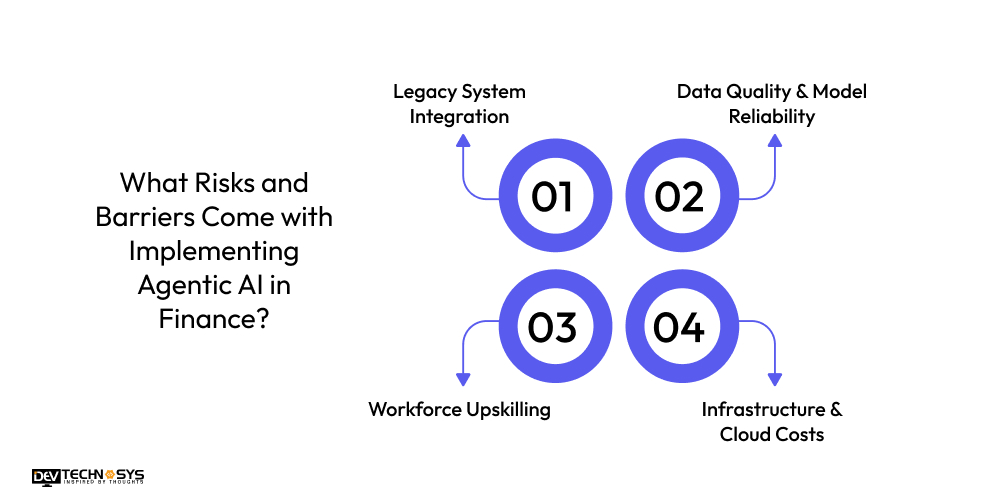
1. Legacy System Integration
Combining Agentic AI with an outdated legacy system not only becomes difficult but costly as well. Due to this, banks might have to face issues related to compatibility, which demand upgrades and adjustments. However, it potentially slows down risk assessment using AI agents and other advanced tools.
2. Data Quality & Model Reliability
High-quality and reliable data is required for AI portfolio management automation and AI credit scoring systems to perform well. When the data is incomplete or inaccurate, there are chances of compromising model reliability. This can lead to flawed predictions, poor decision-making, and financial risk.
3. Workforce Upskilling
Significant workforce upskilling is required to implement Agentic AI for financial workflows and risk management. Employees involved in this integration should be given training for AI systems, data analytics, and new technologies. For training and support, financial institutions can partner AI development company.
4. Infrastructure & Cloud Costs
Be prepared that adopting Agentic AI demands reliance on cloud infrastructure and computing power. Financial institutions generally plan for costs associated with storing and processing large databases. This can significantly affect and strain the budget, and can be really difficult, especially for small businesses.
Agentic AI Pricing Breakdown: From Basic Automation to Enterprise AI
The average cost to develop a fintech app with agentic AI can be somewhere between $30,000-$70,000. The final cost will depend on the scope of work, workflow complexity, number of integrations, required compliance, and deployment scale. No matter what kind of project you consider, knowledge about the costs will be helpful for businesses. Whether involving the automation of some financial processes or creating an enterprise-wide AI ecosystem, here is the Agentic AI in finance cost breakdown:
| Agentic AI Solution | Ideal For | Core Capabilities | Estimated Cost |
| AI Task Automation | Banks & Fintech Startups | Single AI agent, workflow automation, API integration, audit logs | $30,000–$40,000 |
| Multi-Agent Finance System | Growing Financial Institutions | Multiple AI agents, intelligent orchestration, CRM/Core Banking integration, RBAC | $40,000–$55,000 |
| Enterprise Agentic AI Ecosystem | Large Banks & Enterprises | Enterprise-wide automation, compliance management, model governance, real-time monitoring | $55,000–$70,000 |
Build vs Buy vs Partner: Which Agentic AI Development Approach Is Right for Your Financial Institution?
Just as the choice of AI technology is crucial, the development approach should also be chosen correctly. Although ready-to-use platforms enable quicker deployment, in-house development grants full flexibility. Partnering with an expert AI development company brings together all the benefits mentioned above. The table below outlines the features that will help financial organizations decide which path to take to implement Agentic AI. Have a look at the comparison table:
| Factor | Off-the-Shelf AI Platform | Build In-House | Partner with Dev Technosys |
| Time to Deployment | Fast implementation (within weeks) | Long development cycle (12+ months) | Faster custom deployment with early MVP delivery |
| Integration with Banking Systems | Limited customization and third-party connectors | Fully customized integration | Tailor-made solution that seamlessly integrates with your existing banking ecosystem |
| Ownership of Source Code & IP | Owned by the software vendor | Complete ownership | 100% ownership transferred to your business |
| Compliance & Regulatory Support | Limited to predefined compliance features | Built according to your internal requirements | Designed to meet industry regulations, security standards, and governance policies |
| AI & ML Expertise Required | Minimal internal expertise | Requires a dedicated AI/ML team | Access to experienced AI engineers without hiring an in-house team |
| Long-Term Cost | Recurring subscription and licensing fees | High investment in hiring, infrastructure, and maintenance | Predictable development cost with flexible support and maintenance options |
| Customization & Scalability | Limited customization | Unlimited flexibility | Fully customized and scalable as your business grows |
| Maintenance & Support | Vendor-controlled updates | Managed internally | Dedicated post-launch support, upgrades, and optimization |
| Best For | Businesses validating AI ideas quickly | Large enterprises with established AI teams | Banks, fintech companies, and financial institutions seeking custom, enterprise-grade Agentic AI solutions |
How to Successfully Integrate Agentic AI into Financial Systems?
Successfully integrating Agentic AI into financial systems requires strategic planning, collaboration with AI development companies, and ongoing optimization. Now we will learn the step-wise integration of Agentic AI in fintech app development solutions.
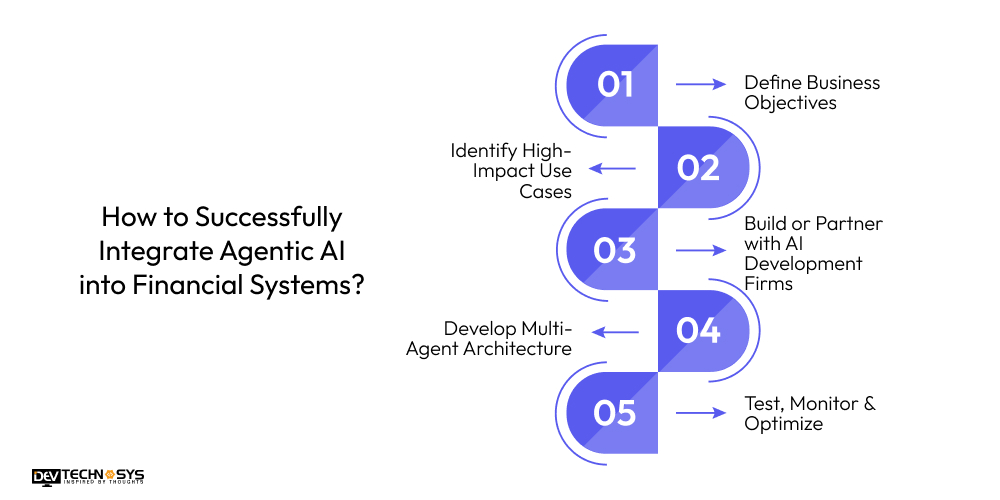
1. Define Business Objectives:
Defining the business objectives with utmost clarity is really important for integrating Agentic AI in financial systems. Generally, financial institutions align AI projects with their goals, like improving risk assessment using AI or optimizing AI portfolio management automation. This helps focus on an effective implementation strategy.
2. Identify High-Impact Use Cases:
A Mobile app development company helps identify high-impact use cases where Agentic AI can drive the most value, which is critical. These include areas like fraud detection, risk management, and AI-driven credit scoring systems. Here, automation and real-time decision-making can significantly improve operational efficiency and reduce costs.
3. Build or Partner with AI Development Firms:
To integrate Agentic AI seamlessly, financial institutions should either build in-house teams or partner with AI development companies. These firms bring specialized expertise in designing and deploying tailored AI systems. They also ensure the optimal performance of the agent and meet regulatory requirements.
4. Develop Multi-Agent Architecture:
Creating a multi-agent architecture allows different AI models to work together in harmony. Hire AI developers to ensure that various AI-driven systems operate in an integrated and efficient manner across all financial processes. These include systems such as AI portfolio management, automation, and fraud detection agents.
5. Test, Monitor & Optimize:
Continuous testing, monitoring, and optimization are crucial in AI integration. AI systems should be regularly assessed for accuracy, reliability, and performance, allowing financial institutions to fine-tune risk management tools and improve AI-powered decision-making processes over time.
Governance, Compliance, and Regulatory Requirements for Agentic AI in Finance
Here’s the cold, hard truth that most systems that leverage agentic AI omit: Making a mistake in a chatbot interaction with customers is one thing; making mistakes in credit decisions, fraud alerts, or fund transfers is another matter altogether.
Agentic AI in finance isn’t a matter of “Does it work?” Rather, it’s about being able to explain, after the fact, precisely why it acted as it did. That is the standard that must be met before it becomes viable. Otherwise, it’s a risk.
It applies to every application, including AML/KYC automation, agentic AI agents for fraud-detection screening of transactions in real time, or FP&A agentic AI agents developing the financial projections on which senior management will base its decisions.
In order to make it into finance operations, an agentic AI system must be able to do the following:
1. Show evidence that it did, retroactively
All actions and decisions are recorded and locked from modifications. So when someone asks “Why was this done six months ago?” the answer is already there.
2. Justify itself in language humans understand
A decision without justification is not a decision; it’s an opaque black box with an outcome. Whenever there is anything related to credit assessment, fraud detection, or any other financial decisions, an explanation is needed for each one.
3. Provide an answer to a human every single time when it matters
There must be an individual with the necessary powers who will be able to check, delay, and cancel any decisions made by the agent. It includes those that are automated as part of standard monthly closing.
4. Do not overreach
An agent should have precisely the same authorities as the process it replaces. If a process allows approvals up to $10,000, the agent should not exceed that limit to prevent unauthorized actions and reduce hidden financial risks.
5. Comply with regulations, not just best practices
SOC 2, ISO 27001, and GDPR are minimal requirements. For any companies providing services in the EU, the provisions of the EU AI Act for financial services are necessary. It implies that credit scoring and fraud detection are considered high-risk applications.
The TRUST Framework for Governance-Ready Agentic AI
To ensure Agentic AI systems operate safely in financial environments, governance cannot be treated as an afterthought. It must be embedded into the core decision-making process of every AI agent . The TRUST Framework defines the five essential pillars. These ensure transparency, accountability, security, and regulatory compliance before any AI system is deployed in real financial operations.
| Pillar | Purpose | Implementation in Financial AI |
| T – Transparent Decisions | Every AI action must be explainable | Human-readable reasoning, confidence scores, and decision summaries for every action taken |
| R – Responsible Oversight | Keep humans in control of high-risk decisions | Human approval required for credit decisions, fraud flags, and large-value transactions |
| U – Unbreakable Audit Trails | Create immutable records for every action | Timestamped logs, model versions, prompts, and user actions, stored securely and never editable |
| S – Secure Access Controls | Prevent unauthorized AI actions | Role-based access, multi-factor authentication, API authentication, least-privilege permissions |
| T – Trust Through Compliance | Align AI with regulatory requirements | GDPR, AML/KYC standards, PCI DSS, ISO 27001, SOC 2, EU AI Act financial services rules, internal governance policy |
Emerging Trends That Will Shape Agentic AI in Finance by 2030
We agree that Agentic AI is itself a trend in this highly advanced technological landscape. In the fintech industry, there are several emerging trends that continue to evolve and shape the work of Agentic AI. These emerging trends can drastically transform the finance industry by 2030.
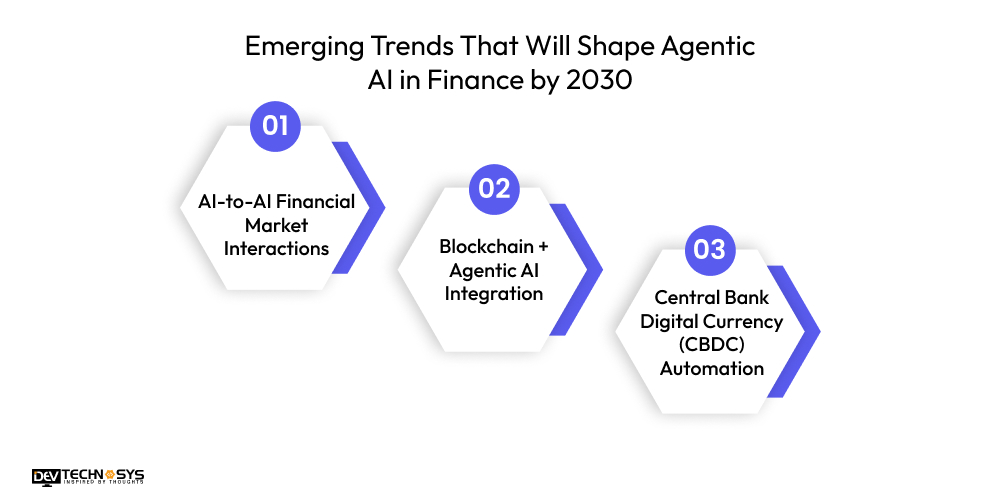
1. AI-to-AI Financial Market Interactions:
By 2030, the financial industry is going to be dominated by AI-to-AI interactions. With this, AI agents will autonomously communicate and trade with each other. It will help in analyzing real-time market predictions and data, and allow users to make fast and informed decisions. AI in banking industry improves efficiency in operations and reduces human mistakes in trading.
2. Blockchain + Agentic AI Integration:
In the coming years, blockchain technology get integrated with Agentic AI. It will enhance transparency, security, and data integrity in financial transactions. This combination can develop decentralized, AI-powered platforms that help in fraud detection and portfolio management. It even increases users’ trust and reliability in the financial services.
3. Central Bank Digital Currency (CBDC) Automation:
By 2030, CBDC will also be powered and automated by Agentic AI. It will streamline the monetary policies and enhance financial inclusion. The AI-driven risk assessments let central banks manage their digital currencies more efficiently. AI agent development solutions enables smooth transactions internationally while reducing operational costs.
Final Words
The Agentic AI is transforming the financial sector at a rapid pace. It automates complex workflows and even strengthens risk management processes. Whether it’s loan processing, real-time fraud detection, or portfolio management, financial process automation with AI becomes easier.
With the continuation of the AI technology evolution in finance, the role of autonomous agents will expand. It drives iinovationm optimizes customer experience, and fosters financial stability. In 2026 and beyond, Agentic AI is no longer just an option but a necessity for financial institutions.
To stay competitive in an increasingly digital and data-driven world, you can reach out to an Agentic AI development company.
Frequently Asked Questions
Find answers to the most common questions related to this article.
Agentic AI helps improve risk management by:
Scanning large databases
Identify user patterns
Predict potential risks
With this, banks can make data-driven decisions and enhance fraud detection. These AI agents optimize operational efficiency and mitigate financial risks effectively.
Yes, Agentic AI is a secure and highly preferred option for baking operations. It provides users with advanced encryption, continuous monitoring, and robust compliance protocols. By analyzing potential risks and vulnerabilities, an AI agent strengthens cybersecurity. It ensures safe and secure transactions within financial institutions.
Yes, small-scale financial institutions can easily adopt Agentic AI. For small institutions, there are several scalable and cost-effective solutions. These tools, with cloud-based services, are tailored for smaller organizations. It enhances efficiency, decision-making, and staying competitive without requiring large investments.
No, Agentic AI doesn’t replace financial analysts at all, but the upgrade their capabilities. AI can seamlessly handle data-heavy tasks such as analyzing trends and recognizing user patterns. However, it allows analysts to focus on strategic decisions, including resource optimization to improve operational efficiency.
The regulatory risks of utilizing AI in finances includes:
Compliance with data privacy laws
Algorithm transparency
Potential biases
Financial institutions must follow these regulations strictly to avoid fines and reputational damage. Following these can make sure ethical AI usage and fair decision-making.