



















Quick Summary
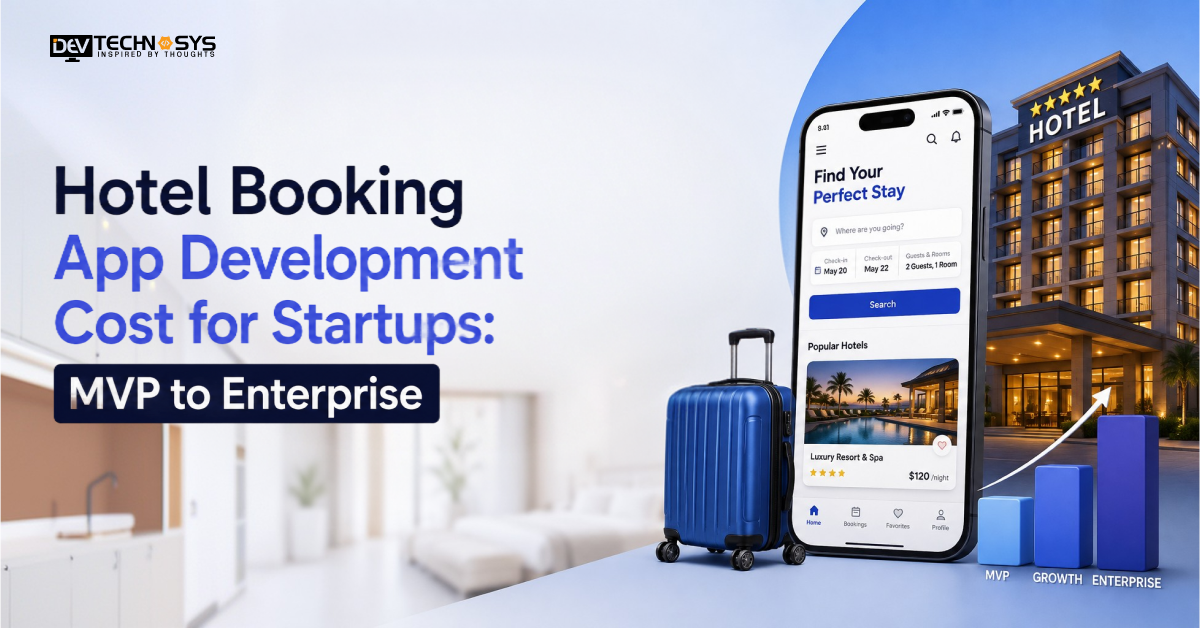
The hotel booking app development cost typically ranges between $30,000 and $150,000, depending on the app’s complexity, business model, number of features, third-party integrations, and AI capabilities.
-
Cost Based on Development Complexity
-
- Basic/MVP Hotel Booking App: $30,000–$50,000
- Standard Hotel Booking App: $50,000–$90,000
- Advanced Hotel Marketplace App: $90,000–$130,000
- Enterprise-Grade Hotel Booking Platform: $130,000–$150,000+
Cost Based on App Type
-
-
- Hotel Chain Booking App: $30,000–$60,000
- Niche Hotel Booking App: $40,000–$75,000
- Online Travel Agency App: $70,000–$120,000
- Hotel Marketplace App: $90,000–$150,000
- AI-Powered Hotel Booking App: $80,000–$150,000
-
Additional Costs to Consider
-
-
- Maintenance Expenses: The annual maintenance expenses may add up to 15%–20% of the total initial project funding and comprise costs for fixing bugs, security, performance, and new features
- AI Integration Expenses: The budget for AI-related tools, which can include personalisation, advanced search, chatbot operation, and analytics, can increase the overall hotel booking app development budget
- Costs of Integrating Other Services: Integration of payment gateways, hotel databases, maps, notifications, and other important services will also influence the final hotel booking app development pricing
-
-
There are many prospects for startups in the travel and hospitality industry due to constant growth in this field. Travellers wish to book hotels, compare rates, check availability, read reviews, and do all these actions using just one app.
The hotel booking app development cost for startups can begin around $30,000-$50,000, whereas developing a more complex app can cost $80,000 and more. The cost to develop a hotel booking app with advanced features may range from $150,000 and above.
In this article, you will find out everything you need to know about hotel booking app development cost 2026, starting from a simple MVP and up to enterprise level. To that end, it will examine the basic factors affecting the cost of development, key features, the stages of development, the choice of technology, and some recommendations on budget optimisation.
Why Are Startups Investing in Hotel Booking App Development?
The travel industry has undergone considerable digitisation, allowing start-ups to develop a hotel booking app like Kayak that focuses on delivering customised services to customers. Unlike major online travel agencies, start-ups can concentrate on selected destination cities, customer types, types of accommodation, and types of travel experiences.
Here are several key reasons explaining why hotel booking app development attracts investment from start-ups.
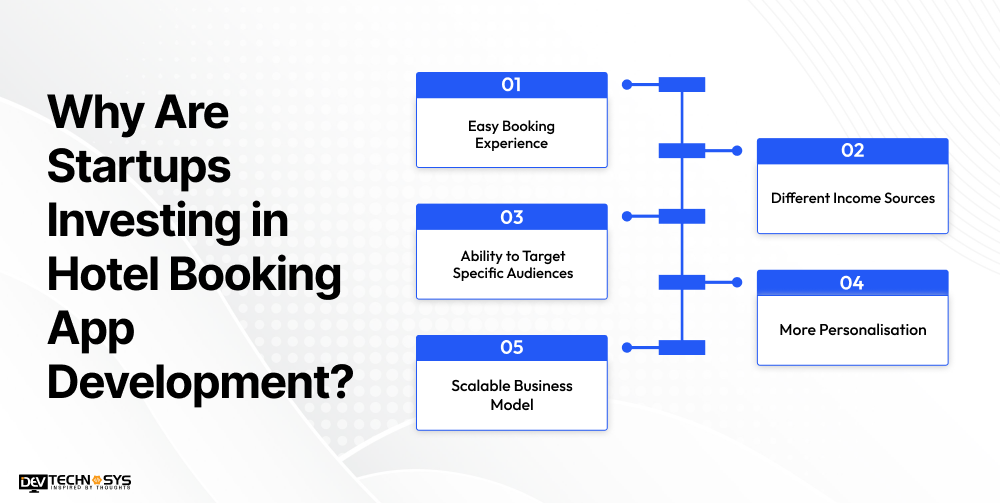
1. Easy Booking Experience
People want to receive information about hotels, prices, and confirmed reservations as quickly as possible. Effective hotel booking mobile app development makes it easy for users to search and book accommodation from their devices 24/7.
2. Different Income Sources
There are multiple revenue opportunities in hotel booking apps; hence, businesses are eager to invest in them. Hotel booking startups have various ways to generate money, from charges on bookings and flat fees to hotel listings and advertising.
3. Ability to Target Specific Audiences
A startup can stand out by focusing on particular types of target markets. For example, the app can target luxury travellers, budget travellers, business travellers, dog owners, eco-friendly travellers, or last-minute bookers.
4. More Personalisation
Modern technology allows platforms to analyse users’ behaviours and offer the most suitable hotels. Personalised search results lead to a better customer experience and higher conversion rates. It can provide the most relevant suggestions according to the users’ recent searches.
5. Scalable Business Model
A startup can start small, with limited properties only available in a specific area, and then scale up the business. This strategy helps it validate its plans and needs for extensive infrastructure investment.
For startups, it is important to create a reliable booking experience for the users. They should not focus on replicating the features of other large travel platforms from the start. To build their app on a large scale, the platform can expand through multi-property management. It is also advisable to consider taking advice from a hotel booking app development company at the start.
How Much Does Hotel Booking App Development Cost in 2026?
The hotel booking app development cost generally ranges from $30,000 to $150,000+, which is determined by various factors such as complexity, functions, integrations, customisation needs, and the platforms used.
A startup company can design and create a simple MVP for a lower amount because a more complex app with many features, including linking with other hotels and using advanced technologies, can increase the hotel booking app development estimate.
App Complexity |
Estimated Development Cost |
Estimated Timeline |
| Basic MVP | $30,000-$50,000 | 3-5 months |
| Mid-Level App | $50,000-$90,000 | 5-7 months |
| Advanced Startup App | $90,000-$150,000 | 7-10 months |
Basic MVP: $30,000-$50,000
A hotel booking app MVP cost generally covers the essential booking journey. This may feature hotel listings, search tools, hotel information, booking features, payment processing, notifications, and a simple admin panel. This option is a great choice for startups looking to evaluate their ideas and gain feedback from users.
Mid-Level App: $50,000-$90,000
A mid-level application may have sophisticated searching features, different user roles, dashboards for hotel partners, reviews, and a more sophisticated reservation management system. Hence, its price point is slightly higher than the basic hotel booking app.
Advanced Startup App: $90,000-$150,000
At this level, the platform may have AI recommendations, a tailored experience, loyalty schemes, multilingual support, advanced analytics, a dynamic pricing engine, and more complex integrations.
The final hotel booking app development price depends on the requirements, so it’s crucial for startups to assess their MVP properly because incorporating every advanced feature creates significantly higher budgets.
Planning a Hotel Pos Project?
Get a tailored development cost estimate in a few simple steps.
- 3 quick steps
- 100% free
- Reply in 1 business day
2 Minutes Read
Hotel Booking App Development Cost by Development Stage
There are many stages in developing an app, and each stage contributes to the overall hotel app development cost. In the table below, we have provided the estimated hotel booking mobile app development cost and its purpose.
Development Stage |
Estimated Cost |
Purpose |
| Discovery & Planning | $3,000-$8,000 | Defines business requirements, workflows, and product scope |
| UI/UX Design | $4,000-$15,000 | Creates wireframes, prototypes, and user-friendly interfaces |
| Frontend Development | $8,000-$30,000 | Builds the customer-facing application |
| Backend Development | $10,000-$35,000 | Handles users, bookings, data, and business logic |
| API & Third-Party Integrations | $3,000-$20,000 | Connects payments, maps, hotel systems, and notifications |
| Quality Assurance | $3,000-$12,000 | Tests functionality, performance, and usability |
| Deployment & Launch | $1,500-$5,000 | Prepares the app for production and release |
Discovery and Planning
At this stage, startups identify their customer segment, business strategy, user journeys, prioritisation of functions, and technical needs. Proper planning helps create a more accurate hotel booking app development budget and reduces unnecessary rework.
UI/UX Design
Designers make sketches and designs for essential screens like search, hotel info, checkout, and the booking confirmation process. A basic MVP costs way less than an elaborate program with intricacies.
Frontend and Backend Development
The frontend part of the development means the interaction that a user has with the interface. The scalable backend part covers database management, user accounts, reservations, availability, real-time data synchronisation, and integrations. For phone apps dealing with hotel reservations, backend development is especially important due to the need to process reservation data without errors.
API and Integration Development
A major part of modern hotel booking app development services involves connecting external systems. Depending on project requirements, startups can hire dedicated developers who may use a REST API or GraphQL for data communication and implement API integration with external platforms.
Testing and Release
Before being released to the public, the app needs to be tested for bugs, performance, payment errors, and compatibility. It is important not to rush this step.
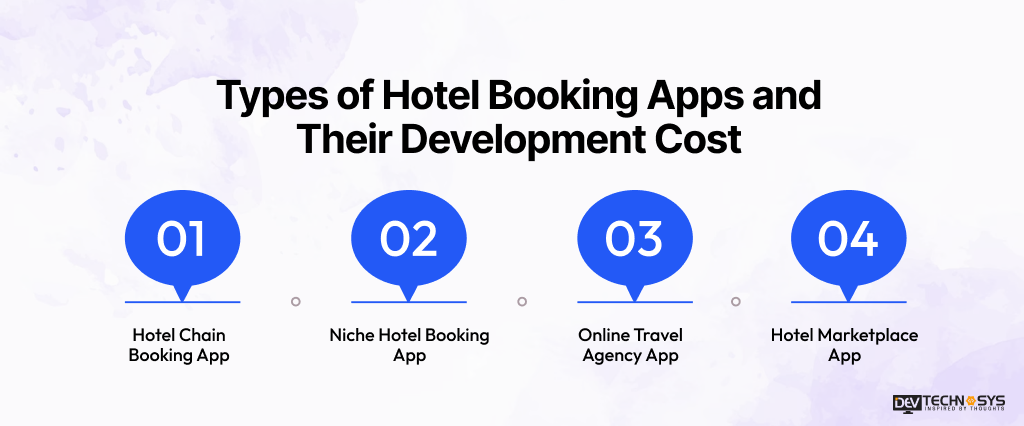
Types of Hotel Booking Apps and Their Development Cost
The hotel reservation app development cost is also influenced by the types of hotel booking apps you are building. Business models influence requirements and costs.
Type of Hotel Booking App |
Estimated Cost |
Timeline |
| Hotel Chain Booking App | $30,000-$60,000 | 3-5 months |
| Niche Hotel Booking App | $40,000-$75,000 | 4-6 months |
| Online Travel Agency App | $70,000-$120,000 | 6-8 months |
| Hotel Marketplace App | $90,000-$150,000 | 7-10 months |
1. Hotel Chain Booking App
This software is intended to operate with just one brand of hotels. Users can search for hotels, view rooms, and book rooms based on their requirements. Given that this platform operates on limited ecosystem features, the software development difficulty is not that enormous.
2. Niche Hotel Booking App
This kind of software solution concentrates on a particular niche. The niche can be boutique hotels, luxury accommodations, eco-friendly, or business-oriented accommodation options. The price to develop hotel management software depends on how customised it is going to be and what functions it is going to have.
3. Online Travel Agency App
OTA software provides users with the ability to search for hotels and compare offers of various providers. These platforms often require a hotel booking API, hotel inventory API, and hotel rate API to retrieve property information and pricing.
4. Hotel Marketplace App
Marketplace software allows different hotel owners to get connected with clients. It may include separate workspaces for guests, hotel partners, and administrators, along with room inventory management. This model generally requires more budget because of many user roles and management systems.
Key Features That Affect Hotel Booking App Development Cost
The overall development budget of the hotel booking app is directly affected by the number and complexity of the key features. For startups, they should prioritise those features that support core booking for the start.
Feature |
Estimated Cost Impact |
| User Registration and Profiles | $2,000-$4,000 |
| Hotel Search | $3,000-$7,000 |
| Search Filters | $2,000-$5,000 |
| Hotel Listings and Details | $3,000-$7,000 |
| Real-Time Availability | $5,000-$12,000 |
| Booking Management | $5,000-$12,000 |
| Payment Integration | $3,000-$8,000 |
| Maps and Location Services | $2,000-$5,000 |
| Reviews and Ratings | $2,000-$6,000 |
| Notifications | $1,500-$4,000 |
Hotel Search and Filters
Users must be able to filter hotels by location, date, number of travellers, money spent, rating, and other amenities. However, this adds complexity to the app development plan.
Real-Time Room Availability
Real-time availability is vital, as inaccurate availability can lead to errors in booking or duplicate bookings. Integrating the room availability API with a hotel inventory system can increase the duration and cost of the project.
Booking and Payment Management
The application has to process bookings successfully and have options for secure payments. Additional requirements, such as cancellation management for refunds, can complicate the application as well.
Reviews and Ratings
User reviews may assist people in making decisions on their property selection; however, some moderation features may be needed for managing inappropriate or scam content on such a platform.
Admin and Partner Management
In case the application functions like a marketplace, it would need to create separate admin and partner management dashboards. The development of multiple dashboards contributes to an increase in the total cost of development but provides significant help with the management of the inventory and operations.
Major Factors Affecting Hotel Booking App Development Cost
In this section, we have mentioned some major factors that affect the development cost of a hotel booking app:
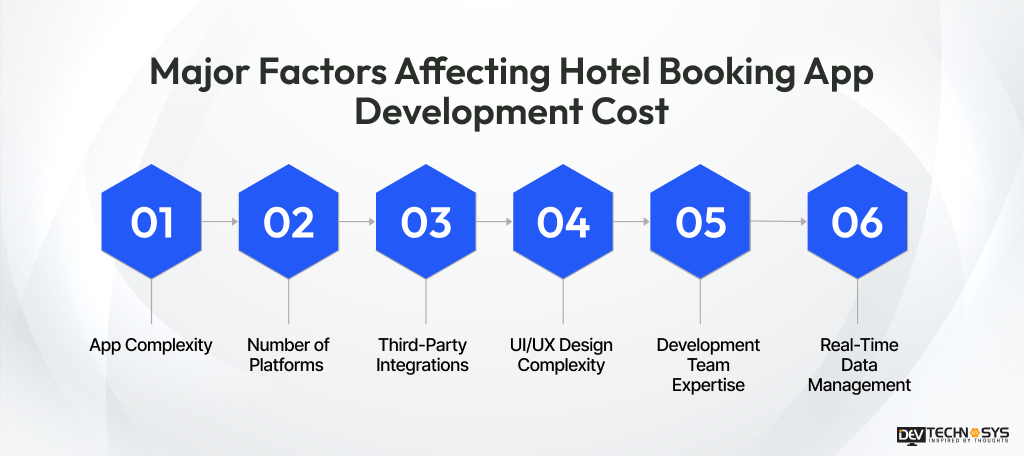
Major Factor |
Basic Cost Range |
Advanced Cost Range |
| App Complexity | $30,000-$50,000 | $90,000-$150,000 |
| Number of Platforms | $15,000-$30,000 for one platform | $40,000-$70,000+ for Android, iOS & Web |
| Third-Party Integrations | $3,000-$10,000 | $15,000-$30,000 |
| UI/UX Design Complexity | $4,000-$8,000 | $12,000-$25,000 |
| Development Team Expertise | $20-$40 per hour | $50-$100+ per hour |
| Real-Time Data Management | $5,000-$12,000 | $15,000-$30,000 |
1. App Complexity
The complexity of a hotel booking app is one of the major factors affecting the cost of development. If you invest in an MVP with basic search and booking options, the budget will be limited. On the contrary, creating a full-featured marketplace with many user roles, real-time inventory, advanced filtering options, and analytics will require a higher budget.
2. Number of Platforms
Creating an app for several platforms, e.g., Android, iOS, and the web, will increase the development costs. Native development for every platform will require its own codebase and team. This issue can be solved with cross-platform frameworks, which, however, require greater investments in order to provide better results.
3. Third-Party Integrations
Integrating a wide range of services such as payment systems, hotel APIs, maps, and notification systems will increase the development costs. Each integration is going to require planning, testing, and maintenance. More complicated integrations, for example, with real-time hotel inventory systems or major payment companies, will increase considerably not only the costs of development, but also the long-term expenses for this application.
4. UI/UX Design Complexity
The degree to which you are capable of customising the design of the interface can determine the cost level of the project. For instance, having a simple interface will result in lower costs since all you limit yourself to is standard layouts. On the other hand, having a complex and interesting design will require a lengthy design process and will cost more. The features implemented in your product, such as animations and personalised dashboards, for example, will increase the cost of the project.
5. Development Team Expertise
The price for Android/iPhone app development will depend on the organisation’s location and proficiency. The best teams may charge more, but they will provide clients with excellent architecture, scalability, and security. Often, less experienced companies charge less, but this will cost you in the long term through maintenance and redevelopment charges.
6. Real-Time Data Management
In hotel booking applications, real-time data plays an important role, including the availability of rooms, price changes, and booking confirmations. Building a reliable system that synchronises that data from various sources requires a rich backend architecture. The more sophisticated the real-time nature of the system is, the more complex and expensive the development process will also be.
How to Reduce Hotel Booking App Development Costs?
While optimising costs, businesses should focus on eliminating unnecessary development work. But they should not compromise on security or essential functionality. Here are some of the ways by which you can cut costs on your hotel booking app and also minimise the hotel booking website development cost:
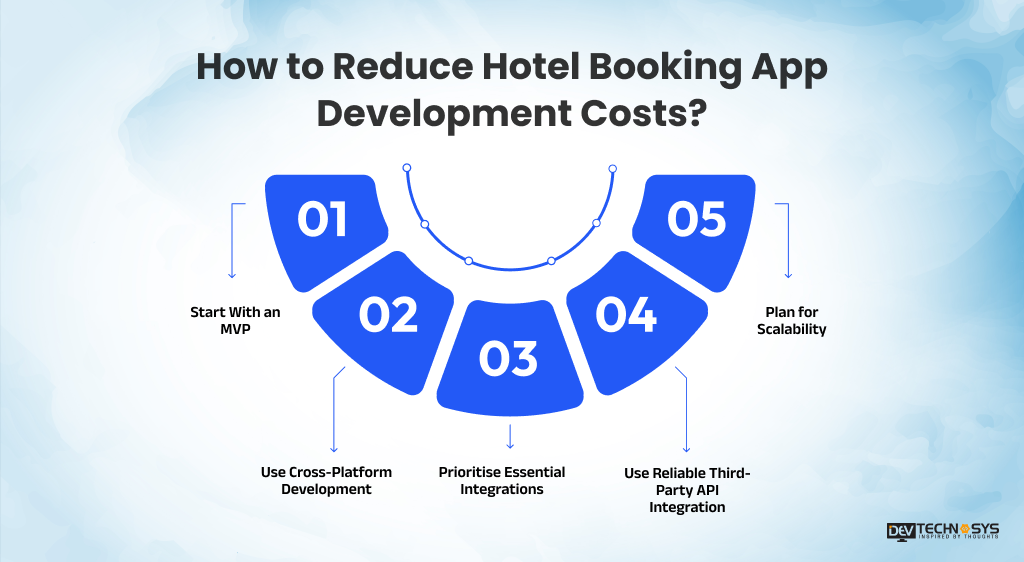
Cost Reduction Method |
Potential Cost Reduction |
| Start With an MVP | 20%–40% |
| Use Cross-Platform Development | 15%–30% |
| Prioritise Essential Integrations | 10%–20% |
| Use Reliable Third-Party APIs | 10%–25% |
| Plan for Scalability From the Start | 10%–20% in long-term redevelopment costs |
Start With an MVP
Employ a minimum viable product (MVP) strategy to quickly validate ideas for the hotel booking app that you are developing. Concentrate solely on the basic features that are needed to have a launched product, such as booking systems, payment systems, and search functionality. This will minimise initial expenses, help launch the product faster, and give you the chance to get feedback from real customers before scaling up your product over time.
Use Cross-Platform Development
Tools for cross-platform development like Flutter or React Native enable startups to create Android and iOS apps faster and cheaper. The use of one codebase allows for getting a uniform experience for users and for bringing the MVP app to the market quickly.
Prioritise Essential Integrations
Focus on integrating only the essential components necessary for the app to function properly, such as a booking system, a payment processor, or maps. At this point in app development, it is important not to utilise any unnecessary third-party tools.
Use Reliable Third-Party API Integration
Utilise these services to expedite the development of a hotel reservation application by incorporating reliable APIs for payment processing, authentication, notifications, analytics, and routing abilities that guarantee the platform’s security and scalability and help lower development expenses and time while giving startup businesses the necessary attention to their basic functionality and development goals.
Plan for Scalability
Construct the architecture of a hotel booking application to accommodate a growing number of transactions, users, and listings. Apply modular services, cloud technology, and well-structured databases. Make preparations for future features, partnerships with third-party services, and possible traffic flows in order to scale without a hitch.
How to Make Money From Hotel Booking Apps?
With hotel booking apps, you can generate money through various business models. In this section, we have provided several monetisation models for hotel booking apps.
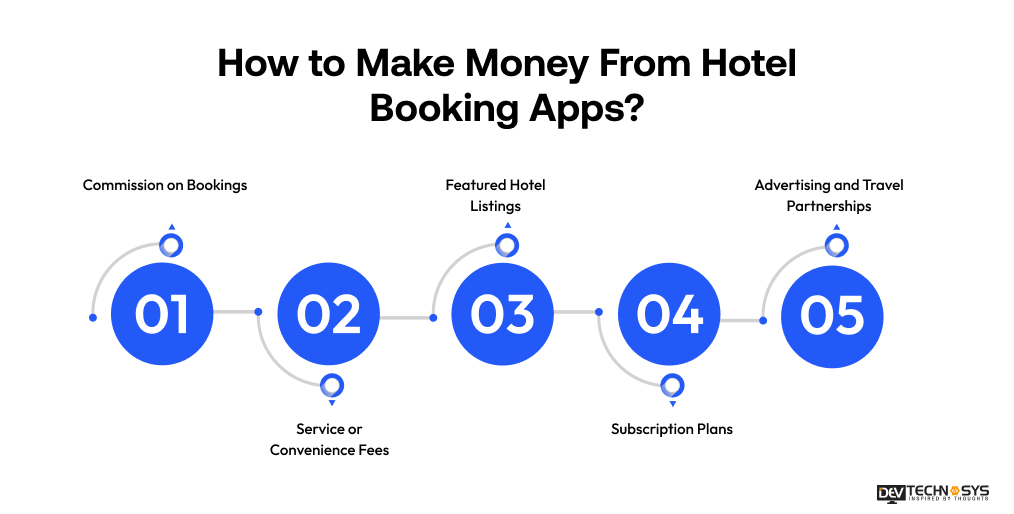
Commission on Bookings
The app gains a certain portion of profits or commission from all the hotel bookings made through it. The model of commission on bookings is commonly used by OTAs. Revenue generated increases with the number of bookings made, and respective agreements with the hotels concerning commissions make it highly scalable and performance-oriented.
Service or Convenience Fees
The app may charge a minor service charge for every booked transaction. This amount helps to cover the operating costs such as maintaining the app system and payment processing.
Featured Hotel Listings
Hotels are able to pay for premium positions on search results, banners on the homepage, and destination pages. This allows hotels to be more visible and boosts booking possibilities. This is a good source of income because hotels profit from being more promoted and the platform receives money from advertisements.
Subscription Plans
Hotel partners can get membership packages on a monthly or yearly basis, which gives access to advanced features of the platform such as analytics, performance reports, prioritised listings, and lower commission fees. This approach guarantees a constant source of income for the platform as well as long-term value and useful information for hotel partners.
Advertising and Travel Partnerships
The platform can make money by marketing other travel companies like travel insurance, taxi transfers from airports, car rentals, etc. The partnerships or affiliate programs allow the platform to earn commission while providing users with other services of importance.
Conclusion
The expenses for creating a hotel booking application may vary between something like $30,000 for a minimal version of a product to over $500,000 for advanced solutions. The exact costs will depend on the functionality set, platforms, third-party integrations, backend complexity, artificial intelligence capabilities, and safety requirements.
For startups, it is usually best to launch an MVP with a narrow focus that addresses a customer pain point. The critical features should include searching for hotels, checking for availability, making reservations, processing payments, and notifying users, while making improvements possible.
When planning to join the digital travel space, start with a recognised mobile app development company that has lots of experience, like Dev Technosys, to figure out what the MVP should cover.
Frequently Asked Questions
Find answers to the most common questions related to this article.
The cost range of a hotel booking application is between $30,000 and $500,000+. A basic MVP may range from $30,000 to 60,000, while advanced and enterprise platforms require a substantial amount of money.
On average, creating a simple hotel booking app should take from 2 to 4 months; however, advanced platforms with AI features, live inventory, and custom integrations may require extended development and testing time before the launch.
Companies should consider incorporating hotel listings, booking engines, secure payment options, push notifications, customer reviews, multilingual capabilities, an analytics dashboard, and AI-powered recommendations to enhance the customer journey and have maximum engagement and revenue opportunities.
Hotel booking applications generate revenue through booking commissions, featured listings, subscription plans, ads, travel collaborations, and premium offerings, thus adding multiple sources of income, while enhancing customer loyalty and brand awareness in the hospitality sector.
Hire dedicated developers who have years of experience in delivering scalable architecture, secure integrations, top-notch technologies, and post-launch assistance, which enables businesses to develop dependable hotel booking apps that not only enhance operational efficiency and customer satisfaction but also lead to the overall growth of the business.