
















Key takeaways:
- ERP Software for Businesses in USA solves complex business challenges by centralizing data, automating workflows, and improving collaboration.
- A market study shows that cloud ERP solutions generate the largest revenue for businesses, reflecting their growing adoption by USA enterprises.
- Businesses should consider total cost of ownership (TCO) before investing in ERP development. This leads to more accurate budgeting.
- As per market highlights by Grand View Research, the U.S. ERP software market is expected to reach USD 37,319.2 million by 2033. This highlights the demand for modern ERP solutions across industries.
ERP Software for Businesses has become a strategic investment for organizations looking to centralize information. The system allows multiple departments (finance, HR, sales, etc.) to collaborate without affecting operational efficiency. However, implementing an ERP system is not just an update but a complete digital transformation.
Business leaders should conduct a cost-benefit analysis, understand the existing system’s limitations, and evaluate the features of a modern ERP system. This comprehensive guide explains everything U.S. businesses need to know about ERP software in 2026.
Is Your Business Ready for an ERP System?
The important fact is to conduct a cost-benefit analysis and understand the benefits of a centralized ERP platform. If inefficiencies are slowing growth, it may be time to upgrade.
1. You’re Managing Multiple Disconnected Systems
Using separate software for multiple departments such as finance, inventory, sales, and HR creates data silos, duplicate work, and inconsistent information. ERP Software for Businesses in USA centralizes all business data into a single platform.
2. Slow Reporting and Delay in Decision-Making
If the team is still spending time filling in spreadsheets manually, then it is the right time to implement ERP software. This leads to more accurate business decisions.
3. Your Business is Growing Faster Than Your Systems
If your business is expanding and the existing system cannot manage the workflow, then automate routine tasks with an enterprise resource planning system.
Market Statistics for ERP Software for Businesses in USA
As per our findings and study from Fortune Business Insights, enterprise resource planning software is rapidly adopted by businesses. Some of the key statistics are:
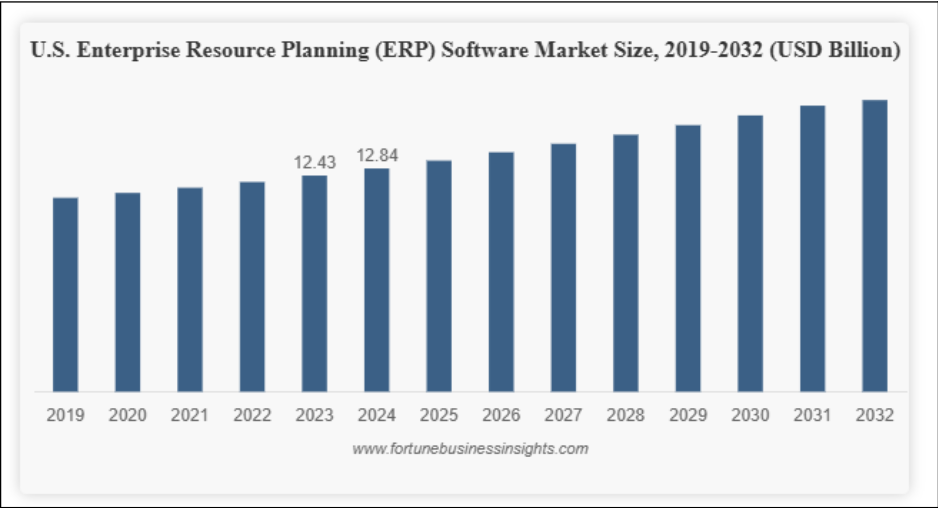
- The global ERP market size is expected to grow by USD 16.99 billion by 2032 from USD 13.29 billion in 2025. This data shows the increasing demand for automation and data-driven business operations.
- The trend of cloud ERP system adoption has significantly accelerated in recent years and is expected to continue, considering lower infrastructure costs.
- Organizations are increasingly integrating ERP with CRM, HR, financial systems, and more industry-specific solutions to improve cross-department collaboration.
- AI and advanced analytics are becoming core ERP capabilities to generate detailed insights. This is improving resource planning and the decision-making process for businesses.
Why are U.S. Businesses Investing in ERP Faster Than Ever?
To understand what is ERP, think of it as a valuable reporting tool for organizations seeking to improve workflow. It eliminates manual data entry while ensuring security.
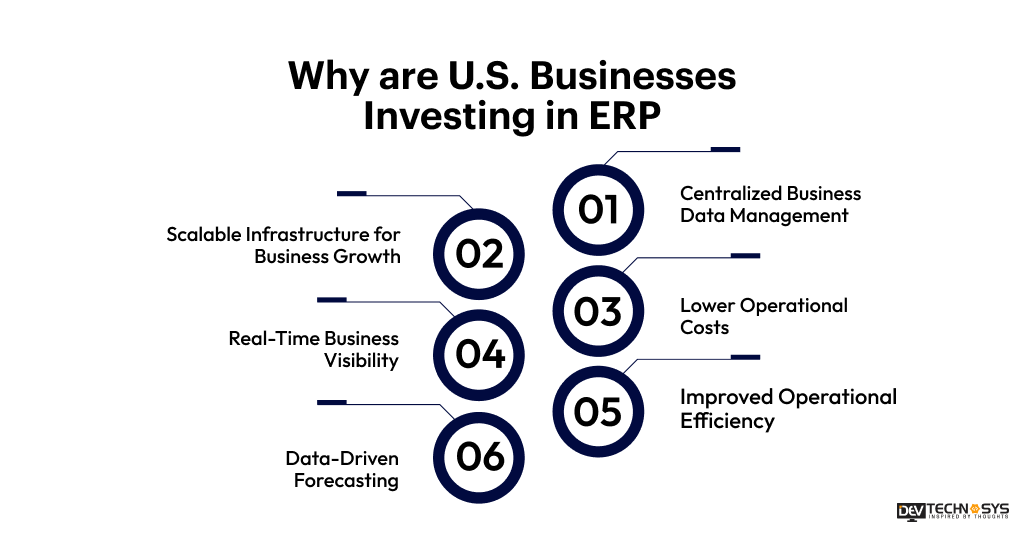
1. Centralized Business Data Management
This approach allows organizations to access the data conveniently from a single system. They can easily communicate between departments. This also allows managers to create reports and analytics without any errors.
2. Scalable Infrastructure for Business Growth
This avoids the requirement for new ERP solutions as the businesses can modify the system according to their specific needs. This also saves cost because a dedicated team can handle the project efficiently.
3. Lower Operational Costs
U.S. businesses are mostly interested in ERP systems because these have lower costs as compared to other integrations. Also, these can be easily converted to modern ERP solutions.
4. Real-Time Business Visibility
Finance, inventory, orders, procurement, sales and marketing, and HR can track performance and can also keep the data of the employees and projects all in one place.
5. Improved Operational Efficiency
An ERP system allows businesses to easily track profitability to work on core business operations. This helps to maintain good client relations and share better responses.
6. Data-Driven Forecasting
Businesses can analyze historical data and predict future demand, revenue, and expenses. This provides accurate and comprehensive information.
Want a chatbot demo or pricing? Fill the form and talk to our experts today.
Pick what you need below — you can select more than one — then tap Get detail to continue.
-
Chatbot demo dashboard
-
Cost to develop an app
-
Industry report
-
Case study
How to Choose the Right ERP Deployment Model for Your Business?
The right ERP depends on factors such as company size, industry regulations, operational complexity, IT resources, security requirements, and long-term growth plans.
Businesses should evaluate their current challenges, future expansion goals, compliance obligations, and budget before choosing custom software development services.
Understanding the different ERP types helps decision-makers choose a solution that delivers operational efficiency without unnecessary complexity.
1. Cloud ERP
This ERP solution requires minimal infrastructure investment and is best for small to mid-level businesses. The main advantage is that it reduces IT maintenance and offers flexibility to businesses. Businesses that are looking to expand their operations can choose this solution.
2. On-Premise ERP
This solution gives complete control to businesses over security, data management, and infrastructure. This solution is best for large enterprises that require strict compliance and need full control over data. Businesses should consider deployment costs and the dedicated staff required.
3. Hybrid ERP
Hybrid ERP combines cloud-based capabilities with existing on-premise systems. Businesses can reduce migration risk and experience lower business disruption.
4. Open-Source ERP
Open-source ERP platforms allow organizations to modify source code and customize the software according to unique business processes. These systems are highly customizable and are perfect for organizations that have dedicated teams. But the important thing is that it requires strong technical expertise.
5. ERP Solutions by Business Size
ERP requirements are different for startups, mid-level, and enterprises. Some businesses may require basic functionalities while others require high-grade features.
Business Size |
Startup |
Mid-Sized Business |
Enterprise |
| Business Profile | Up to 50 employees | 50–500 employees | 500+ employees |
| ERP Needs | Accounting, CRM, inventory | Finance, HR, CRM, supply chain | Enterprise-wide operations, compliance, analytics |
| Deployment | Cloud | Cloud or Hybrid | Hybrid or On-Premise |
| Key Benefits | Affordable, fast setup, scalable | Better collaboration and automation | High security, scalability, and centralized management |
| Best For | Growing startups | Expanding businesses | Large, complex organizations |
Industry Insight
According to Grand View Research, the annual growth of the ERP market in the USA is expected to be 7.7% by 2033. This is increasing opportunities for developers to find better projects to work on.
ERP Requirements by Industry: What U.S. Businesses Need in 2026
ERP systems are designed to meet unique business requirements. For example, a manufacturing company might require an ERP for production planning while a healthcare organization needs it for patient care management. In any of these scenarios, businesses can hire dedicated developers who have experience in industry-specific workflows.
1. Manufacturing ERP software in USA
Manufacturers want to improve production management, which is why they need a software application to manage workflow. An ERP system allows manufacturers to get the real-time analytics.
2. Healthcare ERP software in USA
Healthcare organizations manage highly sensitive patient information while complying with strict regulations such as HIPAA. ERP systems must improve operational efficiency without compromising security or compliance.
3. Construction ERP software in USA
Construction companies coordinate multiple projects, contractors, suppliers, and budgets simultaneously. Their ERP system should provide real-time project visibility from bidding to project completion.
4. Retail ERP Software in USA
Businesses must analyze manufacturing ERP software development cost along with the features required in the system to instantly reply to customers.
5. Logistics ERP Software in USA
Transportation and logistics companies require complete visibility across shipments, warehouses, fleets, and supply chain operations, which is possible with a customized ERP solution.
6. Wholesale Distribution ERP Software in USA
Wholesale businesses manage thousands of products, suppliers, and customer orders daily. ERP software simplifies purchasing, inventory control, and order fulfillment.
7. Professional Services ERP Software in USA
Businesses that offer Professional services must browse the top ERP software development companies in the USA that can build efficient systems. Their ERP should focus on workforce productivity and financial performance.
8. Automotive ERP Software in USA
Automotive businesses manage extensive supplier networks, manufacturing processes, and aftermarket services. ERP systems should support production efficiency and supply chain resilience.
9. Food & Beverage ERP Software in USA
Food manufacturers and distributors must comply with strict food safety regulations while managing perishability and product traceability.
10 Must-Have ERP Features U.S. Companies Should Prioritize
U.S businesses are rapidly adopting AI and other integration capabilities. That’s the reason specific features have to be included in the ERP system.
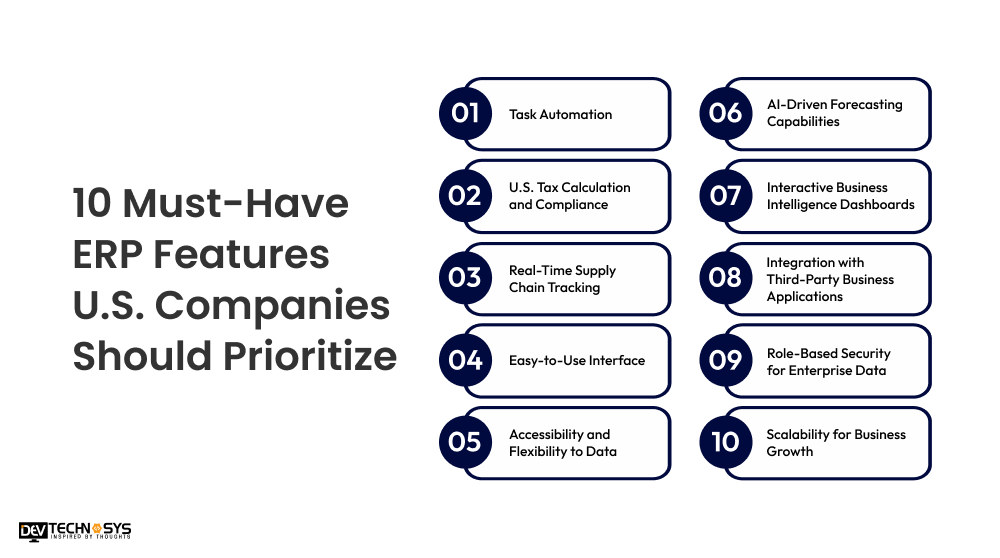
1. Task Automation
Modern ERP manages repetitive tasks such as generating month-end reports, reordering supplies, and generating product invoices.
2. U.S. Tax Calculation and Compliance
A modern ERP automatically calculates the exact state, county, and local taxes for every transaction. It’s easy for the business to pass audit trails.
3. Real-Time Supply Chain Tracking
The system provides clear insight into suppliers and who is buying from them, helping maintain proper track of the supply chain.
4. Easy-to-Use Interface
Businesses today are searching for ERP software development in USA that can build a user-friendly interface.
5. Accessibility and Flexibility to Data
Users can easily access multiple departments’ work from a single system. For example, HR, finance, and warehouse management.
6. AI-Driven Forecasting Capabilities
The use of artificial intelligence enables businesses to identify trends and forecast demand, improving decision-making.
7. Interactive Business Intelligence Dashboards
Decision-makers can easily track sales performance and can check financial reports in real-time without manually compiling the reports.
8. Integration with Third-Party Business Applications
Integrating ERP with existing systems, such as sales, supports multiple business processes, allowing businesses to accomplish work faster and with accuracy.
9. Role-Based Security for Enterprise Data
Using such a security technique, a business meets compliance requirements while ensuring data security for users.
10. Scalability for Business Growth
The ERP software market is rapidly growing in the U.S. because businesses are planning to expand their services.
Industry Insight
A report by Mordor Intelligence mentions that the use of ERP Software for Businesses in USA is increasing at a CAGR of 9.67%. This reflects an increasing demand for scalable enterprise management solutions across industries.
ERP Implementation Roadmap for U.S. Businesses
ERP implementation services in USA demand a clear understanding of phases and careful planning. Businesses can maximize return on investment if they follow a structured roadmap.
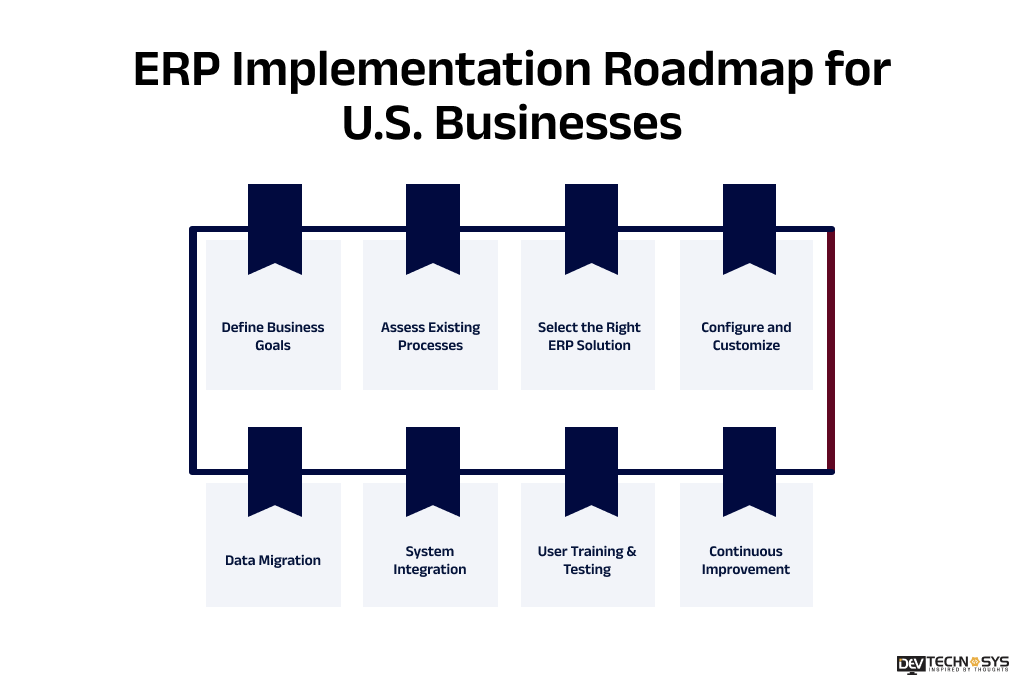
Phase 1: Define Business Goals
Clear goals help guide software selection and help understand ERP software development cost. Businesses should begin by identifying the business problems.
Phase 2: Assess Existing Processes
It is vital to know whether the existing system is inefficient and comprises data silos. If there is no coordination between departments, then the system is outdated.
Phase 3: Select the Right ERP Solution
Evaluate vendors based on:
- Industry expertise
- Scalability
- Security
- Integration capabilities
- Compliance support
- Total cost of ownership
- Customer support
- Product roadmap
Phase 4: Configure and Customize
Share the specific requirements of ERP with experts to avoid unnecessary customization. This phase is important to add standard features in the ERP system.
Phase 5: Data Migration
Prepare data before migration by:
- Removing duplicates
- Correcting errors
- Standardizing formats
- Validating historical records
- Testing imports
Phase 6: System Integration
Once requirements are cleared, it is time to integrate the capabilities. These include IoT, predictive analytics, and integration of existing systems with the new business applications.
Phase 7: User Training & Testing
- Unit testing
- Integration testing
- User acceptance testing (UAT)
- Security testing
- Performance testing
Phase 8: Continuous Improvement
Dedicated software developers consistently monitor the ERP system for accuracy and to refine workflow. They even expand ERP capabilities over time as required by the business.
Expert Insight
Based on our experience in delivering ERP solutions across industries, organizations that provide clear software requirements achieve faster ROI and smoother implementations. Following a phased implementation approach reduces project risks and operational disruption.
How to Evaluate an ERP Vendor Before Signing a Contract?
Businesses should evaluate vendors based on their experience and technical expertise, not just the ERP software development cost. ERP projects usually run for the long term; thus, choosing the right vendor is important.
1. Assess Industry Experience
An ERP development partner should have at least 10 years of experience with industry-specific solutions. The vendor should have verified reviews and case studies to show a successful track record of ERP implementations.
2. Verify Business & Technical Fit
Businesses must ensure the ERP solution matches the growth plans, such as prioritizing scalability. Vendors should be capable of integrating capabilities with existing software.
3. Evaluate Security & Compliance
Businesses should confirm whether a vendor follows strong security practices such as ISO 9001, FDA 21 CFR Part 11, GDPR, ITAR, and ISO 13485. Partners should offer scalable solutions while ensuring regulatory compliance.
4. Review the Total Cost of Ownership
TCO determines the amount associated with ERP Software. It includes the cost of implementation, integration, employee training, security & compliance, and related processes. This helps enterprises to evaluate expenditure and to plan a financial strategy.
5. Check Customer References
Clients who had a good experience with a vendor always share a reference for others. Businesses must check customer reviews to identify a vendor’s reliability and whether top ERP trends are followed or not.
Our Recommendation:
Being one of the best Business management software providers in USA, we have worked on multiple projects and have understood that a 5-year TCO plan is important for organizations. This helps to create a strong investment strategy focusing on improving business value.
ERP vs Multiple Business Applications: Which Saves More Money?
ERP Software for Businesses in USA acts as a single platform to manage the workflow of different departments easily and efficiently. This reduces labor and application maintenance costs.
The table below compares ERP software with multiple business applications across key cost and operational factors.
Comparison Factor |
ERP Software |
Multiple Business Applications |
| Cost (TCO) | Higher upfront cost, lower long-term expenses | Lower upfront cost, higher long-term expenses |
| Operational Efficiency | Unified workflows and automation | Manual work across multiple tools |
| Data & Reporting | Centralized data with real-time reports | Data spread across systems |
| Scalability | Easily grows with the business | Growth requires more software and integrations |
| Security & Compliance | Centralized security and compliance | Separate security across applications |
Industry Insight:
According to Mordor Intelligence, the manufacturing industry accounted for 21.83% of revenue last year. This is the fastest adoption of ERP by a sector in the enterprise resource planning market.
Common ERP Mistakes Made by U.S. Businesses
Businesses often make mistakes while implementing an ERP solution. This can be based on pricing, user training, and poor data migration planning.
Common ERP Mistake |
How to Solve It |
| Choosing based only on price | Consider TCO, scalability, and business needs |
| No clear business goals | Define objectives and KPIs before implementation |
| Ignoring user training | Train employees to improve adoption and productivity |
| Poor data migration | Clean and validate data before moving it to the new ERP |
| Choosing the wrong ERP partner | Select an experienced partner with industry expertise |
AI is Changing ERP: What U.S. Companies Should Expect in 2026?
Businesses should adopt emerging technologies to resolve data silos, inaccurate reporting, and understand demand forecasting. Integration of emerging technologies into existing systems helps businesses improve productivity.
-
Two-Tier ERP
Data silos are the main source of business complexity that a two-tier ERP resolves. This trend allows businesses to implement a phased deployment to minimize disruption.
-
Insights with Agentic AI
The bots can perform cross-functional analysis to deliver valuable insights. For example, agentic AI in healthcare can recommend treatments to patients, schedule appointments, and provide detailed medical analyses.
-
Predictive Analytics
This trend allows businesses to predict customer behavior and future outcomes using historical data. Statistical modeling and machine learning provide accurate, customer-specific data.
How to Choose the Right ERP Development Partner in the USA?
Selecting an ERP software development company means a business is looking for experts who have relevant industry experience. A company that follows regulatory compliance to build software.
For enterprise-grade ERP projects, partnering with a CMMI Level 3-certified company is a strong advantage. This ensures a structured project management process, continuous process improvement, and development of reliable software.
Since ERP software for businesses in USA involves sensitive business information, organizations should always sign a Non-Disclosure Agreement (NDA) before project discussions. Companies that follow these regulations should be prioritized for custom ERP software development in the USA.
Conclusion
ERP software development in USA is becoming common because of its capabilities. Whether it’s a first ERP setup or an enterprise replacing legacy software, they must choose the right deployment model and software development company.
As technologies like AI, predictive analytics, and IoT continue to shape the future of ERP, businesses are willing to invest in secure and scalable ERP solutions. They must carefully evaluate the total cost of ownership, compliance, security, and specify their business requirements.
See What Our Clients Say
Real feedback from real clients who trust us to deliver results.
Dev Technosys developed a custom ERP solution that unified our inventory, finance, and order management processes into a single platform. The project was delivered on schedule with excellent post-launch support
Frequently Asked Questions
Find answers to the most common questions related to this article.
The cost of ERP software depends on business size, customization, deployment model, and integrations. Small businesses typically spend $30,000 - $150,000+, depending on the functionalities required.
PostgreSQL, Oracle Database, and Microsoft SQL Server are popular for mid-sized businesses and enterprises. These databases are known for their features such as scalability, security, and high availability.
ERP implementation timelines vary based on project complexity. ERP deployments can take 12- 24 months depending on small, mid-size, or large enterprise ERP requirements.
Custom ERP solutions are typically built using technologies such as .NET, Java, Python, Node.js, PHP, React, Angular, Vue.js, PostgreSQL, MySQL, SQL Server, Oracle Database, Docker, Kubernetes, and cloud platforms like AWS, Microsoft Azure, and Google Cloud.
- Role-based access control (RBAC)
- Multi-factor Authentication (MFA)
- End-to-end Encryption
- API Security
- Compliance with industry regulations such as HIPAA, GDPR, or SOC 2
Modern ERP platforms allow businesses to add multiple features without replacing the entire existing system. These systems are designed with modular architecture that supports flexible resource allocation for businesses.
Cloud ERP solutions are automatically updated after their deployment. But organizations can set a schedule if updates are required for security or compliance. They can connect to the dedicated team to work on the necessary updates.
APIs are usually integrated with most systems such as CRM, HRMS, accounting, and more. APIs act as a communication bridge between different business systems to provide a unified operational flow.