





Key Takeaways:
-
- Biosensors have transformed the way health data is captured, transmitted, and interpreted outside traditional clinical environments in today’s digitalized world.
- Generally, a remote biosensor monitoring app cost can range between $30,000 and $1,50,000. It depends on the platform’s complexity and other factors.
- The biosensor cloud application development can usually take 4 to 7+ months, due to the app’s complexity, security requirements, and integrations.
- According to Business Research Insights, Hospitals and diagnostic labs lead biosensor adoption, holding an estimated 67.5% market share in 2026.
A cardiologist in the hospital gets an alert about a patient before the condition shows any symptoms. Through a wearable device, the doctor caught an irregular heartbeat overnight and sent it directly to the dashboard. No emergency visit, no guesswork, just data moving from a sensor on someone’s chest to a cloud platform in seconds.
This is only possible because of biosensor cloud applications that enable early diagnosis before a severe health problem. These platforms can turn scattered biometric signals into continuous, actionable health intelligence.
As people in today’s world are becoming health-conscious, the demand for biosensor app development is at its peak. Healthcare companies, device makers, and startups can take it as an opportunity to enter this highly competitive market.
Therefore, understanding how to build these platforms correctly is no longer optional. This guide offers the foundation of modern connected care. So stay connected through this blog.
What Are Biosensor Cloud Applications and How Do They Work?
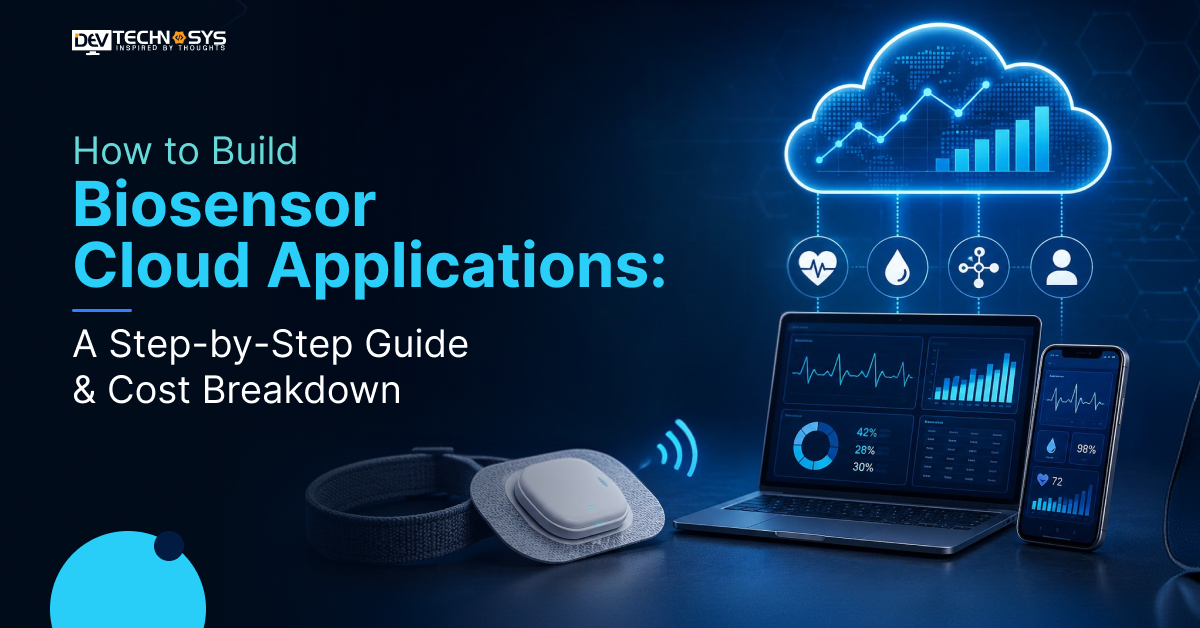
A biosensor IoT application helps connect wearable or implantable sensors to cloud infrastructure. It transmits biometric data for real-time storage, analysis, and clinical or personal use, relying on seamless biosensor data integration at every layer. It turns raw physiological signals into usable health data without manual effort. The common use cases of biosensor software development include:
- Remote patient monitoring
- Chronic disease management
- Fitness tracking
- Clinical trial data collection
Biosensor cloud platform development is really important where continuous readings matter more than one-time checkups. It is the foundation of any wearable sensor cloud platform built for scale.
Workflow of Biosensor Cloud Application: The sensor captures a metric like heart rate, glucose, or oxygen saturation through direct IoT sensor integration. The readings then pass through a connected gateway, usually a phone, via device-to-cloud communication, and reach the cloud. Once it reaches there, the platform stores, processes, and analyzes the readings. After that, the biosensor surfaces insights through a dashboard or alert, often supported by real-time telemetry data streaming from the device.
Biosensor Market Statistics and Growth Trends Shaping Connected Healthcare
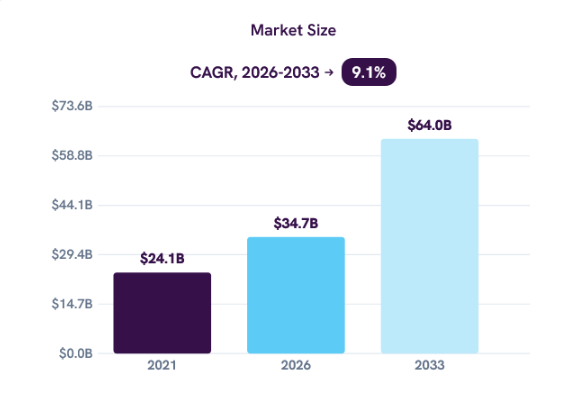
The biosensor market continues to grow rapidly in this tech-savvy generation. This growth is driven by the wider adoption of connected healthcare, remote monitoring, and wearable technologies. It has positioned the modern IoT healthcare sensor platform as a mainstream clinical tool rather than a niche experiment. Have a look at the key market indicators by Grand View Research:
- The global biosensors market reached USD 32.2 billion in 2025.
- The market is expected to reach USD 34.7 billion in 2026.
- The global biosensors market is projected to reach USD 64.0 billion by 2033.
- The market is forecast to grow at a 9.1% CAGR between 2026 and 2033.
- North America dominated the biosensors market in 2025, with a 42.6% revenue share globally.
Why Is Biosensor Cloud Application Development Becoming Important in 2026-2027?
Biosensor mobile app development is increasingly important since the health sector is moving to continuous monitoring. These applications collect real-time health data from connected devices, which allows health practitioners to detect any change early enough. In 2026-2027 or beyond, biosensors will help doctors monitor patients remotely and make faster, data-driven decisions.
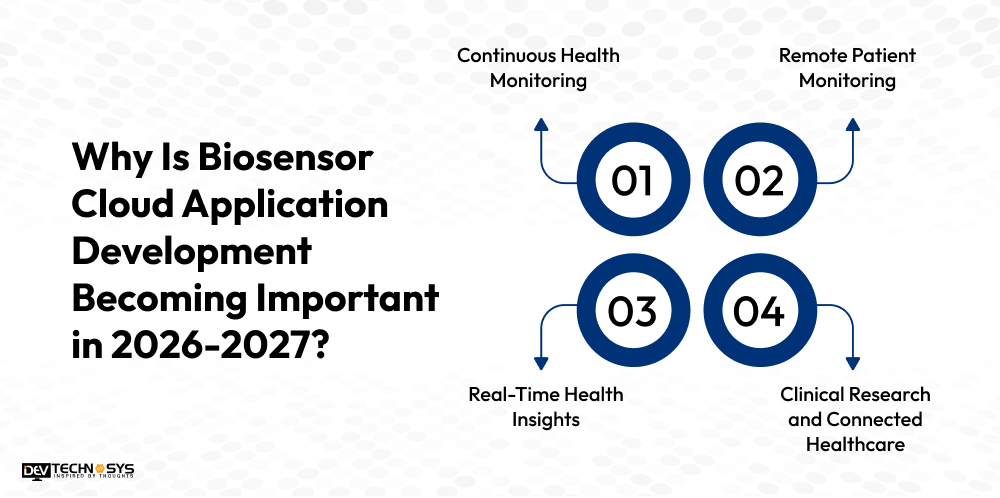
1. Continuous Health Monitoring
To catch any health issue, no need to wait for annual checkups. Biosensors are perfect for real-time health data processing and tracking. They create a data history that reveals trends that could never be shown with a single visit. They can find out the problem earlier, before they become emergencies.
2. Remote Patient Monitoring
Hospital facilities are venturing out of the hospital confines. Through biosensor cloud platforms, clinicians can monitor post-operative patients, chronic patients, and older age patients. It evaluates patients’ health even when they are not physically available. It opens up hospital rooms for actual patients.
3. Real-Time Health Insights
With biosensors, data is analyzed in real time rather than after several days. It is powered by continuous biosensor data analytics running in the background. If the results are abnormal, it is flagged instantly so immediate care is provided. Quick outcomes are expected by the patients and doctors of both clinical and wellness platforms.
4. Clinical Research and Connected Healthcare
Pharmaceutical and research companies conduct large-scale decentralized clinical trials through a biosensor cloud database. Continuous and objective data replaces self-reported diaries for more accurate results. Biosensor data is also used in connected EHR ecosystems for more coordinated care.
How to Build a Real-Time Biosensor Monitoring Platform: 5 Essential Development Steps
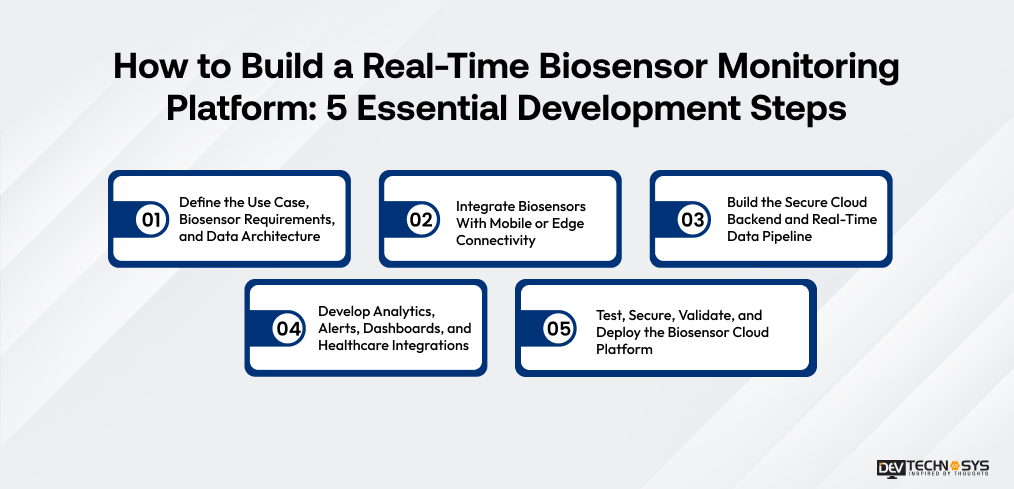
The core steps for biosensor cloud computing app development include:
- Defining scope
- Integrating sensors
- Building the cloud backend
- Developing analytics
- Testing before deployment.
In this section, we will understand the entire biosensor development process, followed by every healthcare app development company.
Step 1: Define the Use Case, Biosensor Requirements, and Data Architecture
Establish clearly what the platform monitors, the end user, and the regulatory class it belongs to. All future decisions depend on this alone, from storage to the timeframe for certification.
- Define the target measurement parameter: glucose, ECG, SpO2, etc.
- Classify as medical grade or wellness grade
- Specify the needed criteria for data residency and storage
- Define the data architecture prior to programming
Step 2: Integrate Biosensors With Mobile or Edge Connectivity
The biosensors require a reliable route to the cloud. This involves connecting devices to the cloud through mobile applications or edge gateways. It often relies on edge computing or fog computing to process data closer to the source. For this, the appropriate protocol is used to ensure reliability while minimizing battery usage.
- Define the communication protocol: BLE, Wi-Fi, cellular, NFC integration, LoRaWAN, or 5G Connectivity
- Choose MQTT protocol, WebSocket, or HTTP/HTTPS based on latency needs
- Offline data caching in case of poor connectivity
- Validation of data signals relative to reference devices
Step 3: Build the Secure Cloud Backend and Real-Time Data Pipeline
The technical backbone of the platform would require a pipeline that could reliably receive, queue, and store high-frequency sensor data analytics. It is stored in real time for continuous monitoring of patient health conditions.
- Ingest and buffer streams in a message broker such as Kafka, Azure IoT, or AWS IoT Core
- Store streams in a time-series database
- Ensure data encryption during transport (TLS) and storage (AES-256)
- Implement role-based access control on all services
Step 4: Develop Analytics, Alerts, Dashboards, and Healthcare Integrations
It is impossible to turn raw data into anything meaningful until analytics and alerting processes are implemented, supported by robust biosensor API integration. The next layer would provide that functionality and enable integrations with current healthcare systems.
- Create rule-based alerts for thresholds
- Integrate biosensor machine learning to detect trends and anomalies, enabling truly AI-powered biosensor applications
- Create separate biosensor data visualization dashboards for physicians and patients
- Interface with EHR systems through HL7/FHIR where needed
Step 5: Test, Secure, Validate, and Deploy the Biosensor Cloud Platform
Validation for the clinical, technical, and security aspects should run in parallel. This is because regulatory approval is likely to take more time than development itself. Some teams also simulate load using a digital twin of the platform before a full production rollout.
- Validate sensors against clinical standards
- Load test the pipeline with simultaneous users
- Penetration testing and security audit
- Roll out through pilot deployment
Biosensor Cloud Application Features: From Core Monitoring to Advanced Intelligence
A biosensor cloud application needs core features for basic functionality and advanced features. A combined feature set can add intelligence, scale, and clinical depth as the platform matures. The right feature mix helps platforms collect reliable sensor data and support real-time monitoring.
Core Features:
Core Feature |
What It Does |
| Biosensor Connectivity | Connects wearable and connected biosensors through BLE, Wi-Fi, APIs, or supported protocols, forming the base layer of biosensor device integration |
| Real-Time Data Collection | Captures and transfers physiological measurements from connected devices to the cloud. |
| User & Patient Profiles | Stores essential user information, health data, device assignments, and preferences. |
| Device Management | Supports device pairing, registration, status tracking, battery monitoring, and connectivity management. |
| Health Data Dashboard | Displays collected measurements, current readings, trends, and relevant health information. |
| Data Synchronization | Keeps sensor data processing synchronized across devices, applications, and cloud systems. |
| Alerts & Notifications | Sends notifications when predefined health thresholds, device issues, or important events occur. |
| Historical Data Tracking | Maintains previous readings so users and providers can review health trends over time. |
| Secure User Authentication | Protects accounts using secure login, MFA, biometric authentication, and session controls. |
| Reports & Data Export | Generates health reports and enables authorized users to export relevant collected data. |
Advanced Features:
Advanced Feature |
What It Does |
| AI-Powered Anomaly Detection | Identifies unusual patterns in biosensor data that may require further attention. |
| Predictive Health Analytics | Uses historical and real-time data to identify potential health risks and trends. |
| Personalized Health Baselines | Establishes individual health patterns to make monitoring more personalized than fixed thresholds. |
| Real-Time Data Streaming | Processes continuous high-frequency sensor data for near real-time monitoring and analysis. |
| Signal Quality Monitoring | Detects poor-quality, incomplete, inconsistent, or potentially unreliable sensor measurements. |
| Multi-Device Interoperability | Connects multiple sensor brands, models, protocols, and healthcare data sources through standardized interfaces. |
| HL7 FHIR Integration | Enables structured exchange of biosensor observations with compatible healthcare and clinical systems. |
| Clinical Decision Support | Converts relevant sensor insights into contextual information that can support healthcare workflows. |
| Advanced Alert Prioritization | Ranks alerts according to severity, patient context, thresholds, and predefined monitoring rules. |
| AI-Based Personalized Insights | Converts continuous biosensor data into personalized trends, recommendations, and actionable health insights. |
Build Biosensor Cloud Applications Architecture: How the Technology Stack Fits Together
The architecture to build biosensor cloud applications together layers sensor hardware, connectivity, ingestion, processing, analytics, and application layers. Each requires a specific technology stack to function securely at scale. Have a look at the tech stack needed according to the biosensor application architecture layering.
Architecture Layer |
Function |
Common Tech Stack |
| Sensor and Device Layer | Captures raw biometric signals from hardware | Medical-grade sensors, wearable chipsets, firmware (C/C++) |
| Edge/Gateway Layer | Processes or buffers data before transmission | Edge devices, RTOS, local caching modules |
| Mobile/Edge Gateway App | Pairs devices and relays data to the cloud | Swift, Kotlin, React Native, BLE/Wi-Fi SDKs |
| API Gateway and Ingestion Layer | Receives and queues incoming data stream processing | REST API, GraphQL APIs, AWS IoT Core, Kafka |
| Message Queue/Streaming | Buffers high-frequency data before storage | Apache Kafka, AWS Kinesis, RabbitMQ |
| Cloud Storage Layer | Stores structured and time-series data | InfluxDB, TimescaleDB, Amazon S3, DynamoDB |
| Cloud Processing Layer | Runs transformation and rule-based logic | AWS Lambda, Azure Functions, Kubernetes |
| Analytics and AI Layer | Detects patterns and predicts health risks | Python, TensorFlow, AWS SageMaker |
| Interoperability Layer | Exchanges data with hospital systems | HL7, FHIR APIs, healthcare middleware |
| Patient and Clinician Applications | Delivers insights through dashboards | React, Angular, Node.js backend |
Security, Privacy, and Compliance Considerations To Build Biosensor Cloud Applications
Biosensor data monitoring software handles sensitive health data, making security and privacy important from the beginning. Strong encryption, access controls, secure device connections, audit trails, and applicable healthcare regulations are highly considered in biosensor platforms. They help protect data throughout collection, transmission, storage, and processing.
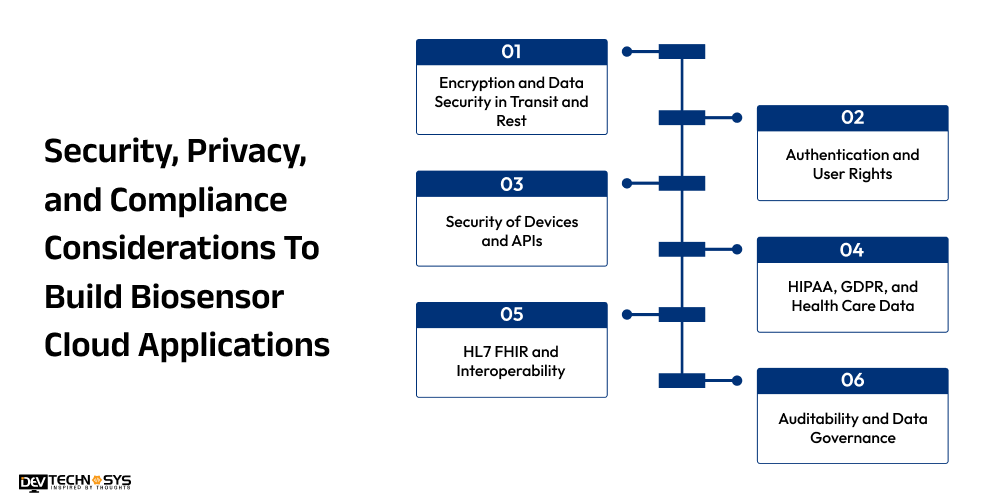
Encryption and Data Security in Transit and Rest
Every piece of data requires securing along its way from the sensor to the point of storage. TLS encrypts data in transit, while AES-256 secures data at rest, closing the main attack vectors in the connected health environment.
Authentication and User Rights
Multi-factor authentication and role-based permissions ensure that only the right users can access patient data. Different types of users, including clinicians, administrators, and patients themselves, require access to different data.
Security of Devices and APIs
Security sensors and gateways are typical targets for attackers. API rate limiting, device certificate authentication, and OTA firmware updates will help to block devices that can add false data.
HIPAA, GDPR, and Health Care Data
HIPAA regulates health data in the US while GDPR imposes additional requirements on EU residents’ data, including consent and data portability. HIPAA obliges businesses to conclude signed Business Associate Agreements with cloud service providers.
HL7 FHIR and Interoperability
Hospital systems expect data in standardized formats. Building to HL7 and FHIR specifications from the start avoids costly retrofitting when enterprise healthcare clients request EHR integration later.
Auditability and Data Governance
Every access, edit, and data transfer needs a logged trail. Audit logs support regulatory audits and give care teams accountability when reviewing who accessed sensitive patient records.
How Much Does It Cost to Build Biosensor Cloud Applications?
The average cost to develop biosensor cloud applications can be estimated from $30,000 to $1,50,000. The overall development expense is determined by the app’s complexity and features. A basic app, built with an MVP structure and limited integration, is less expensive to develop. While an advanced app with real-time monitoring, multiple biosensor integrations, and AI-powered analytics requires a significantly higher investment.
Several factors also influence the biosensor application development cost. These include platform choice, security & compliance, third-party APIs, backend architecture, tech stack, and so on. Here we will learn about the most influential factors affecting biosensor cloud mobile app development cost.
1. Amount of Data and Speed of Transmission
The quantity of data produced and the speed of its transmission affect the biosensor software development cost immensely. Frequent readings taken by sensors of thousands of users require high infrastructure capacities that will not allow data loss or delay.
2. Cloud Infrastructure and Scalability
Development of a cloud-based biosensor platform that supports scalability and future growth. It will be much more costly at first than building one with limited capacity. However, it will save the expenses of redesign in the future but increase current biosensor app development cost.
3. Hardware Communication Protocols
Different types of communication protocols, such as Bluetooth, Wi-Fi connectivity, and cellular networks, complicate the integration process. Each of these protocols requires a different approach to implementation of power management, reliability, and connection issues. It raises the biosensor cloud software development cost.
4. Maintenance and Post-Launch Development
Maintenance and support are additional but crucial expenses after product development and launch. This is due to bug fixes, security patches, compliance updates, and sensor firmware management changes. These changes require additional development work, which leads to increased biosensor app development cost.
Factor |
Complexity Level |
Cost Range |
What Drives It Higher |
| Amount of Data and Speed of Transmission | Medium–High | $15,000–$22,000 | High-frequency, multi-user real-time streams |
| Cloud Infrastructure and Scalability | High | $17,000–$24,000 | Auto-scaling, multi-region, high availability |
| Hardware Communication Protocols | Medium | $13,000–$25,000 | Multiple protocols, multiple manufacturers |
| Maintenance and Post-Launch Development | Ongoing | $4,500–$30,000/year | Compliance updates, firmware changes, patch frequency |
Common Challenges to Consider Before You Build Biosensor Cloud Applications and How to Solve Them
Biosensor cloud platforms face recurring challenges related to interoperability, data quality, connectivity, alert fatigue, and scalability. Each challenge requires deliberate architectural decisions to solve. We have explained some crucial challenges and ways to solve them.
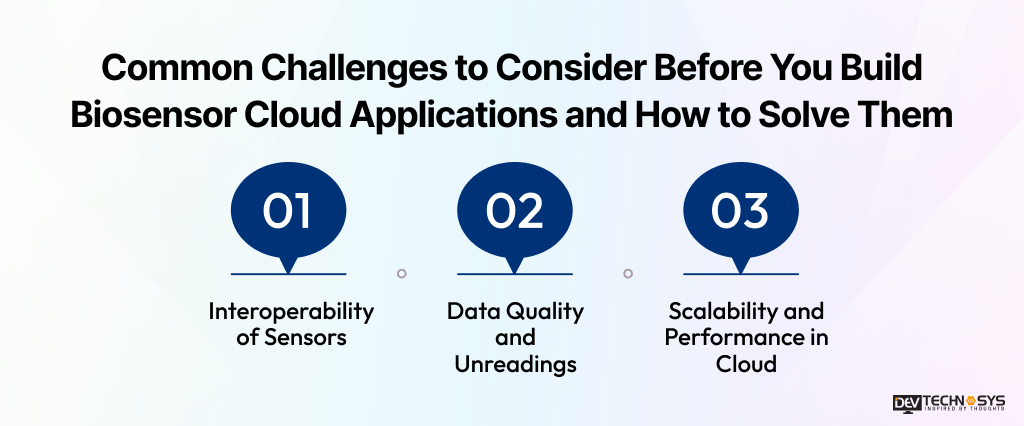
1. Interoperability of Sensors
It is one of the earliest stages in the pipeline and influences all the following steps. The inability to use data from different vendors’ sensors means that all further steps will inherit this issue. It is hard to fix after deployment.
Solution:
- Build a standardized internal data schema
- Use middleware to normalize incoming sensor formats
- Adopt HL7/FHIR early for future-proofing
2. Data Quality and Unreadings
This is more of an issue of credibility than a technological one. Poor quality of data leads to false alarms, which is detrimental to the main benefit of the solution. It gets worse with scaling if not fixed early enough.
Solution:
- Apply data validation rules at ingestion
- Flag and interpolate short data gaps
- Set minimum signal-quality thresholds before storage
3. Scalability and Performance in Cloud
It is the silent killer of platforms after their release. It works great in the pilot but fails to perform once real users start using it. It is closely tied to cost and the platform’s ability to handle growing volumes of real-time biosensor data.
Solution:
- Use auto-scaling cloud infrastructure
- Implement data partitioning and load balancing
- Stress-test the pipeline before major launches
Build vs. Buy vs. Partner: Which Approach Fits Your Biosensor Development Project?
Businesses can build biosensor cloud apps, buy a solution, or partner with an experienced cloud computing software development company. Each approach has different upfront costs, customization, compliance ownership, and time to launch. Here, we explain the differences between build vs. buy vs. partner, so choose the option that suits you.
Factor |
Build In-House |
Buy Off-the-Shelf |
Partner With a Dev Technosys |
| Upfront Cost | High (hiring, infrastructure) | Low to moderate (licensing) | Moderate (project-based) |
| Time to Launch | Slowest (6-14+ months) | Fastest (weeks) | Moderate (3-7+ months) |
| Customization | Full control | Very limited | High, tailored to use case |
| Compliance Ownership | Fully on your team | Vendor-dependent | Shared, guided by partner expertise |
| Scalability | Depends on internal expertise | Limited by vendor’s roadmap | Built for your growth plan |
| Long-Term Cost | Rises with maintenance, hiring | Recurring licensing fees | Predictable, scoped engagements |
| Best For | Large teams with in-house healthcare tech expertise | Simple, non-clinical wellness use cases | Companies wanting custom, compliant platforms without an internal team |
| Risk Level | High, if team lacks compliance experience | Low control over data and features | Balanced, shared accountability |
Why Dev Technosys is the Ideal Option to Build Biosensor Cloud Applications?
Dev Technosys has expertise in healthcare compliance, cloud architecture, and biosensor IoT connectivity. We can develop robust, scalable biosensor cloud applications with utmost perfection. We let your idea move from concept to a compliant, production-ready platform.
Expertise in Healthcare and Cloud Development
We have 15+ years of experience and CMMI Level 3 certification. Dev Technosys has a strong understanding of healthcare compliance and cloud architecture, ensuring minimal rework during development.
Hands-On Experience with IoT Gateway and Device Connectivity
Our developers have hands-on experience working on various biosensors and their connectivity. We are always ready to connect any type of biosensor to the cloud seamlessly, without hassle.
Security and Scalability
All applications are designed with encryption, access control, and infrastructure for auto-scalability from the very beginning. This foundation lets platforms grow from pilot programs to enterprise scale without costly rearchitecting.
Development and Support Services End-to-End
Dev Technosys takes care of everything from planning to post-launch support services for healthcare companies in India, the UK, the UAE, and Australia. Clients get one accountable partner throughout, instead of juggling multiple vendors.
Conclusion
Biosensor cloud solutions are more than just a fad in the field of healthcare technology. They are rapidly becoming a core component of providing care beyond hospital settings. To make it happen, compliance must come first, and architecture built for future scale is required at an early stage.
To develop biosensor cloud applications in 2026-2027, businesses need to hire dedicated developers or a reliable development company. They can bring the healthcare compliance depth and cloud engineering experience together. It is beneficial to turn your biosensor concept into a platform that patients and clinicians can actually trust.
Frequently Asked Questions
Find answers to the most common questions related to this article.
The average time taken to create biosensor cloud applications is 4 to 7+ months. The final timeline is determined by the platform’s complexity, integrations, security requirements, and features. A basic MVP with simple sensor integration and dashboards typically takes 3-5 months. Advanced platforms with AI analytics, EHR integration, and formal medical device certification can take 7+ months
Yes, biosensor data can integrate with electronic health record systems. This is done using HL7 and FHIR interoperability standards. This integration allows healthcare providers to view continuous biosensor readings along with traditional medical records. It supports more coordinated and informed patient care decisions.
The platforms that handle health information for US patients need to be protected by HIPAA compliance. It also includes encryption, access controls, and signed Business Associate Agreements with cloud vendors. Platforms that do not belong to the US require equivalent requirements like GDPR, as per their user’s location.
Yes, AI is commonly integrated into biosensor cloud applications. AI can help in anomaly detection, predictive risk scoring, and reducing false alerts. Machine learning models analyze historical and real-time sensor monitoring to identify patterns that rule-based systems would miss. This can improve both clinical accuracy and patient outcomes.
The cost to develop a biosensor app can be estimated at $30,000 to 1,50,000. The cost is influenced by several factors, including UI/UX, security, API integrations, maintenance, and more. A basic app built with an MVP structure and limited integrations is less expensive to create. While an advanced app with EHR integration and multi-region compliance is more expensive.