







Key takeaways:
-
- In 2026 (up to December 2026), Media & Entertainment SaaS companies raised approximately $1.09 billion in equity funding across 22 funding rounds.
- According to Future Market Insights, the fee-based SaaS online video platform market is expected to grow from about $1.45 billion in 2026 to $3.85 billion by 2032, at a CAGR of 13.5%.
- The SaaS development cost ranges from $30,000 to $1,50,000 depending on various factors like features, platform choice, UI/UX design, and third party integration.
- SaaS-based entertainment applications offer seamless and engaging digital experiences by combining cloud infrastructure, user-centric features, and advanced technologies.
- Successful entertainment SaaS apps prioritize seamless access across mobile, web, smart TVs, and tablets, enabling users to switch contexts while maintaining synced progress and preferences
In 2026, Entertainment apps have established an unshakable presence in people’s lives. SaaS based entertainment app development not only cater to multiple forms of digital content, but they also allow users to stream videos, listen to music, and watch their favorite movies, dramas, and videos from anywhere, at any time, from any device.
The SaaS market is hitting hundreds of billions ($328B+), and OTT video users are nearing 70% penetration by 2029. But developing a SaaS based entertainment app is not a joke, though, especially for entrepreneurs and startups. If you are a business wondering how to develop a scalable and user-friendly SaaS-based entertainment app, then you have arrived at the right place.
This SaaS-based entertainment app development guide will explore the crucial steps to develop an SaaS entertainment app, features, steps, and cost considerations. We hope it will help businesses and entrepreneurs make more data-driven decisions in the evolving entertainment landscape.
What is SaaS in an Entertainment App?
wonderin what is SaaS application development? well, SaaS in the entertainment app refers to a business model that collects recurring subscription fees from users to access software and digital services over the internet, rather than purchasing a single lifetime license. The app, location, and its data are hosted on cloud servers managed by the provider. Common addition of SaaS within the entertainment industry involves:
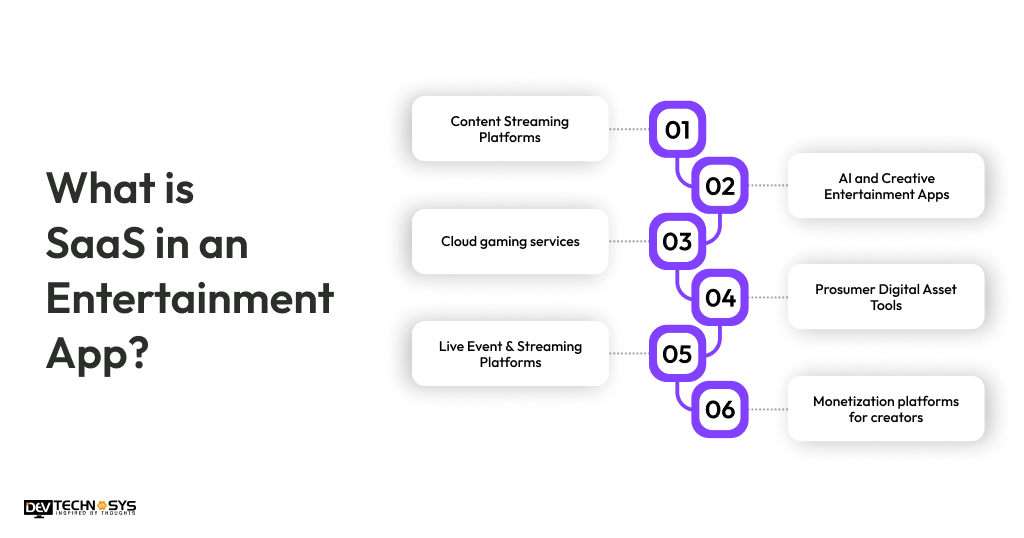
- Content Streaming Platforms: They offer movies, TV shows, music, and podcasts with the help of paid streaming services. Netflix and Spotify are two great examples.
- AI and Creative Entertainment Apps: They offer storylines, virtual characters, creative experiences, and material created by AI through cloud-based subscription plans. Character.AI is the best example of this.
- Cloud gaming services: They let you stream video games directly to your devices, so you don’t have to buy expensive gear or download games. You can see this best in NVIDIA GeForce NOW and Xbox Cloud Gaming.
- Prosumer Digital Asset Tools: It gives creators cloud-based tools for editing videos, animating, making music, and making content. Adobe Creative Cloud is one example.
- Live Event & Streaming Platforms: These let you have virtual shows, live broadcasts, webinars, and other ways for people to interact with you. For instance, Twitch
- Monetization platforms for creators: Memberships, subscriptions, and special material are just a few of the ways that creators can make a steady income. Just take OnlyFans and Patreon as examples.
How SaaS Entertainment Platforms Work?
SaaS entertainment platforms leverage cloud technology to deliver videos, music, games, and other digital content via subscriptions. Let’s understand the workflow of SaaS in entertainment platforms in detail:
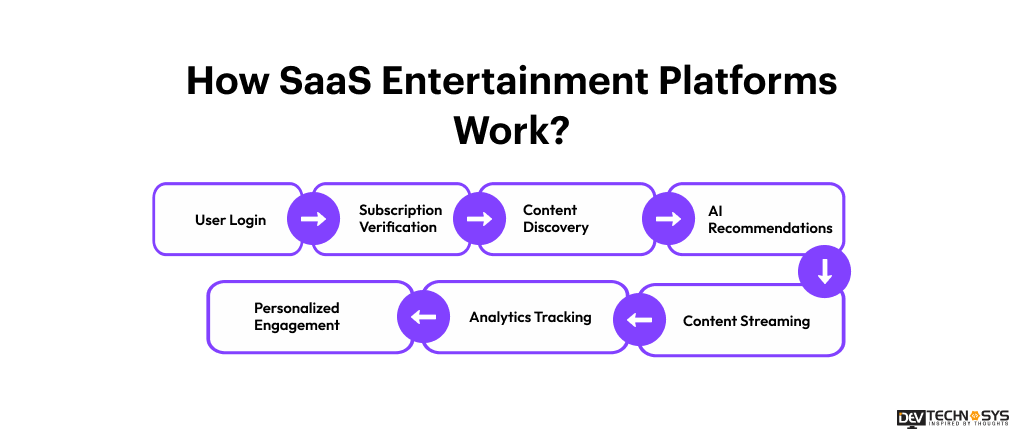
Simplified workflow of SaaS entertainment platform:
User Login → Subscription Verification → Product Discovery → AI Recommendations → Content Streaming → Analytics Tracking → Personalized Engagement.
- User Registration and Subscription: First, users sign up for an account using their email address, phone number, or social logins (such as Instagram, X, or Facebook). They then subscribe to plans that give them access to premium entertainment material.
- Content Management System (CMS): The CMS makes it easy for administrators to upload, organize, tag, schedule, and control videos, podcasts, music, and other digital entertainment material.
- Cloud Storage and Hosting: Media files are kept on a scalable cloud infrastructure that gives users all over the world high availability, reliable performance, and easy access.
- Content Delivery Network (CDN): CDNs send content to various servers around the world. This cuts down on latency and buffering while still giving users a high-quality streaming experience.
- AI-Powered Recommendations: AI looks at a user’s behavior, watch history, and preferences to make personalized content ideas and boost engagement rates.
- Streaming & Playback Engine: New streaming technologies make sure that playing works smoothly on all devices, screen sizes, and network conditions.
- Payment and Subscription Management: Integrated payment systems handle subscriptions, recurring bills, refunds, and multiple payment methods safely. They also keep track of user memberships.
- Analytics & User Insights: Analytics tools keep track of what users do, how often they watch, how long they stay on the site, and how well the content performs so that businesses can make decisions based on data.
- Notifications and User Engagement: Users are told about new content, tips, sales, and subscription updates through push notifications, emails, and in-app alerts.
- Revenue Generation: Platforms make money from advertising, premium memberships, pay-per-view content, sponsorships, and smart content partnerships, as well as from subscriptions and ads.
Entertainment SaaS Market Size in 2026
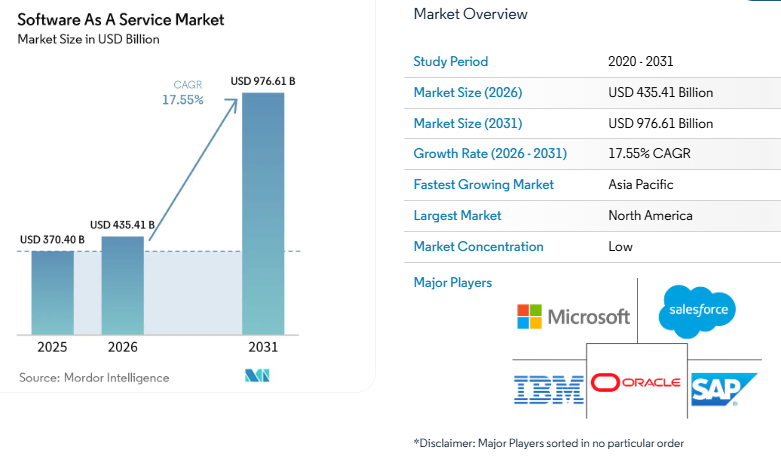
- The Software-as-a-Service (SaaS) market is expected to reach USD 435.41 billion in 2026, up from USD 370.4 billion in 2025. It is expected to be worth USD 976.61 billion in 2031, at a rate of 17.55% CAGR from 2026 to 2031.
- 89.42% of the SaaS market was in the public cloud deployment model. Hybrid cloud, on the other hand, is expected to grow at a 21.8% CAGR through 2031.
- Big businesses made up 58.05% of the SaaS market. Small and medium-sized businesses (SMEs), on the other hand, are growing at the fastest rate, at 19.2% CAGR.
- The customer Relationship Management applications made up 24.58% of the SaaS market’s income. Security and Compliance applications are growing at a rate of 24.1% per year.
- Subscription plans kept 68.2% of the SaaS market, while usage-based models are growing at a rate of 27.9% CAGR.
- The IT and telecom end-user vertical had the largest share of the SaaS market in 2025, accounting for 22.45% of the total market size. The healthcare vertical had the fastest growth, at 22.9% CAGR.
- Most of the SaaS market was in North America (42.6%). Asia-Pacific is expected to grow at a CAGR of 18.7% until 2031.
What are the Key Components of SaaS Entertainment Applications?
SaaS-based entertainment applications offer seamless and engaging digital experiences by combining cloud infrastructure, user-centric features, and advanced technologies. Here are some key components that are required to create a successful SaaS entertainment platform:
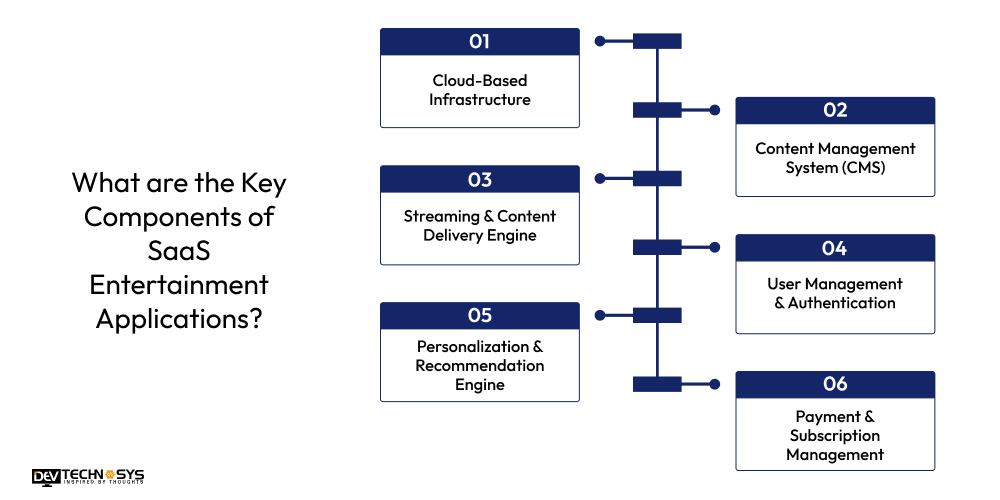
1. Cloud-Based Infrastructure
A strong cloud infrastructure is crucial in an entertainment app to ensure high availability, scalability, and cost-effectiveness. To manage fluctuating user demand, platforms like AWS, Azure, or GCP support elastic scaling and load balancing.
2. Content Management System (CMS)
A powerful CMS allows administrators to efficiently upload, organize, categorize, schedule, and manage digital content. SaaS-based entertainment apps offer content updates and metadata management without disrupting the user experience.
3. Streaming & Content Delivery Engine
It ensures smooth playback using adaptive bitrate streaming and Content Delivery Networks (CDNs). Content delivery engine minimizes buffering, reduces latency, and delivers high-quality video or audio across different devices and network conditions.
4. User Management & Authentication
to manage presence, subscriptions, and viewing history, ensure secure user registration, login, profile management, and access control. Features like social login and multi-profile support enhance convenience and personalization.
5. Personalization & Recommendation Engine
AI and machine learning algorithms in an SaaS-based entertainment app analyze user behavior, preferences, and engagement patterns to provide tailored content recommendations, improving user satisfaction and retention.
6. Payment & Subscription Management
Integrated billing systems support subscriptions, renewals, free trials, and multiple payment gateways. This component ensures secure transactions, automated invoicing, and flexible monetization models.
Types of SaaS-Based Entertainment Apps
There are various types of SaaS-based Entertainment apps that businesses can consider for development. A successful SaaS entertainment platform must ensure it enables personalized user access and on-demand entertainment across multiple devices. The main types of SaaS entertainment apps include:
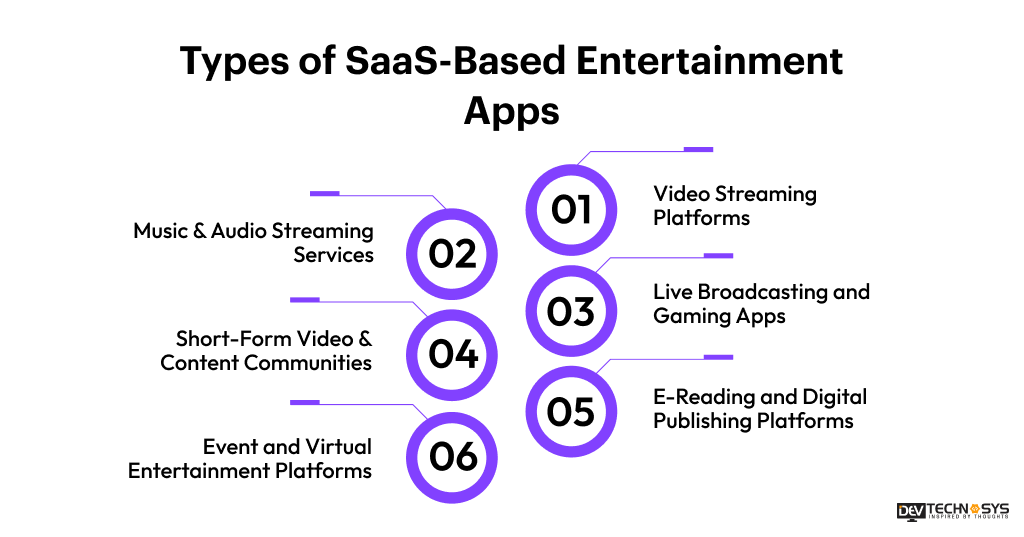
1. Video Streaming Platforms
According to a top OTT app development company, most video streaming SaaS apps deliver live or on-demand video content straight to users by using cloud-based infrastructure. The addition of AI-based recommendation algorithms, variable-bitrate streaming, and personalized user profiles provides a better user experience.
Video Streaming SaaS Platform Examples: YouTube, Netflix, Hulu, Amazon Prime Video
Role of SaaS: In video streaming, SaaS manages subscriptions, hosts videos that can be scaled up or down, and delivers information all over the world with the help of cloud/CDN. It also gives you real-time information about user engagement and retention.
Industry insights: According to reports by Statista, the OTT / digital video users are projected to reach 1.7–2 billion globally in the late 2026s, depending on segmentation.
2. Music & Audio Streaming Services
Music and audio streaming platforms allow on-demand access to huge libraries of music, audiobooks, and podcasts kept in the cloud. They often use both freemium and paid subscription models, and their highlights include curated playlists and personalized music.
Music and Audio Streaming Apps Examples: Spotify, Apple Music
Role of SaaS: SaaS in music and audio streaming can store and stream music instantly, get personalized suggestions, and handle licenses across regions without having to install anything locally.
You can reach out anytime; we are available 24/7. Our team provides a quick response.

3. Live Broadcasting and Gaming Apps
Live broadcasting and gaming apps are the type of interactive SaaS platforms that stream live content. It involves gaming sessions, e-sports, and real-time creative content. Their main audience engagements are through chat and reactions.
Live Broadcasting and Gaming Apps Examples: Twitch, YouTube Live
Role of SaaS: The role of SaaS in live streaming and gaming platforms involves allowing low-latency live streaming, scalable concurrent user handling, cloud-based encoding, and real-time interaction features like chat, donations, and subscriptions.
4. Short-Form Video & Content Communities
As the name suggests, the main focus of these platforms is on providing bite-sized, algorithm-driven entertainment. They allow users to watch and create short videos. AI recommendation systems heavily influence content discovery.
Short Form Video App Examples: TikTok, Instagram Reels
Role of SaaS: SaaS provides real-time content delivery, AI-driven feed personalization, massive-scale video processing, and cloud storage for user-generated content.
5. E-Reading and Digital Publishing Platforms
With the help of subscription models, the E-reading and digital platforms offer cloud-based access to e-books, comics, magazines, and other digital publications. It caters to readers who love to read anytime and anywhere.
E-reading App Examples: Kindle Unlimited, Comixology.
Role of SaaS: SaaS enables digital rights management (DRM), cloud syncing across devices, subscription-based access control, and scalable content distribution.
6. Event and Virtual Entertainment Platforms
These SaaS solutions allow organizations to host virtual conferences, webinars, concerts, and trade shows in a fully online environment with interactive engagement features.
Event and Virtual Entertainment App Examples: Zoom and vFairs
Role of SaaS: SaaS provides virtual event hosting infrastructure, real-time streaming, attendee management, networking tools, analytics dashboards, and scalable cloud support for large audiences.
Look What PwC Says About SaaS-Based Entertainment Apps:
“Global entertainment and media revenues will reach $3.5 trillion by 2029, creating strong opportunities for SaaS entertainment platforms.”
SaaS Entertainment App Architecture Explained
The SaaS based entertainment platform ( OTT, gaming, live streaming, or media apps ) is developed on a layered architecture created to ensure higher scalability, low latency, and seamless user experience. Each layer plays a specific role in delivering fast, reliable, and secure digital content.
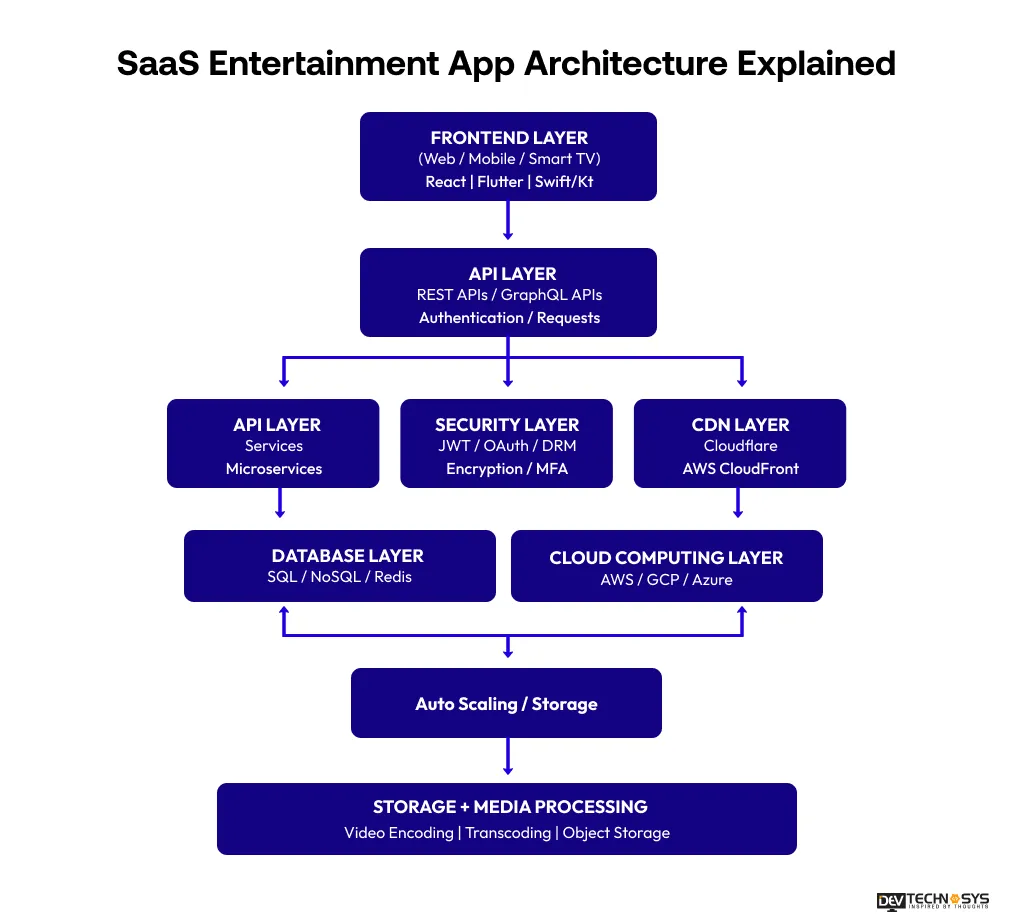
1. Frontend Layer
The frontend layer is the part of this multi-tenant architecture of the app that users see and interact with. It is responsible for delivering a smooth and interactive experience across multiple devices (mobile, web, smart TVs). Developing frontend involves frameworks like React, Angular, Flutter, or Swift/Kotlin (for native apps).
Key responsibilities include:
- Responsive UI/UX design for multiple devices
- Video player integration (adaptive streaming support)
- Personalized content feeds
- User authentication screens
- Real-time interaction (likes, comments, watchlists)
2. Backend Infrastructure
According to SaaS application development services providers, the backend manages the business logic, user requests, and content operations. It is the core engine of the SaaS entertainment platform. It is typically developed with Node.js, Python (Django/FastAPI), Java, or Go, and most of the time, a microservices architecture is employed.
Key responsibilities include:
- User management and authentication
- Content ingestion and processing workflows
- Subscription and billing systems
- Recommendation engine logic
- Analytics and tracking services
3. Cloud Computing Layer
With the cloud layer, we have the flexible infrastructure we need to store, process, and distribute a lot of media material. Popular ones include AWS, Google Cloud, and Microsoft Azure.
Key functions include:
- Auto-scaling compute resources
- Serverless computing for dynamic workloads
- Cloud storage for media assets (videos, images, metadata)
- Load balancing for traffic distribution
- Disaster recovery and backup systems
4. Database Management
The database layer stores all structured and unstructured data required for the application. A combination of databases is typically used:
- SQL: Users, payments, subscriptions
- NoSQL: Content metadata, logs
- Redis: Caching, sessions
Key responsibilities:
- Fast data retrieval for user requests
- Handling large-scale metadata for media content
- Ensuring data consistency and integrity
- Supporting real-time analytics
5. CDN Integration
A Content Delivery Network (CDN) ensures fast and buffer-free streaming across global edge servers. Popular CDNs include Cloudflare, Akamai, and AWS CloudFront.
Key Functionality:
- Delivers content from the nearest edge server
- Reduces buffering time
- Handles traffic spikes
- Improves playback speed
CDNs are essential for delivering high-quality streaming experiences at scale.
API Layer
The API layer acts as a bridge between frontend applications and backend services, enabling smooth communication across the system. It typically includes RESTful APIs or GraphQL APIs.
Key functions:
- Fetching user-specific content feeds
- Handling authentication and authorization requests
- Managing video streaming requests
- Integrating third-party services (payments, analytics, ads)
- Enabling mobile and web app synchronization
Security Framework
Security plays an important role in SaaS entertainment apps because it involves content piracy risks and sensitive user data.
Key security measures include:
- JWT / OAuth authentication
- DRM (Digital Rights Management) for videos
- End-to-end encryption (SSL/TLS)
- Fraud detection & access control
What are the Steps to Develop an SaaS-Based Entertainment App?
According to a top software development company, the process to develop requires great strategy and planning, technical expertise, and constant improvement.
Each step is crucial and ensures that the app remains safe to use, scalable, user-friendly, and successful in this competitive landscape. Here’s the process of SaaS application development for entertainment in simple steps.
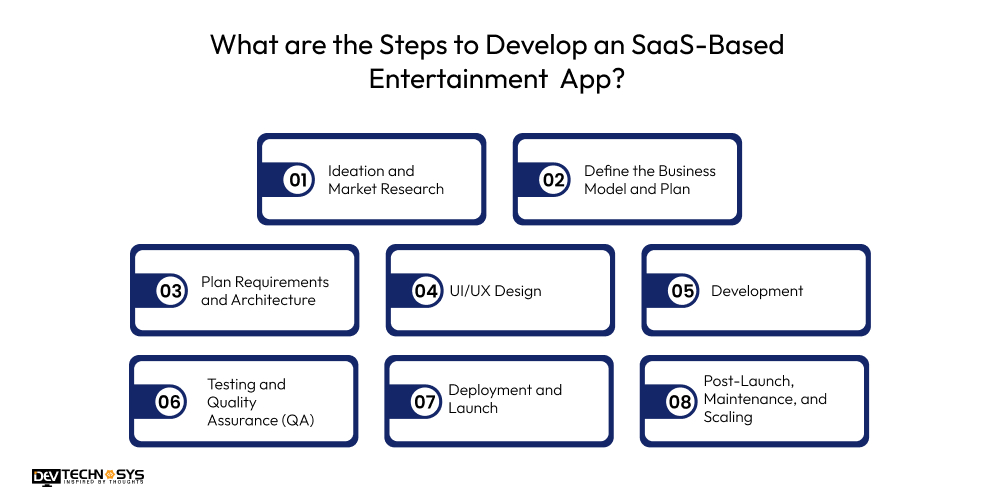
1. Ideation and Market Research
The process of SaaS-based entertainment app development begins by defining the app’s purpose and goals. Identify what problems it will solve, target audience it will cater to, and understand user pain points. Do market research to know the industry challenges and growing user expectations.
Analyzing the strengths and weaknesses of your competitors and validating demand through surveys, interviews, focus groups, or beta communities will help you create a better strategy.
Knowing the latest entertainment app development trends and competitor study will not only confirm product-market fit, but also help you define a compelling Unique Value Proposition (UVP) that differentiates your SaaS product.
2. Define the Business Model and Plan
Once the idea is validated, define a business model that supports long-term growth and profitability. Choose a suitable pricing strategy such as subscription-based, freemium, tiered, or usage-based billing.
After idea validation, your next step should be defining the business model for your SaaS based entertainment app. Make sure the model you choose supports long-term growth and profitability.
Select a suitable pricing model, like subscription-based or usage-based billing. After that, develop a business plan outlining details like goals, revenue streams, operational costs, and financial projections. Create a strong market strategy and discuss it with your mobile application development company.
3. Plan Requirements and Architecture
The third step to building a video streaming SaaS application is turning the business goals into technical requirements. Know your priorities and select core MVP features that address the focus on the main user problem. Document detailed requirements and user stories to guide developers.
Hire designers from a top Saas development company to design a scalable and secure system architecture. For that use a multi-tenant SaaS model that allows multiple users to share a single app instance. Select appropriate technologies for frontend, backend, databases, and cloud platforms such as AWS, Google Cloud, or Microsoft Azure.
4. UI/UX Design
User experience is crucial for SaaS adoption and retention. An intuitive and visually pleasing interface can make user interactions with the app easier. List the whole user journey for smooth navigation and less friction. Incorporate AI in entertainment app development to enhance user experience.
Hire skilled designers to develop wireframes and interactive prototypes to visualize the product early. Testing these designs with real users helps uncover usability issues and enables improvements before music streaming SaaS app development, reducing costly revisions later.
5. Development
The OTT SaaS platform development phase involves building the SaaS application using agile methodologies. Break the work into manageable sprints to deliver features incrementally and adapt quickly to feedback.
Prioritize core functionalities to launch a working product as early as possible. Experts who provide entertainment app development services will add third-party services like payment gateways, email systems, authentication services, and business APIs. It will improve functionality and automate processes.
6. Testing and Quality Assurance (QA)
Quality assurance is an important step to ensure the SaaS app stays reliable and performs consistently well after release. Your video streaming app development company will perform multiple tests to ensure the security and reliability of the app.
It includes functional testing, performance testing, security testing, and user acceptance testing. Addressing these issues at this stage helps prevent costly failures after launch.
7. Deployment and Launch
Use automated CI/CD pipelines to deploy the application as it ensures smooth, consistent launches with minimal downtime. Put together information about production environments, monitoring tools, and security measures before launch.
After the launch, time o employ marketing strategies through SEO, content marketing, paid campaigns, and partnerships to attract and onboard users effectively.
8. Post-Launch, Maintenance, and Scaling
SaaS development continues beyond launch. Post-launch monetization is equally important. Hire experts from top SaaS app development company who will collect ongoing feedback to guide enhancements and feature updates. Provide constant updates and improvements like bug fixes, strengthen security, and scale infrastructure to support user growth, and changing market trends.
What are the Features to Incorporate in an SaaS-Based Entertainment App?
Features are among the most crucial aspects of SaaS-based entertainment app development. Features play an important role in enhancing the performance and user experience of the app.
User Panel Features |
Content Creator/Publisher Panel Features |
Admin Panel Features |
| User Registration & Login | Content Upload & Management | User Management |
| Profile Management | Media Library Management | Content Moderation |
| Personalized Content Recommendations | Content Scheduling | Subscription Plan Management |
| Advanced Search & Filters | Metadata and Tag Management | Role-Based Access Control |
| Watchlists and Favorites | Audience Analytics Dashboard | Payment and Transaction Monitoring |
| Multi-Device Synchronization | Revenue Tracking | Analytics & Reporting Dashboard |
| Content Download for Offline Access | Live Streaming Controls | Advertisement Management |
| Subscription Management | Copyright & Licensing Management | CMS (Content Management System) |
| In-App Notifications | Content Performance Reports | Customer Support Management |
| Ratings, Reviews, and Social Sharing | Monetization Settings | Security and Compliance Controls |
1. High-Quality Content Delivery:
An SaaS entertainment platform must deliver smooth, uninterrupted, and high-resolution streaming experiences, supporting HD, 4K, or even 8K content. Use global content delivery networks and optimized servers to ensure faster load times in different network conditions and across all regions.
2. Personalization & Recommendations:
AI and machine learning algorithms analyze user behavior, watch history, listening patterns, and preferences to deliver highly personalized content suggestions.
Personalized content recommendation system in AI-powered entertainment apps involve shows and games recommendations, curated content feeds, and more, making the SaaS entertainment platform unique for each user.
3. Intuitive User Interface (UI) & User Experience (UX):
A visually appealing, clean, and user-friendly interface ensures seamless navigation. Clear content categorization, smart search functionality, advanced filters, and smooth transitions help users discover content more quickly.
4. Multi-Platform Accessibility:
The AI-driven media streaming apps should provide a consistent and seamless experience on all devices (smartphones, tablets, desktops, smart TVs, and web browsers). Cloud-based entertainment app development ensures continuity, convenience, and flexibility across devices by allowing users to resume content exactly where they left off.
5. Offline Access & Downloads:
Offline viewing or listening allows users to download movies, music, shows, or episodes and access them without an internet connection. It improves user convenience and user retention by offering uninterrupted entertainment anytime, anywhere, on any device.
6. Social Integration:
Social features such as content sharing, ratings, reviews, comments, in-app communities, and collaborative “watch parties” encourage user interaction. These features foster a sense of community, boost organic user engagement, and act as powerful word-of-mouth marketing tools for the platform.
What are the Business Benefits of Investing in SaaS-Based Entertainment App Development?
Investing in SaaS-based entertainment app development leads to various business benefits. Whether it’s a greater audience reach or stronger brand loyalty, video streaming SaaS applications give businesses a competitive edge and enhanced user experiences.
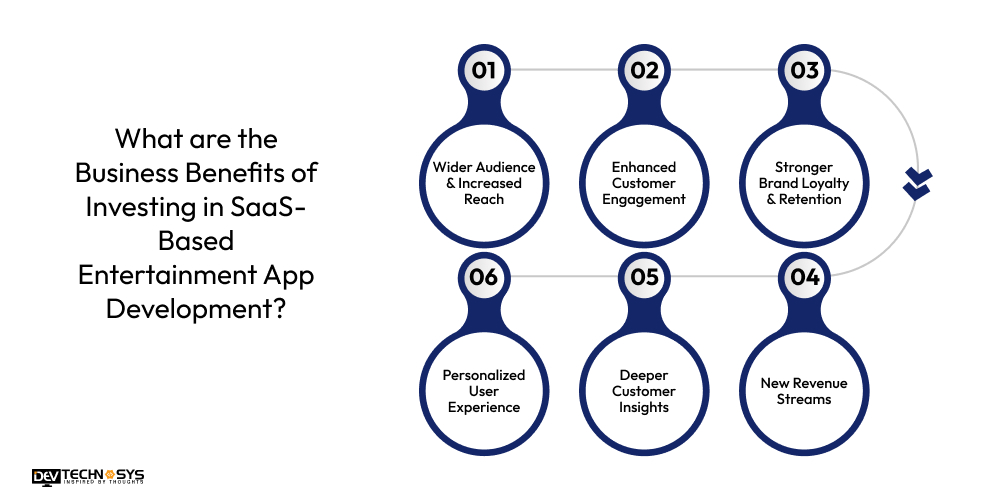
1. Wider Audience & Increased Reach:
An SaaS-based entertainment app development allows businesses to expand their business and reach a massive global audience. These entertainment apps ensure that the content remains available anytime, anywhere, thereby increasing brand visibility.
2. Enhanced Customer Engagement:
Another crucial benefit of investing in short video app development is enhanced customer engagement. Interactive features, social sharing, and push notifications added in AI-driven media streaming apps keep users engaged and coming back.
3. Stronger Brand Loyalty & Retention:
Video and music streaming SaaS app development involves exclusive content, discounts, and loyalty programs to reward loyal users and encourage repeat business. These features reward repeat users and encourage customer retention, thereby strengthening overall brand trust.

4. New Revenue Streams:
Companies that provide SaaS development services contain multiple revenue streams, which helps them generate higher revenue. Businesses can monetize through subscriptions, in-app purchases (IAPs), paid content (pay-per-view), and targeted advertising.
5. Deeper Customer Insights:
SaaS-based entertainment apps gather valuable data regarding viewing or listening patterns, user behavior, and engagement levels. Businesses can improve overall platform performance by using these user insights to develop a content strategy and make data-driven decisions.
6. Personalized User Experience:
AI-driven media streaming apps leverage user data and AI-driven algorithms. These applications provide personalized suggestions, playlists, and notifications. A personalized user experience makes it more immersive and drives long-term loyalty to the platform.
Real Case Study: VLOGGAH
Vloggah is a mobile application for entertainment and video editing built by Dev Technosys for Johan Santos (UAE). The project was created in 5 months by a team of 5 professionals using React Native and Android technologies. The biggest challenge was to make the social media-integrated video editing tool feature-rich and user-friendly. The system allows users to edit videos, add effects, distribute material on all platforms quickly, and monetize their videos through premium channels and earning features, creating a fun experience for content creators and vloggers.
Navneet Rajpoot
– Delivery Head
MVP vs Enterprise SaaS-Based Entertainment Apps
Knowing the difference between MVP and Enterprise SaaS-based entertainment apps helps businesses choose the right development approach based on budget, goals, and growth plans.
MVP-Based Entertainment App
An MVP (Minimum Viable Product) is designed to validate the core idea with essential features. They keep the development cost and time-to-market down. It allows businesses to test user demand, gather feedback, and refine the product before scaling.
Key Characteristics:
- Includes core functionalities such as user registration/login, content discovery, basic streaming or playback, and simple navigation.
- It supports a single platform or limited platforms (web or mobile)
- Basic UI/UX design focuses on usability rather than advanced visuals.
- Standard analytics to track user behavior and engagement
- Faster launch timeline of 8 to 12 weeks
- Cost-effective development ranging between $8,000 and $12,000
Best For: Startups, new businesses, and entrepreneurs who want to validate market demand, test monetization strategies, and minimize initial investment risk.
Enterprise-Based Entertainment App
An enterprise SaaS entertainment app is created to ensure stability and performance, and global reach. It supports high user volumes, advanced features, and robust infrastructure, best for long-term growth.
Key Characteristics:
- Advanced features include AI-powered suggestions, DRM protection, live streaming, multi-language support, and user personalization.
- Multi-platform compatibility includes mobile apps, smart TVs, web, and connected devices.
- High-performance streaming infrastructure using global CDNs and cloud scalability.
- Advanced analytics, automation tools, admin dashboards, and reporting systems
- 4 to 6 months long development timeline.
- Higher investment, typically $18,000 to $25,000+, depending on complexity.
Best For: Established brands, media companies, and enterprises aiming for large-scale operations, international audiences, and long-term revenue growth.
What are the Security and Compliance Requirements for SaaS Entertainment App Development?
SaaS entertainment apps manage sensitive user data, digital content, and subscription payments, making security and compliance essential. Businesses must implement robust security frameworks to protect user information, prevent content piracy, and comply with global regulations.
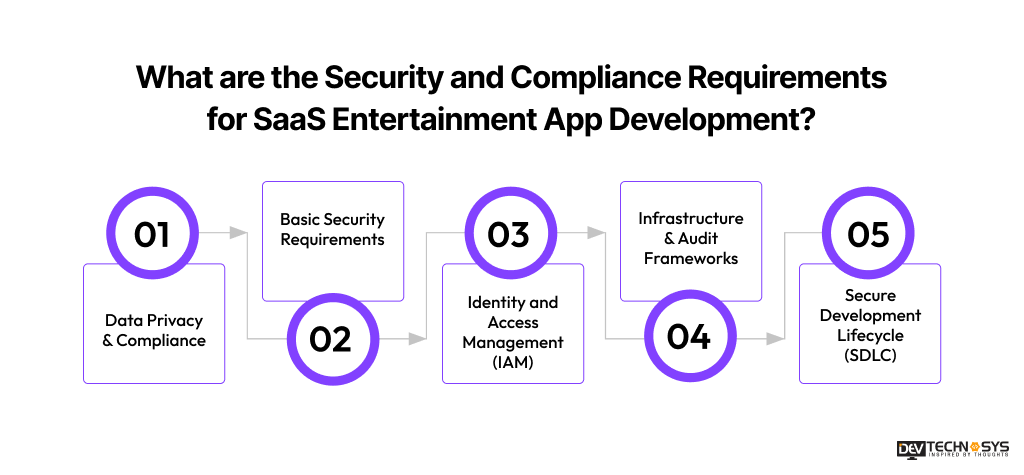
1. Data Privacy & Compliance
Entertainment companies should comply with local privacy regulations to acquire and use data responsibly.
- GDPR Compliance: Collect user permission, allow data portability, and facilitate the “Right to be Forgotten” for European users.
- CCPA Compliance: Give consumers the option to opt out of data sharing, as well as clear information on how personal information is gathered and utilized.
- COPPA & Age Verification: Use parental controls & age-gating tools to prevent minors and obtain parental approval when needed.
2. Basic Security Requirements
Robust security procedures help preserve user data and proprietary media assets.
- Data Encryption: Encrypt data at rest with AES-256 and data in transit with TLS 1.2+
- DRM Integration: Integrate the likes of FairPlay, Widevine, or PlayReady to prevent piracy and unauthorized distribution of material.
- API & Backend Security: Use OAuth 2.0, access tokens, and authentication methods to protect APIs against illegal access.
3. Identity and Access Management (IAM)
Good identity management restricts access to platform resources by authorized users and administrators.
- Multi-Factor Authentication (MFA): Adds an additional layer of protection to administrator and developer accounts.
- Single Sign-On (SSO): Simple and secure login with trusted providers such as Google, Apple, and Facebook.
- Role-Based Access Control (RBAC): Limits access according to user roles and duties.
4. Infrastructure & Audit Frameworks
Security certifications and compliance frameworks allow firms to maintain a high quality of security, ensuring short SaaS application development lifecycle.
- SOC 2 Type II Compliance: Shows solid operational controls for data security and confidentiality.
- ISO 27001 Certification: It certifies that a comprehensive Information Security Management System (ISMS) is in place.
- PCI DSS Compliance: Required for apps that handle subscriptions, in-app transactions, or credit card information.
5. Secure Development Lifecycle (SDLC)
Security must be baked in from the start of the development process so that vulnerabilities can be caught and fixed early on.
- Vulnerability Scanning: Perform ongoing scans of programs and dependencies using SAST and DAST tools.
- Penetration Testing: Regularly perform security assessments to identify exploitable flaws.
- Continuous Security Monitoring: Monitor systems and applications for threats, suspicious activity, and compliance concerns.
Security & Compliance Area |
Key Requirements |
| Data Privacy & Compliance | GDPR, CCPA, COPPA compliance, user consent management, age verification, and parental controls. |
| Core Security Requirements | AES-256 data encryption, TLS 1.2+, DRM integration (Widevine, FairPlay, PlayReady), and secure APIs. |
| Identity & Access Management (IAM) | Multi-Factor Authentication (MFA), Single Sign-On (SSO), and Role-Based Access Control (RBAC). |
| Infrastructure & Auditing | SOC 2 Type II, ISO 27001, PCI DSS compliance, and regular security audits. |
| Secure Development Lifecycle (SDLC) | Vulnerability scanning, penetration testing, secure code reviews, and continuous security monitoring. |
Technology Stack Required for SaaS Entertainment App Development
Choosing the correct technology stack is critical for SaaS entertainment app development. The tech stack selection should accommodate flawless content delivery, real-time streaming, user engagement, cloud scalability, and secure payment processing to provide a fluid experience across numerous devices. Here’s the table showcasing the tech stack needed to develop a SaaS-based entertainment app.
Technology Layer |
Recommended Technologies |
| Frontend Development | React.js, Angular, Vue.js |
| Mobile App Development | Flutter, React Native, Swift (iOS), Kotlin (Android) |
| Backend Development | Node.js, Python, Java, Go |
| Database Management | PostgreSQL, MySQL, MongoDB, Cassandra |
| Caching | Redis, Memcached |
| Cloud Platforms | AWS, Microsoft Azure, Google Cloud Platform (GCP) |
| Content Delivery Network (CDN) | Cloudflare, AWS CloudFront, Akamai |
| Media Streaming & Processing | FFmpeg, Wowza Streaming Engine, AWS Elemental Media Services |
| API Development | REST API, GraphQL, gRPC |
| Authentication & Security | OAuth 2.0, JWT, MFA, Auth0 |
| Payment Gateway Integration | Stripe, PayPal, Razorpay, Braintree |
| DRM Solutions | Google Widevine, Apple FairPlay, Microsoft PlayReady |
| Real-Time Communication | WebSockets, Socket.IO, WebRTC |
| DevOps & Containerization | Docker, Kubernetes, Jenkins, GitHub Actions |
| Analytics & Monitoring | Google Analytics, Mixpanel, Datadog, New Relic |
| AI & Recommendation Engine | TensorFlow, PyTorch, OpenAI APIs, Amazon Personalize |
What are the Challenges in SaaS Based Entertainment App Development?
The road to SaaS based Entertainment app development is not so simple. There are various challenges that you need to overcome, to create a scalable and high-performing entertainment app. Let’s see what these challenges are:
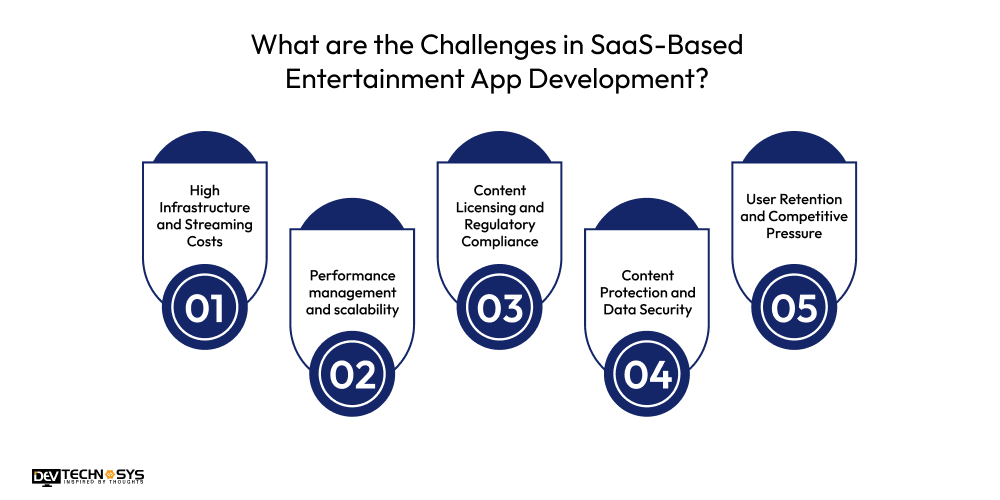
1. High Infrastructure and Streaming Costs
To provide smooth HD or 4K streaming, SaaS-based entertainment services require strong cloud infrastructure, international CDNs, and large bandwidth.
It becomes difficult to keep the balance between performance and operational entertainment app development cost, particularly as the user base and content collection grow.
2. Performance management and scalability
Jumps in traffic during live events, premieres, or the publication of viral material, and entertainment apps. For Video and music streaming SaaS app development, a well-thought-out, scalable architecture and ongoing performance optimization are necessary to provide steady performance, quick load times, and zero downtime.
3. Content Licensing and Regulatory Compliance
Managing copyright laws, geographical limitations, and content licenses across regions adds a great deal of complexity in SaaS entertainment app development. To avoid legal problems, businesses must make sure that local laws, digital rights agreements, and platform-specific policies are followed.
4. Content Protection and Data Security
Ensuring the security of customer data, payment details, and premium content is a big issue. Strong encryption, secure authentication, DRM systems, and compliance with data protection laws are crucial for preventing piracy and data breaches.
5. User Retention and Competitive Pressure
In this extremely competitive entertainment market, making user retention challenging. Continuous content updates, innovative features, personalization, and engaging experiences are required to reduce churn and maintain long-term user loyalty.
Want a chatbot demo or pricing? Fill the form and talk to our experts today.
Pick what you need below — you can select more than one — then tap Get detail to continue.
-
Chatbot demo dashboard
-
Cost to develop an app
-
Industry report
-
Case study
What is the Cost to Build a SaaS-Based Entertainment App?
Wondering how much does it cost to build a SaaS entertainment app? Well, the Saas application development cost typically ranges from $30,000 to $1,50,000. Total cost varies due to features, platform choice, tech-stack, UI/UX design, location of the development team, and more. There’s a difference between MVP vs full SaaS product cost.
- The basic MVP development cost: $30,000 to $70,000
- The mid-level SaaS entertainment development cost: $70,000 and $100,000.
- The advanced SaaS based entertainment app development costs: $100,000 to $1,50,000.
App Complexity |
Development Timeline |
Estimated Cost |
| Basic MVP | 3 – 5 Months | $30,000 – $70,000 |
| Mid-Level SaaS Entertainment App | 5 – 8 Months | $70,000 – $100,000 |
| Advanced SaaS Entertainment Platform | 8 – 12+ Months | $100,000 – $150,000+ |
Now that we know the cost to build a streaming app like Netflix or Amazon Prime, let’s learn about the factors that affect the SaaS entertainment app development cost.
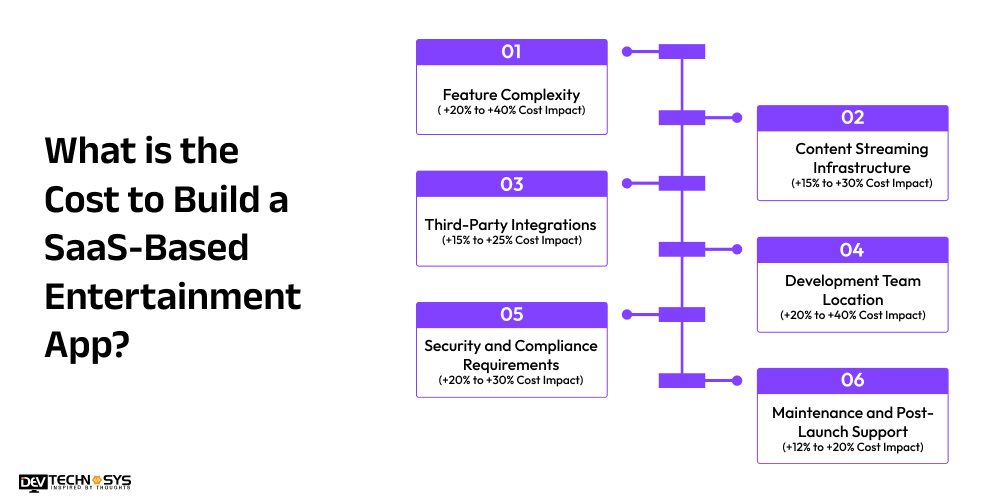
1. Feature Complexity ( +20% to +40% Cost Impact)
The number and complexity of features significantly impact SaaS entertainment app development costs. Basic apps require standard functionalities, while advanced platforms may include AI recommendations, live streaming, DRM protection, and social engagement tools.
2. Content Streaming Infrastructure (+15% to +30% Cost Impact)
SaaS entertainment app development cost also gets impacted because of the content streaming infrastructure. Video-on-demand (VOD), live streaming, adaptive bitrate streaming, and CDN integration demand specialized infrastructure, raising the overall cost to develop SaaS based entertainment app.
3. Third-Party Integrations (+15% to +25% Cost Impact)
Third-party integration involves payment gateways, social media platforms, analytics tools, CRM systems, recommendation engines, and advertising networks. Integrating them in your SaaS-based entertainment app will definitely increase the video streaming app development cost as well as complexity.
4. Development Team Location (+20% to +40% Cost Impact)
Another crucial factor that impacts the cost to develop a SaaS entertainment app is the location of developers. Hourly rates vary significantly across regions. SaaS MVP development teams in North America and Western Europe generally charge more than teams in Asia, Eastern Europe, or Latin America.
5. Security and Compliance Requirements (+20% to +30% Cost Impact)
The cost to build a SaaS-based entertainment app increases with the addition of DRM, encryption, GDPR, CCPA, PCI DSS compliance, MFA, and advanced cybersecurity measures. It is best to hire SaaS developers from reputable company for development.
6. Maintenance and Post-Launch Support (+12% to +20% Cost Impact)
Ongoing costs include bug fixes, security updates, server maintenance, feature enhancements, cloud hosting, and technical support to ensure long-term platform performance. The maintenance cost is between 12% to 20% of the total SaaS entertainment development cost.
Factor |
Impact on Development Timeline |
Estimated Cost Impact |
| Feature Complexity | +2 to 8 Weeks | +$10,000 – $40,000 |
| Content Streaming Infrastructure | +2 to 6 Weeks | +$8,000 – $30,000 |
| Third-Party Integrations | +1 to 4 Weeks | +$5,000 – $20,000 |
| Development Team Location | Varies by Region | 30% – 60% Cost Variation |
| Security & Compliance Requirements | +2 to 5 Weeks | +$8,000 – $25,000 |
| Maintenance & Post-Launch Support | Ongoing | 12% – 20% of Total Annual Cost |
What are the Monetization Models for SaaS Entertainment Apps?
Monetization is a crucial aspect for any business entering the entertainment app development industry. Here are the top revenue-generating strategies businesses can adopt to ensure high revenue and ROI generation.
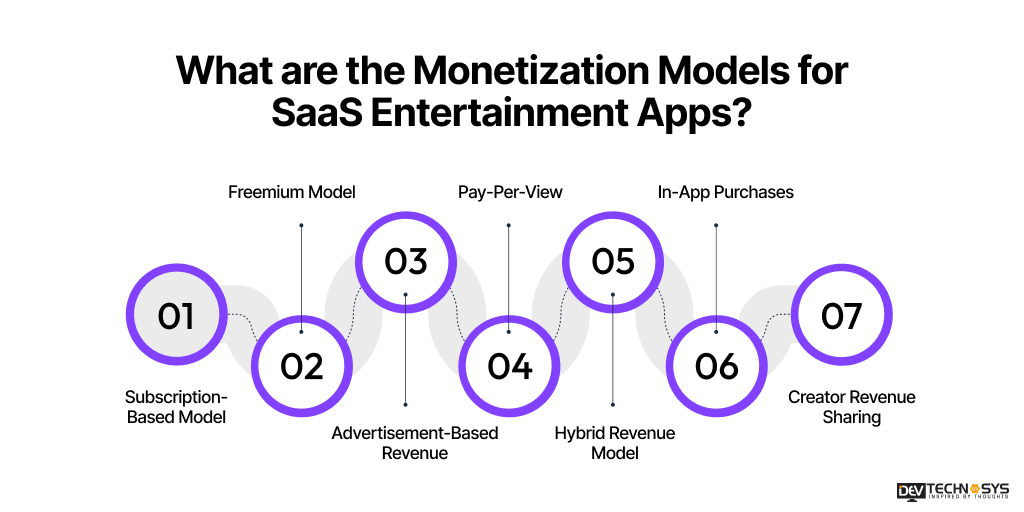
1. Subscription-Based Model ( Revenue Potential: High)
The subscription-based method creates ongoing revenue by collecting a small amount from users as a monthly or annual fee to access premium content. This SaaS monetization models ensures a steady flow of cash and increases client retention. This method is adopted by the top streaming platforms like Netflix and Spotify.
Industry Insights: Business of Apps states that the subscription-based models dominate SaaS entertainment platforms, contributing nearly 50% to 80% of total revenue across leading platforms.
2. Freemium Model ( Revenue Potential: Medium to High)
The freemium model is another popular revenue-generating method. It provides basic content or features for free. However, to access premium functionality, ad-free experiences, or exclusive content, users need to pay a certain amount. This approach attracts a large user base and increases conversion rates.
3. Advertisement-Based Model ( Revenue Potential: Medium to High)
This model monetizes user engagement through display ads, video ads, sponsored content, and programmatic advertising. Revenue increases with platform traffic, content consumption, and audience demographics, making it ideal for free entertainment platforms.
4. Pay-Per-View ( Revenue Potential: Medium)
Pay-per-view (PPV) is a service where consumers can pay for single events, movies, concerts, or unique content without having to pay for membership. This method is often used for live sports, virtual events, and premium broadcasts.
5. Hybrid Revenue Model ( Revenue Potential: Very High)
A hybrid approach leverages a mix of subscriptions, advertising, and pay-per-view services to optimize income streams. It gives users flexible payment alternatives while allowing entertainment firms to diversify income and lessen revenue dependency.
Industry Insights:
“According to our CTO, Mohit Nag, a hybrid revenue model provides the highest ROI for SaaS entertainment apps due to subscriptions, advertisements, and premium content purchases.”
What is the Future of SaaS Based Entertainment App Development?
The future of SaaS-based entertainment apps is driven by rapid technological innovation and evolving consumer expectations for on-demand, personalized experiences. Let’s see how technological advancements are shaping the future of SaaS based entertainment app development.
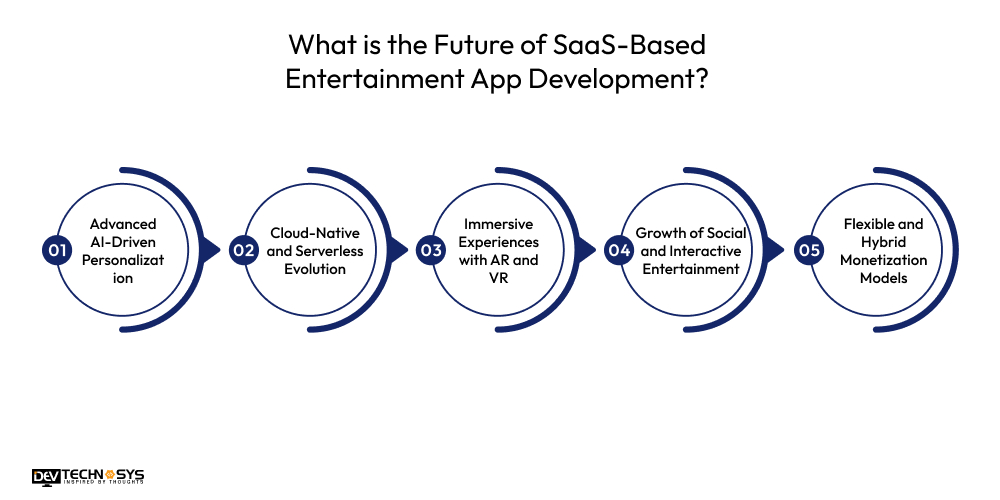
1. Advanced AI-Driven Personalization
AI and machine learning will deliver deeper personalization by analyzing real-time user behavior, preferences, and engagement patterns. This will result in more relevant recommendations, curated content feeds, and improved user satisfaction.
2. Cloud-Native and Serverless Evolution
Future platforms will increasingly adopt cloud-native and serverless architectures, enabling faster deployments, automatic scaling, reduced infrastructure management, and cost efficiency for global entertainment services.
3. Immersive Experiences with AR and VR
Augmented and virtual reality technologies will redefine digital entertainment by enabling immersive concerts, interactive storytelling, and next-generation gaming experiences that increase user engagement.
4. Growth of Social and Interactive Entertainment
Social features such as live chats, watch parties, creator-led interactions, and community-driven content will become integral. These social features play a huge role in turning entertainment apps into interactive digital ecosystems.
5. Flexible and Hybrid Monetization Models
The future will see wider adoption of hybrid monetization strategies that combine subscriptions, ads, pay-per-view, and microtransactions, offering users flexibility while helping businesses maximize revenue streams.
Build vs Buy vs Partner: Which Option is More Cost-Effective?
Businesses that want to establish a SaaS entertainment platform have three ways to implement it: develop it by themselves, buy an off-the-shelf platform, or cooperate with a company specializing in this particular kind of development. Each option has its pros, but the optimal combination of cost, customization, scalability, and time-to-market is frequently found by working with an experienced development firm.
Comparison Factor |
Build In-House |
Buy Ready-Made Solution |
Partner with Dev Technosys |
| Estimated Cost | $100,000 – $300,000+ | $10,000 – $50,000 | $30,000 – $150,000+ |
| Development Timeline | 9 – 18 Months | 2 – 8 Weeks | 3 – 12 Months |
| Customization | High | Limited | Fully Customized |
| Scalability | High | Limited by Vendor | Enterprise-Grade Scalability |
| Technology Stack Flexibility | Complete Control | Restricted | Latest Technologies & Frameworks |
| Maintenance & Support | Internal Resources Required | Vendor-Dependent | Dedicated Post-Launch Support |
| Development Risk | High | Medium | Low |
| Time-to-Market | Slow | Fast | Fast & Efficient |
| Expertise Required | High | Minimal | Managed by Industry Experts |
| Best For | Large Enterprises | Small Projects & MVPs | Startups, SMBs, and Enterprises |
Note: Collaborating with Dev Technosys offers a combination of cost-effectiveness, customization options, and speedier implementation, making it a cost-efficient alternative for organizations wishing to establish a scalable SaaS entertainment platform without the need to build an in-house staff.
Conclusion
The above-provided details and information talk about SaaS-Based Entertainment App Development. We hope this guide helps you understand the process of developing a SaaS-based entertainment app better and clears any doubts or queries you might have.
If you are a business that wants a high-performing SaaS entertainment app, then contact a top entertainment app development company like Dev Technosys. Their dedicated development team will cater to all your business needs and create an industry-leading platform.
Frequently Asked Questions
Find answers to the most common questions related to this article.
An SaaS-based entertainment app is a cloud-hosted platform that delivers digital content such as video, music, gaming, or live streaming through subscription-based or on-demand models, allowing users to access services online without complex infrastructure.
Businesses gain advantages such as scalable cloud infrastructure, recurring revenue opportunities, global market reach, faster feature updates, and personalized content delivery that improves user engagement and long-term retention.
Development typically takes 8 to 16 weeks for an MVP, while advanced platforms with AI-driven recommendations, multi-device compatibility, and high-quality streaming may require 4 to 6 months.
The cost to build an SaaS based entertainment app usually ranges from $8,000 to $25,000, depending on the app’s features, platform support, UI/UX design complexity, streaming infrastructure, and scalability requirements.
Effective monetization models include subscription plans, freemium access, pay-per-view content, in-app purchases, advertising, and brand partnerships, helping businesses generate diverse and sustainable revenue streams.