










Key takeaways:
-
- Entertainment app development trends 2026 have become an integral part of the daily lives of users, whether they are playing music or watching their favorite show.
- According to the market research, the market size of online entertainment was priced at USD 111.30 billion in 2025. It is expected to reach USD 261.23 billion
- YouTube is one of the most famous and widley used entertainment apps in the world. Here, users can upload, watch, share, and comment on a large amount of content.
- AI-Powered Personalization, 5G-Enabled Applications, Cloud Computing Integration, Enhances Cybersecurity & Privacy, and Sustainable & Green Development are some of the latest trends of entertainment apps.
- Fully AI-Generated Movies, Music & Games, Holographic & Mixed Reality Experiences, and Emotion-Responsive Entertainment Apps are some of the trends that can take place in future entertainment app developments.
We are in 2026, and entertainment apps have become a part of our everyday lives. Whether music playing in your car, weekend plans for a web series, or watching recipes while cooking, entertainment apps are everywhere. In short, entertainment apps feel less like tools and more like living worlds.
Imagine getting to an app that plays music according to your mood, shows according to your energy, and for game where your friends are waiting. This is the new era of entertainment app development, where smart technologies are changing the habits of users.
Stories are not just watched, music is not just heard, but they are experienced through entertainment app development trends. These trends include AI-personalization, social interactions, intelligent content ecosystems, and more that work as per the user’s mood, behavior, or moment.
It’s time to learn about the entertainment app development trends 2026 that are redefining how people relax, play, and connect worldwide.
What Are The Market Predictions For Entertainment Apps?
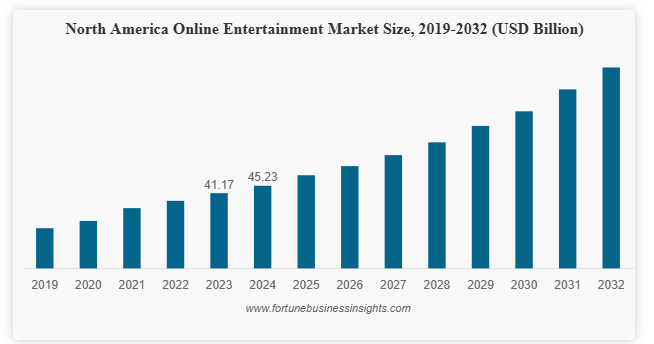
The market statistics on entertainment apps display the expansion of these apps all over the world. It shows the future predictions, user adoption trends, and revenue growth patterns. So, have a look at the market stats for entertainment apps analyzed by Fortune Business Insights.
- The market size of online entertainment was priced at USD 99.98 billion in 2024 and USD 111.30 billion in 2025
- The market is expected to reach USD 261.23 billion by 2032, growing at a CAGR of 13.96% during the forecast period from 2025 to 2032.
- In 2024, North America led the online entertainment app market with a market share of 24% of the overall market revenue.
- As per the global market, the gaming entertainment app trends segment is estimated to retain the largest market share in 2026.
What Are The Market Analysis Of YouTube?
We are all familiar with YouTube, a leading video-sharing platform that offers an on-demand entertainment experience worldwide. This app was launched in 2005 by Chad Hurley, Steve Chen, and Jawed Karim. It is considered the best entertainment app development that uses advanced AI algorithms for a highly engaging experience.
On YouTube, users can access videos, both pre-recorded and live, delivered on the internet in real-time. It also offers personalized content, enhances creator discovery, and delivers highly engaging and entertaining content.
Here we will discuss the market stats and analysis of YouTube:
- As of 2025, YouTube has more than 85 billion monthly active users all around the world.
- It is ranked #2 for being the most visited website, with the monthly visits crossing 75 billion.
- More than 14 billion videos are uploaded on YouTube on a daily basis.
- YouTube Shorts itself has generated more than 70 billion views daily.
- Approximately 125 million people have subscribed to YouTube Premium.
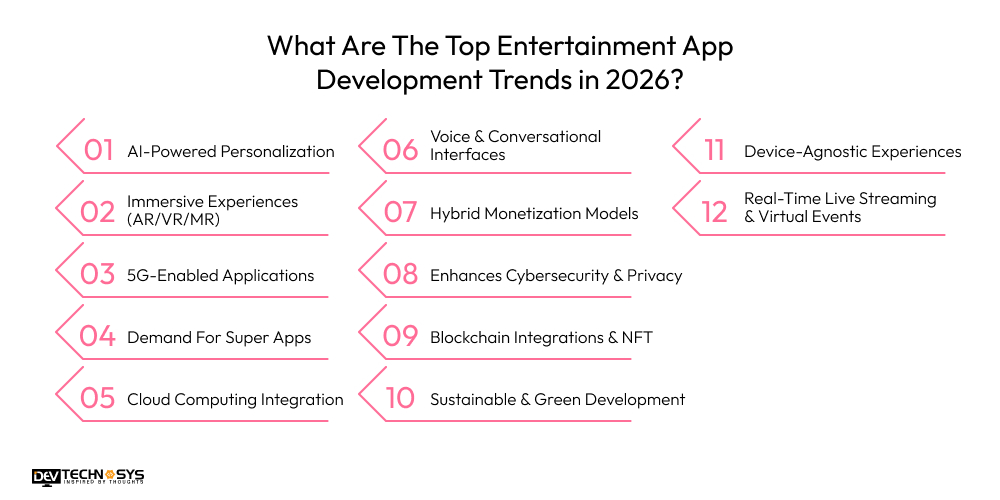
What Are The Top Entertainment App Development Trends in 2026?
An entertainment or video streaming app development company implements artificial intelligence, Machine learning, AR/VR/MR experiences, 5G connectivity, and more as development trends. In this section, we will discuss some widely preferred trends for entertainment app development 2026.
1. AI-Powered Personalization
AI-powered personalization uses the preferences and behavior of the user to deliver tailored content with smart recommendations and adaptive interfaces. The future of entertainment apps depends on AI and generative AI entertainment apps. It improves user engagement, retention, and content delivery on multiple platforms.
2. Immersive Experiences (AR/VR/MR)
XR AR VR entertainment apps can generate attractive storytelling, gaming, and social interactions. These realities upgrade the experience of interactive entertainment apps and metaverse entertainment apps. Some of the top entertainment app development companies allow users to experience content beyond screens in a more engaging way.
3. 5G-Enabled Applications
5G entertainment app experiences more advancement and demand due to ultra-fast and seamless streaming. It also offers low-latency gaming and uninterrupted live interactions. It gives rise to the video streaming app trends 2026. Along with this, 5G technology boosts the performance and responsiveness of edge computing entertainment apps.
4. Demand For Super Apps
The demand for super apps is also extreme because people prefer streaming, social, gaming, and payments, all into one platform. Such apps are backed by mobile app development services and companies. These apps simplify the streaming journey of users and dominate the entertainment app development market with convenience and scalability.
5. Cloud Computing Integration
Cloud computing integration usually provides users with scalable storage, real-time updates, and seamless access. It is among the widely used entertainment app development trends in cloud-based entertainment apps that power live streaming app development. It also reduces the infrastructure costs and improves performance consistency globally.
6. Voice & Conversational Interfaces
Voice and conversational interfaces, or Natural Language Processes (NLP), allow users to navigate through the app hands-free and perform smart searches. Be it podcast app development solutions or music streaming app development trends, NLP is really popular. It improves accessibility, personalization, and user comfort in different entertainment platforms.
7. Hybrid Monetization Models
Hybrid monetization models are well-known entertainment app development trends that blend subscriptions, ads, in-app purchases, and premium content together. It is a common trend in short or long video app development, dating platforms, and OTT services. This model helps in maximizing the revenue of the app while presenting flexible pricing according to user choices.
8. Enhances Cybersecurity & Privacy
Stronger cybersecurity is really necessary to protect the user’s privacy, data, payments, and content rights. Therefore, social entertainment app features encryption, compliance, and secure architectures broadly. An upgraded cybersecurity helps in building user trust in the app while efficiently reducing the entertainment app development cost.

9. Blockchain Integrations & NFT
For transparent transactions, digital ownership, and creator monetization, people are preferring blockchain entertainment apps. Apart from this, NFT-based entertainment platforms help users support exclusive content, collectibles, and fan engagement. It revolutionizes the way value is created and shared in digital entertainment ecosystems.
10. Sustainable & Green Development
Sustainable and green development focuses on codes, servers, and data usage that is energy-efficient and reduces costs. Such eco-friendly and energy-saving models are highly supported in numerous web app development services. They prioritize sustainable practices without compromising the app’s performance and user experience.
11. Device-Agnostic Experiences
The device-agnostic design in an entertainment app makes sure the app works seamlessly on various mobiles, smart TVs, and wearables. It allows the app to offer a consistent experience on various platforms. Through this approach, the user accessibility and engagement are improved. It ensures uninterrupted entertainment regardless of the device users choose to connect with.
12. Real-Time Live Streaming & Virtual Events
One of the most preferred entertainment app development trends in 2026 is real-time live streaming and virtual events. It helps in driving real-time user engagement through live concerts, sports, or interactive shows online. For this, you can hire an OTT app development company to integrate such features to make the live infrastructure scalable.
Entertainment App Development Trends Examples
The entertainment app industry in 2026-2027 is going through a major transformation. This transition is driven by:
- Artificial intelligence
- Immersive technologies
- Cloud infrastructure
- Cross-platform ecosystems
The users in this contemporary world are expecting something more than content consumption. They demand personalized, interactive, and seamless digital experiences across devices. Here we have explained real-world examples of each entertainment app development trends. These examples are evidence that these trends are shaping the global market, along with real-world implementations.
Entertainment App Development Trends at a Glance
| Trend | Real Example | Business Impact |
| AI-Powered Personalization | Netflix | Higher retention & engagement |
| Immersive AR/VR/MR | Apple Vision Pro | Interactive content experience |
| 5G Streaming Applications | YouTube | Low-latency HD streaming |
| Super App Ecosystems | Multi-service engagement | |
| Cloud-Based Architecture | Spotify | Scalability & global delivery |
| Voice & Conversational UI | Amazon Alexa | Hands-free accessibility |
| Hybrid Monetization Models | Disney+ | Multiple revenue streams |
| Cybersecurity & Privacy | Netflix | Trust & data protection |
| Blockchain & Digital Ownership | NBA Top Shot | New revenue models |
| Sustainable Streaming Tech | Akamai Technologies | Reduced carbon footprint |
| Device-Agnostic Experiences | YouTube | Seamless cross-device usage |
| Live Streaming & Virtual Events | Twitch | Real-time audience engagement |
1. AI-Powered Personalization (Core Growth Driver)
Real-World Example: Netflix is the biggest example of this, using machine learning models widely. It helps in analyzing viewing patterns, watch time, preferences, and behavioral signals to offer personalized recommendations.
2. Immersive Experiences (AR/VR/MR)
Real-World Example: Just look at the Apple Vision Pro that accelerated the adoption of AR/VR. It allows users to experience movies, gaming, and virtual environments in a more interactive and three-dimensional format.
3. 5G-Enabled Entertainment Applications
Real-World Example: Take the example of YouTube, which benefits from the 5G technologies like:
- Ultra-low latency
- Higher bandwidth
- Faster content delivery
These technologies enable seamless HD and 4K streaming experiences.
4. Rise of Super App Ecosystems
Real-World Example: We can witness the rise of super app ecosystem through WeChat. It integrates messaging, payments, gaming, video streaming, and mini-programs within a single platform.
5. Cloud-Native Entertainment Architecture
Real-World Example: Spotify broadly uses cloud infrastructure to deliver millions of tracks throughout the world. It allows real-time personalization and playlist generation.
6. Voice & Conversational Interfaces
Real-World Example: For voice and conversational interfaces, have a look at the Amazon Alexa. It enables users to control music, videos, and smart entertainment systems using voice commands.
7. Hybrid Monetization Models (Fastest Growing Revenue Strategy)
Real-World Example: Disney+, a modern entertainment application gifted towards hybrid revenue models. It integrates subscription, advertisement, and ad-supported tiers for revenue streams.
8. Cybersecurity & Privacy-First Entertainment Apps
Real-World Example: Patforms like Warner Bros Discovery heavily invest on encryption technologies, DRM systems, and account protection mechanisms. It is helpful in preventing piracy and data breaches.
9. Blockchain & Digital Ownership in Entertainment
Real-World Example: NBA Top Shot allows users to buy, sell, and trade officially licensed digital sports collectibles. It introduces verified blockchain and digital ownership creators and entertainment platforms.
10. Sustainable & Green Streaming Infrastructure
Real-World Example: Akmai Technologies majorly works on energy-efficient content delivery networks. It helps in reducing carbon emissions while maintaining high streaming performance.
11. Device-Agnostic Entertainment Experiences
Real-World Example: As users want to enjoy content on multiple devices, Plex ensures a consistent viewing experience across all platforms. This cross-device compatibility improves user retention and increases lifetime user value.
12. Real-Time Live Streaming & Virtual Events
Twitch enables real-time interaction between creators and audiences, supporting gaming streams, virtual events, and influencer-driven content. This trend is driving higher engagement rates and new monetization opportunities.
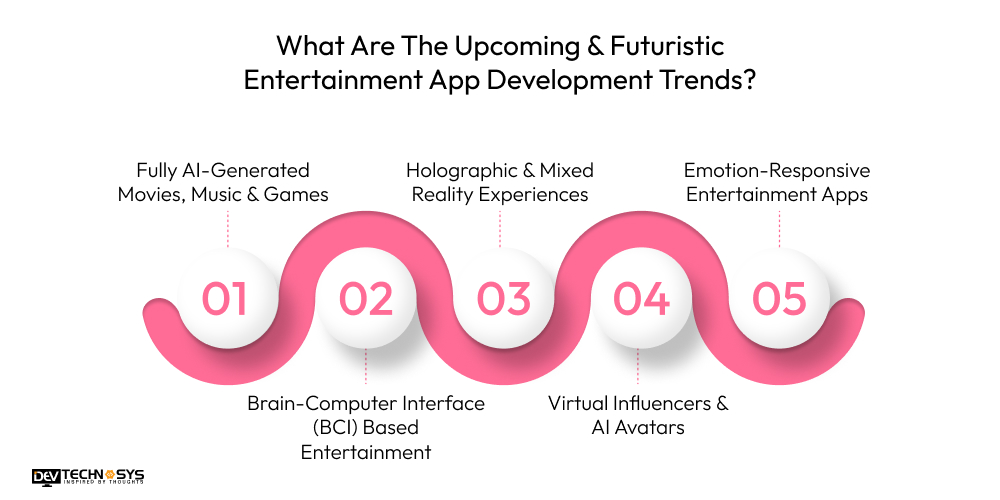
What Are The Upcoming & Futuristic Entertainment App Development Trends?
Despite the entertainment and video streaming app trends 2026 studies above, here are trends that can be widley used in the future. Now we will discuss some upcoming and futuristic trends in entertainment app development solutions.
1. Fully AI-Generated Movies, Music & Games
AI in entertainment apps in the future will fully support AI-generated movies, music, and games that have very little human input. This system helps in creating scripts, soundtracks, and gameplay dynamically. It reshapes the OTT app development trends and redefines the way entertainment app development is done.
2. Brain-Computer Interface (BCI) Based Entertainment
Brain Computer Interface BCI- based entertainment permits the users to control the apps using their brain signals. In the future, on-demand app development company solutions will be going to use this technology. This technology can be best for immersive gaming, relaxation apps, and accessibility-focused experiences across entertainment platforms.
3. Holographic & Mixed Reality Experiences
Holographic and mixed reality experiences combine both the physical and digital worlds. Such apps that integrate holographics and mixed reality enhance live shows, education, and storytelling. In short, it can offer next-level dynamics that would be beyond traditional screens and interactive media formats.
4. Virtual Influencers & AI Avatars
Another futuristic trend includes virtual influencers and AI Avatars, making the content creation and social engagement more entertaining and exciting. They will be widely used in short video app development, dating platforms, and brand marketing. This trend can offer a scalable, customizable personality for entertainment, interaction, and audience connection.
5. Emotion-Responsive Entertainment Apps
The next extremely popular upcoming or futuristic trend is emotion responsiveness in entertainment apps. It works by analyzing facial expressions, voice, or behavior of the human. Many companies and services are going to use this trend to adjust recommendations, mood-based playlists, and personalized viewing experiences.
Final Words
In 2026, the entertainment app development is marked as a turning point due to multiple trends. These trends have combined technology and creativity to redefine digital experiences. With this, entertainment apps have become engaging and user-centric than ever.
Be it AI-personalization or AR/VR implementations, entertainment apps are seamlessly meeting the rising expectations of users. Along with these entertainment app trends, a social media app development company also focuses on security, privacy, and seamless performance.
The worldwide audience continues content consumption, raising the demand for innovative, accessible, and socially connected entertainment apps. The next-gen entertainment app development highlights a future where entertainment apps inspire connection, creativity, and memorable digital experiences.
Frequently Asked Questions
Find answers to the most common questions related to this article.
AI is transforming the entertainment apps by offering personalized content according to user preferences. It also automates the recommendations, improves in-app chats, and optimizes content delivery. Especially if we talk about 2026, AI has enabled adaptive storytelling, smarter search, real-time moderation, and data-driven creativity.
The cost to build an entertainment app will commonly be estimated from $8,000 to $30,000. The final development cost depends on the app’s complexity, number of features, security, backend infrastructure, third-party integrations, and so on.
In 2026, the increased focus is on security and privacy because an entertainment app collects sensitive data of users. It raises the cyber threat, so stricter regulations, user awareness, encryption, secure payments, data transparency, and ethical AI are adopted.
Yes, the demand for entertainment apps continues to grow in 2026 as the demand for immersive and on-demand entertainment remains intact. The constant growth is also driven by expanding smartphone users, faster networks, global content consumption, social integration, and evolving lifestyles.
Some of the latest entertainment app development trends for 2026 include:
● Low-Code/No-Code (LCNC)
● Artificial Intelligence
● Machine Learning
● AR/VR/ and Mixed Reality (XR)
● 5G Technology
● Interactive Content