













Football isn’t just a sport, it’s a religion. And in 2026, the crowd moved worldwide.
With 3.5 billion football fans around the globe hungry for live action on their screens, the FIFA live streaming app market has never been more competitive.
No longer are days when fans would rush to get home to watch a football match on television. Modern day fans demand live streams in real-time, instant highlights and an interactive experience all from one single app, on any device.
Whether you’re an entrepreneur willing to step in a billion dollar market, or a tech company ready to develop a sports platform which sets trends. This guide will give you a clear view of the indispensable features and tech stacks, as well as time scales and estimated costs involved in the FIFA live streaming app development.
Build your FIFA live streaming app, and begin your journey to the peak.
What Is A Fifa Live Streaming App?
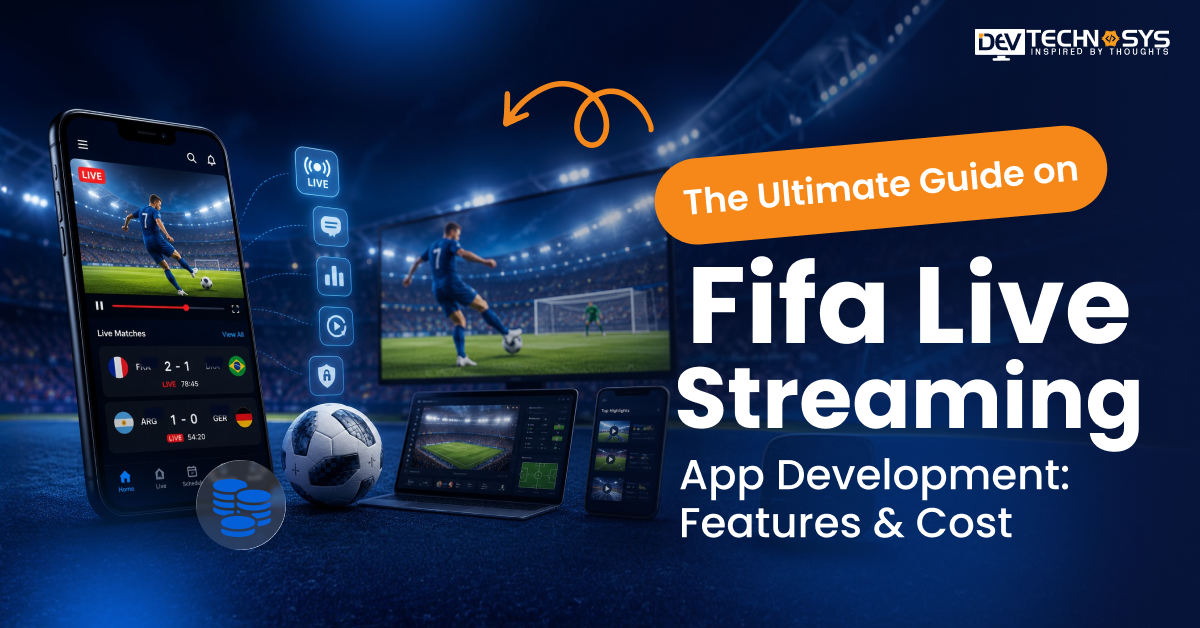
FIFA live streaming app is an electronic system with a purpose of broadcasting real-time coverage of football related live events, tournaments, and matches of FIFA on mobile devices. The system will provide the users with the real-time video coverage, commentation, scores and the highlights from the match they’re watching, on the go.
In general, modern fans of the game, rather than using television to watch games, use the system. In simple terms, a FIFA live streaming app replaces television to a large extent as an entertainment media in the field of sports and delivers content directly through the Internet.
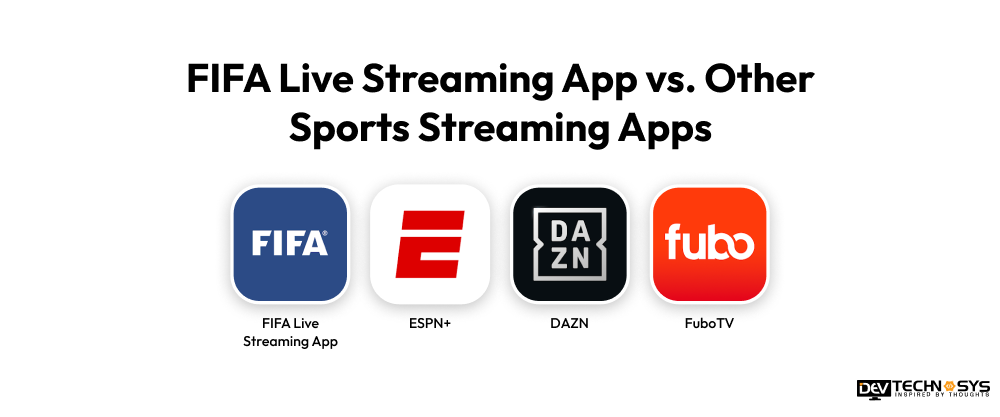
FIFA Live Streaming App vs. Other Sports Streaming Apps
There are many different ways to utilise your video streaming apps on a digital platform, however not all of these applications will offer you a quality experience. Here is how a specific FIFA live streaming application stacks up against three of the biggest sports streaming applications currently available.
Feature |
FIFA Live Streaming App |
ESPN+ |
DAZN |
FuboTV |
| Content Focus | Football (soccer) only | Multi-sport (US-centric) | Multi-sport (boxing, MMA, football) | Multi-sport (heavy on live TV) |
| FIFA/Soccer Coverage | Exclusive FIFA tournaments | Limited soccer | Strong soccer & football leagues | Broad soccer coverage |
| Live Streaming | Yes | Yes | Yes | Yes |
| On-Demand Replays | Yes | Yes | Yes | Limited |
| Global Availability | Worldwide | Mostly US | 20+ countries | US, Canada, Spain |
| Subscription Model | Free / Official FIFA+ | Paid ($10.99/mo) | Paid ($19.99/mo) | Paid ($79.99/mo) |
| Ads | Yes (free tier) | Minimal | No | No |
| Mobile App | Yes | Yes | Yes | Yes |
FIFA & Football Streaming Market Size in 2026
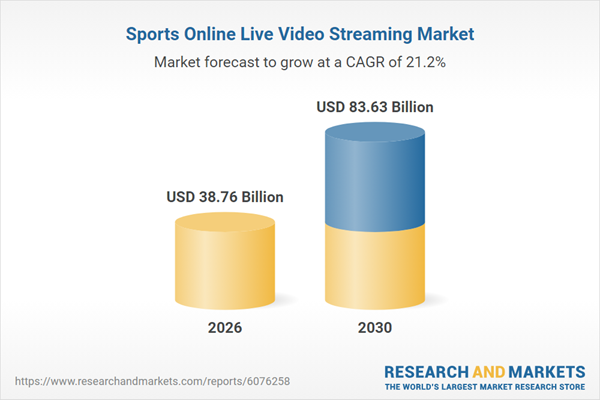
- According to Global News Wire According to forecasts, the worldwide market for Live sports video streaming will grow from a projected $31.86 billion in 2025 to $38.76 billion by 2026 due to continued popularity among fans who watch sporting events on both traditional television channels and through over-the-top (OTT) platforms.
- Total global spending globally on sports programming rights will reach $67.3 billion by 2026.
- The 2026 FIFA World Cup is expected to generate $3.9 billion worth of broadcast and media rights, making it the most commercially valuable FIFA World Cup in history.
- FIFA expects to achieve 6 billion global engagements during the 2026 World Cup compared to 5 billion during the 2022 tournament.
- FIFA’s total revenue for 2026 will be budgeted at $8.91 billion, with 44% of total revenue coming from broadcasting rights.
- The increased number of teams participating in the expanded 48-team, 104-match FIFA World Cup in 2026 has added approximately 62.5% to the number of potential broadcasts and advertisements available from this tournament when compared to last year’s FIFA World Cup.
- Streaming services including DAZN, FOX One, Peacock, and several other regional OTT providers are aggressively acquiring soccer-related streaming rights in order to capture the anticipated increase of viewers for the upcoming FIFA World Cup.
Planning a Video Streaming Project?
Get a tailored development cost estimate in a few simple steps.
- 3 quick steps
- 100% free
- Reply in 1 business day
2 Minutes Read
Why Build a FIFA Live Streaming App in 2026?
The FIFA World Cup in 2026 provides huge opportunities for brands and broadcasters. With increasing demand for live streaming and widening global audiences, advertising revenue is booming, proving football streaming apps to be a sound digital business.
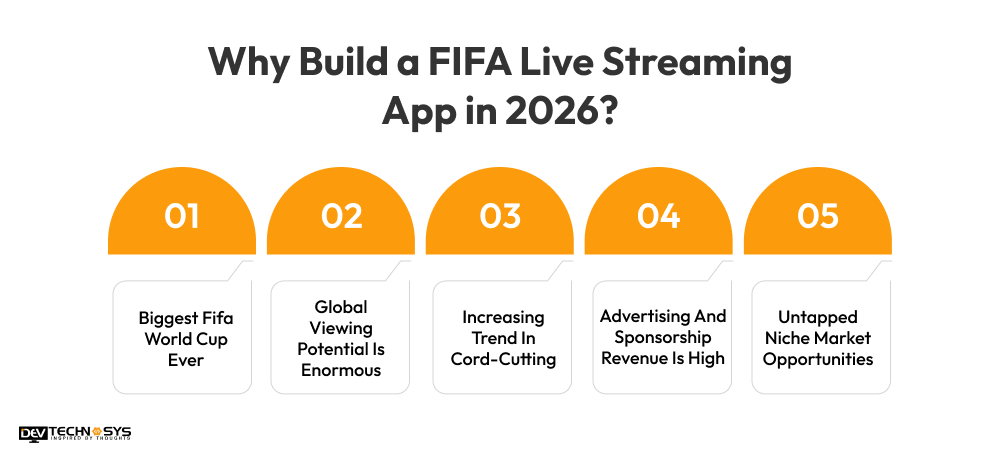
1.Biggest Fifa World Cup Ever
Featuring 48 teams and 104 games played throughout the USA, Canada and Mexico, the 2026 FIFA World Cup is going to set new benchmarks. The expanded nature of the competition ensures longer viewer engagement, more hours of streaming and higher revenue generation potential for app owners and broadcasters alike.
2.Global Viewing Potential Is Enormous
Football continues to be the world’s most popular sport, attracting an estimated 1.5 billion viewers to the final of the 2022 FIFA World Cup. The dedicated football streaming application will tap into this immense viewership in a highly compelling and monetizable way during both international competitions and the regular football season.
3.Increasing Trend In Cord-Cutting
The number of cable subscriptions is continuing to decline as consumers turn to easily adaptable digital streaming services. As thousands of households make the transition, football streaming applications are well-positioned to capture audiences by offering mobile access, on-demand viewing and personalized sports content.
4.Advertising And Sponsorship Revenue Is High
Sports streaming has one of the highest CPM (cost per thousand) rates among digital advertising methods. Premium placement opportunities, sponsorships and branding create substantial and recurring revenue streams for app providers during huge international events and in general throughout the regular football season.
5. Untapped Niche Market Opportunities
Many football fans want access to more features than typical streaming services provide such as commentary in different languages, accessible options, live stats, integrated fantasy games, or second-screen engagement. These niches in the market allow businesses to create and develop niche brands and loyal fan bases.
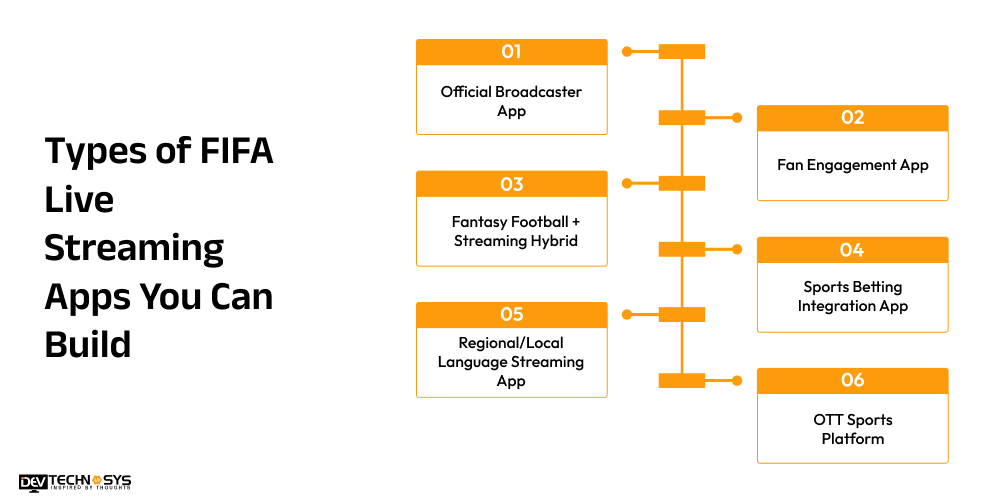
Types of FIFA Live Streaming Apps You Can Build
Various broadcasting models relating to FIFA are available to meet different business goals and target audiences. Different types, from fantasy sports to OTT providers and official broadcasters, require an investment in football match streaming app development, licensing, features, and the choice of which model will generate the most revenue.
App Type |
Example |
| Official Broadcaster App | FOX Sports, BBC iPlayer, ITVX, TSN |
| Fan Engagement App | OneFootball, FotMob, SofaScore |
| Fantasy Football + Streaming Hybrid | Sorare, Sleeper, ESPN Fantasy Football |
| Sports Betting Integration App | Bet365, DraftKings Sportsbook, FanDuel |
| Regional/Local Language Streaming App | Shahid, JioHotstar, TOD TV |
| OTT Sports Platform | DAZN, ESPN+, Sony LIV |
1. Official Broadcaster App
An official broadcaster app takes broadcasting rights for the FIFA streams, offering matches to fans at home. Such apps often provide streaming in HD quality, offer replays and highlights, multi-camera views, exclusive premium content, and are monetized by advertisements and paid membership services.
2. Fan Engagement App
Fan engagement apps focus on real-time scores, live commentary, player statistics, game analyses, polls and discussions without offering live streams of the match.
These platforms appeal to football fans looking for interaction and community engagement, and make money by showing ads, paid features, sponsorship deals and affiliate partnerships.
3. Fantasy Football + Live Streaming Hybrid
Such an app combines fantasy sports team management with live streaming of games. The users get to watch games while simultaneously managing their fantasy teams.
Real-time statistics, leaderboards, awards, and social competition keep fans engaged, and create several avenues for earning money via subscriptions, in-app purchases, etc.
4. Sports Betting Integration App
Sports betting streaming apps integrate live football broadcasts with real-time sports betting markets and dynamically changing odds. These apps provide an immersive and exciting experience as users can watch the games and place their bets at the same time, thereby offering revenue opportunities from commissions, sponsorships and transaction fees.
5. Regional or Local language Streaming App
These streaming platforms offer localized content, commentary, and user interface to reach a wider audience in their specific language and cultural background.
Support for different languages, such as Hindi, Arabic, Spanish etc., can increase the reach and make it easier for football fans who speak these languages to access and enjoy the streams.
6. OTT Sports Platform
OTT Sports Platforms offer users a subscription-based access to a wide array of sporting events, and FIFA tournaments often act as major drivers of content on such platforms.
The platform features include live streaming, highlights, on-demand viewing, personalized recommendations, and a cross-device compatible user experience.
How to Build a FIFA Live Streaming App: Step-by-Step
Creating a FIFA live streaming application involves more than just the ability to broadcast videos. Companies working with a live sports streaming app development company can not only develop quickly but also establish an extensible platform, ensure legal compliance, and provide a flawless viewing experience for soccer fans across the globe. Let’s explore the sports live streaming app development guide:
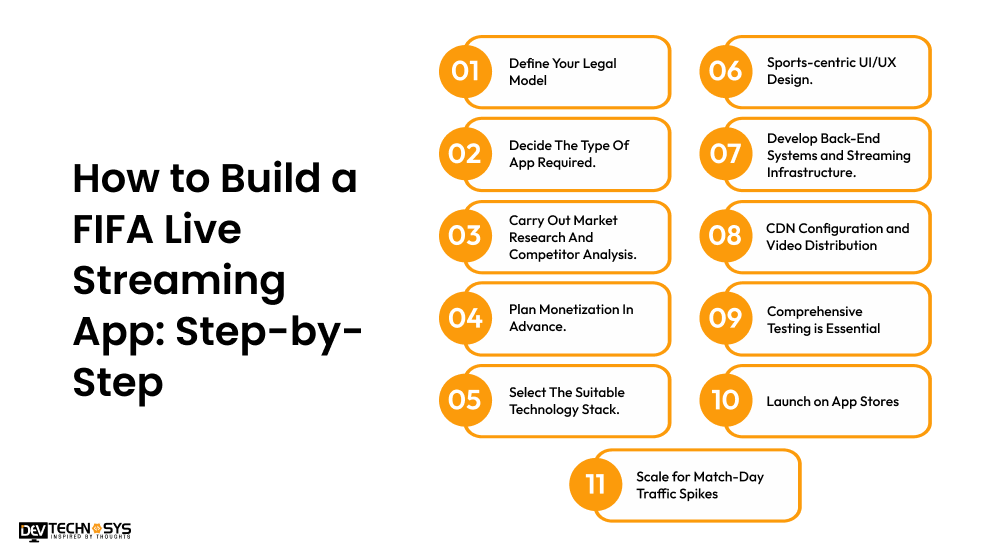
Step 1: Define Your Legal Model
Before you progress to any developmental stage, establish the rights that you have on streaming football matches. A video streaming app development company can help you adhere to all the licensing policies, broadcast deals, content distribution agreements, copyright issues, and more so you can avoid potential legal problems.
Step 2: Decide The Type Of App Required.
Your platform might be a full-fledged streaming service, a fan engagement app, or a package dealing with both the above. The kind of platform you need will influence licensing and, thus, technical and administrative requirements, selected payment models, as well as the long-term business plan and scalability of your platform.
Step 3: Carry Out Market Research And Competitor Analysis.
Identify leading sports streaming applications and their consumers, their unique selling propositions (USPs), target audiences, market gaps, preferred payment methods, subscription types, trends etc.
A professional sports mobile app development company can assist in conducting thorough market research to identify the market opportunities and create FIFA streaming apps that stand out from other competitions.
Step 4: Plan Monetization In Advance.
It is necessary to create streams of revenue from the beginning; the forms of revenue might be a mix of subscription fees, in-app advertisements, sponsors, Pay-Per-View (PPV) access, different levels of premium membership, affiliation with online businesses, etc. Planning the features of the application in advance helps a business to work towards an objective-driven FIFA streaming app architecture.
Step 5: Select The Suitable Technology Stack.
A list of required technology components should include the types of mobile app technologies to be used, backend architecture, Cloud infrastructure, content and data storing mechanisms, APIs, analytic tools and components, stream protocols, and more.
One of the best video streaming app development companies ensures an organization has access to a scalability enabled tech architecture that can facilitate high-quality and robust video delivery and also provides the ability for it to be upgraded and modified later on.

Step 6: Sports-centric UI/UX Design.
In this sixth step of the FIFA live streaming app development process, users look for a readily available app where they can obtain live matches, results, stats, and highlights of their teams and players without a hassle.
Sports apps are quite different from normal ones. It should allow quick updates, multi-view capability, dynamic presentation and interactive features and have a layout.
Step 7: Develop Back-End Systems and Streaming Infrastructure.
Hire dedicated developers to build a robust back-end architecture that takes into account everything from user registration, subscriptions, content, and stream management, analytics, updates.
Provides reliable video streaming services during matches, important tournaments, and particularly during highly rated competitions like the FIFA world cup, when traffic to a certain point can increase exponentially.
Step 8: CDN Configuration and Video Distribution
A Content Delivery Network (CDN) is required for streaming live sports globally without delays in service or stream playback. A reliable streaming architecture also ensures improved playback quality and a choice for adaptive bitrate streaming which can adapt to various network conditions.
Step 9: Comprehensive Testing is Essential
A comprehensive and stringent testing procedure must be applied to test stream quality, app’s responsiveness, user interface/user experience (UI/UX), and security functions of the app, payment gateways, and more importantly, loading speed of the app during peak hours and traffic demands. The application must be load-tested to ensure constant uptime.
Step 10: Launch on App Stores
The application should be prepared to be launched and downloaded on web browsers as well as android and iOS mobile phones, smart televisions, etc. The developer team must make sure to adhere to store policies with regard to content and also ensure payment and privacy terms are complied with.
Step 11: Scale for Match-Day Traffic Spikes
For the post launch period, the functioning and reliability of the app depends on how well it manages high traffic flow during specific games and entire tournaments.
The best live sports streaming app development company can help prepare the appropriate scaling infrastructure and mechanisms to handle excessive load while delivering impeccable service quality.
Must-Have Features of a FIFA Live Streaming App
A FIFA live streaming app will not be complete without user-friendly streaming tools and comprehensive administrative capabilities. All football live streaming app features collectively improve the user experience, encourage loyalty, enhance the monetization potential and simplify platform management.
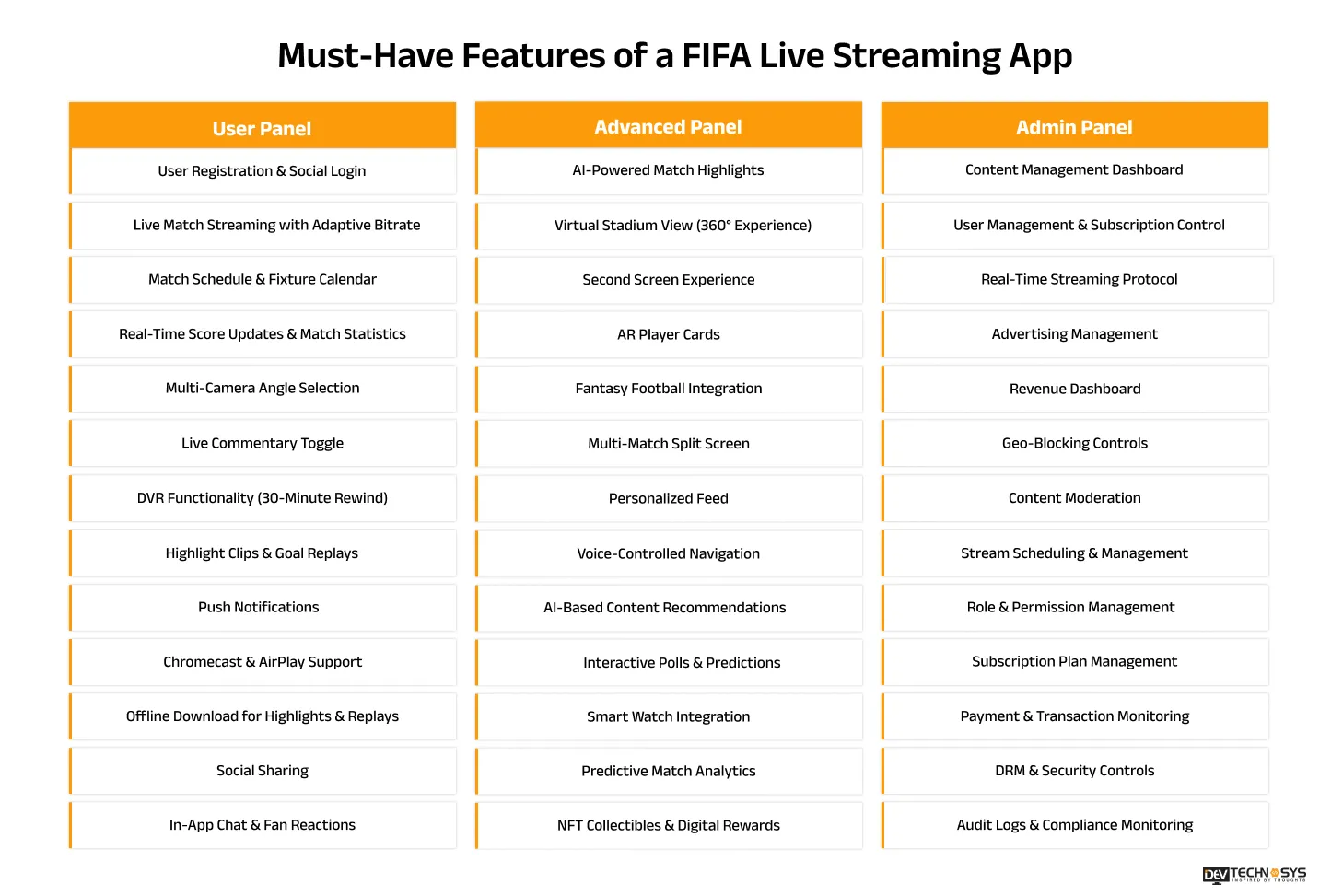
User Panel Features |
Advanced Features |
Admin Panel Features |
| User Registration & Social Login | AI-Powered Match Highlights | Content Management Dashboard |
| Live Match Streaming with Adaptive Bitrate | Virtual Stadium View (360° Experience) | User Management & Subscription Control |
| Match Schedule & Fixture Calendar | Second Screen Experience | Real-Time Streaming Protocol |
| Real-Time Score Updates & Match Statistics | AR Player Cards | Advertising Management |
| Multi-Camera Angle Selection | Fantasy Football Integration | Revenue Dashboard |
| Live Commentary Toggle | Multi-Match Split Screen | Geo-Blocking Controls |
| DVR Functionality (30-Minute Rewind) | Personalized Feed | Content Moderation |
| Highlight Clips & Goal Replays | Voice-Controlled Navigation | Stream Scheduling & Management |
| Push Notifications | AI-Based Content Recommendations | Role & Permission Management |
| Chromecast & AirPlay Support | Interactive Polls & Predictions | Subscription Plan Management |
| Offline Download for Highlights & Replays | Smart Watch Integration | Payment & Transaction Monitoring |
| Social Sharing | Predictive Match Analytics | DRM & Security Controls |
| In-App Chat & Fan Reactions | NFT Collectibles & Digital Rewards | Audit Logs & Compliance Monitoring |
Legal and Licensing Requirements For Live Streaming App
Broadcasting rights are fundamental to any FIFA live streaming platform. Technology can be developed fairly easily but legal distribution of football matches is only possible after acquiring relevant broadcasting/streaming rights to comply with regional laws.
Knowing how to meet those licensing requirements is critical so businesses reduce their risk of legal challenges when creating sustainable streaming platforms.
Why Broadcasting Rights Are the #1 Challenge in Football Streaming?
FIFA controls the entire chain of legal distribution related to all live match broadcasts with exclusive agreements with global broadcasters/streaming providers.
Unlike user-generated content platforms, any applications that stream FIFA match content cannot stream that content legally without having obtained permission from the rights holder to do so. Because of this, licensing represents the largest barrier for the application owner to enter into the football streaming market.
How FIFA Distributes Broadcasting Rights by Region?
FIFA sells broadcast rights on an individual basis for each geographic territory (country), allowing each media company operating in that geographic territory to own exclusive streaming/television rights to FIFA events within that geographic territory.
Therefore, if the broadcaster has obtained broadcast rights from FIFA for one geographic territory, they may not necessarily have the right to stream that same event in another geographic territory. This exclusivity results in a complicated and multilayered licensing environment that app owners must navigate.
What Happens If You Stream Without a Licence?
Streaming FIFA content without a valid license can mean costly penalties and/or criminal charges. Rights holders continue to actively monitor for piracy and copyright violations using sophisticated content protection systems.
Potential penalties include:
- DMCA takedown notices
- Mobile app removal from app stores
- Copyright infringement lawsuits
- Financial penalties and damages
- Website blocking by internet service providers
- Permanent suspension of streaming infrastructure and services
Legal Ways to Build a Football Streaming App Without Owning Broadcast Rights
Businesses interested in entering the football streaming market are not limited to spending large sums for FIFA broadcast rights. They can explore opportunities to engage with football fans and monetize their audience through the use of technology.
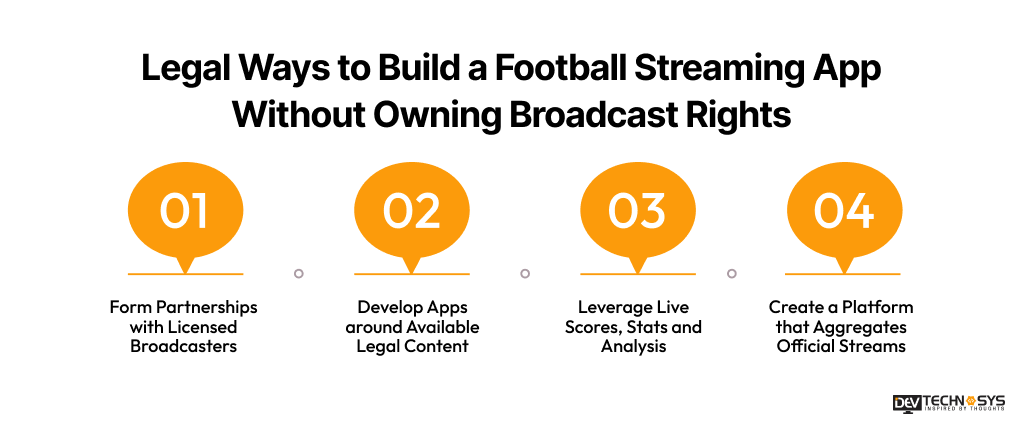
1. Form Partnerships With Licensed Broadcasters
Businesses can provide technology support to broadcasters who currently own streaming rights. These businesses would help create and operate the platform while the broadcaster provides the legally-licensed video content to stream through that technology.
2. Develop Apps around Available Legal Content
Businesses can create and build applications that provide highlights from football matches, post-match analysis, interviews and other related content for which legal licensing has been secured.
By doing so, businesses could greatly reduce the potential for legal issues related to licensing and provide meaningful engagement opportunities to football fans.
3. Leverage Live Scores, Stats and Analysis
Many of the most popular football apps provide football fans with live scores, live match statistics, live player statistics, commentary and engagement with other fans; while they do not normally provide video content. These types of applications allow businesses to have an engaged fan base and avoid having to spend money on broadcast rights.
4. Create a Platform that Aggregates Official Streams
A platform that aggregates all of the distributed legal video streams from the official broadcasters will allow football fans to easily find where the video stream from any given event or match is available. This model of business would continue to provide value in discovering content while complying with all broadcast licensing regulations.
Planning a Mobile App?
Get a tailored development cost estimate in 3 simple steps — app basics, features, timeline, and your contact details.
- 3 quick steps
- 100% free
- Reply in 1 business day
2 Minutes Read
Real-World FIFA and Football Streaming Apps to Learn From
Each of the aforementioned applications has developed their own unique strategy to build and cultivate a fan base while generating a revenue stream in an incredibly competitive marketplace for sports streaming services.
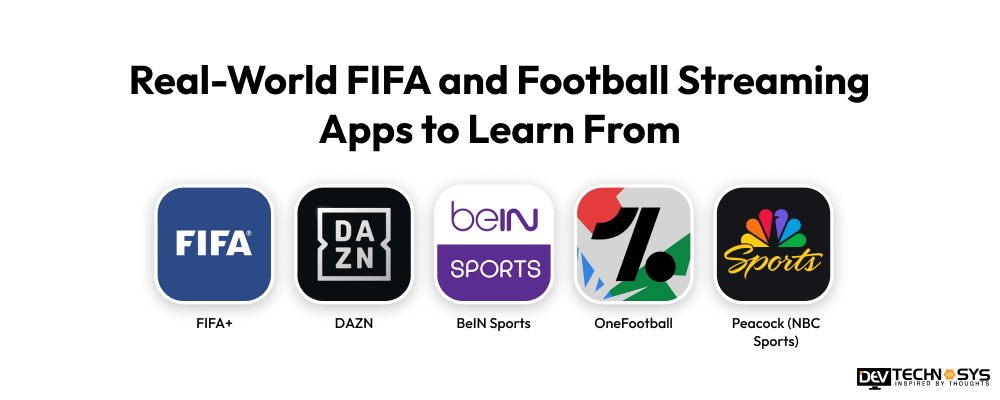
1. FIFA+
FIFA+ is the official streaming service of FIFA and allows viewers to watch a range of football documentaries, match highlights, archives, original content and some live matches for free. It enables viewers to stay immersed in the game 24/7.
2. DAZN
Often labelled the “Netflix of Sports”, DAZN is a global subscription-based sports streaming service that offers a multitude of live sports including football, boxing and many other exclusive sporting areas.
3. BeIN Sports
The sports broadcasting network operates in 43 countries worldwide and offers exhaustive football coverage to millions worldwide by adopting an innovative business model of owning broadcasting rights region-wide, providing multi-language commentary, and premium paid subscription services alongside a multitude of digital streaming options.
4. OneFootball
A football focused application, it provides football fans with live scores, up to the minute news, match statistics, transfer news, highlights and a number of live football matches to its 100m+ subscribers worldwide under a freemium business model sustained through advertisements.
5. Peacock (NBC Sports)
Peacock, owned by NBCUniversal, combines different formats of media from film and television shows, to news channels and premium streaming services with a multitude of live sports including live football matches.
How To Deal With Live Streaming Infrastructure?
Developing infrastructure that enables high-performance live streaming calls for scalable cloud hosting, reliable backend systems, adaptive bitrate streaming and a distributed global network of CDNs.
Implement solutions like HTTP Live Streaming (HLS), MPEG-DASH and WebRTC for delivering low-latency video feeds, while the use of auto-scaling servers, load balancing and real-time tracking can help accommodate the high demands of live streaming at the height of major tournaments etc.
In this respect, partnering with a professional sports streaming app development company is advisable to enhance performance, eliminate buffer problems and avoid interruption in live stream viewing.
Cost To Develop FIFA Live Streaming App In 2026: A Detailed Breakdown
The cost to build an app like Netflix and FIFA will vary based on features like app complexity, hosting the live stream infrastructure, licensing obligations, platform choice, as well as user scalability requirements. The minimum investment to build an MVP will differ significantly from the expense of a comprehensive, enterprise-grade platform.
FIFA Live Streaming App Development Cost Breakdown
App Complexity |
Estimated Cost |
| Basic MVP | $20,000 – $50,000 |
| Mid-Level App | $50,000 – $120,000 |
| Advanced Platform | $120,000 – $200,000 |
6 Factors Affecting FIFA Live Streaming App Development Cost
1. Licensing and Content Rights
Generally the major part of a live sports broadcasting app development cost are broadcasting rights. Licenses can cost a varying amount depending on the country, on the fact that they will be exclusive or not, on the number of viewers and on the matches. These licenses can usually range from a few thousand dollars up to several million.
2. App Development Features and Complexity
More complex app features such as multiview, recommendations based on AI algorithms, live chat, fantasy football or commentary in more languages significantly increase development time, complexity and live streaming app development cost.
3. Streaming Infrastructure Needs
A quality video streaming service demands highly scalable streaming servers, transcoding solutions, high bandwidth optimization and a cloud infrastructure. Serving up to millions of viewers simultaneously will affect both operational costs and FIFA live streaming app development costs.
4. Platform Choice
An application for every ios, android, web, Samsung TV, and connected device will require further effort and dedicated resources. Although across multiple live sports broadcasting app development implies increased effort in developing each individual application, it will allow a much broader reach to customers and will boost profits.
5. CDN and Video Delivery Setup
Content Delivery Networks (CDN) allow to improve the streaming quality by reducing the buffering effect and by lowering the latency. An international distribution of a CDN infrastructure will involve additional costs for its operation and maintenance, which vary depending on the per-region price and infrastructure volume.
6. Development Team Location and Expertise
The fifa live streaming app development cost associated with a football live streaming app development company, depends on the location of the team, as well as the expertise of the developers themselves.
Although it may be considered more expensive, a FIFA app development company that specializes in the development of applications related to OTT platforms and video games will build a Live Streaming App.
FIFA Live Streaming App Development Timeline vs Cost
Development Phase |
Estimated Timeline |
Cost Range |
| Discovery & Planning | 2–4 Weeks | $3,000 – $10,000 |
| UI/UX Design | 3–6 Weeks | $5,000 – $20,000 |
| App Development | 8–20 Weeks | $20,000 – $150,000 |
| Streaming Integration | 3–8 Weeks | $10,000 – $50,000 |
| Testing & Deployment | 2–4 Weeks | $5,000 – $20,000 |
| Total Project Cost | 16–40 Weeks | $20,000 – $200,000+ |
Tech Stack for FIFA Live Streaming App Development
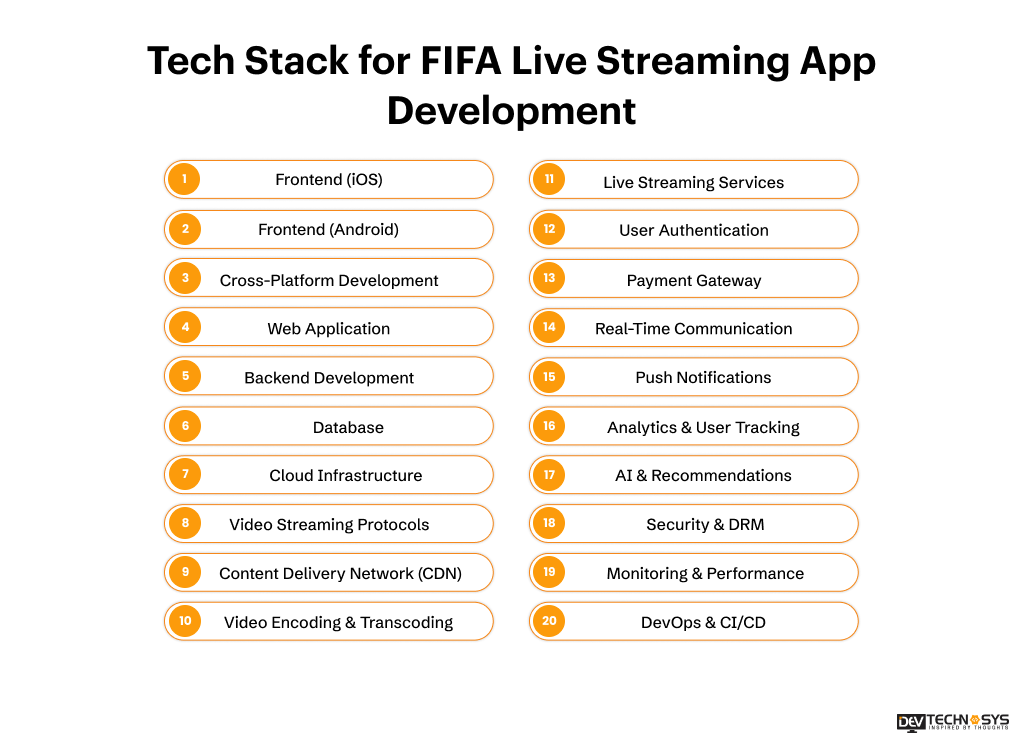
Technology Layer |
Recommended Technologies |
| Frontend (iOS) | Swift, SwiftUI |
| Frontend (Android) | Kotlin, Jetpack Compose |
| Cross-Platform Development | Flutter, React Native |
| Web Application | React.js, Next.js, Angular |
| Backend Development | Node.js, Python (Django/FastAPI), Java Spring Boot |
| Database | PostgreSQL, MySQL, MongoDB |
| Cloud Infrastructure | AWS, Google Cloud Platform (GCP), Microsoft Azure |
| Video Streaming Protocols | HLS, RTMP, MPEG-DASH, WebRTC |
| Content Delivery Network (CDN) | Cloudflare, Akamai, Amazon CloudFront |
| Video Encoding & Transcoding | FFmpeg, AWS Elemental MediaConvert |
| Live Streaming Services | Wowza, Mux, Vimeo OTT, AWS MediaLive |
| User Authentication | OAuth 2.0, Firebase Authentication, Auth0 |
| Payment Gateway | Stripe, PayPal, Razorpay |
| Real-Time Communication | Socket.io, WebSockets, Firebase Realtime Database |
| Push Notifications | Firebase Cloud Messaging (FCM), OneSignal |
| Analytics & User Tracking | Google Analytics, Mixpanel, Amplitude |
| AI & Recommendations | OpenAI API, TensorFlow, Vertex AI |
| Security & DRM | Widevine, FairPlay, PlayReady |
| Monitoring & Performance | Datadog, New Relic, Grafana |
| DevOps & CI/CD | Docker, Kubernetes, Jenkins, GitHub Actions |
How Does a FIFA Streaming App Make Money?
Apps that broadcast FIFA games have several different ways to generate income through various sources of monetization. By combining subscriptions, advertising, sponsorships, and premium services, those who own the platform(s) can increase their revenue potential and build a sustainable and scalable business model.
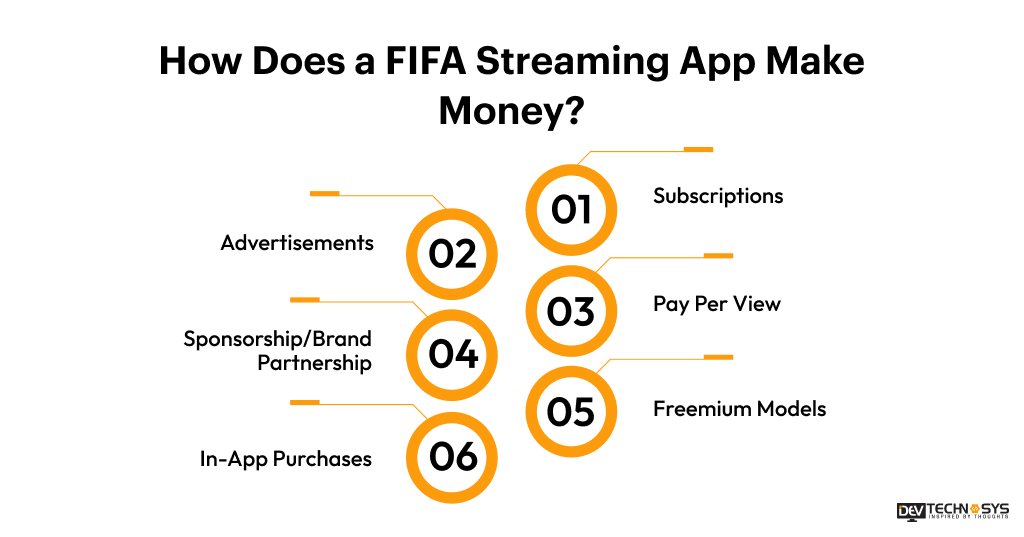
1. Subscriptions
Users pay a monthly, quarterly, or annual fee for access to live games, exclusive content, replays, highlights, and premium features. Subscriptions will generate recurring revenue and create stability in the long-term.
2. Advertisements
The large amount of engagement seen by the virtual audience for sporting events, the platforms can produce revenue from video advertisements, banner ads, sponsored segments, and branded content. Many soccer matches are broadcast live, advertisers often pay a premium per thousand views (CPM) for advertisements that run during these events.
3. Pay Per View
Instead of paying for a subscription, users may be able to purchase access to specific matches, tournaments, or premium content related to FIFA. Thus, this type of revenue model is particularly popular for large FIFA sanctioned events or for prominent international matches.
4. Sponsorship/Brand Partnership
There are a variety of sponsorships that are created for items such as live broadcasts, live coverage of matches, statistics related to individual players, and/or special presentations.
By aligning themselves strategically with sport-related brands, betting companies, and consumer products, large organizations will increase their opportunity to generate revenue from the platform.
5. Freemium Models
Basic OTT app development features are provided free of charge, but users can upgrade to use added functions. Some examples of premium features include the ability to view without ads, the option of multiple camera views, exclusive analysis, downloading for offline use, and premium statistics.
6. In-App Purchases
Buying virtual products, such as enhancements for fantasy football (or for the game itself), can also include premium content bundles, digital collectibles, and exclusive fan experiences. These in-app purchases add your businesses’ revenue sources from in-app purchases to those from subscriptions and ads.
3 Challenges in FIFA Live Streaming App Development
Challenges to the sports streaming app development are multi-facetted with technical, and legal requirements, as well as operational challenges. There are three primary concerns that businesses seek to overcome in order to create a reliable FIFA live-stream:
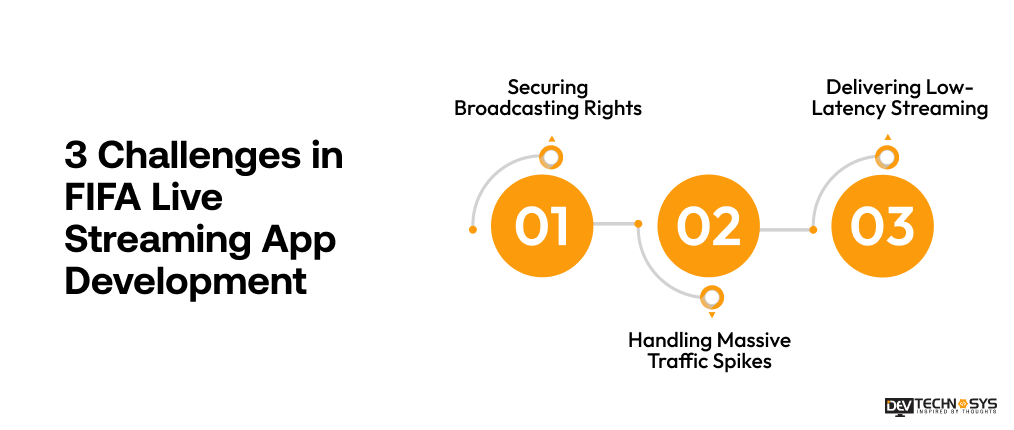
1. Securing Broadcasting Rights
Obtaining legal re-broadcasting rights is one of the main obstacles to creating a successful FIFA live-streaming app, as the broadcast licensing fees can be so high in different regions of the world; therefore, businesses will require to negotiate contracts with both re-broadcasters (those who have paid for the right to stream from FIFA) and legal authorities, prior to launching a FIFA live-streaming app.
2. Handling Massive Traffic Spikes
Major FIFA events attract thousands (sometimes millions) of concurrent viewers from all over the globe; therefore, providing uninterrupted functionality as this level of Internet traffic peaks requires a highly scalable cloud infrastructure, along with load-balancing, auto-scaling technologies, and backend systems that can service millions of concurrent streams.
3. Delivering Low-Latency Streaming
When sports fans are attempting to view any sport via a live-streaming service, they typically do not want any delay (latency) in seeing what is occurring, so businesses need to implement cutting-edge streaming technologies that will minimize latencies and maximize video quality to their users’ high-level data on contemporary video degradation across geographically distinct locations.
FIFA Live Streaming App Development for the 2026 World Cup: Timing Strategy
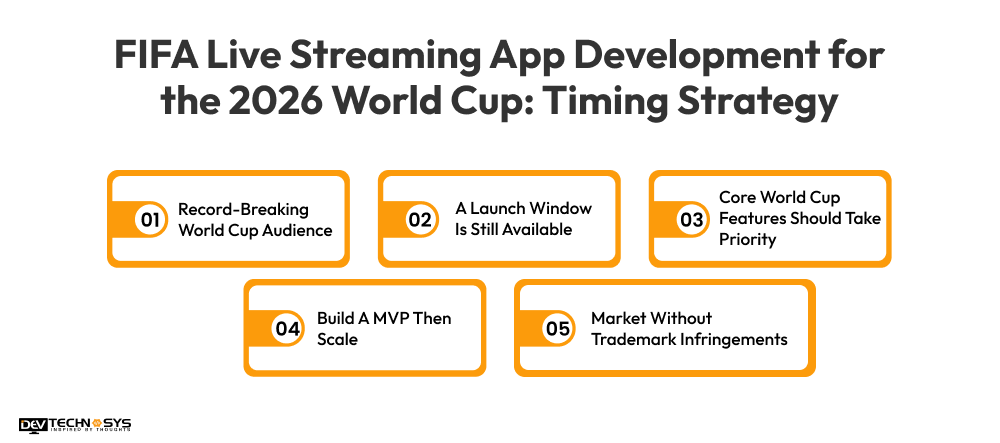
1. Record-Breaking World Cup Audience
The 2026 tournament will see 48 teams participating and 104 matches being broadcast across 3 countries. This unparalleled number will naturally generate high demand for live football streaming, fan engagement and a digital viewing experience.
2. A Launch Window Is Still Available
With development beginning now, it will take roughly 16-20 weeks for a functional MVP to be completed. That’s enough time to test it out and refine it further for the tournament and to build your audience before the games commence.
3. Core World Cup Features Should Take Priority
Live streaming, multi-language commentary, real-time match scores, match schedules, video highlights, push notifications and features enabling interaction amongst fans should be at the core of your application to optimize user engagement.
4. Build A MVP Then Scale
A minimalist MVP helps you validate your idea quickly and minimizes initial costs. Once a strong user base has been established then complex and feature-rich solutions can be implemented.
5. Market Without Trademark Infringements
Promote your app using “football” or “live match coverage”, not official FIFA terminology, branding, or trademarks.
Conclusion
The FIFA World Cup 2026 is an incredible chance to capture the attention of and succeed in the rapidly expanding world of sports streaming. Building a successful FIFA live streaming application will involve many key decisions regarding the app’s structure, necessary features, licensing, technology, and overall development costs.
Whether you’re seeking to build a fan engagement platform, an over-the-top streaming service, or a full-scale live streaming solution, an expert OTT app development services company can be a great help. Here at Dev Technosys, we specialize in creating fully scalable, secure, and feature-rich live sports streaming applications according to your unique needs.
Frequently Asked Questions
Find answers to the most common questions related to this article.
The cost to develop a sports streaming app is around $25,000-$200,000+ and varies based on the chosen features, hourly rate of FIFA app development company platform, streaming infrastructure and licensing.
Yes, it's legal to build an app that streams FIFA matches as long as official streaming rights are acquired from authorized rights holders or broadcasters for the targeted region(s).
To legally stream FIFA matches, one would need to negotiate broadcast rights with FIFA's official media servers partners, regional broadcasters or rights holders.
For FIFA live streaming app development, the most common and recommended technology stack is React Native/Flutter, Node.js, AWS/Azure/GCP, WebRTC/HLS streaming protocols and PostgreSQL/Redis.
This is best achieved with cloud auto-scaling, load balancers, Content Delivery Network(CDN), edge servers and effective caching techniques coupled with real-time monitoring tools.
HLS and RTMP offer similar features; however, HLS delivers adaptive streaming over multiple devices and it's much more compatible, whereas RTMP requires less latency and is typically used for ingesting live video broadcasting.
It's possible to make money through sponsorships, advertisements, integrations with fantasy sports platforms, subscriptions to match analytics, selling news/article content, or using affiliate partnerships and premium features.
Basic applications may take 3-4 months however, a feature-rich and scalable live streaming platform can take anywhere from 6-12 months to develop.
Yes, you can build a football application incorporating news, live scores, stats, and engagement features for the 2026 World Cup now, but licensed streaming would require obtaining rights.
Best CDNs for live sports streaming include AWS CloudFront, Akamai, Cloudflare and Fastly, as these options guarantee global distribution and minimal latency.