
















Key Takeaways:
- Restaurant operations are streamlined through the automation of ordering, payment, inventory management, and reporting from a single source.
- Faster order processing times will reduce customer wait times, increase service efficiency, and also increase table turnover during peak times due to faster service.
- By using real-time inventory tracking, restaurants can avoid running out of items, reduce food waste, and assist in making optimal decisions when purchasing products.
- Features such as scheduling, tracking staff attendance, and performance will simplify managing restaurant staff and allow restaurants to control their labor expenses effectively.
The key to operating a successful restaurant is to do more than produce excellent food; it also requires quickness, exactness, and fluidity in all areas of the restaurant. There are numerous operational difficulties that owners of eateries contend with daily, spanning from order management to bill processing, inventory control and tracking, and analyzing sales figures.
According to Fortune Business Insights, the global POS market is projected to grow from $44.6 billion in 2026 to $138.9 billion by 2034.
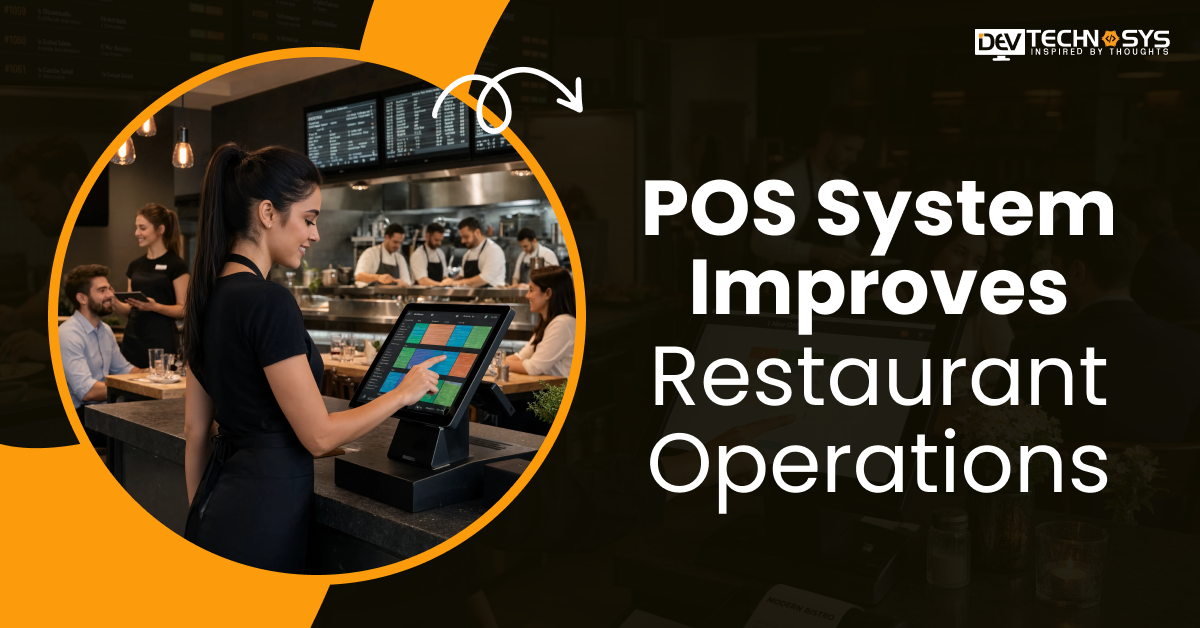
A POS (point of sale) system is a solution that changes the game. Modern POS (point of sale) systems aid restaurants in having many advanced features beyond simple billing capabilities, such as eliminating problems that result from errors, streamlining processes, and enhancing customer satisfaction.
With a POS system, routine processes occur automatically, and real-time data about the state of business aids in the efficient completion of tasks by employees and assists management in making sound decisions. Due to the growing level of competition within the restaurant sector, the selection of the correct POS system improves restaurant operations and profits.
What Is a Restaurant POS System?
The restaurant POS system is a tech solution that manages restaurant operations, such as payment transactions, inventory, orders, and customer data from a single platform. Basically, it offers many advanced features, such as real-time business insights, improved order accuracy, streamlined daily operations, and helps restaurants manage efficiently.
Look What Deloitte Says About the POS System in Restaurant Operations:
“More than 80% of restaurant executives expect AI and technology investments to increase over the next year.”
Planning a Pos Project?
Get a tailored development cost estimate in a few simple steps.
- 3 quick steps
- 100% free
- Reply in 1 business day
2 Minutes Read
Key Hardware Components of a Restaurant POS System
The modern restaurant POS software development solution includes a wide range of hardware that makes it easy to process orders, manage the kitchen, and handle payments.
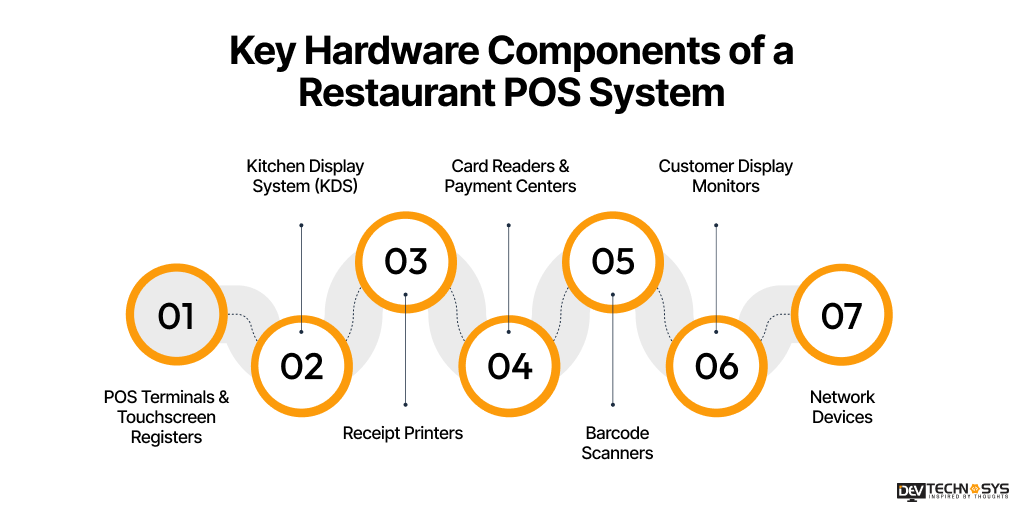
1. POS Terminals & Touchscreen Registers
Desktop Terminals: Full-sized touch-screen computers used at the Host Stand/Counter.
Tablet/Handheld Devices: iPads or Android Tablets used for table-side ordering, kitchen prep, and confirming orders.
Mobile Terminals: Card readers and printers used for outside or food truck usage.
2. Kitchen Display System (KDS)
A large digital screen mounted in the kitchen that displays incoming orders in real-time, replacing paper orders. Orders will display in a color code based on order urgency. Kitchen Staff then would mark items as being complete by simply tapping on them. This will decrease confusion and increase speed for food prep.
3. Receipt Printers
Customer Facing Printers: A printer that prints a receipt and an itemized bill for the customer.
Kitchen Printers: A printer that prints orders for the cook and line cook.
4. Card Readers & Payment Centers
EMV Chip Readers
Secure any credit or debit card transaction using an EMV chip reader.
NFC Contactless Readers
Ability to pay using an NFC contactless reader with Apple, Google Pay, or other platforms.
QR Code Payment Terminals
More common in Asia than anywhere else! Already available in India through UPI.
Cash Drawers
Physical storage of cash to facilitate transaction completion by a merchant.
5. Barcode Scanners
Helpful resources in performing inventory control, product scans/lookup, and stock counting.
6. Customer Display Monitors
A small monitor positioned in front of the customer that displays the items purchased and the amount due.
7. Network Devices
Networking devices include both WiFi routers and switches, enabling you to connect every device in your store to a network. Additionally, backup internet connectivity for payment software solutions reliability can be achieved using a traditional telephone line and a modem for internet connectivity.
Key Software Components of a Restaurant POS System
The restaurant POS solutions offer smart functionalities behind strong hardware. There are various types of key components or modules included in a restaurant POS system:
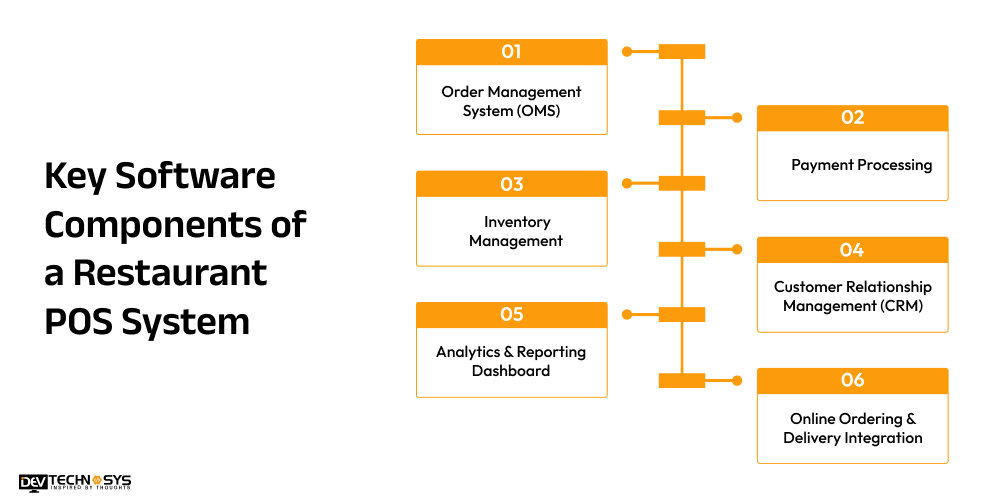
1. Order Management System (OMS)
- All types of orders (dine-in, takeout, delivery, and online) can be accepted through a single system
- Order modifications, special requests, and allergies can all be captured/managed in the system
- All orders can be sent to their appropriate areas (kitchen, bar, assembly area)
- The status/estimated completion time of orders can be tracked
2. Payment Processing
- All credit, debit, mobile payment & cash transactions can be processed securely
- Tip Amount and Taxes/Deductions can be calculated by the system using pre-defined rules
- Supports multiple payment types and multiple payments on one bill
- Customer payment information is PCI-DSS compliant/encrypted
3. Inventory Management
- Ingredients and their stock amounts are tracked in real time
- Auto-Notified when stock reaches a minimum reorder level
- Cost of recipes (the price of food % calculated by linking itemized ingredients to Menu Item)
- Ability to automate Purchase Order Generation, and Supplier integration
4. Customer Relationship Management (CRM)
- A complete customer profile can be built using historical transaction data
- Identifying repeat customers and their preferences/spending habits
- Reward & Loyalty Programs can be managed & tracked
- Targeted promotions can be sent via email/SMS
5. Analytics & Reporting Dashboard
- Peak hour traffic patterns
- Analyze best-selling and slow-moving items
- Staff performance metrics
- Shows real-time sales metrics(Including revenue & average)
6. Online Ordering & Delivery Integration
- API integrations with popular platforms (Uber Eats, DoorDash, Zomato)
- Channel-specific promotions & pricing
- Automatic order synchronization to the kitchen
Types of POS Systems: Three Deployment Models
There are different types of POS systems available for restaurants, and businesses can choose the deployment models as per their needs, requirements, technical infrastructure, and budget.
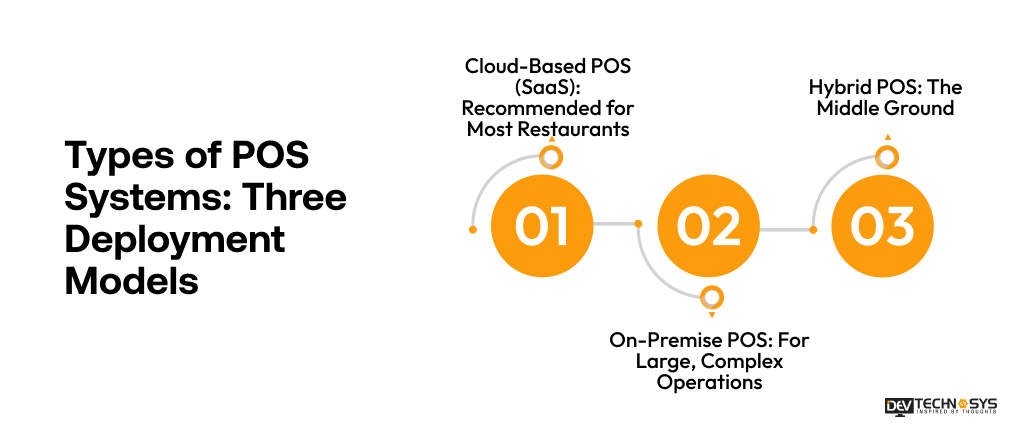
1. Cloud-Based POS (SaaS): Recommended for Most Restaurants
The vendor’s computer server has the software and data you need to operate. You connect through the internet. There is little cost up front ($500 to $2,000). Monthly subscription pricing ($200 to $500 per terminal). Scales easily because of automatic updates, and doesn’t require an IT department. Works best for small to medium restaurants, chain restaurants with multiple locations, and food trucks.
Examples: Toast, Square, Lightspeed, Posist, and Petpooja.
2. On-Premise POS: For Large, Complex Operations
The software and data you need to run your business are on-site at your place of business. There are high costs up front ($15,000+). Repeated expenses are present, but low or none at all. Customization, offline operation, and data usage are completely the same for any business type.
The IT Department is to maintain and update the system. You cannot easily scale this type of POS system over multiple locations. This type of POS is generally used by large restaurant chains and fine dining establishments that have complex business requirements.
3. Hybrid POS: The Middle Ground
The core data and its functions are stored in the cloud and locally for backup in case of offline operation. It’s moderate to expensive up front ($5,000 to $10,000). Monthly costs will be lower than other types of systems ($100 to $300 per terminal).
The Hybrid system has the flexibility to scale and have reliability in an offline environment. Hire software developers to maintain and update the system. This system will provide moderate expansion opportunities and can be used by medium-sized restaurant groups that require both reliability and flexibility.
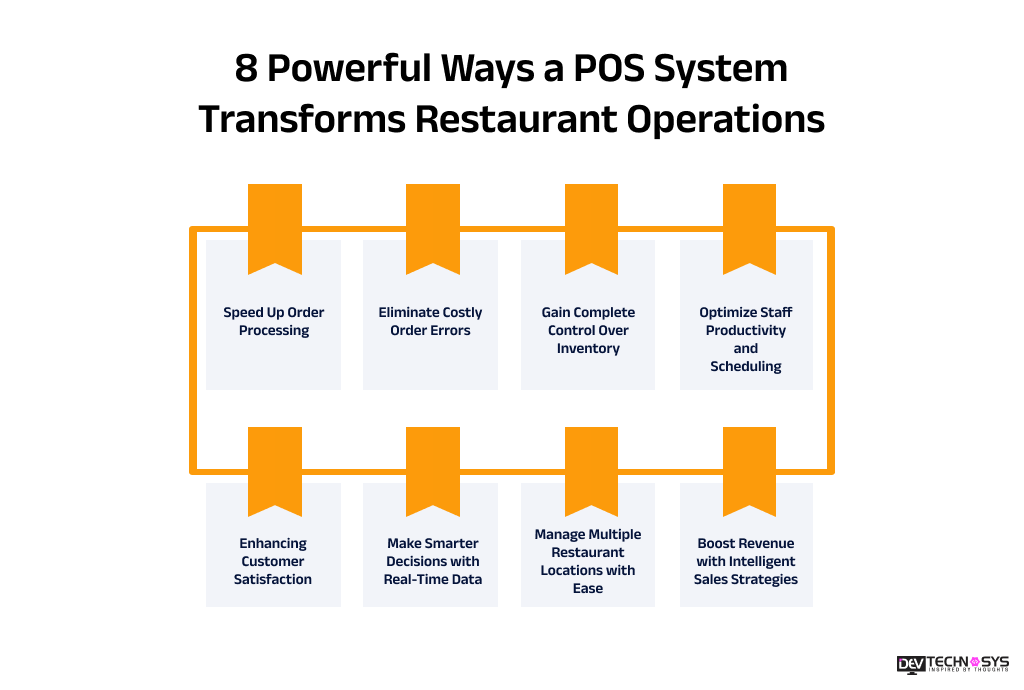
8 Powerful Ways a POS System Transforms Restaurant Operations
Today’s POS system is not just about processing payments. There are numerous other facets that can help a restaurant operate smoothly, improve the speed of service, lower the margin of error, and monitor and maintain its inventory effectively. Optimize its employees, enhance their customer experience, gain invaluable information about their business, and ultimately increase their revenue potential.
1. Speed Up Order Processing
Using a POS system improves restaurant operations. It provides quick, direct entry of orders from servers to kitchen staff, avoiding lag times and preventing any manual requirements to communicate between servers and cooks. As speeds of order processing increase, so does service speed; wait times for customers decrease; and more meals can be produced to serve many customers at once during busy times.
2. Eliminate Costly Order Errors
Manual writing of order taking frequently results in errors, creating poor customer service and loss of food products through surplus or spoilage. By digitizing an organization’s entire order-taking system through the integrated components of a POS system, there is less opportunity for mistakes, as staff correctly communicate orders to the kitchen electronically.
3. Gain Complete Control Over Inventory
Real-time (as items are sold) updates of inventory levels provide restaurant managers a way to monitor ingredient usage and to reformulate their food orders to obtain enough products to produce enough meals, but not more than can be produced or will be wasted after serving.
4. Optimize Staff Productivity and Scheduling
Employee management is simplified by using a POS system to monitor employee attendance, hours worked, and key performance indicators. Managers can efficiently schedule their employees based on productivity trends and properly allocate those employees to the business’s operations. As a result of better employee scheduling practices, the restaurant will be able to save on staffing costs while still providing its customers with the highest possible level of service.
5. Enhancing Customer Satisfaction
Hotel POS software development solutions promote customer thriving through quick transactions. Aspects such as fast and easy checkout processes, various payment options, and customized loyalty programs increase customer satisfaction.
In addition, tailored promotions and quick service create a relaxed customer experience, which will help generate return visits, develop better customer relationships, and provide greater overall customer satisfaction.
6. Make Smarter Decisions with Real-Time Data
Real-time data from POS systems support restaurant owners with sales statistics, revenue trends, and consumer purchasing patterns. Owners are able to evaluate performance on an ongoing basis, identifying the best-selling items on their menu, peak operational hours, and the ability to make informed decisions based on operational performance data.
7. Manage Multiple Restaurant Locations with Ease
If you are operating as a chain, a single POS system gives you a complete view of your restaurants. Managers can gain access to sales information, inventories, employee performance, and updated menu items through a single report and can effectively control the operations of their restaurants similarly.

8. Boost Revenue with Intelligent Sales Strategies
POS system improves restaurant operations and usually have built-in tools for upselling, cross-selling, and targeted promotions. By suggesting complementary products from the menu and gaining information on consumer preferences, restaurants can raise average checks, enhance marketing, and increase revenue opportunities with no extra operational complexity.
Want a chatbot demo or pricing? Fill the form and talk to our experts today.
Pick what you need below — you can select more than one — then tap Get detail to continue.
-
Chatbot demo dashboard
-
Cost to develop an app
-
Industry report
-
Case study
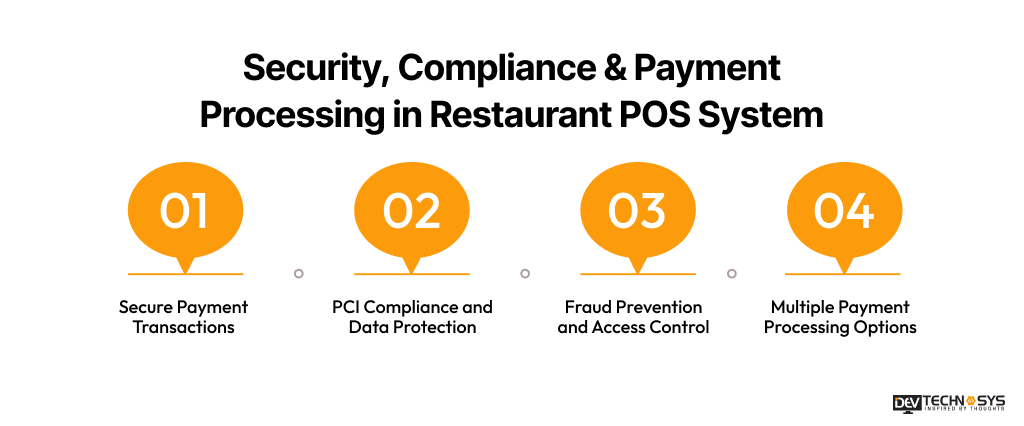
Security, Compliance & Payment Processing in Restaurant POS System
A modern restaurant point-of-sale (POS) system relies on three key areas: security, compliance, and transaction processing. To provide your customers with secure and safe transactions, it’s imperative that build restaurant POS software systems offer advanced security functionality to safeguard customer information and meet all applicable regulations.
1. Secure Payment Transactions
Secure payment processing is an important feature of advanced restaurant point-of-sale systems. Point-of-sale systems provide a secure electronic means (via tokenization) for processing credit card transactions while securing the customer’s financial information before processing any payments.
2. PCI Compliance and Data Protection
All point-of-sale systems are designed to meet the Payment Card Industry Data Security Standards (PCI DSS). An establishment that processes credit card payments must be PCI compliant to protect cardholders’ information, reduce risk, and foster loyalty to customers.
3. Fraud Prevention and Access Control
Point-of-sale systems provide security-related components that help prevent fraudulent activity by providing role-based access controls, secure user logins, and transaction monitoring that allows managers to control employee access levels through the data that is collected within their individual employee transaction records, along with being able to identify potentially fraudulent activity quickly.
4. Multiple Payment Processing Options
Most point-of-sale systems are capable of processing a variety of payment methods, including credit cards, debit cards, digital wallets, contactless payment transactions, and transaction processing using QR codes. The flexibility afforded by the variety of available payment options will make it easier for customers to purchase items and expedite through the check-out processes.
Industry Insights
“According to the National Restaurant Association, 76% of restaurant operators say technology gives them a competitive advantage in improving operations and customer experiences.”
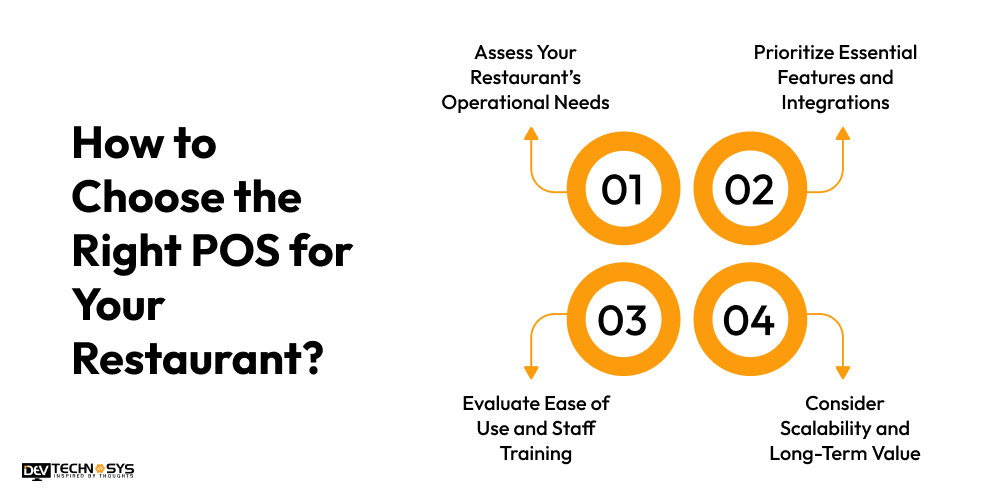
How to Choose the Right POS for Your Restaurant?
Selecting an appropriate POS system improves restaurant operations, and it is very likely to affect your establishment’s productivity and the rate at which it grows. Consider the various factors that affect the overall success of your business, such as operational requirements, key functionalities, future expansion plans (scalability), user-friendliness, security features, & customer support systems.
1. Assess Your Restaurant’s Operational Needs
Begin determining your restaurant’s specific requirements, i.e., whether you offer table service, quick-service operations, online ordering, and managing multiple locations. When you have evaluated the requirements of your restaurant. You will then be able to select a POS that includes features required to support your day-to-day workflows, improve efficiency, and facilitate growth as you develop a long-term strategy.
2. Prioritize Essential Features and Integrations
Look for a POS that includes the essential features, including order management, inventory management, employee scheduling, reporting, and payment processing. Check to ensure it integrates well and efficiently with your online ordering services, accounting systems, and any delivery service that you use to create a seamless and efficient operational ecosystem.
3. Evaluate Ease of Use and Staff Training
Selecting a POS system improves restaurant operations that is user-friendly will reduce the training time for employees helping to reduce business interruptions. Consider a supermarket billing software development solution that has an easy-to-use interface, clear workflow, and solid training resources. So your staff can adjust quickly and maintain productivity when you are experiencing peak business times.
4. Consider Scalability and Long-Term Value
The POS you select should grow along with your business. Evaluate whether the POS has the ability to support the addition of new locations, expand menus, process an increase in transactions, new technology etc. By investing in a scalable POS, you will avoid substantial costs associated with transitioning to a new system due to growth and will increase operational flexibility.
Final Thoughts!
Today’s restaurants need an efficient POS system improves restaurant operations successfully. A well-designed point of sale allows businesses to run their restaurant more efficiently, provide excellent customer service, and increase profitability. The POS system will allow a restaurant to process orders in a quicker manner, keep track of inventory more accurately, manage employees effectively, and provide accurate, real-time information about all aspects of restaurant operations.
A custom software development company will enable restaurant owners to eliminate many challenges associated with running a restaurant, make informed decisions, and provide customers with a seamless dining experience that best suits their overall goals for future success and growth.
Frequently Asked Questions
Find answers to the most common questions related to this article.
A Restaurant Point Of Sale System is used to centralize and manage orders, payments, inventory, employees’ worktime, and sales reporting within one easy-to-use platform. The main purpose of using a restaurant POS system is to optimize daily operations, increase efficiency, decrease manual errors, and provide business intelligence to assist you in making good business decisions.
POS system improves restaurant operations to automate many of the day-to-day routine tasks associated with restaurant operations, like entering orders, creating bills, tracking inventory, and generating reports. By streamlining these administrative processes, restaurant point-of-sale systems also provide faster service, eliminate mistakes, and allow employees to spend more time focusing on delivering exceptional customer service.
Yes! With the use of real-time inventory tracking and monitoring how many ingredients are used, restaurant Point Of Sale Systems help restaurants to identify overstock items or trends that lead to waste so that restaurants can make more informed decisions when purchasing food items, reduce overbuying, and have better control over their inventories.
Prices can vary widely depending on features, hardware needed, number of restaurants, and subscription options chosen. Most small restaurants will pay a lower monthly fee than larger chain-type restaurants that have advanced analytical capabilities, integration with other systems, and manage multilocation businesses.
In selecting a POS system improves restaurant operations, you will want to consider features such as ordering, payment processing, inventory management, employee management, reporting, loyalty programs, and the ability to integrate with other systems.