








Key takeaways:
-
- Artificial Intelligence is no longer a choice but has become a necessity in entertainment app development in 2026.
- Personalized Recommendations, Real-Time Content Optimization, Voice Recognition & Control, and Fraud Detection & Content Protection are some of the key roles of AI in entertainment app development.
- Netflix, Spotify, YouTube, ReelShort, and Google Play Games are a few of the entertainment apps that integrate AI.
- The web portals in AI-powered entertainment apps offer Centralized Content Management, AI-Driven User Analytics & Insights, Compliance Management, and Monetization & Advertising Optimization.
We all know that in this technologically advanced world, entertainment apps are no longer a play content, but they deeply understand the users. In this case, AI works behind the scenes in shaping the user experience, whether they are using streaming, music, or gaming apps.
The role of AI in entertainment app development is evident when an app offers movies, music, or gameplay according to the mood. AI effortlessly predicts what you want before you even search due to its smarter algorithms.
That’s why AI-powered entertainment app development is the most preferred choice of entrepreneurs in 2026. It helps them scale faster while delivering immersive, human-like interactions, personalized content, improved visuals, and enhanced user engagement.
AI in entertainment apps 2026 is making the platform more intuitive, emotional, and deeply connected.
As AI continues to evolve and become a part of everyday digital life, entertainment apps will transform into intelligent companions.
What Is The Role Of AI In Entertainment App Development In 2026?
The role of Artificial Intelligence in entertainment app development is to anticipate user emotions and deliver hyper-personalized experiences that feel truly human. In this section, we will explain multiple points describing the AI role in entertainment app development services.
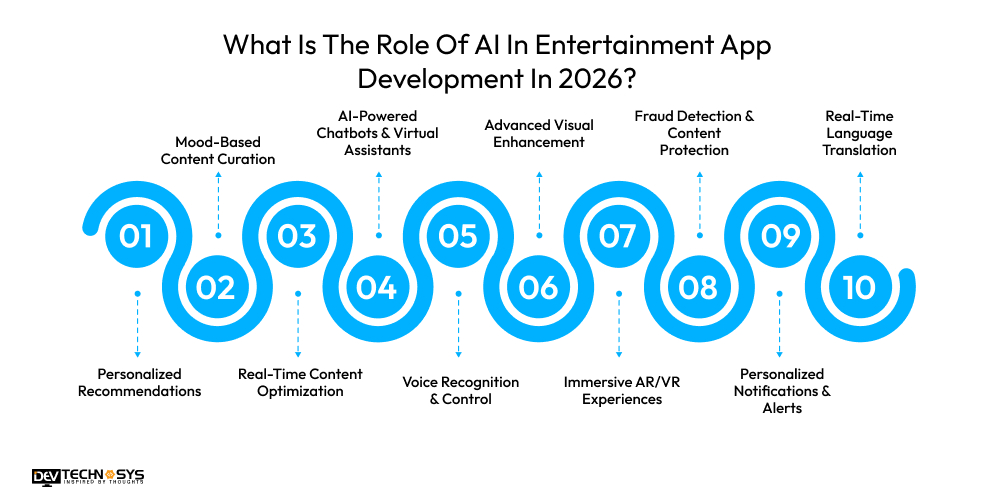
1. Personalized Recommendations
Be it games, music, video streaming, or something else, AI-based entertainment applications can easily analyze the user habits. It examines the behaviour while scanning the user’s watch history, preferences, and interaction patterns.
Then it delivers highly accurate and personalized content recommendations. In 2026, AI is preferably used in suggesting movies, music, or games that match individual tastes.
2. Mood-Based Content Curation
AI is also used in offering mood-based content by detecting the user’s facial expression, voice tone, activity patterns, or behavior. It also analyzes the emotional insights and delivers content as per the current mindset of the user.
In this way, AI development services create more meaningful, emotionally connected experiences in an entertainment app while increasing user satisfaction.
3. Real-Time Content Optimization
The smart entertainment app solutions incorporate AI to continuously monitor user interaction and performance metrics. With this, an app adjusts content quality, streaming resolution, and delivery speed in real time.
It even makes sure the playback is smoother, buffering is reduced, and the experience is optimized. Overall, it makes the entertainment seamless, consistent, and enjoyable across different devices.
4. AI-Powered Chatbots & Virtual Assistants
A web app development company adds AI chatbots and virtual assistants to the entertainment apps to offer users instant support. This assistant also helps app users with immediate content delivery, along with personalized guidance.
AI in entertainment app development offers human-like conversations, which help users in finding perfect content, managing subscriptions, and resolving issues without manual assistance.
5. Voice Recognition & Control
The AI in OTT app development offers the facility of voice recognition and control. Thai integration helps users to search, play, pause, or control content hands-free, with their voice command.
In 2026, natural language processing, an AI technology, will be used widely to build an entertainment app. It understands the accents, commands, and conversational speech for seamless voice-based interactions.
6. Advanced Visual Enhancement
The future of AI in entertainment apps is largely driven by advanced visual enhancements. This upgrades the visuals of the content by improving the video quality, color accuracy, reducing noise, and optimizing frame rates.
This also provides users with cinema-like viewing experiences. Even if you have a smaller screen or low-resolution source content, advanced visuals will be a great companion.
7. Immersive AR/VR Experiences
An entertainment app development company integrates AI to upgrade the Augmented Reality (AR) and Virtual Reality (VR) experiences in the app. It enables realistic environments, responsive characters, and adaptive storytelling in an entertainment app to make the user experience more satisfying. AR/VR experiences, which are driven by AI, make gaming, virtual concerts, and interactive storytelling more immersive and personalized.
8. Fraud Detection & Content Protection
The benefits of Artificial Intelligence in entertainment app development are to detect suspicious activities, piracy attempts, and unauthorized access in no time.
The entertainment and smart TV app development services include AI to protect digital content and secure user data. It even identifies subscription fraud and maintains a secure entertainment ecosystem for both users and content providers.
9. Personalized Notifications & Alerts
Artificial intelligence in entertainment industry sends relevant and timely alerts to the users. These notifications are according to user interests, habits, and engagement patterns.
Apart from general alerts, AI in entertainment apps sends personalized reminders to users. It includes the notifications related to new releases, live shows or events, recommended content, and exclusive updates to increase user engagement.
10. Real-Time Language Translation
The latest entertainment app development trends integrate AI-powered language translation. It breaks the global barriers by offering translations, subtitles, dialogues, and voice content in so many languages instantly.
Every entertainment app in 2026 will use AI to provide users with multilingual experiences. With this, the content in different languages can be accessible for a diverse audience around the world.
What Are The Key Use Cases Of AI In Entertainment App Development?
Whether it is automated content, upgraded gaming, content moderation, or advertising, AI plays a crucial role in these use cases. It enhances creativity, efficiency, and user engagement across entertainment platforms and other on-demand app development solutions. Here, we will discuss some of the most common use cases of AI in entertainment applications.
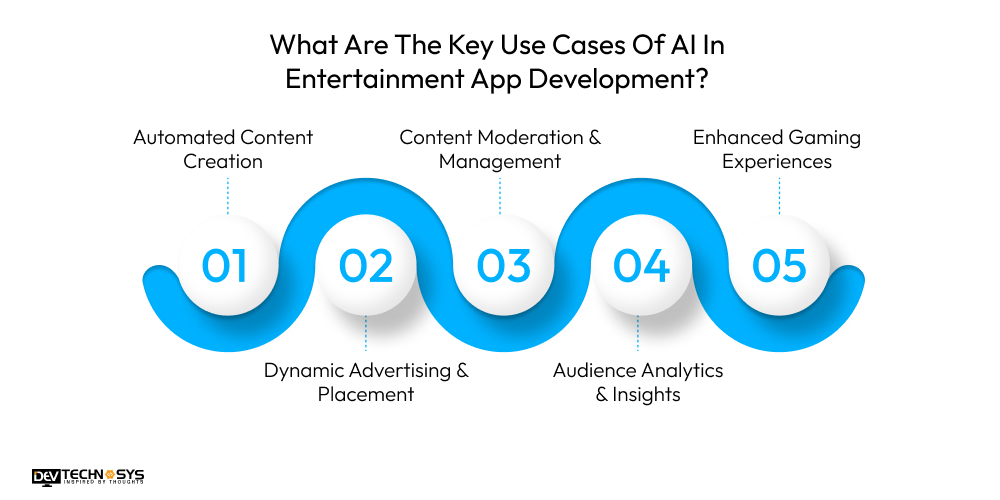
1. Automated Content Creation
AI-driven entertainment platforms help creators build trailers, music, visual effects, scripts, and highlights automatically. In entertainment apps, AI helps in reducing hours of production, along with development costs and resources. It enables faster content delivery while maintaining creativity, quality, and consistency.
2. Dynamic Advertising & Placement
Artificial Intelligence in entertainment app development inspects the behavior and preferences of users and delivers personalized advertisements, whether it’s for gaming or social media app development.
AI also helps the entertainment industry apps in placing the ads naturally with the content. This enhances the relevancy, engagement, and ad performance without disturbing the user experience.
3. Content Moderation & Management
One of the best uses of AI is in detecting inappropriate, violent, copyrighted, or harmful content. With this, entertainment apps can easily manage the large libraries of unlimited content while ensuring compliance with policies. It helps in maintaining safe, secure, and high-quality content for users as well as creators.
4. Audience Analytics & Insights
Top entertainment app development companies incorporate AI to process a large amount of user data. This data is accessed to discover the viewing habits, trends, and preferences of the users. This information is used by entertainment apps to enhance content strategies. It also helps in optimizing marketing and making data-driven decisions.
5. Enhanced Gaming Experiences
AI entertainment software development develops smarter fictional characters, difficulty levels, and realistic environments in gaming apps. In such apps, AI personalizes gameplay by responding to player behaviour and offers a more entertaining experience. You can hire an OTT app development company that lets you deliver immersive challenges for user engagement.
Want a chatbot demo or pricing? Fill the form and talk to our experts today.
Pick what you need below — you can select more than one — then tap Get detail to continue.
-
Chatbot demo dashboard
-
Cost to develop an app
-
Industry report
-
Case study
Which AI Models Are Commonly Used In Entertainment App Development?
Machine Learning (ML), natural language processing (NLP), Large Language Models (LLMs), and so on are some of the most common AI models. These models, when used in entertainment apps, boost user engagement, retention, efficiency, and revenue. Have a look at the AI models that are popularly used in entertainment mobile application development services.
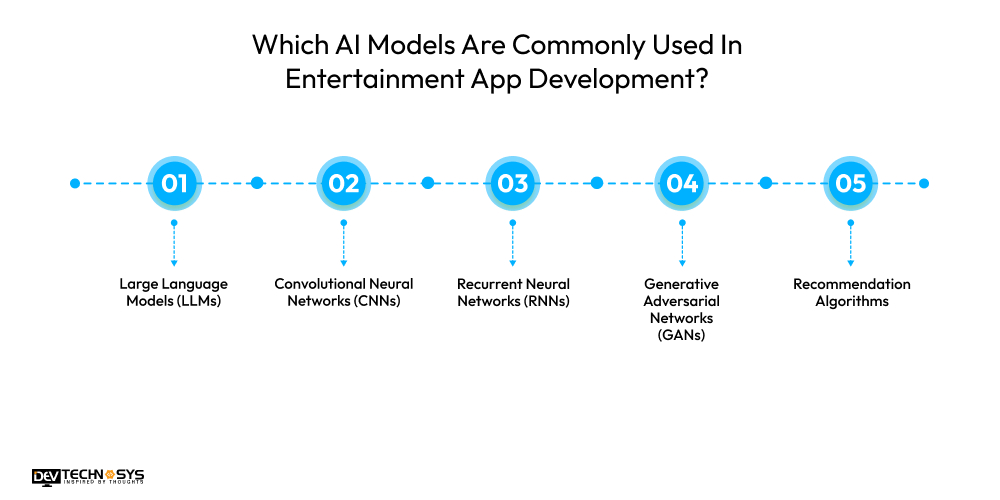
1. Large Language Models (LLMs)
Large Language Models are the most preferred model in an entertainment app development with AI. It supports chatbots, virtual assistants, and interactive storytelling in entertainment apps.
These models understand the context of the user and answer in a very humanized way. It even personalizes the conversations, which helps in improving user engagement and a seamless customer support experience within the app.
2. Convolutional Neural Networks (CNNs)
Convolutional Neural Networks are primarily utilized by the cross-platform development company for processing images and videos in entertainment apps.
This model helps in enhancing visual quality, enabling facial recognition, and detecting objects. It also supports Augmented Reality (AR) and Virtual Reality (VR) features. It even delivers a more immersive and visually attractive user experience so that they come back to the app repeatedly.
3. Recurrent Neural Networks (RNNs)
Recurrent Neural Networks examine the sequential data, including behavior, watch history, and audio patterns of the users. RNNs’ main work in the entertainment app is to predict user preferences.
It helps in enhancing recommendations while processing the speech. It even upgrades the time-based content, such as music and video streaming. In short, RNN delivers timely, context-friendly, and highly personalized experiences.
4. Generative Adversarial Networks (GANs)
Generative Adversarial Networks are mainly selected for generating realistic images, videos, music, and visual effects. Even an MVP app development company leverages GAN in entertainment apps for content creation, animation, and virtual characters.
It decreases the production time and cost while increasing the possibilities of creativity. This network also enables urgent prototyping for creative ideas and customized content.
5. Recommendation Algorithms
Recommended algorithms help in examining user interactions, preferences, and trends to offer content as per relevancy. AI technologies used in entertainment apps increase engagement, retention, and revenue by ensuring user satisfaction.
It quickly discovers the movies, music, games, or shows that users prefer and enjoy. By integrating recommendation algorithms, a cross-platform development company even helps in keeping users active on the app.
What Are The Most Popular Real-World Entertainment Apps?
Amazon Prime Video, Spotify, HBO Max/Max, Google Play Games, and so on are some of the real-world examples that integrate AI. Now, we will understand these apps thoroughly and how AI is used in these entertainment apps.
1. Netflix
To offer personalized content recommendations, streaming quality, and viewing preferences, Netflix uses AI. Its algorithms suggest relevant shows, movies, or series by analyzing their watch history, ratings, and behavior patterns. It helps in increasing user engagement, retention, and binge-watching experiences globally.
2. Spotify
Spotify is one of the most popular AI in music streaming apps that provides users with personalized playlists. It lets users access new music while analyzing their listening habits.
It comes with features like Discover Weekly and Release Radar that utilize machine learning. It helps it understand the user’s taste, mood, and behavior, offering highly curated music.
3. YouTube
One of the best examples of AI in video streaming apps is YouTube. It uses AI in recommending videos, moderating content, optimizing ads, and enhancing search results.
AI algorithms scan the user’s watch time, likes, comments, and viewing history. It keeps users engaged while helping creators reach the right audiences efficiently and effectively.
4. ReelShort
Short video app development, such as ReelShort, uses AI to recommend short videos according to the choices and search or viewing history of the users. Artificial Intelligence, along with machine learning, looks over the user engagement and watch time. With this, these apps offer customized content while boosting retention and streaming experience.
5. Google Play Games
AI in gaming app development can be seen in apps like Google Play Games. In such apps, AI optimizes game recommendations while helping in enhancing the app’s performance and detecting cheating. AI also improves achievement tracking and cross-device gameplay to present users with a smooth, secure, and personalized gaming experience.
You can reach out anytime; we are available 24/7. Our team provides a quick response.

What Are The Struggles Of Integrating AI In Entertainment App Development?
As integrating AI in entertainment app development has so many benefits, there are some drawbacks as well that need to be addressed. Now we will understand the challenges of incorporating Artificial Intelligence in entertainment app development.
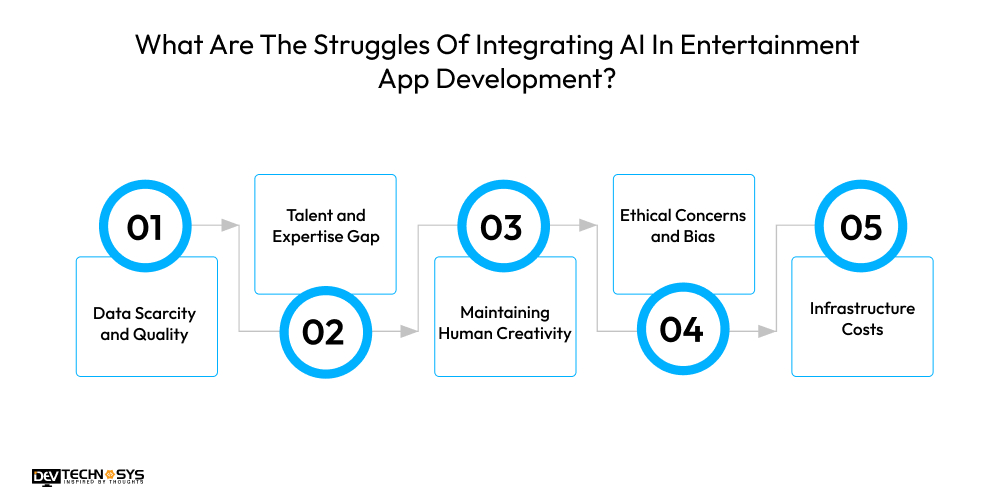
1. Data Scarcity and Quality
The biggest challenge for an OTT app development company while integrating AI is related to data scarcity and quality. It is because AI requires large volumes of high-quality data to function properly.
In multiple entertainment apps, the AI accuracy gets reduced due to incomplete, biased, or poorly labeled data. This can lead to weak recommendations and unreliable predictions.
2. Talent and Expertise Gap
Developing a highly efficient AI-integrated entertainment app requires skilled, professional developers. It is because efficient developers can work amazingly with machine learning, data science, and AI engineering.
The lack of experienced talent can increase the entertainment app development cost and complexity. It even slows down the innovation, while increasing dependency on specialized, high-cost development teams.
3. Maintaining Human Creativity
If entertainment apps overly depend on AI, it limits the originality and emotional depth in the entertainment. Therefore, balancing automation along with human creativity is extremely necessary.
However, it will become a struggle because making sure AI supports artistic expression by developers is difficult. So, building entertainment apps with AI without replacing human storytelling and creative decision-making can be challenging.
4. Ethical Concerns and Bias
Sometimes, Artificial Intelligence in entertainment app development can unintentionally reflect bias present in training data, making it an ethical concern.
This may affect the content recommendation, visibility, and representation of an entertainment app. It raises the potential concerns related to fairness, inclusivity, data privacy, and responsible AI usage.
5. Infrastructure Costs
AI implementation in entertainment apps requires strong and seamless computing resources and cloud infrastructure, which demands ongoing maintenance.
Due to this, a high cost to develop a mobile app is involved. This cost includes data storage, processing, model training, and so on. This becomes challenging for small businesses and startups to invest in elevated infrastructural costs.
What Are The Future Trends Of AI-Powered Entertainment App Development?
With smarter personalizations, immersive experiences, and emotionally intelligent interactions, AI in entertainment app development is transforming rapidly. Here, we will discuss some of the future trends of AI-powered entertainment app development.
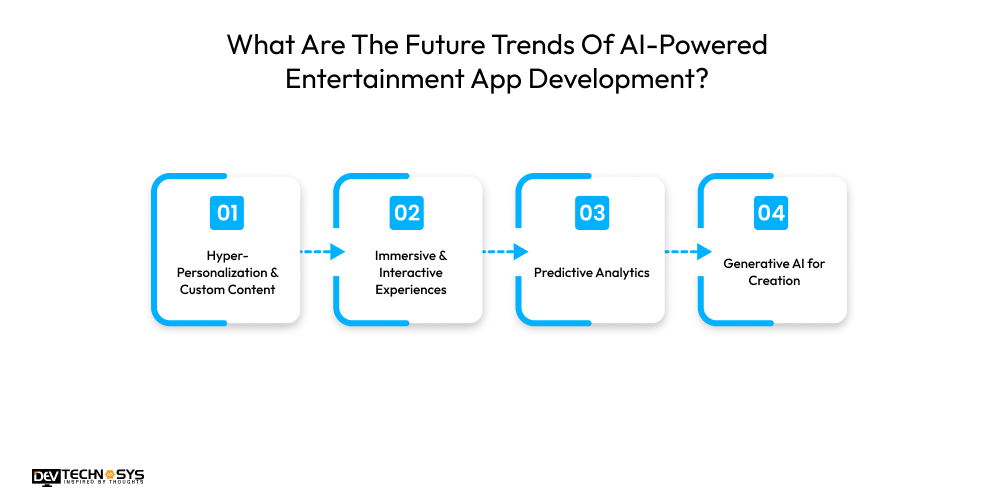
1. Hyper-Personalization & Custom Content
The future of entertainment apps will deliver a hyper-personalized experience using AI. It helps in tailoring content, interfaces, and interactions for every user individually. This even offers user preferences, watch history, and behaviour-based personalized storylines, playlists, and viewing experiences.
2. Immersive & Interactive Experiences
A chatbot development company will combine AI in entertainment apps to upgrade the AR and VR experience for perfect storytelling. These apps will provide users with more responsive environments, intelligent characters, and real-time interactions. It makes the user actively participate instead of passively using the app.

3. Predictive Analytics
Predictive analytics is going to be commonly used in AI-powered entertainment apps. It helps the app in anticipating user behavior, content demand, and ongoing trends effortlessly. Predictive Analytics plans the content, target marketing, and implements active user engagement strategies.
4. Generative AI for Creation
Generative AI is another popular future trend that can transform the entertainment apps development. It enables automated creation of videos, music, scripts, and visuals. It even lets the platform generate high-quality content faster while reducing production costs and supporting content creators.
What Is The Role Of Web Portals In AI Entertainement App Industry?
Web portals in the entertainment app industry are the platforms that offer users a broader range of related content and features. They work as a backbone for connecting AI engines with streaming apps, gaming platforms, music services, and smart TV applications. Learn about the role of web portals in the AI entertainment industry.
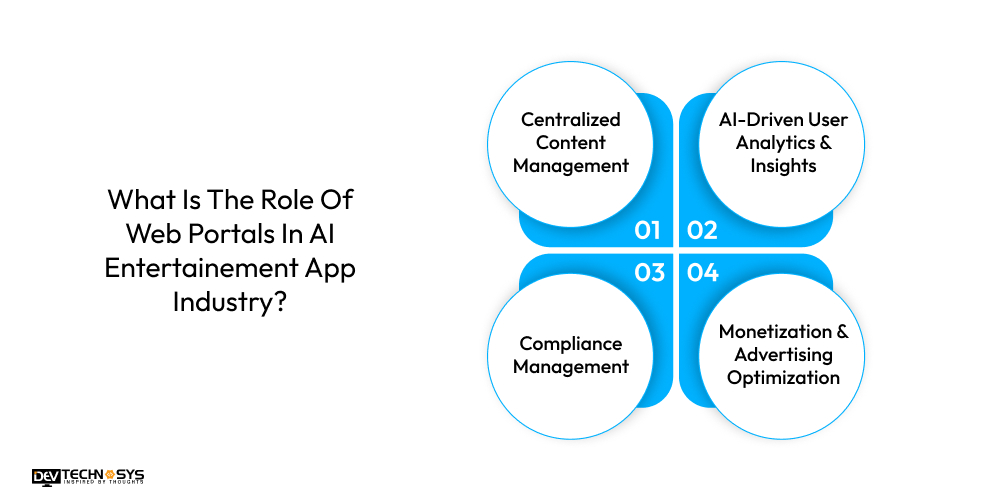
1. Centralized Content Management
The web portal plays a vital role in the entertainment industry for managing entire content, such as movies, music, and games, from one place. It organizes, updates, and distributes the content seamlessly on multiple apps, smart TVs, or other web platforms.
2. AI-Driven User Analytics & Insights
Web portals allow AI to study how users watch, play, or listen to the content and display these insights clearly. It even helps businesses to understand user preferences while improving content quality and features.
3. Compliance Management
AI-powered entertainment apps’ web portals monitor the content for maintaining copyright rules, age restrictions, and platform policies. With this, entertainment apps can easily stay legal, safe, and trustworthy.
4. Monetization & Advertising Optimization
Generally, Web portals also manage subscriptions and ads, while AI improves ad targeting and pricing. This helps in increasing the revenue without influencing the user experience.
Final Words
Last but not least, AI has become an integral part and driving force of next-gen entertainment apps in 2026. AI is transforming the way people watch, play, and connect with digital content while offering smart recommendations and real-time interactions.
As the expectation of users grows, an artificial intelligence development company helps businesses stay innovative and competitive. Definitely, in the coming years, AI will redefine the digital experience by offering a more human-centric, adaptive, and essential bundle of entertainment.
As AI technologies used in entertainment apps, app owners can deliver personalized, engaging, and scalable experiences that feel natural and intuitive. By shaping the future of digital entertainment, AI is turning the platforms into an ecosystem that meets user needs and expectations.
Frequently Asked Questions
Find answers to the most common questions related to this article.
AI is no longer a feature of entertainment apps in 2026, but it is a core intelligence system. It offers personalization, automation, and decision-making. It shapes the user journeys by providing seamless content delivery and real-time experiences across platforms.
In the future, AI will primarily focus on hyper-personalized content, emotional intelligence, immersive experiences, and predictive engagement. It helsp the apps in adopting the user behavior, preferences, and moods instantly across multiple apps.
By integrating features like smart recommendations, adaptive gameplay, automated content creation, voice-based interactions, and real-time analytics, AI is transforming entertainment apps. It also allows the app to deliver relevant, engaging, and seamless experiences to users.
Here are some points that can describe the role of AI in entertainment apps briefly:
Personalized Recommendations
Real-Time Content Optimization
Voice Recognition & Control
Immersive AR/VR Experiences
Fraud Detection & Content Protection
Personalized Notifications & Alerts
Some of the potential challenges faced while integrating AI in entertainment apps are:
Data Scarcity and Quality
Talent and Expertise Gap
Maintaining Human Creativity
Ethical Concerns and Bias
Infrastructure Costs
AI improves the user engagement in an entertainment app by providing interactive experiences, adaptive content, real-time feedback, and predictive suggestions. It also keeps the users emotionally connected, which encourages long-term app loyalty.