















Key Takeaways:
The cost to develop a fintech app in 2026 typically ranges between $8,000 to $30,000, depending on features, complexity, security requirements, and the development team’s expertise.
Cost Breakdown by Complexity:
-
- Basic/MVP App: $30,000 – $60,000 (limited features like login, dashboard, simple transactions)
- Mid-Level App: $60,000 – $100,000 (advanced UI, payment gateways, analytics)
- Advanced App: $100,000 – $1,50,000+ (AI features, blockchain, high-end security, scalability)
Key Cost Factors:
Major factors include app complexity, UI/UX design, fintech app architecture, third-party integrations, security protocols, and regulatory compliance requirements.
Development Timeline:
-
- Basic App: 2–3 months
- Mid-Level App: 3–6 months
- Advanced App: 6–9+ months
Regional Cost Rates:
-
- India: $15–$50/hour
- USA: $80–$100/hour
- Europe: $60–$90/hour
The Fintech revolution is in full swing, and everything seems to be accelerating, yet one question still haunts entrepreneurs at night: how much does it really cost to build a fintech app in 2026? Competition is fierce, with global fintech revenue projected to exceed $460 billion by 2026, and in this fast-paced environment, prudent investment decisions are vital.
Several elements that directly impact your development budget, from security layers and compliance requirements to advanced functionalities such as AI-driven insights and smooth payment integration. Also, consideration of one can result in unanticipated costs or delays to the project.
In this blog, we build the 7 essential factors that actually matter more than anything in deciding the mobile fintech app development cost, which will help startups & business owners plan smartly and scale up future-ready, scalable Fintech solutions with focused budgets.
What is Fintech App?
A fintech app is a mobile or web app that employs technology to provide financial services such as payments banking investing, lending, or insurance. It makes managing money easier, allows secure digital transactions, provides instant information, and enhances accessibility, thus making financial activities quicker, intelligent, and more convenient for both users and businesses.
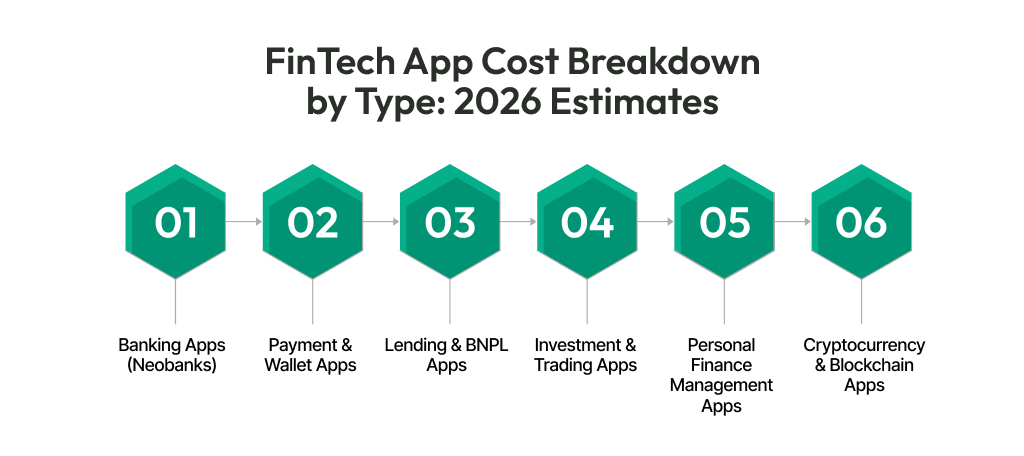
FinTech App Cost Breakdown by Type: 2026 Estimates
Are you a new businesss wondering how much does it cost to build a fintech app? well, the FinTech software development costs vary by type, features, and complexity. Understanding 2026 estimates across different app categories helps businesses evaluate investment needs and choose the right solution based on their goals.
FinTech App Type |
Best For |
Key Features Included |
Estimated Cost |
Development Time |
Complexity Level |
Recommended Tech Stack |
Monetization Model |
| Banking Apps (Neobanks) | Startups, Digital Banks, Financial Institutions | User accounts, KYC, fund transfer, bill payments, AI fraud detection, multi-currency support | $80,000 – $150,000+ | 6 – 12+ months | Very High | Node.js, Python, AWS, PostgreSQL | Transaction fees, subscriptions, interest margins |
| Payment & Wallet Apps | SMEs, Retail Businesses, Startups | P2P transfers, QR payments, payment gateway integration, notifications, transaction history | $30,000 – $70,000 | 3 – 10 months | Medium | Flutter, Firebase, Stripe API, Node.js | Transaction fees, merchant commissions |
| Lending & BNPL Apps | Fintech Startups, NBFCs | Loan management, EMI calculator, credit scoring, document verification, AI underwriting | $50,000 – $120,000 | 4 – 10 months | Medium–High | Python (ML), React, MongoDB, AWS | Interest rates, late fees, processing charges |
| Investment & Trading Apps | Enterprises, Investors, Brokerage Firms | Real-time stock data, portfolio tracking, analytics dashboard, trading engine, alerts | $70,000 – $150,000+ | 6 – 15+ months | Very High | Java, Kafka, AWS, WebSockets | Commission, premium subscriptions |
| Personal Finance Apps | Individuals, Budget-conscious users | Expense tracking, budgeting tools, financial insights, bank API integration | $30,000 – $60,000 | 2 – 8+ months | Low–Medium | React Native, Firebase, Plaid API | Freemium model, ads, premium plans |
| Cryptocurrency Apps | Crypto Startups, Traders | Crypto wallet, blockchain integration, smart contracts, token exchange, security protocols | $60,000 – $150,000+ | 5 – 12+ months | High | Solidity, Node.js, Web3.js, Ethereum | Trading fees, token listing fees |
1. Banking Apps (Neobanks)
Banking app development solutions fall into the category of the most expensive fintech solutions since they require advanced functionality, including account management, KYC verification, fraud detection, and real-time transactions.
Cloud security expectations of customers in key areas, as complexity value (complexity + cost) will increase, leading to the adoption of cloud-based solutions due to high levels of regulation and integration expected with core banking systems.
2. Payment & Wallet Apps
Payment & wallet apps target peer-to-peer transactions, QR payments, and merchant integrations. Ewallet app development solutions are simpler but still rely on strong encryption, secure APIs, and seamless transaction processing. With additional features such as cross-border transactions, multi-currency transactions, and real-time notifications, the costs increase.
3. Lending & BNPL Apps
Lending and Buy Now Pay Later apps require credit scoring algorithms, document verification, risk analysis, and EMI management systems. Integration with financial institutions and AI-based underwriting increases development effort, making these apps moderately to highly expensive depending on automation and scalability requirements.
4. Investment & Trading Apps
Investment apps require features such as real-time market data, portfolio tracking, and analytical dashboards, in addition to secure order execution. The major factors behind their high cost are the need for live data feeds and regulatory compliance, which entail significant infrastructure expenses, making them the more expensive types of fintech apps.
5. Personal Finance Management Apps
Personal finance apps assist in tracking expenses, creating budgets, and understanding spending habits through analysis. Money transfer app development solutions are cost-effective as they mostly utilize APIs, without managing direct transactions.
Nevertheless, the inclusion of AI-driven insights, predictive analytics, and more secondary integrations can slightly raise the cost of fintech software development.
6. Cryptocurrency & Blockchain Apps
Crypto apps need wallet integration, blockchain networks, smart contracts, as well as rigorous security controls. Expenditure on development largely depends on the degree of decentralization, supported token, and available trading options. Meeting compliance, encryption, and scalability challenges also contributes to their technical complexity and costliness.
What is the Average Fintech App Development Cost?
You can expect the average cost of developing a fintech app in 2026 to fall between $30,000 and $1,50,000+, depending on the app’s size, number of features, and required security level.
A simple MVP with just the essential features might cost about $30,000 or $60,000, whereas a really nice app with integrations and analytics can cost $60,000 or $90,000.
In fact, a banking or trading app that requires real-time processing, AI, and regulatory compliance can increase the cost to $1,50,000. Also, factors such as the tech stack, where the fintech app development agency is located, UI/UX design, and third-party integrations have a significant impact on project costs, so it is very important that entrepreneurs plan carefully if they want to build fintech software.
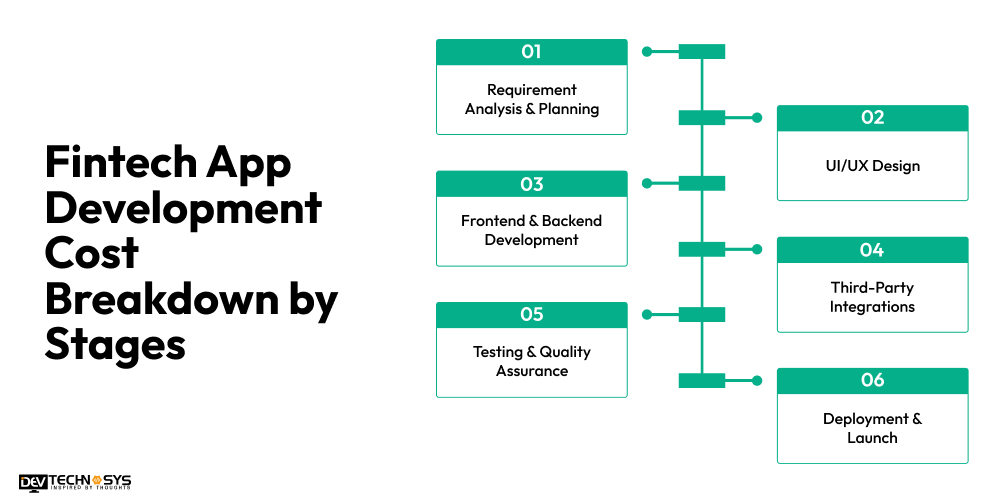
Fintech App Development Cost Breakdown by Stages
A clear breakdown of fintech app development costs by stages helps you understand where your investment goes. Explore how each phase from planning to launch contributes to the total development budget.
Stage |
Key Points |
Estimated Cost (USD) |
| 1. Requirement Analysis & Planning | • Market research
• Feature planning • Roadmap creation • Best stage to hire experts |
$3,000 – $12,000 |
| 2. UI/UX Design | • Wireframes
• Prototypes • User-friendly design • Branding elements |
$5,500 – $20,000 |
| 3. Development (Frontend + Backend) | • Core features
• API development • Database setup • Performance optimization |
$15,000 – $70,000 |
| 4. Third-Party Integrations | • Payment gateways
• Banking APIs • Analytics tools • Real-time sync |
$3,000 – $18,500 |
| 5. Testing & QA | • Bug fixing
• Security testing • Performance testing • Usability checks |
$2,000 – $12,500 |
| 6. Deployment & Launch | • App store launch
• Server setup • Final configs • Go-live support |
$1,500 – $11,000 |
1. Requirement Analysis & Planning (5% to 10% of Total Budget)
At this step, you conduct market research, analyze competitors, and choose the features. Your main focus should be to hire a fintech app development firm that, at this point, will cost you about $3,000 to $12,000, as having experts involved early ensures overall cost savings and avoidance of expensive changes later.
2. UI/UX Design (10% to 15% of Total Budget)
For intuitive payment application development, make wireframes, prototypes, and UI/UX that are the easiest to use. It usually costs from $5,500 to $20,000, during which your fintech apps are very well planned, with intuitive navigation, strong branding, and highly engaging designs that enhance user experience and retention.
3. Frontend & Backend Development (35% to 55% of Total Budget)
This is really the main phase of fintech app development services, where everything is put together: the app’s functionality, databases, and APIs. In this regard, the cost can range from $15,000 to $70,000, depending on the level of your app, to ensure smooth performance, scalability, and secure financial transaction handling.
4. Third-Party Integrations (8% to 15% of Total Budget)
This step involves connecting payment gateways, implementing banking APIs, and setting up analytics tools. Peer to peer payment app development cost typically ranges from $3,000 to $18,500 and is largely determined by the number and complexity of integrations needed to facilitate real-time data exchange and smooth financial operations.
5. Testing & Quality Assurance (8% to 12% of Total Budget)
Testing plays a critical role in verifying that the app is secure, free of bugs, and performs well across various scenarios. Typically, this phase costs between $2,000 and $12,500and is sufficient to conduct functional testing, performance assessment, and security validation to deliver a dependable fintech platform.
6. Deployment & Launch (3% to 10% of Total Budget)
At the end of the development cycle is launching the app which comprises app store submission, server configuration, and launch setup activities. These usually fall within the range of $1,500 to $11,000 targeting smooth delivery and getting the fintech app ready for real-life use without any hiccups.
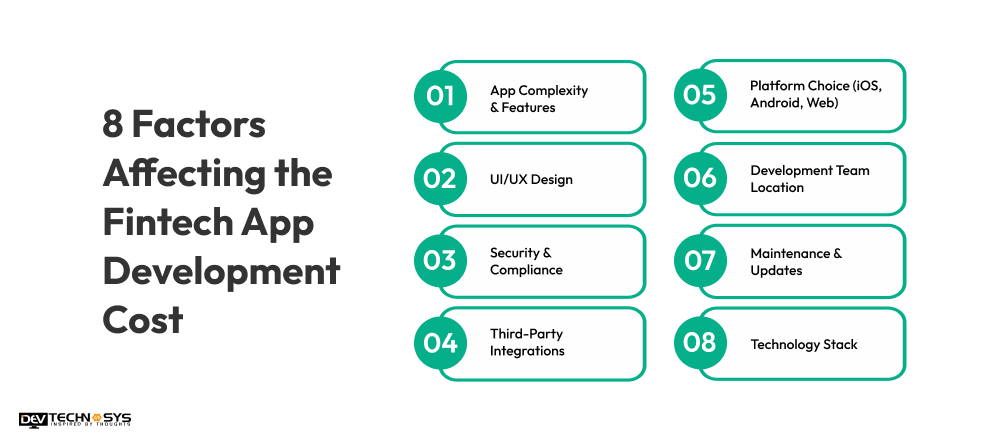
8 Factors Affecting the Fintech App Development Cost
Understanding the key factors that influence fintech app development cost helps businesses plan budgets effectively. Explore these 8 crucial elements to uncover what truly drives pricing and impacts your project’s success.
1. App Complexity & Features
The quantity and level of sophistication of features heavily impact fintech app development cost. Simple apps with only essential features will cost less. However, adding extra features such as AI, real-time data analysis, multi-currency handling, and automation increases development time, resource requirements, and, ultimately, the cost to develop a fintech app like Wise.
|
Complexity Level |
What You Get | Estimated Cost (USD) |
|
Basic (MVP) |
Login, dashboard, basic transactions |
$8,000 – $20,000 |
|
Mid-Level |
APIs, analytics, notifications |
$20,000 – $50,000 |
| Advanced | AI, automation, real-time data |
$50,000 – $90,000+ |
2. UI/UX Design
Design the interface to be user-friendly; the more user-friendly it is, the more it will contribute to user engagement. It will lead to higher fintech app development costs.
For example, if custom animations, interactive dashboards, and seamless navigation are to be added, then the designers’ expertise will be required, which in turn will increase expenses as compared to using standard templates or no-frills design solutions.
|
Design Level |
What’s Included | Estimated Cost (USD) |
| Basic UI | Templates, simple layouts |
$3,000 – $8,000 |
|
Custom UI/UX |
Branding, user journeys |
$8,000 – $20,000 |
|
Premium UX |
Animations, micro-interactions |
$20,000 – $40,000 |

3. Security & Compliance
Security in Fintech apps is always a priority and encompasses measures such as encryption, multi-factor authentication, and compliance with regulations like KYC and GDPR.
Implementing these security measures not only requires experts but also makes security one of the most expensive and critical factors influencing the cost to build a fintech app.
|
Security Level |
Features |
Estimated Cost (USD) |
|
Standard |
SSL, basic authentication | $5,000 – $12,000 |
|
Advanced |
MFA, encryption, fraud detection |
$12,000 – $35,000 |
| Enterprise | KYC, AML, GDPR/PCI-DSS compliance |
$35,000 – $70,000+ |
4. Third-Party Integrations
The cost to build a fintech app also depends on third-party integrations. Adding functionality by integrating APIs such as payment gateways, banking services, and analytics tools also increases costs. In addition to licensing, API usage charges, and integration complexity, these factors can significantly affect the total cost of creating a fintech app.
|
Integration Type |
Examples |
Estimated Cost (USD) |
|
Basic APIs |
Payment gateway, SMS, email APIs | $3,000 – $8,000 |
|
Intermediate APIs |
Banking, analytics, KYC APIs |
$8,000 – $20,000 |
| Advanced Integrations | Open banking, AI APIs, blockchain APIs |
$20,000 – $40,000+ |
5. Platform Choice (iOS, Android, Web)
Financial app development for multiple platforms can increases costs due to different or shared development processes. Building native apps is more costly, whereas cross-platform options are less expensive but may limit performance or customisation.
|
Platform Type |
Development Approach |
Estimated Cost (USD) |
|
Single Platform |
iOS or Android only | $30,000 – $60,000 |
| Cross-Platform | Flutter, React Native |
$40,000 – $90,000 |
|
Multi-Platform |
iOS + Android + Web |
$80,000 – $120,000+ |
6. Development Team Location
The location of the fintech app development company is one of the main factors that determine the cost of fintech software development. Hiring fintech app developers from a mobile app development agency in North America has higher rates than, for instance, India or Eastern Europe, so outsourcing can turn out to be a very cost-saving approach for startups.
|
Region |
Hourly Rate (USD) | Estimated Project Cost |
| India | $20 – $50/hr |
$30,000 – $80,000 |
|
Eastern Europe |
$40 – $90/hr | $60,000 – $120,000 |
| USA/UK | $100 – $200/hr |
$120,000 – $150,000+ |
7. Maintenance & Updates
Continuous investment is required for work after product launch such as fixing bugs, improving the performance of the app, user support, and rolling out new features.
Usually, yearly maintenance fees are 15, 25% of what the initial payment app development cost was, contingent on factors such as app complexity and potential for scalability.
| Maintenance Type | What’s Included | Annual Cost (USD) |
| Basic Support | Bug fixes, monitoring | $4,500 – $10,000 |
| Regular Updates | Feature upgrades, optimizations | $10,000 – $25,000 |
| Full Maintenance | Security, scaling, compliance updates | $25,000 – $37,500+ |
8. Technology Stack
When you opt for modern tech like blockchain, AI, or cloud-based architecture, the fintech software development cost will jump upfront, but you will also ensure the system can be scaled and is highly performant. A simple tech stack is less expensive initially, but you may have to do some upgrades further down the line as the app becomes more popular.
| Tech Level | Technologies Used | Estimated Cost (USD) |
| Basic Stack | PHP, Laravel, MySQL | $5,000 – $20,000 |
| Modern Stack | Node.js, React, Flutter, AWS | $20,000 – $60,000 |
| Advanced Stack | AI, Blockchain, Cloud-native Architecture | $60,000 – $100,000+ |
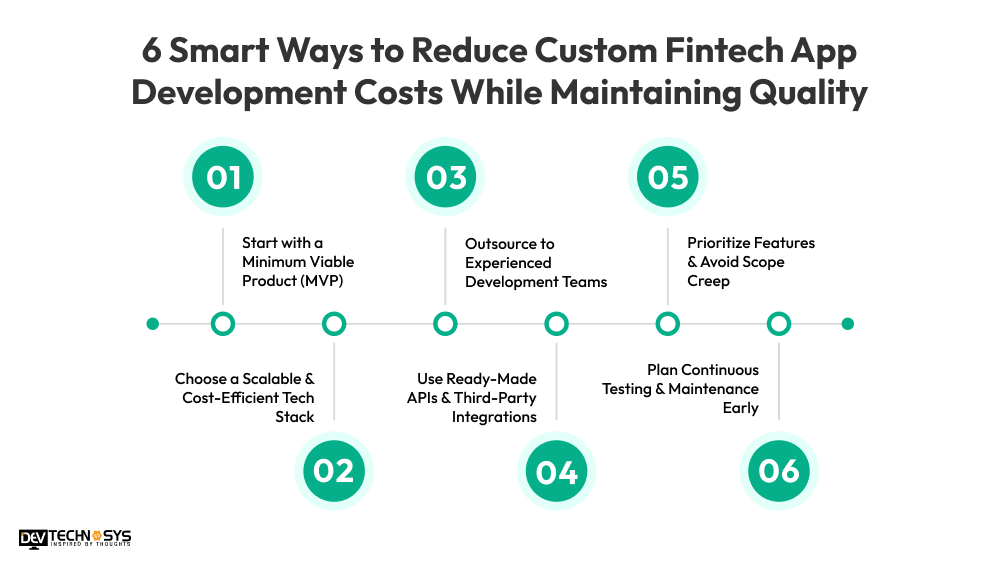
6 Smart Ways to Reduce Custom Fintech App Development Costs While Maintaining Quality
Fintech software development cost can go really high, but smart strategies can optimize expenses without compromising quality. Explore these proven ways to reduce loan lending app development costs while maintaining performance, security, and scalability standards.
1. Start with a Minimum Viable Product (MVP) (20% to 40% Potential Cost Reduction)
The first step is always to build a Minimum Viable Product that contains only the core functionalities. Starting with minimum viable products (MVPs) decided through market research is a great way to start your product development journey.
This strategy helps you save up-front money, launch faster, and get real user feedback. Doing so, you will not only avoid unnecessary increase in the cost to develop fintech app but also upgrade your product in line with actual market demand.
2. Choose a Scalable & Cost-Efficient Tech Stack (10% to 20% Potential Cost Reduction)
The choice of a tech stack, including cross-platform frameworks and cloud solutions, is strategic and impacts development as well as maintenance costs.
Having a scalable technology stack is a wise decision since it minimizes the possibility of costly updates or complete overhauls of your fintech app as it evolves over time.
3. Outsource to Experienced Development Teams (20% to 50% Potential Cost Reduction)
Outsourcing a fintech software development agency from cost-effective countries such as India is a very effective way of saving money. Highly qualified and experienced developers who are operational experts will not only implement best practices and reduce the number of mistakes but will also produce top-notch fintech products, thus helping you save on mobile banking app development cost while not compromising on performance, security, and scalability.
4. Use Ready-Made APIs & Third-Party Integrations (15% to 30% Potential Cost Reduction)
Instead of developing a whole lot of features and systems yourself, it is a good idea to use third-party APIs that are well-known and stable for payments, KYC, and analytics.
This will save you both time and money in production while ensuring reliability, faster deployment, and advanced features at your disposal without major investment in custom infrastructure.
5. Prioritize Features & Avoid Scope Creep (10% to 30% Potential Cost Reduction)
Get feature definitions completed on paper before the developers can start conceiving actual coding. Stay away from adding useless features mid-way when the ewallet app developers are already on their way, as this will only balloon time and costs. Keeping to a plan will lead to a necessary, efficient use of resources, retaining product quality, and achieving business objectives.
6. Plan Continuous Testing & Maintenance Early (20% to 35% Potential Cost Reduction)
Make testing and maintenance an integral part of your product development process right from the start. Finding software bugs early on can be a great way to prevent expensive fixes.
Ensuring the software is regularly updated is great for maintenance and also security. This kind of preemptive thinking can help keep control of the overall costs and guarantee the quality standards of the application all the way through its lifecycle.
Want a chatbot demo or pricing? Fill the form and talk to our experts today.
Pick what you need below — you can select more than one — then tap Get detail to continue.
-
Chatbot demo dashboard
-
Cost to develop an app
-
Industry report
-
Case study
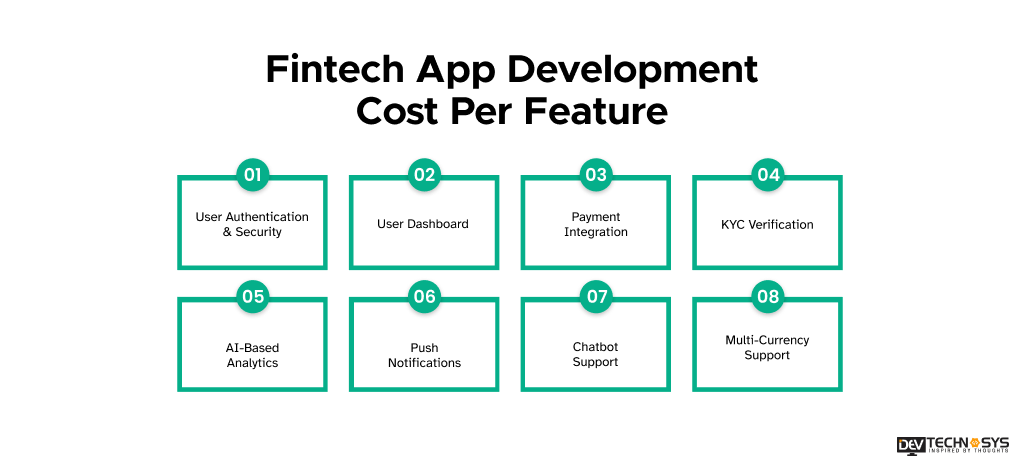
Fintech App Development Cost Per Feature
Understanding fintech app development cost per feature helps businesses plan budgets effectively. From authentication to payment gateways, each feature adds value and expense, making it essential to evaluate priorities before development.
1. User Authentication & Security
The usage of secure login methods, like the combination of multi-factor authentication and biometrics, is a great way to protect the data. But at the same time, this can lead to increased fintech app development budget, as the implementation of encryption measures and the necessity to meet compliance requirements will add to the complexity of the task.
2. User Dashboard
Creating a highly engaging and interactive dashboard that highlights balances, insights, and transactions will definitely entail the necessity of a custom UI/UX design coupled with obtaining real-time data, which is going to influence the fintech app development pricing at a moderate level.
3. Payment Integration
To make payment processing easier via gateways or API, integration will require a third party to be added, creating additional expenses that will vary based on transaction volumes, different levels of security, and the number of ways the client is paying.
4. KYC Verification
KYC verification of documents through an API will assist clients in meeting their regulatory obligations; this verification process may involve additional costs associated with integration complexity, document handling, or legal requirements.
5. AI-Based Analytics
The development of more robust AI and predictive analytics capabilities will increase the overall fintech app development timeline and cost, but the end-user will benefit from improved customer experiences and improved decision-making support.
6. Push Notifications
Real-time alerts for both transaction and operational updates will provide users with increased engagement at a relatively low development cost, but there will be a need to provide for backend setups and/or to integrate alert services with existing systems.
7. Chatbot Support
Implementing AI chatbots to allow instant responses enables a better customer service experience for end-users; however, it potentially adds moderate development costs based on having integrated natural language processing functionality, training models, and establishing backend systems.
8. Multi-Currency Support
Supporting multiple currencies and exchange rates will require a more complex integration with currency conversion APIs, as well as development/maintenance costs associated with adding those currencies to the customer’s account.
|
Feature |
Implementation Complexity |
Estimated Development Cost |
|
User Authentication & Security (MFA, Biometrics, Encryption) |
High | $3,000 – $12,000 |
|
User Dashboard (Account Overview, Analytics, Transaction History) |
Medium |
$2,500 – $10,000 |
|
Payment Integration (Payment Gateways, Bank APIs, Wallets) |
High |
$4,000 – $20,000 |
|
KYC Verification (Identity Verification, Document Scanning) |
Medium-High |
$3,000 – $15,000 |
|
AI-Based Analytics (Financial Insights, Predictive Analytics) |
High |
$8,000 – $30,000 |
|
Push Notifications (Real-Time Alerts and Reminders) |
Low | $1,000 – $5,000 |
|
Chatbot Support (AI Assistant, Customer Support Bot) |
Medium-High |
$4,000 – $18,000 |
| Multi-Currency Support (Currency Conversion, Exchange Rates) | Medium |
$3,000 – $12,000 |
Architecture and Technical Blueprint of a Fintech App
Fintech app architecture is created to guarantee security, scalability, and transaction flow without hitches. Usually, it relies on a layered structure, such as frontend, backend, and database layers. The frontend offers a user-friendly experience, and the backend handles business logic, APIs, and transaction processing.
A cloud environment is used to increase scalability and maintain high performance during busy times. Security-enabled APIs allow integration with payment gateways and banking systems.
Data is kept in encrypted databases in order to safeguard privacy and comply with rules. Security is further strengthened by methods such as multi-factor authentication and a fraud detection system to guard highly sensitive financial information and deliver reliable, future-ready application performance.
Security, Compliance, and Trust Framework in Fintech Apps
Fundamentally, security compliance and trust are the keystones of any fintech app. Powerful security mechanisms such as end-to-end encryption, multi-factor authentication, and secure APIs act as a safeguard for sensitive financial information against digital attacks. Adherence to regulations and laws, including KYC, AML, and data protection, helps ensure compliance and build trust in the market.
A reliable trust framework comprises open policies, on-the-spot fraud detection, and maintaining security through regular audits, all of which help keep users’ trust. Using role-based access control combined with a secure setup of cloud infrastructure is a further measure to provide a powerful shield against violations.
These allow fintech apps to provide a safe, compliant, and trustworthy financial service while also building long-lasting user trust and business growth.
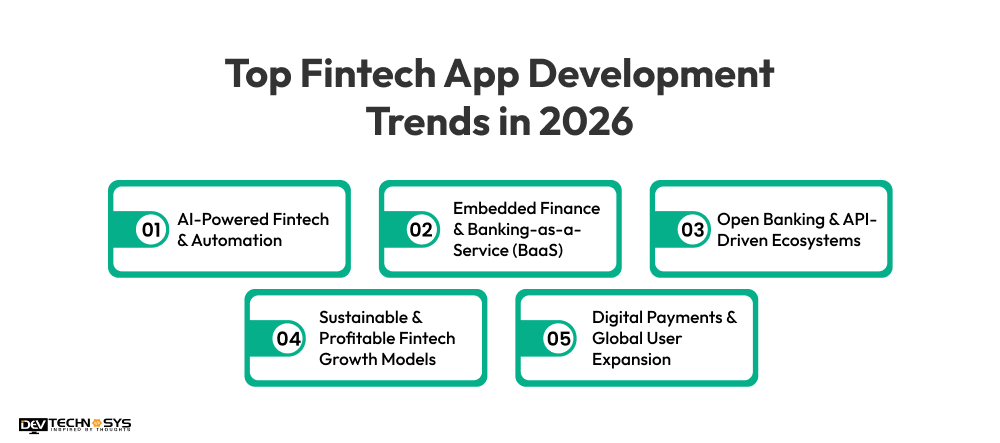
Top Fintech App Development Trends in 2026
This section highlights the top fintech app development trends for 2026, supported by reliable statistics from McKinsey and Statista, helping businesses understand market direction, emerging opportunities, and make informed, data-driven development decisions.
1. AI-Powered Fintech & Automation
Fraud detection, predictive analytics, robo-advisors, and hyper-personalized banking experiences are revolutionizing fintech apps. Per McKinsey & Company, fintechs are the leaders in AI implementation, which allows quick decision-making, automation, and operational efficiency in lending, payments, and wealth management.
Stat: Fintechs account for nearly 70% of AI initiatives despite being only ~40% of firms (McKinsey).
2. Embedded Finance & Banking-as-a-Service (BaaS)
Embedded finance enables the non-financial platforms to offer banking services like payments, lending, and insurance right in their apps. As per Statista, fintech is going beyond banks and entering ecosystems, thus facilitating the delivery of financial services inside eCommerce, SaaS, and mobility platforms in a smooth manner that boosts user engagement and monetization.
Stat: The embedded finance market is projected to grow to $1.7 trillion by 2034 (industry estimates cited in fintech reports).
3. Open Banking & API-Driven Ecosystems
Open banking is pushing forward fintech innovation by allowing safe data sharing between banks through APIs. According to Statista, regulation-driven open finance is spreading worldwide, giving fintech apps the opportunity to offer integrated financial services as well as giving better customer experiences through interconnected ecosystems.
Stat: Open banking adoption continues rising globally with multi-region regulatory frameworks driving expansion (Statista insights).
4. Sustainable & Profitable Fintech Growth Models
According to McKinsey & Company, fintech companies have shifted their focus from chasing rapid expansion to generating sustainable revenues, streamlining operations, and creating shareholder value over the long term, especially after the slowdown in investments and the market correction.
Stat: Fintech revenues are expected to grow ~15% annually vs ~6% for traditional banking (McKinsey).
5. Digital Payments & Global User Expansion
Digital payments are the principal growth engine for fintech, with the use of these platforms continuously expanding in both emerging and developed countries.
Statista reveals a significant increase in users, primarily driven by mobile wallets, real-time payments, and cross-border solutions, rendering fintech applications indispensable for everyday financial transactions.
Stat: Global digital payment users exceeded 3 billion users in 2024 (Statista).
Which Fintech Trend is Right for Your Startup: 3 Ways to Find
Choosing the right fintech trend can define your startup’s success. After exploring key trends, here are three practical ways to identify which innovation aligns best with your business goals, audience needs, and growth strategy.
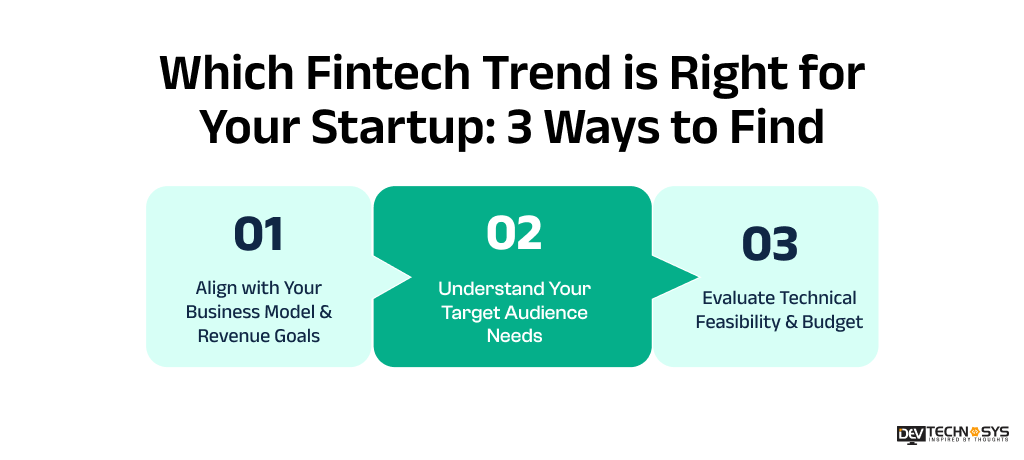
1. Align with Your Business Model & Revenue Goals
Identify a fintech trend that will have a direct impact on your startup’s main product and monetization method. Aligning the major revenue streams with the chosen trends guarantees that the business remains sustainable, scalable, and achieves better product-market fit in competitive fintech sectors, whether it is payments, lending, or wealth tech.
2. Understand Your Target Audience Needs
Before jumping on a trend, your fintech software development company should study your users’ behavior, pain points, and what they expect. For example, digital payments appeal to the masses, while AI-enhanced tools attract affluent audiences. Selecting a trend according to genuine demand results in higher adoption, more interaction, and overall happiness of customers.
3. Evaluate Technical Feasibility & Budget
Always implementing every trend with your current resources isn’t possible. Look at your cost to create a fintech app, the deadline, and the technology that you have at your disposal. Picking a trend aligned with your technical readiness has the advantage of a quicker rollout, lower expenses, and a more stable, secure fintech product.
Fintech App Development Tech Stack
Choosing the fintech app development tech stack is crucial for performance, security, and scalability. It includes front-end, back-end, databases, APIs, and cloud services that ensure financial transactions and user experience.
Layer |
Technology / Tools |
| Frontend (User Side) | React Native, Flutter, Swift (iOS), Kotlin (Android), Angular, Vue.js |
| Backend (Server Side) | Node.js, Python (Django/Flask), Java (Spring Boot), Ruby on Rails |
| Database | PostgreSQL, MySQL, MongoDB, Firebase Realtime Database |
| Cloud & Hosting | AWS, Google Cloud Platform, Microsoft Azure |
| Payment Integration | Stripe, PayPal, Razorpay, Square |
| Security | SSL Encryption, OAuth 2.0, JWT Authentication, Biometric Authentication |
| APIs & Integrations | Plaid API, Yodlee API, Open Banking APIs |
| DevOps & CI/CD | Docker, Kubernetes, Jenkins, GitHub Actions |
| Analytics Tools | Google Analytics, Mixpanel, Firebase Analytics |
| AI & ML Integration | TensorFlow, IBM Watson, OpenAI APIs |
| Compliance & KYC | Jumio, Onfido, Trulioo |
| Testing Tools | Selenium, Appium, TestNG |
5 Ways to Monetize Techniques for Fintech App
Discover proven strategies to turn your fintech app into a revenue-generating platform. Here are five effective monetization techniques that help maximize profitability while enhancing user experience and long-term business growth.
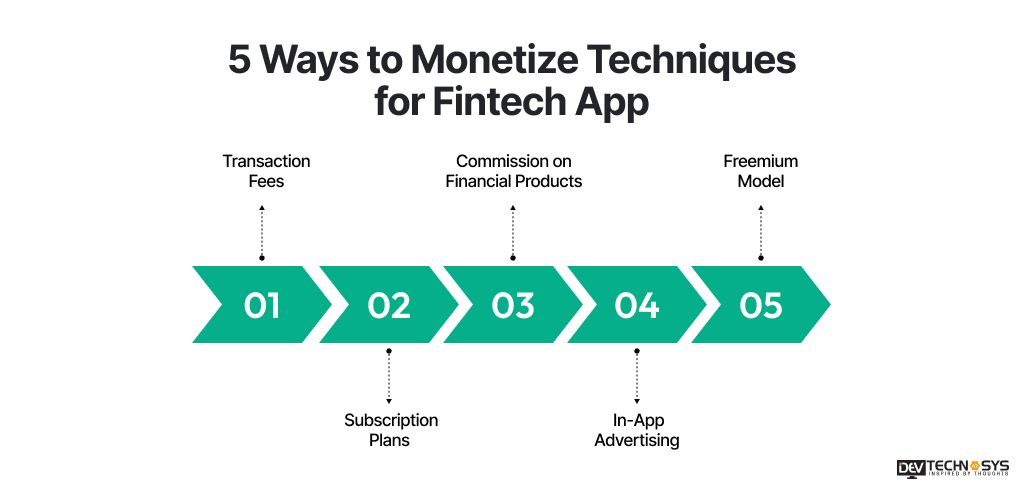
1. Transaction Fees
Charge users a small fee on every transaction, including payments, transfers, or withdrawals. This model ensures consistent revenue generation as user activity increases, making it one of the most scalable and commonly used monetization strategies in fintech applications.
2. Subscription Plans
The fintech on-demand app development solutions offer premium subscription tiers with advanced features like detailed analytics, financial planning tools, or priority support. This creates recurring revenue while providing additional value to users who are willing to pay for enhanced fintech services and exclusive functionalities.
3. Commission on Financial Products
Earn commissions by partnering with banks or financial institutions to offer loans, insurance, or investment products. Each successful referral or transaction generates revenue, making it a profitable strategy for fintech apps focused on marketplaces or financial service aggregation.
4. In-App Advertising
Display targeted advertisements within the app based on user behavior and preferences. Payment gateway software development solutions with large user bases can generate significant income through ads, especially when promoting relevant financial products, services, or partner offerings to the right audience segments.
5. Freemium Model
Fintech mobile app development company provides basic services for free while charging for premium features such as advanced insights, automation, or customization. This approach attracts a large user base initially and gradually converts free users into paying customers, maximizing long-term revenue potential effectively.
You can reach out anytime; we are available 24/7. Our team provides a quick response.

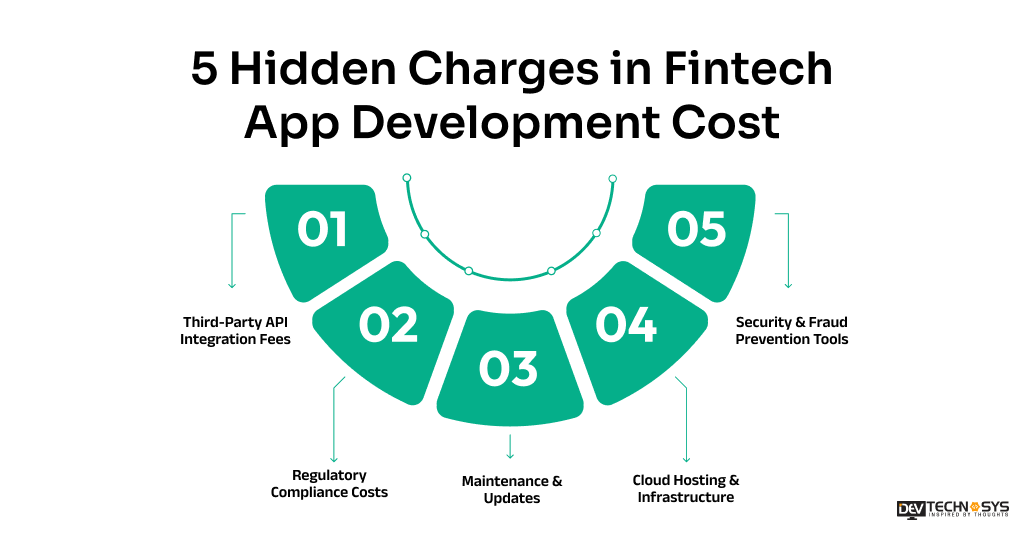
5 Hidden Charges in Fintech App Development Cost
Even after careful budgeting, custom fintech app development often includes overlooked expenses that increase overall costs. Understanding these hidden charges helps businesses plan smarter and avoid unexpected financial setbacks during development.
| Hidden Cost Factor | Estimated Cost |
|---|---|
| Third-Party APIs (KYC, AML, Payment Gateway, Crypto Pricing APIs) | $1,000 – $10,000/year |
| Regulatory Compliance & Legal Audits | $3,000 – $20,000/year |
| Maintenance & Feature Updates | 15% – 25% of Development Cost ($4,500 – $37,500/year) |
| Cloud Infrastructure & Hosting | $1,200 – $18,000/year |
| Security Monitoring & Fraud Prevention | $2,000 – $25,000/year |
1. Third-Party API Integration Fees (3% to 8% Impact on Cost)
Fintech apps depend on APIs for payments, KYC, and analytics. These services charge subscriptions or per-transaction fees that spike long-term costs beyond initial budgets. It seems many teams don’t factor in how much those fees accumulate.
2. Regulatory Compliance Costs ( 5% to 15% Impact on Cost)
experts who provide fintech platform development cost ensures compliance with KYC, AML, and PCI-DSS demands legal work, certs, and audits. Hidden cost to develop a fintech app increases quietly during early planning stages. Hard to ignore how underestimating these leads to costly delays later. Certification alone can add $50k to $150k in first-year costs. Some firms delay compliance until after launch – then face fines and downtime.
3. Maintenance & Updates ( 4% to 12% Impact on Cost)
Financial app development services like updates and bug fixes are constant needs for fintech apps. Maintenance grows fast when scaling or patching security flaws. Ongoing support can triple in cost within 18 months if not managed well. A single vulnerability fixed after deployment might cost more than new feature development.
4. Cloud Hosting & Infrastructure ( 8% to 20% Impact on Cost)
Data storage and processing need secure cloud setups. Monthly bills climb as user traffic increases sharply. The cost to develop a fintech app scales directly with data volume and login frequency. Choosing the wrong provider means paying 30% more than necessary.
5. Security & Fraud Prevention Tools ( 8% to 20% Impact on Cost)
Encryption, fraud detection, and real-time monitoring require extra spending. These aren’t optional – Mainly for handling sensitive financial data. Arguably, security is where most failures happen before users even notice a risk.
Launch, Scale, and Win: Build Your Fintech App with a Trusted Innovation Partner
Building a successful fintech app requires the right blend of innovation, security, and scalability. A fintech app development company helps businesses turn ideas into powerful fintech solutions through advanced technologies, user-centric design, and compliance-focused development.
From ideation to deployment, our experts ensure seamless integration, robust architecture, and future-ready performance tailored to your business goals.
With proven 15+ expertise in fintech development, end-to-end customised solutions, a strong focus on security and compliance, we can be your go-to partner for building a high-performing fintech app.
Frequently Asked Questions
Find answers to the most common questions related to this article.
The cost to build a fintech app in 2026 typically ranges from $30,000 to $1,50,000 depending on complexity, features, platform, and integrations. Advanced apps with AI, blockchain, and high security requirements can cost much more due to compliance and development challenges. It seems hard to ignore how much extra work goes into meeting those standards.
Fintech app development usually takes 3 to 9 months depending on project scope, features, and testing requirements. Basic apps are faster to build, while advanced solutions with integrations, security layers, and compliance checks require more time for development and deployment.
Key features include secure authentication, payment integration, KYC verification, real-time notifications, user dashboard, transaction tracking, and fraud detection systems. Advanced versions add AI-based analytics, chatbots, and multi-currency support to improve usability. The thing is, these extras don't just add value, they change the whole user experience.
Fintech apps ensure security through encryption, multi-factor authentication, secure APIs, and compliance with GDPR, PCI-DSS, and KYC/AML guidelines. Regular audits and monitoring are part of the routine. Fraud detection runs constantly to keep transactions safe.
Businesses should invest in fintech apps because digital payments are growing fast. Customers want easier access to financial tools. Embedded finance opens new revenue paths. Fintech solutions strengthen engagement, and help companies stand out in a shifting market.