




















The estimated cost to develop a Minimum Viable Product (MVP) in 2026 will generally be between $8,000 and $25,000+. The exact cost will depend on the complexity of the product, the types of features, and the method of development.
Impact of Project Complexity:
-
- Basic MVPs ($8,000 – $12,000): Basic core functionality, very little UI/UX design, limited functionality, and low-cost backend development, typically used for initial validation of the product idea
- Average Complexity MVPs ($12,000 – $18,000): Custom design, API Integration, User authentication, Dashboards, Backend designed for Growth
- Complex MVPs ($20,000 – $25,000+): Advanced functionality, Real-time functionality, AI functionality, High-end UI/UX, Robust architecture
Cost Breakdown of MVP Components:
-
- UI/UX Design $2,000-$8,000 based on complexity
- Frontend Development $5,000-$15,000
- Backend Development $5,000-$20,000
- API & Integrations $2,000-$10,000
- Testing & Quality Assurance $2,000-$6,000
- Project Management $3,000-$8,000
According to business type:
-
- Startup: $8,000-$15,000
- Growing Business: $15,000-$20,000
- Enterprise: $18,000 – $22,000+
- Funded Start-ups/Scale-ups: $25,000+ (custom scoped project)
Additional Costs::
-
- Planning & research 10%-20% of total project cost
- Third-party tools & SaaS costs based on actual usage
- Annual post-launch maintenance 10%-20% of the original MVP total development cost
- Marketing & user acquisition budgets vary based on individual company marketing strategies.
- The launch of a startup in 2026 is exciting, but the very first consideration should be how much it costs to build your MVP.
A Minimum Viable Product (MVP) represents the fastest way to get from your original concept to having your product in the hands of actual users. Yet it can be very difficult to accurately assess the cost to develop MVP due to many different factors, including features, technology choices, and team decisions. This is why understanding the components that will contribute to MVP development cost is not only important but critical to creating sound plans.
In this blog, you will learn everything you need to know about the components of MVP pricing, including design and development costs, as well as some hidden costs you may not have taken into account.
If you are a founder, entrepreneur, or product manager, you will be able to make informed decisions and avoid many of the common pitfalls associated with MVP buildouts.
What is MVP?
The minimum viable product (MVP) is the simple version of the product built with enough features to provide solutions to a primary problem and to get early users interested in your idea and attracting them as early users. It allows for the business to quickly test the idea, get feedback, and confirm that there is demand for the idea before developing a full-scale version of the product. Therefore, this will lower the risk, save time, and ensure that the final product will meet the actual needs of users.
How Much Does it Cost to Develop an MVP?
The cost to build an MVP app is around $8,000 to $25,000, which can be mainly based on the business requirements and demands. There are a higher number of factors that impact the cost, such as features, project complexity, functionalities, backend infrastructure, MVP development team, UI/UX design, and security measures.
Basically, the overall cost to develop an AI MVP can fluctuate because of sudden changes, the type of MVP, and the business type.
| Component | Estimated Cost (USD) |
| UI/UX Design | $1,000 – $3,000 |
| Frontend Development | $2,000 – $6,000 |
| Backend Development | $2,000 – $7,000 |
| API Integrations | $500 – $2,000 |
| Testing & QA | $500 – $2,000 |
| Project Management | $1,000 – $3,000 |
| Total MVP Cost | $8,000 – $25,000 |
Industry Insights: According to the Wise Guy Reports, the MVP ecosystem has evolved into a structured $8B+ global service market (2025), projected to reach $15B by 2035 (5.9% CAGR), driven by startups and enterprise innovation labs adopting rapid validation models.
Web vs. Mobile vs. Custom MVPs: Cost Comparison
The amount of money you will spend on your MVP will be determined by the platform and level of complexity. Web MVPs launch more easily and for less money than their counterparts. On the contrary, building a mobile application is more expensive than building a web application because the mobile app must support multiple platforms.
Custom MVPs are expensive because they have many custom features, integrations with other apps, and scalability requirements for their specific businesses.
Factor |
Web MVP |
Mobile MVP (iOS/Android) |
Custom MVP (Advanced) |
| Estimated Cost Range | $8,000 – $15,000 | $10,000 – $20,000 | $15,000 – $25,000 |
| Cost Efficiency | High (most affordable) | Medium | Low (highest investment) |
| Development Time | 4 – 8 weeks | 6 – 10 weeks | 8 – 14+ weeks |
| Platform Dependency | Browser-based | Platform-specific (iOS/Android) | Multi-platform or tailored |
| UI/UX Design Cost | Low to Medium ($1k–$4k) | Medium ($2k–$6k) | High ($5k–$10k) |
| Development Complexity | Low to Medium | Medium | High |
| Maintenance Cost | Low ($500–$2k) | Medium ($1k–$4k) | High ($3k–$5k) |
| Scalability Cost | Moderate | Moderate to High | High (built for scaling) |
| Technology Stack Cost | Lower (standard stacks) | Medium (SDKs, tools) | High (custom tech) |
| Third-Party Integrations | Basic ($1k–$3k) | Moderate ($2k–$5k) | Extensive ($5k–$10k) |
| Team Requirement | Small team (2–4 members) | Medium team (3–6 members) | Larger team (5–10 members) |
| Testing & QA Cost | Low | Medium | High |
| Time to Market | Fastest | Moderate | Slowest |
| Performance Optimization | Basic | Moderate | Advanced |
| Best Use Case | Idea validation, SaaS, marketplaces | Consumer apps, engagement platforms | Complex systems, AI, fintech, scalable startups |
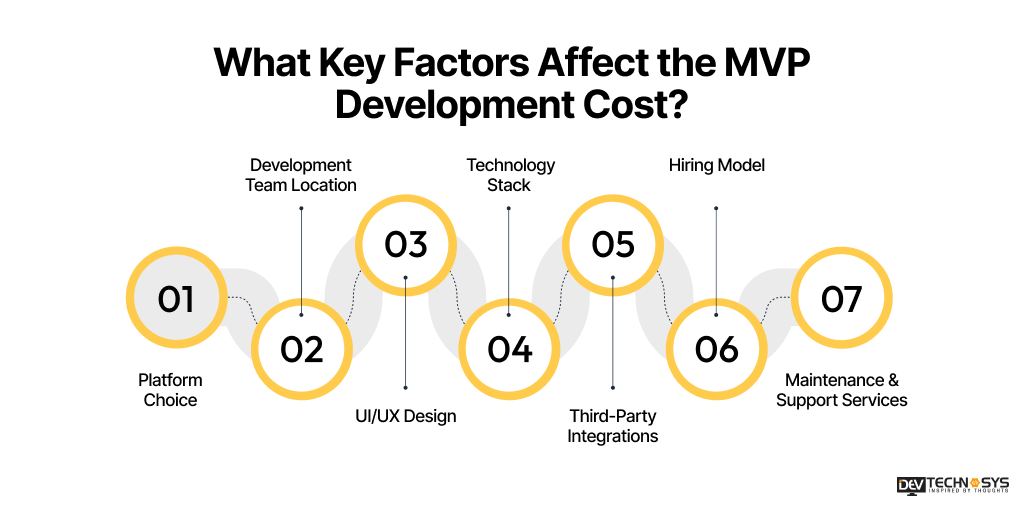
What Key Factors Affect the MVP Development Cost?
Before going into the MVP application development process, you must know about the factors that impact the total MVP app cost. It involves various factors such as premium features, functionalities, design UI/UX, development team, project complexity, and many more. Here is the MVP app development cost breakdown in detail:
1. Platform Choice
In the first cost-impacting factor, select the platforms, such as web, mobile, and cross-platform development, that can affect the MVP app development cost. The Native applications for iOS and Android, but they build separate applications. The cross-platform framework can reduce the cost because these frameworks only use single codebase for both developments. But this has some limitations.
Option |
Cost Impact |
Reason |
| Single Platform (Web or Android) | $1,500 – $4,000 | Lower development effort, faster build, fewer resources required |
| Cross-Platform (Flutter/React Native) | $3,000 – $5,000 | Shared codebase reduces duplication but needs optimization |
| Native (iOS + Android) | $6,000 – $8,000 | Separate apps increase development time and team effort |
2. Development Team Location
Hire mobile app developers (React Native, Flutter, Django) from various regions, such as North America, Europe, and other high-tech regions, can impact the MVP cost estimation for mobile apps. These countries have higher living costs, and developers charge for higher salary packages. Regions like Asia-Pacific offer lower development costs because they have lower labor costs as compared to other countries, and make sure that MVP meets the quality expectations.
Location |
Cost Impact |
Reason |
| Asia (India, etc.) | $2,000 – $6,000 | Lower hourly rates, cost-effective development |
| Eastern Europe | $4,000 – $6,000 | Balanced cost with strong technical expertise |
| North America/Western Europe | $6,000 – $8,000 | High hourly rates and operational costs |
3. UI/UX Design
The UI/UX design can vary in different forms, such as basic, premium, and customized designs. If your MVP doesn’t require any type of customized designer, then it can be completed at a lower cost because it only needs a basic wireframe and UI elements. The customized user interface needs premium layouts, templates, themes, fonts, textures, colors, and UI elements. It can highly affect the total cost to build an MVP app.
Design Level |
Cost Impact |
Reason |
| Basic UI (Templates) | $1,000 – $3,000 | Minimal customization, faster design |
| Custom UI/UX | $3,000 – $6,000 | Tailored design and better user experience |
| Advanced UI (Animations, Branding) | $6,000 – $8,000 | High effort, detailed interactions, and visuals |
4. Technology Stack
The selection of the best tech stacks is necessary for every type of MVP development; strong tech stacks provide scalability and reliability. Some of the tech stacks, like Flutter and React Native, are cost-effective because they offer code sharing between other platforms. And many more of the tech stacks include highly paid services, this can directly impact the total mobile app development cost.
Stack Type |
Cost Impact |
Reason |
| Simple / Standard Stack | $1,500 – $4,000 | Easy to develop, large talent pool |
| Moderately Advanced Stack | $3,000 – $6,000 | Requires experienced developers |
| Complex / Specialized Stack | $6,000 – $8,000 | High expertise and longer development time |
5. Third-Party Integrations
Moving to another factor, basic integrations like social media logins and communication platforms can be integrated more quickly and at a lower cost. The complex or premium integrations, such as payment gateways, CRM systems, analytics, reporting, and more, are time-consuming. Every integration requires error handling, testing, and maintenance. These integrations have higher licensing or usage fees, this can raise the cost to develop an MVP.
Integration Level |
Cost Impact |
Reason |
| Minimal (1–2 APIs) | $500 – $800 | Simple integrations, low complexity |
| Moderate (3–5 APIs) | $1,000 – $1,300 | More setup and testing required |
| Extensive Integrations | $1,300 – $1,500 | Complex dependencies and configuration |
6. Hiring Model
The hiring model is one of the most well-known and common factors that affect the cost to build an MVP app. There are various hiring models available, such as freelancers, an in-house team, and development firms. Hire dedicated developers, as freelancers are very cheap in development, but they lack reliability and scalability. The in-house team is one of the best options for long-term projects, but it can come at a higher cost. And the development agency or firm has expertise in every type of project.
Model |
Cost Impact |
Reason |
| Freelancers | $2,000 – $4,000 | Lower cost but less coordination |
| In-house Team | $4,000 – $6,000 | Higher salaries and overhead |
| Development Agency | $8,000 – $10,000 | Structured process, higher reliability, and cost |
7. Maintenance & Support Services
The maintenance & support services are required after the publishing, as they help to maintain the actual performance and load times. It involves several types of services such as fixing bugs or glitches, optimizing performance, solving security patches, upgrading features, adding design enhancements, and more. These affordable MVP development services are time-consuming for developers, which can raise the overall blockchain MVP development cost and time.
Level |
Cost Impact |
Reason |
| Basic Support | $800 – $1,200 | Bug fixes and minor updates |
| Standard Maintenance | $1,200 – $1,500 | Regular updates and monitoring |
| Ongoing Dedicated Support | $1,500 – $1,800 | Continuous improvements and scaling |
Industry Insights: In accordance with Chorno Innovation, failure studies show 40%+ startups fail due to building products without real market need, highlighting the importance of MVP validation.
Why Businesses Invest in MVP Development in 2026?
To validate concepts rapidly, mitigate risk, and enhance spending before rolling out full-scale launches, businesses will begin investing in MVP development in 2026. With an MVP, a business obtains real user feedback about its product earlier in the process and has a quicker time-to-market. In addition, with an MVP, businesses have an opportunity to make iterative enhancements to their product based on early adoption and to assure investor confidence. The use of this approach allows for the avoidance of excess startup MVP development budget while assuring the final product meets actual marketplace demands and user expectations.
Planning a Mobile App?
Get a tailored development cost estimate in 3 simple steps — app basics, features, timeline, and your contact details.
- 3 quick steps
- 100% free
- Reply in 1 business day
2 Minutes Read
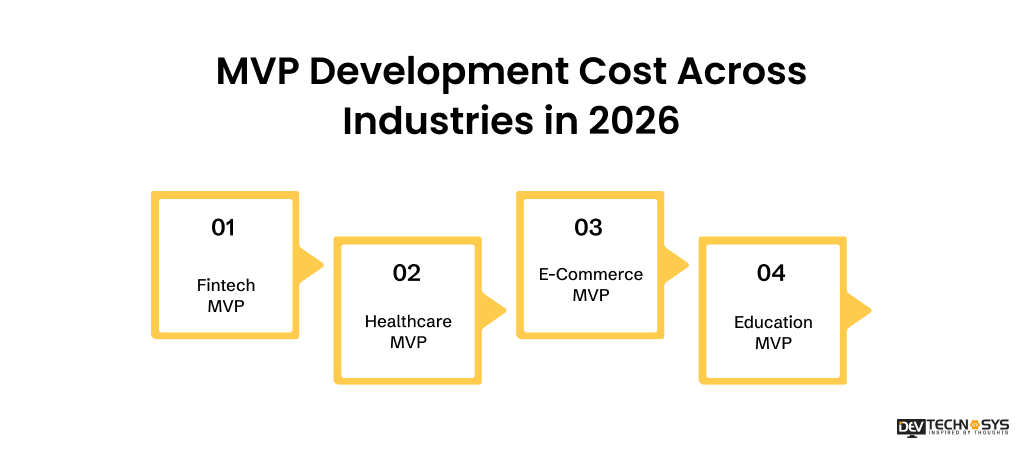
MVP Development Cost Across Industries in 2026
The cost to build an MVP app in 2026 will differ between industries because of differences in complexity, compliance, and features. Medtech and fintech require higher budgets due to regulatory and security requirements, while e-commerce and ed-tech provide relatively inexpensive entry points into the market.
1. Fintech MVP
The average cost of developing a fintech MVP in 2026 is $10,000 to $24,000, depending on a number of factors. It includes regulatory compliance, integration, increasing the complexity and therefore the cost of the product, and most importantly, regulatory requirements typically will determine the length of the project timeline and budget. Fintech MVPs are one of the most expensive products to produce.
2. Healthcare MVP
The cost to develop holistic mental health app MVP is between $15,000 to $25,000 due to regulatory compliance and privacy standards. Additionally, due to the complexity of Healthcare costs (telemedicine, patient dashboard, EHR integration), regulatory compliance affects the absolute cost of your MVP. Security, interoperability, and scalability will also impact the overall MVP development timeline and cost of a Healthcare MVP.
3. E-Commerce MVP
The average cost of developing an e-commerce MVP is $8,000 to $18,000, depending on your company’s e-commerce site, product catalog, and product checkout processes. Base features of an E-commerce MVP include: product listing, shopping cart. More complex features, such as product recommendation engines or multi-vendor product lines, will result in an increased cost to build MVP for startups.
4. Education MVP
The average education MVP software development cost in 2026 is between $12,000 to $21,000. The pricing is dictated mainly by your feature set, integration with learning management systems, and data analytics software. As with other products, the cost and time required to develop your EdTech appliance will also be influenced by the scalability of the application and how engaging the application will be to your users.
5. Social Media MVP
The social media minimum viable product cost is around $14,000-$23,000, depending on the cost for real-time interaction and sharing of information through pictures, videos, and graphics. Additional backend architecture for scalability based on messaging may also increase cost, as well as having a database. Designing an AI-based feed and content moderation capability will also add more complexity to the product.
How Long is the MVP Development Timeline?
The MVP development timeline is around 3 to 6 months for a fully featured MVP, and it can take longer because of several factors. Developing a basic MVP can take around 2 to 4 months with limited features and services. There are many elements that can impact the development timeline, such as project complexity, number of premium features, API integrations, design UI/UX, and more.
Phase |
Duration |
Key Output |
| 1. Discovery & Planning | 5–10 days | Defined MVP scope and strategy |
| 2. UI/UX Design | 7–14 days | Complete design and user flows |
| 3. MVP Development | 2–5 weeks | Fully functional MVP product |
| 4. Testing & QA | 5–10 days | Bug-free and stable version |
| 5. Launch & Optimization | Ongoing | Live product with continuous improvements |
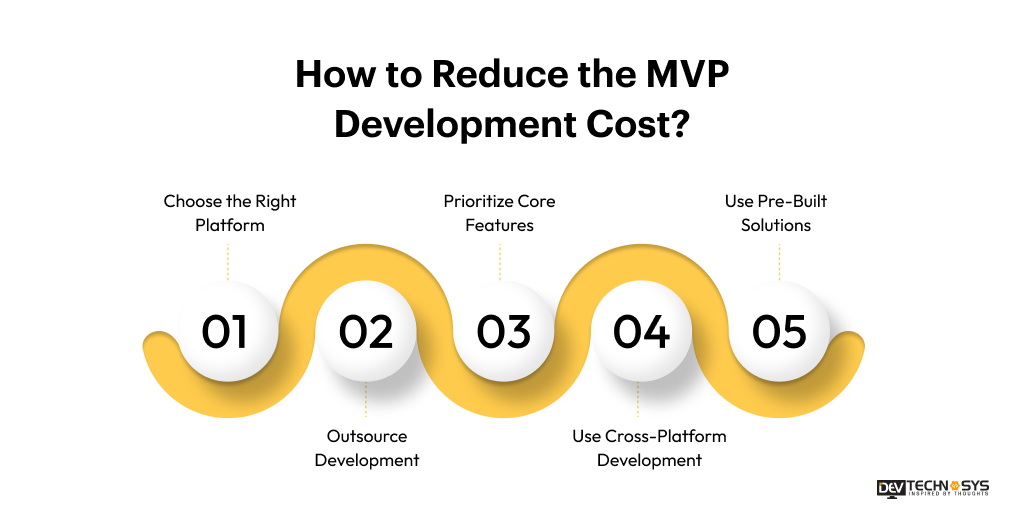
How to Reduce the MVP Development Cost?
To maintain the MVP budget, you will need to follow some ways that help to optimize the total cost and easily build an MVP within a fixed budget. It involves various ways, such as outsourcing development, using open-source tools and frameworks, and many more. Let’s figure out which method helps to reduce MVP development cost 2026.
1. Choose the Right Platform
Start with the single platform that perfectly matches the targeted audiences instead of building an MVP on multiple platforms. This cost-reducing strategy helps businesses save on designing, development, and testing efforts or time. By choosing the single platform, it is a smarter move and prevents from investings on other resources.
2. Prioritize Core Features
You will want to focus on the most important features first, which are also called core features or minimum viable product (MVP). To create the greatest value in the shortest amount of time by avoiding unnecessary features from the beginning of the development process.
3. Use Pre-Built Solutions
Utilize as many existing tools & resources as possible so that you can leverage them instead of building everything from scratch. Which will help you complete the MVP faster, cheaper & with less effort, as well as provide an opportunity to get feedback on the MVP prior to adding additional features.
4. Outsource Development
Use contract developers who can develop the MVP for you, especially in regions where wages are significantly lower than your own. According to the mobile app development company, contractor developers can provide you with access to a larger pool of talent than you could find in-house. Because they have the resources to focus on their core competencies. Good communication, clear requirements, and effective project management.
5. Use Cross-Platform Development
Utilize frameworks such as Flutter or React Native to create applications on several platforms using one codebase. As a result, there will be less duplication of effort and development time. Cross-platform development is an excellent choice for MVPs where speed and cost-effectiveness are essential and enables you to broaden your reach to additional audiences, while keeping your costs relatively low.
What are the Hidden Costs of MVP Development?
MVP development costs in 2026 go well beyond simple estimates; it’s a strategic investment. Every step of the process, from planning to designing, through hidden costs, all contribute to how much it will cost you as a business. The more you understand all of the elements of Minimum Viable Product development costs, the better able you will be to create a smartly developed, rapidly launched, and maximally productive return on investment (ROI).
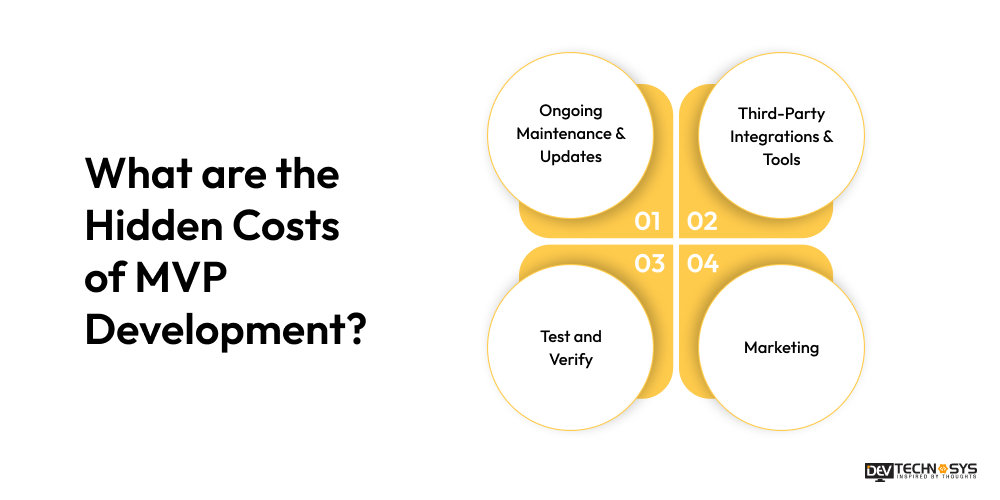
1. Ongoing Maintenance & Updates
The majority of founders typically only focus on getting their platform built and developed, and not on continuing maintenance post-launch; however, ongoing maintenance is also a hidden cost associated with ongoing bugs, feature improvements, performance updates, and new device compatibility requirements, all of which need to be budgeted. Otherwise, you risk creating a poor user experience leading to increased long-term expenses.
2. Third-Party Integrations & Tools
Most MVPs use 3rd parties, such as payment gateways, API’s, analytics tools, and cloud hosts, etc. While some of them have free tiers, as soon as one starts ramping up usage of them, prices can rise exponentially. Subscription fees, usage limits, and complexity of integrations will have an impact on your budget if not planned properly prior to build-out.
3. Test and Verify
Testing is one of the most critical aspects of your project, but very few companies put enough emphasis on this process. The cost of testing can include not only manual testers but also automated testing tools and the cost of fixing unforeseen problems. If testing is skipped or rushed, it can lead to costly mistakes that could hurt user confidence after launch and will require significant investment to fix later.
4. Marketing
Building an MVP makes up only 50% of what it takes to get your product into the hands of users; getting users is another hidden cost associated with your product development process. The costs related to doing digital marketing, such as Google Ads, social media ads, creating content for marketing purposes, etc., can add up quickly. If you do not properly budget for marketing, then even a great MVP could have trouble gaining user acquisition and visibility in the marketplace.
Why is Fixing Project Budget Crucial For Every Business?
Centrally managing a project budget is indispensable for all businesses because of the control it provides over finances, the way overspending is determined, and aligning resources with the organization’s strategic objectives. When the project has its budget defined, it can create better planning, prioritizing, and overall decision-making through the duration of the project lifecycle. In addition, having a project authorizing an established budget can proactively reduce risk, fund allocation, and set realistic expectations. All in all, when businesses exercise budgetary discipline, they have the best possible use of their return on investment.
- Controls overall spending
- Improves financial planning
- Prevents budget overruns
- Guides decision-making
- Allocates resources efficiently

Conclusion
To summarize, to begin building a successful product, it is very important to know how much it will cost to develop an MVP (minimum viable product) in 2026. By concentrating on only what is necessary, choosing a good tech stack, and having a planning strategy. Your business will have the ability to grow quickly and intelligently through its MVP to achieve its long-term success within a highly competitive environment. Dev Technosys, a professional MVP development company in the US, has 15+ years of expertise in developing highly scalable digital solutions. Dev Technosys helps achieve faster development time and reduce your MVP’s risk of being unsuccessful while creating a quality product.
Frequently Asked Questions
Find answers to the most common questions related to this article.
The cost to develop an MVP is around $8,000 to $25,000, based on the unique requirements and demands. It includes various factors that affect the cost, such as functionalities, backend infrastructure, design UI/UX, testing, security measures, and project complexity.
To create an MVP with limited features in San Francisco in 2026 takes around 2 to 4 months. The full-featured or complex MVP can take around 3 to 6 months or longer. The total development timeline can fluctuate due to several factors, such as project complexity, size, number of features, design quality, and many more.
The cost to hire MVP developers(Node.js, Django, Golang) ranges from $15 to $25 per hour, or it can go to a higher cost because of major factors. It involves developers' experience level, project complexity, location, skill sets, onboarding costs, hiring model, and more.
The maintenance cost of MVP lies between 10% and 20% of the initial MVP application development cost. There are various maintenance services are include like fix security patches, regular updates, adding new features, upgrading versions, optimizing performance, solve bugs or errors. The maintenance services are important to keep the product or app up-to-date and maintain the load times.
There are many different types of factors that can highly impact the overall MVP development pricing in 2026:
Development Team Location
Design UI/UX
Project Complexity
Technology Stack
Third-Party Integrations
Maintenance & Support Services