




















ServiceNow support costs depend on business size, platform complexity, and SLA requirements. Most organizations spend around $100 per user/month for standard ITSM. Small setups stay on the lower end, while enterprise environments with advanced automation, integrations, and 24/7 SLAs fall on the higher side.
Cost Breakdown by Support Level
-
- Basic Support (12% to 15%/month): Basic ServiceNow pricing structure 2026 covers routine maintenance, minor bug fixes, and standard SLAs with slower response times.
- Standard Support (15% to 17%/month): Includes ongoing administration, integrations, performance optimization, and moderate SLA commitments.
- Premium Support (17% to 20%/month): Offers 24/7 monitoring, dedicated teams, proactive optimization, and faster response/resolution times.
Key Cost Drivers
-
- Pricing Model: Per-user models scale with workforce size, while subscription or enterprise licensing depends on modules and usage.
- SLA Commitments: Faster response times and 24/7 availability significantly increase ServiceNow annual cost.
- Customization & Integrations: Complex workflows, ITIL framework alignment, and third-party integrations require continuous maintenance and higher expertise.
- Organization Size: Large enterprises with global operations and compliance needs incur higher ServiceNow support pricing plans.
Support Timeline & Engagement
-
- Initial Setup Support: 1 to 3 months for stabilization and optimization after implementation.
- Ongoing Support: Continuous monthly engagement for maintenance, upgrades, and enhancements.
- Enterprise Support Cycles: Long-term contracts (6–12 months or more) with dedicated teams.
As a ServiceNow business, have you considered the cost that keeps your ServiceNow environment running smoothly? Many people think that ServiceNow support is limited to fixing errors and bugs, but that’s just the tip of the iceberg.
ServiceNow support ensures smooth workflows, satisfied users, and zero operational chaos. But here’s the catch: there’s no fixed cost for it. From subscription-based models and pay-per-incident support to fully managed SLAs, ServiceNow pricing tiers (Standard, Pro, Enterprise) can vary widely depending on your business size, complexity, and required response times.
Some companies may spend a few hundred dollars monthly, while enterprise-grade support can run into thousands. To understand this better, we will break down ServiceNow support cost structures, SLA escalation policies, and monthly pricing models in a simple way to help businesses make smarter, budget-friendly decisions. Let’s dive in and simplify everything you need to know.
What is the Average Monthly ServiceNow Support Cost in 2026?
It is difficult to state the exact ServiceNow support cost because costs are rarely flat-rate, which means it is generally tied to the overall platform investment. The cost is often calculated as a percentage of the total cost of licensing. Meanwhile, basic support tiers may start at fewer entry points.
For most businesses, the ServiceNow support follows a subscription-based or per-user pricing model. It increases with the additional services, integration, and performance analytics (PA). Factors like ongoing administrations, enhancements, SLA commitments, and service management can increase the total support cost.
In general terms, the Average ServiceNow support cost is between $12 to $20 percent of the total development cost. ServiceNow consulting services are a substantial but strategic investment, especially for companies relying heavily on automation and enterprise-grade workflows.
| Support Level | ServiceNow Pricing Per Month (in %) | What It Includes |
| Basic Support | 12% | Bug fixes, routine maintenance, basic SLA (24–48 hr response) |
| Standard Support | 15% – 17% | Ongoing administration, minor enhancements, and integrations |
| Premium Support | 17% – 20% | Faster SLA, performance optimization, proactive monitoring |
Which ServiceNow Pricing Models Impact Support Cost?
Each ServiceNow pricing model directly impacts how much you spend on support. Simpler setups with limited users and modules can maintain costs closer to 12%, while ServiceNow enterprise pricing with advanced SLAs and integrations naturally move toward 20%.
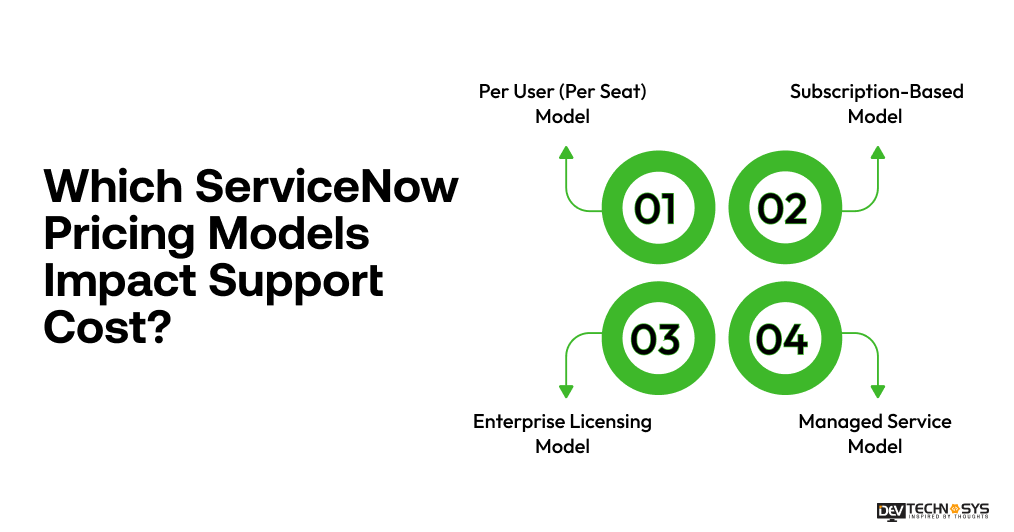
1. Per User (Per Seat) Model
This model charges based on the number of users or agents accessing the platform, making it a popular choice for organizations with expanding teams or fluctuating workforce sizes.
Impact on Support Costs:
As the number of users grows, so does the need for user management, access control, troubleshooting, and performance optimization. This increased demand on support teams typically pushes ServiceNow monthly cost toward the 15% to 20% range, especially in organizations with high user activity.
| Factor | Impact on Support Cost |
| User Growth | Increases support demand as more users require access, issue resolution, and training |
| Administration Effort | Higher user management and role-based access control increase workload |
| Support Cost Range | 15% – 20% of total investment |
| Cost Behavior | Scales directly with the number of users |
2. Subscription-Based Model
Under this model, businesses pay a recurring fee (monthly or annually) based on the modules and features they use, such as IT Service Management (ITSM, IT Operations Management (ITOM), or Customer Service Management (CSM).
Impact on Support Costs:
Because the scope of ServiceNow Managed Services is predefined, support requirements are more predictable. It helps maintain serviceNow subscription cost within the 12% to 18% range, although additional integrations, upgrades, or higher SLA commitments can gradually increase expenses.
Industry Insights: According to Grand View Research, the cloud-based ITSM solutions account for 60%+ of deployments globally.
| Factor | Impact on Support Cost |
| Fixed Modules | Predictable support requirements based on selected features |
| Integrations | Additional integrations can increase complexity and cost |
| Support Cost Range | 12% – 18% of total investment |
| Cost Behavior | Stable, but increases with added services and SLA upgrades |
3. Enterprise Licensing Model
Designed for large-scale organisations who use ServiceNow for IT service management, this model offers a customized licensing structure that includes multiple modules, extensive integrations, and global usage.
Impact on Support Costs:
The complexity of enterprise environments demands continuous monitoring, dedicated support teams, and faster response times. As a result, ServiceNow license cost per user typically falls between 18% to 20%, driven by high customization, automation, and stringent SLA requirements.
| Factor | Impact on Support Cost |
| Platform Complexity | High due to multiple modules and custom workflows |
| SLA Requirements | Requires faster response times and 24/7 support |
| Support Cost Range | 18% – 20% of total investment |
| Cost Behavior | Higher baseline due to customization and global operations |
4. Managed Service Model
In this model, businesses outsource their ServiceNow support to a third-party provider who handles administration, maintenance, updates, and optimization.
Impact on Support Costs:
While this approach may seem slightly more expensive upfront, it consolidates all support services into a predictable monthly fee. Costs usually align within the 15% to 20% range, but the benefit lies in reduced internal workload, access to expert resources, and improved system efficiency.
| Factor | Impact on Support Cost |
| Outsourced Support | Includes admin, maintenance, and optimization in one package |
| Expertise Level | Access to skilled professionals increases efficiency but adds cost |
| Support Cost Range | 15% – 20% of total investment |
| Cost Behavior | Predictable monthly cost with bundled services |
What are the Key Factors Affecting the ServiceNow Support Cost?
ServiceNow support costs are highly dynamic and scale with platform complexity, integrations, and business size. Here are some of the key factors that impact the ServiceNow Support cost significantly.
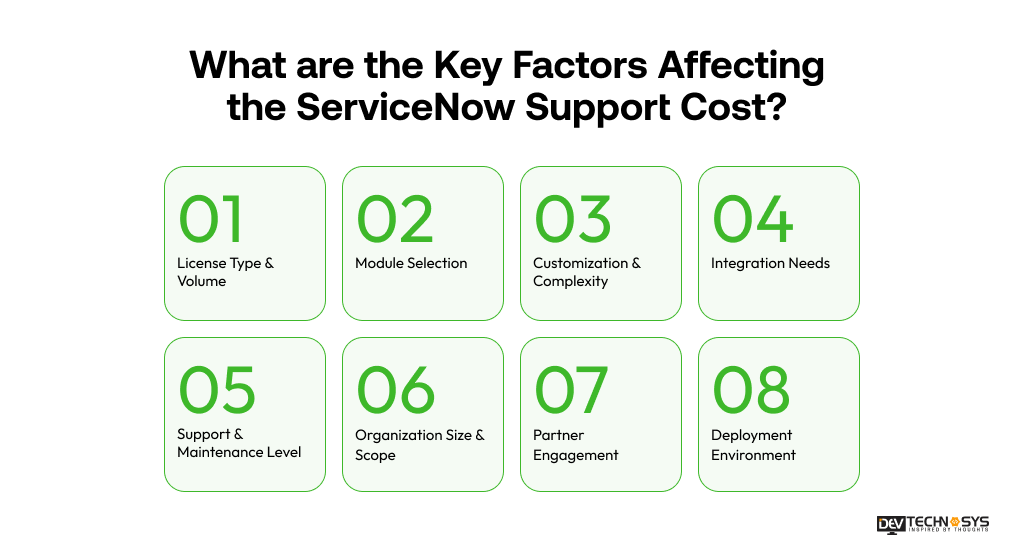
1. License Type & Volume:
ServiceNow pricing heavily depends on the ratio of fulfillers (agents, admins) to requesters (end-users). A higher number of fulfillers increases administrative workload, access control management, and issue handling, ultimately raising monthly support costs as system usage and operational demands grow. Here’s the ServiceNow operational cost breakdown based on license type and volume.
| User Type / Volume | Support Cost Impact (% Annually) | Monthly Cost Trend |
| Low (few fulfillers) | 12% – 14% | Lower admin and support effort |
| Medium | 14% – 17% | Moderate user management workload |
| High (many fulfillers) | 17% – 20% | High support demand and scaling costs |
2. Module Selection:
The choice of modules significantly impacts support costs. Advanced modules like ITOM, HR service delivery, or CSM require more configuration, monitoring, and expertise compared to basic ITSM, leading to increased maintenance efforts, higher resource utilization, and elevated monthly support expenses. Here’s the table showcasing the ServiceNow ITSM cost breakdown
| Module Complexity | Support Cost Impact (% Annually) | Monthly Cost Trend |
| Basic ServiceNow ITSM pricing (ITSM) | 10% – 12% | Minimal configuration and maintenance |
| Moderate (ITSM + CSM) | 12% – 14% | Increased integrations and workflows |
| Advanced (ITOM, HRSD) | 17% – 20% | High monitoring and specialized support |
Want a chatbot demo or pricing? Fill the form and talk to our experts today.
Pick what you need below — you can select more than one — then tap Get detail to continue.
-
Chatbot demo dashboard
-
Cost to develop an app
-
Industry report
-
Case study
3. Customization & Complexity:
Extensive customization, including tailored workflows, ServiceNow development trends, UI changes, scripts, and reports, increases system complexity. It requires continuous updates, testing, debugging, and optimization, making ongoing support more resource-intensive and pushing monthly costs toward the higher end of the typical support range.
| Customization Level | Support Cost Impact (% Annually) | Monthly Cost Trend |
| Low | 10% – 12% | Standard workflows, minimal updates |
| Medium | 12% – 15% | Ongoing enhancements and testing |
| High | 15% – 18% | Continuous development and maintenance |
4. Integration Needs:
Integrating ServiceNow with external platforms like Jira, Salesforce, or Slack adds layers of complexity. These integrations require regular monitoring, updates, and troubleshooting, along with possible ServiceNow licensing costs, significantly increasing the effort and overall monthly support expenditure.
| Integration Level | Support Cost Impact (% Annually) | Monthly Cost Trend |
| Few / None | 12% – 14% | Low maintenance effort |
| Moderate | 14% – 16% | Regular monitoring and updates |
| Extensive | 16% – 18% | High complexity and dependency management |
5. Support & Maintenance Level:
The level of support, basic, standard, or premium, directly impacts cost. Higher SLA commitments, faster response times, 24/7 availability, and proactive monitoring demand more resources and skilled personnel, increasing monthly support costs for within the typical 12% to 20% range.
| Support Tier | Support Cost Impact (% Annually) | Monthly Cost Trend |
| Basic | 12% – 14% | Limited hours, slower SLA |
| Standard | 14% – 17% | Balanced SLA and coverage |
| Premium | 17% – 20% | 24/7 support and fast response |
6. Organization Size & Scope:
Larger organizations with global operations require scalable infrastructure, multi-region compliance, and broader support coverage. Managing diverse business units and higher transaction volumes increases system complexity, resulting in significantly higher monthly ServiceNow support costs compared to smaller organizations.
Industry Insights: According to Statista, large enterprises allocate 20%–30% of their IT budgets to IT operations and service management tools.
| Organization Size | Support Cost Impact (% Annually) | Monthly Cost Trend |
| Small | 12% – 14% | Simple operations |
| Mid-Sized | 14% – 16% | Moderate scalability needs |
| Large / Global | 16% – 20% | Complex, multi-region support |
7. Partner Engagement:
Engaging certified ServiceNow partners or third-party providers ensures expert support and efficient system management. However, their specialized skills, higher hourly rates, or fixed retainers can increase monthly support costs, especially for organizations relying heavily on external expertise.
| Engagement Type | Support Cost Impact (% Annually) | Monthly Cost Trend |
| In-house team | 11% – 13% | Controlled costs |
| Hybrid model | 13% – 16% | Balanced expertise and cost |
| Fully outsourced | 16% – 19%+ | Higher cost, expert-driven support |
8. Deployment Environment:
Managing multiple environments such as development, testing, and production increases operational complexity. Each environment requires monitoring, updates, and maintenance, which adds to the workload and raises overall monthly support costs, particularly in cloud-based or multi-instance deployments.
| Environment Type | Support Cost Impact (% Annually) | Monthly Cost Trend |
| Single environment | 12% – 14% | Low maintenance |
| Multi-environment (Dev/Test) | 14% – 17% | Increased monitoring |
| Multi-instance / Cloud | 17% – 20% | High complexity and cost |
SLA (Service Level Agreement) in ServiceNow Support
Service Level Agreements (SLAs) in ServiceNow define, track, and manage service delivery commitments (like incident response/resolution times) between service providers and customers. They automatically track time, trigger escalation notifications when thresholds are nearing breach, and help measure performance, offering transparency and accountability for service quality.
Industry Insights: According to the industry research by Grand View Research, ITSM platforms like ServiceNow follow a scalable SaaS pricing approach, where costs increase with modules, users, and support complexity.
The key components of SLA in ServiceNow support Includes:
- Duration: The total time allowed to complete a task (e.g., 4 hours)
- Start Condition: When the SLA timer begins (e.g., incident is created)
- Pause Condition: When the timer temporarily stops (e.g., waiting for vendor response)
- Stop Condition: When the SLA is fulfilled (e.g., incident is resolved/closed)
Three Main Types of SLA in ServiceNow Support:
SLAs in ServiceNow for HR play a critical role in ensuring timely service delivery, improving operational efficiency, and maintaining customer satisfaction. Here are the three main types of SLA in Servicenow:
1. Response SLA:
Defines the time taken to acknowledge or respond to an incident after it is created. It ensures quick initial action and contributes around 12% to 15% of the costs due to monitoring and timely response management.
2. Resolution SLA:
Specifies the total time required to fully resolve an incident or request. It involves deeper technical effort, troubleshooting, and escalations, contributing approximately 15% to 20% of the total costs depending on complexity and urgency.
3. Priority-Based SLA:
Assigns different response and resolution targets based on incident priority (low, medium, high, critical). High-priority cases demand faster action and resources, accounting for around 14% to 20% of costs due to dynamic workload handling.
Optimizing ServiceNow costs is essential for reducing unnecessary spending while maintaining performance, scalability, and SLA compliance. Since ServiceNow support and licensing typically account for a significant portion of IT budgets, smart optimization can help businesses reduce costs without impacting service quality.
Top 5 ServiceNow Support Cost Optimization Strategies Businesses Should Consider
Since ServiceNow support and licensing typically account for a significant portion of IT budgets, smart ServiceNow cost optimization strategies can help businesses reduce costs without impacting service quality.
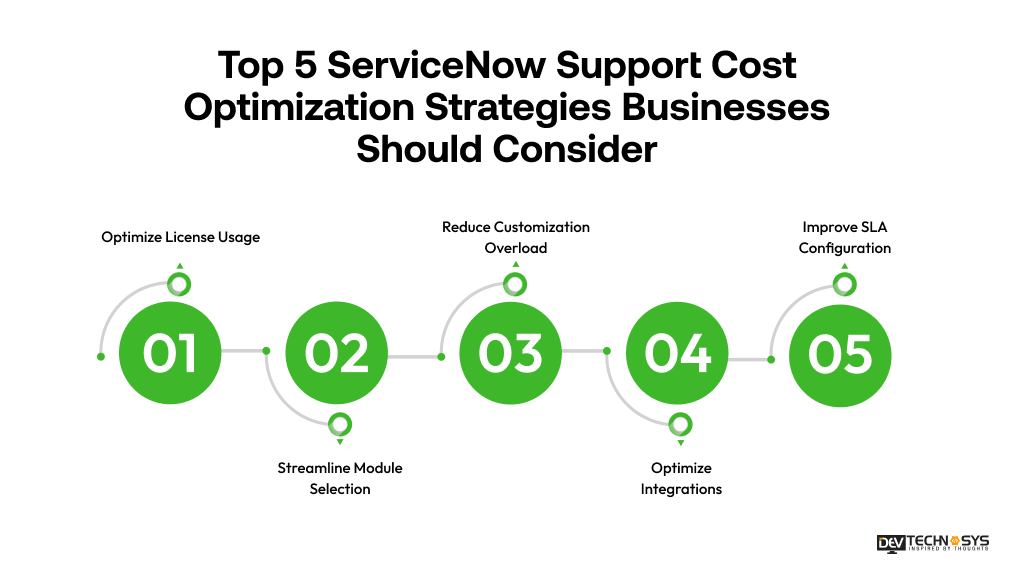
1. Optimize License Usage
Regularly audit user licenses to ensure only active fulfillers and administrators are assigned paid roles. Remove inactive users and downgrade unnecessary high-tier licenses to reduce per-user costs and overall subscription spending.
2. Streamline Module Selection
Avoid over-licensing unused modules like ITOM or HRSD if not required. Selecting only essential modules, such as ITSM, helps control subscription fees and reduces ongoing support complexity and maintenance costs.
3. Reduce Customization Overload
Excessive customization increases long-term maintenance costs. Using out-of-the-box (OOTB) ServiceNow features reduces dependency on custom scripts, lowers upgrade effort, and minimizes support overhead.
4. Optimize Integrations
Limit unnecessary third-party integrations and use IntegrationHub or pre-built connectors where possible. This reduces API maintenance, debugging efforts, and system complexity, ultimately lowering support expenses.
5. Improve SLA Configuration
Define realistic SLA targets based on business priorities. Overly aggressive SLAs increase operational pressure and support costs, while optimized SLA policies balance cost and service performance effectively.

Conclusion
ServiceNow support is not a one-time expense; it’s an ongoing investment that ensures your platform runs efficiently, securely, and without disruption. In 2026, most businesses spend between 12% to 20% of their total ServiceNow investment annually, depending on pricing models, SLA levels, and system complexity.
If you are a business looking for maintenance and Support services for your ServiceNow platform, contact experts at Dev Technosys, a ServiceNow development company in USA. With 15+ years of experience and the strength of 180+ experts, we provide scalable services to optimize your ServiceNow investment.
FAQs
Q1. Is ServiceNow Support Cost Fixed or Variable?
ServiceNow support cost is variable, not fixed. It depends on usage, number of users, selected modules, customization level, and SLA requirements, typically ranging between 12%–20% of total platform investment annually.
Q2. How is ServiceNow Support Pricing Calculated?
ServiceNow support pricing is usually calculated as 12% to 20% of total platform investment annually, influenced by user volume, customization level, integrations, and the complexity of ongoing maintenance and support operations.
Q3. Which Pricing Model is Most Cost-Effective?
A subscription-based model is generally most cost-effective for mid-sized businesses, offering predictable pricing. Enterprises often prefer managed or enterprise licensing models for scalability, advanced features, and dedicated support coverage.
Q4. Do SLA Levels Affect ServiceNow Support Cost?
Yes, higher SLA levels significantly increase costs. Faster response times, 24/7 monitoring, and critical incident handling require more resources, pushing support expenses toward the higher end of the pricing range.
Q5. Is It Better to Choose In-House Support or Managed Services?
In-house support offers greater control and customization, while managed services provide expert handling and scalability. Many organizations adopt a hybrid model to balance cost efficiency, flexibility, and operational reliability.
Q6. Why Does Servicenow Support a Cost Increase With Customization?
Customization adds extra workflows, scripts, and configurations that require ongoing maintenance, testing, debugging, and updates, increasing technical effort and overall support workload, which directly raises monthly and annual costs.
Frequently Asked Questions
Find answers to the most common questions related to this article.
ServiceNow support cost is variable, not fixed. It depends on usage, number of users, selected modules, customization level, and SLA requirements, typically ranging between 12%–20% of total platform investment annually.
ServiceNow support pricing is usually calculated as 12% to 20% of total platform investment annually, influenced by user volume, customization level, integrations, and the complexity of ongoing maintenance and support operations.
A subscription-based model is generally most cost-effective for mid-sized businesses, offering predictable pricing. Enterprises often prefer managed or enterprise licensing models for scalability, advanced features, and dedicated support coverage.
Yes, higher SLA levels significantly increase costs. Faster response times, 24/7 monitoring, and critical incident handling require more resources, pushing support expenses toward the higher end of the pricing range.
In-house support offers greater control and customization, while managed services provide expert handling and scalability. Many organizations adopt a hybrid model to balance cost efficiency, flexibility, and operational reliability.
Customization adds extra workflows, scripts, and configurations that require ongoing maintenance, testing, debugging, and updates, increasing technical effort and overall support workload, which directly raises monthly and annual costs.