


















Quick Summary:
The ServiceNow ITOM cost typically ranges from $8,000 to $25,000+ annually for enterprises, depending on infrastructure size, selected modules, and complexity. Smaller deployments may start around $8,000 to $15,000, but pricing increases as discovery nodes, integrations, and automation needs grow.
Cost Impacted by Project or Implementation Complexity:
-
- Simple / Basic ITOM Setup ($8,000 – $15,000): Includes core features like basic Discovery, limited Event Management, simple monitoring, and standard reporting dashboards.
- Mid-Complex ITOM Implementation ($15,000 – $20,000): Includes Service Mapping, advanced Event Management, cloud integrations, automated workflows, and multi-environment monitoring.
- Complex / Enterprise ITOM Solution ($20,000 – $25,000+): Includes full-scale automation, AI-driven AIOps, advanced Service Mapping, multi-cloud orchestration, predictive analytics, and large-scale integrations.
Cost Based on ITOM Modules:
-
- Discovery Module: $80 – $120 per node annually
- Service Mapping: $10,000 – $15,000+, depending on scale
- Event Management: $10,000 – $18,000 annually
- Cloud Management: $19,000 – $24,000 annually
- Orchestration: $16,000 – $22,000 annually
- AIOps / Intelligence Layer: $20,000 – $25,000+
Cost Based on Organization Size:
-
- Small Business ITOM Setup: $8,000 – $15,000/year
- Mid-Sized Enterprise: $15,000 – $20,000/year
- Large Enterprise: $20,000 – $25,000/year
- Global Enterprise: $25,000+ (custom pricing)
Additional Cost:
-
- Implementation & Setup: 15% – 30% of total licensing cost
- Training & Onboarding: $5,000 – $10,000 depending on team size
- Integration Costs: Varies based on third-party tools and APIs
- Ongoing Maintenance: 15% – 20% of annual license cost
In today’s world, smooth IT operations are essential for most businesses, and ServiceNow IT Operations Management (ITOM) helps with that. Before making any investment, however, it’s important to know what is being purchased, as well as the reasons for purchasing it.
All of the details associated with things such as licensing models, additional feature fees, and hidden costs will have an impact on the formation of a budget.
This breakdown of ServiceNow ITOM’s pricing structure is intended to give you a general overview of each of these areas. So you can understand how the pricing structure of ServiceNow ITOM works in a way that is user-friendly and easier to understand, regardless of the size of your company.
Understanding how ServiceNow ITOM pricing works will help you to make informed choices, avoid surprises, and maximize the return on your investment.
So let’s get started by looking at the things that impact the ServiceNow ITOM cost and how they all fit together.
What is ServiceNow ITOM?
IT Operations Management (ITOM) by ServiceNow is a cloud-based IT operations management tool. It enables businesses to monitor and optimize their IT environments in order to provide reliable digital services. ServiceNow transforms IT operations by providing complete visibility into systems, services, and dependencies so that they can quickly detect and resolve issues when they arise. Through automation of routine tasks and improved performance insights, ITOM helps businesses maintain operational efficiency, minimize downtime, and deliver dependable digital services.
What are the Key Components of ServiceNow ITOM?
Powerful features of ServiceNow ITOM can streamline operations, improve visibility, and decrease downtime. Knowing the service costs and pricing structure will enable organizations to improve the way they plan for, optimize their investments in, and maximize their value. It provides them with an efficient, scalable, and reliable solution.
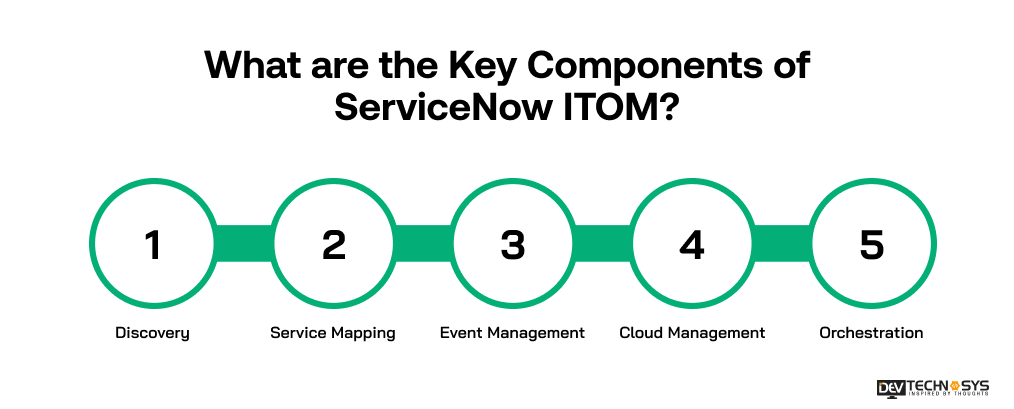
1. Discovery
ServiceNow ITOM Discovery identifies all of the devices, applications, and services in your IT environment automatically. The result is a real-time inventory of all of your assets and their relationships, which enables teams to maintain accurate data. Greater visibility helps teams make better decisions, reduce manual effort, and gain greater control of their infrastructure; ultimately assisting in efficient operations and quicker issue resolution.
2. Service Mapping
Service Mapping enables teams to see an overview of how applications and services are connected and how they depend upon one another within the IT environment. It shows which infrastructure components rely on ServiceNow managed services, enabling teams to quickly determine where an issue resides, improving service visibility, and reducing downtime. It can increase overall service reliability and performance.
3. Event Management
Event Management gathers and analyzes alert data from many different monitoring systems throughout your IT environment to accelerate incident resolution by filtering noise using automation and intelligence to prioritize the most critical incidents, which ultimately allows IT teams to minimize downtime, improve response times to incidents, and maintain the smoothest operations possible by proactively addressing issues before they have an impact on end users.
4. Cloud Management
Cloud Management gives organizations the tools to effectively manage all of their resources in a public, private, or hybrid cloud environment. Cloud Management provides visibility, control over costs, and governance over cloud usage. Automating the provision of resources as well as optimizing their performance allows organizations to reduce waste, increase their ability to scale, and ensure that they have made the proper investment in cloud computing for operational purposes.
5. Orchestration
Through collaboration with all areas of the organization, orchestration automates repetitive IT processes and procedures between systems and applications to minimize manual interaction between systems. Processes such as incident response, provisioning, and configuration management can all be automated through orchestration, which in turn increases productivity and accelerates time to market while reducing human error.
What is the ServiceNow ITOM Pricing Model?
The core tenets of the ServiceNow ITOM cost guarantee flexibility for all organizations while still being geared toward fulfilling an organization’s unique needs. Pricing is generally based on a subscription basis, with factors such as the number of pieces of infrastructure being managed.
Which modules are being utilized, and how much the organization use ServiceNow for IT service management, resulting in the final price paid by the customer. Some of the major cost drivers in how the organization utilizes ServiceNow’s ITOM are Discovery, Service Mapping, Event Management, Cloud Management, and Orchestration.
Organizations should also take into account the costs of implementing, customizing, and integrating ServiceNow’s ITOM, as these will also add to the total cost of the organization. The fact that ServiceNow prices are good negotiable items means that organizations have some flexibility to negotiate towards final pricing on the basis of their size changes within the organization.
| Component / Tier | Pricing Model | Estimated Cost | Details |
| Discovery | Per node/device | $80 – $120 per node/year | Based on the number of servers, VMs, and devices discovered |
| Service Mapping | Add-on module | $10,000 – $15,000/year | Depends on application complexity and scale |
| Event Management | Subscription-based | $10,000 – $18,000/year | Based on alert volume and integrations |
| Cloud Management | Usage-based | $19,000 – $24,000/year | Depends on cloud resources and providers |
| Orchestration | Add-on module | $16,000 – $22,000/year | Based on the number of automated workflows |
| Mid-size Business | Bundle pricing | $15,000 – $20,000/year | Suitable for moderate infrastructure |
| Large Enterprise | Custom pricing | $20,000 – $25,000+/year | Scales with infrastructure size |
| Implementation Cost | One-time | $8,000 – $25,000 | Includes setup, customization, and integration |
Industry Insights: According to ServiceNow, the ServiceNow ITOM follows a custom-quote subscription model, with pricing varying by modules, scale, and usage; no public pricing is disclosed.
7 Major Factors That Impact the ServiceNow ITOM Cost
There are multiple factors affecting pricing and scalability when making service management investments in ServiceNow ITOM, as well as across the overall organization. It includes the size of the company, how complex their infrastructure is configured, which modules are chosen, the level of customization, and what IT service management implementations are necessary.
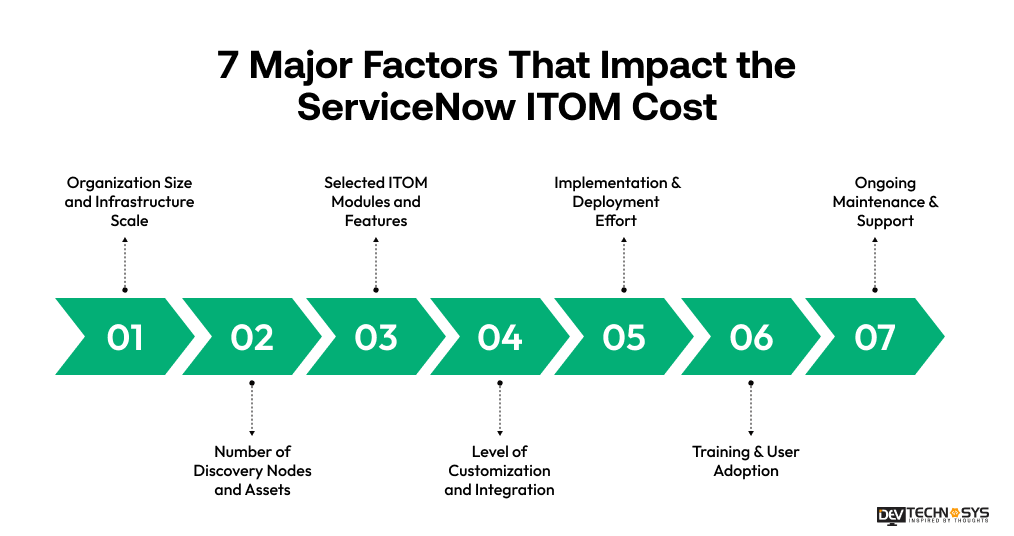
1. Organization Size and Infrastructure Scale
The size of an organization affects how much ServiceNow ITOM costs, with large companies having much larger, more complicated IT infrastructures. Large companies with complicated IT infrastructures will have significant implementation costs due to the scale of the architecture and, thus, the complexity of using your services. This will lead to very high ongoing subscription costs.
| Level | Cost Impact (%) | Explanation |
| Small Business | 5% – 10% | Limited infrastructure and licensing needs |
| Mid-Sized Enterprise | 10% – 20% | Moderate systems and scaling requirements |
| Large Enterprise | 20% – 30% | Higher complexity and an extensive IT environment |
2. Number of Discovery Nodes and Assets
The number of configuration items, such as servers, applications, and network devices, to be managed through ITOM impacts pricing. Each discovered asset will represent an increase in your utilization of licensing and the load on the system. As nodes are added, additional monitoring and data processing capabilities will be required, leading to increased ServiceNow pricing and implementation costs.
| Level | Cost Impact (%) | Explanation |
| Low Asset Count | 5% – 10% | Minimal monitoring requirements |
| Medium Asset Count | 10% – 20% | Moderate licensing and data processing |
| High Asset Count | 20% – 30% | Large-scale discovery increases the cost significantly |
3. Selected ITOM Modules and Features
The selection of ITOM modules will directly impact the pricing on ServiceNow ITOM. Whereas Basic Discovery will generally be the most inexpensive option, more advanced options such as Service Mapping, Event Management, Cloud Management, and AIOps will typically be more expensive. Any module added increases not only the ServiceNow ITOM license cost, but also provides additional complexity to the implementation.
| Level | Cost Impact (%) | Explanation |
| Basic Modules | 5% – 10% | Core Discovery and monitoring only |
| Standard Modules | 10% – 20% | Includes Service Mapping & Event Management |
| Advanced Modules | 20% – 30% | AIOps, Cloud Management, automation tools |
4. Level of Customization and Integration
Customization is one of the most critical pieces of cost in ServiceNow ITOM. Companies that require customized workflows, dashboards, or need to integrate with third-party applications will incur more upfront costs of IT service management solutions & integration services. Particularly when integrating into legacy properties or operating in multi-cloud instances.
| Level | Cost Impact (%) | Explanation |
| Low Customization | 5% – 10% | Standard out-of-the-box setup |
| Medium Integration | 10% – 20% | Some third-party system integration |
| High Customization | 20% – 30% | Complex workflows and enterprise integrations |
5. Implementation & Deployment Effort
The complexity of implementation and deployment efforts can directly affect the total ServiceNow ITOM implementation cost. When you’re dealing with a large deployment, it takes a lot of expert consultants, planning, and time to implement it properly. In addition, if you don’t do the proper configurations, testing, and deployment, you’re going to have a higher initial ServiceNow ITOM cost.
| Level | Cost Impact (%) | Explanation |
| Simple Deployment | 5% – 10% | Quick setup with minimal configuration |
| Moderate Deployment | 10% – 20% | Structured rollout with testing |
| Complex Deployment | 20% – 30% | Large-scale enterprise implementation |
6. Training & User Adoption
The cost of training employees on how to use Service Now ITOM adds to your total ServiceNow ITOM subscription cost. Organizations must budget for onboarding sessions, workshops, and documentation that provide the training necessary to use ITOM successfully. The larger the number of employees or departments using ITOM, the greater your training resource needs, thereby increasing your ServiceNow staff augmentation services cost.
| Level | Cost Impact (%) | Explanation |
| Basic Training | 3% – 8% | Small teams with limited onboarding |
| Department Training | 8% – 15% | Multiple teams involved |
| Enterprise Training | 15% – 25% | Large workforce training programs |
7. Ongoing Maintenance & Support
Maintenance and continued support after an ITOM deployment will entail ongoing costs such as software updates, patches, performance monitoring, and technical assistance. Many organizations choose to use managed services, which add to their recurring costs. Over time, ongoing maintenance will be the largest part of your total ServiceNow ITOM cost.
| Level | Cost Impact (%) | Explanation |
| Minimal Support | 5% – 10% | Basic updates and internal support |
| Managed Support | 10% – 20% | Vendor-assisted maintenance |
| Full Managed Services | 20% – 30% | Continuous monitoring and optimization |
Industry Insights: In accordance with Techradar, large enterprises often receive 30-60% discounts depending on multi-year commitments, bundled ITSM-ITOM deals, and strategic vendor alignment.
What are the Hidden Cost of ServiceNow ITOM?
ServiceNow’s ITOM often has hidden costs in the licensing and subscription costs. Implementing the solution can have a significant impact on the total cost of ownership for the ITOM solution because of the additional costs associated with things like implementation, customization, third-party integrations, data migration, training, scaling, and maintenance.
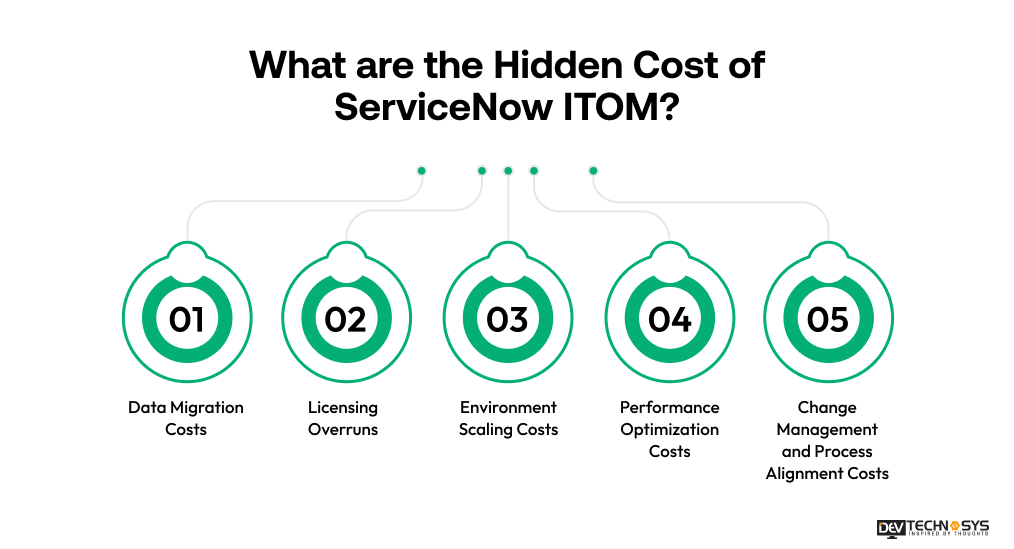
1. Data Migration Costs
Migrating your current data from your IT infrastructure into Service Now ITOM can be complicated and take a long time. Organizations typically have to spend time cleaning, transforming, and validating data before migrating. If a business has poor-quality data, the amount of time and money invested will increase.
To help with the data migration process, there may also be additional costs due to the need for new tools, consultants, and testing cycles, so data migration can be considered a high hidden cost.
2. Licensing Overruns
Many different businesses underestimate their actual usage, which ultimately leads to much higher licensing fees. When businesses grow their infrastructure, they often need new discovery nodes, users, or modules that incur sudden, large increases in licensing upgrade or renewal fees, which result in the overall ServiceNow ITSM pricing being considerably higher than was planned for.
3. Environment Scaling Costs
As your company grows, it needs to be able to grow the Service Now ITOM environment to support the increased services and amount of data. This may include increasing the infrastructure capacity, optimizing performance, and creating additional instances. The scaling requirements that you will need to meet often stem from unplanned costs. Especially if you are an enterprise with a rapidly growing IT ecosystem and are greatly reliant upon the cloud.
4. Performance Optimization Costs
Having a system perform optimally in strategic portfolio management requires continuous tuning as well as real-time monitoring. As the volume of your data increases, your organization will likely need additional tools, expertise, or to upgrade your infrastructure so it will function properly. If performance is not optimized appropriately, inefficient functioning may occur, which will also result in your business needing to incur additional expenditures.
5. Change Management and Process Alignment Costs
Implementing ITOM usually means changing current IT processes and workflows. This includes the alignment of teams, redefinition of roles and responsibilities, and the management of change within the organization, all of which require extra effort. The degree of resistance to change can extend the time taken to implement, increase the number of training, communications, and consulting services required.
6 Tips to Reduce the ServiceNow ITOM Cost
To reduce the ServiceNow ITOM cost, you will need to follow various ways, such as optimizing the discovery scope, selecting only required modules, planning integrations, and more. These ways help businesses to optimize the ServiceNow ITOM cost and maintain the overall project budget.
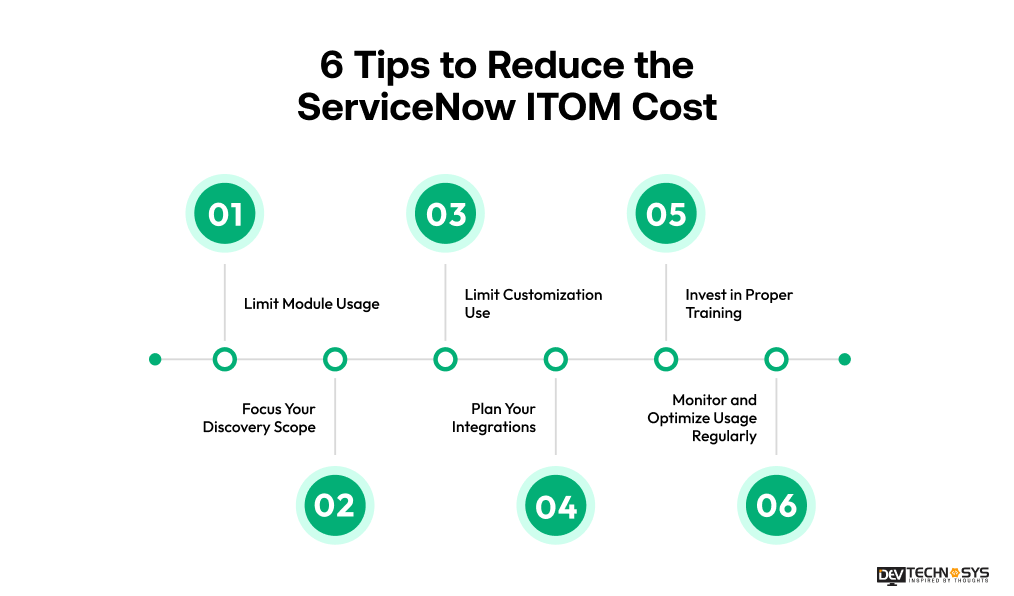
1. Limit Module Usage
Do not default to selecting all ITOM modules. Instead, concentrate on choosing those that meet your business’s requirements. By thoroughly evaluating your organization’s requirements, you will be able to avoid excess licensing and expenditure. Starting with the required modules will better enable you to control ServiceNow ITOM pricing while ensuring operational excellence and long-term flexibility.
2. Focus Your Discovery Scope
Limit your discovery to only critical assets or systems as opposed to scanning your entire infrastructure. You will save both licensing expense as well as enhance performance by reducing the number of unnecessary nodes. A well-thought-out discovery approach will permit accurate collection of data and allow you the ability to control and manage the ServiceNow ITOM price per user.
3. Limit Customization Use
Take advantage of standard, out-of-the-box features rather than a large degree of customizations. Build custom applications on ServiceNow platform, it will increase the length of time, cost, and effort associated with implementation and maintenance.
Managed within standard configurations is easier to upgrade and maintain. A reduction in the overall amount of customizations will result in lower initial investments, as well as reduced long-term operational expenses.
4. Plan Your Integrations
Only integrate third-party tools that are essential and provide value. Integrating additional tools that do not add value increases the development, testing, and maintenance costs associated with integrations.
By using a more strategic approach to integration, you will experience greater ease of performance, complexity reduction, and improved cost management, and will be able to eliminate interruptions to your standard processes across your IT ecosystem.
5. Invest in Proper Training
When properly trained, hire ServiceNow developers to use ITOM features correctly. By doing so, you will improve employee accuracy and productivity and minimize your reliance on external consultants or support services for ITOM assistance. As a result, by offering training for your employees, you will reduce your overall operational costs while maximizing your return on investment from your ITOM systems.
6. Monitor and Optimize Usage Regularly
Continually monitor and optimize your ITOM system’s usage, license, and performance metrics through audits of your ITOM systems. By regularly performing audits of your ITOM system’s usage, you will be able to identify underutilized resources, duplicate processes, unnecessary costs, and therefore, optimize usage to improve your overall return on investment and avoid overspending.
Industry Insights: According to ServiceNow, ServiceNow typically offers better unit pricing under 3-5 year contracts, encouraging long-term enterprise platform adoption and expansion.
Benefits vs. Cost: Is ITOM Worth It?
With Service Now ITOM, you improve operational efficiencies, decrease downtime, and gain scalability over time while balancing upfront costs vs. value gained. Although your initial investment may seem high, the potential for increasing efficiency through process automation and streamlining IT service delivery makes it a viable option for both small businesses and large corporations.
1. ROI Considerations
When looking at ROI, ITOM from ServiceNow is an effective way to reduce manual effort, enhance the speed of incident response, and avoid costly system outages. Although there may be a significant up-front cost associated with ITOM, the long-term ROI comes from increased automation, reduced resource consumption, and fewer interruptions.
2. Long-Term Value
ITOM provides growth opportunities through scalability and flexibility by enabling organizations to be able to grow their infrastructure. As an organization expands, ITOM will continue to keep pace with the increasing demands on its infrastructure.
Furthermore, ITOM improves visibility and control of an organization’s infrastructure, which helps it to make more informed decisions. It allows them to operate in a stable manner without the need to continually invest in new systems or tools.
3. Efficiency and Downtime Reduction
One of ITOM’s key benefits is improving efficiency. By automating many repetitive tasks, organizations can reduce manual effort. They can also implement proactive monitoring, which enables organizations to catch issues before they cause downtime. By decreasing the amount of downtime from network failures, users can experience more reliable services and increase the overall user experience.
| Aspect | Cost Side | Benefit Side |
| Initial Investment | High upfront cost for licensing and setup | Enables advanced IT monitoring and automation capabilities |
| ROI (Return on Investment) | Takes time to recover initial expenses | Long-term savings through automation and reduced manual work |
| Operational Efficiency | Requires training and process changes | Improves productivity and streamlines IT operations |
| Downtime Management | Investment in monitoring tools and setup | Proactively reduces downtime and improves service availability |
| Scalability | Higher cost as infrastructure grows | Easily scales with business growth and evolving IT needs |
| Maintenance Costs | Ongoing support and upgrade expenses | Ensures continuous optimization and system reliability |
| Overall Value | Significant financial commitment | Delivers long-term efficiency, reliability, and business growth |

Conclusion
To summarize, knowing how much it will cost to use ServiceNow ITOM and what the pricing format will look like is very important when making investments in this product. Companies should consider the cost of licenses as well as any other features that are provided with the licenses in order to budget effectively and maximize the value they receive from using Service Now ITOM.
The manner in which you select to implement Service Now ITOM is also a major consideration when analyzing total cost. Partnering with Dev Technosys, a reputable ServiceNow development company, who have 15+ years of experience in digital engineering. It will help you maximize your deployment of ServiceNow ITOM while lowering the cost of unnecessary expenses associated with your implementation.
Frequently Asked Questions
Find answers to the most common questions related to this article.
ServiceNow ITOM pricing is based on several factors, including the number of configuration items (CIs), nodes, or devices within your organization's IT Infrastructure that will be monitored. The selected modules (Discovery, Event Management, Service Mapping) and many modular features, Subscription tiers, infrastructure size, and complexity of integrations with third-party tools.
The primary cost components of ITOM are: application licensing fee, implementation services, customization, third-party integration services, and ongoing maintenance. It includes any additional costs for training, data migration services, or other ongoing operational expenses. Additional considerations for organizations are ongoing scalability, as the growth of the infrastructure will increase both license and operating expenses over time.
The overall cost of Service Mapping will be increased by the addition of advanced capabilities as well as Dependency Mapping functionality. Service Mapping pricing will vary based on the number of Business Services, as well as the complexity of applications associated with those services. While there is an increased amount of upfront expenditure associated with the implementation of Service Mapping.
Because ServiceNow ITOM is primarily delivered through a cloud-based service, there is no meaningful difference in the pricing for a cloud vs. an on-premise solution. There will be some additional implementation costs associated with creating a hybrid environment or interfacing with existing on-premise legacy systems, e.g., customizing, supporting, managing, etc. This may lead to an increase in the total cost of ownership.
The standard cost for support and maintenance on ServiceNow ITOM is included in the monthly subscription and normally consists of all necessary system updates and operational support for the platform. However, if a customer wants higher-level service, from simply being able to get answers quickly, to dedicated support, they may incur costs for upgrades into a premium support tier.